
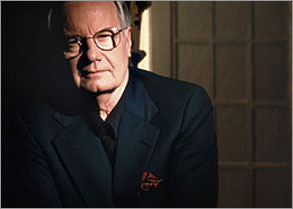

I can’t imagine better company on this beautiful Sunday morning in St. Louis. You’re church for me today, and there’s no congregation in the country where I would be more likely to find more kindred souls than are gathered here.
There are so many different vocations and callings in this room — so many different interests and aspirations of people who want to reform the media or produce for the media — that only a presiding bishop like Bob McChesney with his great ecumenical heart could bring us together for a weekend like this.
What joins us all under Bob’s embracing welcome is our commitment to public media. Pat Aufderheide got it right, I think, in the recent issue of In These Times when she wrote: “This is a moment when public media outlets can make a powerful case for themselves. Public radio, public TV, cable access, public DBS channels, media arts centers, youth media projects, nonprofit Internet news services … low-power radio and webcasting are all part of a nearly-invisible feature of today’s media map: the public media sector. They exist not to make a profit, not to push an ideology, not to serve customers, but to create a public — a group of people who can talk productively with those who don’t share their views, and defend the interests of the people who have to live with the consequences of corporate and governmental power.”
She gives examples of the possibilities. “Look at what happened,” she said, “when thousands of people who watched Stanley Nelson’s ‘The Murder of Emmett Till’ on their public television channels joined a postcard campaign that re-opened the murder case after more than half a century. Look at NPR’s courageous coverage of the Iraq war, an expensive endeavor that wins no points from this Administration. Look at Chicago Access Network’s Community Forum, where nonprofits throughout the region can showcase their issues and find volunteers.”
For all our flaws, Pat argues that the public media are a very important resource in a noisy and polluted information environment.
You can also take wings reading Jason Miller’s May 4 article on Z Net about the mainstream media. While it is true that much of it is corrupted by the influence of government and corporate interests, Miller writes, there are still men and women in the mainstream who practice a high degree of journalistic integrity and who do challenge us with their stories and analysis. But the real hope ‘lies within the internet with its two billion or more web sites providing a wealth of information drawn from almost unlimited resources that span the globe … If knowledge is power, one’s capacity to increase that power increases exponentially through navigation of the Internet for news and information.”
Surely this is one issue that unites us as we leave here today. The fight to preserve the web from corporate gatekeepers joins media reformers, producers and educators — and it’s a fight that has only just begun.
I want to tell you about another fight we’re in today. The story I’ve come to share with you goes to the core of our belief that the quality of democracy and the quality of journalism are deeply entwined. I can tell this story because I’ve been living it. It’s been in the news this week, including reports of more attacks on a single journalist — yours truly — by the right-wing media and their allies at the Corporation for Public Broadcasting.
As some of you know, CPB was established almost 40 years ago to set broad policy for public broadcasting and to be a firewall between political influence and program content. What some on this board are now doing today, led by its chairman, Kenneth Tomlinson, is too important, too disturbing and, yes, even too dangerous for a gathering like this not to address.
We’re seeing unfold a contemporary example of the age-old ambition of power and ideology to squelch and punish journalists who tell the stories that make princes and priests uncomfortable.
Let me assure you that I take in stride attacks by the radical right-wingers who have not given up demonizing me although I retired over six months ago. They’ve been after me for years now and I suspect they will be stomping on my grave to make sure I don’t come back from the dead. I should remind them, however, that one of our boys pulled it off some 2,000 years ago — after the Pharisees, Sadducees and Caesar’s surrogates thought they had shut him up for good. Of course I won’t be expecting that kind of miracle, but I should put my detractors on notice: They might just compel me out of the rocking chair and back into the anchor chair.
Who are they? I mean the people obsessed with control, using the government to threaten and intimidate. I mean the people who are hollowing out middle-class security even as they enlist the sons and daughters of the working class in a war to make sure Ahmed Chalabi winds up controlling Iraq’s oil. I mean the people who turn faith-based initiatives into a slush fund and who encourage the pious to look heavenward and pray so as not to see the long arm of privilege and power picking their pockets. I mean the people who squelch free speech in an effort to obliterate dissent and consolidate their orthodoxy into the official view of reality from which any deviation becomes unpatriotic heresy.
That’s who I mean. And if that’s editorializing, so be it. A free press is one where it’s OK to state the conclusion you’re led to by the evidence.
One reason I’m in hot water is because my colleagues and I at “Now” didn’t play by the conventional rules of Beltway journalism. Those rules divide the world into Democrats and Republicans, liberals and conservatives, and allow journalists to pretend they have done their job if, instead of reporting the truth behind the news, they merely give each side an opportunity to spin the news.
Jonathan Mermin writes about this in a recent essay in World Policy Journal. (You’ll also want to read his book, “Debating War and Peace, Media Coverage of U.S. Intervention in the Post Vietnam Era.”)
Mermin quotes David Ignatius of the Washington Post on why the deep interests of the American public are so poorly served by Beltway journalism. The “rules of our game,” says Ignatius, “make it hard for us to tee up an issue … without a news peg.” He offers a case in point: the debacle of America’s occupation of Iraq. “If Senator so and so hasn’t criticized post-war planning for Iraq,” says Ignatius, “then it’s hard for a reporter to write a story about that.”
Mermin also quotes public television’s Jim Lehrer acknowledging that unless an official says something is so, it isn’t news. Why were journalists not discussing the occupation of Iraq? Because, says Lehrer, “the word ‘occupation’ … was never mentioned in the run-up to the war.” Washington talked about the invasion as “a war of liberation, not a war of occupation, so as a consequence, “those of us in journalism never even looked at the issue of occupation.”
“In other words,” says Jonathan Mermin, “if the government isn’t talking about it, we don’t report it.” He concludes, “[Lehrer’s] somewhat jarring declaration, one of many recent admissions by journalists that their reporting failed to prepare the public for the calamitous occupation that has followed the ‘liberation’ of Iraq, reveals just how far the actual practice of American journalism has deviated from the First Amendment ideal of a press that is independent of the government.”
Take the example (also cited by Mermin) of Charles J. Hanley. Hanley is a Pulitzer Prize winning reporter for the Associated Press, whose fall 2003 story on the torture of Iraqis in American prisons — before a U.S. Army report and photographs documenting the abuse surfaced — was ignored by major American newspapers. Hanley attributes this lack of interest to the fact that “It was not an officially sanctioned story that begins with a handout from an official source.” Furthermore, Iraqis recounting their own personal experience of Abu Ghraib simply did not have the credibility with Beltway journalists of American officials denying that such things happened. Judith Miller of the New York Times, among others, relied on the credibility of official but unnamed sources when she served essentially as the government stenographer for claims that Iraq possessed weapons of mass destruction.
These “rules of the game” permit Washington officials to set the agenda for journalism, leaving the press all too often simply to recount what officials say instead of subjecting their words and deeds to critical scrutiny. Instead of acting as filters for readers and viewers, sifting the truth from the propaganda, reporters and anchors attentively transcribe both sides of the spin invariably failing to provide context, background or any sense of which claims hold up and which are misleading.
I decided long ago that this wasn’t healthy for democracy. I came to see that “news is what people want to keep hidden and everything else is publicity.” In my documentaries — whether on the Watergate scandals 30 years ago or the Iran Contra conspiracy 20 years ago or Bill Clinton’s fundraising scandals 10 years ago or, five years ago, the chemical industry’s long and despicable cover-up of its cynical and unspeakable withholding of critical data about its toxic products from its workers, I realized that investigative journalism could not be a collaboration between the journalist and the subject. Objectivity is not satisfied by two opposing people offering competing opinions, leaving the viewer to split the difference.
I came to believe that objective journalism means describing the object being reported on, including the little fibs and fantasies as well as the Big Lie of the people in power. In no way does this permit journalists to make accusations and allegations. It means, instead, making sure that your reporting and your conclusions can be nailed to the post with confirming evidence.
This is always hard to do, but it has never been harder than today. Without a trace of irony, the powers-that-be have appropriated the newspeak vernacular of George Orwell’s “1984.” They give us a program vowing “No Child Left Behind” while cutting funds for educating disadvantaged kids. They give us legislation cheerily calling for “Clear Skies” and “Healthy Forests” that give us neither. And that’s just for starters.
In Orwell’s “1984,” the character Syme, one of the writers of that totalitarian society’s dictionary, explains to the protagonist Winston, “Don’t you see that the whole aim of Newspeak is to narrow the range of thought?” “Has it ever occurred to you, Winston, that by the year 2050, at the very latest, not a single human being will be alive who could understand such a conversation as we are having now? The whole climate of thought,” he said, “will be different. In fact there will be no thought, as we understand it now. Orthodoxy means not thinking — not needing to think. Orthodoxy is unconsciousness.”
An unconscious people, an indoctrinated people, a people fed only on partisan information and opinions that confirm their own bias, a people made morbidly obese in mind and spirit by the junk food of propaganda, is less inclined to put up a fight, to ask questions and be skeptical. That kind of orthodoxy can kill a democracy — or worse.
I learned about this the hard way. I grew up in the South where the truth about slavery, race, and segregation had been driven from the pulpits, driven from the classrooms and driven from the newsrooms. It took a bloody Civil War to bring the truth home and then it took another hundred years for the truth to make us free.
Then I served in the Johnson administration. Imbued with cold war orthodoxy and confident that “might makes right,” we circled the wagons, listened only to each other, and pursued policies the evidence couldn’t carry. The results were devastating for Vietnamese and Americans.
I brought all of this to the task when PBS asked me after 9/11 to start a new weekly broadcast. They wanted us to make it different from anything else on the air –commercial or public broadcasting. They asked us to tell stories no one else was reporting and to offer a venue to people who might not otherwise be heard. That wasn’t a hard sell. I had been deeply impressed by studies published in leading peer-reviewed scholarly journals by a team of researchers led by Vassar College sociologist William Hoynes. Extensive research on the content of public television over a decade found that political discussions on our public affairs programs generally included a limited set of voices that offer a narrow range of perspectives on current issues and events. Instead of far-ranging discussions and debates, the kind that might engage viewers as citizens, not simply as audiences, this research found that public affairs programs on PBS stations were populated by the standard set of elite news sources. Whether government officials and Washington journalists (talking about political strategy) or corporate sources (talking about stock prices or the economy from the investor’s viewpoint), Public television, unfortunately, all too often was offering the same kind of discussions, and a similar brand of insider discourse, that is featured regularly on commercial television.
Who didn’t appear was also revealing. Hoynes and his team found that in contrast to the conservative mantra that public television routinely featured the voices of anti-establishment critics, “alternative perspectives were rare on public television and were effectively drowned out by the stream of government and corporate views that represented the vast majority of sources on our broadcasts.” The so-called experts who got most of the face time came primarily from mainstream news organizations and Washington think tanks rather than diverse interests. Economic news, for example, was almost entirely refracted through the views of business people, investors and business journalists. Voices outside the corporate/Wall Street universe — nonprofessional workers, labor representatives, consumer advocates and the general public were rarely heard. In sum, these two studies concluded, the economic coverage was so narrow that the views and the activities of most citizens became irrelevant.
All this went against the Public Broadcasting Act of 1967 that created the Corporation for Public Broadcasting. I know. I was there. As a young policy assistant to President Johnson, I attended my first meeting to discuss the future of public broadcasting in 1964 in the office of the Commissioner of Education. I know firsthand that the Public Broadcasting Act was meant to provide an alternative to commercial television and to reflect the diversity of the American people.
This, too, was on my mind when we assembled the team for “Now.” It was just after the terrorist attacks of 9/11. We agreed on two priorities. First, we wanted to do our part to keep the conversation of democracy going. That meant talking to a wide range of people across the spectrum — left, right and center. It meant poets, philosophers, politicians, scientists, sages and scribblers. It meant Isabel Allende, the novelist, and Amity Shlaes, the columnist for the Financial Times. It meant the former nun and best-selling author Karen Armstrong, and it meant the right-wing evangelical columnist Cal Thomas. It meant Arundhati Roy from India, Doris Lessing from London, David Suzuki from Canada, and Bernard Henry-Levi from Paris. It also meant two successive editors of the Wall Street Journal, Robert Bartley and Paul Gigot, the editor of the Economist, Bill Emmott, the Nation’s Katrina vanden Heuvel and the Los Angeles Weekly’s John Powers. It means liberals like Frank Wu, Ossie Davis and Gregory Nava, and conservatives like Frank Gaffney, Grover Norquist, and Richard Viguerie. It meant Archbishop Desmond Tutu and Bishop Wilton Gregory of the Catholic Bishops conference in this country. It meant the conservative Christian activist and lobbyist Ralph Reed, and the dissident Catholic Sister Joan Chittister. We threw the conversation of democracy open to all comers. Most of those who came responded the same way that Ron Paul, Republican and Libertarian congressman from Texas did when he wrote me after his appearance, “I have received hundreds of positive e-mails from your viewers. I appreciate the format of your program which allows time for a full discussion of ideas … I’m tired of political shows featuring two guests shouting over each other and offering the same arguments … NOW was truly refreshing.”
Hold your applause because that’s not the point of the story.
We had a second priority. We intended to do strong, honest and accurate reporting, telling stories we knew people in high places wouldn’t like.
I told our producers and correspondents that in our field reporting our job was to get as close as possible to the verifiable truth. This was all the more imperative in the aftermath of the terrorist attacks. America could be entering a long war against an elusive and stateless enemy with no definable measure of victory and no limit to its duration, cost or foreboding fear. The rise of a homeland security state meant government could justify extraordinary measures in exchange for protecting citizens against unnamed, even unproven, threats.
Furthermore, increased spending during a national emergency can produce a spectacle of corruption behind a smokescreen of secrecy. I reminded our team of the words of the news photographer in Tom Stoppard’s play who said, “People do terrible things to each other, but it’s worse when everyone is kept in the dark.”
I also reminded them of how the correspondent and historian Richard Reeves answered a student who asked him to define real news. “Real news,” Reeves responded, “is the news you and I need to keep our freedoms.”
For these reasons and in that spirit we went about reporting on Washington as no one else in broadcasting — except occasionally “60 Minutes” — was doing. We reported on the expansion of the Justice Department’s power of surveillance. We reported on the escalating Pentagon budget and expensive weapons that didn’t work. We reported on how campaign contributions influenced legislation and policy to skew resources to the comfortable and well-connected while our troops were fighting in Afghanistan and Iraq with inadequate training and armor. We reported on how the Bush administration was shredding the Freedom of Information Act. We went around the country to report on how closed-door, backroom deals in Washington were costing ordinary workers and taxpayers their livelihood and security. We reported on offshore tax havens that enable wealthy and powerful Americans to avoid their fair share of national security and the social contract.
And always — because what people know depends on who owns the press — we kept coming back to the media business itself — to how mega media corporations were pushing journalism further and further down the hierarchy of values, how giant radio cartels were silencing critics while shutting communities off from essential information, and how the mega media companies were lobbying the FCC for the right to grow ever more powerful.
The broadcast caught on. Our ratings grew every year. There was even a spell when we were the only public affairs broadcast on PBS whose audience was going up instead of down.
Our journalistic peers took notice. The Los Angeles Times said, “NOW’s team of reporters has regularly put the rest of the media to shame, pursuing stories few others bother to touch.”
The Philadelphia Inquirer said our segments on the sciences, the arts, politics and the economy were “provocative public television at its best.”
The Austin American Statesman called “Now” “the perfect antidote to today’s high pitched decibel level — a smart, calm, timely news program.”
Frazier Moore of the Associated Press said we were “hard-edged when appropriate but never Hardball. Don’t expect combat. Civility reigns.”
And the Baton Rouge Advocate said “NOW invites viewers to consider the deeper implication of the daily headlines,” drawing on “a wide range of viewpoints which transcend the typical labels of the political left or right.”
Let me repeat that: “Now” draws on “a wide range of viewpoints which transcend the typical labels of the political left or right.”
The Public Broadcasting Act of 1967 had been prophetic. Open public television to the American people — offer diverse interests, ideas and voices … be fearless in your belief in democracy — and they will come.
Hold your applause — that’s not the point of the story.
The point of the story is something only a handful of our team, including my wife and partner, Judith Davidson Moyers, and I knew at the time — that the success of “Now’s” journalism was creating a backlash in Washington.
The more compelling our journalism, the angrier the radical right of the Republican Party became. That’s because the one thing they loathe more than liberals is the truth. And the quickest way to be damned by them as liberal is to tell the truth.
This is the point of my story: Ideologues don’t want you to go beyond the typical labels of left and right. They embrace a worldview that can’t be proven wrong because they will admit no evidence to the contrary. They want your reporting to validate their belief system and when it doesn’t, God forbid. Never mind that their own stars were getting a fair shake on “Now”: Gigot, Viguerie, David Keene of the American Conservative Union, Stephen Moore of the Club for Growth, and others. No, our reporting was giving the radical right fits because it wasn’t the party line. It wasn’t that we were getting it wrong. Only three times in three years did we err factually, and in each case we corrected those errors as soon as we confirmed their inaccuracy. The problem was that we were getting it right, not right-wing — telling stories that partisans in power didn’t want told.
I’ve always thought the American eagle needed a left wing and a right wing. The right wing would see to it that economic interests had their legitimate concerns addressed. The left wing would see to it that ordinary people were included in the bargain. Both would keep the great bird on course. But with two right wings or two left wings, it’s no longer an eagle and it’s going to crash.
My occasional commentaries got to them as well. Although apparently he never watched the broadcast (I guess he couldn’t take the diversity) Senator Trent Lott came out squealing like a stuck pig when after the midterm elections in 2002 I described what was likely to happen now that all three branches of government were about to be controlled by one party dominated by the religious, corporate and political right. Instead of congratulating the winners for their election victory as some network broadcasters had done — or celebrating their victory as Fox, the Washington Times, the Weekly Standard, Talk Radio and other partisan Republican journalists had done — I provided a little independent analysis of what the victory meant. And I did it the old-fashioned way: I looked at the record, took the winners at their word, and drew the logical conclusion that they would use power as they always said they would. And I set forth this conclusion in my usual modest Texas way.
Events since then have confirmed the accuracy of what I said, but, to repeat, being right is exactly what the right doesn’t want journalists to be.
Strange things began to happen. Friends in Washington called to say that they had heard of muttered threats that the PBS reauthorization would be held off “unless Moyers is dealt with.” The Chairman of the Corporation for Public Broadcasting, Kenneth Tomlinson, was said to be quite agitated. Apparently there was apoplexy in the right-wing aerie when I closed the broadcast one Friday night by putting an American flag in my lapel and said — well, here’s exactly what I said.
“I wore my flag tonight. First time. Until now I haven’t thought it necessary to display a little metallic icon of patriotism for everyone to see. It was enough to vote, pay my taxes, perform my civic duties, speak my mind, and do my best to raise our kids to be good Americans.
“Sometimes I would offer a small prayer of gratitude that I had been born in a country whose institutions sustained me, whose armed forces protected me, and whose ideals inspired me; I offered my heart’s affections in return. It no more occurred to me to flaunt the flag on my chest than it did to pin my mother’s picture on my lapel to prove her son’s love. Mother knew where I stood; so does my country. I even tuck a valentine in my tax returns on April 15.
“So what’s this doing here? Well, I put it on to take it back. The flag’s been hijacked and turned into a logo — the trademark of a monopoly on patriotism. On those Sunday morning talk shows, official chests appear adorned with the flag as if it is the good housekeeping seal of approval. During the State of the Union, did you notice Bush and Cheney wearing the flag? How come? No administration’s patriotism is ever in doubt, only its policies. And the flag bestows no immunity from error. When I see flags sprouting on official lapels, I think of the time in China when I saw Mao’s little red book on every official’s desk, omnipresent and unread.
“But more galling than anything are all those moralistic ideologues in Washington sporting the flag in their lapels while writing books and running Web sites and publishing magazines attacking dissenters as un-American. They are people whose ardor for war grows disproportionately to their distance from the fighting. They’re in the same league as those swarms of corporate lobbyists wearing flags and prowling Capitol Hill for tax breaks even as they call for more spending on war.
“So I put this on as a modest riposte to men with flags in their lapels who shoot missiles from the safety of Washington think tanks, or argue that sacrifice is good as long as they don’t have to make it, or approve of bribing governments to join the coalition of the willing (after they first stash the cash.) I put it on to remind myself that not every patriot thinks we should do to the people of Baghdad what bin Laden did to us. The flag belongs to the country, not to the government. And it reminds me that it’s not un-American to think that war — except in self-defense — is a failure of moral imagination, political nerve, and diplomacy. Come to think of it, standing up to your government can mean standing up for your country.”
That did it. That — and our continuing reporting on overpricing at Haliburton, chicanery on K Street, and the heavy, if divinely guided, hand of Tom DeLay.
When Senator Lott protested that the Corporation for Public Broadcasting “has not seemed willing to deal with Bill Moyers,” a new member of the board, a Republican fundraiser named Cheryl Halperin, who had been appointed by President Bush, agreed that CPB needed more power to do just that sort of thing. She left no doubt about the kind of penalty she would like to see imposed on malefactors like Moyers.
As rumors circulated about all this, I asked to meet with the CPB board to hear for myself what was being said. I thought it would be helpful for someone like me, who had been present at the creation and part of the system for almost 40 years, to talk about how CPB had been intended to be a heat shield to protect public broadcasters from exactly this kind of intimidation. After all, I’d been there at the time of Richard Nixon’s attempted coup. In those days, public television had been really feisty and independent, and often targeted for attacks. A Woody Allen special that poked fun at Henry Kissinger in the Nixon administration had actually been canceled. The White House had been so outraged over a documentary called “The Banks and the Poor” that PBS was driven to adopt new guidelines. That didn’t satisfy Nixon, and when public television hired two NBC reporters — Robert McNeil and Sander Vanocur — to co-anchor some new broadcasts, it was, for Nixon, the last straw. According to White House memos at the time, he was determined to “get the left wing commentators who are cutting us up off public television at once — indeed, yesterday if possible.”
Sound familiar?
Nixon vetoed the authorization for CPB with a message written in part by his sidekick Pat Buchanan who in a private memo had castigated Vanocur, MacNeil, Washington Week in Review, Black Journal and Bill Moyers as “unbalanced against the administration.”
It does sound familiar.
I always knew Nixon would be back. I just didn’t know this time he would be the chairman of the Corporation for Public Broadcasting.
Buchanan and Nixon succeeded in cutting CPB funding for all public affairs programming except for Black Journal. They knocked out multiyear funding for the National Public Affairs Center for Television, otherwise known as NPACT. And they voted to take away from the PBS staff the ultimate responsibility for the production of programming.
But in those days — and this is what I wanted to share with Kenneth Tomlinson and his colleagues on the CPB board — there were still Republicans in America who did not march in ideological lockstep and who stood on principle against politicizing public television. The chairman of the public station in Dallas was an industrialist named Ralph Rogers, a Republican but no party hack, who saw the White House intimidation as an assault on freedom of the press and led a nationwide effort to stop it. The chairman of CPB was former Republican congressman Thomas Curtis, who was also a principled man. He resigned, claiming White House interference. Within a few months, the crisis was over. CPB maintained its independence, PBS grew in strength, and Richard Nixon would soon face impeachment and resign for violating the public trust, not just public broadcasting. Paradoxically, the very Public Affairs Center for Television that Nixon had tried to kill — NPACT — put PBS on the map by rebroadcasting in prime time each day’s Watergate hearings, drawing huge ratings night after night and establishing PBS as an ally of democracy. We should still be doing that sort of thing.
That was 33 years ago. I thought the current CPB board would like to hear and talk about the importance of standing up to political interference. I was wrong. They wouldn’t meet with me. I tried three times. And it was all downhill after that.
I was naive, I guess. I simply never imagined that any CPB chairman, Democrat or Republican, would cross the line from resisting White House pressure to carrying it out for the White House. But that’s what Kenneth Tomlinson has done. On Fox News this week he denied that he’s carrying out a White House mandate or that he’s ever had any conversations with any Bush administration official about PBS. But the New York Times reported that he enlisted Karl Rove to help kill a proposal that would have put on the CPB board people with experience in local radio and television. The Times also reported that “on the recommendation of administration officials” Tomlinson hired a White House flack (I know the genre) named Mary Catherine Andrews as a senior CPB staff member. While she was still reporting to Karl Rove at the White House, Andrews set up CPB’s new ombudsman’s office and had a hand in hiring the two people who will fill it, one of whom once worked for — you guessed it — Kenneth Tomlinson.
I would like to give Mr. Tomlinson the benefit of the doubt, but I can’t. According to a book written about the Reader’s Digest when he was its Editor-in-Chief, he surrounded himself with other right-wingers — a pattern he’s now following at the Corporation for Public Broadcasting. There is Ms. Andrews from the White House. For Acting President he hired Ken Ferree from the FCC, who was Michael Powell’s enforcer when Powell was deciding how to go about allowing the big media companies to get even bigger. According to a forthcoming book, one of Ferree’s jobs was to engage in tactics designed to dismiss any serious objection to media monopolies. And, according to Eric Alterman, Ferree was even more contemptuous than Michael Powell of public participation in the process of determining media ownership. Alterman identifies Ferree as the FCC staffer who decided to issue a “protective order” designed to keep secret the market research on which the Republican majority on the commission based their vote to permit greater media consolidation.
It’s not likely that with guys like this running the CPB some public television producer is going to say, “Hey, let’s do something on how big media is affecting democracy.”
Call it preventive capitulation.
As everyone knows, Mr. Tomlinson also put up a considerable sum of money, reportedly over $5 million, for a new weekly broadcast featuring Paul Gigot and the editorial board of the Wall Street Journal. Gigot is a smart journalist, a sharp editor, and a fine fellow. I had him on “Now” several times and even proposed that he become a regular contributor. The conversation of democracy — remember? All stripes.
But I confess to some puzzlement that the Wall Street Journal, which in the past editorialized to cut PBS off the public tap, is now being subsidized by American taxpayers although its parent company, Dow Jones, had revenues in just the first quarter of this year of $400 million.
I thought public television was supposed to be an alternative to commercial media, not a funder of it.
But in this weird deal, you get a glimpse of the kind of programming Mr. Tomlinson apparently seems to prefer. Alone of the big major newspapers, the Wall Street Journal has no Op-Ed page where different opinions can compete with its right-wing editorials. The Journal’s PBS broadcast is just as homogenous — right-wingers talking to each other. Why not $5 million to put the editors of the Nation on PBS? Or Amy Goodman’s “Democracy Now!” You balance right-wing talk with left-wing talk.
There’s more. Only two weeks ago did we learn that Mr. Tomlinson had spent $10,000 last year to hire a contractor who would watch my show and report on political bias. That’s right. Kenneth Y. Tomlinson spent $10,000 of your money to hire a guy to watch “Now” to find out who my guests were and what my stories were.
Ten thousand dollars.
Gee, Ken, for $2.50 a week, you could pick up a copy of “TV Guide” on the newsstand. A subscription is even cheaper, and I would have sent you a coupon that can save you up to 62 percent.
For that matter, Ken, all you had to do was watch the show yourself. You could have made it easier with a double Jim Beam, your favorite. Or you could have gone online where the listings are posted. Hell, you could have called me — collect — and I would have told you what was on the broadcast that night.
Ten thousand dollars. That would have bought five tables at Thursday night’s Conservative Salute for Tom DeLay. Better yet, that 10 grand would pay for the books in an elementary school classroom or an upgrade of its computer lab.
But having sent that cash, what did he find? Only Mr. Tomlinson knows. He apparently decided not to share the results with his staff or his board or leak it to Robert Novak. The public paid for it — but Ken Tomlinson acts as if he owns it.
In a May 10 Op-Ed piece, in Reverend Moon’s conservative “Washington Times,” Mr. Tomlinson maintained he had not released the findings because public broadcasting is such a delicate institution he did not want to “damage public broadcasting’s image with controversy.” Where I come from in Texas, we shovel that kind of stuff every day.
As we learned only this week, that’s not the only news Mr. Tomlinson tried to keep to himself. As reported by Jeff Chester’s Center for Digital Democracy, of which I am a supporter, there were two public opinion surveys commissioned by CPB but not released to the media — not even to PBS and NPR! According to a source who talked to Salon.com, “the first results were too good and [Tomlinson] didn’t believe them. After the Iraq war, the board commissioned another round of polling and they thought they’d get worse results.”
But they didn’t.
The data revealed that, in reality, public broadcasting has an 80 percent favorable rating and that “the majority of the U.S. adult population does not believe that the news and information programming on public broadcasting is biased.”
In fact, more than half believed PBS provided more in-depth and trustworthy news and information than the networks and 55 percent said PBS was “fair and balanced.”
I repeat: I would like to have given Mr. Tomlinson the benefit of the doubt. But this is the man who was running the Voice of America back in 1984 when a partisan named Charlie Wick was politicizing the United States Information Agency of which Voice of America was a part. It turned out there was a blacklist of people who had been removed from the list of prominent Americans sent abroad to lecture on behalf of America and the USIA. What’s more, it was discovered that evidence as to how those people were chosen to be on the blacklist — more than 700 documents — had been shredded. Among those on the lists of journalists, writers, scholars and politicians were dangerous left wing subversives like Walter Cronkite, James Baldwin, Gary Hart, Ralph Nader, Ben Bradlee, Coretta Scott King and David Brinkley.
The person who took the fall for the blacklist was another right-winger. He resigned. Shortly thereafter, so did Kenneth Tomlinson, who had been one of the people in the agency with the authority to see the lists of potential speakers and allowed to strike people’s names.
Let me be clear about this: There is no record, apparently, of what Ken Tomlinson did. We don’t know whether he supported or protested the blacklisting of so many American liberals. Or what he thinks of it now.
But I had hoped Bill O’Reilly would have asked him about it when he appeared on “The O’Reilly Factor” this week. He didn’t. Instead, Tomlinson went on attacking me with O’Reilly egging him on, and he went on denying he was carrying out a partisan mandate despite published reports to the contrary. The only time you could be sure he was telling the truth was at the end of the broadcast when he said to O’Reilly, “We love your show.”
We love your show.
I wrote Kenneth Tomlinson on Friday and asked him to sit down with me for one hour on PBS and talk about all this. I suggested that he choose the moderator and the guidelines.
There is one other thing in particular I would like to ask him about. In his Op-Ed essay this week in the Washington Times, Ken Tomlinson tells of a phone call from an old friend complaining about my bias. Wrote Mr. Tomlinson: “The friend explained that the foundation he heads made a six-figure contribution to his local television station for digital conversion. But he declared there would be no more contributions until something was done about the network’s bias.”
Apparently that’s Kenneth Tomlinson’s method of governance. Money talks and buys the influence it wants.
I would like to ask him to listen to a different voice.
This letter came to me last year from a woman in New York, five pages of handwriting. She said, among other things, that “After the worst sneak attack in our history, there’s not been a moment to reflect, a moment to let the horror resonate, a moment to feel the pain and regroup as humans. No, since I lost my husband on 9/11, not only our family’s world, but the whole world seems to have gotten even worse than that tragic day.” She wanted me to know that on 9/11 her husband was not on duty. “He was home with me having coffee. My daughter and grandson, living only five blocks from the Towers, had to be evacuated with masks — terror all around … my other daughter, near the Brooklyn Bridge … my son in high school. But my Charlie took off like a lightning bolt to be with his men from the Special Operations Command. ‘Bring my gear to the plaza,’ he told his aide immediately after the first plane struck the North Tower … He took action based on the responsibility he felt for his job and his men and for those Towers that he loved.”
In the FDNY, she continued, chain-of-command rules extend to every captain of every firehouse in the city. “If anything happens in the firehouse — at any time — even if the Captain isn’t on duty or on vacation — that Captain is responsible for everything that goes on there 24/7.” So she asked: “Why is this Administration responsible for nothing? All that they do is pass the blame. This is not leadership … Watch everyone pass the blame again in this recent torture case [Abu Ghraib] of Iraqi prisons …”
She told me that she and her husband had watched my series on “Joseph Campbell and the Power of Myth” together and that now she was a faithful fan of “Now.” She wrote: “We need more programs like yours to wake America up … Such programs must continue amidst the sea of false images and name calling that divide America now … Such programs give us hope that search will continue to get this imperfect human condition on to a higher plane. So thank you and all of those who work with you. Without public broadcasting, all we would call news would be merely carefully controlled propaganda.”
Enclosed with the letter was a check made out to “Channel 13 — NOW” for $500.
I keep a copy of that check above my desk to remind me of what journalism is about.
Kenneth Tomlinson has his demanding donors.
I’ll take the widow’s mite any day.
Someone has said recently that the great raucous mob that is democracy is rarely heard and that it’s not just the fault of the current residents of the White House and the capital. There’s too great a chasm between those of us in this business and those who depend on TV and radio as their window to the world. We treat them too much as an audience and not enough as citizens. They’re invited to look through the window but too infrequently to come through the door and to participate, to make public broadcasting truly public.
To that end, five public interests groups including Common Cause and Consumers Union will be holding informational sessions around the country to “take public broadcasting back” — to take it back from threats, from interference, from those who would tell us we can only think what they command us to think.
It’s a worthy goal.
We’re big kids; we can handle controversy and diversity, whether it’s political or religious points of view or two loving lesbian moms and their kids, visited by a cartoon rabbit. We are not too fragile or insecure to see America and the world entire for all their magnificent and sometimes violent confusion. “There used to be a thing or a commodity we put great store by,” John Steinbeck wrote. “It was called the people.”
