
Karl Rove

My right-wing degree

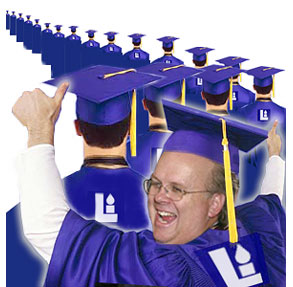
How I learned to convert liberal campuses into conservative havens at Morton Blackwell's Leadership Institute, alma mater of Karl Rove, Ralph Reed, Jeff Gannon and two Miss Americas.

  • more
    • All Share Services

My right-wing degree

One recent Sunday, at Morton Blackwell’s Leadership Institute, a dozen students meet for the second and final day of training in grass-roots youth politics. All are earnest, idealistic and as right wing as you can get. They take careful notes as instructor Paul Gourley teaches them how to rig a campus mock election.

It’s nothing illegal — no ballot stuffing necessary, even at the most liberal colleges. First you find a nonpartisan campus group to sponsor the election, so you can’t be accused of cheating. Next, volunteer to organize the thing. College students are lazy, and they’ll probably let you. Always keep in mind that a rigged mock election is all about location, location, location.

“Can anyone tell me,” asks Gourley, a veteran mock electioneer, “why you don’t want the polling place in the cafeteria?”

Stephen, a shy antiabortion activist sitting toward the rear of the class, raises his hand: “Because you want to suppress the vote?”

“Stephen has the right answer!” Gourley exclaims, tossing Stephen his prize, a copy of Robert Bork’s “Slouching Toward Gomorrah.”

The students, strait-laced kids from good colleges, seem unconvinced. The lesson — that with sufficient organization, the act of voting becomes less a basic right than a tactical maneuver — doesn’t sit easy with some students at first. Gourley, a charismatic senior from South Dakota and the treasurer of the College Republican National Committee, assures them: “This is not anti-democracy. This is not shady. Just put [the polling place] somewhere where you might have to put a little bit of effort into voting.” The rest, Gourley explains, is just a matter of turnout.

When the state or national candidate you’re backing wins by a suitably large margin, as he or she surely will, have the nonpartisan group that sponsored the election sign off on your prewritten celebratory press release and send it statewide. Reporters will almost certainly ignore it, but after a dozen similar victories, they’ll start dashing off articles about the youth phenomenon behind your candidate’s campaign — or better yet, just start plagiarizing your press releases.

There is no better place to master the art of mock-election rigging — and there is no better master than Morton Blackwell, who invented the trick in 1964 and has been teaching it ever since. Blackwell’s half-century career in conservative grass-roots politics coincides neatly with the fortunes of the conservative movement: He was there when Goldwater lost, when Southern voters abandoned the Democratic Party in droves, and when the Moral Majority began its harvest of evangelical Christian voters. In the 1970s, Blackwell worked with conservative direct-mail king Richard Viguerie; in 1980, he led Reagan’s youth campaign. Recently, he’s been fighting to save Tom DeLay’s job.

Yet Blackwell’s foundation, the Leadership Institute, is not a Republican organization. It’s a nonpartisan 501(c)(3) charity, drawing the overwhelming majority of its $9.1 million annual budget from tax-deductible donations. Despite its legally required “neutrality,” the institute is one of the best investments the conservative movement has ever made. Its walls are plastered with framed headshots of former students — hundreds of state and local legislators sprinkled with smiling members of the U.S. Congress, and even the perky faces of two recently crowned Miss Americas. Thirty-five years ago, Blackwell dispatched a particularly promising 17-year-old pupil named Karl Rove to run a youth campaign in Illinois; Jeff Gannon, a far less impressive student, attended the Leadership Institute’s Broadcast Journalism School.

The institute’s classes aren’t tickets into an exclusive and shadowy club, however: I am also an institute graduate. In March, I attended its Youth Leadership School, a one-weekend, 28-hour crash course in political organizing. Registration was open to the public and cost $60, which got me a sourcebook, six free meals, up to three nights in a dorm, and a six-hour lecture on political principles delivered by the 65-year-old Blackwell himself. The morning I arrived at the Leadership Institute, I identified myself as a reporter for Salon. “That’s great,” said communications director Michelle Miller. By the end of the weekend, Blackwell took me on a tour of the headquarters, chatted with me for nearly an hour, and gave me a copy of the institute’s antisocialism in-house film, “The Roots of the Ultra Left.” The institute is a very friendly place.

Over the last 25 years, more than 40,000 young conservatives have been trained at the institute’s Arlington, Va., headquarters in everything from TV makeup for aspiring right-wing talking heads to prep courses for the State Department’s Foreign Service exam. Classes are taught by volunteers recruited from the ranks of the conservative movement’s most talented organizers, operatives and communicators.

The Leadership Institute has succeeded, in part, because it’s had little to no competition from the left. College campuses may still be havens for liberal thought, but the right-wing students are the ones organized enough to win major battles. Perhaps expecting that American youth would organize themselves as they did in decades past, progressive organizations have been outstripped by their conservative counterparts in professionalizing the ragtag world of college activism. “When it comes to campus controversy, from affirmative action to free speech, the right wing pumps in money and expertise and shows [students] how to out-hustle their opponents,” says David Halperin of the liberal Center for American Progress.

Still, Blackwell says conservatives are underdogs on college campuses. Conservative students may be better organized, but they’re still outnumbered. The Leadership Institute contends that liberal higher education is robbing the conservative movement of new blood — and thereby handicapping the institute’s efforts. “You know, the most conservative students are the freshmen,” Blackwell told me. “There is an acculturation there.”

And that’s where the institute is taking its fight. For most of its 25-year history, it has focused on grooming students to work in conservative politics; it’s now increasingly devoting its efforts to making campuses more conservative places. Through its Campus Leadership Program, the institute is leading a growing effort to found and support a national network of conservative student groups and publications capable of permanently altering the intellectual and social environment of universities to conservatives’ advantage. That goal alone is a stark rejection of the standard conservative complaint that post-Vietnam War higher education is not just grossly liberal, but irredeemably so. Already, the program has shown considerable success. Asked about his campus initiative, Blackwell simply says, “You’re talking about the major project for the rest of my life.”

In the wake of the 2004 election, some progressive groups have been working to reinforce their positions on campus. Last February, the Center for American Progress launched Campus Progress, a student activism support center, to combat what Halperin describes as “30 years of effective organizing” by conservative groups like the Intercollegiate Studies Institute, Young Americans for Freedom, and of course, the Leadership Institute. But Blackwell is unfazed by the competition. “If they asked me, which they haven’t, I could let them know that it’s a lot harder than it appeared on the surface,” he told me. “You’ve got to work years before you see any results.”

And Blackwell has put in those years. A young Louisiana Republican in the days when Democrats owned every statewide office, he cut his political teeth on Barry Goldwater’s doomed 1964 presidential bid. “Don’t fully trust anyone until he has stuck with a good cause which he saw was losing,” is an institute maxim rooted in Blackwell’s own political education. “After Goldwater’s defeat, the number of people who would admit to being movement conservatives could all have fit into an average phone booth,” Blackwell said in an interview. “And among us, we didn’t have a dime for a telephone call.”

That was a long time ago. According to Blackwell, allied “movement conservatives” took the first steps toward outmaneuvering their party’s moribund minority leadership in the ’70s. More than a test of character, conservatism’s formerly abject status provided the key to those gains. With a wealth of political talent but few resources or constituencies, conservatives had no choice but to look beyond the two- and four-year cycles that dictate traditional political strategy. Instead of fighting an intra-party struggle they were certain to lose, they built an infrastructure outside the Republican Party dedicated to promoting talent, not winning the next election.

The Leadership Institute is a perfect example of that strategy, according to Peter Murray, a progressive management trainer who studied the institute’s model before launching his own nonprofit political training organization, the Center for Progressive Leadership, last year. “Being a 501(c)(3) not only means they can get tax deductions for their donors and build endowments, but they’re forced to look long term,” Murray says. “They’re not allowed to endorse candidates and get sucked into electoral politics. Year in and year out, all they do is build leaders.”

It’s an approach, Murray believes, that has long since paid off. “Sure, [Blackwell] has trained Karl Rove and Ralph Reed and Grover Norquist and 223 other legislators and members of Congress,” Murray notes, “but more importantly, he’s trained 40,000 other local organizers.” The institute’s graduates, in other words, are part of a movement. “We spent $2 billion trying to win this last election,” Murray says of progressives. “They already spent 25 years, and nearly $100 million, building the talent pool that won the election. And which will consistently win them elections for the next several decades.”

The structure of Blackwell’s Campus Leadership Program is simple. The Leadership Institute trains promising conservative college graduates over the summer and dispatches them to campuses in the fall with a mandate to start conservative student organizations. Need $500 and some ideas to start a combative right-wing campus publication? The institute would love to help you. Is the campus administration discriminating against your Second Amendment club? The institute will help you take your cause to the Internet. No one on campus at your Christian college has ever heard of the institute? Staffers will be glad to drive down, take you to a steakhouse, and talk it up. Last year, the CLP doubled in size, to 418 clubs and counting. By the end of 2006, Blackwell is confident he will have created 1,000 conservative campus organizations.

Unlike chapter-based political organizations, CLP clubs are unaffiliated with either the Leadership Institute or each other. According to Blackwell, this trait offers a serious advantage: “No purges.” The clubs’ independence also comes with the benefit of plausible deniability. “You can get away with stuff that you would take a lot of flak for doing in the College Republicans,” says CLP director Dan Flynn. “Because we’re independent, we can do activities that push the envelope,” agrees University of Miami senior Sarah Canale, whose CLP-organized Advocates for Conservative Thought threw an affirmative action bake sale last year in which the price of a cupcake varied according to the race of its buyer. That it was controversial, she believes, was a victory in itself.

The Leadership Institute teaches the same principle. Controlled controversy — making your point in a manner so bombastic that your opponents blow their cool — is a Blackwell specialty. Before the 2004 Republican Convention, the conservative elder personally went to a drugstore and bought little pink heart stickers, bandages and purple nail polish. At home, he made the “Purple Heart Band-Aids” that he later distributed in Madison Square Garden to mock John Kerry’s war wounds. From Blackwell’s perspective, the Kerry camp’s outrage at the gag was a tactical disaster. Democratic Party chairman Terry McAuliffe, Blackwell says, kept the story alive for days by “running around like a chicken with its head cut off.”

A stunt is one way to get press — but a more effective and sustainable method is to start your own publication. The Leadership Institute trains around 250 students yearly in its student publication workshop, and CLP staff assisted in launching 22 campus publications last year alone.

The Rutgers Centurion is a conservative monthly that got off the ground this fall with institute help. Rutgers student James O’Keefe founded the magazine after coming across a conservative publication at Tufts. “I said, why don’t we have this?” O’Keefe remembers. He taught himself a page-layout program and got in touch with the Leadership Institute, which dispatched a staffer to take him and his coeditors to dinner at an upscale local brewery. The institute gave O’Keefe books on starting a publication, awarded him a $500 “Balance in Media Grant,” and suggested never-fail places on campus to ferret out liberal excess. “They were really excited,” O’Keefe recalls.

The Rutgers Centurion has since analyzed faculty campaign contributions that favored John Kerry over George W. Bush 104 times over, and it accused one of Rutgers’ most esteemed alumni, African-American author and actor Paul Robeson, of being a Stalinist. The magazine has published poetry about abortion from a fetus’s point of view and run allegations of prejudice against Condoleezza Rice, “The Black Woman Liberals Love to Hate.”

The Centurion’s favorite subject, however, seems to be people who don’t like the Centurion. Rutgers student Tabitha Rice earned the February “Liberal of the Month” title for allegedly defacing copies of the Centurion’s previous issue, and in the spirit of Valentine’s Day, the editors framed an excerpt from their hate mail — “‘F*** [The editors of The Centurion.] F*** Them till they’re dead’” — in a heart-shaped box.

The Centurion’s assertion that campus liberals are intolerant lends its vitriolic criticism of leftists the veneer of the free speech movement. CLP coordinator Flynn, the author of “Why the Left Hates America,” recalls that during a speech at Berkeley, he encountered “a Nazi-style book burning” of his work and an attempt to rip his microphone cord from the wall. That might not have quite the allure of Mario Savio’s rallying a crowd from a squad car’s roof during Berkeley’s student protests, but it’s a start.

CLP publications play a crucial role in publicizing such run-ins. Right-wing watchdog groups like Accuracy in Media have railed against liberal bias in the classroom for years, but as outsiders, they lack both standing and a direct connection to campus life. CLP publications have both, allowing them to monitor bias in every classroom. In December, the editor of the Louisville Patriot, a CLP-organized publication at the University of Louisville, reported that sociology lecturer John McTighe had made a very, very tasteless joke about how religious conservatives who had voted for Bush ought to be shot. With sufficient outrage, the story jumped from the Patriot to the local media and the Internet, resulting in McTighe’s suspension and a thoroughly public debate of liberal bias in, of all places, Kentucky.

Sparking such scandals is “absolutely” a part of CLP’s plan, Blackwell says. “In the last year or so, not taking into account the flap over Ward Churchill, you have no doubt noticed more news coverage about complacent leftists’ abuses on campus,” he says. “Academia is the last unbreached citadel of the left, and I believe we are today over the moat.”

There’s still plenty to do before then. Chris Stio, an institute staffer who directed the Bush-Cheney field operations in northeast Michigan, warns his students not to buy into second-term crowing about America’s irrevocable slide into conservatism. “Enough people were yelling and screaming about the president that if they’d actually picked up the phone book and started calling, they might have won,” he says. “They went to concerts, they bashed the president, but they didn’t work. If enough people had, maybe we’d have a different president. The election was not inevitable. And too many think it was.”

Some progressives have come to that conclusion as well. “This was certainly needed 25 years ago,” says Peter Murray, of the Center for Progressive Leadership. “Investing beyond any individual election cycle is the way that we’re going to develop the progressive movement into a more robust, coordinated, compact force that can win elections.” But getting donors to think beyond 2008 is a tough sell. “Our budget this year will be just over a million. We’d love to be bigger than that,” he says. “It’s really going to be up to the progressive donor community as to whether they’re going to look long term and invest in a superstructure. If they do, we can build it relatively quickly.”

In the meantime, the Leadership Institute will continue its work. Blackwell has found plenty of humor in his recent vilification as the evil genius that smoothed fake reporter Jeff Gannon’s path to White House press briefings. “If they want to believe that there’s a vast conspiracy, and they want to waste their time trying to decide who gives all the orders to the conservative movement, well, let ‘em spend their time on that,” he says, laughing.

The Leadership Institute has better things to do, Blackwell says, than conspire to put a male escort up to lobbing softballs to White House spokesman Scott McClellan. For example, training the next generation of Karl Roves.

“Everyone knows that for certain breeds of dogs it is customary to cut their tails short when they are a few weeks old,” begins Blackwell’s lecture to us on the importance of releasing negative information on your opponent incrementally. “Every time you clip the puppy’s tail it hurts. It hurts. You might traumatize the puppy for life.”

“The moral is that if it’s your tail that’s being clipped, you want it clipped once,” concludes Blackwell. “But if you get a chance to clip your opponent’s tail, clip that puppy as often as you can.”

It may be hardball, but it isn’t cheating, and it would be far less effective if it were. “These are powerful techniques,” Blackwell tells the class at the end of his marathon lecture. “So I don’t want anyone going out of here and acting unethically. It’s not necessary.”

Jeff Horwitz, a former Salon editorial fellow, writes for the Washington City Paper.

Using Bush’s playbook

"Karl Rove politics" aren't quite dead: Obama's strategy in 2012 will mirror W's in 2004

  • more
    • All Share Services

Using Bush's playbookGeorge W. Bush and Barack Obama (Credit: Reuters/Larry Downing)

Barack Obama’s presidency was born from nothing so much as his repudiation of George W. Bush’s administration — its policies and politics, its style and tone. One of Obama’s most effective 2008 stump speech refrains was his promise to end the era of “Scooter Libby justice, ‘Brownie’ incompetence and Karl Rove politics.”

But the political dynamics for winning a second presidential term often differ markedly from winning the first. So don’t be surprised by many eerie parallels between Obama’s 2012 reelection bid and Bush’s 2004 campaign. The president may not rely upon “Karl Rove politics” in the strictest sense, and nobody would confuse David Axelrod with Rove. But Obama’s reelection route and rhetoric may bear more than a few Rovian hallmarks.

Now that Mitt Romney has won the Republican nomination, two key features prevail over the 2012 campaign — and both were also plainly evident in 2004. First, the incumbent president’s reelection fortunes are far from certain; and, second, the incumbent faces a decent but nevertheless weak challenger who is further hampered by internal problems within his party’s coalition.

Because incumbents can’t run for reelection promising “change,” and because “hope” during a lingering recession was also off the menu, the Obama campaign’s 2012 theme of  “forward” — a word that often follows “plow,” mind you — was the best available alternative. That said, and substituting the economy for terrorism, Obama is implicitly if not explicitly advancing the same theme Bush did in 2004: America suffered a tough blow, but the situation could have been worse and, more to the point, under my stewardship the nation is steadily regaining its footing.

This counterfactual campaign theme — vote for me not because of what happened, but what might have but didn’t — is a common thread for Bush and Obama. It’s not an uplifting message, but it sufficed in 2004 and Obama is counting on it working again in 2012.

Politics 101 further dictates that when an incumbent’s reelection is in doubt, he must go negative against the challenger. Obama political operatives in the White House and at the Democratic National Committee long ago made it abundantly clear they were willing to do just that. Team Obama may not go negative against Romney to the degree the Bush camp did against John Kerry in 2004. (By mid-summer 2004, 75 percent of Bush’s TV ads were negative attacks on Kerry.) But don’t be surprised if attacks on Romney’s record and even character are plentiful, harsh and relentless. In 2008, America saw candidate Obama’s toothy grin; four years later, expect to see President Obama’s fangs.

Expect the Obama camp to emphasize two major critiques of Romney: that he is a flip-flopper willing to say anything or reverse any position to win; and that he is an economic royalist whose personal and public life suggest a person incapable of understanding the lives and struggles of average Americans. Again — note the unusual parallels with 2004.

Although Romney is a Republican former governor and Kerry was at the time his state’s Democratic junior U.S. senator, the two Massachusetts pols make for similar targets. Each man is an extraordinarily rich preppie and Ivy Leaguer. Each represents the liberal wing of his respective party. Each has shown a propensity for ruining an otherwise valid point with sloppy, backfiring language. And each has a reputation for lacking political spine.

The flip-flop frame is candidate character assassination of the first order. Like the lone negative number in a string of multiplied positives, the critique that nobody can trust any statement or claim made by a politician has the potential to negate every accomplishment or promise. If it sticks, it can be fatal, as Kerry learned in 2004.

Obama and the Democratic National Committee know their electoral history and, sure enough, last November — a year before the election and two full months before a single Iowan had caucused — the DNC released a four-minute “Mitt vs. Mitt” ad and its accompanying website with the damning tag line, “the story of two men trapped in one body.” The site is a brilliant homage to the Bush campaign’s 2004 windsurfer attack ad and the devastating, 11-minute ad the Republican National Committee produced chronicling Kerry’s “evolution” on Iraq.

And then there is what might be called “the Willard factor”: Romney as Richy Rich, the Monopoly Guy with the Bain Capital background and the Swiss bank account. His bio would be political gold to Romney’s opponent any election cycle, but it’s gold-plated platinum in the first full presidential campaign following the biggest economic crisis since the Great Depression, the rise of the Occupy Wall Street movement, and the long overdue national debate over income inequality.

Again, the wealth-personified line of attack mirrors the out-of-touch, Martha’s Vineyard yoke the Bush team put around Kerry’s neck in 2004. Right on cue, in the first public event of his reelection campaign, last week Obama attacked Romney by name and invoked the economic disconnect card with relish. “He sincerely believes that if CEOs and wealthy investors like him make money the rest of us will automatically prosper as well,” said Obama of Romney, adding that “corporations aren’t people – -people are people.” (For the record, Kerry is actually wealthier than Romney, who would become one of the richest men ever to occupy the White House, should he win.)

Obama will also try to shift the national debate toward areas of strength, as Bush did. Historically, this meant the same strategy, but with inverse implications for each party: The so-called mommy party Democrats would encourage voters to focus on more favorable kitchen-table economy issues — healthcare, jobs, education — and away from less favorable “daddy party” Republican issues surrounding foreign wars abroad and culture wars. Because Obama is net-positive in foreign policy approval and net-negative on the economy, rather than mirroring by inversion, Obama will try to duplicate Bush’s shift-in-emphasis in 2004. GOP complaints that Obama is politicizing the killing of Osama bin Laden reveal Republican fears that Obama is going to play the terrorism card in 2012 just like Bush did eight years ago.

The 2004 parallels extend beyond message. Obama will be amply resourced and enjoy a field technology by virtue of his campaign’s state-of-the-art Web, donor, volunteer and social media innovations. Remember the Bush reelection campaign’s vaunted “72-hour” voter turnout model? That seems like an Edsel compared to the Ferrari the Obama team will be sporting this summer and fall. Among the perquisites modern presidential incumbents enjoy is the option to test-drive the best mobilization machines before anyone else.

Finally, what most connects Obama 2012 to Bush 2004 is the stability of the electoral map itself. Only three states — two net to Bush — flipped from one party to the other between 2000 and 2004; only nine states flipped between 2004 and 2008. Split the difference and a good, back-of-the-napkin over-under for number of states likely to flip between 2008 and 2012 is six. And thus, like the lead sailboat during a windless race, Obama doesn’t need or want conditions to change much from 2008: He merely has to replicate the map that swept him into office, with the burden of figuring out how to shake up the Electoral College falling to Romney, just as it did for Kerry against Bush. Even Karl Rove’s mapping of the 2012 election concedes this reality.

The 2008 election was memorable; to borrow the title of one best-selling chronicle, it was a “game changer.” But 2012 will not be. In many respects, it will be a game repeater, with Obama playing Bush to Romney’s Kerry of 2004. The president may be asking Americans to look “forward” in 2012, but the best preview of his reelection campaign can be found by looking backward eight years.

Continue Reading Close

Karl Rove’s hissy fit: “Offended” by Chrysler ad

If Clint Eastwood sounded like Obama, it's because the GOP has ceded optimism to the Democrats

  • more
    • All Share Services

Karl Rove's hissy fit: Karl Rove (Credit: Reuters/Fred Prouser)

I admit it: Chrysler’s “Halftime in America” Super Bowl ad reminded me of President Obama’s best recent speeches. Actor Clint Eastwood, the face of rugged American individualism, talked about “tough eras” and “downturns” and “times when we didn’t understand each other,” but then declared:

But after those trials, we all rallied around what was right, and acted as one. Because that’s what we do. We find a way through tough times, and if we can’t find a way, then we’ll make one…

This country can’t be knocked out with one punch. We get right back up again and when we do the world is going to hear the roar of our engines. Yeah, it’s halftime America. And, our second half is about to begin.

Karl Rove heard echoes of Obama’s rhetoric too, and implicit optimism about the direction of the country, and cried foul.

“I was, frankly, offended by it,” Rove said on Fox News Monday. “I’m a huge fan of Clint Eastwood, I thought it was an extremely well-done ad, but it is a sign of what happens when you have Chicago-style politics, and the president of the United States and his political minions are, in essence, using our tax dollars to buy corporate advertising.”

Rove wasn’t the only Republican who tried to cast the Chrysler ad as essentially payback to the president for supporting the bailout that kept the domestic auto industry alive. Michelle Malkin tweeted her horror Sunday night: “Agh. WTH? Did I just see Clint Eastwood fronting an auto bailout ad???”

Now, Clint Eastwood is no Democrat – he voted for John McCain in 2008, has been a Republican for most of his life, and now describes himself as having “libertarian” leanings. It’s hard to imagine he’d lend his name to an openly and intentionally pro-Obama ad. Chrysler has denied any political motive behind the Eastwood ad.

The flap over the ad confirms the GOP’s serious branding problem: The problem for Rove and the rest of the GOP is that their party’s narrative has become relentlessly negative, pessimistic and uninspiring. They’ve left the language of optimism and resilience, higher ground and common ground, to the Democrats, and lately President Obama has grabbed every opportunity to employ that language.

Rove is essentially complaining that anyone using rhetoric of resilience and tenacity, or suggests “we all rallied around what was right, and acted as one” sounds like a gosh-darn … Democrat.  That’s good news for Democrats. There’s more good news in recent polls showing that Obama is winning back at least some white working-class voters with his feistier message of economic populism. The president’s approval/disapproval ratings have been dismal with whites who make less than $50,000, with his approval dropping into the low 30s and disapproval up in the mid-60s regularly over the last two years.

Now those numbers stand at 43-54, about where they were when Obama was elected. He may not carry that cohort, but holding the share he had in 2008 will make his reelection chances much better. There’s also good news with those same voters in some Rust Belt states, including Wisconsin, Ohio and, yes, Michigan, home of Chrysler.

Karl Rove is angry because he sees the numbers, too, and he’s got to explain them away with dark allusions to “Chicago politics.” But the fact is the president saved the auto industry at a time when Republicans, most notably Mitt Romney, urged him to let it die. If he gets credit for that unpopular decision, that’s because he deserves it.

And if Clint Eastwood sounds like a Democrat when he talks about American ingenuity and optimism, that’s because increasingly it’s Democrats who sound that way – and Republicans who don’t. Ronald Reagan co-opted buoyancy and hopefulness for a generation, painting Democrats from Walter Mondale and Michael Dukakis through Al Gore and John Kerry (with a break for Bill Clinton) as Negative Nellies, whiners and complainers always finding fault with America.

Now it’s Republicans who bad-mouth the American people, warning that lax morals and laziness are behind the problems of the poor and working class (including whites), and who paint scary dystopic pictures of America under its Kenyan anti-colonialist socialist black president. Karl Rove’s hissy fit over the Chrysler ad underscores exactly how bleak his party’s vision has become.

I’ll be on MSNBC’s “The Ed Show” at 8 p.m. ET to discuss Rove and the angry GOP.


Continue Reading Close
Joan Walsh

Joan Walsh is Salon's editor at large.

Meet Karl Rove’s Sheldon Adelson

Texas billionaire Harold Simmons has given $7 million to a Rove-affiliated outside group VIDEO

  • more
    • All Share Services

Meet Karl Rove's Sheldon AdelsonKarl Rove (Credit: AP)

We’ve written a lot about Sheldon and Miriam Adelson and their $10 million in donations to a pro-Newt Gingrich super PAC. Part of the reason the Adelson donations got so much attention is that their existence was leaked to the media before the disclosure filing deadline. Since all super PACs were required to disclose their 2011 donors yesterday, we now have a much better picture of the other mega-donors who are in effect setting the agenda of the GOP primary.

One of the big headlines out of the filings Tuesday is that Harold Simmons, a Texas billionaire, gave the Karl Rove-affiliated American Crossroads an impressive $7 million over the course of just a couple months in the fourth quarter of 2011. That’s nearly 40 percent of the $18 million the group raised last year; an affiliated group, Crossroads GPS, whose donors are secret, raised more than $30 million.

Simmons gave $5 million of the money personally, and another $2 million via a corporation he owns called Contran. Even though the $7 million he gave to Crossroads (along with another $1 million to the Rick Perry super PAC) puts Simmons among the top donors of the cycle, his bank account can handle the hit. Simmons was the 33rd richest American in 2011, according to Forbes, which put his net worth at $9.3 billion. Amazingly, his net worth increased in 2011 $4.3 billion from the previous year, Forbes says.

Simmons owns companies that manufacture a range of products including metal goods and chemicals. And he has generously funded a range of right-wing causes going back to the 1980s; perhaps his most notorious effort in recent years was the money he gave to the Swift Boats group that went after John Kerry’s Vietnam service.

His campaign donations have been known to help his bottom line. Simmons has, for example, been a longtime patron of Rick Perry and he recently got a potentially lucrative favor from the governor, the Los Angeles Times reported last year:

Simmons, the second largest individual contributor to Perry, is poised to gain perhaps the most as his firm constructs the first new low-level radioactive waste disposal site in the country in three decades. The venture could not have happened without the backing of Perry, who early in his administration signed a controversial law allowing a private company to build such a facility in Texas.

Simmons’ company, Waste Control Specialists, or WCS, lobbied fiercely for the measure and eventually got its license approved by Perry-appointed state regulators despite objections from some state environmental agency staff.

Simmons’ donations to Crossroads have been funding ads like this:

Continue Reading Close
Justin Elliott

Justin Elliott is a reporter for ProPublica. You can follow him on Twitter @ElliottJustin

Rove v. Trump: the unlikely war for soul of GOP

Bush's architect attempts to wrest back control of the party from a man simply out to make a buck

  • more
    • All Share Services

Rove v. Trump: the unlikely war for soul of GOPKarl Rove and Donald Trump (Credit: AP)

Newsmax, a nutritional supplement sales organization and expensive email list with a right-wing news website attached, is hosting a Republican presidential debate, “moderated” by fictional television clown tycoon Donald Trump, set to air on a television channel you probably don’t actually know you have that spends most of the broadcast day airing paid programming. Historical fiction author Newt Gingrich — a disgraced serial adulterer with a still-unexplained $500,000 credit line at Tiffany and Co. who is also for some reason the current frontrunner for the party’s nomination — could not be happier. For some crazy reason, Republican campaign strategist Karl Rove is not particularly thrilled with all of this.

Rove, see, is operating from the outmoded idea that the Republican party should attempt to appeal to anyone not currently already old, angry, and skeptical of the president’s citizenship. From Karl Rove’s perspective, a man universally regarded as an unserious ass should not be hosting a major party’s presidential candidates and then selecting one of them, reality show-style, as his endorsee, live on television. For Rove, the fact that polls show associating with Trump is a net negative even among GOP voters is worrying, and not, as it is for the rest of us, hilarious.

On Fox yesterday, Rove encouraged the RNC to step in and fix this, which is unlikely to happen, because what power does the RNC have over any of these clowns?

“More importantly, what the heck are the Republican candidates doing showing up at a debate [whose moderator] says, ‘I may run for president next year as an Independent’? I think the Republican National [Committee] chairman [Reince Priebus] should step in and say, ‘We strongly discourage every candidate from appearing in a debate moderated by somebody who’s gonna run for president,’ ” he said.

Hah, so Trump is unacceptable because… he might pretend to run for president again, and not because he’s an idiotic unrepentant birther who constantly uses barely veiled racist tropes to criticize the president. Just checking!

Though the day Karl Rove objects to a Republican candidate for attempting to drum up support with bigoted dog-whistles is the day Rove accuses someone else of being incapable of feeling shame.

The point is that while everyone else is out, in glorious free market fashion, solely to make a buck (Trump has a book out! Newt has eight books out!), Rove is interested in the state of the party, and he would like to perhaps help the party to win some elections next year. The problem for him, right now, is that the actual people in his party seem to strongly prefer charlatans to proper candidates. Poor Karl Rove! The permanent Republican majority is basically becoming an angry elderly minority, convinced that it represents 100 percent of the only America that should count. (Which is not to say that this angry minority doesn’t have a good shot at taking both houses of Congress and the White House next year, so Rove should relax and continue raising hundreds of millions of dollars in anonymous money.)

Continue Reading Close
Alex Pareene

Alex Pareene writes about politics for Salon and is the author of "The Rude Guide to Mitt." Email him at apareene@salon.com and follow him on Twitter @pareene

Who’s winning the Fox primary?

The conservative cable channel treads carefully in Gingrich-Romney race

  • more
    • All Share Services

Who's winning the Fox primary?Newt Gingrich and Mitt Romney (Credit: AP)

The Republican primary campaign has become a two-man race, with unloved ostensible front-runner Mitt Romney currently suffering the indignity of trailing in the polls to self-satisfied serial adulterer Newt Gingrich. Where does the unofficial communications arm of the conservative movement stand on the race? They’re noncommittal, thus far.

We all know the basic facts: A lot of conservatives see Romney as completely unacceptable. The more pragmatic ones see Gingrich as wholly unelectable. Fox News is run by consummate conservative elite Roger Ailes. Ailes has two objectives: Generate ratings and elect Republicans. The Gingriches of the world excite Fox viewers, because of their shamelessness. Romney excites no one, but he’ll need Fox’s support if he ends up the beneficiary of a Gingrich collapse.

Fox has indulged its audience’s brief surges of affection for unelectable fringe candidates, from Trump through Cain, but the channel’s always been careful to remind the base that they may eventually have to hold their noses and vote for Romney. Karl Rove, who’s already running a shadow campaign against Obama, has made this point explicitly during his Fox appearances.

Romney went from trailing in the Fox News appearances list to getting more uninterrupted airtime over the last week than any other candidate. But Gingrich beat him in minutes the week before. And Newt was just on Hannity last night, where he seemed much more comfortable than Romney did in his earlier sit-down with Bret Baier, a tougher interviewer by any standard.

Watching Fox this morning, clips of Gingrich’s Hannity interview were replayed multiple times. Ron Paul’s devastating anti-Gingrich ad was excerpted for a minute, followed by a clip of Romney sounding like he believed in anthropogenic climate change.

The network seems, in other words, undecided at the moment, or at least willing to see if Gingrich can pull this out without humiliating himself like he always does. The Rovians may yet win the day, but for now Fox seems to be joining the GOP base in convincing itself that Gingrich is electable.

Continue Reading Close
Alex Pareene

Alex Pareene writes about politics for Salon and is the author of "The Rude Guide to Mitt." Email him at apareene@salon.com and follow him on Twitter @pareene

Page 1 of 84 in Karl Rove