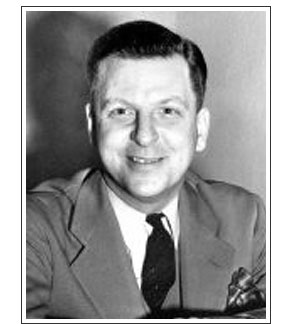
Rush Limbaugh

“Fair and balanced” — the McCarthy way

CPB head Kenneth Tomlinson, who is leading a jihad against "liberal bias" in public broadcasting, and one of his two new ombudsmen both worked for the late Fulton Lewis, a reactionary radio personality associated with Sen. Joe McCarthy.

  • more
    • All Share Services

As the debate over fairness and balance in public broadcasting rages on, there’s a curious historical connection to be found between two men at the forefront of the current conservative crusade and a famous radio broadcaster from 50 years ago. How the three crossed paths — and the way they practiced journalism — put some of the debate into sharper focus.

A main figure in the roiling controversy is Kenneth Tomlinson, the head of the Corporation for Public Broadcasting, who insists that public radio and television suffer from a liberal bias and that actions — such as adding conservative-leaning programs to the lineup — must be taken to counterbalance it. Tomlinson recently singled out the weekly news program “Now,” once hosted by liberal Bill Moyers, as the cause for his concern about bias.

Tomlinson’s conviction is so strong he once suggested to the CPB board that Fox News anchor Brit Hume be invited to “talk to public broadcasting officials about how to create balanced news programming,” according to a report broadcast May 20 on National Public Radio.

Tomlinson’s charge of liberal bias runs counter to two nationwide polls conducted by the CPB in 2002 and 2003, which found little concern among Americans about bias in public broadcasting. The CPB is a federally funded agency that serves as an umbrella organization for public radio and television. Created by Congress, its purpose is both to help raise money and awareness for public broadcasting and to protect it from political pressure. But now the CPB itself has become the source of such pressure.

Tomlinson’s attempt to push back the so-called liberal media is not surprising given his journalistic past — which is where Fulton Lewis Jr., the broadcaster with the intriguing, albeit distant, connection to the ongoing debate, comes in. A prominent radio broadcaster in the ’40s, ’50s and ’60s, Lewis was known for his complete lack of objectivity. At his commercial peak he was heard on more than 500 radio stations and boasted a weekly audience of 16 million listeners. An erstwhile Rush Limbaugh, Lewis was the master of the partisan smear who rarely strayed from GOP talking points. In 1948, New York Herald Tribune radio columnist John Crosby suggested that Lewis “ought to be recognized as a campaigner, not as a commentator, and his national air time be paid for and so listed by the Republican National Committee.”

In 1949 the New Republic noted that Lewis’ “wild charges were part of his campaign over many years to smear in every way possible the New Deal, the Fair Deal, and everybody not in accord with the most reactionary political beliefs.”

In a 1996 interview, poet Allen Ginsberg recalled how Lewis in the ’50s held special disdain for Julius and Ethel Rosenberg, who were convicted of espionage for the Soviets and executed. “There was one commentator on the air, called Fulton Lewis, who said that they smelt bad and therefore should die. There was an element of anti-Semitism in it,” Ginsberg said.

Lewis did not simply target liberal Democrats but also went after Republicans who strayed from the far-right agenda. In 1958 Caspar Weinberger, who later served as President Reagan’s secretary of defense, ran for attorney general in California as a moderate Republican against an arch-conservative Republican who was a close ally of Richard Nixon’s. Lewis, a Nixon acolyte, derided Weinberger during the campaign as “the People’s World candidate,” referring to a communist newspaper.

Hunting communists became a full-time job for Lewis. According to a flattering 1954 biography of the broadcaster, “Praised and Damned: The Story of Fulton Lewis, Jr.,” Lewis was “as close to Senator Joseph R. McCarthy as any other man in the national scene.” Look magazine agreed, calling Lewis one of McCarthy’s “masterminds.”

In “Praised and Damned” Lewis describes his loyalty to McCarthy this way: “When you know an individual to be attempting to do a public service, a patriotic service, and you see him maligned by groups which are not thinking in the public interest, you have a tendency to be a little over-generous with the guy.”

Even after McCarthy was revealed as a phony who could not document his claims that hundreds of communists had infiltrated the federal government, Lewis remained loyal. Over time, the broadcaster’s reputation faded, and today he’s a largely forgotten figure (although in 1987 the Washington Post remembered Lewis as “one of the most unprincipled journalists ever to practice the trade”).

What’s interesting about Lewis now is that two men at the forefront of the effort to rid public broadcasting of its presumed liberal bias both learned journalism at his knee. One, CPB chief Tomlinson, worked as an intern for Lewis. The other, William Schulz, whom Tomlinson recently named as one of the CPB’s two ombudsmen, was a writer for Lewis.

To some, the idea that these two are in charge of promoting objective journalism in public broadcasting is appalling. “It’s shocking and disgraceful,” says former New York Times columnist and reporter Anthony Lewis, who won a Pulitzer Prize for his coverage during the McCarthy era. “If both men wrote for Fulton Lewis it means they were dedicated to an extreme-right position that should disqualify them from determining somebody’s objectivity.”

While there is no mention on Tomlinson’s official CPB bio of his association with Lewis, an Oct. 16, 2002, NewsMax.com article reported: “Tomlinson’s résumé also includes an internship with the late Fulton Lewis Jr., a conservative network commentator in the ‘pre-Rush’ days of AM radio.”

Likewise, the bio of Schulz that the CPB posted online after he was named one of its ombudsmen fails to mention his connection with Lewis. But in a 1997 interview, Schulz recalled, “I went to Antioch College in Ohio, and they had a work-study program, and I got a couple of newspaper jobs, and then I worked for Human Events. Then I went to work for Fulton Lewis Jr., who was a radio commentator and columnist.”

Both Tomlinson and Schulz declined to comment for this article. Lewis died in 1966.

After working for Lewis, both men went on to long, successful careers as writers and editors at another conservative media bastion, the Reader’s Digest, which the National Review recently dubbed “the quintessential magazine of ‘red-state’ America.” The type of journalism practiced at Reader’s Digest also raises questions about whether Tomlinson and Schulz are the best people to police for broadcasting bias.

Says Moyers of Tomlinson, “He seems happiest only in the circles of people who dis liberals.”

During an interview with NPR that aired last week, Tomlinson defended his move to add more conservative programs to public broadcasting’s lineup, stressing, “It’s important to have voices in journalism coming from different directions.” He added, “The reason why we view [PBS's] Jim Lehrer as such a balanced and fair journalist is because he gives no apparent indication of bringing a political point of view to the table.”

Tomlinson’s hunger for newsroom diversity and straight-down-the-middle objectivity appears to be a newfound one, because there certainly was none of either on the Lewis broadcast or during Tomlinson’s time at Reader’s Digest, a magazine famous for its undiluted Republican voice.

“The magazine spent half a century advocating a strong Republican line,” says John Heidenry, who wrote the definitive history of the publication, “Theirs Was the Kingdom: Lila and DeWitt Wallace and the Story of the Reader’s Digest.” He notes that during the ’50s, ’60s and ’70s, Reader’s Digest’s advocacy brand of pro-government journalism served as a dependable platform for the FBI as well as the CIA.

In the ’70s, an internal attempt to broaden the magazine’s political perspective from far right to moderately conservative sparked a civil war between the magazine’s two fiefdoms — or, as Heidenry puts it, “between the moderately conservative Pleasantville [N.Y.] office and the very right-wing, loose-cannon Washington bureau.”

At the time, Schulz was running the D.C. bureau. As Heidenry describes it in his book, “Though cynical about the Digest’s grind-it-out conservatism, he kept an autographed photograph of Joe McCarthy in his home and claimed that the Wisconsin senator was a very misunderstood man.”

According to Heidenry, Schulz’s D.C. bureau routinely tried to kill articles that strayed from the magazine’s traditional far-right agenda. Additionally, the bureau, anxious to play up Cold War fears, interviewed defectors from Russia but sometimes fabricated the details of their tales. “So the whole concept of fact checking was moot,” Heidenry told Salon in an interview. “They created their own facts. The Washington bureau certainly did not practice an objective type of journalism.”

Tomlinson and Schulz’s overseeing a drive to correct partisan journalism in public broadcasting, Heidenry says, is “the pot calling the kettle black.”

According to the Ombudsman Association’s code of ethics, an ombudsman is a “designated neutral” who “strives for objectivity and impartiality.” Yet much of Schulz’s work for Reader’s Digest was precisely the type of loaded, often alarmist and partisan reporting that he’s now supposed to stamp out at PBS and National Public Radio.

In early 1968, Schulz previewed a planned march on Washington led by Martin Luther King Jr. The article, leaning heavily on unsourced quotes from Republican government officials, painted a bleak picture of the demonstration, all but predicting violence in the streets. Schulz appeared to be mostly concerned about America’s image overseas, writing, “One thing is certain: whether or not all of the protesters’ plans materialize, the nation faces international humiliation as a result of the Washington campaign. Communism’s worldwide propaganda apparatus is set for a field day.” (Schulz’s article on King appeared in the Digest’s April 1968 issue, the same month King was assassinated.)

Later that year, in the August issue, Schulz, attacking welfare, charged that in California “able-bodied hippies were financing communes with welfare checks.” And in a 1969 article, he sounded a similar alarm over student protesters, insisting they “posed a major threat to the continued existence of our democratic system.”

Luckily for Schulz and Tomlinson, neither Reader’s Digest nor Fulton Lewis ever employed an ombudsman to check for fairness and balance.

Eric Boehlert, a former senior writer for Salon, is the author of "Lapdogs: How the Press Rolled Over for Bush."

Can radio regulate sexism?

Los Angeles' move to muzzle stupidity on the airwaves is wrongheaded -- and will only backfire

  • more
    • All Share Services

Can radio regulate sexism? (Credit: CREATISTA via Shutterstock)

When KFI-AM radio hosts John Kobylt and Ken Chiampou referred to the late Whitney Houston as a “crack ho” on the air, it was a crass dig. And when Rush Limbaugh went on his three-day rant against Sandra Fluke calling her a “slut” and a “prostitute,” it was a revolting, dishonest display. But should being a bigoted jerk be an actionable offense? I’ll say this – good luck trying to enforce that one, Los Angeles.

By a sweeping 13–2 vote earlier this week, the L.A. City Council passed a resolution that Clear Channel, home to Limbaugh along with Kobylt and Chiampou’s “John and Ken Show,” “ensure that their on-air hosts do not use and promote racist and sexist slurs over public airwaves in the city of Los Angeles.” The resolution also noted that “derogatory language … has no place on public airwaves in the city of Los Angeles or anywhere in America” and urged Clear Channel to reflect diversity with a workforce that includes more “women, African-Americans, Latinos, and Asians.” Clear Channel’s L.A. station KFI employs only one woman on-air personality and no African-Americans.

City Councilman Paul Krekorian told the L.A. Times this week that, “It’s exactly appropriate for this council to speak up against the vile things we hear on the airwaves.” It’s true that it’s essential to assert yourself when the blowhards and bullies try to smear an individual’s character and shout down the exchange of ideas. But much like Jane Fonda, Robin Morgan and Gloria Steinem’s manifesto earlier this month, which suggested that disgusted listeners “complain to the FCC that Limbaugh’s radio station (and those syndicating his show) are not acting in the public interest or serving their respective communities of license by permitting such dehumanizing speech,” the city council move is a potentially chilling one. It’s also virtually unenforceable, unless you’d like to be the one to take a crack at distinguishing every casual joke from true hate speech.

That listeners have been vocal in their opposition to Limbaugh’s slimy blather – and have made it clear that they won’t support his advertisers – is an example of the marketplace working right. Programmers and directors and radio hosts themselves need to learn from their shrinking profits and listener numbers that bigotry and stupidity are unwelcome in our drive times, and change their tones and their talent rosters. That’s more effective than a slap on the wrist from the FCC or a scolding from the city council for an individual crack here and there.

As Fonda, Morgan and Steinem pointed out in their editorial, Rush Limbaugh “is not constitutionally entitled to the people’s airways.” No one is. The particularly grotesque radio rhetoric of late – and the creeping dread that an election year is sure to bring more of the same – have made the battle for a more civil discourse more urgent. Yet the search for ways to make that happen is forcing us all to consider how free our free speech should be. An authoritative muzzling only makes these jerks more heroic to their drooling, dwindling constituency. It’s smarter to keep raising our voices in protest and  hitting the hatemongers where they hurt most – the advertising cash flow. That’s what real freedom of speech looks like.

Continue Reading Close
Mary Elizabeth Williams

Mary Elizabeth Williams is a staff writer for Salon and the author of "Gimme Shelter: My Three Years Searching for the American Dream." Follow her on Twitter: @embeedub.

To reclaim or reject “slut”?

The Limbaugh controversy is a perfect example of the complexities of reappropriating, or renouncing, the slur

  • more
    • All Share Services

To reclaim or reject SlutWalk participants cheer a speaker (Credit: Olivia Harris / Reuters)

Until now, reclaiming the word “slut” never appealed to me. I fully supported the message of SlutWalk — that women don’t ask to be raped by dressing a certain way — but I had no interest in applying the slur to myself. But this Limbaugh thing has me singing a different tune.

I’m not exactly scrawling “slut” on my forehead, but suddenly, reclaiming the word seems potentially exciting. I’m not the only one recognizing a shift in the conversation about reclamation. Megan Gibson of Time wrote, “While the motivation [for SlutWalk] was inarguably sound … the protest caused controversy, in part because many were wary to associate themselves with the word slut.” She continues, “Remarkably, thanks to Limbaugh’s ignorant vitriol, we’re seeing a marked change in that wariness.”

That said, in identifying with Sandra Fluke, the target of Limbaugh’s rant, some women have instead chosen to distance themselves from the term, which perfectly illustrates how complicated reclamation can be.

This week, the hashtag “iamnotaslut” went viral. Jessica Scott, an Army officer who started the hashtag, tweeted, “I am a 35 year old mother of 2, an Army officer who has deployed. I use #birthcontrol to be a good soldier & responsible parent #iamnotaslut.”

Feminist activist Jaclyn Friedman points out that the message here is, “Just because I use birth control doesn’t mean I’m a bad girl” — which might imply that some women are bad. “The problem with the ‘iamnotaslut’ hashtag is that it creates a line,” she explains. “[It says,] ‘I’m a valid spokesperson on this but women who have lots of sex are not.’”

Fluke is such a sympathetic character in part because her testimony — contrary to Limbaugh’s bizarre interpretation — wasn’t about sex; it focused on women who need birth control for reasons other than pregnancy prevention (specifically, polycystic ovarian syndrome and endometriosis).

“It’s a way to categorize and differentiate yourself, that you are deserving of respect,” says Leora Tanenbaum, author of “Slut! Growing Up Female With a Bad Reputation.” It’s not all that different from what she observed among teenage girls while researching her book: The slur was most often used by girls, not boys. It’s a way for girls and women to displace anxiety about their own sexuality. “It’s a classic scapegoating technique,” she says.

The Limbaugh affair is a perfect example of how reclaiming, or rejecting, the term is immensely personal and dependent on context — and it goes much deeper than either SlutWalk or SlutRush. As many have pointed out, the word “slut” comes with different baggage for many women of color. A letter written to the organizers of SlutWalk and signed by hundreds, read, “As Black women, we do not have the privilege or the space to call ourselves ‘slut’ without validating the already historically entrenched ideology and recurring messages about what and who the Black woman is. We don’t have the privilege to play on destructive representations burned in our collective minds, on our bodies and souls for generations.”

How individual acts of reclamation are understood by others is also dependent on context. “If you’re with a girlfriend and you’re like, ‘Yo slut,’ or whatever, everybody laughs and you all understand that you’re being ironic,” says Tanenbaum. “You can be ironic when you’re with people that get the irony.”

One of the major arguments against reclamation at this point in time is that not enough people get the irony. “It may sound funny for me to say, because I did write a book that’s called ‘Slut!,’ but I do have a problem with taking back the term,” says Tanenbaum. “In order to successfully reclaim the term ‘slut’ we need to be in a place where more people have their awareness raised and are cognizant of the sexual double standard and what that means for women’s sexuality and freedom.” It’s still “too much of an in-joke,” she says.

It also means different things to different reclaimers, depending on the context they use it in. Bikini Kill’s Kathleen Hanna once explained her early-’90s performances with “slut” scrawled on her stomach, like so, “I thought a lot of guys might be thinking this anyway when they looked at my picture, so this would be like holding up a mirror to what they were thinking.” It was a way to preempt critics. Friedman gave a similar explanation for why she chose “My Sluthood, Myself” as the title for a personal essay she wrote about her experience with Craigslist’s Casual Encounters.

“Slut” can also “denote an uninhibited, adventurous and celebratory approach to sex for both men and women in all their magnificent diversity,” says Dossie Eaton, author of the classic “The Ethical Slut,” which was published in 1997. She says, “In the wondrously explorative ’70s, I learned that gay men use the word ‘slut’ as a term of admiration and approval, as in ‘What did you do at that party? Oh, you slut!’” Similarly, the organizers of SlutWalk Seattle wrote in a blog post that “slut” serves as a “sex-positive” term for individuals “who have and enjoy frequent consensual sex, especially with multiple partners.”

In reaction to Limbaugh’s remarks, saying, “Yes, I’m a slut!” feels to me like saying, “Yes, I’m a woman!” My comfort in this case might speak to a lack of daring: It’s certainly less bold to align yourself with “sluts” who use birth control and testify before Congress in conservative professional attire than with “sluts” who raucously march through the streets wearing fishnets and bustiers. Maybe on an emotional level I buy into the notion of good girls and bad girls.

The truth is that, as a slur, “slut” is used to control the sexuality of all women. It can be leveled at any woman, regardless of sexual experience or dress. There is no strict definition of what a slut is — there is no set partner count, no percentage of exposed skin. Part of the difficulty of reclaiming “slut” is that it’s such a divisive term, but that’s also part of the argument for reclaiming it.

Continue Reading Close
Tracy Clark-Flory

Tracy Clark-Flory is a staff writer at Salon. Follow @tracyclarkflory on Twitter.

The right wing’s pornography of resentment

When Rush Limbaugh calls women sluts and asks for their sex tapes, he's not the first prude who wants to watch

  • more
    • All Share Services

The right wing's pornography of resentment Bill O'Reilly, Dr. Judith Reisman and Rush Limbaugh (Credit: AP/drjudithreisman.com)

The sliming that Sandra Fluke has endured — from Rush Limbaugh, of course, but also from his rabid cheering section like Atlas Shrugged’s Pam Geller (“She is banging it five times a day…. Calling this whore a slut was a softball”) and the blogger Ace of Spades (“A shiftless rent-a-cooch from East Whoreville”) — is bizarre and over-the-top enough.

But even weirder was Limbaugh’s proposition: If “Miss Fluke and the rest of you Feminazis” expect us to pay you to have sex, “we want something for it,” Limbaugh said last week. “We want you to post the videos online so we can all watch.” (Those words were later erased from Limbaugh’s official transcript of the show; Atlantic Wire preserved them.)

Prudery and prurience often go hand in glove. Prurience and paranoia are fellow travelers as well. Eighteenth- and 19th-century anti-papist authors and pamphleteers turned out a steady stream of stories about the goings-on between priests and young women in confessionals. “The Awful Disclosures of Maria Monk,” the ghosted confessions of a nun who was supposedly held as a sex slave in a convent in Montreal, was outsold only by “Uncle Tom’s Cabin” in the years before the Civil War. “Anti-Catholicism,” as the historian Richard Hofstadter put it, “has always been the pornography of the Puritans.”

Protestants aren’t the only ones with a penchant for pornography. In the Inquisition era, the Catholics themselves — whose dungeons and torture chambers would provide so many of the lurid tropes of anti-Catholic gothic fiction — filled their witch hunting manual, the Malleus maleficarum, with pantingly precise descriptions of infanticide, cannibalism, bestiality and orgies. Back in the 14th century, the Knights Templar were accused of trampling, spitting on and urinating on the cross, and welcoming initiates into their order with obscene kisses on the mouth, navel and buttocks.

The church father Epiphanius’ horrifying description of the Phibionite Gnostics’ supposed sexual practices in his “Panarion” dates back further still, to the late fourth century. It’s worth quoting, since it contains so many monstrous (and licentious) allegations — and perhaps the world’s earliest depiction of what a right-wing propagandist today might call a partial-birth abortion:

First they have their women in common. … The man leaving his wife says to his own wife: Stand up and make love with the brother. … Then the unfortunates unite with each other, and as I am truly ashamed to say the shameful things that are being done by them. … Nevertheless, I will not be ashamed to say those things which they are not ashamed to do, in order that I may cause in every way a horror in those who hear about their shameful practices. … They have intercourse with each other but they teach that one may not beget children. … And if … the woman becomes pregnant, then … they pull out the embryo in the time when they can reach it with the hand. They take out this unborn child and in a mortar pound it with a pestle and into this mix honey and pepper and certain other spices and myrrh, in order that it may not nauseate them, and then they come together, all this company of swine and dogs, and each communicates with a finger from the bruised child. … Many other horrible things are done by them.

They have intercourse with each other but they teach that one may not beget children — a practice that has come in for some unusually intense criticism this campaign season, considering how commonplace it is.

There are no studies that I am aware of to back this up, no authorities I can cite in a footnote, but while almost everyone worries that their enemies are enjoying more and better sex than they are, programmatic haters are downright certain of it. Most men are mildly anxious about how they measure up sexually, but haters are obsessed with what they fancy to be their enemies’ superior prowess and potency; worse yet, they are morbidly certain that given half a chance, their wives and daughters (or their sons, for that matter) would happily surrender themselves to them. Call it “The Pornography of Resentment.” Though they might put their women on pedestals, there is more than a whiff of misogyny in their chivalry.

“The black-haired Jewish youth lies in wait for hours on end, satanically glaring at and spying on the unsuspicious girl whom he plans to seduce, adulterating her blood and removing her from the bosom of her own people,” Adolf Hitler wrote in “Mein Kampf.” American slaveholders, who raped their female chattel with neither compunctions nor consequences (“To debauch a Negro girl hardly injures an American’s reputation,” as Tocqueville famously observed in “Democracy in America,” “to marry her dishonors him”), suffered nightmares about their male slaves’ designs on their wives. Some of the anti-gay literature circulating today has a wistfully lascivious undertone to it as well, premised on the notion that predatory gays can “recruit” confused teenagers, presumably by offering them a better time than they would have had with a member of the opposite sex.

A couple of years ago, I came across a bizarro-world specimen of this masochistic tendency in the writings of the 13th-century Jewish sage Isaac ben Yedaiah. A woman, he wrote, “will court a man who is uncircumcised in the flesh and lie against his breast with great passion, for he thrusts inside her for a long time because of the foreskin, which is a barrier against ejaculation.”

This is because of the pleasure that she finds in intercourse with him, from the sinews of his testicles — sinew of iron — and from his ejaculation — that of a horse — which he shoots like an arrow into her womb. They are united without separating and he makes love twice and three times in one night. . . . But when a circumcised man desires the beauty of a woman . . . he will find himself performing his task quickly . . . he arouses her passion to no avail and she remains in a state of desire for her husband, ashamed and confounded. . . . She does not have an orgasm once a year, except on rare occasions, because of the great heat and the fire burning within her.

Ben Yedaiah went on to propose that it was this very penchant for premature ejaculation that accounted for Jewish supremacy in intellectual and spiritual matters, because their lackluster sex lives left them with more bandwidth for study and prayer — but that sounds like sour grapes to me. Let’s face it: A lot of hatred stems not just from fear but from envy.

If bondage pornography is the preferred genre for the expression of racial, gender and religious resentment, 1950s science fiction movies embodied many of America’s deepest fears about the insidious nature of the Communist threat. A spurious “textbook” that the Soviet Union purportedly provided to aspiring sleeper agents in the 1930s, “The Communist Manual of Instructions of Psychopolitical Warfare,” explained how “a good and experienced psychopolitical operator, working under the most favorable circumstances, can, by the use of psychopolitical technologies, alter the loyalties of an individual so deftly that his own companions will not suspect that they have changed.” The book was widely circulated in the mid-1950s and can easily be downloaded on the Internet today. Almost certainly concocted by the young L. Ron Hubbard, it resonated perfectly with the nation’s paranoid mood.

The young boy in “Invaders From Mars,” who realizes that aliens have possessed his parents’ minds, and Kevin McCarthy’s desperate efforts to warn the public about the soulless pods who were replacing his neighbors in “Invasion of the Body Snatchers” both reflected and exacerbated those anxieties. As Jeff Sharlet relates in “The Family,” the movie “The Blob” was conceived by a Christian filmmaker, Irvin “Shorty” Yeaworth, at the 1957 National Prayer Breakfast, specifically as a metaphor for creeping Communism.

The Great Adversary of the right-wing imagination is supernaturally protean; it can take possession of your thoughts and subject you to mind-blowing sexual pleasure, whether you want it or not; it can change its appearance at will. It is not just Satanic. For all intents and purposes, it is Satan — both the object and the reification of shameful and frustrated desires.

And so we come back to Sandra Fluke. Limbaugh’s defenders rushed to prove that she is neither a victim nor even a real law student, but is in fact a professional provocateur, a “plant.” “There is no doubt in my mind, in my investigator’s mind,” Bill O’Reilly opined, “that this woman, from the very beginning, was what they call ‘run’ by very powerful people … So I’m going to say — and I can’t prove it beyond a reasonable doubt, I think I will be able to — that this was run out of the White House. The White House ran this.”

Since this crowd also believes Obama is not who he says he is — if he is not a Kenyan-Muslim impostor, then at the very least he is a Saul Alinksy-style radical — it all makes a rough kind of sense, in a tin-hat sort of way. And I’m not done talking about sex yet, either.

If you didn’t know it, Obama is a disciple of Alfred C. Kinsey and Playboy magazine. Just ask Dr. Judith Reisman, who has “exposed” his administration’s war on the family — beginning with mandatory sex education for kindergarteners and continuing with the normalization of homosexuality. “Dr. Kinsey said that his mission was to eliminate the sexually ‘repressive’ legal and behavioral legacy of Judeo Christianity,” she says. “[His] mission has been accomplished, mostly posthumously, by his legion of true believers – elitists who have systematically brainwashed their fellow intellectual elites to adopt Kinsey’s pan-sexual secular worldview and jettison the Judeo Christian worldview upon which this country was founded and flourished.”

I will not be ashamed to say those things which they are not ashamed to do, in order that I may cause in every way a horror in those who hear about their shameful practices. It’s almost as good as watching.

Arthur Goldwag’s new book, “The New Hate: A History of Fear and Loathing on the Populist Right,” was published by Pantheon in February. He is also the author of “The Beliefnet Guide to Kabbalah,” “Isms & Ologies” and “Cults, Conspiracies and Secret Societies.”

Continue Reading Close

Arthur Goldwag's new book, "The New Hate: A History of Fear and Loathing on the Populist Right," was published by Pantheon in February. He is also the author of "The Beliefnet Guide to Kabbalah," "Isms & Ologies" and "Cults, Conspiracies and Secret Societies."

Rush Limbaugh, media victim

A Washington Post writer apologizes to Rush for an error. Because Limbaugh takes nothing more seriously than truth! VIDEO

  • more
    • All Share Services

Rush Limbaugh, media victimRush Limbaugh(Credit: AP)

Don’t you just hate it when someone in the media reports something about you without checking the facts first? Isn’t it a cheap shot when you’re inaccurately depicted as some kind of opportunistic jerk? My God, isn’t that just the worst? No wonder poor, misunderstood Rush Limbaugh is upset. No wonder he had no recourse but to take to what’s left of his airwaves Thursday to clear his name after Washington Post writer Alexandra Petri erroneously stated that his show “targets jerks.” And did you see how the guy with a bit of an image problem with the ladies was forced to bust out the “B word”?

Writing about the way advertisers have been dumping Limbaugh’s show like it’s toxic waste – exactly like it’s toxic waste, really – Petri had reported that among his new sponsors, “So far, he’s picked up AshleyMadison.com, the site where you go to cheat on your wife, and another web site that is explicitly for sugar-daddy matchmaking.” Except that Limbaugh had done no such thing. Why, it’s as if Petri thought Limbaugh had no integrity or something.

So horrified was Limbaugh at this besmirching of his character that he addressed it at length on his show Thursday, explaining, “We do not sponsor companies that help people cheat on their spouses.” He then added, “It’s an out and out lie complete with your b-i-itchy opinion in it and it is untrue.” He then condemned Petri’s “snarky, lying, full-of-holes” reporting by vowing, “I guarantee you, she’ll run another story tomorrow saying I made this all up.” He guaranteed it! In a totally non-snarky, non-lying, non-full of holes way.

On Friday, Petri did not, in fact, accuse Limbaugh of making things up. Instead, she penned a mea culpa to the noted Viagra aficionado, saying, “In the age of instant deadlines, when the correct time to have written about something is yesterday at 3 a.m., it’s easy to make mistakes, and the thing to do is admit them, fix them and do better.” She even offered to buy Limbaugh a conciliatory sandwich, which proves she may just have the strongest stomach in the Beltway.

What a harrowing ordeal it must have been for Limbaugh — a man who prides himself on being “huge on personal responsibility and accountability” — to have his reputation so falsely tainted. What an awful thing for a human being to endure. It’d be like, oh I don’t know, being called a slut and a whore and prostitute from some whimsical blowhard’s personal sniper tower for three days in a row. It’d be like having someone declare that you’d testified before Congress that you were “having so much sex” that you were “going broke buying birth control,” that you “must be paid to have sex,” and that you “want to be paid to have sex,” even when, of course, nothing could be further from the truth. Isn’t it disgusting when people use their platform to spread misinformation? Isn’t it vile when they brag about their blatant character assassination, and then try to act like it never happened? Keep calling it like you see it, Rush, and don’t let the b-i-itches get you down. We’d hate for anybody to get the idea that you’re some kind of whiny, dish-it-out-but-can’t-take-it d-i-irtbag.


Continue Reading Close
Mary Elizabeth Williams

Mary Elizabeth Williams is a staff writer for Salon and the author of "Gimme Shelter: My Three Years Searching for the American Dream." Follow her on Twitter: @embeedub.

The hidden meaning of Rush’s apology

The fact that the radio host said sorry at all is the result of a welcome push for a more civil discourse

  • more
    • All Share Services

The hidden meaning of Rush's apologyRush Limbaugh (Credit: AP)

During his long career as the most famous talk radio host in modern history, Rush Limbaugh has only rarely apologized for his rhetoric — so when he does, it’s worth pondering the contrition’s deeper meaning. Was his apology last week for calling a Georgetown student a “slut” just a shrewd move to undercut a potential defamation lawsuit? Was it a frightened response to an intensifying backlash from advertisers? Does it prove the power of the liberal political organizations that have an ideological ax to grind against Limbaugh?

The answer to all those queries is yes — but none of those factors is the genuine news of the matter. Instead, what makes Limbaugh’s apology so important is its context. Capping off other similar brouhahas from across the mediasphere, Limbaugh’s mea culpa — however insincere — is significant because it is proof that America may be both setting some basic standards for political discourse and rejecting the right-wing shrieks about “censorship” and “political correctness.”

Consider what preceded Limbaugh’s apology. Only a few weeks ago, MSNBC announced it had terminated its relationship with Pat Buchanan, who had become a television mainstay despite the Anti-Defamation League documenting his long record as an “unrepentant bigot.” Just prior to that, Los Angeles radio station KFI suspended two hosts for calling Whitney Houston a “crack ho”; CNN suspended commentator Roland Martin for his homophobic Super Bowl tweets; and MSNBC suspended liberal host Ed Schultz for calling a competitor a “right-wing slut.” And before that, there was the seminal big-bang moment that kicked off the whole trend: the removal of Glenn Beck from Fox News — a decision that traced its roots to an advertiser boycott after Beck insisted that President Obama has a “deep-seated hatred of white people.”

In all of these examples, as with Limbaugh’s “slut” comment, the speech in question set off a firestorm not just because it was ideologically extreme, but also because it was indisputably inappropriate. To paraphrase the jurisprudential terms surrounding pornography, it crossed the line from merely offensive to overtly obscene.

Of course, this kind of slander was tolerated for decades without so much as a peep of objection from the media powers that be. Thanks to that silence, talk radio and cable television came to be wholly defined by such political obscenity — a development that made spectacularly lucrative careers for hate-speech demagogues.

That downward spiral seemed destined to continue because any time there was even a hint of protest, the conservative movement’s powerful media intimidation machine trotted out self-righteous rants against “political correctness” and odes to the First Amendment. Looking to manufacture its own insipid version of “political correctness” that crushes dissent, this machine typically portrayed conservatives as victims, marshaling anti-censorship arguments to insinuate that bigotry, anti-Semitism, homophobia and sexism are somehow entitled to a constitutionally protected place in major media outlets.

Not surprisingly, this same argument is now being made by conservatives in defense of their disgraced heroes.

“He has every right to his ideas, as we all have the right to our own,” wrote conservative Cal Thomas in an emblematic screed criticizing MSNBC for firing Buchanan. “It’s called free speech.”

It’s certainly true that all Americans have a right to their own ideas and to advocate for those opinions on their own. But having one’s ideas broadcast to millions of Americans over the public airwaves by major media corporations is not a right. It’s a privilege.

Limbaugh’s apology, made under pressure and designed to safeguard his privilege, concedes that indisputable truth. In doing so, the talk-radio icon is implicitly acknowledging a welcome change — one in which media executives, advertisers and the larger American audience are finally declaring that privileges can be withdrawn from those who violate the most basic standards of decorum.

Continue Reading Close
David Sirota

David Sirota is a best-selling author of the new book "Back to Our Future: How the 1980s Explain the World We Live In Now." He hosts the morning show on AM760 in Colorado. E-mail him at ds@davidsirota.com, follow him on Twitter @davidsirota or visit his website at www.davidsirota.com.

Page 1 of 43 in Rush Limbaugh