
Obesity

Do today’s kids have “nature-deficit disorder”?

A new book argues that children desperately need to be able to play in the woods -- and that our culture's sterile rejection of nature is harming them in body and soul.

  • more
    • All Share Services

Do today's kids have

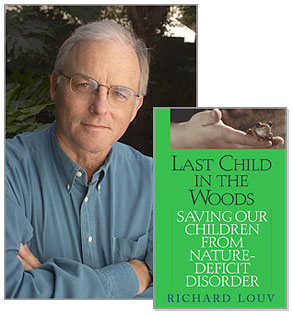
In the not-so-distant past, kids ruled the country’s woods and valleys — running in packs, building secret forts and treehouses, hunting frogs and fish, playing hide-and-seek behind tall grasses. But in the last 30 years, says journalist Richard Louv, children of the digital age have become increasingly alienated from the natural world, with disastrous implications, not only for their physical fitness, but also for their long-term mental and spiritual heath.

In his new book, “Last Child in the Woods: Saving Our Children From Nature-Deficit Disorder,” Louv argues that sensationalist media coverage and paranoid parents have literally “scared children straight out of the woods and fields,” while promoting a litigious culture of fear that favors “safe” regimented sports over imaginative play. Well-meaning elementary school curricula may teach students everything there is to know about the Amazon rain forest’s endangered species, but do little to encourage kids’ personal relationship with the world outside their own doors. And advances in technology, while opening up a wealth of “virtual” experiences to the young, have made it easier and easier for children to spend less time outside.

Louv spent 10 years traveling around the country reporting and speaking to parents and children, in both rural and urban areas, about their experiences in nature. In “Last Child in the Woods,” he pairs their anecdotes with a growing body of scientific research that suggests children who are given early and ongoing positive exposure to nature thrive in intellectual, spiritual and physical ways that their “shut-in” peers do not. By reducing stress, sharpening concentration, and promoting creative problem solving, “nature-play” is also emerging as a promising therapy for attention-deficit disorder and other childhood maladies. Indeed Louv, in both the book’s title and content, suggests that while increased exposure to nature may prove a salve for many of the childhood disorders that now run rampant, the very ubiquity of those disorders is evidence that two generations of alienation from nature may have already resulted in considerable harm to our kids.

Louv recently visited Salon’s New York office to discuss the correlation between the decline in kids’ contact with nature and the rising obesity epidemic; the criminalization of old-fashioned play; and the simple pleasure of having dirty hands and wet feet.

What is nature-deficit disorder?

It’s the cumulative effect of withdrawing nature from children’s experiences, but not just individual children. Families too can show the symptoms — increased feelings of stress, trouble paying attention, feelings of not being rooted in the world. So can communities, so can whole cities. Really, what I’m talking about is a disorder of society — and children are victimized by it.

Why, in the age of ADHD, did you choose such a loaded name?

Because I do think it is a disorder, just one of society. I am very careful in the book not to give the suggestion that this is some kind of clinical diagnosis. Maybe someday it will be, but until the scientists come up with a better name, that’s the one I’m using.

Is this just an urban problem, or does it affect children in suburban and rural areas as well?

For my research, I tried to cross every barrier I could think of — for instance, I did interviews in more rural areas and suburban areas, like the one I grew up in outside Kansas City, which still has a lot of nature. I went in there thinking, Well, certainly if you have woods next to you, kids will be out in them. But that simply wasn’t true. The parents and the kids there were saying the same things as kids in more urban areas. In fact, the amount of nature you have in New York City is actually better than some of the newer suburbs; imagine, today, a city building a Central Park.

A major study came out a few months ago that said that the rate of obesity in children is growing faster in rural areas than it is in cities and suburbs. Again, it seems counterintuitive. But it’s not so counterintuitive when you think about the fact that the family farm is fairly nonexistent now. Kids in rural areas are playing the same video games, watching the same television, and they’re on longer car rides.

Certainly the explosion of technology over the last 25 years — from cable TV, to video games, home computers and the Internet — has curtailed the amount of time kids spend playing outside each day. But during that same time, hasn’t society as a whole become much more aware of environmental issues?

I say early in the book that it’s more like the polarity has reversed. When I was a kid I had an intimate knowledge of woods and fields, to the extent that I pulled up hundreds of survey stakes to protect them from bulldozers. I really had a sense of ownership — I had no clue that my woods were connected to other woods ecologically. It’s the reverse now. Kids today can tell you lots of things about the Amazon rain forest; they can’t usually tell you the last time they lay out in the woods and watched the leaves move. It’s not that learning about the Amazon is bad — it’s great, and I’m glad it’s happening — the problem is, it becomes an intellectualized relationship with nature. And I don’t think there’s much that can replace wet feet and dirty hands. It’s one thing to read about a frog, it’s another to hold it in your hand and feel its life.

By now, we’ve all heard the reports that two out of 10 American children are clinically obese — four times the number reported in the late 1960s. And you note that this obesity epidemic has coincided with the greatest increase in organized sports for children in history. So, what can unstructured outdoor play offer kids that soccer and little league can’t?

First, I’m not against soccer, and it’s not a 1-to-1 ratio in terms of cause and effect. In the book, I’m cautious when talking about obesity — it’s complex. But I think it is a striking fact that the two [statistics] have grown alongside one another. One factor is just frequency of movement — it’s one thing to go to soccer practice once a week, or even three times a week — compared to the way kids used to come home from school and just head out. Sometimes I played free-form pick-up baseball, but most of the time, I was just gone, in the woods, and I was moving, I was racing my collie. That was constant. And I was so skinny I had to run around in the shower to get wet.

But there’s something going on here that’s more mysterious, and frankly the lack of study on it means any answer to your question will be incomplete. There is the “biophilia” hypothesis, which in some quarters is controversial, but that suggests we are still hunters and gatherers and biologically we have not changed. That hypothesis says there is something in us that needs natural forms, that needs association with nature in ways that we don’t fully understand. I think we instinctively understand that there is something about being in nature that you cannot get on a soccer field.

At one point you quote research that says children playing in parks are naturally drawn, not to the landscaped fields, but to the rocky borders where there are natural plants and ravines. But parents seem to spend a lot more time these days looking for spaces that are “child-friendly.” By building super-structured suburban communities dominated by gates and playing fields, are we actually making kids’ imaginative worlds smaller?

What we usually design is really more “lawyer-friendly” than “child-friendly.” This is a litigious society, and a lot of the places you are talking about have been designed by attorneys, not park designers. But there is interplay between the fear of lawsuits and [parents'] fear of a “bogeyman” that is going to hurt their children — indeed, they almost have become one and the same.

In the book I write about natural tort reform, and the idea that we will have to confront this problem sooner or later. For instance, I bring up the idea of the “criminalization” of natural play, where if you take all the state regulations, the well-intended and often needed environmental restrictions, and add those to the covenants and restrictions that now cover almost any new development that has been built in the last 20 years — things that control everything to whether you can plant rosebushes in the front to what color your curtains — well, the idea of a freewheeling, tree-house-building, nature-loving kid doesn’t fit that. So if all of [these restrictions] were to be enforced, playing outdoors by kids would be essentially illegal. It’s not all enforced, but the message still gets through — kids get a sense that there’s something unsavory about playing outdoors. And it’s too easy to blame this on lazy parents who let the TV do the baby sitting, when the truth is there is a matrix of forces that have come together to create this problem, and those forces are hard to stand up against as an individual and as a people.

You say that parents’ anxious attitude about the world — what you call “stranger danger” — a nebulous paranoia about violent criminals and sexual predators, kidnappers, traffic accidents, lawsuits and freak disease  is one of many factors, including increased technology, that has alienated kids from nature.

It’s not good for human beings to live with fear all the time. In this society we are increasingly living in fear, whether it’s of terrorism or “stranger danger” — and statistically, most of that fear is not warranted. Child abductions by strangers are, in fact, rare, and criminologists and others report that the number of them may have decreased in recent years. A 1988 report by the National Incidence Study on Missing, Abducted, Runaway and Throwaway Children in America, stated that there were between 200 and 300 children abducted by strangers in 1988. The most recent such National Incidence Study, found 115 children kidnapped by strangers in 1999. A relatively few child abductions are amplified into the appearance of an epidemic through nonstop coverage by the media. All of this is not to say that child abductions are a small matter, but fear of them must be weighed against the effects of that fear on our daily lives — including children’s ability to find joy in nature. However, if you live next door to somebody whose child was kidnapped, it doesn’t matter what the statistics are, and I understand that fear and I’ve felt it myself as a parent.

According to the 2005 Duke University Child Well Being Index, American kids are safer now than they have been at any time since 1975. Specifically, violent victimization of children has dropped more than 38 percent. So why do we feel that so much has changed?

Now, to play devil’s advocate to my own theory, if kids are safer now it may well be because we’re holding them inside. But what we don’t measure is the danger of what happens to their imaginations and inner lives because of it — those other repercussions aren’t measured at all.

In terms of where it all comes from — well, there’s a story I mention in my book about a little girl who was stolen from her bedroom and killed, one of these cases that was ’round the clock on CNN for a long time. That happened right over the hill from where I live in California. It’s an important story, I don’t mean to dismiss it — but weeks of it, around the clock? We’re being conditioned to be fearful all the time. So a lot of it is the media.

That said, the name you chose for your book — “Nature-Deficit Disorder” — probably plays directly into the fears of many parents.

I knew that would come up and made a conscious decision to accept the criticism, because I am confident this issue is important enough to deserve attention.

That said, I don’t want to dwell on the negative; I’m hopeful that as this change becomes more visible to everyone, and the detriments of this shift begin to be discussed, that we also start to discuss the good news — the wonderful things that nature play can do for kids, like reducing the symptoms of ADHD, stress reduction, increased creativity, cognitive skills, and full use of the senses. “Last Child in the Woods” may be the first place all this research has come together outside of academia, but there have already been some very brave researchers working on these ideas. I call them brave because most of them are not winning big grants — since as one of them explained to me, “Who’s going to pay for a toy you can’t sell?” For instance, at the University of Illinois, there is remarkable study happening that suggests that nature play might be a therapy for kids with ADHD. Well, I would also flip that around and ask if there is something missing in kids’ lives that is actually contributing to or aggravating their symptoms? I’m skeptical about a lot of the diagnoses of ADHD, really.

You repeatedly refer to a 1991 study that found that the radius children are allowed to roam outside their homes has shrunk to a ninth of what it was 20 years ago. I remember being a young teenager and sneaking off into the woods to tell stories and smoke cigarettes with my girlfriends. This didn’t necessarily promote good health, but it did give me a feeling of independence and the knowledge that I had a life — a kid’s world — that existed separate from my parents. Maybe what is hurting kids is not just that they have been given less freedom to interact with nature, but that they have been allowed less freedom and independence in general?

Well, there have been a lot of cigarettes smoked in tree houses. (Laughs) Seriously, it’s true that not only nature can give the feeling of autonomy. But then when you think about where could kids be getting that instinctual self-confidence and independence — where could they go — it’s hard to think of a lot of positive places. Nature often provides an atmosphere you can’t get anywhere else, a sensation of being solitary. And again, I think there are mysterious things that happen, a lot of which have to do with the full use of our senses. I can’t think of many places, other than maybe the New York subways, in which we have our senses going full cylinder. And I make the case in the book — though I am very careful to say that I am speculating about this — that letting your kids have some independence in nature, where they can use all their senses, in the long run makes them safer.

Usually hyper-vigilance — behavior manifested by always being on guard and ready to fight or flee — is associated with trauma in childhood. But the hyper-awareness gained from early experience in nature may be the flip side of hyper-vigilance  a positive way to pay attention, and, when it’s appropriate, to be on guard. We’re familiar with the term “street smart.” Perhaps another, wider, adaptive intelligence is available to the young? Call it “nature smart.” One father I spoke to said he believes that a child in nature is required to make decisions not often encountered in a more constricted, planned environment — ones that not only present danger, but opportunity. Organized sports, with its finite set of rules, is said to build character. If that is true, and of course it can be, nature experience must do the same, in ways we do not fully understand. A natural environment is far more complex than any playing field. Nature does offer rules and risk, and subtly informs all the senses.

And certainly, the other aspects you mention — that give a child self-confidence, independence and the sense that they can exist in the world and are somewhere bigger than their parents and their problems — are all a part of the healing possibilities of nature that I hope people will explore.

Another refrain that surfaces in your book is kids who say, “I don’t really have time to play,” because they are always being carted off to some kind of lesson or “enrichment” activity. In this context you speak of both the “criminalization” and “commercialization” of play — that unless play takes the form of a competitive, structured activity, parents and kids think of it as just “wasted time” — a lazy afternoon of daydreaming. When do you think this shift began?

The shift has been happening for several decades with increasing rapidity. But the essential thing to realize is that we can do something about it. If you think about the phrase “nature-deficit disorder” — all you really have to do to deal with the disorder is get your kid out in nature now and then — it’s not brain surgery. It’s actually fun, and it’s fun for parents.

The key is that as long as nature experiences are considered an extracurricular activity, nothing will change. There are folks out there who are hungry for it, who want an alternative to what is going on in terms of organized sports and over-structured lives. The minute it begins to be seen as a health issue, truly a mental health issue — that wonderful things can happen for your child if you give them direct experiences with nature — then it’s no longer an extracurricular activity and really, it’s no longer even leisure. When that kind of conceptual shift happens, I think a lot of parents will be relieved — they’ll have a logical reason to do what their instincts tell them to do anyhow.

Sarah Karnasiewicz is a freelance writer and photographer based in Brooklyn, N.Y. Until recently, she was senior editor at Saveur magazine; prior to that she was deputy Life editor at Salon. She has contributed to the New York Times, the New York Observer and Rolling Stone, among other publications. For more of her work, visit thefastertimes.com/streetfood and Signs and Wonders.

Beating back obesity

America's weight problem is only getting worse. Here's how we can fix it

  • more
    • All Share Services

Beating back obesity

If Benjamin Franklin was writing his famous letter to Jean-Baptiste Leroy today, his famous aphorism might read: “In this world nothing can be said to be certain, except death, taxes and the obesity crisis.” It seems no matter the year or the season, that crisis inexorably continues, with experts now saying 42 percent of Americans will be obese by 2030. And whether you are one of the 42 percent or not, that trend is going to affect you, because it is expected to cost the country roughly half a trillion (yes, trillion) in additional healthcare costs.

And yet, as relentless as the obesity crisis appears to be, its expansion doesn’t have to be a foregone conclusion. That’s because, unlike a naturally occurring epidemic, it’s almost completely human created — a reality that allows for the possibility of a human-directed reversal.

What does such a reversal require in practice? First and foremost, awareness, and thanks to everything from Michelle Obama’s fitness campaign to HBO’s new documentary “The Weight of a Nation,” that prerequisite is finally starting to be met. But then what? As GI Joe said, “knowing is half the battle” — but it’s only half. Once more of us are aware of the emergency at hand, what will be the most reliable way to address the problem?

In an instant gratification culture obsessed with extreme makeovers and get-thin-quick diet schemes, it’s easy to feel confused about a path forward. But a tranche of new science, data and public policy proposals that cut through the fog of misinformation suggests that path is there — if we’re willing to take it. Here are five of the most promising ways forward.

1. Tax Junk Food

Over the last four decades, we went from spending $3 billion a year on fast food to $110 billion a year on fast food. At the same time, there’s been an explosion in the amount of chemically enhanced, calorie-packed processed foods Americans eat at home, at work and in the school cafeteria. Not surprisingly, in predictable cause-and-effect fashion, this has all happened as obesity became a public health epidemic.

The response from some policymakers has been to champion junk-food taxes, initiatives whose supreme press-release-worthiness can make them seem a bit gimmicky, but whose merits are nonetheless rooted in substance. Indeed, a bevy of new studies show that such levies, when structured properly, can disincentivize junk food consumption on a large scale.

In one University of North Carolina study, ABC News reports that “Patients got significantly less of their calories from soda or pizza when there was a 10 percent increase in the price of either.” In another study of college-age adults, “researchers found that the students generally bought fewer lunchtime calories when sugary, high-fat fare came with a tax of 25 percent or more.” In yet another study, this one from the University of Buffalo, it was much the same result: Higher taxes meant more healthy consumer choices.

New York Times food columnist Mark Bittman has noted that while taxes alone won’t solve the obesity crisis, they are an important part of a multifaceted attack on the problem — and they will also raise much-needed public revenues at a time of crushing deficits:

A study by Y. Claire Wang, an assistant professor at Columbia’s Mailman School of Public Health, predicted that a penny tax per ounce on sugar-sweetened beverages in New York State would save $3 billion in health care costs over the course of a decade, prevent something like 37,000 cases of diabetes and bring in $1 billion annually. Another study shows that a two-cent tax per ounce in Illinois would reduce obesity in youth by 18 percent, save nearly $350 million and bring in over $800 million taxes annually. Scaled nationally, as it should be, the projected benefits are even more impressive; one study suggests that a national penny-per-ounce tax on sugar-sweetened beverages would generate at least $13 billion a year in income while cutting consumption by 24 percent…A 20 percent increase in the price of sugary drinks nationally could result in about a 20 percent decrease in consumption, which in the next decade could prevent 1.5 million Americans from becoming obese and 400,000 cases of diabetes, saving about $30 billion.

Put it all together, and junk food taxes should be about as close to a no-brainer as you’ll find in the public policy arena.

2. Stop Subsidizing Junk Food

There’s no scientific reason junk food should cost less than whole grains, fruits and vegetables. After all, the former are the product of a mechanized process relying on an entire industrial system, while the later can be grown directly out of the ground by almost anyone.

Yet, junk food consistently beats natural foods in the price competition. Why? It’s all about the subsidies.

As a the U.S. Public Interest Research Group’s “Apples to Twinkies” report shows, your taxpayer dollars subsidize junk food and artificially deflate the cost of that junk food so that it undersells everything else. “Between 1995 and 2010, $16.9 billion in tax dollars subsidized four common food additives—corn syrup, high fructose corn syrup, corn starch, and soy oils.” At the same time, PIRG points out that “taxpayers spent only $262 million subsidizing apples, which is the only significant federal subsidy of fresh fruits or vegetables.” To put those numbers into real-world terms, “if these agricultural subsidies went directly to consumers to allow them to purchase food, each of America’s 144 million taxpayers would be given $7.36 to spend on junk food and 11 cents with which to buy apples each year — enough to buy 19 Twinkies but less than a quarter of one Red Delicious apple apiece.”

While studies show that changing this subsidy structure would be no cure-all for obesity, there’s no evidence to suggest that keeping it in place does anything but make the obesity crisis worse — and there is evidence that changing the subsidies would make things better. This isn’t surprising; it’s basic economics.

Think about it: If subsidies for commodity crops that create junk food were redirected into subsidies for natural foods, it would radically change the market incentives for healthful eating. Sans the subsidies, industrial food corporations would no longer be able to price processed foods at artificially lower prices than their natural competitors. Instead, healthful foods would have the price advantage — and, quite likely, bigger market share.

3. Ban Junk Food in Schools

The Obama administration has been trying to reduce the amount of obesogenic foods in school cafeterias, under the theory that stopping obesity-inducing eating habits at an early age might stop the obesity crisis in its tracks. It’s been an uphill fight. According to the Associated Press in February, “Junk food remains plentiful at the nation’s elementary schools,” with “nearly half of public and private schools surveyed sold sweet or salty snack foods in vending machines or other places.”

Nonetheless, new data proves the administration’s efforts, in conjunction with local school districts, are indeed worthwhile. As the New York Times recently reported:

Five years after California started cracking down on junk food in school cafeterias, a new report shows that high school students there consume fewer calories and less fat and sugar at school than students in other states…The study found that California high school students consumed on average nearly 160 calories fewer per day than students in other states, the equivalent of cutting out a small bag of potato chips. That difference came largely from reduced calorie consumption at school, and there was no evidence that students were compensating for their limited access to junk food at school by eating more at home…

To study the effect of this policy, the researchers examined data from the Centers for Disease Control and Prevention on the eating habits of high school students in California, comparing it with data on students from 14 states that did not have nutrition standards for vending machine snacks and other foods sold outside of school lunches and other meal plans…California students had the lowest daily intake of calories, fat and, especially, added sugars.

In light of this, it’s hard to imagine anyone still defending the American school system’s role as glorified junk food machines.

4. Stop Glorifying Unhealthy Eating Habits

In his endorsement of the campaign to legalize gay marriage, Vice President Joe Biden said that “when things really began to change is when the social culture changes … I think Will & Grace probably did more to educate the American public than almost anybody’s ever done so far.” It was an acknowledgment that televisual images often play as big a role in our society as ironclad policies — and the same truism relates to the obesity crisis.

Today, our political culture regularly equates unhealthy eating habits to Americanness and authenticity. As evidence, recall that the party nomination fights have become a kind of televised eating contest, with candidates trying to one-up their competitors with photo ops stuffing corn dogs and cheesesteaks.

The committee now has a White House petition calling on the president to stop undermining his wife’s crusade against obesity and end such photo ops. It’s the least the administration can do.

5. Start Broadening Our Understanding of Obesity

Conventional wisdom holds that a calorie is a calorie, and that if Americans simply take in fewer calories and use more via exercise, obesity can be stopped. But journalist Gary Taubes reports that science now suggests that this formula may be fundamentally flawed — that obesity is a product of specific kinds of calories from sucrose and fructose:

There is an alternative theory, one that has also been around for decades but that the establishment has largely ignored. This theory implicates specific foods—refined sugars and grains—because of their effect on the hormone insulin, which regulates fat accumulation. If this hormonal-defect hypothesis is true, not all calories are created equal…

Sucrose and high-fructose corn syrup have a unique chemical composition, a near 50-50 combination of two different carbohydrates: glucose and fructose. And while glucose is metabolized by virtually every cell in the body, the fructose is metabolized mostly by liver cells. From there, the chain of metabolic events has been worked out by biochemists over 50 years: some of the fructose is converted into fat, the fat accumulates in the liver cells, which become resistant to the action of insulin, and so more insulin is secreted to compensate. The end results are elevated levels of insulin, which is the hallmark of type 2 diabetes, and the steady accumulation of fat in our fat tissue—a few tens of calories worth per day, leading to pounds per year, and obesity over the course of a few decades.

He goes on to note that “back in the 1980s, the FDA gave sugar a free pass based on the idea that the evidence wasn’t conclusive” — but that now, the evidence can’t be ignored.

This isn’t to say that the theories about sugar are 100 percent correct; it is only to point out that if we are going to reduce our consumption of junk food in order to stop the obesity epidemic, we need a better understanding of exactly what junk food is. That means broadening our understanding of obesity’s roots and rejecting the reductionism that says simply that “a calorie is a calorie.”

Continue Reading Close
David Sirota

David Sirota is a best-selling author of the new book "Back to Our Future: How the 1980s Explain the World We Live In Now." He hosts the morning show on AM760 in Colorado. E-mail him at ds@davidsirota.com, follow him on Twitter @davidsirota or visit his website at www.davidsirota.com.

Our guns and butter economy

America has two favorite new exports: Firearms and obesity

  • more
    • All Share Services

Our guns and butter economy (Credit: ChinellatoPhoto via Shutterstock)

With the economy still struggling and the debates over how to fix the problem more intense than ever, one word still evokes bipartisan consensus: exports. “I want us to sell stuff,” said President Obama, summing up the bipartisan sentiment.

That nebulous word “stuff” is significant. It asks us to see all exports as the same and to refrain from making nuanced value judgments about what exactly we’re shipping overseas. In this coldblooded view, a job-creating export is a job-creating export, and that’s as far as any conversation should go.

At first glance, such reductionism seems logical, rational, even boringly uncontroversial. But two recent news items highlight how in a globalized economy, there are troubling consequences that come from the particular kind of export economy we’re building.

The first bit of news came from the Washington Post, which this week reported that “the Obama administration is crafting a proposal that could make it easier to export firearms and other weapons.” Though the Homeland Security and Justice Departments say the new rules could make it easier for terrorist and drug cartels to further arm themselves, the White House is nonetheless citing the “stuff” theory of exports to ignore the objections.

This is part of a larger pattern since President Obama took office. During Obama’s first year in the White House, he began to gut the Pentagon’s approval process for arms exports, weakening controls on what could and could not be sold. Later, diplomatic cables uncovered by WikiLeaks showed, as Fortune magazine put it, “American officials act(ing) as de facto pitchmen for U.S.-made weapons.”

The result is that America has become the true “Lord of War,” as the arms dealer motto goes. We are the leading arms supplier to the developing world and we are responsible for the majority of all weapons sales across the globe. Yes, we are so committed to selling instruments of death to the rest of the planet that military industries have almost tripled their share of the U.S. economy in just a decade.

The second bit of news came from the Institute for Agriculture and Trade Policy, whose new study shows that America is exporting our obesity crisis to Mexico. Coupling health statistics with U.S. export data since the North American Free Trade Agreement tore down Mexico’s agriculture trade barriers, researchers found that the Mexican market was flooded by American agribusinesses’ taxpayer subsidized commodities (corn, soybeans) and their processed derivatives. According to the report, that quickly wiped out Mexico’s local food economy, leaving its food system exactly “like the industrialized food system of the United States — characterized by the overabundance of obesogenic foods.” Not surprisingly, Mexican obesity rates have consequently skyrocketed.

Taken together, these export booms represent what could be called America’s new Guns and Butter economy. We are so desperate to export any “stuff” we can, we are now fattening up the world and arming it for permanent bloodshed.

Seeking to short-circuit any objections to this trend, President Obama has said simply that “we’re at a moment where necessity has tempered the old debates” over exports and economic policy. In terms of history, he’s not wrong — during the previous century, America witnessed fevered fights over what constitutes a moral farm policy, and in the 1930s the U.S. Senate’s Nye Committee held almost 100 hearings into “greedy munitions interests” that were unduly influencing public policy. Sadly, Obama is correct – those debates have been silenced.

But should they be? Should we simply say that any exports — no matter their moral, ethical, environmental or health implications — are inherently good? Does “necessity” really mean that “stuff” for stuff’s sake must be the basis of our export economy?

Washington and profit-at-all-cost industries certainly say yes — but that doesn’t mean it’s the right answer.

Continue Reading Close
David Sirota

David Sirota is a best-selling author of the new book "Back to Our Future: How the 1980s Explain the World We Live In Now." He hosts the morning show on AM760 in Colorado. E-mail him at ds@davidsirota.com, follow him on Twitter @davidsirota or visit his website at www.davidsirota.com.

The real key to good health

Don't fear resolutions or dread the January fitness crunch. Just make yourself one simple promise in 2012

  • more
    • All Share Services

The real key to good health (Credit: Shannon Stapleton / Reuters)

January sucks. Every magazine cover is festooned with the image of a celebrity in a bikini, promising you the secrets of a BETTER BODY for the new year. Your friends are all going on juice fasts. And the answer to “Feel like going for a bike ride today?” is “Maybe sometime when it’s not 11 degrees out.”

So here’s a crazy idea. This time, let’s not use the beginning of the year as an excuse to hate on our bodies. Let’s not swear to get a tinier butt by Memorial Day, or even Labor Day. No 21-day “action plans.” No master cleanse. Nothing, in fact, that sounds like an enema from a dominatrix. Instead, let’s do something radical. Let’s do something small.

In just the time it takes to realize that “Work It” is the worst thing that ever happened to television, you could change your life. Thirty minutes a day. That’s the minimum amount of physical activity the CDC recommends to stay fit. Yet approximately 30 percent of Americans get no weekly activity at all. Zero. Not even candy-ass pastimes like gardening. And many more of us aren’t exactly wearing out the gym membership cards. Right now, the only thing moving at a fast pace in our country is the obesity rate – 30 percent and climbing.

In an already over-saturated life full of work and family and errands and commuting, it’s often grueling to find 30 minutes to do anything at all. There are days when carving out a window of opportunity to grab a shower feels like a big deal. But I promise, a half-hour is not a lot of time. Treated seriously and honored consistently, it’ll do a lot more for your health and well-being than that spinning class across town you go to once a month. And don’t you deserve as much loving attention as you’d give your car or your iPad?

Here’s what you need. Sneakers. A mix of cardio and strength training. An understanding that you can’t fool your body by not making an effort. A casual saunter on the treadmill while tweeting isn’t going to do jack. You know that lady in the Apple Siri ad, the one who wants to be reminded to call Chris while she’s going for a run? Yeah, don’t be her. No talking on the phone. No checking the weather. And no excuses. Thirty minutes to put in real work, whatever work feels like for your fitness level. (Here’s the inevitable reminder that this isn’t medical advice, and you should talk to your doctor about a plan that’s realistic for you.) Here’s the payoff. Research says that you can build bone density and ease the symptoms of arthritis, high blood pressure and even depression. If this stuff came in a pill, it’d be hotter than Viagra and Effexor put together.

Like a lot of people, I spend most of my days on my butt. Yet I have a beautiful heartbeat. When I see my doctor for my weekly health monitoring, he smiles appreciatively as he presses the stethoscope to my sternum, praising my “slow, steady, runner’s rate.” And last summer, shortly before my lung surgery, the respiratory technician was similarly complimentary. “Look at that pulmonary function,” he said encouragingly as I puffed into a tube. “I can always spot the yoga people.”

Now here’s what you need to know about me. I was always chosen last in gym class. I can’t open a jar of pickles without assistance. I don’t train for marathons. I will never be on the cover of a magazine, Valerie Bertinelli-style, flaunting my abs. I have a body that’s over 40 and has birthed two children, and looks it. And many days, I don’t want to get out of bed. But I put in three and a half hours of exercise a week – mostly running, mixed with the use of a pair of five-pound dumbbells and a yoga app on my phone. I breathe hard. I stretch muscles. I resist gravity. Then I’m back on my butt, possibly holding a beer. That’s it.

Good health should not be reserved for the perky sporty types. Screw the jocks. Almost everybody, of every age and fitness level, can afford a half-hour a day. You can. Why am I telling you this? Because when the surgeon had to cut some cancer out of my lung last August, I was pretty happy I could breathe unassisted afterward. And because I hope that if you’re ever in a similar situation, you are likewise prepared.

This year, it’s not about fitting into those jeans that linger accusatorily in the back of the closet. It’s not about the scale. It’s about getting in touch with what we humans were meant to do – move around. It’s about taking the stairs. It’s about being able to play with your kids. It’s about those sweet, sweet endorphins. And it’s about knowing that though we’re all different, we’re all capable of greater wellness. Is it hard sometimes? Does it get boring at times, day in and day out? Sure. Is it achievable, and is it worth it? Always. But don’t listen to me. Listen to my beautiful heartbeat. Now get out there and thump along. And tell me about your progress — I’ll be right alongside, cheering you on.

Continue Reading Close
Mary Elizabeth Williams

Mary Elizabeth Williams is a staff writer for Salon and the author of "Gimme Shelter: My Three Years Searching for the American Dream." Follow her on Twitter: @embeedub.

Is childhood obesity abusive?

A 200-pound third-grader is removed from home for neglect. Should the government take custody of overweight kids?

  • more
    • All Share Services

Is childhood obesity abusive? (Credit: iStockphoto/tibor5)

Is childhood obesity child abuse? Child services officials in Cleveland seem to think so. They recently removed an 8-year-old boy from his mother and placed him in foster care — because the child tips the scales at over 200 pounds. Department of Children and Family Services spokeswoman Mary Louise Madigan told the Cleveland Plain Dealer that the boy’s condition constituted “a form of medical neglect.”

“This child’s problem was so severe that we had to take custody,” Madigan said, adding that her office had worked with the boy’s mother for over a year before removing him. The boy first caught the attention of child services when his mother brought him to the hospital last year with breathing issues. He was diagnosed with sleep apnea, and now uses a machine to assist his breathing while he sleeps.

Was the boy’s mother, in fact, neglectful? That’s something the state still appears to be determining. The boy’s mother told the Plain Dealer that “They are trying to make it seem like I am unfit, like I don’t love my child. Of course I love him. Of course I want him to lose weight. It’s a lifestyle change, and they are trying to make it seem like I am not embracing that. It is very hard, but I am trying.”

But how do you undo deeply ingrained patterns, combined with a damming family history? Both of the boy’s parents are overweight. (His teenage brother is not.) For her part, the mother says she enrolled the boy in a local Healthy Kids, Healthy Weight program at a local hospital. She got him a bike. She says she tried to talk to him about what foods to eat. And for a while, he lost weight. Then he gained it back — and then the county intervened. He was taken from his school last month, and now his mother sees him once a week for two hours. Reps for the county say he has, in the past few weeks, lost “a few pounds.”

Was his removal an overreaction or a necessary intervention? In a July piece for JAMA, the Journal of the American Medical Association, Lindsey Murtagh of the Harvard School of Public Health and David S. Ludwig of the Children’s Hospital in Boston recommended “State Intervention in Life-Threatening Childhood Obesity.” In the article, they noted, “Improper feeding practices, causing undernourishment and failure to thrive, have long been addressed through the child abuse and neglect framework.” If we consider it a social responsibility to step in when a child is being starved, should the same imperative apply if he’s overfed? Aren’t both forms of malnourishment?

Deprivation, however, has a very different connotation. The notion of being harmed by having too much has generally been too unusual to consider seriously. Now, however, 20 percent of American children between the ages of 6 and 11 are obese — and approximately 2 million of them are extremely obese.

Public defender Sam Amata said Monday the removal of the Cleveland boy would be challenged on the grounds that he was never “in imminent danger.” It should, however, be uncontroversial to say that a 200-pound child – well over triple the average third-grader’s weight — is a child whose health is severely at risk. He needs help, and so does his family. Not diets, not restrictions, but help. Help shopping. Help cooking. Help embracing physical activity.

Yes, parents are responsible for their children. And extreme obesity may be a sign of deeper, more severe issues at home. But it is nonetheless seriously disgusting to see children wrenched from their parents when, at the highest levels, we are represented by a government that has made it abundantly clear it would prefer to pander to the interests of the frozen food industry than reform childhood nutrition. One in which presidential candidates mock children’s health initiatives as “nannying.” Even the authors of that provocative JAMA story recommended governmental “investments in the social infrastructure and policies to improve diet and promote physical activity among children.” It takes a village to raise a child without a body-mass index number in the danger level.

Imagine if you were a little boy, perhaps without the best body image, and you knew that seeing your mom was contingent upon losing weight. Now imagine the over 12 percent of third-graders in Ohio who are severely obese and may now be facing a similar fate. Whatever you think of parental accountability for childhood obesity, ask yourself this: If one child can be removed, what happens to the rest? Who’s going to decide which parents of obese kids are neglectful? And who will take care of their health when neither their government nor their families seem to know how?

Continue Reading Close
Mary Elizabeth Williams

Mary Elizabeth Williams is a staff writer for Salon and the author of "Gimme Shelter: My Three Years Searching for the American Dream." Follow her on Twitter: @embeedub.

Should I blame my parents because I’m fat?

A new study has unleashed more hatred on people like my folks. Were my mom and dad wrong to raise me like they did?

  • more
    • All Share Services

Should I blame my parents because I'm fat?

I was channel surfing mindlessly, avoiding some household chore, when I landed on a cable talk show discussing child abuse. The guests were talking about horrible things: parents who starve children, beat them or sexually abuse them. Parents who let their children get fat. This last one, one woman leveled, was the same as any other form of abuse and deserved the same unequivocal response: Remove the kids from the parents.

I had happened upon yet another media debate in response to the controversial JAMA article that came out a few weeks ago. This study looked at whether intervention was ever warranted when parents allow their children to become dangerously obese. The study itself was balanced in its approach, but the talking-head response was anything but. This particular pundit — shoulder-shrugging with a clear look of disgust on her face — talked about taking fat kids away from their parents as if it were nothing more than trading in a car. I had to turn the TV off, my stomach in knots.

I wondered what this woman would say if she met my own parents. Would she blame them for the way I turned out? For that matter: Should I?

Let me back up a bit. I’m fat and have been since I was a toddler. Not “trapped in my trailer” fat, or “have to use an extra-wide electric wheelchair at the grocery store” fat, but medically, technically, morbidly obese. I confess that whenever I hear that term — morbidly obese — I giggle, because I picture chubby Goths with back nail polish and dog collars. That is not to say I do not take it seriously, because I do. It is the first thing I think about when I wake up in the morning, the last thing on my mind when I go to bed at night. And I will never be a member of the “fat acceptance movement,” because I don’t accept it. I have been fighting my weight for over 35 years.

But I don’t believe I deserve to be hated, and hate is what I feel every single day as a fat woman. I feel it in the stares from strangers’ children, and when someone screams “fat ass” as I walk my dogs. I feel it when I get a flawless performance review, but my boss asks if I have considered weight loss surgery — as if that has something to do with my professional skills. I feel it in the constant stream of media images about what women should look like, in the tired fat jokes from comedians (come on, stop phoning it in — get creative!), and in the constant articles about the doom that is The Obesity Epidemic. Fat people are taxing the healthcare system, they make other people uncomfortable on planes and trains, they use more fossil fuels because it takes more gas to haul their big butts around thus causing global warming, and they suck up the world’s food resources while others starve.

And yet, I understand: These arguments aren’t without merit, and it is after all human nature that some people express their points with meanness and derision. I don’t take it personally.

But even at my most open-minded, I could not bear the debate that erupted in response to the JAMA article (and the derisive online comments). While the study, by Dr. David Ludwig and Lindsey Murtagh, did suggest that obese children — in some extreme circumstances — should be taken away from their parents, coverage of the article focused on the most sensational elements of the argument. It resulted in a cascade of hate on cable news and morning shows that was packaged as concern for children, like that disgusted-looking pundit who made me sick to my stomach.

Did my parents make me fat? Probably. They fed my siblings and me meals of bologna on white bread, hot dogs and potato chips. They let us have four of those Oreo-knock-off cookies-that-don’t-quite-taste-right in a sitting, rather than one or two. They used fast food as a reward and eating in general as a form of entertainment. If I was upset, I might be offered a tasty snack as a pick-me-up. Even if nothing got done all day, not the dishes, not the vacuuming, not mowing the lawn, by god dinner would get done and there wouldn’t be any leftovers to pack up and put away. I suppose to some people it is a portrait of failed parenting.

But my parents are also a success story. They were teen parents. They had me — the eldest — at age 16. It was not a mistake but a planned pregnancy. My mother grew up in a household where she faced daily abuse at the hands of people she trusted. There were challenging finances and in a family with eight children, food could sometimes be scarce. My father grew up in a slightly more stable financial situation, but where violence was the primary outlet for anger, or disappointment, as well as for discipline of children. When these two wounded, but hopeful souls met they made a forever pact in heart-shaped doodles on their class notebooks. They crafted an escape plan: Create their own family where they would make different rules. That is just what they did.

And they did it all on their own. My dad worked two jobs while finishing high school. My mom went back to night school after I was born. Dad worked double night shifts and Mom cut coupons and raised the kids while balancing work at McDonald’s. They never got welfare. They never received food stamps. They modeled hard work and commitment and most of all, love. They are still married — still go out on date nights and still laugh and look longingly in each other’s eyes — almost 40 years later.

Doctors did warn them about the children’s weight, and these problems were not ignored. My mom worried. She ached for me when I came home crying after schoolmates teased me all day long. She was my biggest cheerleader when, in the fifth grade, I became the youngest member of the local Weight Watchers group to reach the 50-pound weight loss mark. She saved money we didn’t have to buy weight-loss shakes and exercise equipment. She went without sleep sewing cute clothes that actually fit well, unlike the pricey crap in the husky department. Dad did his best when he wasn’t working.

But once the fat is on, it is hard to get it off. When you get it off, it comes back with a vengeance. My parents could never quite bridge the gap between what was recommended and what we could afford, between what they went without and what they would never allow us to miss. And who’s to say what part their parenting played in all this, really — which part was simple genetics and which part of was the learned behavior of emotional eating; which part overindulgence and which part the negative side effects of yo-yo dieting; which part was uncooperative children and which part plain lack of knowledge and time. To think of that pundit giving such a disgusted look to my parents, crushes me. They tried so hard. They, in fact, did way more than so many. From troubled beginnings, they created a family where the cycle of violence was broken, where their children had access to more education and opportunity than they had. Did they make mistakes with food? Yes. But there was nobody better to raise my siblings and me than the two people who sacrificed so much to make sure we grew up happier and healthier than they had.

That’s the real point here: We are healthier for their efforts. No matter our size.

Stacey R. Hall lives and works in southwest Ohio, where she regularly walks her dogs, despite the rude yelling, and works with her siblings to educate the next generation on healthy eating, exercise and the importance of family.

Continue Reading Close

Page 1 of 19 in Obesity