
Scientology

Stranger than fiction

L. Ron Hubbard's "Dianetics" is a fantastically dull, terribly written, crackpot rant -- it's also the founding text of Scientology. So, what does it actually say?

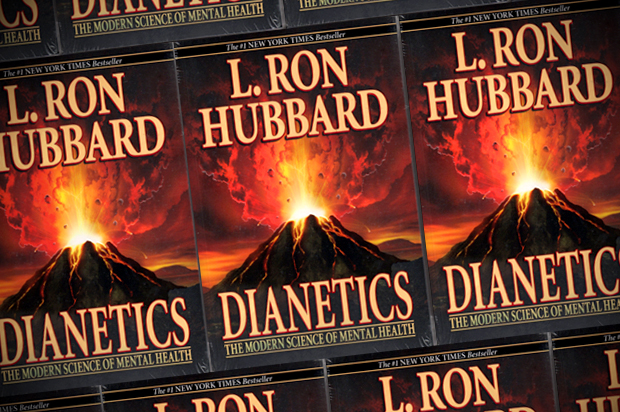
Most of us respond instinctively to “Dianetics.” We glimpse the covers (for some reason, you only see this book in battalions of copies), with their lurid pictures of spouting volcanoes emblazoned with screaming, foil-stamp lettering, and as if by reflex, our steps quicken, our eyes avert and our faces compose themselves into the expression of someone who would never, ever have time to fill out a 500-question “personality assessment.” But then, last week, under cover of darkness, a copy of “Dianetics” was delivered to my doorstep with the terse order, “Review this.” It was time, as they say on bad TV shows, to face my fears.

The first thing you notice about “Dianetics” is that it is spectacularly dull. L. Ron Hubbard promises, in this seemingly endless treatise, that his “modern science of mental health” will cure everything from schizophrenia to arthritis, claims for which he presents no credible evidence whatsoever — unless you consider merely insisting that you’ve got evidence to be the same thing as offering it. But I am here to testify that “Dianetics” is a phenomenal remedy for at least one widespread affliction: insomnia.

“Dianetics” belongs to a category of books that will be instantly familiar to anyone who’s done time reading the slush pile of unsolicited manuscripts for a book publisher. This kind of book is typically an explanation of life, the universe and everything written by a choleric gentleman (often a retired military officer) who has holed up in a converted basement or former kid’s bedroom to hammer out his ideas about how the world works — ideas that have for too long been disregarded by the incompetents and assholes around him. (If you are not familiar with this sort of book, know that you have the slush pile readers of America to thank for that.)

In a way, it’s impressive. Hubbard not only managed to get one of these books published, it actually became a bestseller and the founding text for Scientology. It’s not your garden-variety crank who can take a crackpot rant, turn it into a creepy gazillion-dollar church with the scariest lawyers around, and set himself up as the “Commodore” of a small fleet of ships, waited on hand and foot by teenage girls in white hot pants. But, I digress.

“Dianetics” begins with a stern admonition: “Important Note: In reading this book, be very certain that you never go past a word you do not fully understand. The only reason a person gives up a study or becomes confused or unable to learn is because he or she has gone past a word that was not understood.” This seems a bit punctilious, as everyone knows that one of the main ways people learn the meanings of new words is by hearing or reading them in context. Since only a few pages later, we’re promised that only “basic language” will be used in “Dianetics,” how tough is this going to be?

Alas, it is not only individual words that can cause confusion. Perfectly clear words can be dragooned into sentences so grammatically torturous and incoherent that any meaning once inhabiting those words runs screaming from the wreckage. Context only helps you figure out a word’s definition when the context itself makes sense, and in “Dianetics,” it often doesn’t. Still, there’s a certain twisted panache to preemptively scolding your readers for not trying hard enough to grasp your point before you bedevil them with logic-defying exercises in the hanging modifier and the passive voice. You don’t get it? That’s because you didn’t look up enough words! What did I tell you, idiot?

By the way, all that stuff about “basic language”? That’s a bald-face lie. No sooner does Hubbard get going with whatever it is he’s trying to do, than he starts mangling and making up words willy-nilly. Visual memories are rechristened “visio”; “evolute,” a term that used to refer to the center of a curvature, serves as an entirely unnecessary synonym for “develop”; and sense impressions become “perceptics.” Footnotes offer helpful definitions of commonplace idioms like “a far cry: only remotely related” and the sublimely tautological “present time: the time which is now.”

Obviously, Hubbard is keen to depict Dianetics as “an organized science of thought built on definite axioms (statements of natural laws on the order of those of the physical sciences),” and so he wraps his “technology” in a cloak of impressive-sounding jargon and crams the bottoms of his pages with inane footnotes in order to create the impression of research. This doesn’t keep him from sneering at doctors for obfuscating when (according to him) they call a cold a “catarrhal disorder of the respiratory tract,” or from condemning the pretensions of a (hypothetical) “scholar” enamored of “Hegelian grammar.” Then, with blithe hypocrisy, Hubbard proceeds to lard “Dianetics” with faux-learned name-droppings from the Western Civ. grab bag (Lucretius, Dante, Schopenhauer, etc.) — all of it patently cribbed from Will and Ariel Durant’s multivolume middlebrow classic, “The Story of Civilization.”

So what is this guy on about? The premise of “Dianetics” is that the brain remembers everything we experience and is “utterly incapable of error” except for an evolutionary holdover called the “reactive mind.” This portion of the mind, usually inaccessible to the reasoning or “analytical” mind, takes over when we are “unconscious.” By “unconscious,” Hubbard means not just the conventional sense of the word, but any condition of pain or fear. When you are “unconscious” and also suffering some kind of pain or discomfort, the reactive mind seizes upon all your sensory impressions at that moment and melds them together into an “engram.” The engram is then “soldered” into the circuitry of the mind and, when retriggered by a combination of factors, causes people to think and behave in irrational and destructive ways.

The average person supposedly has thousands of these engrams gumming up his or her works, but with the help of Dianetics’ “science of mind,” and a process called “auditing,” anyone can have them removed from the reactive mind and become a “Clear.” Clears are “optimum individuals,” devoid of engrams and other “aberrations” and furthermore blessed with “full color-visio, tone-sonic, tactile, olfactory, rhythmic, kinesthetic, thermal and organic imagination,” in addition to other qualities akin to superpowers.

Auditing is the repetitive reliving of the engram-creating experience with the aid of a Dianetics auditor and while in a mild hypnotic trance. (The auditor is instructed to say “When I count from one to seven, your eyes will close.” Hubbard maintains that the resulting state is “vastly different” from hypnosis because the subject isn’t “asleep” and knows what’s happening around him, but this just doesn’t sound that different from what most hypnotherapists do.) The most significant engrams, the theory holds, are formed prenatally, starting with the moment of conception. Any words overheard in an “unconscious” state, even pleasant ones, will become a particularly tenacious and unpredictable part of the engram, which is why you must never ever speak to a woman who has, for example, just fallen down in the street. Help her up, but don’t say a word! She might be pregnant!

It shouldn’t take anyone 700 pages of gobbledygook to cover this material, so along the way it’s easy to be distracted by Hubbard’s numerous personal and writerly eccentricities. I kept scouting the book for hints of something I’d heard about, the wacky science fiction mythology that lies at the inner sanctum of Scientology, though I knew it wouldn’t appear per se in “Dianetics.” That’s reserved only for those who have undergone the church’s intensive training and indoctrination. Scientologists say they withhold this information because learning it can drive the unprepared person insane and give you pneumonia, but it’s all over the Web, and it strikes me as far less likely to cause suffering than Hubbard’s prose.

Critics say the church hushes up this story — it involves an evil demiurge who, 75 million years ago, blew up 178 billion souls with hydrogen bombs planted in Earth’s volcanoes, trapped them on “electrical strips,” brainwashed them and packaged them into clusters that now cling to every human being and mess with our bodies and heads — for two reasons. One is that the church needs a sufficiently dramatic payoff after stringing members along through years of courses and trainings, all costing upward of a quarter of a million dollars. The other reason is fear that revealing this fantasia of kooky stories might turn off potential converts — but, hey, that never hurt the Old Testament.

Not only does “Dianetics” offer precious little sideshow appeal, it’s impossible to read much of it without realizing that it’s the work of a very disturbed man. (Here’s where things get less entertaining.) Hubbard’s grandiose preoccupation with “an answer to the goal of all thought,” the reiteration of fantasies of perfect mastery foiled by invasive, alien forces (engrams are described as “parasites”), the determination to envision the mind as a machine that can be brought under absolute control if only these enemies can be ejected — all these are classic forms of paranoid thinking. The alarm bells really start to ring when Hubbard describes colorblindness as caused by a “circuit” in a person’s mind that “behaves as though it were someone or something separate from him and that either talks to him or goes into action of its own accord, and may even, if severe enough, take control of him while it operates.”

All self-help books — and for all its attempts at intellectual hauteur, “Dianetics” is just that — resort to examples and case studies, and those examples tend to reflect the values of their time and the author. When “Dianetics” was first published in 1950, pop psychology books were still widely read by men (now, it’s mostly a women’s genre), and they often tackled such problems as how to get ahead at the office and deal with wives who nagged or withheld sex — the concerns of the average middle-class ’50s guy.

“Dianetics” is way off the reservation in this department. Certain motifs keep recurring with a compulsive regularity that suggests Hubbard himself was anything but clear of past traumas. Eventually, these recurring images and examples gel into a sad and scary narrative that must have had particular power for Hubbard, since it keeps cropping up throughout the book.

It involves an adulterous wife and a brutal husband. The wife becomes pregnant (presumably by her lover) and fears discovery of the affair. She tries repeatedly to abort the pregnancy on her own, using orange sticks and other household objects. Her husband, suspecting the truth, beats her, punching her pregnant belly, calling her a “whore” and “no good.” When the child is born, the parents pretend it was wanted, but the child’s only true ally is a grandmother, who thwarted the mother’s attempt to abort him and cares for the child when he’s sick. Eventually, the mother starts beating the child, using many of the same insults her husband has flung at her.

This horrific tale never appears in its entirety in “Dianetics,” but the book is haunted by it. Every time Hubbard reached into his mind for an example of how a fetus might come to feel pain, or how an engram “keys in,” or how engrams are passed on through generations, he came up with a piece of this story.

The prevalence of physical violence — almost exclusively domestic violence — in “Dianetics” makes itself felt early on. Among the first examples in the book (meant to illustrate the condition of “unconsciousness”) describes a woman being knocked down and kicked by her husband, and beaten women appear throughout with bizarre regularity. Hubbard also seemed to be obsessed with attempted abortion, which he believed to be widespread. Admittedly, when “Dianetics” was written, legal medical abortion wasn’t available in the U.S., but even so, the assertion that “twenty or thirty abortion attempts is not uncommon” among women who aren’t Clears is simply demented.

From reading “Dianetics” alone, you can glean a picture of Hubbard as a man wrestling with mental illness, who saw his mind as a potentially superhuman machine beset by invaders and parasites. Without knowing anything about his life, you can tell that this is someone raised in an environment of betrayal, secrecy, bullying and violence, someone who stands a good chance of re-creating the same conditions in his adult life if he’s not careful. You can figure out all of this just from reading “Dianetics,” like I did. Then, afterward, you can go on the Web and check out the many sites devoted to critiquing Scientology and documenting the truth about Hubbard. Chances are what you find there won’t surprise you at all.

Laura Miller

Laura Miller is a senior writer for Salon. She is the author of "The Magician's Book: A Skeptic's Adventures in Narnia" and has a Web site, magiciansbook.com.

My Scientology excommunication

I was one of the world's top 50 church members -- then one mistake changed my life

(Credit: PeterG via Shutterstock)
This article is an adapted excerpt from the new book, "A Queer and Pleasant Danger," from Beacon Press.

They made a lovely couple, my parents. Mildred was as gracious as she was elegant and beautiful. Paul was as gallant as he was rugged and handsome. My mom thought she was the luckiest girl in the world. My dad never got it, how a class act like Mildred could fall for a palooka like him.

Around the time that my teenaged mom-to-be was making googly eyes at my dad-to-be, L. Ron Hubbard — like my father — was in his early twenties. While my father was setting up a medical practice on the Jersey Shore, Ron Hubbard was reportedly off tramping through Asia, learning Eastern religions and customs. All of us in Scientology believed this about Ron. He was an explorer, an intrepid researcher into the darkest depths and starry heights of the human soul. He engineered and built the Bridge to Total Freedom.

Lafayette Ronald Hubbard was a rugged guy, just like my dad.

He was born on March 13, 1911, in Tilden, Nebraska. My dad was born just a few months later, on May 19. If you believe the authorized biography, Ron grew up out by a tribe of Blackfoot peoples. By the time he was four, he’d already learned all the Blackfoot lore there was to learn, so tribal elders made him a full-fledged blood brother. What’s more, at thirteen years old, Ron became the youngest Eagle Scout in the history of Scouting. So goes the authorized biography, and as Scientologists, we believed it.

A great deal of that authorized biography has been poked full of holes. There’s evidence that many of the outrageous claims about Hubbard’s life are out-and-out lies — go ahead, give it a Google. As Scientologists, we always figured he stretched the truth a little — to make a good story a little bit better — but we thought most of his reportedly grandiose and holy life was true.

—————

I joined the Church of Scientology in 1970, and by the end of the decade, I was at the top of my game. I was a full Lieutenant. Only fifty people in all of Scientology outranked me. I’d been First Mate of the Flagship; and a few years later, I was working directly with the Commodore [Hubbard], planning public relations strategies for Scientology worldwide. I managed an entire fucking continent for them. Then I crashed and burned on Southern Comfort and Coca-Cola, sex, junk food, and tranny porn. My job performance took a nosedive, and I was summarily removed from my post in middle management and demoted to sales, where, phoenix-like, I rose from my own ashes brighter and stronger than ever.

I was a terrific salesman, a natural. I’d spent my life trying to make people happy with me, and there’s nothing more happy-making than selling someone their dreams-come-true. In Scientology sales, we were taught to find a person’s “ruin” — whatever it was that was making a person’s life miserable and keeping them from achieving their goals. I could find anyone’s ruin in minutes — and in less than an hour, I’d have sold them thousands of dollars worth of Scientology services to handle it. I put together a crack staff, and together the six of us pulled in close to a quarter of a million dollars a week. I was a real man in every aspect of my life — and it all came down to money money money. After all, what are your dreams worth to you? How much money would you spend if that’s all it took to make your dreams come true? You needed what we had, and we needed your money — most, if not all, of it.

It was common knowledge in the Sea Org that the US government and economy could topple at any moment — splat — end of the world as we know it. That’s when we’d march in and take over. We were amassing a war chest for that day, and with that in mind, L. Ron Hubbard took very little money from the Church — only the royalties on his books and a small administrative stipend on top of his room and board. Beyond that, every penny went into Church maintenance, defense, and expansion.

In Scientology, we never used the word sales. People who sell Scientology services have always gone by the more pleasant euphemism registrar, often shortened to reg. In the Sea Org, we softened the euphemism even further: I was first posted in New York City as part of the international sales team called Flag Service Consultants. We were among the most highly skilled sales people in all of Scientology, and we sold only the most expensive services — the topmost levels of Scientology, all of which were delivered solely on Flag by the most highly trained Sea Org members in the world. In the late 1970s, I was transferred to the post of Tours Reg — Europe became my primary beat, and I was pulling in an average of $20,000 a week for Flag. My personal sales figures often topped out at $50,000 to $70,000, which made me one of the Sea Org’s top income makers, which in turn gave me what they call ethics protection. In short, no one was allowed to fuck with me.

In Europe, Scientologists wrote us checks made out to the Religious Research Foundation, a shell company that maintained a Swiss bank account that was in no way linked to the Church of Scientology. Any money we deposited would be used in the service of the Church without having to pass through any country’s tax system — it’s a common business practice used by many international organizations. Of course, L. Ron Hubbard had no connection with that Swiss account because it was vitally important to keep all his personal finances on the up-and-up so that no enemy of the Church could use any inadvertent financial glitch against him. But that was unthinkable — (a) because he was so powerful, and (b) because he had both the Sea Org and the Guardian’s Office to protect him, and we protected him fiercely.

So, life was . . . great. Thanks to my high income, I’d become a Sea Org star. Crew members actually lined up at the doors to send me off on tour, or welcome me home. It all came unraveled on a sunny autumn day in Zurich, 1982. I had just finished making a sizable deposit to the Swiss bank account. I was out on a quickie one-week tour on my own; my second wife, Becky, was back in Clearwater.

This was my first time inside the bank’s home office. What a beautiful old place it was! The reverence for wealth was manifest in the severe architecture, lightly touched here and there with tasteful elegance. I was waiting for the teller to return to his window with my receipts when a clerk appeared at my elbow and asked me to step inside the office of the vice president of the bank. Now, this had never happened to anyone else on my staff in all the time we’d been making deposits at this branch, so my antennae went up. I allowed the clerk to usher me into the huge office of what very well might be a member of some vast international Swiss banking conspiracy. An old man sat behind the huge desk. He rose creakily to his feet, his face broke into a wide smile, and he walked around his desk toward me with his hand extended as if in friendship. Swiss bankers never do that.

“Mr. L. Ron Hubbard,” the old guy said to me, “the bank so appreciates your business all these years, and it’s such a pleasure to finally meet you in person.”

Oops. No, this was much more than an oops — this was a genuine oh fuck! It must have been the work of some SP [Suppressive Person — Scientology’s term for a person who is completely and irredeemably evil. Like me today; I’m an SP.] Well, some SP inside the Swiss banking conspiracy had obviously broken into the files of the Religious Research Foundation and falsely linked them to the Old Man. Fuck, fuck, fuck! I took a deep breath and reminded myself that I was a far superior being to the old man — lying to him came easy.

“I’m so sorry,” I say. “But I am not this Mr. El? Hub Hubbard? of whom you speak.”

By then, we were both visibly pale. My mind was racing with worst-case scenarios — and the old guy realized that by naming me, he’d violated some strict law of Swiss banking privacy. We froze, our eyes locked in a long awkward silence. Then we each forced a laugh at the silly mistake, we said our goodbyes, and I strolled casually out of the bank.

There was no such thing as a cell phone. I walked across the city square to my hotel, where I placed a call from the pay phone in the lobby. I couldn’t trust that the phone in my room wasn’t tapped. I called a secret number and reached a telex operator in Denmark. I spoke to her guardedly, but she got what I was saying and fired a message off to Florida that there was some plot afoot that warranted investigation, and I would stand by for orders. Orders came back swiftly. I flew to England, where I was questioned for three days. Then the all clear came through, and I was ordered to fly home to Clearwater, Florida. I’d done a great job uncovering the plot against the Old Man!

As I stepped off the plane in Tampa, I was met at the gate by seven tall, muscular young guys in Sea Org officer uniforms. Heh. I was still the superstar. But it did strike me as odd that I didn’t recognize any of these officers, and I knew personally every senior officer in the Sea Org. The young men had serious faces — they told me they were members of the newly formed Financial Police. I’d never heard of that.

“What’s going on here . . . sir?”

“You’ll find out, and don’t speak unless you’re spoken to, mister.”

“Yessir.”

One for one, they outranked me, so there was no questioning their authority. These guys escorted me into a cold, damp hallway in the basement of the Fort Harrison Hotel. Two of the Financial Police sat me down on a metal folding chair, then took up more comfortable chairs for themselves on either side of me. I couldn’t say a word — I still hadn’t been spoken to.

After three hours, the other five officers showed up — showered, freshly shaven. I smelled sour to myself, and I had a five o’clock shadow that rivaled Richard M. Nixon’s. The seven officers escorted me down the hall into a room set up with a table and an e-meter. Non-Scientologists (we called you wogs) believed that at best, the e-meter — short for electropsychometer — was an unsophisticated lie detector. But we believed completely that in the hands of a trained Scientologist, that little meter could detect your deepest, darkest thoughts and deeds — going back millions and millions of years. That’s the basic principle of their therapy, which they call spiritual counseling, or auditing.

Now, mostly when you’re audited, you’re in a small room with one other person, the auditor. There’s never more than the two of you. But now, one member of the Financial Police sits across from me, operating the meter. Two big guys are standing behind him, two more big guys stand behind me, and one more big guy stands at the door. Years later, I’d find out they call it a gang-bang security check. One of them spoke.

“How long have you been an agent for a foreign government?”

“What the fuck?”

“Thank you,” says the big guy across from me.

Now, he didn’t say thank you because I’d told him anything he felt grateful for. He said thank you because in Scientology you’re supposed to verbally acknowledge anything that anyone says to you. You use words that show you’ve heard the other person — Thank you, OK, Good, Very Good, and so on — words that show you’ve heard the other person. It’s actually quite a civilized way to talk with people, letting them know you heard them. So he says Thank you, then a guy behind me says,

“How long have you been a drug addict?”

“What?!” I turned to face the guy.

“Good.”

“Have you ever had unkind thoughts about L. Ron Hubbard?”

“Not a one,” I answered. “Ever.” But why wasn’t he personally pinning a medal on my chest for pulling his ass out of the financial fires? Unless the Swiss account actually did belong to him, in which case . . .

“OK. That read on the meter. I’ll repeat the question: Have you ever had unkind thoughts about L. Ron Hubbard?”

“Not unless you’re telling me that the Religious Research Foundation is a bank account that funnels money into the Old Man’s pockets. Is that what you’re telling me?”

“Good. Have you ever had unkind thoughts about L. Ron Hubbard?”

For two more hours, they quizzed me about all the possible unkind thoughts I could ever have had about L. Ron Hubbard, until the meter convinced them I was OK on that score.

“Thank you. How long have you been a spy for a foreign government?”

And they kept asking me those kinds of questions for a total of six hours, carefully watching the e-meter for any signs that might reveal my evil deeds. Six hours, no evil deeds. Finally, the guy across from me played his ace. He said I’ve got a choice: I can do three years of hard physical labor, sleeping a maximum of six hours a night on a cold cement floor, eating only table scraps, and talking only with other bad people like me who were relegated to the months-old Rehabilitation Project Force. I could either do that, he said, or I could leave and be excommunicated from the Church of Scientology for the remainder of all my lifetimes ahead of me. The young officer told me that he’s going to live into the future as a hero.

“Without Scientology, you are gonna degrade into a mindless slug of a spiritual being. You’re gonna be a body thetan, attached to the toe of some street bum.”

So help me, that’s what he said. I didn’t thank him for saying it. It had been twelve years since I failed to acknowledge something another person said to me. Twelve years.

What was he saying? Sleeping on a cement floor with this neck? And he never answered my question about the Old Man and the Swiss bank account.

Twelve years.

It had to be true. Daddy was a liar and a cheat — I could deal with everything else about Scientology but that. My mind shattered like a plate glass window in a Mack Sennett comedy.

“You excommunicate me,” I said, and so they did.

———-

It was January 24, 1986, when a judge handed down her approval of my legal name change from Albert Herman Bornstein to Katherine Vandam Bornstein. It was the very same day L. Ron Hubbard died.

The Commodore was seventy-five years old, living alone in a double-wide out on a Church-owned ranch in the desert of Southern California. It was a luxury trailer, but it was a trailer, and it was the best he could do for a hideout. The Old Man had been named as a co-conspirator by US government prosecutors, but he hadn’t been indicted so he was on the lam. The government had a pretty much iron-clad case against more than twenty Scientologists who’d infiltrated the IRS for years in order, reportedly, to mine personnel files that the Church could leverage into getting itself a nonprofit status. Ron’s wife, Mary Sue, had been tried and found guilty, along with ten other Scientologists — they were all serving time in jail. Mary Sue Hubbard adored Ron as deeply as my mom adored my dad. Both women worshipped their men, fought for their men, and placed their men above themselves. Mary Sue and my mother were women of a generation, and I loved them both. Mary Sue Hubbard was behind bars the day the love of her life died alone out in the desert. That’s just not right.

There’s a photo of L. Ron Hubbard taken just before he died. You can find it online easily enough — it’s the grainy blotchy one. He’s disheveled and unshaven, wearing what looks like a stained nightshirt. His eyes are unfocused and his jaw’s gone all slack. It’s heartbreaking. Yes, yes, yes, he was a mean old man. But so many of us held him in our hearts like we’d hold daddy. He was a bad daddy to be sure, but he was daddy. No one’s come forward online to say they were there when the Old Man was lost, or that they held his hand and cried with him. If I’d been there, I would have.

Adapted excerpt from A Queer and Pleasant Danger by Kate Bornstein. Copyright © 2012 by Kate Bornstein. Reprinted by permission of Beacon Press, Boston.


Continue Reading Close

Did Anonymous hack Colbert?

"Suddenly I'm wearing a mask? I don't understand. It wasn't even 'Eyes Wide Shut' Wednesday"

Stephen Colbert dedicated the first portion of his show last night to a nefarious breach of security at the Report — when an image of Guy Fawkes (i.e., the masked dude from “V for Vendetta”) was super-imposed over his face during a broadcast last week. Colbert blamed the intrusion on the hacker collective Anonymous, a shadowy organization that also targeted Americans for Prosperity, the political action group headed by the Koch brothers. To Anonymous, Stephen said:

Lay off Americans for Prosperity. If you’ve got a problem with the Koch brothers, go after them the democratic way — by funneling millions of dollars into a front organization to launch attack ads against teachers.

The Colbert Report Mon – Thurs 11:30pm / 10:30c
Anonymous Hacks The Colbert Report
www.colbertnation.com
Colbert Report Full Episodes Political Humor & Satire Blog Video Archive
Continue Reading Close

The Church of Scientology’s friends in Washington

The embattled religious organization has allies in Congress, though it lobbies quietly

Clockwise from upper left: Mark Foley, Greta Van Susteren, Brad Sherman and Ileana Ros-Lehtinen

Did you read that New Yorker piece on the Church of Scientology? You really have to. I know it’s long, but it’s worth it. If you’re short on time, there are a lot of summaries.

Along with some incredible new details, there are the previously reported stories of rampant physical abuse of underlings by church head David Miscavige, the church’s “Sea Org” full of underage workers signed to “billion-year contracts” performing manual labor for little to no money, and the tales of the church separating families and milking its members for thousands of dollars. The church is even under investigation by the FBI for what could amount to human trafficking.

And, of course, like any other moneymaking American enterprise, it has good friends in Washington.

As far as I know, the only Scientologist to ever actually serve in Congress was the late Sonny Bono. His widow, Mary Bono Mack, who inherited his seat, attended courses, but never took to the religion.

Former Rep. Ben Gilman, R-N.Y., received thousands from the church, and, in return, as chairman of the International Relations Committee, he complained on several occasions that European nations were discriminating against Scientology. Or, put another way: “[On] the same day (July 2, 1998), ten prominent Scientologists donated a total of $7,400 to Congressman Benjamin A. Gilman’s coffer — three months before he signed on as a co-sponsor to Matt Salmon’s House of Representatives bill that was critical of Germany’s protection of religious freedom …” He was also thanked with this glowing profile in the church’s Freedom magazine.

Brad Sherman, D-Calif., and Ileana Ros-Lehtinen, R-Fla., are two of the church’s best friends currently serving in Congress. They were both honored at a 2004 Celebrity Centre gala. (Here’s Ros-Lehtinen with John Travolta and Kelly Preston, and here’s Brad Sherman praising the church publicly.)

The church avoids “official” political donations (it is, after all, a tax-exempt religious organization), but prominent members still support politicians and politicians return the favor. Florida’s Mark Foley was a Scientology ally. (It was rumored that he checked into a church-affiliated recovery center after his resignation from Congress.) As a state legislator, Nevada’s Sharron Angle supported a Scientology-affiliated drug treatment therapy program for prisoners.

Craig Jensen, founder of the software company Diskeeper, and his wife, Sally Jensen, are major Scientologists, and their donations help identify which politicians are friendliest to the church. Former congressman James E. Rogan, now a Bush-appointed judge on the Superior Court of California, received thousands of dollars from prominent Scientologists throughout the 1990s. Even Ron Paul gets Scientology love, because he supports its tax-exempt status and opposes mental health screening for children.

And, of course, Sarah Palin is personal friends with prominent Scientologists Greta Van Susteren and her husband, attorney John Coale. Coale helped Palin start her PAC — and he once proposed starting a Scientology PAC, in the 1980s. At the time, the idea fizzled out.

But Scientology actually had a semi-open PAC for a few years, called “Citizens for Social Reform.” The church hasn’t donated anything in the last two cycles, but before that, it gave to the following pols:

  • Rep. Dan Burton, R-Ind.
  • Rep. Loretta Sanchez, D-Calif.
  • Rep. Brad Sherman, D-Calif.
  • Rep. Diane Watson, D-Calif.
  • Rep. Danny Davis, D-Ill. (also a friend of the Reverend Moon)
  • Sen. Sam Brownback, R-Kan.
  • Rep. John Sweeney, R-N.Y.
  • Rep. Dylan Glenn, R-Ga.

The church has had, throughout its history, plenty of friends on both sides of the aisle. Or, at least, plenty of people willing to cash its checks. Few prominent politicians, that I know of, have said much about the things we’ve learned about the church more recently.

[Correction: Judge James Rogan serves on the Superior Court of California. He was nominated for the seat by then-California Governor Arnold Schwarzenegger in 2006, and won election to the seat in 2008. He was nominated by President Bush for a seat on the U.S. District Court, but his nomination stalled in the Senate. I apologize for the error.]

Continue Reading Close
Alex Pareene

Alex Pareene writes about politics for Salon and is the author of "The Rude Guide to Mitt." Email him at apareene@salon.com and follow him on Twitter @pareene

Why do so many people dislike Katie Holmes?

The star inspires vitriol -- and fascination -- because she's the perfect mom we all know

Katie Holmes

Is Katie Holmes truly so terrible? Well, she’s probably not all that great. In recent weeks, she’s been the subject of toxic rumors that her new thriller, “Son of No One,” was such a bomb at Sundance that audience members stormed out — a tale eagerly lapped up by legitimate news organizations like Reuters. The Hollywood Reporter observed, “When Katie showed up on screen, there was a collective groan. She plays the wife of a Queens cop and she was completely miscast. They have her cursing a lot. And when she swore, there were chuckles.”  And even though other critics who attended the screening have since offered differing accounts of what really went on, the fact that such a rumor started — and took off with such vigor — gives an indication of how little Holmes is regarded by audiences and the press.

Maybe the speculation was based on the blink-and-you-missed-it failure of her last Sundance outing, “The Romantics.” Or perhaps it was the mixed reviews for her 2008 Broadway debut in “All My Sons,” a performance that prompted Ben Brantley to observe that Holmes delivered her lines “with meaningful asperity, italicizing every word.” Or maybe it’s her freaky husband.

Long ago, the former “Dawson’s Creek” star was just another so-so television actress with a string of middling to decent movies under her belt — Neve Campbell without the girl-on-girl scenes.  But her public image changed forever the day she met actor and couch jumper Tom Cruise in 2005.  Within two months, she was engaged, and within a year she was married and toting around a baby daughter. By then, the actress, who once drew raves for “Pieces Of April” — Elvis Mitchell praising that “Each actor shines, even Ms. Holmes” — appeared to have been assimilated by the borg. The former Catholic had embraced her husband’s Scientology to the extent that she acquired a new “best friend” — who doubled as her “Scientologist chaperone.” And soon, like many new mothers, she had put her career on the back burner to raise her daughter, the world’s most obsessed-over little fashionista, Suri Cruise.

More than five years later, Holmes still seems better known for her shopping trips and hair color commercials than her work. Increasingly, she’s a woman who appears less and less to have a there there, one so placid, she’s repeated in several interviews that she lets her 5-year-old tell her what to wear

So when her latest project — starring as Jackie in an eight-, count ‘em, eight-hour miniseries on the pahk yuh cah Kennedys — was dumped by the History Channel, you could almost hear the schadenfreude. It hasn’t slowed down a bit now that the miniseries has been picked up by the fledgling Reelz network, thanks in part to the trailer’s revelation of Holmes’ apparent typecasting as the breathy, unblinking first lady.

Sure, a big part of the umbrage — and the bottomless tabloid fascination — concerns Holmes’ seemingly Svengali-like mate. For years, rumors have swirled that Cruise, learning nothing from Japanese horror movies, “auditioned” several comely starlets for the role of his offscreen leading lady before connecting with Holmes. But it’s not so much Cruise himself as the notion of a woman who would at best so easily surrender her religious convictions and personal ambitions that makes Holmes such an easy target for shudders. She may possess the Little Miss Perfect vibe that Gwyneth Paltrow practically invented, but she lacks Paltrow’s air of steely achievement. And she certainly inspires considerably more vitriol than her Oscar-winning predecessor, Nicole Kidman.

Instead, despite her fame and opulent wealth and weird religion, she hits a nerve because she is that familiar, one-in-every-crowd mom — the woman whose worshipful marital devotion can be summed up with, “We do collaborate on everything at home. But I mean, he’s Tom Cruise!” She’s that lady, the one who dabbles in fashion design even though her company’s website has zero images of its wares.  She’s the woman who seems, but for one or two different life choices, the sort who’d totally be dominating on “Toddlers and Tiaras.” She’s the one with the husband everybody really hopes doesn’t tag along on the play date, the one who, on the day after you’ve missed your child’s bedtime because you’re working overtime to pay for orthodontia, swans onto the playground to complain she’s thinking of firing her maid. It doesn’t matter if it’s true. What matters is how wholeheartedly audiences swallow it. Katie Holmes may be a well-rounded woman who happens to truly adore her beautiful daughter and movie star husband. But while she is no great actress, when she does her dead-behind-the eyes Stepford shtick, she’s chillingly convincing.


The Kennedys | Barry Pepper | Greg Kinnear | Katie Holmes | Tom Wilkinson | Movie Trailer | Review

Continue Reading Close
Mary Elizabeth Williams

Mary Elizabeth Williams is a staff writer for Salon and the author of "Gimme Shelter: My Three Years Searching for the American Dream." Follow her on Twitter: @embeedub.

Sharron Angle hides from reporters, defends Scientology to conservative press

Nevada's great Tea Party hope ducks the D.C. media, tells right-wing press that Scientologists are victims of bias

Nevada Republican nominee for Senate Sharron Angle was in DC yesterday to lunch with the Senate GOP and meet the Republican campaign committee. She did not have time to answer any questions about anything from the press. The mainstream press, anyway. She did sit down with the National Review.

Angle’s one comment to the assembled members of the mainstream press was “yes,” in response to basically being asked whether she enjoyed lunch.

The reason Angle is unable to answer questions is because she is an Outsider. Also, she only has two full-time staffers. She needs a couple weeks with the campaign pros behind Scott Brown’s victory before she’s qualified to say what she believes to reporters. Once she owns a truck, you can ask all the question you want, lame stream media.

Texas Republican John Cornyn explained:

And Cornyn acknowledged that Angle is not yet prepared for what he considers to be a coming onslaught of attention. “I don’t think anybody would be prepared for a race. where 20 or 30 million dollars is going to be spent in negative advertising,” he said. “It’s going to take a few weeks, I would think, but, you know, it’s really up to her.”

But as I said, Angle did make time for the National Review.

Angle apparently referred to herself as an “accidental politician,” though once you’ve been in politics for a dozen years, you should probably just own up to being a professional accidental politician.

Her statement on Social Security is a series of completely incompatible buzz-phrases borrowed from both parties. She admires Tom Coburn, Jim DeMint, and Michele Bachmann. She seems to tell a verifiable untruth about removing the “issues” page from her website. (It is now back.) She also defends her advocacy for a Church of Scientology-developed quack drug therapy program by claiming Scientologists are the victims of religious persecution.

What we’re seeing here is a very slippery slope. Whenever religion becomes the focal point — we saw this during John F. Kennedy’s race and also, to some degree, in Mitt Romney’s race — whenever this becomes the focus, we Americans should be very, very concerned. We have a First Amendment that guarantees us all the right to worship as we please. We as Americans should, even if we don’t agree, should defend their right to have that right. It shouldn’t come into play in any political arena.”

God, if a real journalist manages to get anything out of her before the consultants do their work, she’ll be a goldmine of nuttiness.

Continue Reading Close
Alex Pareene

Alex Pareene writes about politics for Salon and is the author of "The Rude Guide to Mitt." Email him at apareene@salon.com and follow him on Twitter @pareene

Page 1 of 6 in Scientology