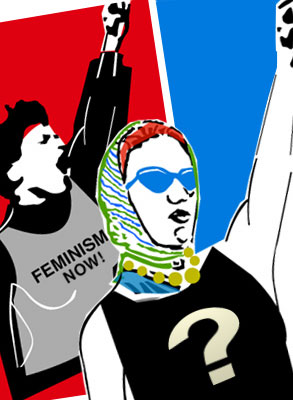

A couple of years ago I interviewed a big-eyed activist-actress whose work and politics I have always admired. I asked her a question related to feminism. Her response? That she didn’t like the word “feminist” and preferred “humanist.”
What a crock, I thought, with the same disdain I once felt for a high-school classmate who memorably piped up that though she was “totally not a feminist,” she wondered if Mr. Rochester’s willingness to treat Jane Eyre badly and imprison Bertha in an attic might indicate a low-level misogyny. It was a fair observation, I thought at the time. Why did she have to preface it with personal disavowal? Did she think that the expression of such a sentiment brought her close enough to a militant conception of feminism that her lissome 10th-grade body might dramatically sprout armpit hair?
It’s no great news that “feminism” — the word and, by extension, the movement — has an image problem. Women of all ages and colors have, at turns, bristled at the term, embraced it, lauded it and disdained it, practically since it was coined. However, after years of soldiering on under the burden of a heavily loaded word, a new crop of progressive and politically active women are finally addressing the problem. Some are looking to reinvigorate “feminist” by laying claim to the word — a new magazine and a recent book are both cheekily titled “The F Word” — while others are contemplating new words and phrases to employ in the fight for women’s equality. After years of quiet debate, women are tackling their own labels with the energy of a movement anxious to make itself fresh again.
The debate acquired a new urgency with Supreme Court Justice Sandra Day O’Connor’s announcement on July 1 that she is retiring from the court. If Bush, as expected, nominates a judge opposed to Roe. v. Wade, women’s issues will move to the center of the national stage.
It’s almost remarkable that “feminism” has survived as long as it has, stigmatized as it’s been by a sneering right, and criticized by groups on the left for its early lack of interest in the concerns of poor and minority women. Now, as second-wave feminists look to the future and see a generation of women with a very different set of battles than their own, the question becomes: What do we do about “feminism”? Does it have anything to do with younger female activism anymore, or is it simply an Achilles’ heel? Do we replace it, phase it out? Or do we embrace it with renewed vigor and a spruced-up, all-inclusive definition?
When asked to consider what other terms besides “feminist” might be useful descriptors of the movement she helps to lead, National Organization for Women president Kim Gandy laughed and said, “Nothing has really swept anyone off their feet, but ‘egalitarian’ is one that always comes up. There’s ‘humanist.’ Sometimes ‘womanist.’”
Gandy isn’t suggesting that anyone rub the word “feminism” off their bumper stickers or refrigerator magnets. But she did acknowledge that she has had informal conversations — both with people who work at NOW and with those she meets on the road — about agitation from some within the movement who believe it’s time to retire “feminism’s” number.
“There’s nothing inherently wrong with the word,” said Gandy, invoking Dame Rebecca West’s famous assertion, “I … have never been able to find out precisely what feminism is; I only know that people call me a feminist whenever I express sentiments that differentiate me from a doormat or a prostitute.”
But, she said, we cannot pretend that “feminism” has escaped the fate of “liberalism” before it. “This is what the right-wing has done to our language,” she said. “‘Liberal’ is a proud term. But at a certain point, it became very difficult for people to call themselves liberal. If you asked them about issues they would say, ‘I’m not liberal, I’m progressive.’ Excuse me, you are a liberal! But the right made that a bad word. They’ve done the same thing with ‘feminism.’”
Unsurprisingly, Gandy has had countless encounters with women and men who open up a conversation by saying, “I’m not a feminist,” and then go on to espouse feminist ideals. “It’s like, ‘Do you have a belief in the political and social equality of women?’ Yeah? Then you’re a feminist,” she said.
Language shifts have often transformed the struggle for women’s equality. Gandy recalled the way that the term “suffragists” became the diminutive, mockingly feminine “suffragettes,” as though those who devoted their lives to secure the vote for women were actually a backup group for Ray Charles. Then there was the time in 2003 when the National Abortion Rights Action League changed its name to “abortion”-lite NARAL Pro-Choice America. But language has strengthened the movement as well. Gandy said that when she started at NOW in 1973, “We didn’t even have a word for sexual harassment. We knew how women were treated at work and on the street, but we didn’t have language for it. Domestic violence? You didn’t even whisper words for that in public. Now we have women’s studies. Now we have a word for everything,” said Gandy.
But she acknowledged, “I think that there’s a new generation that’s looking for a word or a term they can call their own. At some level they associate ‘feminism’ with their mothers. Not in a bad way, but just in a way that’s not about them.”
It might seem like a simple suggestion. But the hyper-sensitivity surrounding the “feminism” discussion makes it an ideological fire-starter. Weeks after my interview with Gandy, I called Feminist Majority leader Eleanor Smeal about this story. When I asked her to respond to some of the comments Gandy had made, I was apparently unclear, somehow leaving Smeal with the impression that I was reporting that Gandy wanted NOW to abandon the word “feminism.” This was certainly not what I was reporting. But Smeal alerted Gandy to the possibility that my story might suggest that Gandy was rejecting the word just days before her reelection as NOW president. A very agitated Gandy called me to clarify that her comments were not reflective of any formal discussions within her organization. I assured her that I only planned to report what she had told me: that she had had discussions about the word with colleagues at NOW. She responded: “I hear people talk about it. But they don’t talk about it that often. To say that ‘there have been discussions within NOW’ would convey a really inaccurate thing.” Gandy emphasized that she can’t imagine ever backing away from “feminism.”
But some people didn’t think the notion of ditching the word was such a crazy idea at all. “I think it’s very smart,” said Erica Jong, whose use of explicit language in “Fear of Flying’ changed the nature of American women’s fiction in 1973. “The problem hasn’t gone away. Women are still second-class citizens; the problem of choice is still with us — in fact it’s gotten worse. So if we need to change the name to get people involved, we should.”
But Jong was stumped as to what a replacement could be, and noted that “words always get degraded when associated with something progressive or something female. This is the way right-wingers capture the language, so we need to be smart.” She noted the right wing’s use of the term “pro-life” in the abortion debate. “If we had called ourselves pro-life — as in we don’t want women to die in illegal abortions — we would have won on that one, but they got there first.”
Jong thought that dusting off our lexicon was a natural generational progression. “It’s all so cyclical,” she said. “Mothers push forward, daughters pull back,” she said. “We have been in a period of backlash and now we’re ready to push forward again.”
It’s true that there is resistance to the feminist label from some young people. Kristin Rowe-Finkbeiner, a Seattle-area writer and author of “The F Word: Feminism in Jeopardy — Women, Politics, and the Future,” described a poll she’d done for her book. Noting that the 300 respondents were self-selected college-educated women between the ages of 18 and 34, Rowe-Finkbeiner said, “Sixty-eight percent of young women didn’t want to be confined by labels, and the word ‘feminism’ chafed the worst.”
But other national polls — including a 1984 Wall Street Journal/Gallup poll, a 1986 Newsweek/Gallup poll, and a 2003 Ms. Magazine poll — have shown that the younger the woman, the more willing she is to identify herself as a feminist. And, sure enough, many of the young women contacted for this piece were more vociferous in their defense of the word than their elders.
Melody Berger, a 25-year-old college student in Philadelphia, launched the new feminist magazine the F-Word in late May. She said she chose the name for her publication “because I was tired of tiptoeing around the word, of saying, ‘Don’t worry about us, we’re not feminists, we’re totally acceptable.’” Instead, Berger has proclaimed herself a full-blown “Howling Harpy.”
Berger is not alone in her affection for the word. “If I hear one more person say, ‘I’m not a feminist, I’m a humanist,’ I’m going to kill them,” said 26-year-old Jessica Valenti, founder of Feministing.com. “How do you possibly think you’re going to talk about gender equality if there’s no acknowledgment of gender?”
When I told Valenti that there was even casual discussion about the future of the word, she snorted, frustrated with what she perceives as generational tension between second-wave feminists and her activist peers — many of whom don’t align themselves with feminist organizations. “When they say they’re interested in pulling in young women, I understand where the sentiment is coming from because they feel like young women don’t like the word, but come on. How much are we willing to give up?”
Valenti acknowledged that many young women are “afraid of the word.” “Part of me gets so angry at younger women who are nervous about feminism because they’re afraid that boys won’t like them,” said Valenti. One of the reasons she started Feministing is because she wanted to meet young women and tell them, “I’m a feminist. And despite what you may think, feminism is pretty fucking cool.” In addition, Valenti added, “Part of me wants to say, ‘Yeah, someone’s going to call you a lesbian. Someone’s going to say you’re a fat, ugly dyke.’ Suck it up.”
Valenti did have a couple of non-linguistic suggestions about how to bring older and younger activists together, starting with how the older generation treats its daughters. She described meetings for young feminists where the young women talk “while famous feminists are sitting there taking notes and watching you like you’re some National Geographic animals.” She said that the very suggestion that “feminism” could be disposable in any way makes her feel like saying, “Hey! This is your word! You started this and I took it on. I have been working hard for you. And now you’re going to just give up on it?”
Erin Matson, the 25-year-old NOW chapter president in Minnesota and a member of the Young Feminist Task Force, said, “I wear the feminist label with pride and I love it. It’s hard for me to imagine leaving it behind or discarding it.” But Matson did recently write an article questioning the notion that feminism is a word that can describe a single, cohesive group, “all of us with pierced lips and hairy legs and the same concerns. That’s simply not true,” she said. Instead of the plaintive 10th-grade cry, “I’m not a feminist, but…” Matson’s piece suggested that the new disclaimer is “I am a feminist, but…”
“Crystal Plati, 32-year-old executive director of Choice USA, said that at her organization, We use [the word feminism] but we don’t belabor it. We are also open to other words.
She continued, “More than looking at just one word, for me it’s about doing some listening for what kinds of language young women are using to define their empowerment for themselves.” She also pointed out that it’s not just young women who are alienated by the term. “No matter what choice we make about language,” said Plati, “we need to be building toward an inclusive movement, in particular a movement that has women of color and young women in leadership. Changing the word is not enough. We need to address why it’s alienating.”
It’s an assertion familiar to women in the movement, who for years have been reminded that second-wave feminism of the 1970s did not address the concerns of women of color and women from lower economic strata.
It’s a concern that activist and author Rebecca Walker — whose mother, Alice Walker, coined the term “womanist” as an inclusive alternative to “feminist” — said she’s been anxious about for a long time. In an e-mail, she referred me to an interview she gave to Satya magazine in January. In the interview, Walker said that in 1992, when she co-founded Third Wave, an organization for young women activists, she worried that “the word feminist had become too divisive and culturally loaded.” Walker also told Satya, “It seemed clear to me that the term had more of a repellent effect than a magnetizing one within my generation, and I did not feel the need to prove my allegiance and gratitude to the women that came before me by holding on to something that had meant so very much to them, but did not mean that much to me.”
In the interview, Walker continued, “The left is getting our collective ass kicked because of just this kind of romantic, naove attachment to movement narratives and aesthetics of 20 and 30 years ago.” She also pointed out that “many women of color do not feel an affinity with the term because, among other things, we know firsthand that people who call themselves feminists are not always our friends,” she said. “They have not de facto done their work around race … though [they] would become appalled if we suggested that some ‘feminists’ were also racist.”
The racial wound remains fresh for many women who spend their lives thinking about and working on issues of female empowerment. When Berger launched her F-Word site in May, she said she was surprised that some of the anti-”feminist” mail she got was from other women activists. Berger explained, “The word ‘feminist’ alienated a lot of political allies I wanted to be tied to,” including women of color “who told me that traditionally this word is off-putting because of the predominantly white, middle-class vibe it had.” Others, she said, told her, “I hope you don’t make the same kinds of mistakes your foremothers did.”
The result, said Berger, is that a month after her launch, “the word ‘feminism’ is on the site, but it’s not the tag line anymore. I’ve toned it down a little bit.”
When I asked her what words could possibly replace the pesky descriptor of the movement, Berger was stumped. “I’m not such a fan of the word ‘humanist,’” she said in an e-mail. “I think it’s one of those ‘well, duh … who ISN’T pro-human??’ kind of concepts.” As for “womanist,” Berger wrote, “I like that it may be more appealing to women of color … However, I don’t think feminism is just about ‘women’ anymore.” It’s these qualms, Berger said, that keep her “pretty attached to the f-word.” But she conceded, “Maybe it isn’t worth fighting to reclaim a word. There are much bigger things we need to be fighting for.”
But what if we don’t need to fight to reclaim it? What if we’ve already begun to make it new?
There is a camp of women who say, “‘Feminism is just what we determine it is,’” said Mandy Van Deven, 25, founder of Altar magazine, a magazine about social justice, and the director of Community Organizing for Girls for Gender Equity in Brooklyn, N.Y. “‘So if we wear makeup and call ourselves feminists then we are feminists,’” she continued, adding that she did not necessarily identify with this multi-purpose definition. Van Deven said that changing definitions is “part of the evolution of political movements and the evolution of language and how people are going to identify themselves as individuals and in the scope of larger political context.”
Van Deven said she thinks that there are a lot of young women out there who — while they may not like the word or embrace the entire exclusionary history of the movement, “are really anxious to grab the word and claim it and say, ‘No, I don’t care, I am going to make this word work for me.’”
Rowe-Finkbeiner, author of the book “The F Word,” said that Van Deven’s attitude is typical of broader political and linguistic patterns. “In the history of social movements, many of the people who are most impacted by negative connotations of a word are the ones who take that word back,” she said. Rowe-Finkbeiner pointed out that women have already done this with “bitch” — as in popular “stitch and bitch” knitting circles and “bitch-n-swap” clothing swaps. It’s a phenomenon similar to a gay re-appropriation of “queer,” or African-American usage of “nigger.”
Third Wave co-founder Amy Richards said she isn’t too worried about the women’s movement agreeing on one word. In her work on campuses, she said the number of projects she sees young women taking on — from prison reform to AIDS funding in Africa to living-wage fights for university staff — is enough to satisfy her that there is tremendous life in the movement, even if no one knows what to call it. “The thing that’s different from 30 years ago is that young women are moving beyond organizing around reproductive issues and violence against women. It’s not that those issues aren’t relevant to them, but I think they’re just tired of them.”
Gandy said that membership in her organization is bigger than ever. “Eighty percent of people in the United States, based on what they think now about pay equity and domestic violence, would have been considered total feminists had they felt that way 30 years ago. And the women’s rights movement is living in our daughters every single day. Whether or not they consider themselves feminists.”
Besides, said Richards, “Whatever we’d change ‘feminism’ to would become a bad word too.” This story has been corrected since it was originally published.
A young woman sleeps in her bed, in the embrace of someone who has a leg draped over her thigh and an arm comfortingly around her middle. When the alarm clock buzzes, jolting this spooning pair to consciousness, we realize that they’re not a romantic couple; they are best friends and roommates, Hannah and Marnie.
It’s an early, lovely moment in “Girls,” the new HBO series created, directed, written, produced and, really, detonated onto the pop landscape by 25-year-old Lena Dunham. Dunham stars as Hannah, who is joined in bed by Marnie because Marnie is avoiding having to be touched by her over-kind swain, and because both girls like to stay up late watching reruns of “The Mary Tyler Moore Show.”
These details, along with the image of two friends snoozing happily entwined, make the moment emblematic of a dynamic central to “Girls’” appeal and its importance. Despite Dunham’s protestations about not wanting to be some symbolic emissary from the land of young ladies (Sorry, kid, you’re it!), this is what she’s telling us about Women Right Now: that the lives of contemporary Mary Richardses and Rhoda Morgensterns are not based on pursuit or enjoyment of hetero congress; rather, they are often most firmly and warmly wrapped around each other.
You have likely already read something about the sex on “Girls,” which in early episodes, at least, all takes place between straight, sort-of-realistically-bodied young people. What you’ve read is true: the show’s abundant sex – as experienced by its four female leads – is either boring and unsatisfying, porn-fantasy-driven and unsatisfying, nonexistent and unsatisfying, or performed as conquest (Jessa says after bagging an ex, “That was me showing that I cannot be smoted. I am unsmoteable”) and yet … unsatisfying. Sex for these young women is an awkward element in their lives, and whether you think that this characterization is hilariously awful, worryingly awful, or whether it prompts you to reflect, once again, on how everyone else but you is a prude, there is no question that “Girls” features some awful, awful sex.
But part of the point of “Girls” is that the sex, and the guys with whom the sex happens, are not the point. Instead, as titularly advertised, “Girls” is about girls, and the fact that they do make connections – emotional, intimate, irritating, satisfying, pleasurable, lasting. Just not, so far anyway, with men. The show, among many other things, is crucial and corrective testament to the ways in which women’s friendships with each other have flourished and changed during the same period in which their liberties and status have increased.
Minutes into the first episode, Hannah sits naked in a bathtub eating a cupcake, laughing pityingly with a betoweled Marnie about Marnie’s emasculated boyfriend. When the boyfriend accidentally comes into the room, it’s clear he has no place in this room of unclothed communion. A similarly awkward entrance occurs later, during one of several scenes in which one of the four lead characters sits on the toilet, making serious confessions (of pregnancy, for instance) to a girlfriend while peeing. The bodily closeness depicted on “Girls” makes flesh the role these women play in each other’s lives: They are the non-sexual lovers of each other.
It’s the girlfriends who provide the physical affirmations usually associated with boyfriends. “You are beautiful, shut up,” Marnie tells self-deprecating Hannah. “Your skin is, like, hauntingly beautiful,” Long Island girl Shoshanna says to her worldly cousin Jessa. “When I look at both of you, a Coldplay song plays in my heart,” Hannah tells Marnie and Jessa, kidding but serious. In one scene, having been meanly rejected by a boy because of her virginity, Shoshanna desperately asks her friends if they would have sex with a virgin, meaning her. “Oh Shosh,” Jessa says kindly, “if I had a cock, it’s all I’d do.” You get the feeling that she means it; if they could provide that kind of fulfillment for each other, they would.
This same-sex affinity feels extremely contemporary, part of what has prompted critics to write about the show as revolutionary. But noting female friendship as a (or the) primary source of emotional sustenance only feels strange in the context of relatively recent history; in fact it’s a dynamic that is very old.
For the many centuries during which marriage was regarded as an economic and a socially ratifying necessity, rather than as an institution from which women could reasonably hope to derive emotional or sexual pleasure, intense social and physical bonds between women were an accepted part of life. From Celia and Rosalind in “As You Like It” to Hermia and Helena in “A Midsummer Night’s Dream,” whom we’re told were as close as “two lovely berries, moulded on one stem,” Shakespeare regularly used the assumed closeness (and sometimes the bed-fellowship) of women as a plot device. Much of what we learn of the fate of Samuel Richardson’s Clarissa Harlowe is from letters to her best friend, Anna Howe. Then there’s Lucy Montgomery’s Anne Shirley, who meets her “bosom friend” and “kindred spirit” in Diana Barry.
The term “Boston marriage” was used during the late 19thcentury to describe unmarried women who lived together in long-term partnerships. In “Bachelor Girl,” a history of single female life in the United States, Betsy Israel writes that around the same period, near-romantic female bonds were encouraged by parents. Two girls, meeting perhaps in school, would be “‘smashed’ – think of best friends going steady – and once smashed, they’d learn trust, loyalty, tolerance, patience.” Of course, all that social growth was supposed to be in service of marriage. “Once they’d mastered these skills,” Israel writes, “they would be able … to transfer them onto a marital relationship. Even if those who wed never felt quite the same about their husbands.” For a long time, there was no questioning the sexuality of women who held hands, slept side-by-side, confided in each other or wrote long love letters to one another.
It wasn’t until the early 20th century, as marriage came to be treated as a union based on love and sex, that same-sex friendships began to be seen as competitive to the closeness a woman was supposed to feel to her husband, and thus as sexually suspect. Marriage historian Stephanie Coontz has described how, by the end of the 1920s, American psychoanalyists “were warning that one of the most common ‘perversions of the libido’ was the tendency of teenage girls to fix their ‘affections on members of the same sex.’ Such perversions, they claimed, were a serious threat to normal development and to marriage.” The fix, Coontz writes, was to discourage social unions between women and encourage more early sexual experimentation between the sexes. Networks based on female camaraderie, trust and dependence began to break down.
These mid-20th-century decades are the ones on which most of us have drawn, until recently, our understanding of how a woman’s life is supposed to proceed. They were years in which women made stupendous social, economic and professional strides, yet during which they were still told to pursue, and mark their graduation to adulthood with a “traditional” marriage, in which a man is lover, confidant, provider, partner and companion. These were also years in which messages about women’s behavior toward women were nasty; girls were hair-pullers, back-stabbers and bitches, always after each other’s jobs, wardrobes and men.
Now, it seems, we are coming out on the other side of the looking glass. The median age of first marriage for women has been rising steadily since the late 1980s. Marriage – while still widely fetishized as some kind of goal – is no longer the only acceptable marker of maturity. The idea of young adult women living, working, earning, spending and having sex on their own, outside of marriage, is, in many parts of this nation, not aberrant, but an expected phase of life, a norm.
These are Dunham’s “Girls,” and while the privileged Oberlin grads depicted on the show are members of the demographic statistically most likely to eventually marry – and to enjoy successful companionate marriages – their walks down aisles might well not take place for a decade or more. During that period, the people with whom they are likely to form their most intense emotional partnerships are, like the smashes of old, other young women. Except now, the smashes are happening not in anticipation of unfulfilling marital futures, but in advance of potentially happy marriages; they’re not a reflection of the powerless quandary of women compelled to marry practical strangers for money and social acceptance, but rather of a generation of women who, even if they don’t yet have real power, experience historically unprecedented autonomy and freedom.
Yes, we’ve seen friends on television before. From Mary and Rhoda to Laverne and Shirley to, yes, the show that must not be named but to which “Girls” is always compared. But Carrie and her brightly colored cadre made history in almost cartoonish fashion, in which material consumption was supposed to be symbolic of social liberty (until it just became material consumption), in which friendship was a public performance enacted in expansive shiny clubs over jewel-colored cocktails. Those flamboyantly drawn expressions have given way to Hannah and Marnie, who breakfast in their grim apartment kitchen, Marnie listening with irritation as Hannah slurps her cereal milk and talks with her mouth full, like regular best friends, not fabulously implausible best friends.
Their life is not one of aspirational adornment, but of the quotidian realities of (even privileged) young adult life, in which the people you trust and argue with and talk to at the end of the day about your job, whom you share beers and breakfasts with, are your girlfriends.
It’s hard to talk about the role of female friendships without making them sound like placeholders for marriage. But it sells female friendship very short to regard it as some kind of training ground for later, committed heterosexual (or homosexual) partnership. These relationships take place not in some liminal state, as women are waiting for “real” life to begin; marital partnership no longer defines “real” life. Young women, older women, unmarried women – they are simply living their actual lives, not dress rehearsals for them, and the bonds they form with each other are as real, as varied, as complex and often as long-lasting as the ones they may or may not form with romantic and sexual partners, and as fraught and as true as the love they may or may not feel for their kids.
These women are, make no mistake, partners, spouses, family to each other. They get mad at each other for being late for dinner, for sleeping with the wrong people. They are jealous, possessive, dismissive of and bored by each other, sometimes in the emotionally manipulative style associated with lovers. Fighting over that too-adoring boyfriend, Marnie tells Hannah that she can’t understand because “you’ve never been loved this much.” She pauses. “Except by me. I love you that much.” While Jessa at one point turns to Hannah and issues a line that could have been taken from either romantic comedy or drama: “I am not a character for one of your novels. Stop staring at my face so hard.”
The bad stuff – the fighting – is as much a part of adult connection as the good stuff, and the good stuff – the love – is there in abundance in “Girls.”
At the end of an early episode, Hannah, recovering from a series of life’s traumas, dances by herself in her bedroom to Robyn’s “Dancing on My Own.” Marnie arrives home; they laugh at the day’s indignities, and then, before you know it, they’re dancing – happily, freely, satisfyingly – together.
Continue Reading
Close
The startling intensity that we saw this week in response to Susan G. Komen for the Cure’s decision to pull its grants from Planned Parenthood — an intensity that prompted the Komen foundation to reverse its decision today — may be the best thing that’s happened to the conversation about reproductive rights in this country for decades. It certainly should be.
Practically since Roe v. Wade was decided in 1973, reproductive rights activists have been left to play stilted defense against ideological opponents who grabbed the language of morality, life, love and family as their own, always deploying it with reference to the fetus. The rhetoric around reproductive rights, which has more recently begun to creep into arguments over contraception, has become suffocating in its emotional self-righteousness, but too muscular, too ubiquitous to effectively combat.
But the overreach by the Komen foundation, while surely intended to strike yet another blow on the side of antiabortion activism, succeeded instead in waking a powerful constituency — armed with precisely the language and emotional heft they’ve been lacking for too long.
That this week’s blow against Planned Parenthood came not directly from John Boehner’s House of Representatives – which, ever since taking power a year ago promising to focus on jobs, has manfully focused on the single task of attacking women’s reproductive rights – but instead from a popular, officially nonpartisan organization dedicated wholly to women’s healthcare somehow brought this argument into the open.
The response to Komen was surely so tinderbox explosive because it had been building with every politically theatrical investigation launched by Cliff Stearns and every grisly abortion scene enacted on the House floor by U.S. Rep. Chris Smith. But it was not just Washington wonkery, and was not ginned up or amplified by professional political cranks. It was the reflexive kick of a shin hit just below the knee, and the visceral anger spilled everywhere, from a Planned Parenthood Saved Me tumblr and onto Facebook, where people posted images of Komen’s pink ribbon cut in half. It poured from bank accounts, including that of New York Mayor and former Republican Michael Bloomberg.
It came from often dispassionate media figures like Andrea Mitchell, was tweeted by novelists like Judy Blume, Terry McMillan and William Gibson, actors Ellen Barkin and Martha Plimpton, politicos like Donna Brazile, Reps. Gwen Moore and Jackie Speiers, former Speaker Nancy Pelosi and from 22 senators including Frank Lautenberg, Al Franken and Kirsten Gillibrand, who signed a letter urging Komen to reverse its decision. It came from callers to radio programs, announcing their intentions to drop out of Komen races, and from the American Association of University Women, which canceled a scheduled service event with Komen. In the three days after Komen’s announcement of its Planned Parenthood break, Planned Parenthood received more than $3 million in donations, said PPFA president Cecile Richards in a press call on Friday.
More than that, though: The starkly observable attack against something as crucial and basic as breast exams for poor women, as well as the fact that so many divergent voices were pulled into it, meant that the conversation was not about partisan politics; it was about women. For the first time in what feels like forever, passion and fury were being loudly, proudly given in a full-throated voice, on behalf of women – women as moral actors; women as citizens with rights, health, bodies, freedoms; women as people with families and economic concerns.
Taken together, these factors mark this as a watershed moment in the contemporary conversation about reproductive rights. This is a story in which we see the possibility of a turned tide, a new way to gauge how the public actually feels about women’s rights and health, and a new way to talk about it, as well. Because what we saw this week was big. It was mass. It was emotional. This was so different from the various polls activists on both sides of the abortion question are always throwing around, polls that depend so much on how a question is asked; polls that offer far less clarity than head-banging confusion about where America stands on the issue of reproductive heath. This was not a poll. This was America announcing that it cared about women’s health, and more specifically, that it cared about Planned Parenthood.
In many ways, the activism that forced Komen to backtrack was ignited by Boehner’s House Republicans a year ago, when they voted to cut off all funding to Planned Parenthood because it provides abortion services. This despite the fact that since 1976’s Hyde Amendment, no federal money has been able to be used to provide abortion services. The organization Republicans want to squash provides more than 800,000 women a year with breast exams, more than 4 million Americans with testing and treatment for sexually transmitted diseases, and 2.5 million people with contraception, which prevents unintended pregnancy and thus abortion. But playing to what they must imagine is overriding public sentiment, Republicans have worked tirelessly to lodge the image of Planned Parenthood as an abortion factory deep in the American imagination.
A year ago, some of the anger at this strategy began to bubble over. In response to Smith’s description of a second trimester abortion, read on the House floor, Democratic U.S. Rep. Jackie Speier went to the House well and described her own painful second trimester abortion. “For you to stand on this floor and suggest that somehow this is a procedure that is either welcomed or done cavalierly or done without any thought, is preposterous,” Speier said, directing her comments at Smith. “Planned Parenthood has a right to operate. Planned Parenthood has a right to provide services for family planning. Planned Parenthood has a right to offer abortions. The last time I checked, abortions were legal in this country … I would suggest to you that it would serve us all very well if we moved on with this process and started focusing on creating jobs for the Americans who desperately want them.”
It was around this time that a viral “Thank You Planned Parenthood” meme cropped up online. With participants noting the instances in which they had relied on PPFA for birth control, breast exams, gynelogical care, and yes, abortions. Twitter, Facebook and blogs began to be dotted with “I stand with Planned Parenthood” emblems. Comedian Lizz Winstead kicked off a tour called “Planned Parenthood, I am here for you.”
But this recent wave of defense of Planned Parenthood has remained broad, ambient. The politics of the congressional witch hunt have been so labyrinthine, so convoluted, that it has been difficult to know how to effectively harness an angry response. When, last fall, Rep. Cliff Stearns launched an investigation into PPFA’s bookkeeping, the move was so needless, such a trumped-up piece of political stagecraft (since PPFA does receive federal funds, it must scrupulously account for every dime it spends, no special investigation required) that it was hard to even know how to make sense of it, let alone respond. This week, a caller to WNYC’s “Brian Lehrer Show” professed her belief that the Stearns investigation centered on whether Planned Parenthood was performing late-term abortions.
The demonization of Planned Parenthood should have awakened the country to the radicalism of the right, and how far it has pushed the political conversation. It’s been hard to measure the degree of the radicalism, so slowly and unceasingly has it crept across our consciousness and the political discourse. But it’s important to remember how mainstream Planned Parenthood used to be. It was the respectable, even Republican, advocate for women’s health, including reproductive services; the leaders of the National Abortion Rights Action League were the activist agitators. Sen. Prescott Bush, the father of President George H.W. Bush, served as treasurer of Planned Parenthood’s first national fundraising campaign. Richard Nixon signed the family planning legislation in 1970 that authorized its federal funding.
As a congressman, George Bush and his wife, Barbara, were reliable friends of the organization. Barry Goldwater’s wife, Betty, was a founding member of Arizona Planned Parenthood; President Gerald Ford’s wife, Betty, was a high-profile supporter of the group. More recently, Ann Romney, wife of the 2012 GOP presidential front-runner, donated $150 to Planned Parenthood in 1994. And when a Romney relative died of a botched abortion in 1963, the family asked that memorial donations go to Planned Parenthood.
But what happened this week was a clarifying moment. Right-wing extremism, coming this time not from the partisan mill but from a mainstream women’s organization, was put in a direct and unflattering spotlight. Suddenly, so much was clear, and finally, the response was unified and thunderous. Right-wing overreach — and the backlash it inspired — feels a lot like the way other radical GOP power grabs in the last year have galvanized the public to fight back. Attacks on collective bargaining, public workers and unions by Republican governors in Wisconsin, Ohio and Indiana have produced mass mobilization in those states, the likes of which we haven’t seen in decades. Public workers – cops, firefighters, nurses, teachers, paramedics, sanitation workers – once were the proud backbone of the middle class. Now they find themselves derided by the GOP as the new welfare queens who are taking more than their fair share. Ohio voters repealed a law that abolished collective bargaining in November, and pro-union organizers in Wisconsin have forced a recall election for Gov. Scott Walker.
Efforts to restrict voting rights are likewise waking up the citizenry; Maine repealed a law that banned same-day voting and registration in November, and Ohio blocked a voter photo ID bill. Even on the issue of reproductive rights, a draconian “personhood” amendment to the state constitution failed to pass in Mississippi, one of the reddest of the red states. Overreach by the right has re-inspired movements – unions, voting rights, women’s rights — that have too long been dormant and too easily dismissed by their ideological opponents as outside the mainstream of American values, when in fact, they used to represent the most American of values.
For defenders of Planned Parenthood, and more broadly for reproductive rights activists, this moment of repositioning is a valuable one. Until now, it has proven very difficult for advocates to resuscitate their side with language anywhere near as powerful as that used by antiabortion forces. Instead they have relied too heavily on the fungible, limp, endlessly open-ended language of “choice.” (Even among “pro-choice” advocates, the “I choose my choice!” joke from “Sex and the City” has become a ubiquitous critique.)
But what happened this week was powerful. It was mass. It was direct. It was emotional. And it restores women as the moral center of this conversation — which is where they belong.
Continue Reading
Close
When will Barack Obama learn how to talk thoughtfully about women, women’s health and women’s rights?
Apparently, not today.
On Wednesday, Health and Human Services Secretary Kathleen Sebelius unexpectedly overruled the Food and Drug Administration’s recommendation that emergency contraception be sold on drugstore shelves and made available without a prescription to women under the age of 17. The move came as a surprise blow to healthcare and women’s rights activists, the kinds of people regularly counted as supporters of the Obama administration.
Today, Obama doubled down on his disregard for the concerns of these groups, claiming that while Sebelius made her decision without his counsel, he agreed with it. Obama pooh-poohed the findings of the FDA, which had concluded that Plan B pills posed no medical hazard and supported Sebelius’ official argument, citing a lack of confidence that “a 10-year-old or 11-year-old going to a drugstore would be able to, alongside bubble gum or batteries, be able to buy a medication that potentially if not used properly can have an adverse effect.” The logic expressed today by the president, and yesterday by Sebelius, is ludicrous: Medicines like Tylenol – which have been proven to have adverse effects in high doses – are available by the truckload on drugstore shelves, at prices far cheaper than the $30 to $50 it would cost a preteen to purchase just one dose of Plan B, let alone go wild with it.
But part of what was most disturbing about Obama’s statement was his reliance on language that reveals his paternalistic approach to women and their health.
“As the father of two daughters,” Obama told reporters, “I think it is important for us to make sure that we apply some common sense to various rules when it comes to over-the-counter medicine.”
First of all, the president was not talking about “various rules.” He was supporting a very specific rule, one that prevents young women from easily obtaining a drug that can help them control their reproductive lives, at an age when their economic, educational, familial and professional futures are perhaps most at risk of being derailed by an unplanned pregnancy. “As the father of two daughters,” Obama might want to reconsider his position on preventing young women from being able to exercise this form of responsibility over their own bodies and lives.
But as an American, I think it is important for my president not to turn to paternalistic claptrap and enfeebling references to the imagined ineptitude and irresponsibility of his daughters – and young women around the country – to justify a curtailment of access to medically safe contraceptives. The notion that in aggressively conscribing women’s abilities to protect themselves against unplanned pregnancy Obama is just laying down some Olde Fashioned Dad Sense diminishes an issue of gender equality, sexual health and medical access. Recasting this debate as an episode of “Father Knows Best” reaffirms hoary attitudes about young women and sex that had their repressive heyday in the era whence that program sprang.
A question of who should be allowed access to a safe form of contraception is at its root a question of how badly we want to, or believe that we can, police young women’s sexuality. When Obama is talking about his daughters, we know he’s not really basing his opinion on an anxiety that they might suffer the adverse effects of drinking a whole jug of Pepto-Bismol or swallowing 50 Advil, things that any 11-year-old who walks into a CVS with a wad of cash could theoretically do. When he says that he wants to “apply common sense” to questions of young women’s access to emergency contraception, he is telegraphing his discomfort with the idea of young women’s sexual agency, or more simply, with the idea of them having sex lives at all. This discomfort might be comprehensible from an emotional, parental point of view. But these are not familial discussions; this is a public-health policy debate, and at a time when “16 and Pregnant” airs on MTV, the fact that a daddy feels funny about his little girls becoming grown-ups has no place in a discussion of healthcare options for America’s young women. It is also nearly impossible to imagine a similar use of language or logic to justify a ban of condom sales.
Moreover, Obama’s invocation of his role as a father is an insult to the commitments and priorities of those on the other side of this issue. Are we to believe that those who support the increased availability of emergency contraception do not have daughters? That if they do, they care less about those daughters than Barack Obama does about his? And that if they do not, they cannot possibly know better than a father of daughters what is best for young women? Why should we be asked to believe that Obama’s paternity imbues him with more moral authority on the subject of women’s health and reproductive lives than the investments of doctors, researchers and advocates who – regardless of their parental status – have dedicated their lives to working on behalf of increased reproductive health options. This line of argument is no better than the Mama Grizzly argument developed by Sarah Palin during 2010′s midterm elections, in which she asserted that her band of super-conservative mothers were qualified for office because “moms just know when there’s something wrong.”
Barack Obama has long had a tin ear for language that has anything to do with women and even more specifically with women’s rights. While on the campaign trail for president in 2008, he waved off a female reporter who asked a question about the future of the auto industry, referring to her diminutively as “sweetie.” The same year, attempting to play both sides on the issue of reproductive freedom, he gave an interview with a religious magazine in which he asserted his support for states’ restrictions on late-term abortions as long as there was an exception for the health of the mother, but added that he didn’t “think that ‘mental distress’ qualifies as the health of the mother.” Attempting to recover from that line and reassert his pro-choice bona fides, Obama later clarified that of course he believed in a medical exemption for “serious clinical mental health diseases,” just not when seeking a late-term abortion is “a matter of feeling blue,” perpetuating a wildly irresponsible vision of the rare and difficult late-term abortion as a moody impulse-buy.
Today also isn’t the first time he’s used references to members of his family to make a larger offensive point about women. Back in 2009, when charges that his officially female-friendly administration included some boys’ club tendencies hit the front of the New York Times, Obama dismissed the claims as “bunk.” Reporter Mark Leibovich noted at the time that the president “often points out that he is surrounded by strong females at home,” an argument that not only mimics an old saw about how being henpecked by women is equivalent to respecting them, but reflects a dynamic as old as patriarchal power itself and sidesteps the question of how strong females are treated at work. In 2010, while appearing on “The View,” Obama made a creaky Take-My-Wife-Please joke about how he wanted to appear on “a show that Michelle actually watched” as opposed to the news shows she usually flips past. The joke being that his missus, the one he met when she mentored him at a high-powered law firm, just doesn’t have a head for news delivered by anyone other than Elisabeth Hasselbeck.
It should no longer come as a surprise that the president of the United States is, on perhaps an unconscious level, an old-school patriarch. What’s startling is the degree to which Obama seems not to have learned from any of his past gaffes, how no one seems to have told him – or told him in a way that he’s absorbed – that the best way to address a question of women’s health and rights is probably not by making it about his role as a father.
This might be an especially valuable chat to have with the president as he moves into 2012 and toward an election in which he is going to be relying on the support of people he has just managed to anger, offend and speak down to — women. The least he could do is learn to address them with respect.
Continue Reading
Close
Last week, the summer’s surprise blockbuster, “Bridesmaids,” was released on DVD, after a spectacular run both in the United States and abroad. The fortunes of the film, which starred a brace of funny women and dealt equally in fart jokes and friendship, were regarded as crucial to the future of women in entertainment.
Hollywood, perpetually on the verge of never making another movie for anyone but teenage boys, was in need of a slap in the face, reminding it that women buy tickets, fill theaters, tell friends they loved it — and know men who are occasionally eager to see the opposite sex portrayed compellingly on celluloid. “Bridesmaids” delivered a wallop, bringing in more than $280 million worldwide, and drawing an audience reported to be a third male, and largely over 30.
But has it actually whetted the film business’s appetite for more female-driven projects? Salon called Lynda Obst, producer of movies like “Sleepless in Seattle,” “Contact” and “How to Lose a Guy in Ten Days,” the television show “Hot in Cleveland,” the author of “Hello, He Lied” and all-around movie sage, to see what, if anything, has changed in her town this summer.
Did the success of “Bridesmaids” make a difference to your business?
Yes. It had the biggest impact of any women’s movie that I can remember in my career.
In your whole career, which began with “Flashdance” in 1983?
Yeah. It came at a moment when any movies for women, women’s comedies — forget dramas, there are no dramas for anybody — but women’s comedies, women’s thrillers were going to get put by the wayside forever. Women’s projects were dying everywhere. That’s why the opening of “Bridesmaids” was so critical for every woman in features, why its success was attended with such profound interest by every woman writer, producer and director in town.
The second important factor was that there were no stars in the movie and it wasn’t tracking in advance.
And that matters because it means that it was the material, not a movie star, that drew people to theaters?
Yes. Its success wasn’t automatic. A star opens a movie. Sandra Bullock opens a movie. But there was nobody in this movie who had ever been in a movie before, so it’s the hardest kind of movie to open.
It means that its success was due to the fact that people enjoyed it, and gave it good word of mouth once the movie started screening. Which leads us to the gigantic thing, which was the revelation that women can open a movie, and also, that this [women's movie] crossed over. Men came. It drew women of all ages and it drew guys and was a major hit. And not just domestically, which is part two of this gigantic thing, because the movie business right now is being driven by international box office.
Comedy doesn’t usually travel well. Movies that travel are movies with very little dialogue, usually dependent on action or family content or big international stars. But “Bridesmaids” did very well internationally. The concept was easy to understand in all languages. It gave us a clue as to what movies will work internationally with women in them. So what we learned is: Broad comedies will sell abroad, even with broads.
What are the immediate effects of this?
There are suddenly projects for women! I’m pitching one right now that is a female-based comedy and people are really responsive to it. And then my directing debut, which was dead in the water at New Line, went from having no momentum to having momentum, the weekend right after “Bridesmaids” opened. “Bridesmaids” meant that the idea of being able to make a movie about women was resuscitated.
Well, for now. What if the next female comedy flops?
If the next one flops, who knows? Two action movies flop and it means nothing; one women’s movie flops and it’s the end. But “Bridesmaids” was followed immediately by the success of “The Help,” which was terrific because that was driven by women too.
So what we’re finding in the American market is that younger male eyeballs are disappearing in large numbers, going to video games, going to the Internet. But women are going to the movies, if you make movies for them.
Now, does this mean we will stop making movies for the younger male quadrant? No, because the young male quadrant likes the same movies as international audiences — action movies, man movies.
Man movies?
“Ironman,” “Spider-Man,” “Batman.” Man movies.
Are studios pursuing women’s projects or are people just feeling like they can pitch them again?
I think the latter. But I think studios were suddenly receptive to them.
This is not the first time in recent memory that a woman’s movie has done well and studios have failed to notice in any permanent way. “The Devil Wears Prada,” your movie “How to Lose a Guy in Ten Days,” “Sex and the City” have all been big women-driven hits, and yet women’s movies were on the brink of extinction.
Studios have institutionally short memories when it comes to women’s movies. “Sex and the City II” did better internationally than it did domestically, which would have made you think that they would have noticed it. I mean, that’s what inclines Fox to make “Ice Ages”; sequels do so well internationally. But studios don’t seem to generalize by the same rules in women’s movies as they do for other movies.
Every time a woman’s movie does well, it’s a brand-new fact. Every time we rediscover the female audience, it’s astonishing.
So it’s possible that despite “Bridesmaids’” success, four years from now you and I will be having the same conversation about the death of women’s comedy?
Yes.
That’s depressing. But back to the success of “Bridesmaids.” There was a certain amount of social awareness around going to the movie. Because of the press it got, women seemed to be aware that going to see the movie was not just about enjoying it, but about sending a message to Hollywood. Do you think that had an impact on its box office?
Well, I know there was tremendous awareness in Los Angeles that we had to open this movie. I believe it happened in New York too, but I don’t know that that happened nationally.
What happened nationally was that there was a hunger for something for women to relate to, because there’s usually nothing out there for them. It’s what happens with an urban audience with Tyler Perry.
I had a sense from friends in other cities that they were going with their girlfriends and that they knew it was made for them. It’s so rare that there’s a movie made for them. It generated such excitement.
You would think that that excitement alone would send a message that there is an eager audience out there for material about women.
Well, I think you can see a lot of that reaction on television. It is the year of women on television. Television is much more female-friendly than Hollywood. There are a tremendous number of female executives, and when they see something like “Bridesmaids,” it’s much easier to react fast to it, and there’s less institutional resistance. They love the zeitgeist.
But timing-wise, this season of television was already a done deal before “Bridesmaids” opened, so it can’t have been a reaction, can it?
Well, the [final] decisions about this current fall season were made at the upfronts, which roughly coincided [Editor's note: actually, directly coincided in mid-May] with the opening of “Bridesmaids,” so there actually could have been a connection.
But also, I have just been through the next season of creative development and let me tell you it’s just as female-friendly as the one that’s on air now. There are shows about women and girlfriends and not just couples. There is television about women, for women. Real women.
Continue Reading
Close