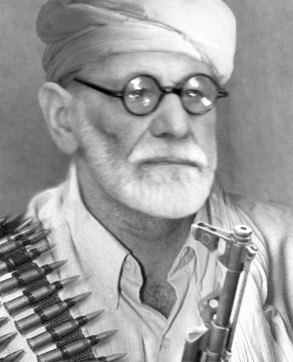

Credit for the horrific bombings of the London Underground and a double-decker bus on Thursday morning was immediately taken on a radical Muslim Web site by a “secret group” of Qaida al-Jihad in Europe. By Thursday afternoon, as the casualty toll rose above 40 dead and 700 wounded, British Foreign Minister Jack Straw was saying, “It has the hallmarks of an al-Qaida-related attack.” Although U.S. President George W. Bush maintains that al-Qaida strikes out at the industrialized democracies because of hatred for Western values, the statement said nothing of the sort. The attack, the terrorists proclaimed, was an act of sacred revenge for British “massacres” in “Afghanistan and Iraq,” and a punishment of the United Kingdom for its “Zionism” (i.e., support of Israel). If they really are responsible, who is this group and what do they want?
The phrase “Qaida al-Jihad” refers to the 2001 decision made by Ayman al-Zawahiri, a leader of the Egyptian terrorist group al-Jihad al-Islami, to merge his organization into bin Laden’s al-Qaida (“the Base”). The joint organization was thus renamed Qaida al-Jihad, the “Base for Holy War.” (Zawahiri and bin Laden had allied in 1998.) The group claiming responsibility for the London bombings represents itself as a secret, organized grouping or cell of “Qaida al-Jihad in Europe.” It is significant that they identify themselves as “in Europe,” suggesting that they are based on the continent and have struck from there into London. This conclusion is bolstered by their description of the attack as a “blessed raid.” One raids a neighboring territory, not one’s own. Whether this group carried out the attack or not, the sentiments they express do exist among the radical fringe and form a continued danger. Jihadi internet bulletin boards expressed skepticism about the group, and pointed to an inaccuracy in the quotation from the Quran. But al-Qaida wannabes are often engineers without good Arabic or Islamics training.
Most probably, then, this group consists of a small (and previously obscure) expatriate Muslim network somewhere in continental Europe, which has decided to announce its allegiance to Qaida al-Jihad. It is highly unlikely that al-Qaida itself retains enough command and control to plan or order such operations. They could have found many cues in al-Qaida literature, however, that London should be attacked.
The United Kingdom had not been a target for al-Qaida in the late 1990s. But in October 2001, bin Laden threatened the United Kingdom with suicide aircraft attacks if it joined in the U.S. campaign in Afghanistan. In November of 2002, bin Laden said in an audiotape, “What do your governments want from their alliance with America in attacking us in Afghanistan? I mention in particular Britain, France, Italy, Canada, Germany and Australia.” In February of 2003, as Bush and Blair marched to war in Iraq, bin Laden warned that the U.K. as well as the U.S. would be made to pay. In October of 2003, bin Laden said of the Iraq war, “Let it be known to you that this war is a new campaign against the Muslim world,” and named Britain as a target for reprisals. A month later, an al-Qaida-linked group detonated bombs in Istanbul, targeting British sites and killing the British vice-consul. Although bin Laden offered several European countries, including Britain, a truce in April of 2004 if they would withdraw from Afghanistan and Iraq, the deadline for the end of the truce ended in mid-July of that year.
Ayman al-Zawahiri recently issued a videotape, excerpts of which appeared on al-Jazeera on June 17, which stressed the need for violent action as opposed to participation in political reform. True reform, he said, must be based on three premises: The rule of Islamic law, liberating the lands of Islam from the Occupier, and the freedom of the Islamic community in managing its own affairs. He thundered that “expelling the marauder Crusader and Jewish forces cannot be done through demonstrations and hoarse voices.” Al-Zawahiri’s videotapes have often been issued just before major terrorist actions, and some analysts believe that they are intended as cues for when they should be undertaken. Abdel Bari Atwan, the London editor of the Arab newspaper al-Quds, warned that the appearance of the tape signaled an imminent attack.
The communiqué on the London bombing is unusual in appealing both to the Muslim community and to the “community of Arabism.” “Urubah,” or Arabism, is a secular nationalist ideal. The diction suggests that the bombers are from a younger generation of activists who have not lived in non-Arab Muslim countries such as Pakistan and Afghanistan, and think of Arabism and Islam as overlapping rather than alternatives to one another. The text makes relatively few references to religion, reading more as a statement of Muslim nationalism than of piety.
In accordance with al-Zawahiri’s focus on violence as the answer to the “marauding” of occupying non-Muslim armies in Muslim lands, the statement condemns what it calls “massacres” by “Zionist” British troops in Iraq and Afghanistan, both of them Muslim lands under Western military occupation (and, it is implied, similar in this regard to Gaza and the West Bank under Israeli control). These bombings, it says, are a form of revenge for these alleged predations. The language of revenge recalls tribal feuds rather than Islamic values.
The terrorists refer to the bombings, which they say they carefully planned over a long period, as a “blessed raid.” They are recalling the struggle between the wealthy, pagan trading entrepot, Mecca, and the beleaguered, persecuted Muslim community in Medina in early seventh century west Arabia. The Muslims around the Prophet Mohammed responded to the Meccan determination to wipe them out by raiding the caravans of their wealthy rivals, depriving them of their profits and gradually strangling them. The victorious Muslims, having cut the idol-worshipping Meccan merchants off, marched into the city in 630. Al-Qaida teaches its acolytes that great Western metropolises such as New York and London are the Meccas of this age, centers of paganism, immorality and massive wealth, from which plundering expeditions are launched against hapless, pious Muslims. This symbology helps explain why the City of London subway stops were especially targeted, since it is the economic center of London. A “raid” such as the Muslim bombings is considered not just a military action but also a religious ritual.
If the communiqué of Qaida al-Jihad in Europe proves authentic, the London bombings are the second major instance of terrorism in Europe directly related to the Iraq war. In March of 2004, the Moroccan Islamic Combatant Group (French acronym: GICM) launched a massive attack on trains in Madrid in order to punish Spain for its participation in the U.S.-led coalition in Iraq, following on their bombing of Casablanca the previous year.
From the point of view of a serious counterinsurgency campaign against al-Qaida, Bush has made exactly the wrong decisions all along the line. He decided to “unleash” Israeli Prime Minister Ariel Sharon rather than pressing for Israeli-Palestinian peace and an end to Israeli occupation of the territories it captured in 1967. Rather than extinguishing this most incendiary issue for Arabs and Muslims, he poured gasoline on it. His strategy in response to Sept. 11 was to fight the Afghanistan War on the cheap. By failing to commit American ground troops in Tora Bora, he allowed bin Laden and al-Zawahiri to escape. He reneged on promises to rebuild Afghanistan and prevent the reemergence of the Taliban and al-Qaida there, thus prolonging the U.S. and NATO military presence indefinitely. He then diverted most American military and reconstruction resources into an illegal war on Iraq. That war may have been doomed from the beginning, but Bush’s refusal to line up international support, and his administration’s criminal lack of planning for the postwar period, made failure inevitable.
Conservative commentators argue that Iraq is a “fly trap” for Muslim terrorists. It makes much more sense to think of it as bin Laden’s fly trap for Western troops. There, jihadis can kill them (making the point that they are not invulnerable), and can provoke reprisals against Iraqi civilians that defame the West in the Muslim world. After Abu Ghraib and Fallujah, many Muslims felt that Bin Laden’s dire warnings to them that the United States wanted to occupy their countries, rape their women, humiliate their men, and steal their assets had been vindicated.
These claims were not credited by most of the world’s Muslims before the Iraq war. Opinion polls show that most of the world’s Muslims have great admiration for democracy and many other Western values. They object to the U.S. and the U.K. because of their policies, not their values. Before Bush, for instance, the vast majority of Indonesians felt favorably toward the United States. Even after a recent bounce from U.S. help with tsunami relief, only about a third now do.
The global anti-insurgency battle against al-Qaida must be fought smarter if the West is to win. To criminal investigations and surveillance must be added a wiser set of foreign policies. Long-term Western military occupation of Afghanistan and Iraq is simply not going to be acceptable to many in the Muslim world. U.S. actions at Abu Ghraib and Fallujah created powerful new symbols of Muslim humiliation that the jihadis who sympathize with al-Qaida can use to recruit a new generation of terrorists. The U.S. must act as an honest broker in resolving the Israeli-Palestinian conflict. And Bush and Blair must urgently find a credible exit strategy from Iraq that can extricate the West from bin Laden’s fly trap.
Chicago political scientist Robert Pape argues in his new book, “Dying to Win,” that the vast majority of suicide bombers are protesting foreign military occupation undertaken by democratic societies where public opinion matters. He points out that there is no recorded instance of a suicide attack in Iraq in all of history until the Anglo-American conquest of that country in 2003. He might have added that neither had any bombings been undertaken elsewhere in the name of Iraq.
George Bush is sure to try to use the London bombings to rally the American people to support his policies. If Americans look closer, however, they will realize that Bush’s incompetent crusade has made the world more dangerous, not less.
A Palestinian family sit outside a disputed house as Jewish settler rests at the house door, in the east Jerusalem neighborhood of Sheikh Jarrah, Thursday, March 25, 2010. Following a seemingly chilly reception at the White House, Benjamin Netanyahu is learning the hard way that he can't have it all. The Israeli leader will not likely be able to settle east Jerusalem with Jews and maintain strong relations with the Obama administration. He will be hard pressed to please his far-right coalition partners and still negotiate credibly with the Palestinians. (AP Photo/Bernat Armangue)(Credit: AP)
The episode underlines the ways in which their forced statelessness leaves Palestinians (almost uniquely among major world nationalities) completely vulnerable to loss of the most basic human rights. That he was forcibly moved to Gaza by the Israelis suggests that many of those singled out for potential deportation from the West Bank may be moved to the small slum along the Mediterranean, which the Israelis have cut off from its traditional markets and which they keep under a blockade of the civilian population (a war crime). The Israeli establishment has decided not to try to colonize Gaza, and its isolation and hopelessness make it an attractive place for them to begin exiling West Bank residents, thus making more room for Israeli colonists.
The new policy, which is illegal six ways to Sunday in international law, is the brainchild of the government of far right-wing Likud leader Benjamin Netanyahu.
Netanyahu, an Israeli hawk and expansionist, slapped President Barack Obama in the face again Thursday when he confirmed that he refused to halt construction of new homes in Palestinian East Jerusalem, which is militarily occupied by Israel.
Netanyahu’s announcement is probably the nail in the coffin of any two-state solution to the Israeli-Palestinian conflict (in which the Israelis have thrown most Palestinians now living beyond the Green Line off their land and deprived them of citizenship in a state and all the rights that go with such citizenship). Palestinians are so despairing that only 57 percent even believe in having an independent Palestinian state any more. The rest are resigned to becoming Israelis in the distant future, when demographic realities and perhaps world-wide boycotts of Israel for its apartheid-style policies toward the occupied Palestinian will force Israel to accept them.
Palestinian leaders reject this formulation, which is intended to allow the Israelis to continue aggressively to colonize Palestinian territory while pretending that they are engaged in a “peace process.” The Palestine Authority, established in the 1990s, was already a sort of interim state then, and Palestine’s borders were then “temporary.” So temporary that Israel has made deep inroads into them through massive colonies and building a wall on the Palestinian side of the border, cutting residents off from their own farms and sequestering entire towns and cities.
Netanyahu’s various moves this week, from illegally expelling a Palestinian from the West Bank to Gaza — to blowing off the president of the United States and hitching his wagon to massive increased colonization of Palestinian land — all of these steps are guaranteed to mire Israel in violent disputes for years and perhaps decades. And the U.S., which has already suffered tremendously in Iraq and elsewhere from its knee-jerk support of illegal and inhumane Israeli policies toward the Palestinians, will suffer further.
“Yunus Muhammad” says in the interview that the Quran instructs Muslims to “terrorize the disbelievers.” It does no such thing. The Quran instructs Muslims to live at peace with non-Muslims who are at peace with them.
The verse to which this individual referred was in the chapter of the Spoils (al-Anfal), 8:60:
Wa a`iddu lahum ma istata`tum min quwwatin wamin ribati ‘lkhayli turhibuna bihi `aduwwa Allahi wa`aduwwakum
Which means, “Prepare against them all the power, and all the war horses that you can, whereby to strike fear into the enemies of God and your enemies.”
The context of this verse is the Battle of Badr on March 17, 624 of the Common Era. In the 610s, the pagan Meccans had persecuted the new religion of Islam and ultimately chased Muhammad and the Muslims out of Mecca for preaching the one God. They took refuge in the nearby city of Yathrib, which became known as Medina (i.e., the City [of the Prophet]). The wealthy Meccan polytheists hoped to wipe Islam and the Muslims out, and fought skirmishes with them. The early Muslims riposted by raiding Meccan trading caravans, in hopes of weakening their foe economically. That March in 624, the Meccans sent out their best fighters to protect a caravan. A Muslim force more or less stumbled onto this expedition. Badr, named after a well south of Medina, was the first major battle between the two sides, and the Muslims won it, thus saving themselves from genocide.
So what the Quran is saying in 8:60 is that the Muslims should keep a stable of fighting steeds at the ready and let the Meccans know about it, to strike fear into the hearts of an enemy trying to wipe out them and their religion.
The verse does not command any act of “terrorism.” It commands that Muslims attempt to forestall irrational violence against a Muslim state through deterrence. It is defensive in intent.
The verse does not say anything about mere ‘disbelievers’ or non-Muslims. It is warning of the designs of “enemies of God,” i.e., militant and violent anti-Muslims. Moreover, there is no implication that Muslims should act as individuals or vigilantes. Medina was a city-state that the Prophet Muhammad ruled, and he gave the orders. Muslims could not just run off and attack whomever they pleased whenever they pleased. A duly constituted Muslim state was in charge of defense of the community.
So unless Yunus Muhammad can find a group of armed individuals who aim at violently attacking Muslims en masse and trying to wipe out them and their religion, he should stuff a sock in it and go home.
In fact, trying to import terrorism into the Quran is an infinitely greater blasphemy than that of any Western cartoonist, and one would hope Muslim groups would get more upset about Yunus Muhammad and “Revolution Muslim” than about an irreverent American TV program.
Unfortunately, along with people with genuinely hurt feelings, there will be some cynical political forces that manipulate Muslim fundamentalists and will try to advance their agendas by taking advantage of this “South Park” controversy. (The show depicted the Prophet Muhammad in a bear suit to avoid showing him — which is about as close as “South Park” gets to deference to religious feelings.)
Joint Chiefs of Staff Chairman Adm. Mike Mullen said at Columbia University that a military strike on Iran over its nuclear enrichment activities would be his “last option.” He makes an excellent point, too often overlooked. In some instances the price of doing something is just about as high as the price of doing nothing. A U.S. strike on Iran would risk throwing Iraq and Afghanistan into chaos, with our troops in the midst of it.
The Obama administration is now moving to tighten economic sanctions on Iran, as an alternative to a more direct approach. These measures include pressuring countries and firms not to buy Iranian petroleum and gas; pressuring them not to sell gasoline to Iran; and attempting to make it difficult for Iranian banks to interface with the world economic system.
While these measures could impose costs on Iran, these costs can easily be borne by the country, and more especially by the regime.
Moreover, it is unclear that President Obama can even swing further sanctions on Iranian petroleum and gas. Such harsh measures are opposed by Brazil, Russia, India and China, the so-called BRIC bloc of nations that are emerging diplomatic and economic players outside the U.S.-dominated G-7 nations. At the BRIC summit in Brazil last week, a consensus emerged against strong new sanctions on Iran. Brazil is on the U.N. Security Council at the moment, and in May Lebanon will assume the rotating chairmanship of that body. Given that Turkey also currently has a seat and is strongly opposed to new Iran sanctions, it may be difficult for Obama to get a significant new resolution.
Financial sanctions are not all that they are cracked up to be. Iran Oil & Gas reports that from March ’09 to March ’10, Iran swapped 450,000 tons of petroleum products. Some 90 percent of the swaps were with nations of the former Soviet Union (CIS), and 10 percent were with Iraq. Likely we are talking about Azerbaijan, Turkmenistan, Uzbekistan and Kazakhstan. This item is an example of how Iran can import refined gasoline (it has a temporary shortage of refineries) without needing to go through the international banking system. Even if some sort of official ban on trading with Iran could be arranged by the U.S. with these CIS countries and Iraq, private traders and corrupt government officials would simply step into the resulting black market and make a pile. Smuggling oil products out of Iraq on trucks was a specialty of Jordan and Turkey in the 1990s, and that sort of black market would operate quite efficiently were Iran to be put under the sort of sanctions imposed on Saddam Hussein.
Few commodities are more easily transported and more fungible (easily exchanged for other goods or for cash) than gasoline, and the plan for a gasoline embargo on Iran (popular in Congress) is a pipe dream.
But we are hardly in a stage of black marketeering. Rather, direct deals are being done by major players, despite the withdrawal of some players, such as Lukoil, from exporting gasoline to Iran. Chinaoil just directly sold Iran 600,000 barrels of gasoline, and Sinopec, another Chinese oil giant, is preparing to resume direct gasoline sales to Iran. Soft gasoline demand in Asia because of the global economic downturn has left petroleum companies with high inventories that they are eager to offload anywhere they can, and Iran as a destination suits them fine.
Reuters reports, “As long as there is money to be made, and economic benefits to be taken advantage off, Iran will always find ready sellers of gasoline from the international market,” a trader said. “The politicians don’t understand markets … sanctions are cosmetic.”
And if direct sales became difficult, indirect ones would be substituted. And if that became difficult, smugglers would step in. A lot of Iraqis would get rich. And while paying extra to smuggle things in would hurt ordinary Iranians, the regime would use its oil profits to cushion the elites and keep them happy. (That cushioning is why very severe sanctions on Iraq never had a chance of shaking the Baathist regime.)
The man said it all: “Sanctions” are purely cosmetic, designed to make it look as though U.S. politicians had taken some dramatic and effective step. It is odd that the politicians in Washington, who are always loudly proclaiming their belief in the market, think its iron laws can be suspended by a simple vote on their parts.
And another development taken as a bellwether of increasingly effective sanctions turns out to have been a mirage. Malaysian Prime Minister Najib Razak clarified remarks he made last Thursday about creeping sanctions on Iran. He was misunderstood to have said that Petronas, the Malaysian petroleum company, had suspended gasoline sales to Iran, but he never said any such thing and it never happened. He referred to a canceled third-party spot oil deal that collapsed for purely economic reasons.
Moreover, Iran’s need to import gasoline is probably temporary. It has the wherewithal to build new refineries, and is doing so. Germany’s ABB Lummus has a a $512 million deal with the National Iranian Oil Co. and a consortium in Iran to raise gasoline production at the Bandar Abbas refinery to about 3.5 million gallons a day from the present 1.3 million gallons.
In fact, there are 10 such projects to expand existing refineries, which could allow Iran to nearly double its production of gasoline by 2012. In addition, Iran is investing nearly $40 billion in building seven new refineries. So even a successful squeeze on Iran’s gasoline imports, if it could be implemented right away, would only have much effect for two years. But such a squeeze is unlikely to be successfully implemented in the first place.
Nor is Iran lacking for customers. A Swiss company just signed a deal worth $13 billion to import Iranian natural gas over the next 25 years. As for financial sanctions, so far Iran is evading them through banking partners in the United Arab Emirates, and Iran and Venezuela have two joint banks. These measures provide Iran with a back door, allowing it to mitigate the effects of financial sanctions.
Very few sanctions have actually produced regime change or altered regime behavior. The U.S. could not even accomplish this goal with regard to a small island 90 miles off its shores, Cuba. That an oil giant halfway around the world with a population of 70 million that is as big as Spain, France and Germany can be effectively bludgeoned with sanctions is not very likely.
The U.S. needs to engage in comprehensive security talks with Iran, in hopes of striking a grand bargain. Because as Adm. Mullen rightly says, there are no good military options here.
Robert Wright argues that not only is assassination (including by drone) legally and ethically troubling, but there is reason to think that it is counterproductive when deployed against religious terrorist groups. He cites the study of Jenna Jordan, a Ph.D. candidate at the University of Chicago, in the journal “Security Studies.” Jordan did a large-scale study of violent organizations that had been dealt with by the assassination of leaders, and found that such assassinations generally caused the organization actually to last longer than groups that had not suffered such assassinations.
As for the first question Wright raises, of the legal implications of assassinations, such as the one President Obama authorized for American citizen Anwar al-Awlaki, they are horrible. Having CIA officers operate the drones makes the attacks a covert operation, which cannot be spoken about publicly by U.S. government officials, and which cannot be investigated by ordinary Americans worried about the direction of their government. The drone assassinations are lawless, and they have killed large numbers of innocent civilians, as Wright notes. For Obama to take out a contract on al-Awlaki diminishes us as a nation. If al-Awlaki is guilty of a crime, he should be brought to justice if possible, and tried, even in absentia. Yemeni authorities should arrest him and extradite him on that basis. For the U.S. to allow 300 al-Qaida in the Arabian Peninsula guys to draw it into unethical actions and perhaps even into an unwinnable war in Yemen, would be foolish.
Jordan’s study seems to me generally sound, and one can think of lots of supporting evidence. It seems to me that it would be useful to further amplify a distinction that Jordan makes, between highly organized and more inchoate religious organizations, with the latter being more common.
The Greens in Iran since last summer have been a movement, and it seems obvious that Mir Hosain Mousavi and Mehdi Karroubi as leaders are not all that central to it. The Sadrists in Iraq are a movement, and after a campaign of arrests and assassinations waged against them by the U.S. and British militaries and then the government of Prime Minister Nuri al-Maliki over years, they continue to survive and reemerged to take some 12 percent of seats in the Iraqi parliament on March 7.
What is often missed about Hamas is that it, too, is a movement. They have gotten up big demonstrations, and waged campaigns, including political campaigns. They aren’t just a terrorist group, and they depend on kinship links and informal networks, not a corporate-style leadership flow chart.
Movements that are embedded (as most are) in a particular population can draw on enormous resources.
Ariel Sharon was convinced by some game theorist who knew nothing about Palestinian Arab society that if he could kill off one-quarter of the Hamas leadership, he could cause the organization to collapse. What I heard was that the original basis for this thesis was risk studies of corporations like IBM, where the models had shown that in case of a catastrophe that took out a quarter of the management, the organization would implode.
So Sharon’s government assiduously assassinated suspected Hamas leaders, killing the spiritual leader of the movement, Shaikh Ahmad Yasin, in his wheelchair as he came out of a mosque, along with 17 others, including juveniles. Then titular leader Abdel Aziz Rantisi was assassinated. And so on and so forth. But Hamas did not collapse. It won the 2006 Palestine Authority elections, and even when the resulting government was overthrown by the PLO in the West Bank — with U.S. and Israeli help — it proved powerful in Gaza. The Gaza war was another Israeli attempt to destroy Hamas, which failed miserably. Israeli military leaders professed themselves astonished at how little resistance to the invasion Hamas put up, showing that they don’t understand movements. Movements can afford to lie low during attacks, because they have the resources and support to reemerge once the heat is off.
Assassinating movement leaders, as opposed to organization leaders, is usually worse than useless, especially if the movement has a strong social base in a compact population.
On the other hand organizations such as the Egyptian Islamic Jihad and the Islamic Grouping (al-Gama’a al-Islamiya) in Egypt were effectively defeated by the Egyptian security forces. They arrested some 30,000 militants in the 1990s, and they engaged in running street battles with armed members. Since 1997, these groups have been defeated in the Nile Valley and seldom can pull off even a small attack. The Egyptian government caught a break, because the radicals’ 1997 attack on Western tourists at Luxor produced profound revulsion toward them among almost all Egyptians. The leadership of the Islamic Grouping (whose blind sheikh, Omar Abdel Rahman, is in an American penitentiary for involvement in the first World Trade Center bombing) has even renounced violence and now sees the Koran as forbidding terrorism. This leadership had not been systematically killed, however. It was incarcerated in Tura prison.
In this regard, U.S. drone attacks on al-Qaida figures in Pakistan must be contrasted to assassinations of Taliban leaders. Al-Qaida is more like an organization, and its leaders seldom have a lot of local support (the Arabs in the northwest of Pakistan are not embedded in a local population that adulates them, but rather live among Pashtuns who have a variety of views of Arab expatriates). There has never been a big al-Qaida demonstration (I mean by al-Qaida Osama Bin Laden’s organization, and don’t consider the Islamic State of Iraq to be actually al-Qaida), because they don’t have the numbers to pull it off.
In contrast, just killing Pashtun insurgent leaders, whether in Pakistan or in Afghanistan, is unlikely to destroy the Taliban, because they are a movement embedded in an often supportive population.
President Barack Obama acknowledged Tuesday that, despite the expenditure of substantial political capital by his administration, progress may not be made on Israel-Palestine peace. The AP quoted his reply to a question about how recent successes in negotiating nuclear arms reduction with Russia — and getting 48 nations to sign on to a nuclear material security agreement — might translate into diplomatic successes elsewhere.
The two sides “may say to themselves, ‘We are not prepared to resolve these issues no matter how much pressure the United States brings to bear,’” Obama said.
Obama reiterated that peace is a vital goal, but one that may be beyond reach “even if we are applying all of our political capital.”
Obama may be right. But note the implications of no progress between Israel and the Palestinians on political settlement of their dispute:
Iran – the primary rejectionist state in the region, will grow in power and popularity in the Middle East
Anger in the Arab world toward Israel and the US will grow in intensity
Israeli policy toward East Jerusalem could itself be the cause for a war. Jerusalem is sacred to Muslims and Christians as well as to Jews
Israel’s status as a de facto Apartheid state will be made permanent and the boycott movement will grow, ultimately affecting the Israeli economy
If the two-state solution is dead as a doornail Israel will either have to give the Palestinians citizenship or face a long and bitter struggle to make their own state in the teeth of Israeli opposition
Obama’s team tried to get Palestine Authority president Mahmoud Abbas to restart negotiations last year, but the long-suffering Abbas insisted first on a freeze of creeping Israeli colonization of the Palestinian West Bank. That is, he insisted that Israel not be actively annexing the very territory at issue while the talks proceeded. It would sort of be like negotiating to buy a mansion from a seller who was dismantling wings of it, carting them off to his new residence, while he kept jacking up the asking price on his increasingly diminished domicile.
Prime Minister Benjamin Netanyahu finally agreed to an eight-month settlement freeze on the West Bank. But the offer was insincere. Building within existing settlements would continue; they would just get denser. And the parts of the West Bank Israel had illegally and unilaterally annexed to its district of Jerusalem would continue to be settled.
The first, flawed offer by Netanyahu was enough to bring Abbas to indirect negotiations. But then the implementation of the second bit of insincerity scotched any movement toward peace talks as the Palestinians decided that they had to retain a modicum of self-respect. The building of 1,600 new homes on Palestinian land near Jerusalem was announced just as Vice President Joe Biden arrived in Israel to kick off the proximity talks made it look as though Israel is not only a fickle and unreliable diplomatic partner. Beyond that, it looked as if its government was intent on kicking Biden in the teeth and humiliating Washington.
One problem Obama faces is that the American Israel Public Affairs Committee, a coordinating body for the Israel lobbies, has successfully mobilized congress against him with regard to putting further pressure on far right-wing Netanyahu to stop building settlements. Congress decides on how much money to give Israel annually, and how many weapons to sell it. Obama cannot effectively threaten Netanyahu with a reduction in the billions of dollars a year in aid, trade privileges, loan guarantees, and military equipment sent to Israel by the U.S. Those goods are giftds from Congress, and Congress typically yields to AIPAC and its colleagues.
As John Mearsheimer and Stephen Walt have demonstrated in The Israel Lobby, these lobbies cultivate congressmen and senators from the beginning of their careers. The Christian Zionists, who form a significant movement within U.S. evangelicalism, probably number some 10 million, and it is not hard to get them to write their senator on behalf of Israeli expansionism. Pro-Israel organizations and individuals are disproportionately politically active and likely to give to political campaigns.
A recent Israeli government decree that could lead to the expulsion of thousands of Palestinians from their homes in the West Bank has stirred extreme anxiety in the region.
According to the London pan-Arab daily, al-Quds al-Arabi, the Jordanian government fears that Netanyahu and his even more right wing foreign minister, Avigdor Lieberman, will engineer clashes between Israeli colonists on the West Bank and the Palestinian villagers on whom they are encroaching, as a pretext for pushing tens of thousands of Palestinians into Jordan.
Certainly, Israeli-Jordanian relations are at their lowest point since the 1994 peace treaty between the two countries — a treaty that King Abdullah II says he is beginning to regret. He worries that Jerusalem is a keg of dynamite, that Gaza and Lebanon could explode into hot war at any time, and even that Israel and Iran may go to war against one another.
Yep, that’s what you worry about if you know the region well.