
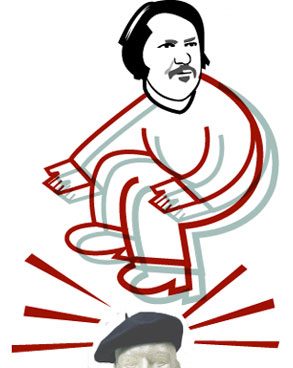

Ways to praise a book include quoting favorite lines, leaving it by your bedside, and pressing it on your friends. Other books you cherish by rereading them. I’m not much of a rereader (still too much to read for the first time), but I usually return to “The Great Gatsby” every year. And then there are a few books that you honor by your refusal to read them, by your postponement of the encounter — because you suspect them of being too dazzling, too good or too close to the bone.
My failure to read Balzac’s “Lost Illusions” had been a tribute exacted on the basis of fear. I arrived in New York one winter with an internship at a magazine and a fearfully simple ambition: to be a writer. And, in spite of worrying more or less constantly that my ambition would turn out to exceed my talent and discipline, I hoped that in a few years’ time I wouldn’t be the only person to think of myself as one. In particular I wanted to vindicate myself in the eyes of my parents back in Eagle, Colo., where I grew up. For some reason it felt important to supply proof of my gifts to precisely the people who’d never doubted them.
I’d heard enough about “Lost Illusions” that when I came to New York it naturally occurred to me to read the book. I understood that this was a novel — the novel — about a provincial young man who shows up in the cultural capital of his day with the notion of making it as a writer. And, well, evidently he loses some illusions. Having read “Phre Goriot,” I imagined that in this novel, too, corruption might supply the main theme. Balzac, you learn right away, is a novelist of money — in “Phre Goriot,” Rastignac, the ambitious young man of that book, thinks of money as “the world’s final authority” — and it may be that in the New York of the late ’90s I felt I didn’t need money brought to my attention any more than it already was. Also, perhaps I didn’t want to compare Balzac’s caffeinated productivity (92 novels!) with my similarly caffeinated lack thereof. Most of all, I think, I was afraid of compounding my anxieties about literary and personal failure with too apt a cautionary tale. Besides, the book is 700 pages long.
This summer, after half a dozen years in New York, I was curious to find out whether my fears had been justified.
One way to describe Lucien, the literary young man of the novel, would be to say he has tremendous good looks, enormous talent, two last names, little money and no character. In the provincial town of Angouljme, a married aristocrat with literary interests makes him her pet. Their close but chaste relations cause a local scandal, and force Mme. de Bargeton and Lucien to flee to Paris, where they imagine their love will flourish and the young poet will win his fame. There is also the possibility that literary glory and social success will encourage the king to grant Lucien a patent of nobility, so that he can trade in his father’s plebeian surname for his mother’s aristocratic one. These are the illusions with which Lucien Chardon, aspiring to be Lucien de Rupembri, leaves his hometown, along with some seed money given him by his devoted sister and best friend. The sister and friend have recently married, and are also allied in their goodness of heart and their fond hopes for “the poet,” as Balzac calls him with mounting irony. Lucien will practically forget about Eve and David while he’s in Paris, but the reader should remember them.
As he was in “Phre Goriot,” Balzac is categorical on the need to possess at least one good suit. And no sooner has Lucien arrived in Paris than his high-born sponsor drops him essentially because he has the wrong clothes; a provincial dandy is a coarse hick in the city. Mme. de Bargeton refuses to see Lucien, and leaves him to his cold garret and his fate — this, the woman who had claimed to love him. There’s one illusion down. And the summary coldness with which Lucien is abandoned offers a sort of key to Balzac’s world, where people think of one another mostly in terms of utility and convenience.
Balzac taxes Lucien with a “deplorable instability of … character, that would as easily precipitate him into an evil way of life as into a good,” and it’s easy to be reminded of yourself (or myself) at 23 or 24. On the side of the good are ranged a group of young intellectuals resigned to poverty and obscurity and dedicated to the patient realization of their genius. “If you have not determination in your heart,” one tells Lucien, “if you have not the patience of an angel, if, no matter how far the freaks of fortune have placed you from your goal, you are not prepared to find the way to your infinite, as turtles, wherever they may be, will make their way back to the ocean, you may as well give up at once.” I’m sure I would have copied this speech into my journal had I read it in my first days in New York.
As for evil, Balzac’s name for it is “journalism.” Newspapers in 1822 are a growth industry if ever there was one, and churning out columns is a way to make money, which in turn is a way to support a beautiful mistress, eat out every night, and hire a carriage from which you might look down upon the titled people who snubbed you when you first arrived. Lucien’s new journalist friends mock his old genius friends. Genius? “I would rather have a glass of sherry!” comes the unanswerable reply.
Like most novelists, Balzac seems to consider happiness undramatic, and he doesn’t linger on his hero’s brief, happy career as a lover and a journalist. Lucien’s corruption has hardly begun before it is complete. He changes his political spots overnight, going from Liberal to Royalist for the sake of his career; he racks up debts faster than he can write copy; he stops even thinking about poetry; and he forges the signature of his brother-in-law, in order to cover the funeral expenses of the 19-year-old mistress whose death he is more or less responsible for. The unauthorized loan nearly brings about the ruin of David and Eve back in Angouljme. (Lucien’s selfishness is of the blind rather than the cruel variety; other people simply don’t occur to him.) David and Eve ultimately settle Lucien’s debts, but their illusions about “the poet” are dashed — which is finally the meaning of the title.
Whether or not “Lost Illusions” counts as the greatest novel ever written, as the Italian literary scholar Franco Moretti claims, it’s a pretty magnificent one. You can read it for its combination of social scope and psychological insight, and for its cinematically vivid portraits of faces (“and his veined cheeks, bloated with purple, violet, and mottled patches, suggested vine leaves”) and many fine phrases (“ambitious credulity” just about sums Lucien up). You can also read the book to see what the novel was like before novelists cared so much about style or objectivity — Balzac is a shamelessly uneven writer who plays clear favorites among his characters. And then you can read “Lost Illusions,” as Marx read Balzac, for its account of the double-edged nature of early capitalism: Here, for the first time, is a society open to talent and drive — and, at the same time, a society in which you either make it as a commodity, or you don’t make it at all. Meanwhile Balzac will treat you to his amusing and varied opinions: He dislikes tinted eyeglasses, considering them the accoutrements of shady businessmen; when it comes to courtship, he favors “the German style,” which is “undemonstrative and without any ardent protestations”; and he takes the time to reproach his fellow Frenchmen because they “continue to wear inexplicable hats” — which would seem to be a disobliging reference to the beret.
If the hat you wear is that of a writer, there is plenty of free advice. Balzac counsels patience, perseverance and solitude. In a book populated by writers and would-be writers, one of these warns against squandering on reviews the sort of ideas that should be reserved for books, while another suggests that writing on deadline makes our minds dangerously versatile, so we think only of what’s plausible and no longer of what’s true. There is also a wonderfully accurate statement on seeing yourself published: “Print is to manuscripts what the stage is to an actress — it brings to light both beauties and defects.”
It’s interesting to imagine a “Lost Illusions” set in New York today. I’ll keep my estimations of my strength of character to myself, but I’m glad to have been spared Lucien’s opportunities to sell out. No one today would imagine literature as a ticket to high society, or grow intoxicated with the wealth and power available to the book critic. Publishers don’t come breaking down your door when they hear you have a collection of sonnets. And getting an MFA, rather than taking up with a courtesan, seems the readiest danger in terms of acquiring debt.
Still, doesn’t every young writer in New York think I write too many short pieces, I go out to dinner too often, I’m neglecting my real work? Time slips through your hands more quickly here than elsewhere, and money, too; I’m not altogether proud of how I’ve spent either. Shouldn’t my one completed novel be more like two or three? And, er, shouldn’t my credit card bill be not quite as large as it is this month?
And yet you get the feeling from “Lost Illusions” that Balzac isn’t quite giving the devil — or rather the book reviewer and dissipated playboy — his due. After all, Balzac himself devoted his 20s to hack journalism and dubious entrepreneurial schemes, probably knocking back a fair quantity of sherry in the process. By the age of 30 he was deeply in debt, a failure. But by then he had also, of course, stored up all the necessary material for his longest and, some say, best novel. That’s the thing: When you’re a novelist, or want to be one, and instead of staying at home to nurture your genius, you’re chasing some romantic prospect, or drinking too much with your friends, or writing another book review, it’s never entirely clear whether you are wasting your time, or whether, in fact, you are investing in so many treasury bonds to be paid out in the form of mature works. It could be that ostensible distraction is really just a diversified portfolio of experience. A novelist has to write about humans, and it doesn’t much expand your knowledge of the human to do the things you should. Besides, a novelist also has to achieve a style that’s fluent without being glib, and precise without being pedantic. Journalism — which after a point begins to hurt your writing, by making it too facile — up to that point probably helps. Good luck locating that point.
I look back on my first years in New York and wish I’d worked harder. I also look back and wish I’d gone out dancing far more often, and spent more money on concerts and plays. Nor am I sure it would have done me much harm to have drunk more wine, or to have seen more of a certain actress (who by the time I met her was actually a director). The idea that you can live in a big rich city and look back on half a dozen years without regrets of some kind — without regrets of all kinds — is another illusion, and one that I’ve lost.
