
Aaron Kinney

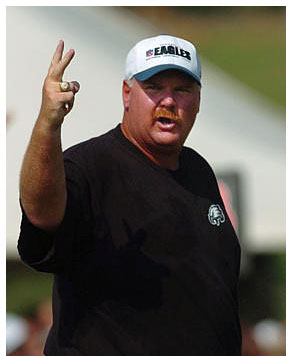
Run, Andy, run!

If head coach Andy Reid doesn't junk his pass-first philosophy -- especially with his top receivers now grounded -- the Philadelphia Eagles will never be more than Super Bowl bridesmaids.

  • more
    • All Share Services

Run, Andy, run!

As Todd Pinkston hit the grass last week, his Achilles tendon torn, the Philadelphia Eagles’ chances of winning the Super Bowl this season took a severe blow. With one of their starting wide receivers from last year’s NFC Championship team out for the season, the Eagles were suddenly dependent on petulant receiver Terrell Owens, whose demands for a new contract have poisoned his relationship with the team. On Wednesday, the Eagles suspended Owens for a week after a heated argument with head coach Andy Reid. Now the Eagles have to decide whether T.O. (for whom quarterback Donovan McNabb has a feeling that “borders on hate,” according to Peter King of Sports Illustrated) will be around this year, whether his noxious presence would be worse than his absence.

There’s a lot to dislike about how this has turned out. It’s too bad that T.O.’s career in Philadelphia appears to be over because his first year with the Birds in 2004 — from the boisterous love Philly fans showered on him to his outstanding performance on the field — looked like the beginning of a beautiful friendship. With the psychologically disordered Owens trashing Eagles management and bad-mouthing McNabb on ESPN Thursday, it now looks almost certain that he will be traded or benched. Which is a shame, because otherwise the Eagles would begin the season with arguably the best, most complete team the organization has ever fielded. The worst thing about the rotting relationship between T.O. and the Eagles, however, is that it overshadows the greatest obstacle to the Andy Reid-era Eagles finally winning a Super Bowl: Andy Reid himself.

By leading the Eagles to four straight NFC Championship games, Reid has earned the respect and admiration of Eagles fans. But despite his role in making the team one of the elite franchises in professional sports, Reid is plagued by two character traits that may block the Eagles from going all the way. As a big-game strategist, Reid is a timid coach who becomes more conservative under pressure. And his aversion to running the football runs counter to everything that history has taught us about how teams win Super Bowls. Now that the Eagles are once again having personnel problems at wide receiver, their inability to move the chains on the ground could prove fatal to their Super Bowl ambitions.

Even before Owens went nuclear, Iggles fans entered the season with a nasty hangover. They’d limped away from the television after the Eagles’ Super Bowl loss to the New England Patriots with lingering questions. Chief among them: Why Donovan McNabb has a habit of vomiting during big games, but more important, why the Eagles didn’t show any urgency during the penultimate drive of the game. After all, they trailed by 10 points with less than six minutes to go. Where was the hurry-up offense? They finally did score a touchdown but by then there was not enough time to get the ball back from the Patriots and tie the game with a field goal.

But if Eagles fans thought they’d get some straight answers about what happened, they were mistaken. Vomitgate went unresolved, with different people giving different accounts. As for Reid’s brain lock in the fourth quarter, he refused to answer the question after the game, then on Monday made one of the more cerebellum-paralyzing statements ever made by an NFL coach. Claiming that he didn’t really remember the Eagles’ tortoise crawl up the field, Reid told reporters that he had “put that away a little bit,” as if he were repressing an unpleasant memory. Then he said he was done addressing the issue.

As Eagles fans regrouped during the offseason, they had every reason to be leery of their quarterback and head coach. Any Eagles fan who has paid attention over the past few years is painfully aware of the tics that pervade Reid’s offensive play-calling — the quick out pattern to the physically unimposing Todd Pinkston, for instance, which has maybe once gained more than 1 yard in all the times Reid has called it. But these idiosyncrasies are part of a larger pattern.

First, there’s Reid’s strange lack of chutzpah. For a man who loves the trick play and who has opened more than one game with an onside kick, he pulls his head into his shell in the pressurized atmosphere of the post-season. The Eagles’ Sunday stroll in the fourth quarter of the Super Bowl was not the first time that Reid lacked aggression in a high-stakes playoff game. The Eagles took their time developing a sense of urgency in their 14-3 loss to the Carolina Panthers in the 2004 NFC Championship Game, and in the 2003 championship game against the Buccaneers Reid declined to go for the jugular when the Eagles intercepted a Brad Johnson pass in Tampa Bay territory with a 7-3 lead in the first quarter. With the delirious crowd at Veterans Stadium howling for blood, Reid responded with ultra-conservative play-calling. The Eagles went three and out and wound up punting. That cleared the stage for Bucs wide receiver Joe Jurevicius, not known for his speed, to take a 10-yard crossing route on third down and, as Eagles fans watched in open-mouthed horror, race 71 yards down the sideline, setting up a 1-yard touchdown run by Michael Alstott. The Eagles never recovered.

But Reid’s strange mix of recklessness and conservatism is not his biggest flaw as a coach. That distinction goes to Reid’s well-established aversion to running the football. The West Coast offense that Reid employs is predicated on the short passing game. And to a certain extent, coaches who run any version of the West Coast offense substitute short passes for runs. But none of the coaches who have wielded the West Coast offense with any great success since Bill Walsh established it in the 1980s have eschewed the running game as much as Reid has in his six years as coach of the Eagles.

Being able to run is critical to a team’s success. A team that runs the ball allows its offensive lineman to go on the aggressive and pound the other team’s line, wearing it down, rather than backpedal in pass protection. A successful running game keeps the opposing defense off-guard: Rather than charging straight upfield at the quarterback, the other teams’s defensive linemen have to be prepared to hold their ground. Success in the running game opens up passing lanes by forcing opposing linebackers and safeties to cheat up to the line of scrimmage, creating opportunities for the play-action pass.

Reid runs the ball less than all his West Coast counterparts except for Seattle Seahawks coach Mike Holmgren — and less than all the coaches who ran Super Bowl-winning dynasties in the ’80s and ’90s. According to the unofficial statistics at pro-football-reference.com, 56 percent of the plays that Reid has called during his six years with the Eagles have been passes. Holmgren also averaged 56 percent during his seven years with the Green Bay Packers, but Holmgren’s offense was less radically anti-run than Reid’s. For one thing, the Eagles run stats are inflated by the fact that Eagles quarterback Donovan McNabb has averaged 65 rushes per season over his career, about 25 more rushes per season than Packers quarterback Brett Favre. And Holmgren’s offense featured the power running of Dorsey Levens, as opposed to Reid’s finesse approach.

The three most successful West Coast offense head coaches — Bill Walsh, who won three Super Bowls in 10 years with the San Francisco 49ers; his successor George Seifert, who won two championships in eight years; and Mike Shanahan, who won back-to-back titles with the Denver Broncos — all ran the ball more than Reid does. And in all seven of those Super Bowl seasons, their teams ran the ball more often than they did in non-championship years. Shanahan ran the most balanced attack of the three in his Super Bowl victories in ’98 and ’99. With Terrell Davis slashing downhill through the defense and John Elway throwing over the top, the Broncos passed the ball on just 50 percent of their plays.

And the same logic applies to the other coaching dynasties of the past two decades: Jimmy Johnson’s Dallas Cowboys, who won Super Bowls in 1993 and 1994; Joe Gibbs’ Washington Redskins, who won championships in 1983, 1988 and 1992; Bill Parcells’ New York Giants, Super Bowl champs in 1987 and 1991; and Bill Belichick’s Patriots, who have won three of the last four Super Bowls. All those teams ran the ball more often than Reid’s Eagles, and they ran the ball with even greater frequency in the years they won the Super Bowl.

There are a couple of exceptions to the rule that stand out. West Coast acolyte Jon Gruden took over the Tampa Bay Buccaneers in 2002 and led them to the championship in a season in which they passed the ball 58 percent of the time. But with bruising running back Mike Alstott, Gruden’s Bucs could run the ball when they had to. And they had the advantage that year of a dominating defense, which returned three interceptions for scores in their Super Bowl rout of the Oakland Raiders. The St. Louis Rams won the Super Bowl in 2000 after a regular season in which they passed the ball 55 percent of the time. But that team was loaded with a sickening array of talent — two All-Pros at receiver in Torry Holt and Isaac Bruce; a future Hall-of-Famer in his prime at running back in Marshall Faulk; and a quarterback, Kurt Warner, having one of the best seasons of all time. While running the ball a lot doesn’t guarantee victory, teams that can’t run the ball don’t win championships.

Reid’s offensive philosophy is not without merit. The way he “flexes out” Brian Westbrook, for example, using him as a wide receiver, creates mismatches that opposing defenses struggle to parry. And Reid has myriad other positive qualities as a coach and general manager. But his disinclination to incorporate a power running game into his offensive philosophy runs counter not just to football wisdom but to the football gods, who ultimately award NFL championships to the teams that are most adept at kicking the snot out of their opponents, not tiptoeing around them.

Reid’s run as coach of the Eagles represents the third time in the past 25 years that Philadelphia has controlled the NFC East. It happened first in the early ’80s with Dick Vermeil, then for a brief period in the late ’80s under Buddy Ryan. But none of that dominance has yielded a Super Bowl trophy. In that same period of time, the Eagles’ division rivals, the Cowboys, Redskins and Giants, have won a total of eight Super Bowls. Today, Reid runs the risk of becoming the NFC equivalent of AFC coach Marv Levy, whose Buffalo Bills lost four straight Super Bowls from 1991 to 1994. None of Reid’s success will count for much if the Eagles don’t win it all while he’s here. And unless he changes his offensive philosophy, that could be his legacy.

Continue Reading Close

The right take on Libby?

Conservatives defend and criticize Vice President Cheney's indicted chief of staff.

  • more
    • All Share Services

Reaction from conservative pundits to the news of “Scooter” Libby’s indictment on Friday varied — some stuck with positive spin, but a number of others struck a somber tone. The coverage on Fox News Channel was somewhat muted from the outset. Anchor Rick Folbaum opened an interview with Bill Kristol, editor of the Weekly Standard, by playing up the news that Karl Rove wasn’t indicted. “How much of a victory is this for the president?” he asked.

“Well, we shouldn’t kid ourselves,” Kristol responded. “It’s not a victory … [This is] awfully bad for the White House.”

Paul Mirengoff, of the conservative blog Powerline, acknowledged the indictment “looks strong on its face” and that the charges against Libby “are serious,” though he predicted that the political fallout “is likely to be almost nonexistent.” Fellow Powerline blogger and Weekly Standard contributor John Hinderaker added that the Plame affair has proved to be “the anti-Watergate.” “It is evident from the indictment itself,” he argued, “that administration officials, including Dick Cheney, Ari Fleischer and others, followed President Bush’s order to cooperate fully with the Plame investigation. But it’s premature to conclude that the administration is out of the woods until we find out what, if anything, happens to Rove.”

“I think Karl Rove is vindicated,” talk radio host Hugh Hewitt told Salon Friday in an e-mail. “And I think it is quite obvious that there was no underlying crime of any sort. But that does not, of course, excuse lying under oath if lying under oath occurred, or obstruction,” Hewitt added.

Others sought to shift the focus as far away from the White House as possible: Lorie Byrd of the conservative blog PoliPundit declared that former Ambassador Joseph Wilson himself has been guilty of lying throughout the affair, and wondered, “When will Wilson’s indictment come down?” Glenn Reynolds, of the blog Instapundit, predicted that it “will be a blue Fitzmas” for some liberals because even Libby was not indicted on the underlying charge of knowingly divulging the name of an undercover CIA agent.

But other conservative bellwethers were somber — and turned their back on Libby.

“This is not Watergate or Iran-Contra, but neither is it a trifle,” wrote the editors of the National Review Online. “Please spare us the excuses warmed over from Democratic talking points in the 1990s: the prosecutor is out-of-control, there was no underlying crime, etc., etc. It is the responsibility of anyone, especially a public official, to tell the truth to FBI agents and grand juries. If Libby didn’t, he should face the consequences.”

The editors of NRO added that conservatives would be “well-advised” not to attack Fitzgerald personally, though they also expressed their dissatisfaction with “the limits of special-prosecutor investigations,” arguing they prevent knowledge from reaching the public. Kristol of The Weekly Standard shared the Review’s esteem for Fitzgerald, calling him a careful and “conscientious” prosecutor.

Speaking to MSNBC’s Chris Matthews, commentator Tucker Carlson expressed doubts about whether the revelation of Valerie Wilson’s identity was damaging to national security — but his main concern appeared to be how a man as smart as Libby could be so “dumb” as to lie to investigators in the manner that he apparently did. Right-wing commentator Pat Buchanan concurred, calling Libby’s actions “a matter of remarkable stupidity.”

Back on Fox, convicted Watergate felon and talk radio host G. Gordon Liddy insisted that Libby couldn’t have outed Valerie Wilson, because, according to Liddy, her husband had already done it. “Valerie Plame had been outed by her husband numerous times,” Liddy said. “He would go to parties, and she’d be on his arm, [with him] saying, ‘Meet my CIA wife.’”

Nonetheless, Liddy said Cheney’s chief of staff could save his boss and President Bush a lot of trouble by doing a plea deal. And he had some words of advice about what it’s like for a political operator who ends up in prison: “I went in there as someone who was determined to prevail in prison, and I did,” Liddy said of his own five-year stint. “You know, it’s a matter really of being an individual. You’re either a strong person or a weak person. That will be detected in prison almost immediately. And your life will transpire accordingly.”

Continue Reading Close

Hurricane horror stories

Why did false tales of rape, shootings and murder flood out of New Orleans in the wake of Katrina?

  • more
    • All Share Services

Topics:

Hurricane horror stories

By the time Brian Thevenot, a reporter for the Times-Picayune, arrived at the New Orleans convention center on Monday, Sept. 5, the makeshift emergency shelter had achieved mythic status as a place where unspeakable crimes had been committed. Police Chief Eddie Compass had told the media that people were being raped and beaten inside. The New York Times had reported that evacuees witnessed seven dead bodies lying on the floor, and a 14-year-old girl who had been raped. Fox News, MSNBC, CNN and other television news channels had repeated stories of rape and murder there.

The convention center was empty when Thevenot arrived, except for about 250 members of the Arkansas National Guard and other rescue officials in the immediate area. The last evacuees had been bused out over the weekend. Thevenot interviewed guardsmen, who showed him four bodies that had been deposited inside a food service entrance of the building. “[Mikel] Brooks and several other guardsmen said they had seen between 30 and 40 bodies in the convention center’s freezer,” Thevenot reported in the Times-Picayune the following day, adding that Brooks told him one of the bodies was a “7-year-old girl with her throat cut.”

Lt. Col. John Edwards, the commander of Brooks’ unit, told Salon he first heard of the Times-Picayune story about two weeks later. “This was news to us,” Edwards said of the alleged dozens of bodies in the freezer, which were never found. Only four bodies were discovered inside after the convention center was evacuated, and only one of them was a suspected homicide, according to the Louisiana Department of Health and Hospitals.

The aftermath of Hurricane Katrina left the American media with its biggest story since the 9/11 terrorist attacks. Some reporters, including CNN’s Anderson Cooper, earned praise for challenging equivocating public officials and a slow government response that left thousands stranded in desperate conditions. But the media also displayed shortcomings of its own: Two of the most prominent and disturbing types of stories from the New Orleans disaster zone — violent criminals committing atrocities inside the two main refugee centers downtown, and rogue gunmen firing at rescue helicopters — turned out to be wildly exaggerated, and in many cases plain false.

Even today, questions remain about various incidents, and why the unconfirmed horror stories were treated as fact and gained such wide currency. It is clear, however, that the media was only the last link — if the most influential one — in a chain reaction that led the world to believe gang rape, rampant shootings and infanticide were fast compounding the city’s devastation. Many of the overblown reports trace back through poorly informed public officials, to overworked police officers and national guardsmen, to frightened evacuees themselves. The flooded city of New Orleans, experts say, was hit with a perfect storm of conditions in which fear, despair and wild rumors, like a contagious disease, can thrive. Latent racism, some suggest, further distorted the picture of devastation and chaos presented around the world.

Lt. Col. Edwards says he conducted a review around Sept. 16, interviewing every member of the Guard who was on patrol Sept. 5. Brooks and the other guardsmen claimed that they never told anyone they had actually seen bodies in the freezer, but rather that they’d heard other emergency personnel talking about it in a food line set up for police, guardsmen and other rescue workers outside Harrah’s New Orleans Casino. Edwards invited Thevenot to talk with the guardsmen again, and on Sept. 26, the Times-Picayune published a follow-up report, co-written by Thevenot. It clarified that the paper’s initial report about events at the convention center — picked up by media worldwide — had been wrong, as had been other accounts of unchecked mob violence around the city.

Thevenot was one of the few Picayune staffers who had remained in New Orleans from the time Katrina hit, working in what he describes as “stone-age conditions.” He and other journalists had been working up to 16-hour days without showers or fresh changes of clothes, and had to dictate a number of their stories to editors in Baton Rouge over phone lines that worked only sporadically.

“We worked, as we now know, amid a swirl of misinformation,” Thevenot says. He says he pressed the guardsmen to show him the bodies in the freezer, but that they wouldn’t permit him access. “None of us had access to official, authoritative sources on most subjects we reported until days after the storm. Even some of those official sources proved unreliable, as they worked in the same swirl of rumor as we did.”

Keith Woods, dean of faculty at the Poynter Institute for Media Studies, says one reason that stories from New Orleans turned out to be wrong was that reporters were unusually reliant on uncorroborated information from individual sources, whether government officials, soldiers or evacuees. “For the most part the structures that might undergird accurate reporting were often literally underwater,” Woods says.

But in the many cases in which the media repeated accounts of atrocities as fact — without noting that they were unconfirmed — more could have been done to accurately inform audiences. Reporters, editors and anchors, says Woods, should have been more forceful about asking, “How do you know that?” — and at the very least have made sure the public heard the answer to that question.

The tales of mayhem from the Superdome, which had been turned into a massive refugee center, were also erroneous. On Sept. 1, CNN ran a report on its Web site quoting an evacuee there who spoke of “people simply dragging corpses into corners.” “They have quite a few people running around here with guns,” CNN quoted the unidentified man as saying. “You got these young teenage boys running around up here raping these girls.”

By Sept. 6, “The Oprah Winfrey Show” aired interviews with New Orleans Mayor Ray Nagin and police Chief Eddie Compass, who repeated accounts of utter depredation as fact, from which they would later backpedal. The show also featured correspondent Lisa Ling talking to unidentified evacuees who had fled to nearby Metairie, La.; they told Ling there were shootings inside the Superdome and dead bodies on the ground. “There were boys waiting in the bathroom for the children,” one unidentified woman said, “and they’d have — they raped the children, have sex with them. One of the girls they raped, then they killed her.”

But according to members of the Louisiana National Guard who were present at the Superdome throughout the crisis, none of these atrocities was verified to have taken place. The guardsmen checked evacuees into the Superdome starting Sunday, Aug. 28, and patrolled the facility until the last evacuees were bused out on Sept. 4. Though isolated cases of assault or rape could remain difficult to verify, there was no pervasive lawlessness. According to Maj. Ed Bush, a Guard public affairs officer who was there from start to finish, no gang members were running around with guns, and no shots were ever fired, except for one instance in which a guardsman accidentally shot himself during a scuffle in a darkened locker room. Of the six people that died there, according to Maj. Bush and other reports, none were murder victims.

“Trust me, we would have known,” Bush said, regarding the reports of rampant gunfire. The reaction from the crowd, he says, “would have been instantaneous, [triggering] massive panic.”

The rumors swirling around the Superdome forced the guardsmen to expend a good deal of energy dispelling the tales of rape and murder, Bush says. He emphasized that the vast majority of evacuees there were “very well behaved.” People would rush up to him and ask, “Don’t you know there’s people being killed in the bathroom? What are you going to do about it?”

“It’s hard to believe that in one building you could have such a fear of the unknown,” Bush says. “It’s almost like the boogeyman was everywhere.”

The miasma of fear was in fact predictable, says Patricia Turner, a scholar in African-American studies at the University of California at Davis who has researched how rumors proliferate. “The odor, lack of hygiene, the heat — death comes with the same odor that apparently was in the air, just choking people in there,” Turner says. Worse yet, she says, was the lack of information. “I think that human beings are inclined to create stories that satisfy a lack of news and closure to things.” People have a set of norms they associate with worst-case scenarios, she says, including the breakdown of social order and acts of raw brutality. As rumors get passed along in such an atmosphere, people often “validate” what they’ve heard by claiming to have witnessed it themselves.

Lennie Echterling, an expert on crisis intervention and a professor of psychology at James Madison University, calls this phenomenon an “emotional contagion.” In crisis situations, he says, people’s suggestibility goes way up. According to Echterling, neurological studies have shown that when confronted with dangerous or disturbing circumstances, the amygdala, a neural structure in the brain strongly linked with emotions, takes over, and can defeat rational thinking and response. Echertling says a person looking at a poisonous snake at the zoo shows how this works: He or she will typically jump back in fear if the snake strikes, despite knowing that the reptile is safely behind a glass barrier.

But while the tales of mayhem and murder were spread by frightened evacuees, they were further perpetuated by the media itself, in a kind of feedback loop: According to Maj. Bush, those stuck inside the Superdome were also hearing the reports on AM radios they’d brought with them — apparently conflating what was happening at the nearby convention center. After the crisis abated, officials confirmed that armed thugs had been largely in control of the convention center until the Arkansas National Guard arrived on the afternoon of Friday, Sept. 2. Deputy Police Commissioner Randy Winn later confirmed that his SWAT unit went into the convention center about 10 times, responding to reports of gunshots, though they said they heard shots and saw muzzle flashes on only one occasion.

Maj. Bush said news organizations often generalized what was happening in the city. “Did it all probably get lumped together to where it got confused if it was heard over an AM radio?” he asked. “I’m sure it did.”

The coverage of Katrina’s aftermath raised the question for many of whether the fact that the population of stranded evacuees was overwhelmingly black helped unleash the flood of false stories. The editor of the Times-Picayune, Jim Amoss, told the Los Angeles Times on Sept. 27 that “if the dome and convention center had harbored large numbers of middle-class white people, it would not have been a fertile ground for this kind of rumor-mongering.”

Turner says Amoss had a point, though she says the impact of class cannot be overlooked, as the vast majority of people stuck in the downtown centers were poor and had no other option but to land there. “The desperation, the poverty and the race of the evacuees” combined, Turner believes, made the media, and perhaps its audiences, more credulous about the atrocities.

Steve Rendall, senior analyst at media watchdog Fairness and Accuracy in Reporting, said excessive focus on black looters in the immediate wake of the storm — especially by Fox News — served to equate African-Americans with crime and set the tone for later coverage. That made the stories of widespread violence at the convention center and Superdome “more believable and thus reportable for journalists,” Rendall says.

As for the evacuees’ role in the rumors, both Turner and Rendall point to African-Americans’ long history in the South of experiencing racism and victimization — including the Tuskegee experiments and the deliberate flooding of some of New Orleans’ poorer parishes in 1927. The latter buoyed anti-black conspiracy theories after Hurricane Betsy submerged poor neighborhoods in 1965 — areas like the Ninth Ward, which were also devastated by the fallout from Katrina this year.

At the height of the crisis in New Orleans — from Wednesday, Aug. 31, to Friday, Sept. 2 — newspapers, radio stations and TV channels were also filled with reports of rogue gunmen firing on rescue helicopters.

A Fox News report from Sept. 2 quoted an unidentified ambulance official who said a shot was fired at a military helicopter at the Superdome. “There are people just taking potshots at police and at helicopters,” Lt. Cmdr. Cheri Ben-Iesan, a spokeswoman for the Coast Guard, told Fox. Additionally, the Associated Press, CBS News, NBC News, MSNBC, CNN and the Los Angeles Times all reported as fact on at least one occasion that shots were being fired on helicopters, while a Washington Post article stated that “angry crowds have repeatedly shot at rescue crews.”

According to Officer Austin Banks of the Bureau of Alcohol, Tobacco and Firearms, a 20-year-old resident of the Algiers district in the West Bank area of New Orleans was arrested on Sept. 5, after neighbors said they witnessed him firing at a helicopter. Federal authorities found two revolvers and a box of ammunition in his apartment, and the suspect has been charged with shooting at a military aircraft by the U.S. Attorney’s Office in Baton Rouge.

But according to military and Coast Guard officials, no other reports of helicopter shootings have been corroborated. Maj. Bush of the Louisiana Guard says that Task Force Eagle, the military command in charge of all the planes and helicopters that entered the New Orleans area, had no confirmed reports of people firing at aircraft. A civilian had told a guardsman that he’d witnessed a helicopter taking fire while approaching the Superdome, but the report turned out to be false. Likewise, Lt. Col. Edwards of the Arkansas Guard, which operated around the more volatile convention center, knew of no such incidents.

Capt. Bob Mueller, who was in charge of the Coast Guard’s relief efforts in New Orleans, provided Salon with a similar account, saying there were no verified reports of anybody firing upon Coast Guard helicopters. And as Knight Ridder reported on Oct. 3, representatives from the Air Force and the Department of Homeland Security have also been unable to confirm a single incident of gunfire at helicopters.

Woods, of the Poynter Institute, says that because information in post-Katrina New Orleans was so difficult to verify, that made it all the more critical for reporters to press their interview subjects about the information they were providing. He credits the Times-Picayune staff, which managed to operate under extreme conditions, for continuing to report out stories of the aftermath — including the ones they got wrong initially.

Thevenot says he was grateful for the opportunity to go back and correct the record. “Among the Picayune New Orleans team, we all heard far more outrageous tales of violence and death than we actually reported,” he said. “Most of it stayed in our notebooks, unconfirmed and unpublished.”

This story has been corrected since it was originally published.

Continue Reading Close

The White House stumbles into the weekend

Karl Rove's grand jury appearance and more news on Bush's fake powwow with U.S. soldiers top off a bad week for the administration.

  • more
    • All Share Services

Topics:

A dismal week for the Bush administration ended with Karl Rove walking out of a courthouse following more than four hours of grand jury testimony and audio clips demonstrating that the president’s video teleconference with soldiers in Iraq Thursday wasn’t just rehearsed, it was pretty much scripted.

The revelation Thursday that the president’s video conference was rehearsed showed just how disordered the administration has become, as it stumbles from one mishap to another. Even CNN, not a network inclined to rock the White House boat, ran a tape of the embarrassing pre-conference preparations. Like Madonna told her domineering father, “You can’t hurt me now,” in “Oh, Father,” CNN announced to the world, in effect, that it’s not afraid of the White House anymore.

That wasn’t the only sign of weakness. When White House spokesman Scott McClellan dropped the ultimate Bush administration insult on reporter Helen Thomas Thursday, suggesting that she was “opposed to the broader war on terrorism,” Terry Moran of ABC leapt to his colleague’s defense. A remark that would have seemed ominous had it been uttered two years ago — like Ari Fleischer’s warning that a reporter’s comments on the Bush daughters had been “noted in the building” — appeared comical now.

Moran and McClellan then embarked on the following exchange:

Moran: “On what basis do you say Helen is opposed to the broader war on terrorism?”

McClellan: “Well, she certainly expressed her concerns about Afghanistan and Iraq and going into those two countries. I think I can go back and pull up her comments over the course of the past couple of years.”

Moran: “And speak for her, which is odd.”

McClellan: “No, I said she may be, because certainly if you look at her comments over the course of the past couple of years, she’s expressed her concerns — ”

Thomas: “I’m opposed to preemptive war, unprovoked preemptive war.”

McClellan: “She’s expressed her concerns.”

As for the phony video conference, it’s not unusual for such an event to be rehearsed, especially in this rigidly on-message administration. What was unusual was that the White House allowed the rehearsal to float into the ether where the news networks could see it. Or perhaps these moments before and after Bush appearances are always floating out there, but news organizations have been too timid or indifferent to air them.

There was no question that the episode was embarrassing, however, and that it added to the administration’s image problem at a time — post-Katrina and mid-Harriet Miers — when it is in desperate need of a breather from the constant stream of bad news.

In the rehearsal, as reproduced by the AP, Allison Barber, deputy assistant defense secretary, coached the soldiers on who was going to take which questions.

“OK, so let’s just walk through this,” Barber said. “Captain Kennedy, you answer the first question and you hand the mike to whom?”

“Captain Smith,” Kennedy said.

“Captain Smith? You take the mike and you hand it to whom?” she asked.

In this light, the back-and-forth that took place following Bush’s first question rings more than a little false:

President Bush: “And so, like — I mean, and so the vote is in less than 48 hours — or about 48 hours, I guess. And so how do you — how would — are you confident? I mean, how do you feel the operations are going?”

Captain Kennedy: “Mr. President, I’m going to field that question to Captain Smith.”

President Bush: “I didn’t want to give you — I didn’t want to throw you a hardball there, Captain.”

Captain Smith: “Morning, Mr. President. I’m Captain Dave Smith from Grand Rapids, Mich. …”

Hardball? Really? It looked like more of an eephus pitch.

One person who definitely plays hardball is Plame affair prosecutor Patrick Fitzgerald. Karl Rove walked out of his appearance Friday without being indicted, but he hasn’t been told that he won’t be indicted either, according to his lawyer. The grand jury moves toward its finish now, and with the prospect of his brain getting sucked out of the White House, the news cycle doesn’t promise to get any easier for rumbling, bumbling, stumbling George W. Bush.

Continue Reading Close

Leaking Plame’s name is no big deal?

The Post's Richard Cohen comes under fire for downplaying the seriousness of the Plame affair.

  • more
    • All Share Services

Topics:

Richard Cohen of the Washington Post is getting pummeled in the blogosphere for his column yesterday in which he argued that the leak of CIA Valerie Plame’s name was no big deal and that special counsel Patrick Fitzgerald should “return to Chicago and prosecute some real criminals.”

Cohen, who said he’s bothered by the fact that no one in Fitzgerald’s office is leaking details of the grand jury proceedings to him, claimed that the revelation of Plame’s identity is just business as usual in the hardball world of Washington politics. Fitzgerald’s case could wind up preventing administration secrets from getting out to the public by discouraging future leakers, Cohen argued. (This latter point is well taken; the short answer to Cohen’s assertion is that the leakers in this case were committing crimes, not exposing them.)

It’s very difficult to believe that at this stage any intelligent commentator could in good faith dispute the idea that the leaking of Plame’s identity was wrong and dangerous. But according to Cohen, since it was not the intent of Karl Rove, “Scooter” Libby and other administration officials to out Plame and “have her assassinated,” there was nothing wrong with leaking her name. How can Cohen know so little about the world of intelligence?

Put aside any possible threats to Plame’s life. The leaking of her identity means that anyone who ever interacted with her while she was operating under nonofficial cover in the Middle East, whether fellow agents or foreign intelligence assets, has come under suspicion. Their lives were put in jeopardy and they may find it too risky to continue providing the U.S. with vital information. The outing of Plame also sends the message abroad, as former CIA analyst James Marcinkowski asserted at a hearing on Capitol Hill in July, that “politics in this country does in fact trump national security.”

“What has suffered perhaps irreversible damage is the credibility of our case officers when they try to convince our overseas contact that their safety is of primary importance to us,” Marcinkowski said, referring to the ability of CIA officers to recruit spies in the Middle East. (Read the transcript of Marcinkowski’s testimony here, courtesy of the Nations David Corn.)

All of this, of course, comes in the context of the fact that the United States’ lack of human intelligence is universally acknowledged to be its greatest liability in fighting global terrorist networks, including al-Qaida in Iraq. Our human intelligence needs to be strengthened, not undermined. Former CIA analyst Larry Johnson responded to Cohen’s article yesterday on his blog. Johnson ended his post with a point that ought to be clear by now but that many pundits and politicians in Washington still don’t understand: “The best thing Patrick Fitzgerald can do is a send a clear message to politicians in both parties that when it comes to political hardball intelligence assets must be kept out of the game. At the end of the day our nation’s security is no game, it is a matter of life and death.”

Continue Reading Close

Memo to Ken Mehlman

An eye-opening NBC/Wall Street Journal poll reveals that President Bush has alienated African-Americans.

  • more
    • All Share Services

Topics:

A new NBC/Wall Street Journal poll contains the stunning information that President Bush’s approval rating among African-Americans has fallen to 2 percent in the wake of Hurricane Katrina.

Because there only 89 blacks were interviewed for the poll out of a total of 807 respondents, the 2 percent figure is subject to a high margin of error, according to Howard Kurtz of the Washington Post. Still, Peter Hart, a Democratic pollster who helped conduct the poll, “said he has never seen such a dramatic drop in presidential approval ratings, within any subgroup,” according to Kurtz.

This has to be worrisome news for Republican strategists, who already have their hands full with the Valerie Plame affair, Supreme Court nominee Harriet Miers and the troubles of Tom DeLay, Bill Frist, David Safavian and Jack Abramoff. In July, Republican National Committee chairman Ken Mehlman made a public appeal to the black community that included an apology for the GOP’s past use of divisive racial tactics. Now, Republicans have dug themselves into an even deeper hole courtesy of the president, whose response to Hurricane Katrina gave the impression that he wasn’t concerned with the plight of poor blacks.

The new poll has President Bush’s overall approval ratings dipping below 40 percent. What’s more, fewer than 30 percent of respondents think the country is headed in the right direction. There is evidence that Supreme Court nominee Harriet Miers hasn’t gone over very well with the country either, with only 29 percent saying she is qualified to serve on the court.

Along with the president’s sinking popularity, the poll found that 48 percent of respondents want a “Democratic-controlled Congress,” while 39 percent prefer Republicans to be in control. The nine-point difference is the “largest margin between the parties in eleven years.”

Continue Reading Close

Page 1 of 14 in Aaron Kinney