
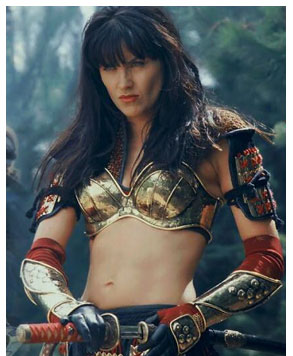

I’m not sure when I first heard about “Xena: Warrior Princess,” or when I first tuned in to see what it was all about. I remember watching reruns on the SciFi Channel and being drawn by the show’s unique balance of dark drama and wacky comedy, the fights that mixed gritty realism with stylized martial arts, the reinvention of ancient history and myth combined with snappy modern dialogue — and the characters, above all Xena herself.
There was something different about this show and its hero. Eventually, after watching a sixth-season episode that made me curious about story lines I had missed, I went on the Internet to catch up, and fell in love.
This month marks the 10th anniversary of the first time Xena rode onto America’s television screens. Actually, not quite the first: the Warrior Princess, played by New Zealand’s Lucy Lawless, had debuted several months earlier on “Xena’s” parent show, “Hercules: The Legendary Journeys,” as an evil warlord (warlady?) plotting to kill the great Hercules. This first incarnation of Xena was less a true warrior than a femme fatale who kicked ass. Still, the character appealed to viewers and producers alike: Originally meant to turn good, have a fling with Hercules, and die at the end of a thee-episode arc, Xena got a reprieve and a show of her own. For the next six years, she battled on, conquered the syndicated action/adventure market and changed history — the history of the world in the Xenaverse and the history of popular culture in real life.
“Xena” is credited by many, including “Buffy the Vampire Slayer” creator Joss Whedon, with blazing the trail for a wave of female action heroes: Buffy, Max of “Dark Angel,” Sydney Bristow of “Alias,” Starbuck in SciFi’s new “Battlestar Galactica” (in which Lawless guest-starred last week) and the Bride in Quentin Tarantino’s “Kill Bill.” (Tarantino is an enthusiastic “Xena” fan: He talks about his love for this “really cool show” in an interview on the DVD of “Double Dare,” a recent documentary about Hollywood stuntwomen featuring “Xena” and “Kill Bill” double Zoë Bell.) Nonetheless, the series could have adopted as its own the Rodney Dangerfield mantra “No respect.”
“Buffy” largely eclipsed “Xena” on the cultural landscape as the “girl power” show, garnering the critical analysis, the accolades for creative innovations that “Xena” did first (such as a musical episode) and, when it wrapped up, the grand farewell in the media. Too often, “Xena” got written off as campy swords-and-sorcery fare, a kids adventure show or a chicks-in-leather lesbian romp. Yes, of course it was campy, and it was a fantasy action show with gods and monsters that appealed to many children. And it did play unabashedly with lesbian themes. But it was so much more than the sum of all those parts. It had great characters and smart writing; riveting stories that often drew not only on ancient history and mythology but on sources as varied as medieval legends, Shakespeare, Richard Wagner and “The Producers”; and a cool, bracing feminism that was practiced, not preached.
How was Xena a female pioneer? Let me count the ways. She had no male support or regular romantic interest. She didn’t, unlike Wonder Woman or the Bionic Woman, have a conventionally feminine day-to-day alternate identity, though on a mission she could pose as a Roman matron, a virgin priestess or an exotic dancer. Xena was not “strong but feminine”; she was unapologetically strong and unapologetically female, sexy and powerful, unafraid to get sweaty and dirty on the job, and all the more beautiful for it. Nor did she care about pleasing anyone: In one memorable exchange, a slick opportunist seeking to enlist Xena as an ally says, “I like you,” and she shoots back, “Don’t. I’m not a likable person.” (As Lawless once said, Xena is “a good person who doesn’t think she is.”)
A flawed hero haunted by her dark past, even the “good” Xena could be angry, arrogant and, at times, driven by rage and revenge. She could also be vulnerable and tender, capable of caring and feeling deeply — Lawless did a superb job of capturing this blend of toughness and vulnerability — but those qualities always felt like aspects of her humanness, not reassurances of her womanhood. Yet while she pushed the limits of how much like a male hero a heroine could be, Xena was the first and probably is still the only action heroine who was also a mother — not counting warrior moms who fought only to protect their young, like Linda Hamilton’s Sarah Connor in “Terminator 2.” She was, safe to say, the only one who gave birth and breast-fed onscreen.
The show’s groundbreaking depiction of women was not limited to Xena herself. Her sidekick and friend, Gabrielle (Renee O’Connor), a village girl who had left home to travel with Xena and pursue her dream of becoming a warrior, had her own heroic journey. And there were plenty of other strong female characters: the vengeance-obsessed warrior Callisto, whose family had been killed in one of warlord Xena’s raids; the charismatic guru Najara, who was either a noble crusader against evil or a dangerous fanatic; Lao Ma, a fictional Chinese philosopher-empress whom the series whimsically credited with writing the Tao Te Ching; and Boadicea, Britain’s historical warrior queen.
Unlike some other female-empowerment shows, “Xena” eschewed overt feminist messages (with occasional exceptions, such as a jab at beauty pageants when Xena went undercover as a contestant). Xena and Gabrielle fought a variety of mostly male baddies, but they were not fighting sexism or the patriarchy. Gender, in the Xenaverse, just wasn’t a big deal: No one questioned Xena’s ability to fight and command, or Gabrielle’s desire to be a warrior, because they were girls. Ironically, one of the few episodes that dealt explicitly with gender issues introduced a man-hating female outlaw just to teach her the lesson that it’s not women vs. men, it’s good people vs. bad. In fact, plenty of the show’s good people were men; its primary male regular, Xena and Gabrielle’s occasional tag-along, Joxer (Ted Raimi), was a comically bumbling warrior wannabe — but also, in his own way, a true hero willing to risk his life for his friends. Meanwhile, the Amazons were not an idealized sisterhood but tribes with their own power struggles, conflicts and tyrannies. Women on “Xena” were simply human, no better or worse than men: feminism as it ought to be.
Yet “Xena” was exceptional for much more than its feminism. This tongue-in-cheek adventure show not only tackled “big” issues — redemption and justice, revenge and forgiveness, personal loyalty and the greater good, pacifism and violence — but usually handled them without pat resolutions and with an understanding that in many situations there are, in Xena’s words, “no good choices, only lesser degrees of evil.” Was it right for Xena to pay for her crimes with death or life imprisonment when she could do much good as a free woman? Was it just that she should be acclaimed as a hero when countless people were dead or shattered because of her? What did she owe her victims, and what responsibility did she bear for their crimes? How could Gabrielle reconcile her reverence for life with the need to defend the innocent with deadly force? Was even justified violence destructive to the soul?
The characters, too, were surprisingly rich and complex. (And brought to life by a talented cast: Besides Lawless, O’Connor and Raimi, standouts included the sadly unknown Hudson Leick as Callisto, Kathryn Morris of “Cold Case” as Najara, Marton Csokas as Xena’s past lover/fellow warlord Borias, and New Zealand TV star Kevin Smith — tragically killed in a movie set accident several months after the end of “Xena” — as the god of war Ares.) While Xena struggled with her past and present, Gabrielle grew from a spunky kid into an idealistic fighter who didn’t kill, then a total pacifist, and finally a formidable but battle-weary warrior. The women’s relationship developed from starry-eyed hero worship on Gabrielle’s part and affectionate protectiveness on Xena’s into a deep emotional bond. Yet, more often than not, it was rife with tensions and conflicts. Less central to the series, but still fascinating, were Xena’s relationships with her nemesis Callisto, with her onetime lover turned mortal enemy Julius Caesar (yes, the Julius Caesar), with Borias and with Ares, the god with a very human weakness for the Warrior Princess.
“Xena” was a show that made bold choices: to make its archvillain, Callisto, a tragic and often sympathetic character with a legitimate gripe against the hero; to allow the sidekick a series-long character growth arc that in some fans’ eyes made her the true hero of the show, and suggest that this growth was ultimately tragic; to let a comic-relief character die a noble and poignant death; to reinvent the history of the transition from pagan religions to monotheism with Xena as a protagonist. And it managed to do all that while (almost) never taking itself too seriously or losing its sense of humor and fun. Even some dark moments that could have easily slipped into melodrama were given a cool twist by the snappy dialogue that was one of the series’ trademarks. Callisto told Xena, “A part of me was hoping you would win and put out the rage in my heart. Sometimes it scares even me” — and added with a gleeful grin, “But then I get over it.”
The sense of mischievous, quirky, anything-goes fun was heightened by the setting: a pseudo-historical, kind of mythological world in which ancient Greeks wore medieval or Middle Eastern clothes and talked late-20th century American English (where else could you hear an Olympian god talk about someone’s “inferiority complex”?); in which Caesar and Pompey coexisted with Amazons, centaurs and gods; and in which the Trojan War, the Battle of Marathon and the death of Cleopatra were separated by just a few years. This time tweaking culminated in the hilariously demented sixth-season episode, “You Are There,” in which the Xenaverse was invaded by a Geraldo Rivera-type TV reporter named Nigel, hot on Xena’s trail with a microphone and a camera crew.
Unlike “Buffy” with its tight, carefully planned story arcs, “Xena” was the product of spontaneous evolution more than intelligent design. Sometimes, this approach could lead to glaring inconsistencies: The dialogue in Xena’s first onscreen encounter with Ares implied that she had never laid eyes on him before, yet later on it was hinted and then confirmed that they had a history in her warlord days. But this spontaneity was ultimately a strength more than a weakness: a loose, freewheeling creativity that included actors ad-libbing or changing their lines. And, somehow, it worked.
Not always, of course. Talk to a few “Xena” fans, and you will hear a lot of theories about when, if ever, the series jumped the proverbial shark. Most agree that it reached its pinnacle in the brilliant third season and had its peaks and valleys after that: There were some wobbly story lines, some recycled plots and other signs of creative fatigue, and in the final season a tendency to amp up the sexual titillation and overly graphic violence (with an overdose of both in an episode that had the heroines infiltrate a harem to rescue Gabrielle’s kidnapped niece). But at its most uneven, it was still a terrific show.
One offshoot of the show’s evolution was the much-talked-about lesbian subtext. Early on, some viewers — mostly though not exclusively gay women — discerned a romantic attraction in Xena and Gabrielle’s developing bond. Despite an early crop of male love interests, the idea that there was something going on between the Warrior Princess and her young companion made the rounds of Internet chat rooms and quickly got back to the show’s producers. After the initial surprise, they began to play to this perception with deliberate sexual innuendo, from double entendres (when a love-struck villager asked Gabrielle if Xena had considered settling down, Gabrielle replied, “No, she likes what I do,” then quickly corrected herself, “She likes what she’s doing”) to scenes of the duo sharing a hot tub.
The subtext took on a life of its own, and eventually the possibility that Xena and Gabrielle were “more than friends” was treated as a plausible reading of their relationship — preferred in some episodes, downplayed or contradicted in others. (There was no question that, however defined, it was the most important relationship in the two women’s lives.) In the last two seasons, another kind of subtext — between Xena and Ares, whose dynamic had been rife with sexual tension from the start — was also brought to the fore and developed into a complex love-hate relationship. Late in the series, both of these ambiguous romantic “texts” were explicitly acknowledged in “You Are There,” the off-the-wall comedy with the TV reporter: The nosy Nigel accosted Xena and Gabrielle with questions about their special relationship and demanded to know if Xena was in love with Ares. Both questions, of course, went unanswered.
The subtext gave “Xena” an added edge; it also resonated with vast numbers of lesbians who saw the heroines as role models and felt empowered by seeing what was, to them, a same-sex couple at the center of a television show. Many say that the series helped them come to terms with their sexuality, such as a 24-year-old British nurse who says that she found strength and happiness in the fact that everyone involved with the show thought that “one woman being genuinely in love with another is fine and lovely and beautiful.” For others, the subtext had a flip side. From the start, many straight female fans were concerned that it played into some vexing stereotypes: that a tough, independent woman in a traditionally male role must be a lesbian, that two women who have a close relationship and no boyfriends must be lesbians, or that a woman’s story must be a romance. Even some fans who appreciated the subtext saw it as a mixed blessing. One woman, a 28-year-old bisexual New Yorker, told me that while she’s “glad the characters became gay icons,” the disadvantage is that this can overshadow everything else that made “Xena” so great: “I hate it when I tell someone I love ‘Xena’ and I get the response, ‘Oh yeah, the show with the lesbians, right?'”
One might say that Xena’s sexual ambiguity adds to her larger-than-life quality: She is beyond labels, all things to all people. And yet it’s a pity that so much of the buzz generated by a show about a mythic female hero has ended up focusing on who she’s sleeping with. As openly gay “Xena” producer Liz Friedman once said in an interview, the show was “not about the romantic foibles of Xena and Gabrielle,” it was about redemption and friendship.
The fan-driven growth of the subtext illustrates another “Xena” phenomenon: the special relationship between the show and the fandom. Other than “The X-Files,” “Xena” was the first cult hit of the Internet age: the face that launched a thousand Web sites. One of the producers and principal writers on “Xena,” Steven Sears, participated in discussions on “Xena” message boards (and occasionally still does); other staff members and actors reportedly lurked there as well, and seemed well aware of fandom debates. In the last season, popular fan-fiction writer Melissa Good was hired to write several scripts for the series, two of which were made into episodes.
This involvement with the fandom turned out to be a double-edged sword. Almost from the start, the fandom was bitterly divided among various factions, particularly subtext fans pitted against those who saw Xena and Gabrielle as friends. Fandom wars over relationships are nothing new: “X-Files” fans clashed vehemently over whether Mulder and Scully should do the deed. In the “Xena” fandom, though, these wars had the added angle of sexual politics. Some of the anti-subtext sentiment was undoubtedly driven by bona fide bigotry. Some lesbian fans, on the other hand, approached the argument as a real-life gay rights struggle and labeled all dissent as homophobic: To them, denying a sexual relationship between Xena and Gabrielle was tantamount to denying the reality of their own lives, and the “Are they or aren’t they” tease was an insulting way to keep the characters in the closet.
In a way, knowing that the staff paid attention to fan opinions may have made matters worse: There was an incentive for the rival groups to out-shout one another to make themselves heard. Many fans who had no appetite for these wars fled the online fandom. Story lines that were seen as betraying the subtext, particularly the Xena-Ares relationship in the fifth season, were met with intense hostility from a small but vocal group; at other times, non-subtext fans grumbled about what they saw as pandering to the pro-subtext fan base (such as several sixth-season episodes emphasizing Xena and Gabrielle’s transcendent bond as soul mates). At the end of the series’ run, the Internet fandom exploded in a hysterical backlash against the finale, in which Xena died to right yet another past wrong and Gabrielle was left to travel alone. The official Xena forum at the Studios USA Web site filled with cries of betrayal and profanity-laced rants against the producers — who attempted appeasement by releasing a “director’s cut” version, in which the poignant final shot of Gabrielle alone on a ship was replaced by a hokey image of Xena standing next to her as either ghost or imaginary friend.
Yet, like “Xena” itself, the fan base, on and especially off the Internet, transcends the stereotype. Most of the fans, for instance — including some devoted subtext fans — are straight, and quite a few are men. They are lawyers and stay-at-home moms, high school kids and Ph.D. students, white-collar workers and artists, soldiers and college professors; East and West Coast urbanites and residents of Midwestern and Southern small towns (not to mention Australians, Europeans, Israelis and Russians); Wiccans and churchgoing Christians. They include a middle-aged psychology instructor who first started watching because she thought Xena looked cool and now regards the show as a philosophical guide to living, and an exploration geologist in his 30s who discovered “Xena” when he wanted to tape a baseball game and set the VCR to the wrong channel.
The afterlife of “Xena” has been a mixed success. Its ability to attract new fans has been hampered by the fact that for the past four years it has aired exclusively on Oxygen, the Lifetime Channel’s poor relation, its limited market access now compounded by the indignity of an 8 a.m. Eastern time slot. Its DVD sales have lagged far behind those of “Buffy,” “Angel” and “The X-Files.”
In spite of it all, “Xena” lives and thrives. Fans still flock to the annual convention. On the Internet, several “Xena” boards remain active; with no new battles to fight over the show’s direction, what remains of the online fandom is a far more peaceful, live-and-let-live kind of place that continues to draw new members. And in the wider culture, the impact of “Xena” is definitely still felt. In fact, “Xena, Warrior Princess” has become a kind of generic term for “tough chick.” (Condoleezza Rice, who does a pretty good Xena-style steely gaze herself, has been nicknamed “Warrior Princess” by her staff — much to the dismay of many left-leaning “Xena” fans.) Recently, a Chicago Daily Herald review of a gender-bending, nearly-all-female production of “Henry IV” was titled “Shakespeare Meets Xena,” and the reviewer noted that today’s audiences can easily accept the feminization of the play’s power struggles and battle scenes because of “familiarity with battling babes like Xena.”
And just last month came the news that a team of astronomers at Caltech who discovered a new heavenly body that may be the solar system’s 10th planet have nicknamed their find “Xena.” It’s not going to be the object’s official moniker — the astronomers have already applied to register it under another name — but for now, it has already made headlines as Planet Xena. Take that, Buffy.
