
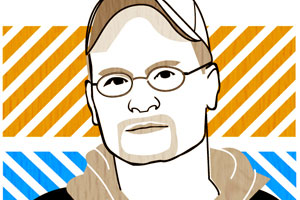

When it comes to milking fame out of a life story, few navel-gazers have been as successful as Augusten Burroughs. For close to 100 weeks, his 2002 memoir “Running With Scissors” has been sitting on the New York Times bestseller list, alongside longtime bestsellers from fellow memoirists Dave Pelzer (“A Child Called It”) and David Sedaris (“Dress Your Family in Corduroy and Denim”). Next year, a long-awaited film version of “Scissors” starring Gwyneth Paltrow and Annette Bening will hit the big screen, and an earlier Burroughs book, the novel “Sellevision,” is also being made into a movie.
Although he’s only 40, Burroughs’ life story seems to contain no end of salable anecdotes: After “Scissors,” he published the follow-up memoir “Dry” (2003) and a collection of personal essays, “Magical Thinking” (2004); he writes a monthly autobiographical column for Details (his writing has also appeared in Salon) and frequently contributes to NPR’s “Morning Edition.” According to his Web site — a vision of salesmanship that helpfully reminds you on every page that Burroughs is a “#1 BESTSELLING AUTHOR” — he’s also working on a collection of essays and a holiday book. All of this would be only vaguely interesting if Burroughs were regarded as simply a wildly popular mass-market hack. But Burroughs’ memoirs consistently generate glowing reviews and flattering comparisons to David Sedaris’ work. And yet, he is a terrible writer.
To say that Burroughs is a writer akin to Sedaris is so befuddlingly off-course that the suggestion smacks of sheer laziness, akin to the tired P.R. game that creates suspect book-jacket blurbs (for “Joycean,” read “long-winded and obscure”) and overzealous movie marquees (If you liked “Some Like It Hot,” you’ll LOVE “White Chicks”!!!). And to proclaim that Burroughs and Sedaris should share a fan base suggests that literary merit has nothing to do with craft, that a tenuous similarity of substance — both writers trade in autobiography and humor — trumps the quality of the writing.
Sedaris’ essays are careful constructions of artful manipulation; like a good composer, he understands that where you place the notes is as important as what notes you use, and he perfectly times his tricks — the witty one-liner; the more expansive, subtle joke; the somber, introspective moment that tugs out your heart. Not so for Augusten Burroughs. His narratives are shapeless lumps of clichid sentiments, boring dialogue and tortured metaphors. As an authorial voice, Burroughs has a third-grader’s wit and the introspective wisdom of a stone; as a crafter of stories, he possesses an ear for tone and pitch as flat as William Hung’s. Still, this lack of literary flair doesn’t bother many readers. Stories of sex, abuse, valium overdoses and bizarre spiritual beliefs offer us an opportunity to gawk at a grisly scene, to make us feel glad our childhoods weren’t that bad, and to warm the cockles of our hearts with what is, ultimately, a happy-ending story about overcoming adversity.
But how does Burroughs snow the critics? For one thing, to pick on the memoir of a junior-high dropout, one who claims not to have read a book until he was 24, might feel downright mean. Burroughs positions himself in his books as a victim — of parental neglect, of a pedophile’s advances, of alcoholism — pleading for a little kindness, and it seems likely that many otherwise-shrewd critics have willfully overlooked his books’ flaws and extended the hand of friendship out of sheer pity. Yet there are glimpses of a secret dislike, snippets of doubt, in otherwise positive reviews of “Scissors.” In the New York Times, Janet Maslin conceded that the book “slips occasionally into hackneyed territory”; Virginia Heffernan, in her Times review, admitted that it “lack[s] the fire and art that make literature different from life”; Stephen J. Lyons wrote in the Boston Herald that in “Scissors,” “the writing advice ‘show, don’t tell’ is taken too literally.” But it’s one thing to personally forgive Burroughs for writing like an adolescent, another to lower the bar on writing altogether — especially when it comes to a genre that, like fiction, relies on critics to uphold a meritocracy that the marketplace ignores.
This critical charity, like that of readers, is based on the idea that Burroughs’ books are completely true, a concern that has also occasionally cropped up in reviews and then been quickly paved over. “Can you, reader, suspend disbelief?” Virginia Heffernan archly asked, before succumbing to pity: “But let’s not inflict more therapy on Burroughs.” That the question still lingers says something about the vulnerability of Burroughs’ work. Disbelief isn’t an issue in Sedaris’ essays; one suspects that the underlying true-story details have been filed down and rearranged anyway, to create something better than true, something that’s qualifiably art. If it turned out that Sedaris had, say, never worked as a Christmas elf at Macy’s, “Santaland Diaries” would still make great fiction, because it is charming and funny and well-crafted. Burroughs’ work, on the other hand, resembles less a mosaic construction than a coughed-up hairball: It’s gross, primitive and smacks of something that needed to be released for the creator’s own health, but really shouldn’t have been shared with others. As dismal as his writing is as memoir, it would make for unforgivably awful, boring fiction that no one would bother to read, much less recommend.
So imagine this: What if Burroughs made it all up? What if he isn’t the train wreck, the victim, the innocent bystander who overcame the odds? In late July, the surviving members of the family with whom Burroughs once lived, and who gave him the fucked-up childhood he writes about in “Scissors,” filed a lawsuit against him alleging defamation, fraud, emotional distress and invasion of privacy. The Turcottes are claiming that most of “Scissors” is composed of Burroughs’ “own bizarre, imagined scenarios and exaggerated descriptions,” and, in addition to seeking unspecified monetary damages, they’re asking that the book be reclassified as fiction.
Burroughs, born Christopher Robison, grew up in the Pioneer Valley in Western Massachusetts, with a stoic, alcoholic father and an egotistical poet of a mother, the quality of whose verse was inversely proportionate to how extraordinary she believed it to be. According to “Scissors,” when Burroughs was 11, his parents divorced, and at 12, his manic-depressive mother had left him in the care of her psychiatrist, Dr. Finch, who “looked exactly like Santa Claus,” who had a “Masturbatorium” in his office, and who taught Burroughs such things as how to fake a suicide attempt to get out of school. By the time Burroughs was 13, Finch had become his legal guardian, and the 33-year-old Neil Bookman, Finch’s former patient and adopted son, had become Burroughs’ lover — to the approval of Burroughs’ mom and Dr. Finch.
Burroughs describes life in the Finch house as a social worker’s worst nightmare: The kids play with an old electroshock therapy machine; Finch’s grandson defecates on the carpet while the older children cheer him on; one of Finch’s daughters, the 14-year-old Vickie, lives with a pack of roving hippies; and another, Natalie, 13, lives with her 42-year-old “legal guardian,” a former patient of Finch’s and, it is eventually revealed, Natalie’s lover. The family’s spiritual practices consist of asking God questions via “bible-dips” (in which the questioner points blindly at a word in the Bible and then interprets the answer from that word) and clustering around the toilet to divine messages left in Finch’s feces.
But according to the lawsuit, Burroughs ”fabricated events that never happened and manufactured conversations that never occurred.” It also asserts that Burroughs’ editor at St. Martin’s Press and literary agent (both of whom are listed as defendants) encouraged Burroughs to “sensationalize and exaggerate” in order to have “a more commercially viable ‘true story’ to market to the book-buying public,” and that Burroughs meant to ”knowingly caus[e] harm and humiliation to the Turcotte family.”
(Neither the defendants nor their lawyers would comment on the case for this story.)
Whether he meant to hurt them with his portrayal, Burroughs does take pains to describe the Finch household in the most simplistic and shocking way, leaving nothing of the squalor to the reader’s imagination. He calls Finch’s wife, Agnes, “a lady hunchback with kinky, grayish, almost purple hair,” and when he first meets Vickie and Natalie he notes their “long, greasy, stringy hair and dirty clothes.” Of the house itself, from the outside it “was pink and seemed to sag”; inside there was “the overturned sofa in the living room, the dog shit under the grand piano [and] the moving blanket of roaches that covered all the dishes and pots and pans that were piled on the sink and on the kitchen table.”
On the other hand, many of the details about Dr. Finch do correlate to Burroughs’ real guardian, Dr. Rodolph Turcotte, who died in 2000 at the age of 80. Like Finch, Turcotte looked exactly like Santa Claus (even occasionally wearing a Santa hat), and was a former psychiatrist at Northampton State Hospital. In the early ’80s, Turcotte’s psychiatrist’s license was revoked when he was accused of sending his 13-year-old daughter to live with a former patient, which jibes with Burroughs’ account of Natalie’s lover/guardian (though the real former patient was in his 30s, not 42 as Burroughs claims).
Yet, a reporter for the Republican in Massachusetts who had interviewed Turcotte in 1989 doesn’t remember the Turcottes’ house being squalid. And the suit also implies that there’s something suspect about Burroughs’ chronology. According to the Turcottes, Burroughs’ entire family was in therapy with Rodolph Turcotte starting in 1971. Assuming Burroughs doesn’t lie about his age, that would make him 5 years old, not 10, as he claims in the book, which would make the sequence of events leading to his life with the Finches less of a whirlwind and more, perhaps, of a gradual progression. Although it’s a small detail, it’s one that supports the contention that Burroughs exaggerated for effect.
And of course Burroughs stretched the truth; all memoirists do. The problem is that his exaggerations, if that’s what they are, have damned an entire family. The Turcottes’ explanation of how Burroughs came to live with them is so mundane that it’s easier to swallow than the one Burroughs offers in “Scissors”: According to the suit, when, around 1979, Burroughs was having difficulty at his Amherst school, “he, with his mother, asked Dr. Turcotte to become his legal guardian so that he could attend school in Northampton.” Rather than a matter of abandonment, the story of Burroughs’ childhood upheaval, in the Turcottes’ telling, becomes a situation of school zoning.
Burroughs has acknowledged that, of course, there are times when one must “creatively recreate,” though he claims to be able to back up everything he’s written with his childhood journals, and in a 2003 Bookslut interview, he basically threw down the gauntlet: “With my own memoirs, they are truthful, and I write everything fully expecting to some day end up televised on Court TV, and I’m fully prepared to be challenged legally on it,” he said. “Everything I write is the truth and I know that I would win. I know I would win.” But could he really have recorded — or worse, remembered — such banal conversation as this? “‘Well, I gotta go,’ Hope said. ‘Dad needs me at the office. We’re behind on the insurance forms. See you guys later?’ ‘Yup. Catch you later,’ Bookman said. Hope opened the front door to leave. ‘Bye, Augusten. Have fun.’ ‘Okay, see ya.'”
And if that seems like a trifle of an exchange to make up, consider that the vast majority of Burroughs’ dialogue is equally vapid and useless. Or that every character in the book, unless he or she has a funny accent to comically exaggerate, sounds the same, like Burroughs himself — shiny-eyed and dull, full of clichis and snapless comebacks. “‘Knock it off you two, I’m trying to sleep,’ Hope would sometimes complain in the middle of the night.” Who the hell cares? If this is the type of thing Burroughs recorded in his journals, then perhaps he does deserve our pity — for being the most boring child on earth.
Throughout “Scissors,” there is a childishness to Burroughs’ writing, a lack of self-reflection or analysis evident in the vague and redundant ways he tries to explain how certain moments affected him. Although it’s clear from the get-go that the affection-starved Burroughs latches on to the pedophilic Neil Bookman as a source of attention, he repeatedly explains his desire — “Secretly I wanted revenge, but I also wanted his companionship, and that won out”; “Bookman was the only person who gave me attention, besides Natalie and Hope”; etc., etc. — as if we just might not get it that a 13-year-old never really consents to sex with an adult. Burroughs may have taken much of “Scissors” from the journals he kept as a child, but his attempt to explain how he felt after anal sex is so juvenile, it sounds like a spoof of a kid’s diary entry: “On the one hand, I had gotten used to the sensation of him up there, even if it made me feel really full and like I needed to take a big shit. But on the other hand I didn’t like doing it because I didn’t like him anymore and I didn’t like being on my back like that and it just seemed so weird.” As irritatingly vague as these passages are, they play perfectly into Burroughs’ victim persona; by refusing to analyze, he forces the reader into the role of therapist, sharply diagnosing abuse where the patient can’t see it and moving us to pity his innocence.
To connect with a book like “Scissors,” one has to believe Burroughs’ story — has to believe in him. In his tendency to defend the absolute truth of what he writes, Burroughs sounds a lot like his other neighbor on the Times bestseller list: Dave Pelzer, whose line of memoirs starting with “A Child Called It” (1995) also recounts a tortured childhood, and who is the guy widely credited with shepherding in the memoir craze. (Pelzer has yet to be legally challenged on his books, but that may be because his mother, who he claims abused him when his siblings weren’t looking, is dead. At least one of Pelzer’s four brothers has disputed his books, while another has come out with a memoir of his own, claiming he too was abused by their mother.) This isn’t to suggest Burroughs is a hustler on the level of Pelzer — whose bulk buying of his own books may be responsible for his bestseller status. But both writers rely on the horror of what they describe — not the felicity and power of their writing — to entertain readers.
Burroughs’ fans tend to use phrases like “darkly funny” and “wildly entertaining” to describe his writing, but it seems what they’re responding to most is the fact of the story and not the way it’s told. Humor is subjective, sure, but there is nothing witty about Burroughs’ punch lines — sentences like “Ours had become a seesaw relationship, and right now it was all saw,” or “I was lit from above, the most unflattering light, like a hamburger at a fast food restaurant.” What surprises readers into laughing are the unfortunate events happening around the bad lines — in this case, Burroughs’ relationship with Neil Bookman — coupled with the jokey tone in which they are related. Burroughs’ sunny narration of dark events, the same cheery lack of introspection that turns the reader into a therapist, obscures his positioning of himself as a victim; because he doesn’t seem to be self-pitying, because he tries to crack jokes about his horrible childhood, the hoodwinked reader admires his plucky optimism and, once again, forgives him his utter lack of wit.
Also like Pelzer, Burroughs — whose first job, not so incidentally, was in advertising — has created a brand of himself: In “Scissors” he presents himself as a generally agreeable and all-around nice guy, an adorable eccentric who only does bad things because he’s victimized (or later, in “Dry,” because he’s an alcoholic); he is never mean, and there is always someone close by to remind him (and us) that he is talented and sweet and funny. In “Scissors,” the only texture to the young Burroughs’ personality is a desire for fame: “I craved fan letters and expensive watches,” he writes, and thinks up schemes involving his own brand of hair-care products to achieve his goal.
Could memoir be the grown-up Burroughs’ hair-care line? It’s hard to know. But regardless of whether his product claims are true or not, his books have always been made with the crudest ingredients. In the beginning of “Dry,” a memoir that Burroughs initially wrote as a novel, he offers an author’s note: “This memoir is based on my experiences over a 10-year period. Names have been changed, characters combined and events compressed. Certain episodes are imaginative re-creation, and those episodes are not intended to portray actual events.” What would have happened if “Scissors” had carried a similar warning? Jonathan Yardley, perhaps the lone critic to resist pitying Burroughs, wrote in the Washington Post, “If you insist on reading “Dry” — and for the life of me I cannot imagine why you would — read it as a novel. If you do that, you’re going to end up thinking: ‘So what? '” The same has to be said of “Scissors.”
So as Turcotte v. Burroughs gets underway, while the lawyers fight about whether Burroughs is truthful, let a shadow tribunal spring up, composed of Burroughs’ fans and critics, to judge why truthfulness is so important to his writing, and what it means to his place on the literary ladder. Let them think about why David Sedaris gets away with describing his work as “true enough” and freely admitting to exaggeration, and why Burroughs can’t. Even though mediocre memoirs that appeal to voyeuristic urges will probably sell big for a long time to come, conflating these with literary memoirs is not only absurd, it has spawned an entire movement of limp, I-had-a-wacky-childhood tell-alls — and who needs them? Isn’t it time to put an end to this madness?
