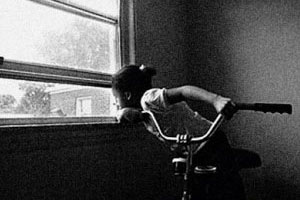

In debates about America’s swelling prison system, a shadow population often remains unmentioned: the children of the convicted. But in a new book, “All Alone in the World: Children of the Incarcerated,” journalist and activist Nell Bernstein lifts the cloak of invisibility from prisoners’ families — and challenges the criminal justice system to stop punishing kids for their parents’ crimes.
In the book, readers are introduced to Susana, 15, who has hugged her father only once but faithfully sends Father’s Day cards inscribed with Bible verses to his cell at San Quentin. Seven-year-old Anthony has been set adrift in the foster care system since his mother had her parental rights terminated after shoplifting a Bic lighter from a grocery store. And there’s Carl Metz, whose mother is serving three life terms for dealing cocaine, and who dreams of rapping on BET, wearing a “Free Danielle Metz” T-shirt.
Meticulously reported and sensitively written, Bernstein’s book draws upon a decade of research and astounding personal interviews. Rather than abstracting the issue, she lets her child narrators lead readers through each stage of the criminal justice system — beginning with the piercing shock of a parent’s arrest and the arbitrary punishment of sentencing, through the humiliation of searches in sterile prison visiting rooms, into the maze-like mess of foster care. Kids and parents may dream of reunification, but Bernstein shows readers how often the cruelties of incarceration continue even after a parent is released.
Despite these grim realities, Bernstein — a former Soros fellow who writes occasionally for Salon and is a Mother Jones contributor — remains hopeful that change is coming. She scours the country in search of advocates who are working to improve the prison system’s treatment of families and highlights programs that model a more humane approach to crime and punishment. She entreats readers to understand that it is not prisons themselves that dissolve family bonds — but the application of justice without empathy. “We are able to lock people up … only so long as we see them as useless,” Bernstein writes. “But the majority of prisoners are mothers and fathers: they are needed in the most fundamental way.”
Bernstein spoke with Salon by phone from her California home about the unbreakable bonds between children and parents, how Hurricane Katrina has devastated already-fragmented families, and why she believes prison is the modern-day equivalent of slavery.
Your book is about prison, but it touches on so many other issues — drug sentencing reform, criminal justice, foster care, child welfare, and family rights.
Even though I’ve been working on this topic directly for about five years, the idea behind the book really began to grow five years before that — and it didn’t come out of an interest in criminal justice per se, but rather an interest in family. I spent almost a decade editing a youth newspaper — and that was mostly in the 1990s, which of course was the “family-values” decade. If you think back to the 1992 Republican convention with Dan Quayle, you remember there was a growing public rhetoric around family values — and the idea was that a lack of those values was attacking the American culture. At the same time, I was working in an office full of young people who were really fighting tooth and nail for family but were facing really intense pressures that made it difficult to maintain those connections. It was clearly not that they didn’t value them.
It was just one of those cultural moments when the gap between rhetoric and reality got a little too big to stomach. And then right in the middle of that work, while I was doing some reporting on foster care, I met this kid named Ricky. Now, I thought I was interviewing him about foster care, so I asked how he came to be in the system and he told me the story — which is in the book — about being 9 years old, at home with his mother and his baby brother, when the police came and took away his mother and just left him there. Ricky spent two weeks taking care of a baby in an empty apartment before someone noticed. And hearing that made me realize how much of a role the criminal justice system was playing in the forcible disruption of families and also how completely invisible these kids were.
Really the statistics are staggering. In the book you say one in 33 of all American kids and one in eight African-American kids currently have a parent behind bars. How can they still be invisible?
The other number that really stands out for me is that one in 10 kids has a parent that is either in jail, on probation, or on parole. So if you think about the number of kids who have had or will have this experience, it is almost inconceivable.
How can they still be invisible? Well, that’s something I’ve been struggling with. There was a story I saw just a few weeks ago in Police Chief Magazine…
Wait, did you say “Police Chief”?
Yeah, I know, people have asked me if I subscribe, but no, that’s just the kind of thing people send you when you write about this stuff. But anyway, the article looked at the issue of how to deal with children at the time of arrest from a liability perspective, and ran through some cases that had made their way to the courts.
There was one case I knew about that really set the precedent for police liability, in which a man was pulled over for speeding and then left his three nephews alone in the car by the side of the freeway. And in that instance the boys wandered out onto the freeway, so the courts did find police liability. But there was another case that I hadn’t known about where police pulled a woman over because her 2-year-old wasn’t in a car seat and she had a couple of older kids in the car too. Then, when police ran her license they found that she was driving with a suspended license, so they arrested her — but left the three kids, including the 2-year-old, behind.
So I read that, and I just sat there and tried to figure out how 10 minutes ago the police officers had cared enough about the welfare of that 2-year-old to pull his mother over because she needed to have him in a car seat — but then the moment she crossed over and was arrested and became an “offender,” suddenly her child didn’t need or deserve even the most basic protections. So that’s how these kids stay invisible.
But why do we treat them this way? In a way that’s one of the central mysteries I explore in the book, and I haven’t quite answered it yet. But I think that it comes down to this idea of American individualism, and our obsession with individual responsibility and just desserts and that retributive model of criminal justice, and the lack of imagination that makes us think the only way that we can deal with everything from writing a bad check to carrying a bag of marijuana is to pull people out of their communities and isolate them. That’s a really profound mind-set and it’s a mind-set that doesn’t allow for the reality that people are connected to one another, and are part of families and communities that are disrupted when we use isolation as our main mechanism of correction.
In fact, most of the children you spoke with seemed to feel a lot of anger and cynicism about justice and authority after watching their parents get locked up.
That’s true, and I think one reason we have to keep these kids invisible is because if we really saw them, we’d have to change how we do business in a pretty profound way. Obviously that’s what I would like to see happen, but there’s a lot invested in doing things the way we do now.
You point out the irony that it’s kids who are so often used as a rhetorical tool in the war on drugs and crime — as in “we need to protect kids” from these dangerous people. To be fair, isn’t it really the state’s intention to remove these kids from a potentially harmful parenting situation?
You know, when I do interviews and talk about these things on the radio, there are a few questions I always hear. The first is, isn’t this all really the parents’ fault? The second is, wouldn’t these kids be better off without these kinds of parents? Now, of those questions, the least relevant to me is “Isn’t it the parents’ fault?” Because, you know, if I were to turn my back and my son were to wander off a cliff, I’d want someone to catch him, whether or not it was irresponsible of me to let him play so near the edge. But the second question — “aren’t they better off?” — I think that really is what people think, but it desperately needs to be addressed. I think there are a few things that allow people to think like that, for one, not understanding that when you take a child’s parent away there’s not some sort of perfect other adoptive home out there waiting for him. There’s 20 or 30 foster homes or an impoverished grandmother or being passed from hand to hand. It’s not as if we’re actually offering them something that will make them better off. But the main thing that I’ve learned from talking to so many kids, which should be so obvious, is that these are the parents they’ve got. These are the parents they love. And their connections to those parents are exactly as real and as deep as my connection to my kids. And I know that should go without saying, but it never does.
You point out how isolation and incarceration cause the “reciprocal relationships” that hold people together to become eroded, until whole communities face crises. That made me think about Katrina, when you heard so many people asking, “Why aren’t these people leaving New Orleans? Why don’t they go stay with family somewhere else?” without understanding that they were talking about individuals stuck in poverty, literally stripped of family resources or any kind of community safety net to fall back on.
Are you reading my mind? Really, it’s so interesting that you should raise that point, because two of the families in the book were affected by Katrina, and in exactly the way you describe. Dorothy Gaines, a woman I write about from Mobile, Ala., was arrested in the mid-’90s on extremely shaky conspiracy charges and as a result got clemency six years later and came home to her kids. She had previously worked as a nurse’s technician but after her release she wasn’t able to go back to that field because of the felony restrictions — so she wasn’t able to find work, she wasn’t able to live in public housing, she wasn’t able to get any kind of support. When Katrina hit, she was living with three children and four grandchildren in her oldest daughter’s two-bedroom apartment. I spoke to her not long after, and she told me about sitting on her daughter’s porch and watching, as she put it, the big long cars leave the city. She was among those who didn’t have gas to put in a car. And when their apartment flooded, they just sat there. And obviously Dorothy wasn’t the only one, but this was a family that prior to her incarceration had resources. They didn’t have a big, long car, but she worked and she provided for her kids, and she would have been able to put gas in the car and get out of the city. Her incarceration drained her family of those resources, and it was simply made very visible post-Katrina
The other family is the Metz family, many of whom actually live in New Orleans. Danielle Metz, as you read in the book, is serving triple life for being involved in her husband’s cocaine business. While she has been away, her children have been cared for by grandparents and her sister Adrian — a woman who in addition to caring for her sister’s daughter also took in four grandchildren in the wake of her own daughter’s murder. Adrian always talks about how her greatest prayer is that God will release Danielle so that she would be able to help her in caring for all these children, including her grandchildren.
Adrian lives in Stockton, Calif., but when Katrina hit she happened to be in New Orleans visiting some of the extended family. So she wound up at the Astrodome and then after the storm passed, she brought her two brothers and their families, as well as her 67-year-old mother, back to California. On top of that, Adrian’s church in Stockton chartered three buses and drove 150 more people to California. So here’s Adrian — whose life has already been turned upside down by her sister’s incarceration — and is now trying to reconstitute her entire family, again drained of resources. I actually got a letter from Danielle where she said exactly what you’re saying — that it’s hard to have your family need you and not be able to do anything for them. That idea of reciprocity is the basis of family life.
So, it’s just not working, and no one has really faced that. The state may have gotten Danielle Metz off the street, but New Orleans is still one of the most violent, corrupt, drug-plagued cities in the nation. And recent events don’t indicate that law and order began to reign once they began giving people whose husbands sold drugs triple life sentences.
You cite a half-dozen programs that have proven to be viable alternatives to incarceration — but even D.A. Joe Hines, who runs the very successful Drug Treatment Alternatives to Prison program in Brooklyn, N.Y., is adamant about not being thought of as a “finky liberal.” Do you think that need to be seen as “tough on crime” is part of the problem?
Definitely, and what’s really interesting is that every state in the nation does have several model programs that work — they lower crime, they lower recidivism, they help people get over drug problems. And states are rightly always very proud of these programs — but they are still always the exception. And I haven’t figured out why we create special funding streams that last three years for the programs that actually work, while the pot is bottomless for the system we know doesn’t work. You know the recidivism rate in California is something like 80 percent, but prisons are still the untouchable item in the budget.
What do you think about the fact that if reform does come, it will likely be because overcrowded prisons cause fiscal strain?
You know, we’ll be lucky to even get that reform. A couple of years ago when the states were facing these intense budget crises there were a lot of small but significant activities that were budget-driven. A few states rolled back their mandatory sentencing laws, and a number of states started doing early release and things like that. But just last week, the government’s latest round of prison numbers came out, and the population is up, again, and the rate of incarceration for women is growing at double the rate of men.
That’s a statistic you hear a lot about these days. Why do you think that women — many of whom are mothers — are ending up behind bars in such large numbers?
There’s pretty good evidence that it’s not because there’s this unprecedented rash of violence among women. It’s because of the drug laws — it’s really just that simple.
But aren’t far fewer women major players in the drug world?
Yes, but that fact also means they have little information to trade — which under mandatory sentencing is the only way to get your sentence reduced. In fairness, they are still the smaller part of the prison population, but they are nonetheless the fastest-growing and least violent.
And because that rate is rising, and has been now for a few years, what you’re seeing now is that neighborhoods that were first drained of fathers over a period of decades are now being drained of mothers. So, people are still talking about single-parent families without recognizing that there are growing numbers of kids growing up in no-parent families.
We can’t really talk about this issue without looking at the fact that minority children are disproportionately affected by the criminal justice system; something like half of all parents in prison are black and another quarter are Hispanic. There is one passage in the book where you make a comparison between the current dissolution of families through incarceration and the dismantling of families during slavery.
Well, it is an idea that is complicated and controversial. There is a whole set of activists who describe prison as the new slavery and I think it’s a complex analysis. But when you look at it from a child’s perspective, the parallels really jump out at you.
I used that passage that you are referring to, from Peggy Cooper Davis, because I thought it was important to note that the Abolitionist movement didn’t just talk about slavery as a violation of personal autonomy but also as a denial of family bonds. And in fact, that was one of the most convincing arguments that the Abolitionists made and that ultimately led to the end of slavery. In the book, I quote one Abolitionist who wrote, “Pro-slavery men and women! For one moment only, in imagination, stand surrounded by your loved ones, and behold them, one by one torn from your grasp, or you rudely and forcibly carried from them — how think you would you bear it?”
Because when I read that, I felt like I could have, except for some of the archaic language, been listening to the description of the experience of a kid who’d seen his mom arrested over and over. To him, the fact that she did something to make it happen is not the central fact.
But aren’t there always going to be prisons, and always going to be some people who really do deserve to be in them, even if they might be parents?
Well that’s really the big issue. And we can look at it from two parallel tracks. At the very least, we need to not leave kids alone in empty apartments. We need to not break down doors if we don’t have to if there are kids present. It would be nice to ask a mom to step outside before we handcuff her, so her kids don’t have to see that. There are a whole range of things that could be done to make things better for kids when a parent is arrested. We need to have a more humane visiting environment, more supports for poor elderly grandparents.
But I think the danger is that we will stop with that. And I think the conversation so far — to the degree that it’s being had at all — has ended there. How can we make things better when a parent is incarcerated, with the assumption that that’s inevitable? But I’d like to see us start to look at sentencing through the kids’ eyes. So that would mean every time we remove somebody from her family, we stop to look at what the problem is we’re trying to correct. Is this the only option? Or is there another option that would keep us “safe” — because public safety is always the counterweight — perhaps by solving her addiction or tendency to write bad checks, and still allow her children to have a parent. I think that if we look at sentencing through that lens, my guess is that the prison population would drop by half.
Because so many people are incarcerated for nonviolent, drug-related crimes?
Well, there is that. But it’s also because prison is meant to rehabilitate — and there are people who commit violent acts but could be rehabilitated and won’t do it anymore. There are people in prison who have been there 20, 30, 40 years and are never going to get out and are going to need hundreds of thousand of dollars in geriatric care. So, I want to be careful — I don’t think we need to leave the people who have committed violent crime out.
Well, it seems like that’s where you may lose a lot of support. Because there is a big gap in most people’s minds between drug addicts and murderers and rapists.
Yes. But one thing that one of the women I write about in the book, Elizabeth Gaines, really has helped me understand is that if you’re a kid, your needs and what you deserve don’t vary based upon whether your parent is a nonviolent or violent offender.
You know, I think even I was overly invested in that distinction to begin with. I think that when there is a public safety reason for intervening, we need to make sure that intervention makes the person less violent rather than more. That’s again, the terrible irony of prison — some people don’t get out, but many people commit violent acts, go to prison, are immersed in a violent culture, given no help and no treatment, and come out more violent. So we’re still not safer.
You resist the idea of an intergenerational “cycle of crime.” But still you recognize that an incredible number of children who have parents in prison eventually wind up in prison themselves. How do you explain that conflict?
Well, I used to cite a number that you’d see everywhere — it’s even been in Senate testimony — which was that a kid whose parent has been incarcerated was six times more likely than other children to wind up behind bars himself. And finally Denise Johnston, who runs the Center for Children of Incarcerated Parents in Pasadena, Calif., sat me down and explained to me that if that number were accurate, there would be more people incarcerated than our population. The math just didn’t work.
But that number is still everywhere, and it became the central argument for helping the kids — like “help these kids now or in 10 years they’ll hit you over the head and steal your purse” — when often that just contributes to the stigma and becomes a self-fulfilling prophecy and is ultimately not fair because although many kids go on to get in trouble, many, many don’t. On the other hand, if you go into juvenile hall and ask a group of young men or women how many of them have experienced the incarceration of a parent, most of the hands will go up.
There is just no denying that reality. I think, though, that the assumption is that that is because their parents are criminals and teach them criminality, which may be part of it — but again, I think that we have to look at whether the trauma of our intervention might be making it more or less likely that that cycle is going to be perpetuated.
One young man that I spoke with had a mother who was in and out of prison his whole life, and then eventually so was he. And I remember him saying, “The system, her, they made me who I am.” Like in his head, his mother’s addiction and criminality and the system’s response to it were the same thing. They were both pressures that lead him to being addicted and locked up himself.
As a culture we have already done battle over women’s rights and gays’ rights and minorities’ rights — why do you think the concept of “children’s rights” has been so difficult to get our heads around?
You know, I think we’re almost radically unable to see things through kids’ eyes. Even you and I are having that problem — we keep drifting back to the adults, and the question of what the adults deserve. I did a radio talk show the other day, and the host asked, “But aren’t there some people who just don’t deserve to be parents?” And my immediate thought was maybe, but there aren’t any kids who don’t deserve to have parents.
And it’s just very hard for institutions, whether it’s criminal justice or child welfare, to see things through kids’ eyes. And one of our central fallacies, which I’m becoming more aware of now that I have my own kids, is that if we don’t tell kids, they won’t know. Like if we don’t talk to kids about what is happening, it won’t affect them, or we shouldn’t take them to visit parents because prison is a scary place.
You asked me at the beginning why these children were invisible, but really, in some ways, aren’t all kids? I think we live in this kind of crazy culture where we talk about them all the time but mostly they’re a rhetorical device. That’s probably just a natural extension of being an adult, but that’s why in the book, while I didn’t talk to little kids for obvious reasons, I did talk to a lot of people who had been little kids when this happened to them — and it was just so illuminating for me to see it through their eyes and to see how very much they saw.
Sarah Karnasiewicz is a freelance writer and photographer based in Brooklyn, N.Y. Until recently, she was senior editor at Saveur magazine; prior to that she was deputy Life editor at Salon. She has contributed to the New York Times, the New York Observer and Rolling Stone, among other publications. For more of her work, visit thefastertimes.com/streetfood and Signs and Wonders.
More Sarah Karnasiewicz.
The call came early in the morning. The 3-month-old granddaughter of my neighbor had finally succumbed to the illness she was born with. I am a midwife, but this call wasn’t about a birth. This time the call was from the mortuary.
I have spent the last 30 years taking care of women in pregnancy, birth and beyond. I use my hands to help bring life into this world. Over the past few years, however, I found myself using those very same hands in the performance of a Taharah, a Jewish ritual that prepares a dead woman for burial. Birth, life, joy, beginnings vs. death, decay, finality. Such a contrast! What could be more different? And yet, somewhere in my consciousness, there was a commonality. Caring for a woman in her life, preparing a woman for birth had a parallel in preparing a woman for burial. The act of helping a woman and her baby through their many transitions seemed analogous to helping the soul transition from this plane of existence to the next.
“Taharah” means “to purify.” Particular prayers are said and simple hand-sewn white linen garments dress the body. All this is identical for everyone, no matter how old, how young, how rich, how poor. During a Taharah, all are treated the same.
I performed my first Taharah, and it was more than I expected – more silence, more depth, more sensitivity. The concern of being with and touching a dead body left as soon as I entered the room. The midwife in me took over. The four members of our team worked quietly, with tenderness. The peace in the room was tangible and present, and our lady seemed to reflect that. Her entire body, as well as her face, seemed to relax as we completed the ritual, intoning the prayers. And the energy, amazingly, felt the same as at a birth — a feeling of completion, a palpable sense of the soul transitioning and a humble appreciation of the privilege of being there.
To perform the Taharah when a woman has lived out her life, has seen her children grow and have their own children, seems part of the natural logic of life. The first Taharahs I took part in were just that. This next Taharah, however, involved someone who had not lived a long life, had not lived to see her children grow, and this time, I was to be alone.
The call stunned me. I knew she was sick, but this wasn’t expected. Now the mortuary was asking, could I be the one to take care of her? I had never before performed a Taharah on a baby. My experiences with babies were of life, not of death. There was always joy, a new beginning. Here was unimaginable sadness, an ending.
As I looked at the tiny garments, it became real, and I worried about how I would react. My mind remembered my nursing training, when we were doing a rotation in the NICU and how I just couldn’t bear to be with sick babies. All I could think about were my own babies and I had cried to my instructor, “Just get me out of here!” Now I was going to be with this fragile body, with this baby who was no longer sick, but was actually gone.
I entered the room alone. I washed my hands in the correct ritual way, pouring water first over my right hand, then my left, right, left, right, left. I retrieved her body. She was so small, so light, wrapped in a clean sheet. It was time for the first prayer. “Master of the world! Take pity upon the present deceased for she is the daughter of Sarah, Rivkah, Rachel and Leah. May her soul rest among the righteous women.” I didn’t know what to expect as I began the unwrapping. She had been so sick, she had had so many invasive procedures and devices. What would she look like? I uncovered her slight form, and she simply looked as if she was sleeping. Did I detect the barest hint of a smile on her face?
I removed the IVs, the bandages and washed her carefully, talking softly to her and caressing her the whole time. I worried about her delicate, almost transparent skin. And then it was time for the ritual immersion. I would submerge her in the pool of water known as the mikvah, a symbolic act of purification, representing the body’s return to the womb, to the bath of the amniotic fluid, and the soul’s return to the original waters of Creation. I cradled her body, continuing my dialogue and immersed her in the ritual bath. Tears streamed down my face, falling into the water, as I repeated the prescribed words, “Tahorah he, tahorah he, tahorah he” … “She is pure, she is pure, she is pure.” The silence was piercing; time seemed irrelevant.
Finally the dressing. These garments, though they were the smallest ones, overwhelmed her tininess. I continued the ritual, placing her in the casket, then covering it. I ended with the ceremonial asking of forgiveness from her, just in the event that anything done was humiliating or disrespectful to her or had deviated from the tradition. I left the room and her.
Driving home in silence, my mind spun with the images of this Taharah. At the same moment I parked in front of my home, her grandfather pulled up across the street. Most of the time, the mourners don’t know who performed the Taharah and unless they ask, nothing is said. But as I looked at him, at the visible unspeakable grief on his face, I knew that I had to tell him. “I took care of her,” I said. His face and body seemed to dissolve. Recovering, he asked me to come across the street to his home, to talk with his wife and daughter. They needed my reassurance, he said.
The baby’s mother, his daughter, only wanted to know if her baby looked frightened. I told her how peaceful she looked, with that almost-smile I thought I had seen. That seemed to comfort her. Then there were a few more questions, many tears, and expressions of gratitude. It was clear that it was time for me to leave. They needed to do their mourning without me.
So why had I been drawn to participate in this ritual? Death carries with it such pain, and whether the death is that of a young person or an elderly one, there is great sadness. However, having watched women in birth, it’s so clear that pain is transitory. There is so much more than just the pain. And with death I believe that there is more than sadness. The process of the Taharah is perhaps a metaphor for what is left — the dignity and integrity of the person, the love that she experienced during her life and leaves as an inheritance to the ones close to her.
I find myself grateful to be part of a tradition that recognizes this and expresses our connection to the Creator, which treats everyone, even in death, with respect and caring. I feel privileged that I am able to participate in this final act for a woman, that I can be midwife to her spirit.
Children can ask a lot of very annoying questions. Starting at about 2 years of age, they begin barraging their parents with endless queries, from “Are we there yet?” to “Why is the moon round?” — questions that often seem more like desperate ploys for parental attention than anything else. And, to make things worse, cooperative parents are often treated to a relentless barrage of follow-up questions, many of which involve one word: “Why?” Is this process infuriating? Yes. But is it crucial to their development? Far more than most of us think. And furthermore, the frequency and form of those questions can tell us a lot, not only about how children learn but also about cultural and class differences in America.
In his new book, “Trusting What You’re Told,” Paul L. Harris, a Victor S. Thomas Professor of Education at Harvard, argues that much of what we’ve assumed about our kids’ early learning may be misguided. Although many parents and teachers think of children as primarily independent “scientific” learners who best absorb knowledge by physically interacting with the world — an idea that informs everything from Montessori education to museum planning — Harris believes it woefully underestimates the importance of dialogue in young kids’ lives. Conversation — and question asking — allows young children to grasp highly abstract concepts, from religion to history, at an earlier age. However, as Harris points out, the way young children learn can vary surprisingly between working-class and middle-class children, and people from different ethnic backgrounds.
Salon spoke to Harris over the phone about Montessori’s mistakes, Asian-American kids’ deference levels, and why working-class kids ask fewer questions.
Why is it so important to determine where young children actually get their information?
A lot of research on cognitive development has argued that children do best when they’re exploring the world for themselves in a scientific fashion. That idea has a long pedigree. If you read someone like Rousseau, that’s what he’s basically advocating — along with more recent researchers or educators like Paget or Montessori. Even in the last decade or so there have been a lot of titles within the popular science mode that have focused on the “scientist in the crib” or the “child as a scientist.” But I think it dramatically underestimates children.
Where is this, as you argue, misguided approach to early education reflected?
If you go into a Montessori classroom, which is the archetype of this, the child is given materials to play with — be they rods or cones or things to assemble — and the assumption is that the child learns best about numbers and space from interacting with those concrete materials. I’m not quarreling with this as an educational device; I just don’t think it’s the whole story. You also see this philosophy in progressive science museums for children that pride themselves on being hands-on experiences: The child is not necessarily told very much, and he or she is encouraged to try things out for themselves.
You argue that, rather than allowing children simply to figure things out for themselves, it’s incredibly important that children learn things by interacting with adults from a young age. When does that form of learning start?
Probably before the child learns how to talk. There was a nice set of experiments where toddlers who were barely able to walk were given a slope to go down. The slope was made a little bit too steep for them to be confident on, and they’d often turn toward a parent of caregiver looking for advice. The evidence showed that if the parent looked anxious and apprehensive, the toddler would probably hesitate to tackle the slope, and if the caregiver looked encouraging and optimistic, the toddler would go ahead and try to negotiate it.
But this process of learning from others really comes into its own when the child is starting to talk, from 18 to 24 months upward. If, for example, the child puts a toy in a box in a room, and the child comes back into the room, and you tell the child that you’ve moved the toy to a different box, by around two and a half, children are very good at listening to you and will go search in the new place. This is a very early illustration of the way human children realize that the world may not be as they saw it, or as they see it, and that their best bet is to listen and trust other people for guidance.
At a certain point in their childhood, kids start asking lots and lots of inane question where they don’t even seem to be interested in the answer. It can be insanely annoying, and a lot of parents dismiss this as a way to get attention, but you argue that it’s actually incredibly important.
It’s true that children ask a lot of questions, but if you look more closely at the kinds of questions they ask, about 70 percent of them are seeking information as opposed to things like, for example, asking permission. And then when you look at those questions, 20 to 25 percent of them go beyond asking for bare facts like “Where are my socks?” Children ask for explanations, like “Why is my brother crying?” If a child spends one hour a day between the ages of 2 and 5 with a caregiver who is talking to them and interacting with them, they will ask 40,000 questions in which they are asking for some kind of explanation. That’s an enormous number of questions.
And it’s not just attention seeking. When children ask questions and you answer them, that is actually a setting for a sustained dialogue, and they’re trying to get clear in their minds about a particular issue that’s confusing to them or bothering them.
One disturbing finding you highlight in the book is that children in less wealthy families are far less likely to ask these kinds of inquisitive questions.
The most critical variable is the education of the mother. The more educated the mother, the greater the richness of the vocabulary and sentences they use with their children, and to some extent the greater the amount of time they talk to their children. One study was done in the U.K. with a group of working-class 4-year-olds and middle-class 4-year-olds, and the middle-class 4-year-olds were more likely to ask questions than the working-class 4-year-olds. This was also true not just of the single one-off questions but more persistent series of questions. That study also showed that children asked many more questions at home than at preschool, so when we send kids to preschool we’re giving them opportunities to play with other children and pretend play or whatever, but in terms of one-to-one dialogue where these kinds of sustained explorations can take place, we may be limiting the opportunities.
Children also seem to trust answers that come from parents more than other people they don’t know as well.
We’ve done a variety of experiments, and children seem to have a variety of biases that steer them more toward some informants than others. One of the most basic is that they’ll often turn to familiar people rather than strangers. Though by the time the child is 5, if a familiar person starts saying things that from the child’s point of view are incorrect or implausible, the child will become less receptive to that person.
There’s a surprising finding in the book that Asian-American children are more deferential in their early learning than others. What does that mean?
There is data comparing American children who are European-American and children from Asian-American families, and to cut a long story short, it looks as if the first-generation Asian-Americans children are more likely to scan the social horizon, more likely to listen to other people. I don’t think we should automatically jump to the conclusion that’s an intellectually inferior strategy; it’s actually an intellectually sophisticated strategy. We don’t know exactly what brings this cultural difference about, but our best guess is that it goes back to the dialogue between caregiver and children — that mothers differ in the extent to which they encourage children to voice their own opinions or record a child’s opinion as worthy of attention.
But the willingness to provide and act on what you’re told is not something that’s peculiar to any particular culture. Deference has been an important tool for the transmission of culture. Human technology becomes more elaborate, more complicated, from one generation to the next, and deference allows information to be picked up and acted upon. Chimpanzees, for example, deprive themselves of the ability to learn culturally inherited wisdom passed on from generation to generation. If we look at chimpanzee tool use, it tends to be unsophisticated; it doesn’t accumulate over generations.
You draw parallels and contrasts between childhood beliefs in religion, in the sense of the existence of God, and in more scientific things, like germs. What are the conclusions you can draw from that?
This is another illustration of how the traditional portrait of the child as a little scientist doesn’t work. A 4- or 5-year-old child isn’t in a position to observe germs, but talk to one, and they are pretty convinced they exist. It’s perfectly routine for children to believe in things that they can’t observe, and they do that presumably by listening to what other people say and looking at the presuppositions in what people say. This is as much true of germs and oxygen as it is of special beings such as God or Santa Claus or the tooth fairy. From the perspective of the child the primary evidence they have is what other people tell them about these entities.
The making of that distinction between scientifically established and more religious or supernatural entities is far from straightforward. There’s a sense that children are a little bit like psephologists: They look at what people say around them, and they do a head count, and they see that there’s nobody who’s a skeptic about germs. But on the other hand there are very subtle signs that God has a different status. Then of course when it comes to Santa Claus and the tooth fairy — and eventually in the schoolyard — they’re going to meet a skeptic if not several, so their belief in those entities is going to suffer a heavy blow at some point.
What do findings tell us about how children first learn about death and understand it?
They start by understanding that the body has a life cycle, and that people have these internal organs that have to be working for them to live — and that at a certain point in time the life cycle comes to an end. These internal organs cease to function. The biological account of death implies that once you’re dead, that’s it. Life has ceased. By contrast the religious conception of death typically carries with it the implication of some sort of afterlife. But it takes them a longer time to start accepting the claims that a particular community will make about the afterlife. The other interesting finding is that it’s not as if those two accounts are in competition with one another. So when children subscribe in the end to a Christian notion of the afterlife, it doesn’t lead them to abandon the biological conception. Both coexist in the child’s mind — and get recruited in different contexts.
Given your findings, how should we be changing the way we educate and parent our children?
One thing that it calls attention to is how much children can learn just by talking to people and engaging in dialogue with someone they’re familiar with. Even at a fairly young age, children can be guided to think about episodes, places, periods in history which are fairly remote from their own immediate experience. Part of the human experience is the capacity to leave behind the here and now and to think about very different times and times and places. I suppose the other aspect of the book that I didn’t dwell on, though it’s increasingly on our mind, is the fact that thanks to technology, children’s access to information is now amplified. At an early age children have these spontaneous filters. They’re trusting some people more than others; navigating the Internet, which is tricky; and many of them are left to their own devices in figuring out how to do that. It’s not as if we have educational programs which encourage children to think more carefully about where they gather information from. What we tend to do is try to guarantee that children’s access to certain misleading sources or difficult sources is blocked rather than giving them the tools to make assessments for themselves. In the future we’ll have to address that question more systematically than we do and at an earlier age.
“Never work with children or animals” is an old W.C. Fields chestnut that, for a while in the ’90s and ’00s, everyone outside of children’s entertainment seemed to be holding sacred. Child actors were off on their own in a parallel entertainment universe created by Disney and Nickelodeon, while adults held down the fort in dramas and reality shows. There were some notable exceptions, like Haley Joel Osment and Christina Ricci, but by and large, children were almost entirely absent from grown-up entertainment.
Things are very different today. Kid-targeted movies filled with teenage actors like “The Hunger Games” and the “Harry Potter” franchise have found a huge adult audience, while actors like 15-year-old Chloë Moretz (who stars in the new movie “Hick,” opening this week) and the Fanning sisters are given prominent roles in serious dramas. On TV, children have become a regular part of many casts, from sitcoms (“The Middle,” “Modern Family”) to dramas (“Shameless,” ‘The Walking Dead”). Child actors, once a sign of cheesiness and unprofessional conduct, have become integral to the success of a large number of critically respected and commercially successful entertainment properties. And not only that, many of these child actors have gotten really, really good.
Think of Kodi Smit-McPhee from “The Road,” holding his own next to Viggo Mortensen. Or Emma Kenny’s Debs on “Shameless,” capable of moving from a funny scene — yelling “Eat my ass!” at a video game — to the heartbreaking moments she shares with her unappreciative father, slipping him beer or covering his passed-out body with a blanket without getting any thanks. Or even Aubrey Anderson-Emmons, the new Lily on “Modern Family,” only 4 years old but emphasizing the weirdness rather than the cuteness of the 2-year-old she plays. (When she was cast, other cast members talked about how good of an actress she was, which seemed strange to say about a 4-year-old, but she’s proved it this season.)
The rise of the quality child actor (coming, it should be noted, considerably later than the rise of “quality” TV) can be traced to two general phenomena. One is that scriptwriters and directors figured out how to use child actors effectively, emphasizing a naturalistic style that let them fit in with their costars and lose all the groan-worthy signals that a movie was just for kids. But the other is the emergence of that very parallel entertainment universe. Nickelodeon and Disney didn’t just create hugely successful TV shows and movies; they also created a reason for more and more child actors to come to California, to learn their craft and to be able to fill those new, cheese-free parts.
Why were child actors so reviled throughout the ’80s? Here are some names that might jog your memory: Michelle Tanner. Jennifer Keaton. Willis Jackson. Child actors seemed either designed to run onstage and say something cute to elicit an “awww!” in unison from the studio audience, or to smirk and hack their way through the broad teen comedies filling mall multiplexes. While directors like Stephen Spielberg and John Hughes were able to elicit compelling performances from younger actors, their technique didn’t seem to take and derivatives of their successes seemed to share more with the B-movies of yore than they did with “E.T.” or “The Breakfast Club.” (It didn’t help that a lot of those “kids” were being played by adults, either.)
It’s no surprise, then, that anyone backing a TV show or movie intended to be seen as serious and high-quality would do everything they could to keep kids out of it; even good shows focused on kids couldn’t survive on network TV during the dead zone between the mid-’90s and early ’00s, as “My So-Called Life” and “Freaks and Geeks” could attest. It’s a style of acting we still see today: think poor Jake Lloyd playing young Anakin Skywalker in “The Phantom Menace” in such a cutesy way that it rendered the movie nearly unwatchable. Or most of the actors on Disney and Nick shows, for that matter. (Though at least the kids are playing themselves; previously many “teenagers” were played by adults.)
Sometime during that fallow period, though, producers figured out how to not only capture that Spielberg magic, but even improve on it. There are times (see above, or here) when the acting in Spielberg’s kiddie flicks is so unaffected that it comes close to breaking the fourth wall. Young actors are now placed in fantastic situations (wizard school, vampire wars, Upper East Side prep schools) and expected to convincingly embody a real character — and they’ve become very good at it.
“Over the years, the acting style has changed,” said Harriet Greenspan, a casting agent and acting instructor in Los Angeles who has worked with a number of kids’ shows. “It’s become a lot more real. Thirty years ago, acting was acting. We look for kids that aren’t acting anymore, that are more real.”
The general path of child actors has always been commercials to TV shows to movies, but there was a long-standing block at that second level: There simply weren’t very many TV shows child actors could work on. Most “children’s entertainment” was cartoons or educational programming staffed by adults. Cable changed all that. While the first shows for tweens are generally thought to have aired on NBC during its Saturday-morning block of “Saved by the Bell” and its spinoffs, cable created a venue for kids to watch themselves acting like kids — and, unsurprisingly, it turned out they really liked it. (Cable also created the split, in its way: If the kids were off watching tween shows, “family hour” shows didn’t have to feature cute kids to get the parents to watch.) This marked an important shift in how kids were portrayed.
“Nickelodeon first came up with its ‘Kids Rule’ slogan quite purposefully in the early ’90s,” Dave Moore, a media expert at Temple University, wrote in an email. “This necessarily transformed kid actors from subservient to adult programs to perceived ‘rebels’ acting out against authority.”
Both Disney and Nickelodeon slowly built up universes of programming and stars that spanned media from TV to music to movies, a world with kids playing kids to an audience of kids. The acting there was frequently as broad as you might have seen on any ’80s sitcom, but that wasn’t the important thing. “Child actor” isn’t a career anyone decides to pursue; first you get a gig, and then you make a life of it. The emergence of so many more roles for younger actors created a much larger pool of actors other projects could draw from. By the time a child actor is being asked to play an 8-year-old, he or she is likely to have more experience now than ever before.
“The trend of ‘grooming’ child actors from a young age has probably been facilitated in an age with more media exposure sooner,” Moore noted. But this has not always been a positive development.
“It’s a kids’ world out there,” said Greenspan. “So many families are picking up their lives and moving to California because of their child’s career. Of course, kids get bad advice — they get one role and the parents pack up and move, and sometimes it’s months or years before they get another gig.”
Exploitation has always been a concern when it comes to child actors; while California has strict rules about how long kids are allowed to work per day, it can’t control the bad decisions parents might make when their kid isn’t working. Bogus “talent searches” and managers ostensibly trying to discover the next big child actor or model pop up regularly in cities small and large, and most of these are scams. Nor has the fate of child actors generally been smooth.
All that said, the return of younger characters to mainstream entertainment has been a welcome one. In the last decade, both comedies and dramas have gotten a lot better at showing us adults who are recognizable humans, not just collections of showbiz gestures assembled into a numbing whole. While that sophistication in storytelling techniques was happening, though, children were largely left out, as if adults wouldn’t be interested in seeing compelling portrayals of kids (even as they cropped up in shows like “Malcolm in the Middle” or movies like “The Sixth Sense”). Now, Chloë Moretz can give us a dark comedic take on a character her age while Helena Bonham Carter does the same; Kiernan Shipka shows us how girls like Sally Draper deal with the socio-historical shifts of the ’60s just as Elisabeth Moss does the same for young women; and if Chandler Riggs’ portrayal of Carl on “The Walking Dead” sometimes makes you root for his death, well, he’s right there alongside Dale and Lori. On the children’s shows of Disney and Nickelodeon, kids have been portrayed from their own perspective for the last few decades. Now, adults are getting to see kids as real humans, too.
Michael Barthel is a PhD candidate in the communication department at the University of Washington. He has written about pop music for the Awl, Idolator, and the Village Voice.
More Michael Barthel.
I must’ve been eight or nine the one time my dad took me along to meet Bart. This was somewhere near Tompkins Square Park. What I recalled was a shaggy shock of blue hair, and feelings of both elation and terror: On the one hand thrilled to be old enough to be taken along one night to the city to meet a guy with blue hair, and on the other frightened of the jagged dark in the Alphabet City of the late ’80s. In my memory Bart looked like Warhol, but maybe that was just part of the dream pedigree I had for my dad, the one that looked to White and Genet and not “Will & Grace.” But I did think that my dad once said he’d gone with Bart to sell drugs to Allen Ginsberg, so maybe in this case my retrospective fantasy — that if he’d had a secret life, it could at least have been an exciting one, something worth escaping his surface life for — was accurate. I remembered hearing for the first time about AIDS, and I remembered my dad walking around for some months, maybe years, as though accompanied by ghosts. It was selfish and obscene for me to look back and want his secrets, the secrets I’d come here to try to clear up, to have hidden amazing things: It meant I have at best ignored and at worst aestheticized the fact of what must have been unimaginable pain. Like any gay man of his age, he’d watched a great number of his close friends die of AIDS, but unlike many of those men, he was not able to talk about it to the people closest to him, the people he lived with. Maybe the reason he liked “Will & Grace” and not so much White and Genet — though, now that I think of it, I did give him “The Married Man” once and he told me it was the best novel he’d ever read — was that all he wants now is to be normal and happy. He wanted to marry Brett and drink boxed wine and take Yoshi out for walks and watch “Mamma Mia!” until their DVD player caught fire. I myself had never been less than loathsome on the subject of “Mamma Mia!” and I felt terrible about it, but I didn’t want to digress into overemphatic apology, and I would stand by my derision of “Mamma Mia!”
It was around the time that Bart died of AIDS that things began to get really bad. That was when my dad had dyed his bangs platinum, which didn’t go over so well with the congregation he then served and would not serve much longer. This was around the time that in a fifth- or sixth grade art class I made a painting of a male seraph sealed in a black box in the center of an otherwise Edenic scene and wrote, in black block letters across the top, Who are you forcing into the closet? A nasty debate ensued over whether it could go up on the middle-school wall. I can only imagine that my dad had gone to see “Angels in America,” talked about it at home. It is, however, also possible that this episode lends credence to his idea that I knew all along. He talked about theater a lot back then and gave me John Simon’s reviews to read when he thought they were particularly savage. They were confusing for a 10-year-old. But I liked waking up in the morning to clippings he’d left under my door. Sometimes he said he’d wished he’d been an actor, had become a rabbi less for the liturgical than for the performative aspects of the job, and because he’d so much liked spending time in Israel and speaking Hebrew. This was also around the time my dad started to seem arbitrary and punitive, when he would come home late and throw all my CDs down the stairs because there was unfolded laundry on the dining room table. I began then to understand there were sealed-off swaths of my dad’s time, and that the patterns of his emotional climate could neither be predicted nor accounted for.
“Bart was the first person I ever told I was gay. That was in 1986. I was taking social-work classes one night a week in New York. It was raining and I was headed downtown in a cab. The cabbie asked if I minded if we picked up a guy standing in the rain. He got in the cab and looked at me and knew right away, and we went out for coffee. He was the first person I could talk to openly.” Again, it’s hard to get his stories straight (again: so to speak). When he told me, at nineteen, that he knew I already knew he might prefer men, the backstory went like this: In the early to mid-’90s he discovered he was bisexual but chose to live with this knowledge and remain in his marriage. In 1997 or 1998, after meeting Brett, he began to envision a different sort of life. It was time for him to do something for himself for a change, put himself first. This meant the license to make up for lost time. There was a lifetime of Palm Springs poolside drag parties to catch up on.
After five or six years he was telling a new version, or hinting at one. There were salacious allusions to the loss of his virginity, wistful ones to his first love. But these comments felt more like boasts than invitations to further inquiry. Under the pretense of closeness it expanded the distance between us. His unexplored asides reminded me of how much I didn’t know, how much had happened that had nothing to do with me. “I had a boyfriend who sold drugs to John Lennon. Someday I’ll tell you about that,” he’d say, and then smile and trail off. These conversations made me angry. No, more than that, they made me feel stupid, gullible, excluded. He’d deceived me, deceived us, and then everything he ever said could only appear in that light. His clumsy attempts to clue us in only ever deepened my sense of deception. The implication of this second story was that he’d been with men before and then decided—in a way that somehow suggested a proleptic sacrifice — to martyr himself with a straight life. Twenty years later he found the strength to live once more for himself. His stories always ended with this new resolve, a moment in which he at last was able to swear off his burdensome obligations.
I told people, when they asked me about my expectations for Rosh Hashanah in Uman, that what I thought was going to happen — what I wanted to best-case-scenario happen — was to hear the third version of his story, the one where Micah and I found out he’d been with men all along. I wanted to hear this in part because I wanted to feel undeceived. Of course, though, there’s no such thing as making yourself undeceived; I suppose I wanted the deception confirmed. Contained. Laid bare. There had always been rumors. My freshman year in high school I heard third-hand from a classmate that my father had told someone he was gay, or maybe had been seen at a gay fundraiser. What was worse than not knowing was that other people did somehow.
“I told Max in 1988. I went to Philadelphia on business and I stopped into his office at the thermocouple plant when I knew I only had 10 minutes to talk. I told him and I walked right out before he could really respond. He didn’t know what to say. He didn’t say he knew all along. I think he was stunned.”
“Did Max seem accepting?”
“I don’t know. I didn’t give him a chance to say anything. I told my mother a few months later. By then Bart was taking me out and introducing me to people, showing me around, taking me to the Roxy.”
“So you and Bart were involved, then?” I tried to keep my voice even.
“No! Never. That first time I met him, over coffee, I made a pass, but he looked at me and said I was craaaazy, that he’d have to be crazy, that I had a wife and two little kids at home. He didn’t want to get involved with that. So we were only ever friends, which was better anyway, because what I needed then was a friend I could talk to about things I’d never talked to anybody about.”
“I want to know how you were feeling then. Did you wake up in the morning at home and look around you and think, This is not really my life?” I thought of David Byrne, This is not my beautiful house . . . this is notmy beautiful wife.
“No. I wanted that life too. I wanted to be married. I loved you guys, and I loved your mother, and I know you don’t believe me but I still love your mother. I never thought about doing anything differently.”
“But didn’t you feel regrets? Don’t you feel regrets now? Wasn’t it hard to live this double life?” I was baiting him a little. It seemed important to me, had seemed important to me for a long time, to know he regretted everything, he was sorry for everything, he wished it had been otherwise. I do not know how to account for this but there was some part of me that wanted to hear he regretted we’d been born.
“Gay guys compartmentalize. It’s just what you have to do. No, it wasn’t that hard, mostly, and I really have no regrets at all. At that point in my life I had no way to imagine anything else. In 1974 there was simply no openly gay role model in my life that might have shown me a way to live differently. And I never didn’t want to be married. I never didn’t want to have my family. I’d always wanted a family.”
“So, what made you finally stop? What made you decide it was time to come out. Also, wait a second, what’s 1974?”
“I wanted to give your mother her life back.” Micah and I exchanged our long-practiced well-that’s-bullshit look. The one thing we knew we were absolutely not going to talk about was our mom, because whatever he was possibly going to say was going to make us angry. “And I wanted to do something for myself. I wanted to put myself first.”
“But weren’t you already putting yourself first, at least half the time? In your New York life? In whatever was going on in the other compartment? Weren’t you number one there?”
“I guess I wanted to put myself first successfully.”
“And you couldn’t have done that before? And you never regretted not having done that before?”
“No, really, Gideon. I am not lying to you. I couldn’t and didn’t.”
We stood over fragments of Jewish gravestones strewn amid the clumps of dead grass. This was all a little much, the broken gravestones, the pogrom detritus. I was surprised. I’d always imagined this was going to be a conversation about his regrets, about the psychic strain of having committed to a life that didn’t feel like yours, that didn’t feel like what you’d wanted or chosen for yourself. I was prepared to be sympathetic to him — the volatility, the punitive tendencies, the absences — if I could hear from him that he’d been driven out of his mind by the suspicion that his real life was happening elsewhere. If he’d had two lives, I could have been at the very center of one and at the very periphery of the other, and I would have known to take only the first one personally.
But my dad was making it clear that he did not feel as though his real life had been elsewhere. I had suggested it must have been hard to have two lives, and he’d agreed, but he didn’t actually have two lives. Nobody has two lives, just like nobody lives an imitation life. He had one life, a real life, and in that one life he’d told a lot of lies and kept a lot of secrets, and it was never clear if I was — if we were — at the center or on the margin. I’d never wanted to think of him as a liar. I’d never wanted to feel like someone who could be so easily lied to. I’d wanted him to have regretted a lot of things because that might also have meant he hadn’t lied about a lot of things, and if he regretted them, it meant he was acknowledging he hadn’t made the best decisions — even if he continued to think of the consequences of those decisions in terms of his own life, not in terms of ours.
But I could hardly deal with his regret, either. If he was a liar, I was an idiot; but if he was regretful, Micah and I had been burdens. It would be better to admit I’d been deceived, deceived by the person in the world I most wanted to be like — the navigator who knew all the long-cut (mileage-saving, time-adding) hypotenuses on local back roads; the only parent who was willing to drive around on empty unplowed streets after a blizzard to pick up all of our friends on the way to the secret sledding hill he’d found; the former college radio DJ who’d always been so endearingly baffled by the part in “MacArthur Park” (the Donna Summer version, of course) where someone leaves a cake out in the rain; the news junkie who came to dinner with labeled manila folders for each of us, full of relevant and absurd clippings from the five daily newspapers and three weekly magazines he read; the theatergoer who loved the savagery of this John Simon guy and took me to off -off -Broadway productions in dingy Greenwich Village basements when the other suburban parents made the thirty-minute trip into New York once a year to go skating at Rockefeller Center; the rabbi who seemed so proud and calm and authoritative giving demanding High Holiday sermons in which he alluded to the lyrics of Queen and Procol Harum, who made me so proud to be the rabbi’s son, progeny of moral authority, near to a moral center, even if I had so little practical knowledge of Judaism — than to continue to feel as though my existence as the rabbi’s son had thwarted his chance at having the life he deserved. I did not want to have to imagine my childhood and adolescence as an obstacle. I wanted to be able to think of his happy gay life now in terms other than contrastive freedom.
We paused under a lone shade tree and looked at a few sheared-off gravestones with Hebrew names. We picked our way over the uneven ground. Micah had grown completely quiet. He’s got other issues, or maybe he doesn’t have any issues at all. He doesn’t remember as much as I do. He’s much quicker to let go of things.
“But, Dad, wait a second.” I felt as though we’d skipped something here, that whatever had actually been going on — this other life we’d started to talk about — was being acknowledged without being admitted. If he wasn’t going to talk about regret, then we were going to talk about lies.
“You said that Bart was the first person you ever told you were gay. But didn’t you have relationships with men before that?”
“Well, there were always physical things. Bart would take me out and I’d find gratification. After a certain point you just get tired of masturbation, you know? But there was nothing emotional, nothing serious. It was all just physical. After all, don’t forget, I was married.”
I hadn’t forgotten. This felt so unfair. If your dad casually admits to having serially cheated on your mom for your entire childhood with other women, you have the right to be furious. If your dad casually admits to having serially cheated on your mom for your entire childhood with men, you’re supposed to be sympathetic. Or I felt as though I had to be sympathetic. He was such a convincing martyr. I hadn’t been allowed — hadn’t allowed myself — to be furious for so long, because I’d believed the story of sacrifice my dad told. I wanted to feel furious now, but all I could feel was a surprising sense of gratitude. I felt as though these casual admissions had fixed something for me, both in the sense of repair and in the sense of the record I’d come to get, and I was somehow finally understanding where I stood in relation to him.
“No, I mean, that’s interesting,” I said, eager to keep this going, “but that wasn’t quite what I meant. I thought once when you were visiting me in Berlin you made some comment about your first boyfriend, your first love. And a minute ago I thought you said something about 1974.”
“Oh, well, that was before my marriage. That was Rocky.”
My dad stopped and smiled his least melodramatic smile. The imminent unveiling of these memories made the moment seem staged, as if he’d been given a script and asked to play the part of a father overcome with nostalgia. He looked engulfed, totally convincing. I didn’t know if I wanted to hear what was coming. When so much has been kept secret, it’s impossible to know what you do and what you don’t want to know, what ought to be shared and what might best be kept to oneself.
“I was twenty-one and in Jerusalem alone. I’d wanted to go abroad to Russia but it was hard to do that in 1974, and my plans fell through at the last minute. So I scrambled and went to Israel instead. If I’d gone to Russia, I probably would’ve ended up in the CIA or the State Department or something, but as it was I went to Israel and I met Rocky, and I loved Hebrew and I loved Israel and I thought, I’ll just stay here and become a rabbi. Rocky was in his forties. He was an ophthalmologist. He once fitted Golda Meir for contact lenses.” My dad laughed.
“Where did you guys meet?”
“At the Turkish bathhouse, which was the only thing like a gay scene in Jerusalem in the seventies. You could go and, you know, have sex with young Arab boys.” I hadn’t known that. Micah, I am willing to guess, hadn’t known that.
“Rocky had money, and he had this great apartment, an entire floor on the fourth floor of a building on King David Street, right near the YMCA and HUC,” the reform rabbinical seminary where my dad met my mom a year or two later. “He had such nice things, such beautiful furniture, wonderful rugs. Exquisite taste. I was a kid and away from home and he took care of me.” My dad looked so sweet and serene as he remembered this other place, this thing it’s tempting to call a previous life. We all kept stumbling on the shards of pogrom gravestones underfoot.
“When did it end?”
“I started rabbinical school the next year and met your mother and that’s what I wanted then, so I broke it off with Rocky.”
“And there was really no way for you to imagine living a gay life then? No role model?”
“It was unimaginable to me.” I wondered why Rocky himself didn’t count.
“How did he take it when you broke up with him?”
“To be honest with you, I can’t remember. I hadn’t made any promises to him. I was really just a kid. But then” — he paused — “I went and saw him once, years later, maybe 15 years later, I looked him up when I was back in Jerusalem.” We’d gone to Israel as a family in 1988, when I was eight and Micah was five. Micah had been run over in the street by a kid on a bike. “I can’t remember what we said to each other, though.”
“I’m sad that you were never able to tell us these stories. I’m sorry you weren’t able to tell them to us growing up.” I was a little shaky, but it was a lot easier to hear stories that predated my mom than the other ones he’d been telling. We’d gone back past the mikveh and were walking by a low-slung trailer soliciting donations for a “Fond Rising for the Monuments to Victims of Holohost.” I wanted to hear these stories, didn’t want to hear these stories, felt bad about needing to hear them, felt bad about not wanting to hear them, doubted that even this third version of his life was totally honest, angry to have to feel doubt, very sorry for my mom — sorry for my mom both because of what she went through and because it felt like a kind of betrayal to feel so good that talking to him about all this stuff made him feel so good.
It is nothing special that my dad had a life separate from me, or that he kept secrets; this is something all parents do — straight ones, scrupulous ones — and it’s what we grapple with, to varying degrees of success, our whole lives. What’s unusual about my relationship to my dad’s life is not that there were things about it I didn’t know because he was gay. It’s that I was able to indulge the fantasy that he kept secrets only because he was gay, that if he had been able to be openly gay he would’ve shared his entire life with me and I always would have known exactly where I stood. At a certain point other people have to understand that parents keep secrets, that parents close parts of themselves off to their children, because that is what parents do.
What was I getting out of learning this now? In part, I wanted to hear him tell a story about his life in which he claimed some responsibility for the way things had turned out, rather than a story in which he was first in thrall to social mores and later in thrall to biological urges, in which the pretexts had shifted but the irresponsibility had remained. In which he’d never simply said, “I did it because I felt like it.” I wanted him to be a father who provided an example of how to live a life that he could describe as more than just a series of obligations to others, a life in which he did more than just hurt others under the cover of conflicting obligations. We follow St. James to the end of the world, and follow Kōbō Daishi in his path around that horrible island, because we want to associate ourselves with their absurd decisiveness. We want to inherit from them the ability to make our own absurd decisions, even when that means taking the damn train to the karaoke party. But we also want to know that when people get hurt it’s because they had to be hurt. We also want to be reassured that the eight innocent sons of Emon Saburō had to die in order for justice to reign. That the promises he made had to be broken, that he could not possibly have done what he said he was going to do.
This longing for his decisiveness helped explain my preoccupation with the history of his sexuality. There are very few examples in modern adult life of the successful instantaneous transformation, the switch that is flicked to make everything new — the fantasy of the transformative arrival in Santiago — but the example of coming out is one of them. Which I think is why I’d for so long kept such careful tabs on what story he was telling whom when: I wanted to nail down the moment of his coming out, with the hope that if I could pinpoint that transformation I could . . . I don’t know what I could do, I would just feel better, would be able to look to him as a model of resolve. I wanted to identify the moment that he decided to live for himself despite the costs involved. I wanted to know where he stood.
I wanted him to have been able to say, “I did this because I felt like it.” I wanted that example. But I didn’t want him to stop saying, “I did it because I had to.” I wanted that example too. It is an intolerable conflict to want your father to have been resolute and unapologetic and also need him to have not hurt you, to want to take nothing personally and everything personally.
What I was finally coming to understand here was that there was no such moment, no grand gesture of repudiation, no final grace, no scene of coming through the Wall, nothing you can do now that makes all future cost considerations fall away, no way to know what you might regret. There was just a long muddle in which he’d had terribly conflicting desires and had been doing his best to resolve them. I still do not believe he’s ever reckoned with the costs — or perhaps he’s reckoned with the costs he paid, but not the costs borne by others. But in Uman I accepted, in a way that felt new, that he had been in a crisis, and that he had also been doing what he wanted.
I’d drawn exactly the wrong lesson from his surfeit of contradictory stories. I thought it was just his standard obfuscation. But it was just his ongoing and incomplete attempt to tell a story about his life that made everything make sense.
There is no such thing as knowing, once and for all, where you stand with someone. Life has no fixed points. But pilgrimage does; that is the point. And the fixed points of a pilgrimage allow people to exist for each other in motion. There is no such thing as coming out.
In Tokyo, three months later, we’ll be having a great time — a really remarkable time — at Thanksgiving dinner and I’ll ask Brett what he thinksabout the idea of coming out.
“I’m 48,” he’ll say, “and I’ve been in the process of coming out for 30 years.”
Gideon Lewis-Kraus is the author of "A Sense of Direction: Pilgrimage for the Restless and Hopeless." He has written for Harper's, the Believer, McSweeney's, Bookforum and other publications.
More Gideon Lewis-Kraus.
When HuffPo blogger Amelia’s son came out to her, she went down to her city’s LGBT community center to inquire about any youth groups that might be open to him. “They told me, ‘We have a support group for ages 14 and up,” she recalls. “I said, ‘My kid is 7.’”
Even down at the local LGBT center, it’s still unusual to think of a young child as gay. Childhood is, after all, a fairly neutral time, one in which the concept of love is reserved largely for parents and ice cream. But just because a kid isn’t yet engaged in the stream of romantic attachment, it doesn’t follow that he isn’t developing his sense of self. Who you are is not a single adolescent rite of passage like a bar mitzvah or quinceañera. Every gay adult was once a child. And in every classroom and playground in America right now are our future gay adults. So how do we raise those children – and all our children — in a way that acknowledges and accepts that?
“I think every parent has to step back and say, ‘I have an equal chance that any child I bear will be heterosexual or homosexual,” says Paul V., who created the Born This Way blog as a showcase for photographs and stories of growing up gay — and whose book based upon it comes out later this year.
A compelling argument for the persistence of identity, Born This Way is a powerhouse testimonial in words and images. “I knew I liked women at the age of five,” writes one woman. A photo at age 6 is accompanied by the words, “Though I didn’t really understand it then, I was attracted to Superman.” Another contributor writes, “I think I first realized I was gay around 3 or 4, but I didn’t know it was called being gay.”
Though Paul says he created the site for gay men and women to share their stories, it has also attracted a sizable — and different — audience that he hadn’t predicted. “Most of the emails off the blog have been from parents who say, ‘I see some of these signs in my own child,’ and they don’t know how to bring it up,” he says. “I tell them, just address the topic. Tell your children, ‘You can talk to me about anything because I love you.’ It’s not taboo and it’s not dirty and it’s not shameful. These attractions and these innate feelings you can’t describe — every kid goes through their own version of them. I think the big mistake these anti-gay people make is to confuse emotions and feelings with sexuality.”
When we conflate identity strictly with sex, we make the error of postponing having conversations about sexual orientation. We run the risk of not equipping all our children with the vocabulary for their feelings, and not preparing them for the social storms of middle and high school. When that happens, we wind up losing more children like Carl Joseph Walker-Hoover, a straight-identified kid who was bullied and taunted with gay slurs. He killed himself in 2009, before his 12th birthday.
You’d think that in a world where kids now have far more opportunities to see both gay and straight characters and images, when your daughter is likely having play dates with a classmate with two dads, the notion that a child might be gay wouldn’t be so strange or confusing. Yet heterosexuality is still very much the expected course. From before birth, kids are jokingly paired off in future prom dates; they still get more than their share of princesses marrying handsome princes and swashbuckling pirates saving ladies in distress. If you’re looking for indoctrination, I think the straights have that one sewn up.
Lauren, who grew up gay in Kentucky in the late 1980s, says, “One of the things that makes it hard on very young gay children is that parents have a tendency to unintentionally force this very straight narrative on them, and to do so even in the face of evidence that said children might not be straight. I was mostly just called a tomboy, and it was assumed I’d grow up and get over it.” She advises, “The best things parents can do for both their straight and gay children is just not to presume anything about their kid’s sexuality — and to admit that, even early on, your kid has one. Talk openly — and casually! — about gay people. Then, years later, if they realize they’re gay, they can just be like, ‘Hey guess what? I’m gay!’ and their parents can be all, ‘Cool!’ and they won’t build it up in their heads as some arduous, difficult task.”
Furthermore, when they have those conversations with their children, parents need to respect what their kids tell them. Amelia, who has been writing about her parenting experience since her son began insisting that “Glee’s” Blaine was his boyfriend, says, “I think people are more dismissive of it than anything else. Like, ‘Oh, whatever, he’s 7. He doesn’t know.’ I say, this is my child. His feelings are serious to me. What’s important is that this is who he sees himself to be, and the last thing he needs is for us to give him the idea that he should be someone else.” She tells parents, “The more we take away that stigma and fear and hate, the more and more of those young people who know they are gay are going to talk about it. I get that it’s really frickin’ unusual to have a 7-year-old who identifies as gay. But I can’t help but think this is the tip of the iceberg.”
I agree with her. This year, when my elder daughter Lucy started middle school, she promptly formed a close friendship with a gay classmate. Fortunately, she’s in a school that has an active anti-bullying curriculum and LGBT resources for kids as young as sixth grade, but it’s still middle school. It’s challenging for anybody, let alone an 11-year-old child who’s out.
The other boys, Lucy says, horse around freely with each other or just can walk together in the halls. But when her friend tries to jump in, the kids are quick to speculate on his imagined hidden agenda. “I feel like that’s not fair,” she says. “Nobody makes a big deal about who I hang around with.” She adds, “Some of the kids are big jerks to him because they’re already big jerks anyway. Having one thing to be mean about and focus on makes it easier for them.” But it doesn’t change her friend. “He knows who he is,” Lucy says. That’s something that any uncomfortable classmates will just have to get used to.
All kids develop at their own paces, and that includes how they develop in their awareness of orientation. Not every 7-year-old is solid in his gayness or straightness. But what all of us as parents and educators need to do is create space in our children’s lives to let them come to their own understanding of themselves. Amelia says, “We need to start parenting equal rights. We need to ask, what kind of message am I sending my kids — and is that message harmful? I get letters all the time from people saying, ‘My dad didn’t mean to be awful.’” She reminds parents, “People have been trying to make gay kids straight for a long time and it hasn’t been working.”
It’s a sentiment that Paul echoes. “I grew up in a completely heterosexual society,” he says, “and it didn’t take. You can believe what you want, but when you’ve got 600 people on your blog telling you, ‘I knew when I was a child,’ why wouldn’t you believe them?” He adds, “Can you imagine how great and better the world will be when every kid is nurtured young, and isn’t quashed until he’s 19?”
If we can get past the idea that being gay is something you become one day because you did or didn’t play football or dress-up, and past the idea that sexual orientation equals sex, we can conquer fear and homophobia. We can stop freaking out and trying to change individuals. We can grasp that when we’re loving and accepting of all people, we’re including children in that number. And children need all the love and acceptance we can give them. As Amelia explains, “Parenting is something you choose. Being gay isn’t.” Then she breaks it all down to its most basic, essential element. “This is our kid,” she says of her 7-year-old gay son. “Whoever he is, he’s awesome.”