
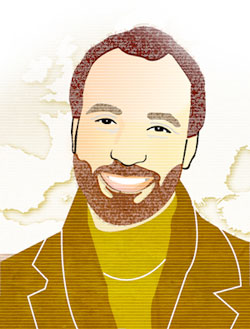

Tariq Ramadan is considered by many to be a leading philosopher and scholar of Islam. In 2000, Time magazine selected him as one of the most important personalities of the new century. But he’s also a figure of controversy, especially in the post-9/11 era. “The reformer to his admirers, Tariq Ramadan is Europe’s leading advocate of liberal Islam,” the Boston Globe wrote of the 43- year-old intellectual, who was born in Geneva and holds Swiss citizenship. “To his detractors, he’s a dangerous theocrat in disguise.”
The Department of Homeland Security considers Ramadan to be a radical, and when Notre Dame University in Indiana offered to hire him as a professor of religion and conflict studies, the Bush administration refused to provide Ramadan with a visa to enter the country.
In contrast, Britain’s government recently asked Ramadan to join a panel of experts to advise the government on how to deal with radical Islamists. Currently, he is a guest lecturer at St. Anthony’s College in Oxford.
Ramadan comes from a family well familiar with political philosophy, activism and conflict: His grandfather, Hassan al-Banna, became a co-founder of Egypt’s Society of Muslim Brothers in 1928, and was assassinated in 1949 for his religious agitation. In a recent interview, Ramadan talked about the rioting that has rocked the French suburbs, the deep-rooted problems with the integration of Muslims in Europe, and the need for modernization of Islam.
You are one of the most influential and one of the most controversial Muslim intellectuals in Europe. Where were you when the French riots broke out?
My Paris office is in one of those banlieues, Saint-Denis, one of the focal points of the unrest. But I must admit that I had no inclination whatsoever to expose myself to rocks and burning projectiles on the street at night.
That sounds a bit indifferent. Many Muslims pay attention to what you say — they listen to your taped lectures and read your writings. Don’t you feel compelled to make an attempt to convince these youths to turn away from violence?
Listen, my position is perfectly clear. There is no doubt that violence is not a solution and that the destruction of buses and cars must end. These crimes must be punished. There is also no doubt that a certain number of youths are descending into pure vandalism and uncontrolled anarchy. Naturally, reestablishing order is of critical importance, especially for the residents of the suburbs, who are bearing the brunt of the violence.
So you truly have no sympathy for the rioters?
Of course I do. But feeling sympathy and searching for explanations isn’t the same as believing that the violence is justified. I am firmly convinced that the government’s efforts to suppress the riots are inadequate, and that they will remain ineffective until we understand the message behind this outbreak.
And how do you interpret this message?
This revolt has nothing to do with Islam. Islam, as a religion, has been established in France for a long time, and the religious question has been resolved in this country. Islam does not threaten France’s future in any way. But it is the social question that poses a true danger to the unity of the republic. Politicians across the political spectrum have underestimated this reality. They stick their heads in the sand and mislead their constituents by attempting to denounce Islam as the source of the problem.
No one disputes the magnitude of social rifts in French society. But it just so happens that these divides run along ethnic and religious lines. Hasn’t Islam promoted or even encouraged the formation of social ghettos, the isolation of ethnic communities?
The concepts of unity and equality, which are idealized to the point of excess in France’s political rhetoric, are nothing but myths and blatant lies at the social level. The main purpose of the public debates over Islam, integration and immigration is to stir up fear. In a sense, politicians use these debates as ideological strategies, as a way to avoid confronting reality.
What are they attempting to distract from?
The truth is that certain French citizens are treated as second-class citizens, if not the leprous members of the national community. Their children are sent to ghetto schools and taught by inexperienced teachers, they are crammed into inhumane public housing developments, and they are confronted with an essentially closed job market. In short, they live in a bleak, devastated universe. France is disintegrating before our eyes into socioeconomic communities, into territorial and social apartheid. The rich live in their own ghettos. Institutionalized racism is a daily reality.
Isn’t Interior Minister Nicolas Sarkozy aware of this when he calls for targeted assistance for the poor, for dialogue with the Muslims and for relaxing France’s rigorous secularism?
Sarkozy is acutely aware of the potential for votes in the suburbs. In crises such as the current one, he shows his true face: contempt and rudeness. If he views entire sections of the population as “riffraff,” he shouldn’t be surprised if that’s the way they end up behaving. He is giving the police free rein in a climate characterized by lack of respect. He is fixated on the 2007 presidential election instead of developing a workable political structure for 2020. Changes will only take place in this country when the residents of the suburbs are treated as fully entitled Frenchmen, as part of the solution, not an expression of the problem.
That’s all very well and good — but doesn’t self-criticism have a place alongside criticism? Are Muslim immigrants truly interested in integration, or do they prefer segregation?
The attempt to Islamicize social issues perverts and falsifies political discourse. The overwhelming majority of Muslims in Europe value the fact that they live in democratic, constitutional states, states that guarantee them freedom of conscience and religion. But mutual trust is often shattered, and the result is that fear and racism are deeply affecting France, Great Britain, the Netherlands and Germany. By the time they have reached the second, third or fourth generation, the descendants of immigrants should no longer be stigmatized as ghetto children, as “scum” who are “out of control.”
Nevertheless, what makes the integration of Muslims so difficult, compared with earlier immigrants from Poland, Italy, Spain and Portugal?
Two things, I believe. First, this immigration no longer occurs in individual waves; instead, it is a large-scale and continuous immigration. That’s the problem of quantity. And then there is the issue of quality. For Muslim immigrants, religion is inseparable from their roots and identity. They feel that transforming themselves from Moroccans or Algerians into Frenchmen makes them bad Muslims. This makes integration more difficult because it apparently forces Muslims to choose between two alternatives: self-abandonment or self-isolation.
But hasn’t Islam remained a foreign religion in the Western world, a religion that has yet to enter the modern age?
There are traditionalists, adherents to a literal exegesis of the Koran. I have spent the last 15 years campaigning for a genuinely European Islam, one that requires evolution with respect to time and the environment, as well as a separation of dogmatism and rationality. Islam cannot place itself outside of history.
And where is the boundary between dogma and reason, between being faithful to tradition and being receptive to the modern age?
The dogmatic and, therefore, invulnerable core in Islam is understandably simple: acknowledgement of faith, prayer, charity and fasting. Almost everything else is open to interpretation and modification in space and time.
It does indeed sound clear and simple. Why don’t we put it to the test with an example: Is a Muslim permitted to break with his faith?
Not according to the majority opinion among Koran scholars. But the prohibition on apostasy arose at a time when the first Muslim followers of the prophet Mohammed were at war with neighboring tribes. At the time, changing one’s faith was tantamount to high treason or desertion. Nowadays this context has changed completely.
In other words, the fight against “infidels” is completely outmoded?
Even the concept of the infidel is misleading, because the infidel is normally someone with a different faith, someone who refuses to recognize the truth of the words of the Koran, as revealed by God. He has every right to do so, as long as he does not question my right to believe in my truth.
So each individual must become blessed in his own way? What about atheists?
The logic of freedom of religion implies freedom to be an atheist, even though, from a historical perspective, this has not been accepted in the Muslim world…
…and often leads to brutal punishment. How do you feel about equal rights for men and women?
We need an Islamic feminism. Traditional Islam views the women merely as mother, wife, daughter or sister. She has obligations and rights in this capacity. But we must come to a point at which we treat the women as an independent individual with a right to self-determination, as someone who can run her own life without coercion.
Should she be permitted to decide for herself whether to stop wearing the head scarf?
Of course, just as she is permitted to decide whether to wear the head scarf.
But that’s an illusion, at least in the real world. Women and girls are not emancipated within their families.
You’re right. This is often the case, but emancipation can only come from within; it cannot be dictated by someone else. A law banning the wearing of head scarves changes nothing, except perhaps external appearance. Naturally, Islamic feminism must also include the right to education, to work and the freedom to select one’s own husband.
That’s all fine and good, but can you explain, then, why you have publicly called for a moratorium on the stoning of women accused of committing adultery — rather than condemning the practice outright? Some would argue that’s hypocritical.
Once again, Islam can only be modernized from within. If I stand there and state that I condemn the practice of stoning, that this punishment is despicable, it changes nothing. My fellow Muslims will say: Brother Tariq, you became a European, a Swiss citizen, so you are no longer one of us. I want to trigger a process of contemplation and thought within the Islamic community. Critiques and attacks from the outside can produce tension. Incidentally, a number of U.S. states have imposed a moratorium on the death penalty, in an effort to buy time to think about the meaning and legitimacy of this penalty.
Is a tendency toward violence inherent to Islam? Isn’t it true that many Muslims view jihad as an elementary part of Islamic identity?
Are the Crusades an elementary part of Christianity? No. Every community has the right to self-defense. The Palestinians have the right to fight for their independence from Israel. But this goal does not justify all means. Nothing legitimizes the killing of innocent civilians. The suicide bomber who blows up Israeli children cannot transform himself into a martyr. The Palestinian problem is not an Islamic problem.
Where do you see the process of reform and modernization of Islam, of which you have been a proponent? Has it made any progress anywhere?
In Europe. The impetus must come from European Islam and then influence the Arab world. There is some overlap between the universal values of Western democracy and those of Islam — the constitutional state operating under the rule of law, the equality of citizens, universal suffrage, the changeover of power, separation of the private and public spheres. These are basic principles, and although they are not spelled out in the Koran, I do not believe that they contradict Islamic tradition.
That is an opinion that many Muslim legal scholars do not share.
An excessively literal interpretation of the Koran ever since the 13th century has led Islam into intellectual calcification and political tension. Remaining faithful to the texts must be distinguished from interpretation of historical and social context. If we begin applying this exegesis and hermeneutics, we will begin to see progress in Islam thought.
Your words are like those of a rationalist, an enlightened theologian with purely intellectual ambitions. But in political reality, in France, Great Britain and the United States, you are suspected of secretly promoting the expansion of Islam and sympathizing with violence.
Oh yes, I am one of the most maligned Muslim intellectuals. Tariq Ramadan, the slippery trickster. They talk about people like me the way they used to talk about the Jews: He is Swiss and European, but his loyalties also lie elsewhere. He says one thing and thinks something else. He is a member of an international organization — in the past, it was world Jewry, today it’s world Islam. I am disparaged as if I were a Muslim Jew.
Could that have something to do with your family history? Your grandfather, Hassan al-Banna, was the founder of Egypt’s Muslim Brotherhood in Egypt in 1928, an organization that envisioned an Islamic fundamentalist transformation.
Thoughts are not genetically inherited traits. I admire my grandfather for his anti-colonial fight against the British. He was very involved in education for girls and women. His five daughters — my aunts and my mother — all attended university. And the organization he founded was very progressive for its time. However, I am highly critical of the Brotherhood, with its affected, conspiratorial behavior, its hierarchical structures and its oversimplified slogans.
Were you ever a member of the Brotherhood?
I can assure you that I am no Muslim Brother, despite the fact that my critics have repeatedly launched this rumor in an effort to slander and harm me.
Do you ever think about forming your own party, organization or movement?
No. I am not a politician. I have often been approached in this regard in the past 15 years, but I have always declined these sorts of offers. I view myself as an independent, critical intellectual, as someone who tries to stimulate thought on the left and the right, to encourage intellectual evolution. The Islamic world is obsessed with the notion of strong leaders. This is a mistake. We don’t need powerful leaders, but rather unconventional, progressive thinkers with the courage to open our minds.
Translated from German by Christopher Sultan.
– – – – – – – – – – – –
This article has been provided by Der Spiegel through a special arrangement with Salon. For more from Europe’s most-read newsmagazine, please visit Spiegel Online at http://www.spiegel.de/international or subscribe to the daily newsletter.
