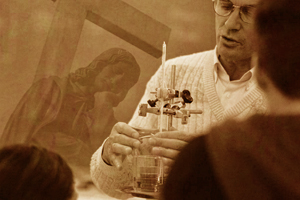
In a remarkably unequivocal decision Tuesday, a federal judge ruled that teaching intelligent design in public science classrooms in Dover, Pa., is prohibited by the constitutional separation of church and state. In the decision, Judge John E. Jones III declared that the school district’s claim that I.D. is a scientifically valid alternative to evolution is simply wrong. “Intelligent design is nothing less than the progeny of creationism,” he writes.
The judge’s ruling was not a surprise to those of us who had spent time at the trial, which had earned the nickname Monkey Trial II, a reference to the famous 1925 court case in which Tennessee schoolteacher John Scopes was found guilty of teaching evolution. In the Harrisburg, Pa., courtroom, we could see from the first week that the trial was going badly for I.D. proponents. That the school board intended to promote their religious views was evident, as was the strong scientific consensus that the basic tenets of evolution were unimpeachable.
The much ballyhooed scientific defense of I.D. — the idea that some aspects of the natural world are best explained as designed by some unnamed intelligence rather than as the products of purely naturalistic processes — was also a dud. Then came an article in the Dec. 4 New York Times suggesting that I.D. may be losing some academic ground in the evangelical Christian colleges that were assumed to be its base.
Despite Jones’ ruling, the Discovery Institute, the Seattle-based engine of the I.D. movement, is claiming victory. “Anyone who thinks a court ruling is going to kill off interest in intelligent design is living in another world,” says John West, associate director of the Discovery Institute’s Center for Science and Culture, in a press release. “Americans don’t like to be told there is some idea that they aren’t permitted to learn about. Banning intelligent design in Dover will likely only fan interest in the theory.”
Although it seems far-fetched to spin I.D.’s loss in Dover as a triumph, I.D. remains firmly rooted in mainstream culture. After all, 2005 was a banner year for the theory. Pope Benedict XVI embraced the “intelligent project” that he said underlies nature, and President Bush endorsed teaching I.D. alongside evolution. The Kansas School Board decided to alter its definition of science to accommodate I.D., and several school boards around the country promise to follow suit.
Perhaps Tuesday’s ruling will cause people to think differently about I.D., but polls taken earlier this year suggest that most Americans consider I.D. or some form of creationism a plausible alternative to evolution. A growing majority thinks it should be taught as an alternative to Darwin’s theory in public science classrooms.
Most significantly, given that I.D. has reached a tipping point in the United States, nearly every high school biology teacher, community college instructor and college professor is being forced to deal with it in one way or another. Some dismiss it outright, but others are striving to craft intelligent ways to incorporate it into their classrooms, including the controversial approach known as “teach the controversy.” As recently as 10 years ago, few could have guessed that science teachers would be wrestling with how to weave God into their curriculums. But thanks to the publicity surrounding I.D., many teachers say they don’t have much choice.
Intelligent design did not spread through culture on its scientific merits. It got a big push from religious and political advocates. Funded by millions of dollars from some of the same religious supporters that helped put President Bush in the White House (conservatives like Philip F. Anschutz, Richard Mellon Scaife, and Howard and Roberta Ahmanson), the Discovery Institute has pushed a fringe academic movement onto virtually all the front pages and TV sets in the country. The New York Times has reported that the institute has granted $3.6 million in fellowships to 50 researchers since 1996. Those investments produced 50 books on intelligent design, innumerable articles, and two I.D. documentaries that were broadcast on public television.
Oxford biologist Richard Dawkins has said that Darwin’s theory of evolution made it possible to be an intellectually satisfied atheist. Intelligent design, it seems, has made it possible for many fundamentalists to be intellectually satisfied creationists. Wesley Elsberry, a biologist at the National Center for Science Education, says millions of evangelical Christians craved a more science-like, sophisticated yet Bible-friendly theory to explain the diversity of life on earth.
“Discovery’s early documents say that they consider the Christian community to be their base,” Elsberry says. “They mean people who are in some sort of fundamentalist faith community, which takes a literal approach to Genesis. That’s by far their biggest public base and it was ready-made for I.D.,” says Elsberry.
In fact, I.D.’s advance has been one of the great coups of modern public relations, says Barbara Forrest, philosophy professor at Southeastern Louisiana University. She points out that plenty of bad science has been launched into the orbit of public consciousness — Ronald Reagan’s space-based missile system, for one — but intelligent design is different. “I.D. is not bad science,” she says. “It is non-science.” With her Southern accent, she pronounces it “nonsense.”
Intelligence design “is not just non-science — it’s anti-science,” says Brown University biologist Kenneth Miller, who testified against I.D. at the Dover trial. It doesn’t merely defy the definition of “science,” which limits explanations to naturalistic causes, but also stops research in its tracks by attributing complex problems to supernatural causes.
Yet the I.D. movement has infiltrated the mainstream with “good slogans and sound bites,” Forrest says, adding that I.D. advocates’ “most intuitively compelling argument is their appeal to the American public and to parents to let their kids hear both sides of the debate. But it’s a bogus appeal: There’s nothing fair about trying to teach children something that isn’t true.”
West bristles at the idea that I.D.’s success is due to good P.R. “Darwinists like Forrest don’t seem to understand that by caricaturing I.D. they ultimately undercut their own efforts,” he says. “When students or scholars who have been exposed to Forrest’s straw-man version of I.D. actually read science journal articles or academic books by I.D. scholars, they suddenly discover for themselves that the evidence and arguments for I.D. are a lot more impressive and sophisticated than they’ve been led to believe. And once they start to engage the real issues raised by the scientific evidence, the spin and scare tactics pushed by Darwinian fundamentalists like Forrest don’t cut it.”
Whether I.D.’s scientific core is “impressive and sophisticated,” as West says, is debatable. Certainly Judge Jones didn’t think so. Still, biology teachers are being pressured to bring it into their classrooms. A recent study published in American Biology Teacher, for instance, shows a near doubling over the past decade of public-school teachers in Minnesota who report being pressured from students, parents or administrators to spend less time teaching evolution in their classes. The study also shows growing pressure to teach creationism as an alternative to evolution.
An increasing number of high school science teachers are happy to comply. Twenty percent of Minnesota science teachers and nearly 50 percent in Kansas have endorsed teaching some form of creationism alongside evolutionary theory.
“The real danger is not that teachers will start teaching creationism,” says geologist Warren Allmon, the director of the Museum of the Earth in Ithaca, N.Y., which features an exhibit on evolution seen by thousands of school kids every year. “It’s that they will stop, or reduce, the teaching of evolution. Many now just assign [students to voluntarily read] the chapters on evolution and don’t cover it in class, in order to avoid controversy.”
Allmon’s museum has initiated a special training program to help museum docents answer the growing number of questions about creationism and intelligent design that come from visitors. “There has been a definite increase over the past two years,” he says, “though the questions are by no means all hostile ones coming from creationists. Even visitors who understand evolution are curious about what all the commotion over I.D. is about.” The museum docents explain to visitors that the theory of evolution neither confirms nor denies the existence of God and that such questions are simply not the bailiwick of biology.
Many high school biology teachers still object to even discussing I.D. in their classrooms, saying that although there are lively controversies within evolutionary biology (arguments, for example about the relative importance of natural selection, sexual selection and physiological selection, or about the mode and tempo of evolutionary change), they are not “weaknesses” but inevitable and welcome signs of a lively science. Teaching I.D. alongside evolution would give it more scientific credibility than it deserves, they say.
“Whenever you debate, you should really have one person representing I.D. on one side and 10,000 scientists on the other,” says Brown University biologist Miller. “That would give a fair representation of the division of opinion in the scientific community.”
But refusing to discuss it gives the wrong impression, too, making it appear that scientists are afraid of it, think it is irrelevant, or are just too arrogant to bother. “There is an intellectual curiosity on the part of kids I teach,” says Mark Stefanski, a high school science teacher at Marin Academy, a private school in San Rafael, Calif. “I don’t want to teach them creationism and I won’t. But they do want to know where all of this interest in intelligent design and creationism is coming from.”
College-level academics and research scientists face a more acute Catch-22. If they debate creationists and I.D. proponents in public, they lend credibility to the notion that there is a substantial debate going on within science, says Miller, one of the few prominent biologists who publicly debates intelligent-design advocates. His many debates and published point-and-counterpoints with I.D.’ers were cited as evidence of scientific controversy in Dover. “But if we don’t engage, it can mean ceding the public square to the other side, and that can be a huge mistake as well.”
“The important thing,” Miller says, “is always to make the distinction between the very real debate that is going on over science education and the non-debate among scientists about the validity of evolution on the whole. There is not a single scientific organization of any size anywhere in the world that has endorsed the point of view that these folks want to elevate to the level of science.”
Teachers are addressing intelligent design in their classrooms in a variety of ways. Carol Dixon, a high school biology teacher in Castro Valley, a suburb east of San Francisco, tells her students that any discussion of religious subjects must be kept out of the science classroom because the First Amendment’s establishment clause, protecting the separation of church and state, requires it.
“If my students ask about intelligent design or creationism, or ask me about my own religious views, I simply tell them that it’s not an appropriate subject for science class,” she says. “If I were required to teach about creationism or intelligent design, I’d have some serious problems. I’m just not trained to teach religion. And I don’t want to.”
Melissa Kindelspire, another high school biology teacher in Castro Valley, doesn’t pull any punches when it comes to teaching evolution. “The theory of evolution via natural selection is the thing that ties everything else we are learning in my classroom together. If and when there are other [non-evolution-based] scientific theories that are accepted by scientists, I will introduce them,” she says. But in her opinion, I.D. doesn’t come close to fitting that bill.
Kindelspire says that she has heard from some students and parents who are troubled by her straightforward defense of evolution. But when parents give her brochures about creationism, she simply thanks them and puts the brochures aside. However, one recent incident did make her a little uneasy. She was told that the science department, and her name specifically, came up at a local church in a sermon about “evil influences on the parishioners’ children’s souls.”
Other teachers, such as Dawn Wendzel and Julie Olson, who teach seventh-grade science in Gull Lake Middle School, near Kalamazoo, Mich., have simply woven I.D. into their curriculum. The two teachers, both evangelical Christians, presented I.D. as an alternative to evolution and had their students write papers comparing and evaluating the two views. Complaints from parents brought their practice to a halt. But Gull Lake school administrators have decided to make I.D. the subject of an elective social study class available to high school students.
The Discovery Institute advocates “teaching the controversy” about evolution, an approach that casts doubt on the biological validity of natural selection and gives credence to I.D. The term was coined about 20 years ago by Gerald Graff, an English professor at the University of Chicago, to describe a method of exploring cultural disagreements over whether, say, Huck Finn is a racist, rather than simply teaching one side or the other of a conflict.
Graff, a self-described “secular left-liberal” says he first felt as if his “pocket had been picked when the intelligent design crowd appropriated my slogan.” But recently, in an essay in Inside Higher Ed, Graff suggests there may be a silver lining to the I.D.-evolution debate.
“I can at least imagine a classroom debate between creationism and evolution that might be just the thing to wake up the many students who now snooze through science courses,” Graff writes. “Such students might come away from such a debate with a sharper understanding of the grounds on which established science rests, something that even science majors and advanced graduate students now don’t often get from conventional science instruction.”
Some teachers, such as Susan Sperling, an anthropology and interdisciplinary studies professor at Chabot College in Hayward, Calif., have adopted a version of this process. She is trying to teach the controversy without granting undue legitimacy to I.D. as science. This semester, Sperling, a Berkeley-trained physical anthropologist, is holding a course in which her students learn about evolutionary biology by reading Charles Darwin’s “On the Origin of Species.”
In connection with the course, Sperling organized a series of three public lectures about creationism, I.D. and evolution. “I thought it would be good to have students and others in our community provided with a forum for looking at intelligent design in its larger cultural context,” Sperling says, “and to be able to see the debate from different sides.”
I decided to attend the lectures for myself. I wanted to see how the largely working-class, middle-American students at Chabot would respond to the different lecturers: Elsberry, an evolutionary biologist; Ken Malloy, a young-earth creationist and author; and Philip Johnson, a retired UC-Berkeley law professor who is considered the father of I.D.
Elsberry launched the series to a standing-room-only crowd, with a detailed review of the history of evolutionary theory from pre-Darwin days until now. It was thorough and fair and totally lacking in hype or flair. As one who has long studied evolution and natural history, I managed to follow along. But judging by the drooping heads and the dozen or so empty seats when the lights came up, I’m not sure how many of the Chabot students did.
At one point, as Elsberry was zipping through his talk about the synthesis of species, the young woman next to me muttered “Jesus” in exasperation before abandoning her frantic effort to take notes. For the rest of the talk, she just sat there, eyes half shut, letting the names, facts and figures wash over her like a foreign language.
Elsberry’s commitment to detail and lack of rhetorical flourish sent Sperling into a bit of a panic. “Dr. Elsberry is a wonderful and meticulous scientist, but I don’t think he really could see how little of what he was saying his audience even understood,” she said after his lecture. “And now, to be brutally honest, I’m worried that I may be undermining my own science teaching.” In other words, she was afraid the next speakers, the anti-evolutionists, might win the day.
I could see what an uphill climb it is for biologists trying to compete for the hearts and minds of Americans that are undereducated in the sciences, especially in evolutionary biology. Evolutionary theory isn’t Einsteinian relativity, but it is counterintuitive in many ways and a detailed explanation is needed for it to make much sense, while the essential I.D. argument has a strong intuitive appeal: Life is too complex and meaningful to be accidental.
Yet some Chabot faculty members were just happy to see students and the community showing up for a public science lecture at all. “I could never draw this kind of crowd with a straightforward lecture on astronomy,” Scott Hildreth, a lecturer in astrophysics at Chabot, told me. “This is a great forum in which to teach students about the meaning of science, where its limits are, and what it’s all about.”
A week later, Malloy, the young-earth preacher, was before the same audience explaining his literal interpretation of Genesis: Earth is about 6,000 years old, Noah’s Ark was real (it has been found in Turkey, proven authentic beyond a shadow of doubt, he says), and rescued not only two of every currently living species, but two of every species that had ever lived, including Tyrannosaurus rex. He explained that T. rex had had to be brought aboard as babies, due to space constraints. “I use the words ‘evolutionist’ and ‘atheist’ interchangeably,” he said. He dismisses carbon and other dating techniques of fossils as simply inaccurate. It was almost surreal, an evolutionist’s nightmare, seeing a fundamentalist creationist standing in a college lab teaching a biology lecture right out of the Bible.
The lab full of students sat up straight and paid attention during Malloy’s talk. For one thing, unlike Elsberry’s lecture, it allowed them to easily follow his drift, even if, as Sperling pointed out afterward, “he might as well have been a tribesman telling creation stories from the highlands of New Guinea.”
“Even though he said his claims were true, there wasn’t any mistaking them for science,” says Chabot freshman Christopher Jacob. “It was just interesting to see how different someone’s view of the world could be.”
The next lecture, by Johnson, would be more problematic for the 18-year-old Jacob, who afterward said he was thinking of studying biology to protect science from “political attacks like this.”
Johnson’s 1993 book, “Darwin on Trial,” the publication of which marks the birth of I.D., is a rhetorically powerful critique of evolutionary biology that avoids saying much about God or the Bible. In his lecture at Chabot, Johnson argued that the evidence for I.D. is strong, that evolution is full of logical and evidentiary gaps. “Science should follow the evidence wherever it leads, not draw some arbitrary line at the appearance of design,” he said. “To say, ‘Despite the evidence [for design], we won’t look there’ is very unscientific.”
Although Johnson is recovering from a stroke that impaired his speech, he had no problem holding the Chabot College audience’s attention. Even Sperling, a trained evolutionist, was compelled by some of Johnson’s arguments, saying they caused her to “think hard and long about how the boundaries of science get drawn.”
Now that the lecture series is over, Sperling says she is convinced “that the evidence, power and logic of evolution speak for themselves. As an evolutionist and teacher, I’m not in the business of compelling anyone’s opinion. There are good reasons that evolution is the organizing theory of modern biology, and my students can see that and think critically and intelligently about what they are hearing.”
Time will tell whether I.D. continues to thrive in the nation’s public schools. In the meantime, John Hoopes, an anthropologist at the University of Kansas, has designed his own intelligent approach to teaching I.D. Next fall, he will hold a class titled “Archaeological Myths and Realities.” It will cover UFOs, crop circles, ESP and intelligent design.
Language matters. And we are lucky that some people will go to the mat over a few words. In Austin, Texas, this week, scientists and creationists battled over whether to include the words “strengths and weaknesses” in the state’s official statement about evolution. The words would influence how evolution is taught in Texas classrooms and would be immortalized in Lone Star textbooks. As the largest textbook market in the country, the decision could pressure other high school textbook publishers to conform to Texas standards.
Dan McLeroy, the Texas State Board of Education chairman, a dentist and self-described creationist, led the charge to mandate teaching the “strengths and weaknesses” of the theory of evolution. After three days of high-pitched argument on both sides, the 15-member board, by a vote of 8-7, rejected the language, relieving textbook authors and publishers of the pressure to insert what opponents called “junk science” into their pages. But in a compromise that alarms and dismays many science education advocates, the board did adopt language that attempts to cast a shadow of doubt over the validity of the central evolutionary concepts of natural selection and common ancestry.
Proponents of the theory of intelligent design, and other brands of neo-creationism, argue that evolution is inadequate to the job of explaining the diversity and history of life on earth. If they can cast doubts about evolution’s validity, they have a chance to fill the authority vacuum with the tenets of creationism. But since late 2005, when a federal judge in Dover, Pa., ruled that intelligent design was a form of creationism, and that its introduction into public high school curricula was unconstitutional, advocates of teaching neo-creationism have been forced to seek other ways into public science classrooms. Enter the “strengths and weaknesses” strategy, crafted by the Seattle-based, pro-intelligent-design think thank, Discovery Institute.
Eugenie Scott, director of the National Center for Science Education, an Oakland, Calif.-based organization dedicated to protecting the integrity of science education in the public schools, says that once McLeroy and his allies failed to pass the “strengths and weakness” language, “they had a fallback position, which was to continue amending the standards to achieve through the back door what they couldn’t achieve upfront.”
And they succeeded. Casey Luskin, a Discovery Institute lawyer, and its guy on the Austin scene, was psyched by the outcome. “These are the strongest standards in the country now,” he says. “The language adapted requires students to have critical thinking about all of science, including evolution, and it urges them to look at all sides of the issue.”
One amendment calls for students to “analyze and evaluate scientific explanations concerning any data on sudden appearance and stasis and the sequential groups in the fossil record.” The key words are “sudden appearance” and “stasis.” McLeroy argues that “the sudden appearance” of forms in the Cambrian period, when there was a rapid multiplication and diversification of species, and the persistence of forms over long periods of time (stasis) are evidence against evolution. And thus for creationism.
In 2012, when the board next selects textbooks, anti-evolution members will be able to argue against books that don’t sufficiently “evaluate scientific explanations” concerning stasis or so-called sudden appearance. Another amendment requires that teachers and textbooks include language to “analyze and evaluate scientific explanation concerning the complexity of the cell.” Arguing for the “irreducible complexity” of cells is another key creationist theme.
Each of the amendments singles out an old creationist argument, strips it of its overtly ideological language, and requires teachers and textbook publishers to adopt it. In other words, says Joshua Rosenau of NCSE, if the books don’t at least pay lip service to criticizing natural selection, they risk not being adopted.
However, the overwhelming scientific consensus is that neither periods of rapid evolution, nor the persistence of forms that have adapted successful ways of surviving for long periods of time, poses any threat to the theory of evolution. Yes, cells are complex, but so are the explanatory tools of modern evolutionary theory. Over the history of the debate, critics of evolution have invariably said something or other was too complex for Darwin’s theory to explain. Yet scientists have consistently pointed out that two of the critics’ favorite examples, the human eye and the bacterial flagellum, have been illuminated by and explained in terms of natural selection.
“The theory of evolution has no weaknesses,” says Kenneth Miller, a biology professor at Brown University. There are many unanswered questions about how organisms evolve and diversify, and what drives them to do so, but Charles Darwin’s 150-year-old insights that all life on earth descended from one or a few simple common ancestors, and that natural selection explains how they did, remain solid foundations of modern biology. As the late, great biologist Theodosius Dobzhansky is famous for saying, “Nothing in biology makes sense except in the light of evolution.”
Not that science makes sense to a creationist like McLeroy. “Scientific consensus means nothing,” he tells Salon. “All it takes is one fact to overthrow consensus. Evolution has a status that it simply doesn’t deserve. People say it’s vital to understanding biology. But it’s genetics that’s the foundation for biology. A biologist once said that nothing in biology makes sense without evolution. Well, that’s not true. You go into the top biology labs, and it makes no difference if evolution is true or false to what they’re doing and studying. It makes no difference.”
It makes all the difference in the world, says Miller, who notes the irony of McLeroy quoting Dobzhansky, one of the fathers of the modern evolutionary synthesis. Adds Miller: McLeroy’s “fundamental misunderstanding of the way genetics and evolution have produced a unified science of biology is nothing short of breathtaking.”
Continue Reading
Close
For a decade or so, brain studies have seemed on the brink of answering questions about the nature of consciousness, the self, thought and experience. But they never do, argues University of California at Berkeley philosopher Alva Noë, because these things are not found solely in the brain itself.
In his new book, “Out of Our Heads: Why You Are Not Your Brain, and Other Lessons From the Biology of Consciousness,” Noë attacks the brave new world of neuroscience and its claims that brain mechanics can explain consciousness. Nobel Prize-winning molecular biologist Francis Crick wrote, “You, your joys and your sorrows, your memories and your ambitions, your sense of personal identity and free will, are in fact no more than the behavior of a vast assembly of nerve cells and their associated molecules.” While Noë credits Crick for drawing popular and scientific attention to the question of consciousness, he thinks Crick’s conclusions are dead wrong and dangerous.
Noe’s conversational style is gentle, attentive and easygoing. But, in true philosopher fashion, he also picks his words deliberately, as if stepping off the path of right thinking would result in some tragic plummet into the abyss of illogic.
In San Francisco there’s a brain gym where members exercise their brains with “neurobic” software. A sign outside the place reads: “You Are Your Brain!” It has become almost a mainstream notion now. But the subtitle of your book begins “Why you are not your brain.” What’s wrong with the “You are your brain” view?
It’s one thing to say you wouldn’t be you if not for your brain, that your brain is critical to what you are. But I could say that about your upbringing and your culture, too. It’s another thing entirely to say that you are your brain.
I don’t reject the idea that the brain is necessary for consciousness; but I do reject the argument that it is sufficient. That’s just a fancy, contemporary version of the old philosophical idea that our true selves are interior, cut off from the outside world, only accidentally situated in the world. The view I’m attacking claims that neural activity is enough to explain consciousness, that you could have consciousness in a petri dish. It supposes that consciousness happens inside the brain the way digestion occurs inside the GI tract. But consciousness is not like digestion; it doesn’t happen inside of us. It is something we do, something we achieve. It’s more like dance than it is like digestion.
Even if we had a perfect way of observing exactly what a brain was doing, we would never be able to understand how it made us have the kinds of experiences we do. The experiences just aren’t happening inside our skulls. Trying to understand consciousness in neural terms alone is like trying to understand a car driving down the road only in terms of its engine. It’s bad philosophy masquerading as science.
Maybe I’m naive but it seems kind of obvious that the brain is the mechanism that — in the context of a person’s life and environment — gives rise to consciousness. That’s not to say it is the same as consciousness, but that it is the mechanism from which consciousness emerges.
The brain is necessary for consciousness. Of course! Just as an engine is necessary in a car. But an engine doesn’t “give rise” to driving; driving isn’t something that happens inside the engine. The engine contributes to the car’s ability to drive. Consciousness is more like driving than our philosophical tradition leads us to expect. To be conscious is to have a world. The fact is, you and I don’t have what it takes to make a world on our own. We find the world, we don’t make it in our brains.
The brain is essential for our lives, physiology, health and experience. But the idea that it is the whole story, or even the key to understanding the story, is not a scientific conclusion. It’s a prejudice. Consciousness requires the joint operation of the brain, the body and the world.
In fact, neuroscience is probably not in the best position to answer questions of consciousness and mind and experience. When we look for who and what we are in the brain alone, we lose the phenomena that interest us most.
Imagine that we find the Holy Grail of neurobiology, the patterns of neural activation that correlate perfectly with different events in our mental lives. We would still never understand or make sense of why those correlations exist. There is no intrinsic relationship between the experience and the neural substrates of the experience. We always need to look at what factors bring the two together. The environment, other people, our needs and desires — all these things exist outside the brain and have to be seen as essential parts of our selves and consciousness. So we aren’t just our brains, we’re not locked inside our craniums; we extend beyond our skulls, beyond our skin, into the world we occupy.
Francis Crick did us a major service by taking seriously and publicizing the problem of consciousness. But in the journal Nature he wrote, “Scientists need no longer stand by listening to the tedious arguments of philosophers perpetually disagreeing with each other. The problem of consciousness is now a scientific problem.”
I say, “Bravo!” Consciousness is a scientific problem! But Crick framed the problem in terms of an unquestioned set of philosophical dogmas; namely that the key to consciousness will be found in the brain, that that’s literally where experience and thought take place. My book is not anti-science; it’s a challenge to science to get serious. It’s deluded to think we’re free of philosophy.
Is your battle a turf war between philosophy and neuroscience?
Not at all. I think these are scientific questions. I want to help science take them over. But I think science is in philosophically troubled waters here and it’s just not ready yet to go it alone.
You’re arguing that all we’ll learn about by studying the brain is the brain. We’ll never learn from the brain what love is? Or what religion is? Or consciousness?
Right. And that the radically reductionist view is not only unfounded, but it’s also ugly. And dangerous.
Dangerous, how?
There are practical dangers, like raising expectations too high for specific scientific programs. The motivation for proceeding along some line, or justification for funding it, may be based on the assumption that it will find the place where consciousness is happening.
Second, the question of consciousness is a problem for all of us — not just for science. We all want to know how to understand humans and think about ourselves. And claiming that neuroscience is going to explain us to ourselves is false advertising. It’s important that we not believe it.
But the view that the self and consciousness can be explained in terms of the brain, that the real us is found inside our skulls, isn’t just misleading and wrong, it’s ugly. In that view, each of us is trapped in the caverns of his own skull and the world is just a sort of shared figment. Everything is made interior, private, rational and computational. That may not pose a practical danger, but it presents a kind of spiritual danger.
In that view, each of us is an island of intellect, alone. When you think of us as just interior neurological mechanisms, you see us as alienated from the world around us. The world shows up for us as bits of information that we decipher, like linguistic relics of an ancient culture that we have to interpret. Like when Mr. Spock says, “What is this strange kissing custom?” The danger is alienation, plain and simple. We’re strangers in a strange land.
I find this a very sad and ugly picture of our circumstance. Now contrast that view with a sense of ourselves as engaged in the flow, responsive to the things going on around us, part of the world. It’s a very different picture.
The late David Brower, conservationist and founder of Friends of the Earth, said that a California condor is only 5 percent feathers and blood and 95 percent its environment.
Exactly.
There’s a kind of temporal lobe epilepsy that causes people to experience deeply religious feelings. Couldn’t the relevance of that association tell us something about, say, the roots or essence of religious experience?
I’m pessimistic. A lot is context; things always happen in a setting. Imagine how you feel after a run. Out of breath, rapid heartbeat, sweaty? Now imagine you just woke up feeling like that. It would be terrifying. But after a run it makes sense and it feels good. Meaning is not intrinsic, it’s relational. It’s only in context that an intense feeling means one thing or the other. Again, we need to look outside neuroscience to understand what that significance is.
If someone had a seizure that caused a sensation like they imagine they might have if they were meeting God, that would be very confusing. But it would be a mistake to conclude from that that religious experience is only a brain state.
I’m not a religious person. And putting aside the fact I don’t believe in God, I don’t think the impulse of religion can be thought of as a kind of biological feature of us, or that there’s something about our brains that makes us apt for that. I think of religions as communal and as literary traditions, both things existing outside the brain. I don’t think of religious belief as something we can understand individualistically. When someone says they believe in God, you’ve got to understand the practices, customs, backgrounds and social realities that are part of that. None of it is going to reduce to anything individual inside of that person’s brain.
People like Sam Harris, who worry about the irrationality of religious customs and practices, are right to be concerned. I agree that religion can be dangerous. But I don’t think neuroscience is the way to understand it at all.
Why are so many smart people these days looking at the brain as the key to understanding consciousness? Is it just irrational exuberance about the new imaging techniques and other technological advances that give us peeks inside the functioning brain?
Yes, but there’s something else, too. For a long time now, going back at least to Descartes and Galileo, we’ve liked to be told that things are not what they seem. When we go to a magic show, there’s a feeling of delicious pleasure when the wool has been pulled over our eyes. Similarly, to be told that the love you feel is actually just a chemical reaction, or that your depression is just a malfunctioning of your brain, is surprising and in some paradoxical way satisfying. There’s a modern pleasure in the unmasking of our everyday experience. We feel like we’re seeing behind the curtain, seeing how the trick is done.
It validates our suspicion that the world is different than it looks?
Yes. Galileo said that the apple in your hand is colorless, odorless and flavorless. That color and so on are effects that the apple has on you, comparable to the sensation of the prick of a pin. The flavor of the apple, he said, is no more in the apple than the prickliness is in the pin. The taste and the prickliness are in you. Galileo thought we were radically deceived by the world around us. The contemporary neuroscientists simply extend this even further — this idea that the world is a kind of grand illusion that the brain creates.
Sure, it’s an important fact that the perception of colors depends on the physics of light and the nature of the nervous system. If our physiology were different, our ability to detect colors would be different. But none of that speaks to the unreality of color, any more than saying that I can’t see anything in my room if I turn the lights off speaks to the unreality of my desk. We’ve almost made a fetish of this desire to be told that things are not what they seem. We get a thrill from the paradox.
OK, if our brains aren’t going to explain thought and consciousness, then how should we study these things?
Consciousness is an achievement of the whole animal in its environmental context. And to really understand it, you’d have to study it that way.
Suppose we ask ourselves: What makes certain patterns of neural activity visual? What I have proposed — building on work with collaborators — is that to answer that question, we need to look to the behavioral and environmental context. I think we can make progress toward explaining the character of experience, but only by looking at the way the neural activity arises in and indeed enables a certain kind of dynamic exchange with the world.
Seeing is a certain way of relating to the world around you; the brain plays a critical role in supporting that relation. It’s not revealing something about the cells themselves — or the way they are firing — that does the explanatory work. Rather, it’s understanding the way the cells participate in a larger interaction with the world that will shed light on what it is to see. This is a whole new way of approaching the problem. The “it’s all in your brain” approach doesn’t work. If we expand our idea of the machinery of mind to include the body and the world, whole new ways of thinking about and explaining consciousness come into view.
The study of consciousness should be a cross-disciplinary field: behavioral science, math, linguistics, robotics, artificial intelligence and philosophy — these all make contributions. Brain studies, too. But you can’t reduce the study of human life to the study of things happening inside a person’s brain. You have to look at a person’s active life in its context.
Evolutionary biology is one good example of the way to proceed. We don’t look at an organism as a collection of cells or molecules or atoms. We look at it as a creature with interests and needs. We take an ecological approach that has the organism as an actor facing problems and struggling to survive and reproduce. We view all of that as the natural backdrop against which to carry on our investigations. I think it’s that organism-centered approach, where you look at the animal in its environmental situation, that’s the appropriate way to approach and study consciousness and the human mind.
Now, neuroscience can look for meaningful correlations between what’s going on in the brain and experience, or the ways brain functions contribute to our ability to have the kinds of experience we have. It makes sense to use brain-imaging techniques like fMRI that way. Studying the brain is part of the picture, but only a limited part. The important point is not to think we’re somehow catching the mind in action by stop-motion photography; that’s not what we’re doing with fMRI at all.
What role do you think the brain does play in consciousness?
Instead of asking how the brain makes us conscious, we should ask, How does the brain support the kind of involvement with the world in which our consciousness consists? This is what the best neuroscientists do. The brain is not the author of our experience. If we want to understand the role of the brain, we should ask, How does the brain enable us to interact with and keep track of the world as we do? What makes a certain pattern of brain activity a conscious perceptual experience has nothing to do with the cells themselves, or with the way they are firing, but rather with the way the cells’ activity is responsive to and helps us regulate our engagement with the world around us. There’s a lot to learn about the way the brain does this and this work is important.
At the end of your book you say that we occupy “Home sweet home.” What do you mean by that?
The dominant view in neuroscience today represents us as if we were strangers in an alien environment. It says that we go about gathering information, building up representations, performing calculations and making choices based on that data. But in reality, when we get up in the morning we put our feet on the floor and start to walk. We take the floor for granted and the world supports us, houses us, facilitates us and enables us to carry on whatever our tasks might be. That kind of fluency, that kind of flow, is, I think, a fundamental feature of our lives. Our fitting into the world is not an illusion created by our brains, it’s a fundamental truth about our nature. That’s what I mean by home sweet home.
Continue Reading
Close
Two years ago, Pennsylvania federal Judge John Jones III handed down a stunning decision that many said would take down the intelligent design movement. But American creationism doesn’t die. It just adapts.
Decades earlier, when the courts deemed creation science — proto intelligent design — a religious view and not constitutionally teachable as science in public schools, it adapted by cutting God off its letterhead and calling itself “intelligent design.” The argument for I.D., and for “scientific creation theory” before it, is that evolution isn’t up to the task of accounting for life. Given biology’s complexity, and natural selection’s inability to explain it, I.D. thinking goes, life must be designed by a, well, designer. I.D.ers skirted any mention of God, hoping to avoid getting snagged on the First Amendment’s prohibition against promoting religion by arguing that I.D. was just a young and outlying science.
In the Pennsylvania case, Kitzmiller v. Dover, Judge Jones ruled that if you want to teach intelligent design in science class, first you have to show that it is a distinct species from its earlier, creationist form, not just a modified type. You’ve got to show us the science part, he said. Besides, Jones declared, your intelligent designer is obviously God.
The six-week trial — the focus of a Nova documentary, “Judgment Day: Intelligent Design on Trial,” airing Nov. 13 — addressed a host of heady questions. What is science and how does it work? Can evolution account for the diversity of life we see on earth? What is religion? Can science say anything about the existence of a creator and still be science? It also examined the motivations of a local school board that tried to smuggle creationism into its high school biology curriculum. The judge’s decision — that I.D. was not science and that the school board was trying to promote its members’ own religious views — was followed by a short period of shock from the I.D. community.
But like bacteria adapting to antibiotics, creationism has slimmed down once again, this time shedding even a mention of an intelligent designer. A new textbook put out by the Discovery Institute, the Seattle think tank that promotes I.D., doesn’t even have the words “intelligent design” in its index. Instead of pushing I.D. explicitly, “Explore Evolution: The Arguments for and Against Darwinism,” promoted as a high school- or college-level biology text, “teaches the controversy.” Teach the controversy is the new mantra of the I.D. movement.
“We want to teach more about evolution,” says Discovery Institute’s Casey Luskin, “not less.” The “more” they want to teach, of course, is what they see as evolution’s shortcomings, leaving an ecological niche that will then be filled by intelligent design.
But not all creationists have embraced the strategy. Many responded to the Dover trial by coming out of I.D.’s big tent, which once gave shelter to young earth creationists, old earthers, academics interested in I.D.’s hypotheses, and anyone who wanted to promote a Christian-compatible view of science. Judge Jones’ decision was like a lightning strike on the big top, sending many of the constituents running home through the rain. Creationist groups like Answers in Genesis, the Institute for Creation Research, and Reasons to Believe are now attacking I.D. for not having the guts to call its designer God or to be explicit about such key questions as the age of the world. (Answers in Genesis’ answer: about 6,000 years.)
Perhaps not surprisingly, the I.D.ers have adopted a persecution complex. “After Dover,” Luskin says, “there’s been an increase in the boldness of Darwinists who persecute I.D. proponents: researchers, teachers and students. The debate in the academy has intensified radically,” he says. “It’s just a lot more political.” He points to Guillermo Gonzalez, a physicist at Iowa State who failed to get tenure, allegedly because he is an advocate of I.D., and Richard Sternberg, a scientist at the National Institutes of Health who was “attacked” for publishing an article by Stephen Meyer, a proponent of intelligent design, in a peer-review journal Sternberg edited.
Evolutionary biologists respond that hiring a biologist who doesn’t accept evolution is like hiring a mathematician who doesn’t accept multiplication. That oversimplifies, but for better or worse, the battle has intensified and come out more into the open.
Recently, long retired chemist Homer Jacobson retracted a paper titled “Information, Reproduction and the Origin of Life,” which he’d published in the journal American Scientist 52 years ago. Upon Googling himself, the 84-year-old Jacobson found that his old paper was often cited by creationists as evidence of the implausibility of life emerging from the prebiotic soup found on early Earth. Jacobson noticed some errors in his paper (it was a half-century old!) and, in order to keep neo-creationists from engaging in “malignant denunciations of Darwin,” he wrote a letter of retraction to the journal. Retraction of a scientific paper is rare, and doing it for political reasons is rarer still. The act provoked accusations of “historical revisionism” from Discovery Institute senior fellow William Dembski.
Following the Dover decision, some I.D.ers became more timid, or at least more evasive. John Angus Campbell, a Discovery Institute fellow and coauthor of a book about teaching I.D. in the schools, ran for a school board seat in Mason County, Wash., last week. During his campaign, he intentionally left his middle name out of his election materials and failed to mention his affiliation with the Discovery Institute. The camouflage strategy worked and he was elected.
I.D. will also be striking back in “Expelled: No Intelligence Allowed,” a pro-I.D. documentary, to be released in February. Featuring conservative writer and political commentator Ben Stein, it portrays I.D. proponents as a group of iconoclastic firebrand scientists with the guts to go after the dogmatic Darwinists who have, the I.D.ers say, grown lazy and corrupt sitting atop a monopolistic theory with zero tolerance for dissent, within or outside of their ranks.
Stein told the New York Times that Darwin may well have been onto something with his theory of evolution, but that it is isn’t up to explaining the origins and diversity of life on its own. Plus, he thinks Darwinism leads to racism and genocide. If Stein had his way, he said, the documentary would have been called “From Darwin to Hitler.”
No, the battle between creationism and evolution is hardly over. The true believers in intelligent design and other forms of creationism aren’t about to lay down their worldview for a federal judge or anyone else. And polls show that about half of America is on their side. “Evolution remains under attack,” says Eugenie Scott, an anthropologist and a director of the National Center for Science Education, a nonprofit dedicated to teaching evolution in public schools. “If creationists have their way, teachers will eventually just stop teaching evolution. It’ll just be too much trouble. And generations of students will continue to grow up ignorant of basic scientific realities.”
Continue Reading
Close
A young woman sat on the subway and sobbed. Her mascara-stained cheeks were wet and blotchy. Her eyes were red. Her shoulders shook. She was hopeless, completely forlorn. When I got off the train, I stood on the platform, paralyzed by emotions. Hers. I’d taken them with me. I stood there, tears streaming down my cheeks. But I had no death in the family. No breakup. No terminal diagnosis. And I didn’t even know her or why she cried. But the emotional pain, her pain, now my pain, was as real as day.
Recent research in neurobiology would explain my response as the automatic reaction of a kind of brain cells known as mirror neurons. On Nov. 4, neuroscientists announced that mirror neurons had for the first time been directly identified in humans. Previously their existence had only been inferred from primate research and the observation of human brains through fMRIs (functional magnetic resonance imaging).
Enthusiasm among scientists has been spreading as growing evidence suggests that “mirrors” may explain the roots of human empathy and altruism as well as provide insight into such disorders as autism and even schizophrenia. But that’s not all. In the past few years, dozens of studies have linked mirror neurons to the emergence of language, abstract reasoning and even self-awareness or consciousness. “The self and the other are just two sides of the same coin. To understand myself, I must recognize myself in other people,” says Marco Iacoboni.
Sound like Marin County, Calif., Buddhism? Maybe so. But it’s also SoCal neurobiology. Iacoboni is a neuroscientist and professor of psychiatry at UCLA, where he directs the Ahmanson-Lovelace Brain Mapping Center. “We are hard-wired to feel what others experience as if it were happening to us,” he says. Down the road in San Diego, Vilayanur Ramachandran, director of the Center for Brain and Cognition at UCSD, offers, “We used to say, metaphorically, that ‘I can feel another’s pain.’ But now we know that my mirror neurons can literally feel your pain.”
Iacoboni’s “hard-wiring” is a network of ordinary-looking neurons distributed throughout the brain. Unlike other kinds of brain cells, such as motor neurons, which control muscles, mirror neurons fire both when a person is in action, and when he or she observes someone else engaged in the same action. Before the discovery of mirror neurons, cognitive scientists assumed that we gained access to the feelings of others by theorizing about them. Now we know that a direct experience is responsible for much of what we thought was computation, speculation, memory or inference. Through my mirror neurons, the young woman cries in the same part of my brain where I do.
Not all scientists believe that mirror neurons represent “a great leap forward,” as Ramachandran has written. Alison Gopnik, a developmental psychologist at U.C. Berkeley’s Institute of Cognitive and Brain Sciences, flatly labels mirror neurons a myth. But her voice is drowned out by an academic chorus of mirror hosannahs.
If Ramachandran, Iacoboni and hundreds of other neuroscientists now poring over mirror neurons are correct, directly sharing the experience of others is a key to who and what we are, how our brains and minds evolved, and how they develop from childhood. Compassion and empathy, feeling the experience of another, is not just something we’re capable of, it is woven into the fabric we are cut from. “Mirror neurons dissolve the barrier between you and someone else,” says Ramachandran. He calls them “Gandhi neurons.”
Along with dozens of studies in neuroscience journals, mirror neurons have also taken a place in the folk psychology battle over how to frame human nature. Alan Greenspan and the rugged individualists may love Ayn Rand’s libertarian vision of each person alone against the world, but another set prefers to think of humans as inextricably tied to one another, creating codependent realities and sharing inter-subjective space.
In fact, the problem of altruism has vexed biologists since Darwin. Why do people sacrifice their own self-interest, sometimes even their lives, in order to help others? Genes for such behavior should be selected against quickly and definitively. But if mirror neuron theorists are right, the advantages of directly understanding others may be so great that it blows the evolutionary cost of occasional self-sacrifice out of the water. What’s selected for might be the ability to imitate others, and to understand and feel what they are feeling. Self-sacrifice and altruism might be mere byproducts of mirroring and not themselves adaptive in a way selected for by evolution. In any case, “we are good,” says Iacoboni, “because our biology drives us to be good.”
Like many of science’s great accomplishments, mirror neurons were discovered by accident. In the early 1990s, neuroscientist Giacomo Rizzolatti and his research team at the University of Parma were studying motor neurons in the frontal cortex of macaques and had attached tiny electrodes to individual cells in the monkeys so they could watch how very specific hand movements were initiated in the brain. When a wired-up monkey picked up a peanut, the neuron fired. But to Rizzolatti’s surprise, the same motor neuron also fired when a perfectly still monkey was watching a lab assistant pick up the peanut.
Why would a motor neuron fire when there was no motor action? They not only fired when the macaques tore a piece of paper and saw a piece of paper torn by another macaque, but also when the monkeys merely heard the sound of paper being torn, without any visual stimulus at all. Many tests and retests later revealed the whole new class of brain cells, mirror neurons, located in the parts of the macaques’ brain that process both sensory information and kindle emotions.
When Rizzolatti’s work was published in Experimental Brain Research in 1992, the neuroscience community went ape looking for evidence of mirror neurons in other primates, notably humans. Because they couldn’t go fishing with electrodes in human brains, scientists had to search with other, less invasive tools. The fMRI revolution in neuroscience was under way, allowing scientists to observe accurate, high-resolution, three-dimensional images of brain activity in real time. Neurobiologists looked for mirrorlike brain activity in the same areas where the systems had been found in macaques. And they found evidence of them in far greater numbers and more elaborate formulations than in macaques or any other primates. “Humans are heavily wired with mirrors,” says Ramachandran.
Only recently, though, have scientists identified individual mirror neurons in humans. Iacoboni’s team at UCLA collaborated with Itzhak Fried, a neurosurgeon who was implanting electrodes into epileptic patients in an effort to find the origins of their seizures so they could be surgically treated. Once those electrodes were in place, and after patients gave permission, it was possible for Iacoboni to test individual human neurons for mirroring. He found mirror neurons in several parts of the human brain.
Evidence of the clinical importance of mirror neurons comes from the study of psychological disorders. Both Iacoboni and Ramachandran are looking at links to autism, which may result from a breakdown or suppression of the mirror system. People who suffer from autism are less empathic, worse at reading the emotional states of others, and less emotionally connected to those around them. Functional MRIs show they also appear to have significantly less mirror neuron activity, says Iacoboni. Strengthening mirror activity in autistic kids, through imitation and other simple exercise, seems to help them, says Iacoboni.
The evolutionary roots of human mirror neuron systems reach back millions of years, says Michael Arbib, director of the USC Brain Project, and author of “From Action to Language via the Mirror System.” The evolution of language appears to be connected to the mirror-neuron-rich area of the brain associated with movements of the hands, he says, while the evolution of our empathic mirroring capabilities seems to be associated with regions of the brain governing movements in the face.
Early mirroring must have enhanced our ancestors’ ability to learn by imitation — one primate can “practice” using tools in its head simply by watching another. These new capacities eventually led to the kind of “metaphorical” exercises employed in abstraction of all kinds, including the development of symbolic systems like language, says Ramachandran, whose lab at UCSD is currently investigating the connection between mirror neurons and the human ability to employ metaphor.
“Not just literary metaphors,” says Ramachandran in his deep, dramatic East Indian British accent, “but abstractions of all kinds. Once you understand the cross-modal computations that mirror neurons are doing, you can see why human beings are so good at all kinds of abstraction.”
A map, for example, is a kind of powerful metaphor for the terrain it is depicting. Using maps — and only humans can — requires cross-modal computation and abstraction. Imagine our forebears making a simple map in the dirt to help them plan a hunt; the twigs stand for hunters, the pebbles stand for prey, two lines for the river banks. The ability to understand how a twig can be a person — and in what ways it can’t — also boils down to mirror neuron systems, says Ramachandran.
Other primates engage in “cross-modal abstraction,” or metaphor, says Ramachandran, but humans are distinct even from the most speculative and metaphorical apes. Some millions of years ago, he says, the part of the mammalian brain in the left inferior parietal lobule mushroomed. This mirror-neuron-rich area, called the angular gyrus, which sits at the crossroads of the brain’s vision, hearing and touch centers, is far more developed in humans than in other primates. “And when the angular gyrus is damaged,” Ramachandran says, “people experience metaphor blindness.”
Being able to make abstractions, to go from recognition of a vertical limb, say, to the abstract notion of verticality, and then to assign it a word, “verticality,” or a mathematical symbol, conveys a clear evolutionary advantage that can be parlayed not only into better tree climbing, but also into making ladders, and elevators, and rocket ships, says Ramachandran.
Mirror neurons had an inconspicuous start, says Daniel Dennett, director of the Center for Cognitive Studies at Tufts University and the author of “Darwin’s Dangerous Idea,” and other books about evolution. “All evolutionary innovation begins with a mistake,” he says. Some genetic mutation may have led to a misfiring set of neurons that enhanced hand-eye coordination. This “programming bug,” as Dennett calls it, must have conveyed an advantage amplified by natural selection. And once simple mirror-neuron networks were established, he says, “they may well have played a big role in the evolution of empathy, and imitation, and social understanding.”
Ramachandran goes further, explaining that mirror neurons help us understand the evolution of the self, the mysterious narrator that provides continuity in each of our life stories. The self, which Ramachandran calls the Holy Grail of neuroscience, may be an evolutionary innovation adopted not first to give each person a conscious foreman, but as a way to model others. In this theory, the self started as a kind of little program — fed with data from the mirror system — for understanding other people, a kind of algorithm for generating a mini-you in me. Once it evolved, this program swung around and began to apply its algorithmic investigations also to its host, the brain in which it resided. Self-consciousness was born.
“It was almost certainly a two-way street,” Ramachandran adds, “with self-awareness and other-awareness enriching each other in an auto-catalytic cascade that culminated in the fully human sense of self. You say you are being ‘self-conscious’ when you really mean being conscious of someone else being conscious of you.”
To U.C. Berkeley critic Gopnik, the significance of mirror neurons “is blown way out of proportion.” She says their power to explain consciousness, language and empathy “is just a metaphor.” As a psychologist, Gopnik views behavior at a different resolution than the neurologists do. She bristles at the idea that science can find hard-wired explanations in the brain for complex behaviors. “You never get single neurons calculating anything,” she says. “What you’ve got are these enormous suites and interactions and computation among many different levels of neurons all calculating different things. And also changing what they calculate even from moment to moment.”
Even something as seemingly mundane as recognizing the edge of an object requires huge numbers of interacting neurons, Gopnik says. In the 1960s, perceptual psychologists thought they had found a kind of neuron that detected edges. There was a lot of hullabaloo over the discovery of so-called edge neurons. “But the truth turned out to be much more complex,” says Gopnik. “The idea that a kind of neuron alone could explain empathy or behavior or self-consciousness simply makes no sense.
“It’s just as likely that those neurons are mirroring because people are imitating each other and feeling empathy, not the other way around,” says Gopnik. Yet she is sympathetic to some of the conclusions of the mirror neuron researchers; her own work in developmental psychology also stresses what she calls the “distinctive human capacity to link the self to others,” as a key trait of evolution and something essentially human. But she is impatient with “the giant illogical leaps” that she says neurologists sometimes take in reaching overly broad conclusions. “Scientists have always been susceptible to the temptation of thinking that they’ve solved the secrets of the universe,” she says. “And neurologists are no different.”
Dennett agrees that it is rash to draw profound conclusions about the role of mirror neurons so soon. “Some mirror neuron enthusiasts are saying that these are some kind of magic bullet, a giant leap by evolution that made language and empathy possible. I think that is much too strong.”
Ramachandran and Dennett, who are friends, disagree on this point. Ramachandran thinks that mirror neurons will indeed bring about a revolution in the way we see the brain and the way we see ourselves and our relationship to one another. “Mirror neurons will do for psychology what the discovery of DNA did for biology,” he wrote several years ago.
Whether mirror neurons bring about a paradigm shift in our conception of ourselves remains to be seen. In the meantime, there seems to be near consensus that we are exquisitely tuned to one another’s experience and that mirror neurons help us to experience each other viscerally and directly. While that may explain the direct emotional impact the crying woman on the train had on me, it doesn’t explain why I did nothing to help her. We may be fundamentally interconnected, but we are individuals too. If the crying woman had been diagnosed with terminal cancer, I might have felt her emotional pain, but I wouldn’t have grown her tumor. So perhaps, as Gopnik says, the leap that connects the co-firing of neurons to the human condition is only metaphorical after all.
But then, Ramachandran points out, a good mirror-neuron-enabled metaphor is one of the most powerful things a human can have. Or share.
Continue Reading
Close