
Among Hollywood’s big guns, Steven Spielberg is a rarity: a filmmaker who’s willing, every so often, to tangle with moral ambiguity. Or who at least knows moral ambiguity when he sees it. His 1993 “Schindler’s List” has plenty of detractors, people who see the picture as Spielberg’s milking of an unspeakable human tragedy for dramatic value. But I think Spielberg’s motives are far less calculated than that view suggests, and they stem from a touchingly simple need: telling the story of Oskar Schindler’s efforts to save people whose persecution was, to him, indefensible by any morally rational stretch of the imagination was Spielberg’s way of seeking out a bit of recognizable human behavior in the face of inhuman cruelty. (That’s not the same thing as making a “feel-good” Holocaust movie, as he has been accused of; Spielberg doesn’t stint on the horrors of genocide, and he’s always aware of how few people, in the grand scheme, Schindler was able to save.)
Love him or hate him — and some of us have both loved and hated him over the years — Spielberg is often as interested in notions of personal responsibility and guilt as he is in pure storytelling. And at his best, he helps us make the distinction between the facile and somewhat detached motto favored by Christian teens, “What would Jesus do?” and the more probing realist-humanist question, “What would — or should — I have done?”
Which brings us to the thorny tangle of Spielberg’s latest, “Munich,” a fictionalized version of a real-life story: After the Palestinian terrorist group Black September kidnapped and murdered 11 members of the Israeli Olympic team during the 1972 Summer Olympics in Munich, Germany, Israel responded — secretly — by assigning a team of underground hit men to seek out and kill 11 men whom Israeli intelligence had identified as masterminds of the plot. “Munich,” its script by Eric Roth and Tony Kushner, was inspired by Canadian journalist George Jonas’ controversial book, “Vengeance.” (The book’s sources have been questioned. The new edition, published to coincide with the movie’s release, contains a defense of its veracity by journalist Richard Ben Cramer. Neither the Israeli government nor the Israeli intelligence agency, Mossad, has officially acknowledged that these assassination teams existed.)
Eric Bana plays Avner, a Mossad intelligence officer drafted to lead the hit squad. He approaches the job with mild reluctance, since his wife (Ayelet Zurer) is pregnant, and he’ll be cut off from her until his work is done. We don’t quite know what makes Avner accept the job — presumably, patriotism and anger over the massacres, although as Bana plays him, Avner is so grounded and even-tempered that we have to guess at what his convictions are. (Bana gives a sturdy performance here, but there are some clues to his character that might have been strengthened in the writing.) His steadiness suggests that he hasn’t thought through — or doesn’t yet dare think through — the implications of the mission.
Before long, Avner’s sharing a flat in Frankfurt with four compatriots: Belgian toy maker turned bomb maker Robert (Mathieu Kassovitz); South African getaway driver Steve (Daniel Craig); German forger Hans (Hanns Zischler); and Carl (Ciaran Hinds), the cleanup man who steps in after the assassins have done their work to make sure no evidence has been carelessly left behind. On the team’s first night together — Avner has prepared a brisket for dinner — the five sit around a table, introducing themselves and talking about their various specialties. Carl, his solemn, enormous eyes blinking behind heavy-rimmed glasses, describes his job this way: “Me — I worry.”
The team’s work — their orders have come from Mossad officer Efraim (Geoffrey Rush), a government servant so dutiful and inscrutable he barely seems like a human being — is ruthless and specific. “Use guns if you have to,” they’ve been told, “but bombs are preferable.” They’re also urged to spare civilians at all costs. So they begin methodically hunting down their targets, often with the help of a shady Parisian contact, Louis (Mathieu Amalric, in an astonishing, finely chiseled performance), who runs his family business, an outfit capable of tracking down anyone, anywhere. The assassins begin with a Palestinian poet and translator living in Italy, a seemingly gentle soul who has passed information to the terrorists; their next target, a Parisian-based Palestinian, represents a trickier job and one that could take the lives of the man’s wife and daughter as well.
We feel the weight of these acts before the assassins do, which is all part of Spielberg’s exquisite, unnerving cleverness. The poet-translator, chatting so jovially with a shopkeeper, seems like such a nice guy; it gives us no pleasure to see a bullet go through his chest. (He has just come back from the store, clutching a bag of groceries; a milk bottle inside shatters — shades of John McGiver’s murder in the original “The Manchurian Candidate” — and the man’s blood puddles on the floor in a milky swirl, possibly a visual metaphor for the commingling of purity and guilt.) And the second target’s young daughter, who will supposedly be at school when the bomb planted in her family’s flat goes off, suddenly rushes back into the building just as the device is about to be detonated. Spielberg pulls the strings taut in this sequence; his intent is to make us squirm, and if his technique is a little obvious, at least his ideas are clear: If you want revenge, this is the risk you run. Each act of violence makes us feel queasy with complicity; it’s just a matter of time before the men committing these acts feel it too.
And eventually, they do feel it. But, strangely — or maybe not — the movie begins to lose its power just as the assassins start to reckon with their actions. The movie’s middle section raises some difficult questions about the uses, and the occasional necessity, of violence. At one point Carl, responding to some of the team members’ sudden doubts about the validity of what they’re doing, asks them how they think the Israeli state came to be in the first place. “How do you think we got the land?” he asks. “By being nice?”
In Greece, while attempting to kill one of the team’s most significant targets, Avner encounters a young member of the Palestine Liberation Organization (who believes Avner is part of a European espionage outfit, not an Israeli one). “You don’t know what it is not to have a home,” he tells Avner, and we can see the flicker of enlightenment in Avner’s eyes. He seems to be pondering, for the first time, the complexities of the Israeli-Palestinian conflict (and also failing to realize that while homelessness could be seen as motivation for terrorism, it doesn’t excuse it). From there, we see Avner struggling more and more with the ethical weight of his mission. And when he finally sees his toddler daughter, for only the second time, he realizes he wants out. His ultimate realization: Violence begets violence.
And he’s not wrong. But the problem with “Munich” is that Spielberg has made a beautifully crafted, intelligent picture that raises some very complicated, and not easily dismissed, moral questions — only ultimately to find the easiest way to dismiss them. Avner’s realization that violence doesn’t solve anything is cemented just before the movie’s final shot: It’s 1973; Avner now lives in Brooklyn, N.Y., with his wife and daughter, and the last thing Spielberg shows us is the World Trade Center in the distance.
It’s unclear what Spielberg means by that juxtaposition. Is he making a blanket statement about the evils of retaliating against terrorists? Is he making the point that, in 1972, Americans felt safe from the kind of terrorism visited upon the Israelis in Munich, but it was really just a matter of time before we’d experience it for ourselves? Spielberg is too intelligent a filmmaker to trade in accidental images, but his meaning isn’t at all clear here, and the World Trade Center is too loaded a symbol to use as indistinctly as Spielberg does.
Spielberg does so much right in “Munich” that it’s disheartening when he goes wrong. In the finest scene in the movie, Avner is invited out to the French countryside to meet Louis’ father, known only as Papa (he’s played, wonderfully, by Michael Lonsdale). The scene is so beautifully staged — and so subtle in the way it gets at the link between patriotic duty and the importance of family, even in the face of immoral acts — that it sets a standard the rest of the movie doesn’t quite live up to.
And there are bigger problems: The picture opens with a swift primer on the Munich hostage massacre, blending news footage with filmed re-creations of the events. It’s a stunning sequence, a compact way of both laying down essential details for the audience and making them feel the horror of the murders. But through the course of the movie, Spielberg revisits the murders in flashback, filling them in with increasingly more graphic detail. In the movie’s most egregious scene, Spielberg intercuts shots of the hostages being murdered with Avner making love to his wife — this may be Spielberg’s clumsy way of affirming that the political is personal, but it’s a case where, I think, Spielberg is cheapening and trivializing tragedy. (I also wonder how the graphic depiction of the murders must look to the surviving members of the hostages’ families. Exploring the needlessness of violence by showing violence is all well and good, but perhaps not at the expense of people who have already suffered so greatly from it.)
“Munich” is both astonishing and frustrating. It’s not easy to tell how much of the tone comes directly from Spielberg and how much comes from Kushner, who was called in to polish the script after Roth completed it. But it appears that both want to force some kind of satisfying resolution onto these very tricky moral issues. And although this picture is a world apart from Spielberg’s atrocious, small-spirited “War of the Worlds,” in some ways both movies speak to Spielberg’s inability to wrestle with the potential justifiability of violence. In “War of the Worlds,” the U.S. military shows up, in all its bravado, to fight the giant aliens with its tanks and guns. But in the end — an ending straight out of the H.G. Wells source material — lowly bacteria are what prove to be the aliens’ undoing. Violence is bad, it’s ineffective — and luckily, with bacteria around to do all the dirty work, it doesn’t have to be effective.
Violence isn’t the answer, Spielberg tells us in “Munich.” But the artists and filmmakers who are fondest of that handy platitude are never able to tell us what the answer is, particularly in cases involving terrorist acts, acts that generally exist outside the context of sane moral reasoning. Diplomacy, obviously, is a much more civil and ethical way of solving disputes than violence is. But if terrorists were responsive to diplomacy, we’d have to call them by another name. And “Munich” doesn’t begin to consider the differences between the terrorists of ’72, fighting for the concrete goal of a Palestinian state, and contemporary Islamic terrorists fighting for the amorphous goal of an Islamist paradise on Earth.
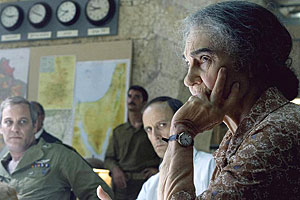
By the end of “Munich,” when Avner has finally begun to question what he’s done in the name of his country and his religion, we may find we’ve forgotten one of the saddest and most revelatory moments of the movie’s beginning: Early in the picture, we see Golda Meir (played by Lynn Cohen) deliberating, with her cabinet, whether to take action against those who enabled the Black September terrorists. She paraphrases the climax of Hannah Arendt’s “Eichmann in Jerusalem.” And then, her voice clouded with weary resignation, she says, “These people — they’ve sworn to destroy us. Forget peace. We have to show them we’re strong.” There’s no rah-rah nationalism in her stance, or in her voice. Spielberg stages the moment to make it clear that this was a decision made with reluctance, not self-righteous certainty. “Munich” is fascinating when Spielberg gives himself the latitude to work in these shades of gray, but their shadowy uncertainty is hardly comforting. No wonder he prefers the resolute hopefulness of black and white.
