
U.S. Military
Fit to command
The U.S. should require that presidential candidates have military experience.
It’s been four years since Richard Reid attempted to set fire to his explosive shoes on that Paris-Miami flight, and thanks to him we still do our little dance in stocking feet through airport security, a testimony to the power of the individual to gum up the works for millions of others. Eventually somebody will attempt to scoot through with an underwear bomb, and then we’ll be arriving at the airport three hours before departure so we can be inspected by crotch-sniffing dogs.
An individual has vast power to do mischief, which is why our parents inoculated us against narcissism. “Spoiled” was a strong pejorative. When it was applied to us, it stung. And so you went through many little experiences that taught you not to think that the world revolves around you.
Small horrific experiences like taking a shower in gym class in seventh grade, when you shed your skivvies and stepped bare naked into a shower room with 30 other boys, moist pink flesh under a showerhead, soaping up, rinsing, getting the heck out and into your clothes. A democratic moment. There were many of them.
Of course the great experience that most of us missed out on is the American military, a baseline experience for my dad’s generation, the kick in the pants that propels the dreamy adolescent into responsible adulthood. I don’t apologize for dodging the draft in the Vietnam years — there is a time and place for cowardice — but there was a price to be paid for it: A dreaminess persisted that some sergeant at Fort Leonard Wood might have adjusted.
I met a West Point cadet once, and in her I could see what I’d missed out on, a keenness of focus, a great sense of poise. She embodied the word “capable.” I would’ve followed her into a burning building. Had she skipped the Army and swanned around amongst the perpetual adolescents, she might have missed out on her life entirely.
Whenever I meet military men and women, I’m struck by their bearing and temperament. I sit down to dinner with a Marine captain just back from Iraq and immediately feel a little childish in his presence, though he’s 30 years younger. He is friendly, polite and tremendously focused. What might appear at a distance to be rigidity is really heightened attentiveness. Everything he says is appropriate and precise. When you ask about his experience in Iraq, he tells you, without spinning the story. He is no tin soldier, no flag waver. There’s no bombast in him. Like dancers, or pilots, or violinists, or lion tamers, he is a man trained to operate consistently at a high level of attention.
As you see the price to be paid for flabbiness and immaturity and narcissism and bad manners and lousy grammar, you appreciate the military more and you ponder the consequences of its isolation in American life. Fewer and fewer of our leaders have military service in their résumés. They prefer to sweep blithely along from one comfy perch to the next, cushioned in self-regard, promoting, puffing, spinning, hitting their talking points, building their skill sets. They slip into public office without ever having been yelled at by a bullet-headed black man with sergeant’s stripes and made to stand up straight in 95-degree weather and march back and forth across a dusty field and not ask why. This is a shame.
The way to put military service back in the picture is to pass a constitutional amendment requiring that a candidate for president have at least two years of full-time military service. It would be a boon to the country, to the military and to the young. It would confirm the importance of service. The 42-year-old governor who discovers that he wants to be president would need to go down to the recruiting office and enlist. It’d be a big moment, like when Elvis went off to basic training. Think of Newt Gingrich climbing on a bus and going off to have his head shaved and his individuality taken away and rebuilt.
The Constitution requires the president to be at least 35 and a native-born American. The current president certainly casts doubt on the worth of that native-born requirement, but never mind — amend the Constitution and let the boys and girls of Harvard and Stanford and Yale ponder their future. You will see the Army become more representative of the country, more middle-class and educated, and when it is, it will not likely be sent so casually off to war as the blue-collar Army has been.
- – - – - – - – - – - –
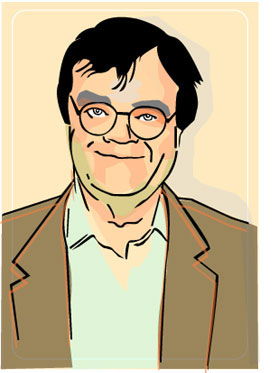
(Garrison Keillor’s “A Prairie Home Companion” can be heard Saturday nights on public radio stations across the country.)
© 2006 by Garrison Keillor. All rights reserved. Distributed by Tribune Media Services, Inc.
Garrison Keillor is the author of the Lake Wobegon novel "Liberty" (Viking) and the creator and host of the nationally syndicated radio show "A Prairie Home Companion," broadcast on more than 500 public radio stations nationwide. For more columns by Keillor, visit his column archive. More Garrison Keillor.
Don’t ask, don’t tell 2.0
Conservatives in Congress are pushing for new ways to keep discriminating against gay and lesbian soldiers
(Credit: AP/David Lewis) People who thought the repeal of “don’t ask, don’t tell” was the final word on discrimination against gay and lesbian soldiers were mistaken. As the House of Representatives debates the National Defense Authorization Act this week, Republicans will push for two amendments to permit the military to discriminate against gay and lesbian service members, using “religious freedom” as a cover.
One amendment, offered by Mississippi Republican Steven Palazzo, would prohibit the use of military property to “officiate, solemnize, or perform a marriage or marriage-like ceremony, involving anything other than the union of one man with one woman,” even on bases in states in which same-sex marriage is legal. Rep. Todd Akin’s, R-Mo., amendment would require the military to “accommodate the conscience and sincerely held moral principles and religious beliefs of the members of the Armed Forces concerning the appropriate and inappropriate expression of human sexuality” and would prohibit “adverse personnel actions” against them.
Continue Reading CloseSarah Posner is the senior editor of Religion Dispatches, where she writes about politics. She is also the author of God's Profits: Faith, Fraud, and the Republican Crusade for Values Voters" (PoliPoint Press, 2008). More Sarah Posner.
America’s real Hunger Games
Young people are already being sacrificed at the whims of the 1%. Just look at Iraq and Afghanistan
U.S. Army soldiers respond after a suicide attack on the US..-led provincial reconstruction team (PRT) compound in the Behsood district of Jalalabad, east of Kabul Afghanistan, on Sunday, April 15, 15 2012. (Credit: AP Phot/Rahmat Gul) When I was growing up, I ate books for breakfast, lunch and dinner, and since I was constantly running out of reading material, I read everyone else’s — which for a girl with older brothers meant science fiction. The books were supposed to be about the future, but they always turned out to be very much about this very moment.
Some of them — Robert Heinlein’s “Stranger in a Strange Land” — were comically of their time: that novel’s vision of the good life seemed to owe an awful lot to the Playboy Mansion in its prime, only with telepathy and being nice added in. Frank Herbert’s “Dune” had similarly sixties social mores, but its vision of an intergalactic world of disciplined desert jihadis and a great game for the substance that made all long-distance transit possible is even more relevant now. Think: drug cartels meet the oil industry in the deep desert.
Continue Reading CloseRebecca Solnit grew up in California public libraries and is thrilled to be revisiting them all over the state as part of the Cal Humanities California Reads project, which is now featuring five books, including her A Paradise Built in Hell: The Extraordinary Communities That Arise in Disaster. More Rebecca Solnit.
Conservatives mad at liberal media, Obama over Afghanistan photos
Confused right-wing responses to a grisly scandal
U.S. Army soldiers from 4-73 Cavalry Regiment, 82nd Airborne Division walk during a mission in Zhary district of Kandahar province, southern Afghanistan April 17, 2012(Credit: REUTERS/Baz Ratner) The L.A. Times Wednesday published photos of American troops in Afghanistan posing and grinning with the body parts of dead Afghan insurgents. There are 18 photos in all of soldiers posing with human remains, all from 2010, and the Times published two of them. The newspaper received the photos from a soldier in the unit depicted, who, according to Times editors, sought to publicize “dysfunction in discipline and a breakdown in leadership that compromised the safety of the troops.”
Continue Reading Close
Alex Pareene writes about politics for Salon and is the author of "The Rude Guide to Mitt." Email him at apareene@salon.com and follow him on Twitter @pareene More Alex Pareene.
The army’s new photo scandal
Photos released by the LA Times show American troops posing with the corpses of Afghan suicide bombers
In a cropped version of a photo released by the LA Times, a soldier from the Army's 82nd Airborne Division with the body of an Afghan insurgent killed while trying to plant a roadside bomb (Credit: Los Angeles Times) The Los Angeles Times released photos on Wednesday showing American troops posing with the mangled corpses of Afghan suicide bombers, leading the Pentagon to issue a strongly worded statement condemning the actions in the pictures, which were taken in 2010.
The photos were provided to the newspaper by a soldier distressed about the actions of his division. He sent 18 photos saying they pointed “to a breakdown in leadership and discipline that he believed compromised the safety of the troops,” the newspaper wrote. The Army requested the newspaper withhold the images.
Tim Fitzsimons is a freelance print, photo and radio journalist based in Washington, D.C. More Tim Fitzsimons.
Afghanistan syndrome
Today's endless war has overtaken Vietnam in our collective consciousness as America's great military nightmare
Wounded U.S. soldiers lie on the ground at the scene of a suicide attack in Maimanah, the capital of Faryab province north of Kabul, Afghanistan on Wednesday, April 4, 2012 (Credit: AP Photo/Gul Buddin Elham) Take off your hat. Taps is playing. Almost four decades late, the Vietnam War and its post-war spawn, the Vietnam Syndrome, are finally heading for their American grave. It may qualify as the longest attempted burial in history. Last words — both eulogies and curses — have been offered too many times to mention, and yet no American administration found the silver bullet that would put that war away for keeps.
Richard Nixon tried to get rid of it while it was still going on by “Vietnamizing” it. Seven years after it ended, Ronald Reagan tried to praise it into the dustbin of history, hailing it as “a noble cause.” Instead, it morphed from a defeat in the imperium into a “syndrome,” an unhealthy aversion to war-making believed to afflict the American people to their core.
Continue Reading CloseTom Engelhardt, co-founder of the American Empire Project, runs the Nation Institute's TomDispatch.com. His latest book, "The United States of Fear" (Haymarket Books), has just been published. More Tom Engelhardt.
Page 1 of 74 in U.S. Military