
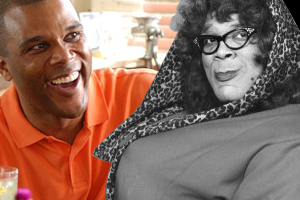

Blacks and whites don’t always understand each other. But in Hollywood, everyone’s favorite color is green. So movie executives of all races took notice last February when a movie called “Diary of a Mad Black Woman” hit No. 1 at the box office — despite no bankable stars, scant mainstream press attention and reviews that were almost laughably bad.
“Downright awful,” “an absolute mess” and “one of the worst pictures in ages,” critics wailed. Salon’s Stephanie Zacharek called it “the sort of movie that’s so bad, you just wish it would go away.” Roger Ebert was offended by the movie’s star, a “Big Momma’s House”-style granny named Madea, who smokes reefer, keeps a pistol in her purse and slices up furniture with a chain saw. This “Grandma from Hell,” as Ebert called her, was played in drag by the film’s 6-foot-5 writer-producer-mastermind, Tyler Perry. “All blame returns to Perry,” Ebert wrote. “What was he thinking?”
But there was no arguing the numbers. Perry made “Diary” on a shoestring $5.5 million budget, and as of last April it had grossed some $50 million. Perry’s distributor, Lions Gate Films, quickly greenlighted $10 million for a sequel, “Madea’s Family Reunion,” which hits theaters Feb. 24. Now the suits are thinking franchise. “We’ve got Tyler fever,” says Lions Gate head of production Michael Paseornek. “As far as we’re concerned, the last weekend of February belongs to Tyler Perry, and we plan to be there every year.”
What shocked Hollywood insiders was how Perry seemed to come out of nowhere. In the wake of the “Diary” success, the Hollywood trade paper Variety wrote a story that led off, “Tyler who?” Paseornek had been asking himself the same question a year before, after he received a letter from Perry’s agent, talking about a guy who wrote plays for African-American audiences on the “chitlin circuit,” a name that goes back to Jim Crow days, when African-Americans were banned from mainstream auditoriums. Nowadays, Perry’s plays regularly sell out major venues such as New York’s Beacon Theater and the Kodak Theatre in Los Angeles, where the Oscars are held, and in the last eight years, they’ve grossed more than $100 million through ticket sales and DVDs of live performances sold through his Web site.
“It was an astronomical number for someone I’d never heard of,” Paseornek recalls, “so I called around to other people in showbiz, and they hadn’t heard of him either.”
But those people were white. Paseornek got his first insight into the Perry phenomenon when he walked down the hall to the Lions Gate inventory control department, to talk to an African-American employee named Kenya Watson. “She said, ‘Sure, I’ve heard of Tyler Perry,'” he recalls. “‘I own all his DVDs. Whenever we have a cookout, we put one on.'”
“When I first went to the studios,” Perry told Salon in a recent phone interview, “they told me my fans didn’t go to movies.” But actually, his audience — hardworking, family-oriented, Christian African-American women — had just been waiting for someone to make a movie they would like, and Perry used his own powerful marketing apparatus to get the fans out for “Diary.” In the weeks leading up to the film’s release, there were constant ads on black radio stations and Perry reached out to the more than 500,000 fans who’ve signed up on his Web site’s e-mail list. “Every week or so, we tell them what’s going on,” Perry says of his fan base, adding that a similar countdown has been underway for “Family Reunion.” He also talked to pastors at some of the country’s most important African-American megachurches, with whom he says he has “really good relationships”; they got the word out, sometimes even talking about “Diary” from the pulpit. Church auxiliaries started buying group tickets and making plans to see “Diary” en masse.
“People forget that churchgoing folks like to be entertained,” says Tamara McLaurin, a 32-year-old catering sales manager at the Atlanta convention center. The release of “Diary” was a major event for McLaurin and the other women in her church’s “dance ministry,” a group that dances during services. They were traveling to perform that weekend, watched four Perry DVDs in a row on the bus, and then piled into a multiplex to cheer “Diary.” “We called it ‘Tyler Perry Day,’ ” recalls McLaurin, who now owns a “Diary” DVD that she still watches about once a week — “just in the background, while I do things around the house.”
“These people were desperate to be spoken to,” says Boston Globe film critic Wesley Morris. “When something came along that was even remotely relevant, they threw all their weight behind it, even though it was a shittily made movie.” Morris didn’t like “Diary.” “Blows to the head are delivered with more subtlety,” he wrote in his review. He also happens to be African-American, but as soon as his review came out, he says, he got phone calls and e-mails from Perry fans who accused him of being white — and a racist at that. The fans were even harsher when they knew for sure that the critic was white. Ebert, who is married to an African-American woman and has long been a champion for black cinema, received so much angry e-mail and became such a lightning rod because of his negative “Diary” review that Perry felt compelled, during a visit to Chicago, to plead with his fans to lay off the guy.
All this devotion has meant gold for Perry, the 36-year-old son of a New Orleans house builder, who now lives in an Atlanta mansion he calls Avec Chateau (“with house”) as a reminder of the days when he was homeless, living in his Geo Metro and scraping together money to produce his first show. Perry’s rise from difficult beginnings, about which much has been written, is a vital part of his mythology. As a child, he was abused by his father — “The first 28 years of my life, I don’t remember ever being happy,” he says — and he started to write after hearing Oprah Winfrey talk about how cathartic it is to put your troubles on paper. The result was “I Know I’ve Been Changed,” a gospel musical about adult survivors of child abuse, which Perry produced at venues around the country for six years, without much success. Perry was so discouraged, he has said, he contemplated suicide. But he collected enough money for one last production, at the Atlanta House of Blues in 1998, and on the first night, he looked out the dressing-room window and saw a line snaking around the corner. The show wound up selling out all eight performances. Perry was on his way.
Eight years later, he’s on top of the world. In addition to promoting “Madea’s Family Reunion,” Perry is currently putting the final touches on his first book, “Don’t Make a Black Woman Take Off Her Earrings” (coming from Riverhead in April), writing his third movie, “Daddy’s Little Girls” (due next February), finishing his ninth play, “What’s Done in the Dark” (which should hit the road by September), and working on a proposal for a children’s animated series. And Perry still travels the country constantly, performing Madea live to 2,000-seat audiences. In his current touring production, “Madea Goes to Jail,” Perry spends at least half the show as the center of attention, stomping around the stage in drag, yelling, shooting off pistols and improvising huge chunks of dialogue.
As soon as he gets offstage, he switches to business mode. “I’ve had phone meetings with Tyler where I can hear the audience laughing in the background,” Paseornek says. “We’ll talk for a while, and then he’s like, ‘I have to go. I’m due onstage.’ ” When Salon spoke to Perry earlier this month, he was in a South Carolina hotel room, still exhausted from the previous night’s performance. “Where am I?” he said. “Charleston, I guess.”
After all that time in front of his fans, Perry knows them well; his plays are calibrated to please them. The actresses in his shows look like his audience. They are what that Dove soap ad campaign calls “real women” with “real curves.” On the other hand, the men are fantasy types, with ridiculously cut bodybuilder torsos. Perry’s story lines are also designed to satisfy his fans, many of whom have experienced plenty of tragedy. In “Madea Goes to Jail,” we meet good-hearted Katie, who’s in jail because of some sad mistakes. Madea meets Katie there and agrees to check in on Katie’s rebellious 16-year-old daughter, Toni. Madea winds up taking Toni in as a foster child, to get her away from a father who is threatening to pimp her out on the street. We also spend time with Madea’s nephew, Sonny, who works as a jail guard and puts up with a slutty wife, Vanessa. She goes to bed with Sonny’s co-worker and gets so wrapped up in her illicit passion that she ignores the cries of their 6-month-old child, who winds up almost drowning in the bathtub.
These messed-up youngsters drive the plot of “Madea Goes to Jail,” but the real stars are their mothers and aunts, who worry, fret and pray to Jesus for help. That is, unless they’re the no-nonsense Madea (who has nothing to do with Euripides’ “Medea,” by the way). Whenever she comes across a villain like Vanessa, Madea does just what you might want to do — kick her in the ass. In the theatrical version of “Madea’s Family Reunion,” she catches a Vanessa-like tramp seducing the husband of her best friend’s daughter — and chases her out of the yard with a couple of gunshots and an Eastwood-worthy catchphrase. “Girl, you like Skittles?” she yells, brandishing the pistol. “Well, taste the rainbow!”
Perry’s audience loves nothing more than a Madea rampage, and Perry milks it for every bit of fun. After the tramp runs away, Madea tries to calm herself down by rolling a joint, but it doesn’t work. “I said I wasn’t going to bother nobody,” she tells her friend. “But that woman done worked on my nerves.” Madea paces, waves her gun in the air and gets so angry that her enormous fake breasts bounce up and down. “She done worked — on — my — nerves,” Madea bounces, as the audience falls out with laughter. “I ain’t lying,” she says. “I’m ready to go to jail to-day.”
In a Perry stage show, this mix of serious and slapstick is all part of the over-the-top experience, along with the shirtless hunks, the melodramatic stories — and especially the roof-raising gospel music. Perry’s shows feature a live band, an enormous sound system and a cast that can seriously belt. Every few minutes, a character breaks out with a number that starts in sorrowful lamentation and builds to a joyful climax that gets the audience to their feet, pumping their hands and praising the Lord.
But the fun of the stage shows doesn’t necessarily translate to the movies. Lions Gate had no advance press screenings of the film version of “Madea’s Family Reunion” in New York (a clear sign that they’re expecting bad reviews) but Perry says that, like “Diary,” it features a lot less singing and a lot less Madea than the stage version. “I’m not trying to duplicate the theater experience,” he says.
But maybe he should try. “Diary,” which was directed by music-video veteran Darren Grant, is a sentimental and often boring melodrama that comes alive only when Madea is on-screen. Perry directed “Family Reunion” himself, but to truly capture the divine madness of his plays, he needs to take some daring risks that neither he nor his audience is probably ready for. Making his next film a full-on musical and putting Madea front and center would help. But the Boston Globe’s Morris has an even nuttier idea: “I think John Waters should direct his movies,” he says, with a laugh. “What you have now is trash that doesn’t know it’s trash. Someone like Waters or Pedro Almodóvar could take that trash and transform it into art.”
Perry’s plays convey a Christian message. They’re firmly rooted in the tradition of other chitlin circuit gospel shows such as “My Grandmother Prayed for Me,” “God Don’t Like Ugly” and “Why Good Girls Like Bad Boyz.” But while those plays can be preachy, Perry keeps things lively with Madea, who has nothing but contempt for Christianity. (“When are we getting you to church?” a reverend asks Madea in one of the shows. “When you put in a smoking section,” she snaps back.) That irreverence works just fine for Perry’s fans. “I know Madea is crazy,” says Bishop Paul Morton of New Orleans’ Greater St. Stephen Full Gospel Baptist Church, the congregation in which Perry grew up, “but somebody always comes to God in the end.”
Making a non-churchgoer the star of a Christian-themed show is an intriguing choice. And Perry sets himself apart in other ways as well, most notably by investing in a talented cast and strong production values. “When I came out on the circuit eight years ago, most of the plays had horrible acting, horrible sound, horrible writing, horrible everything,” he recalls. “The audiences were only half-full because they had been burned so many times.”
Transcending the worst parts of his genre, Perry has earned the respect of some major players in the highbrow black theater world. “Tyler goes way beyond the clichés,” says Woodie King, founder and artistic director of New York’s Tony Award-winning New Federal Theatre. “When Madea is trying to convince a girl to change her life, there’s an honesty and brilliance. He taps into that wisdom of our grandmothers and mothers, and we sit there and say, ‘Yes.’ ”
Others just say no. Gary Anderson, the founder and artistic director of Detroit’s respected Plowshares Theatre, finds the Perry phenomenon offensive. He believes Perry’s characters can be traced back to the insulting caricatures of Jim Crow-era minstrel shows. “He has the lazy coon, the pickaninny and the loose woman who wants everyone’s man,” says Anderson, adding that he sees Madea as a modern update on Sapphire, the nagging wife in that nadir of mid-20th-century racist stereotyping “The Amos ‘n’ Andy Show.” “If a white person wrote these scripts, my community would be in outrage. I find it no less stinging that a black man wrote it.”
Carlton Molette, a professor of dramatic arts and senior fellow of the Institute for African-American Studies at the University of Connecticut, takes a more favorable view. “I think some black people just hate to see other black folks laugh in public because they’re afraid white folks won’t take us seriously,” he says. Molette teaches the stage version of “Madea’s Family Reunion” alongside works by August Wilson and Amiri Baraka and sees a lot to like in Perry’s work. “When white people see crime in the black part of town, they tend to forget that a lot of the people living there are hardworking, middle-class people who are appalled by what’s going on around them,” he says. “These are Tyler’s fans. He doesn’t cry about their situation. He says, ‘This is our world. We have to live in it. Let’s laugh at the ironies that exist and have a good life to the best of our abilities.'”
Perry’s success at the multiplex has already started to change Hollywood. Other studios are starting to look for their own Tyler Perrys. Last October, Screen Gems signed a deal with chitlin circuit regular David E. Talbert for a movie called “First Sunday” about a couple of bumbling criminals who rob their local church.
Meanwhile, Perry’s newfound power has brought a new responsibility that may move Perry away from the character that made him famous. He has begun to tone down some of his more extreme impulses. Four years ago, the theatrical version of “Madea’s Family Reunion” featured a running gag about a crack baby and how ugly it was. But that shtick now embarrasses Perry. “Imagine if you were the child of parents who used drugs,” he says. “How would it make you feel?” The crack baby isn’t in the movie version of “Family Reunion,” and neither are Madea’s guns. Perry made that change after a recent shopping mall encounter with a mother and her young son. “This boy pointed his finger at me like it was a gun, and he said, ‘Rock-a-bye, baby,’ which is a Madea line,” Perry recalls. “When I saw that, I thought, ‘All right, no more guns.’ If parents aren’t going to be responsible for what’s taken in, then I need to be.”
And Madea herself may be retiring. When Perry appeared on “The Oprah Winfrey Show” in late January, he announced that his alter ego wouldn’t be in either his next movie or his next play: He’s sick of putting on a fat suit and women’s makeup every day. “It has been six years, 250 to 300 shows a year,” Perry told Winfrey, who has become a major supporter. “I need a break. I need to check in with Tyler.”
