
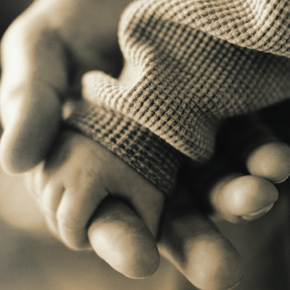
The first time I met my daughter, Madison, she wasn’t mine yet and I wasn’t sure she would ever be. I stared into her solemn face and looked shyly at her mother, Jessica.
“Can I pick her up?” I asked.
“Of course,” she said proudly.
There was nothing about her that was familiar — not her round face, her tuft of hair, the heft of her body. When I gazed at her, I felt enormous tenderness and the quiet stirring of potential love, but I didn’t know her. And I was afraid to look too closely because I knew that, just as I had felt the shift and click of my son’s life falling into place after his birth seven years before, so Jessica was coming to know Madison. All those months, she had thought she was carrying just any baby when all along it was Madison. She was saying to her daughter what I had said to my son: “Oh, it was you!”
Adoption social workers say that every woman needs to say hello to her baby before she can know if she can say goodbye. But I wanted to say hello to Madison, too. I wanted to let myself fall in love with her. I wanted to unwrap her and examine each little limb, bury my face in her neck, let my fingers trail across her features. But she wasn’t mine. I grieved her even as I knew she wasn’t mine to grieve.
Three days after Madison’s birth I watched my husband buckle her into the car seat, and then I climbed into the back seat beside her. I thought about Jessica, who we’d left sobbing in the maternity ward. I knew her arms were aching for her daughter, the daughter that was now ours.
“She’s beautiful,” I said to my husband. He glanced into the rearview mirror. “I know,” he said. We sped through the gray morning, heading home.
“I feel like a kidnapper,” I told him.
“I know,” he said.
– – – – – – – – – – – –
My husband and I came to open adoption filled with hopeful naiveté. We tried for several years (and several miscarriages) to have a second child, but when our infertility doctor said we might need more extensive treatment, we decided to walk away. A few months later, we began to explore adoption. Foster-to-adopt, we decided, would be too emotionally risky for ourselves and, more importantly, for our then 6-year-old son. International adoption was too expensive. But when we found domestic infant adoption through a local nonprofit agency, we realized that we had found our way to be parents again.
We knew that our adoption would be at least semi-open. We would be sharing our vital statistics — first names, ages, religion, as well as carefully chosen pictures — with birth mothers, as per the agency’s requirements. But we wanted more. We wanted a fully open adoption with an ongoing relationship and continuing contact. We wanted holiday visits, regular phone calls and even — dare we hope — contact with the extended birth family. We felt our baby-to-be would benefit from knowing his or her origins; we considered it a birthright. We also strongly believed birth parents were due some kind of relationship with their children and with their children’s adoptive parents — if they wanted one.
We weathered the fear-mongering tales of well-intentioned friends and acquaintances, people who had watched nightly news stories of toddlers snatched by their birth parents from adoptive families who had cared for them since birth. We listened as they wondered aloud what kind of woman would have the strength to walk away from her baby and then come back for occasional visits. “What if she kidnaps the baby?” they’d say. “What if she treats you like babysitters?”
Other adoptive parents we knew chose to go abroad in part because they were alarmed by the trend toward increasing openness in domestic infant adoptions. “Won’t you feel jealous?” they’d ask. “Won’t it confuse the child? What if your child likes her more than she likes you?”
I dismissed their concerns with all of the blind optimism of someone who had waited through four years of infertility for a baby and now finally thought she might get one. “Don’t be surprised if you get placed quickly,” our social worker told us. “Most adoptive parents aren’t ready to be that open, and it’s something a lot of birth mothers look for.”
Our agency asked that each hopeful adoptive family put together what they called a profile and other adoption professionals sometimes call a “Dear Birth Mom” letter. (The reason they call it a profile, our agency explained, is that a pregnant woman considering adoption is not a birth mother; she is an expectant mother and should be respected as such.) When a woman came to the agency saying she was considering placing her child for adoption, they gathered at least five profiles to share with her. The profiles were pulled on the basis of any requirements that she might have. If a potential birth mother said she wanted an adoptive family where one parent was a teacher, only the teacher profiles would be pulled. If none of the profiles appealed to the woman, she could ask for more.
The profile contained information about us, about our path to adoption and our intentions as adoptive parents. And the profiles are usually printed out on pretty paper.
“Pretty paper?” I asked Denise, our social worker, when she gave us the instructions.
“It matters,” she said. “You’d be surprised.”
It was a lot of pressure to take to the stationery store. My son and I spent a long time analyzing our choices. I rejected the pastel baby feet as too pushy, the blue sky and clouds as too ethereal. I finally decided on white with a tasteful abstract green border. We made a dozen copies and dropped them off at the agency.
While our agency allowed “matches” as early as the seventh month, they stressed to us that a match was nothing more than a woman expressing her right to consider an adoption plan. It was not the promise of a baby, it was not a guarantee that we would be parents again.
“There is always a 50 percent chance that a woman who chooses you will change her mind,” Denise made clear. “A real baby changes things and no matter how sure she is while she’s pregnant, she will need to make that decision again once she has the baby.” It was a common refrain from the agency during our wait: “Guard your heart,” they told us. “The baby isn’t yours until the papers are signed.”
Seven months after completing our adoption homestudy, our social worker called. “There’s a woman who seems like a good fit for you, and we would like to share your profile with her.”
Jessica was 19, they told us, and African-American. The birth father, who was choosing not to be involved, was white, like us. The baby was healthy — Jessica’s prenatal care had been good. “And it says here what she’s having,” Denise added. “Do you want to know?”
We did. A girl, she told us, due April 4. A week later we got another call. Jessica wanted to meet with us.
Our agency facilitated our first meeting at a downtown restaurant. Jessica brought three of her closest friends, and we all sat across from each other fidgeting awkwardly. Jessica was polite, guarded but not shy, and greeted us with sonogram pictures of the baby she was carrying. She was due in two months and feeling good.
I liked Jessica right away. I liked her confidence and sense of humor. I liked her wide smile. And I liked how direct she was with us. “I’m going to name the baby Madison,” she told us. “You can change it later but that’s the name I’m going to give her.”
When it was time to go we exchanged phone numbers and last names. Over the next few weeks she and I talked regularly — not just about Madison but about other things, too. Politics, music, Jessica’s plans to travel and go to school. One day I hung up the phone after a particularly long conversation and told my husband, “If she decides not to place Madison, she’ll be a good mother.”
We talked about the adoption, too, about what her plans were and why she chose us to be part of it. Those reasons are complex and not ones I feel I can share here.
“You already had a son,” she said. ” I liked knowing Madison would have a brother. I also liked what you said about including me. And the paper. I liked your paper. It was tasteful.”
At the first meeting at the restaurant, Jessica told us that she knew she would want to be alone with Madison for the three days before she could legally sign the surrender. We said we understood. But the morning that Madison was born she called to say that she had changed her mind and wanted us to come in.
“I need to see you with her,” she said simply.
– – – – – – – – – – – –
Even after we arrived home with Madison, I could not get Jessica’s tears out of my mind. I felt numb. I didn’t know how to answer when people congratulated us. They saw only the happy event, but each time Madison cried I felt sure that every one of her ordinary infant sorrows was magnified by the separation from her birth mother. This was not the gauzy, soft-focus motherhood I had envisioned.
Jessica was everywhere because she was in my daughter. The shape of her brown eyes, the curve of her face — they became mixed up in my mind. During every diaper change I’d gaze at Madison’s small body and imagine how Jessica must have looked at one week old. They mirrored each other; the vulnerability of the mother who had given up her child and the child who had lost her mother.
“You need to move on,” friends said. “You need to let Jessica move on. Quit taking her phone calls. Step up and be Madison’s mother!” But no one could tell me how to be her mother when she already had a mother. I could care for her — rock her, feed her, and sing her to sleep — but something would not allow me to claim her.
Was it the phone calls? Jessica called about once a week to hear how Madison was doing and to tell me what was going on in her life. I kept my stories sweet and lively. She was working hard to put her life back in order and was forthright with me about her struggles. She missed Madison, she told me. The decision was the right one but oh, she missed her. I welcomed our talks even as I shrank from them. I felt it was my duty to hear her cry. It was the least I could do, I thought, because I had her baby. My guilt was a necessary purgatory, an inadequate payment for my privilege.
Each time, I would hang up determined to embrace Madison as my own. Jessica wanted me to be Madison’s mother, didn’t she? She chose me. She signed the papers. She had released her to me, and now I was failing her trust.
So I went through the motions. I sang to Madison so she would learn my voice. I strapped her to me and walked in circles so she would learn the rhythm of my movements. I hoped proximity would breed devotion. But I felt like a liar when we went out and people said what a pretty baby I had. Not my baby, I wanted to tell them, anxious not to take Jessica’s credit.
“She even looks like you!” some gushed. Of course this wasn’t true. Her smooth coffee-with-cream skin is nothing like my own rosy complexion. Such was their strong determination to fit her to our family.
“She looks just like her birth mother,” I’d reply. I wanted them to see Jessica, to acknowledge her. I couldn’t stand to have her obliterated, even in casual conversation. It was if they were trying to deny the truth of Madison, the fact of who she was beyond being my adoptive daughter. I didn’t want to pretend that she came to us without her own history. But at the same time, polite society seemed to want to dismiss her origins. Per United States law, Madison’s post-adoption birth certificate even listed me as the woman who gave birth to her.
The next time Jessica called, I tentatively told her how I was feeling. “I can’t stop thinking about you and how hard this must be,” I said, my voice cracking. “I know how sad you are…”
“I don’t want you to feel guilty,” Jessica admonished me. “I want you to love her. I need you to love her and be happy.”
“But how can I be happy when you’re hurting so much?” I asked.
“It’s easier when I think of you cherishing her,” she said. “I need you to do that for her and for me, too. I don’t regret this.”
I wanted it to make better sense. We didn’t find Madison languishing in a destitute orphanage. She didn’t come to us with a history of abuse and neglect. I didn’t know how to justify this great gift of her presence in our lives at the expense of her mother. If there just something I could hang it on, an obvious reason that Madison was better off with us — but there wasn’t. There was just the word of her first mother who said, “This is what I need to do.”
In my lowest moments, I would browse the list of adoptive parents on our agency’s Web site. One night, I happened upon a profile of a fantastic family, African-American professionals who ran a newspaper and had a daughter the same age as my son. They should have gotten Madison, I thought. They were better educated than me, had better jobs — and could give Madison the one thing I never could: a connection to the black community.
My friend Elisabeth, who used to do patient support at an abortion clinic, took me to task.
“This is a choice issue,” she told me. “You keep telling me how strong and smart Jessica is, but you’re second-guessing her. That’s not fair.”
“I just want us to both be winners in this,” I said.
“There is more than one way to be a winner here,” she replied. “Stop denigrating Jessica’s decision.”
I had been picturing the two of us balanced on opposite sides of a tipping scale. If one of us was the real mother, then the other one was not. If one of us was happy, then the other must be sad. But when I hung up with Elisabeth, I realized that I couldn’t ease Jessica’s struggle by taking it on as my own. Besides that’s not what Jessica wanted; she did not want her sorrow to color these first months of Madison’s life. It was my guilt that betrayed her, not my love for Madison.
When I stopped feeling so consumed by what Jessica had lost, I was able to find joy in what I gained, the everyday pleasures of parenting again — dressing my daughter, giving her a bath. Certainly, with that joy came vulnerability and the insecurity my worried friends predicted. Sometimes I don’t want to share Madison. Sometimes I want to feel that I am the only mother she has and will ever need. But even at it’s most challenging, I still believe in openness. How much easier it will be for our daughter, I think, to never have to search for her roots. She will never have to wonder why her first mother chose adoption; she can ask her.
Jessica lives in our city and visits when her busy life allows, which ends up being about once a month, and we e-mail and phone more often. A few weeks ago she came over and made us jerk chicken with mango salsa; she is studying to be a chef. We joked that now we know where Madison gets her enthusiastic love of good food. After dinner I shared the beginnings of this essay with her and we cried a bit together.
“I didn’t know it was so hard for you,” she said.
“Well,” I shrugged, helplessly. “I didn’t know how to tell you.”
Last summer Jessica and I took a trip to Washington together so Madison could meet her extended birth family. Jessica was hoping, in part, to show them that it had all worked out OK and that her decision to place Madison with us was a good one. As an interracial family already, the transracial aspect did not grieve them; it was the loss of this wondrous first grandchild to strangers. “When they see us together, how things are, they’ll understand,” Jessica assured me. Still we were both nervous.
The family reunion took place at a country club on a beautiful cool summer evening. It was amazing to meet people who looked like Jessica and thus just like Madison, too. I kept my camera ready. Madison, open and sunny, charmed everyone, and several people took me aside to thank me for making the trip. “It’s my pleasure,” I said honestly.
“She looks like her mother,” said someone admiringly, and I felt the discomfort the comment left in the room. “Yes, she does,” I rushed to say. “She has Jessica’s beautiful smile.” And they were generous with me, too. “Better ask your mommy,” said Jessica’s father when Madison reached for another slice of cake. Then he handed her to me although I know it pained him.
When the party spilled outdoors, Madison and Jessica wandered away to play in one of the sand traps on the club’s golf course. I stood on the edge and snapped a series of pictures — first Madison and Jessica crouching together to poke at the sand. Then Madison with her head thrown back to look up at Jessica while Jessica gazed down at her, smiling with great tenderness. Then a shot of Madison laughing and running away. Running toward me.
