
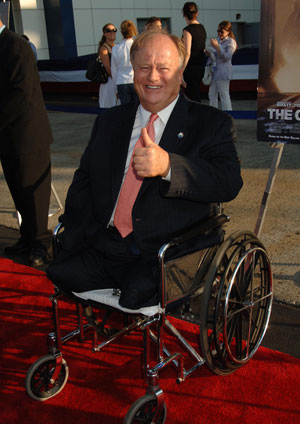

Max Cleland grew up in Lithonia, Georgia. After graduating from college he entered the Army as a signal officer and was given a desk job, but requested a transfer to Vietnam. During the siege of Khe Sanh, after surviving five days of point-blank rocket attacks on his hillside position, Cleland boarded a Chinook helicopter to set up a new communications post. Upon leaving the aircraft, he saw a grenade at his feet. Thinking that it was his, he reached down to pick up the grenade. It exploded. It was April 8, 1968.
“When that grenade went off, I was totally conscious. Totally,” Cleland recalled. “Saw the bone sticking out from my right arm. Body was on fire, filled with hot shrapnel. The flash burns seared my flesh and was the only reason I didn’t burn to death right there. I was bleeding to death. Three men ran to me after the smoke cleared. I was burning. I was literally smoking, dying, and bleeding to death. They staunched the bleeding. Called in a chopper. Put me on the chopper and medevac’d me 50 miles to a hospital. A Quonset hut. I was just about to pass out by then. I said, ‘Do what you can to save my leg.'”
“Every time I think about the incident,” Cleland writes in his autobiography, “Strong at the Broken Places,” “I blamed myself for getting wounded, for not coming back from the war whole, for somehow ‘screwing up.’ For thirty-two years, I had carried around the weight of that uncertainty. When I was having a bad night, the lingering self-doubt could keep me awake for hours.”
In 1999, Cleland received a phone call from a former Marine who had just watched a History Channel show on combat medics in which Max was interviewed. The caller, David Lloyd, had been in the helicopter with Max. He was also the first to come to his aid, tying off the bleeding on one of his legs with a tourniquet fashioned from strips from Max’s uniform and web belt. Lloyd then attended to a young soldier who was wounded by the blast. The soldier kept crying, “It’s all my fault!” Fresh out of basic training and only in-country for several days, he had foolishly straightened out the pins of his grenades for quick access. That made them live grenades. When one fell loose from his pack, it exploded.
Lloyd’s call changed Cleland’s life. “David had given me an invaluable gift, the gift of peace of mind,” Cleland said. “Finally, I can say, ‘It was not my fault.’ That is a great burden off my shoulders. It makes all the other burdens in my life seem less significant and more manageable.”
Facing life as a triple amputee, Cleland sunk into despair. Politics pulled him out. At 28, he became the youngest member of the Georgia State Senate. Picked by President Jimmy Carter to head the Veterans Administration, Cleland created veterans’ centers across the country and worked to create the diagnosis of post-traumatic stress disorder, a revolution in veterans’ health care. He ran successfully for the U.S. Senate in 1996.
In 2002, what Cleland calls “the second big grenade in my life” blew up in his face. Running for reelection to the Senate, he was confronted by a Republican challenger, Saxby Chambliss, who used the George Bush/Karl Rove playbook to smear him as a weakling on national security. Chambliss (who sat out the Vietnam war with a bad knee) ran a commercial that depicted Cleland’s face morphing into that of Osama bin Laden. Cleland lost the election, a blow from which he says he still hasn’t recovered.
Since then, Cleland has thrown himself into working for Iraq veterans. He campaigned on behalf of Tammi Duckworth, who recently won the Democratic nomination for an Illinois Congressional seat. Duckworth is an Iraq war vet who lost her legs in 2004 when a rocket-propelled grenade downed the helicopter she was flying.
Asked by NPR what it was in Duckworth that reminded him of himself, Cleland said, “Her sense of having been blown to Hell and back. And that, coming back to this country, you know that you’re not going to sit on your rear end. You’re not just going to collect a retirement or a pension. You’re going to fight like hell for a new life, a new job, a new career and one in public service.”
– – – – – – – – – – – –
I find myself today, going on sixty-four, a washed-up, dried-up prune of a military veteran who has been thrown on the scrap heap of time and looking back wistfully and saying, “I wished I’d done more to prevent the current disaster in Iraq that’s exactly mocking the first disaster in Vietnam that I was personally a part of.”
I go to Walter Reed Hospital now for trauma counseling. For my own self. Because it never ends. I’ve got post-traumatic stress disorder. Didn’t know I had it. Anxiety and fear and all that crap. And it never goes away. But you can submerge it into a higher cause like politics.
So here I am, back at Walter Reed, thirty-seven years later, dealing with the trauma of Vietnam. I never got the counseling back then. But I look down the hall, and it’s still 1968. Seeing all these young Iraq War veterans blown up, missing arms and legs and eyes, I just can’t stand it. It triggers all of my stuff from Vietnam. And these young men had the same grit and courage that we had going off to war. You go up to ’em, and say, “How ya doing, son?” “Fine, sir!” they answer. But years later, it will take its toll. They just don’t know yet.
I’m seeing the full circle of the Vietnam experience. What’s happening today is that a certain number of young Marines and Army guys are doomed to get killed and blown up and have missing arms and legs and eyes, and maybe they’ll be on the phone twenty to thirty years later talking to some guy writing a book about them. I have seen this movie before. I’m terrified that I’m seeing Vietnam all over again in my lifetime.
Iraq is Vietnam on steroids. I recently had a phone call from a friend of mine who was in the same infantry battalion that I later went into. He wrote the history of that battalion in a book called “The Lost Battalion.” His name is Charley Krohn and he teaches at the University of Michigan. He is a hard-core Republican, but he transcends his party. He says, “We have the worst of both worlds in Iraq.” Charley knows combat. His squad lost over half its men — over twenty men — in the woods outside Hue during the Tet Offensive.
Anybody who understands Vietnam or went through it, like me and Charley and others, sees this war in Iraq as nothing other than total folly. Its impact on me has been profound. It got me involved in the Kerry presidential campaign. It attracted my fellow Vietnam veterans who understood the arrogance of power and were wounded by it. When I speak with soldiers back from Iraq, they have the same deep, mixed feelings that we had when we came back from Vietnam. They are proud of having served their country. But then again, they are disgusted and angry with the way they were used and finding themselves in a situation where they get blown up and maimed and worse.
Bush has created a war that didn’t have to happen. As Richard Clarke put it, “Invading Iraq after 9/11 was like invading Mexico after Pearl Harbor.” Instead of going after bin Laden and all of his terrorists in the mountains, Bush transferred those resources and those men on the ground to Iraq. We now see a new generation of terrorists willing to blow themselves up to take out a bunch of Americans. And you add the Iraqi people. What you have is an absolute disaster.
Bush has gotten young Americans killed and wounded and blown up in a shooting gallery in Iraq. In a way, that is criminal. It is grinding the American military down. People are going back for their third tours. We have in effect thrown in everything we’ve got. And it ain’t working. It’s getting worse. There’s continued killing. And sooner or later either the people or Congress is gonna ask, “Is it worth it?” And they are gonna answer, “No!” And then where are all these young men and women who have lost legs and arms and eyes going to be? That’s called Vietnam.
The main problem is that there is no exit strategy to win in Iraq. What was our exit strategy in World War I and World War II? My answer was to win. Former Army Chief of Staff General Shinseki requested 250,000 to 500,000 troops for Iraq. These additional troops were necessary to secure the population. Bush didn’t want to go with that number. So there are not enough troops on the ground to win. We are trapped in the quagmire. And the American people will ultimately reject that. As a matter of fact, the majority of Americans think it is not worth it anymore. I knew it would happen. It took the American people about two years to come to that realization.
Sooner or later, the U.S. will ultimately withdraw from Iraq. What they have created in Iraq is a terror haven, a civil war that has no end. We destabilized Iraq. It had a stable government. We didn’t like it. We had Saddam Hussein in a box. But this president went in and took Saddam Hussein out and thought that was gonna be the end of it. He didn’t listen to Secretary of State Colin Powell, who said, “Mr. President, do you understand the consequences?” Of course he did not. Not only didn’t he know the consequences of those decisions, Bush wanted to be macho and be better than his daddy.
The people who got us into this war didn’t want to learn from history. Of the 550,000 who served in Vietnam, 100,000 were foxhole strength. So Defense Secretary Rumsfeld wanted to go in on the cheap. The original Pentagon Plan for the invasion of Iraq called for 500,000. That’s the first plan Bush was shown, because the Army has about 131 indices on a matrix that says: Given the terrain, given the forces, given the population, if you are going to invade the country and do regime change and have to occupy and secure the population and control the terrorists, then take all these factors and you come out with the X factor, which was 500,000 troops. Rumsfeld and Bush wanted to go in and do it on the cheap in a running start — not as Colin Powell did in the first Gulf War and send 500,000 people in there at one time. Your ground war lasts ten hours and it’s over. No. Not this crowd. They had no idea what they were doing. So the problem is that another generation of young Americans will come to grief over war. Under Bill Clinton, General Hugh Shelton, chairman of the Joint Chiefs of Staff, used to say, “American military is the great hammer. But every problem in the world is not necessarily a nail.”
John Kennedy once described himself as an idealist with no illusions. In conflicts outside the boundaries and waters of the United States, you better be a realist. The history of the world teaches us that no foreign power is going to invade some country without tremendous opposition. We ran up against the Oriental mind-set in Vietnam. In the Middle East, they think in thousands of years: “Though it takes a thousand years for revenge, I’ll get ya.”
Sooner or later, the impact of the politics of unmitigated war in the Middle East will be felt here in America. But it will take time as the impact of these policies is felt in our pocketbook, in the gut, in the minds and hearts of American people. There is a great line by Benjamin Franklin. Coming out of Constitution Hall in Philadelphia, a lady asked, “Dr. Franklin, what kind of government do we have?” And he said, “We have a Republic — if you can keep it.” So this sense of an American experiment is not a given thing.
I’ve run across people — young people, old people — who want to continue the fight for what they perceive as the defense of democracy in our country. I met this lady who worked for former Senator Tom Daschle. They were clearing out his office on Capitol Hill. She said that she initially wanted to leave the country and move to Costa Rica. She then quoted something from Thomas Jefferson, and I will paraphrase: “Every generation has to decide anew whether it wants to continue this democracy.” One of Kerry’s campaign speeches used a quote from President Kennedy. It went: “Every man can make a difference. And all of us should try.” That is what inspired me to get involved in politics.
When I had gone over to Vietnam, I was thinking it would be like South Korea. Finger in the dike. Stop the bad guys from taking over the south. You know, we are the good guys. They are the bad guys. I bought the whole premise. But then each week, each month that went by, I saw that we were more motivated than the South Vietnamese troops. Then I ran across a friend of mine who was an adviser to the Vietnamese. He was an Army captain. He said, “We are on the wrong side.” The situation on the ground was completely different than we had been told. The Viet Cong went after us with dynamism, and they did so with such ferocity that they were looked upon as patriots. The Viet Cong swam in the sea of the people. They could not have existed had the public not supported them. So we became the new French.
I wound up being retired from the United States Army the day before Christmas Eve 1969. I was sitting in my mother’s living room in my little hometown. No future. No hope. No job. No income. No apartment. No car. So the decade which had dawned with such promise in January 1961 and with such great words — “Ask not what your country can do for you; ask what you can do for your country” — ended up with me biting the whole bait. I went with the whole program. In Georgia, nobody would give me a job. Nobody was coming around and saying, “Oh, you’re a great American hero.” I’d have a friend take me to Atlanta and we’d get drunk. I’d come back and think, “What the hell kind of life is this?” So I decided to get back into politics. I really had no other alternative if I wanted to get out of all this pain and sorrow. Running for public office was something that would give me a sense of meaning and purpose and direction. It was something I could do to make a contribution. I had been interested in running for Congress, but I didn’t think I could win as a fresh face. I looked at the State Senate, which included my hometown in the district. I thought, “Well maybe if I ran a good campaign, I could win.” And so I ran and raised my own money.
After I got elected to the Georgia State Senate in 1970 and Jimmy Carter was elected governor, I put forward a resolution in the State Senate for the withdrawal of our ground forces in exchange for our POWs. Although I had never joined Vietnam Veterans Against the War, what began to sink into my mind, as I saw more and more casualties coming home with arms and legs lost, was, “This has got to stop.” The only thing that I thought could get us out of Vietnam was to get our POWs back.
When he became president, Jimmy Carter took a big chance on me to run the Veterans Administration, because I was only thirty-four and I had never run anything bigger than a platoon. He put me in charge of a department larger than eight cabinet departments combined. And it was a glorious experience. Tremendous stress. Tremendous pressure. But we were highly focused. We were highly motivated. Because we had to take care of these Vietnam veterans coming back.
We created a diagnosis for PTSD — post-traumatic stress disorder. The former chairman of the Veterans Affairs Committee in the House of Representatives thought Vietnam veterans were crybabies. World War II guys didn’t believe all this stuff. So, PTSD was created as a diagnosis. I created the vet center program with Senator Alan Cranston and Jimmy Carter. The first vet center I dedicated personally. It was in Van Nuys, California. It was me and two guys. No band. No flag. No flair. Nothing. Now there are twenty vet centers in the country. And they are swamped — not only by veterans of the Vietnam era, but also from the Gulf War. Now more and more are from the Iraq War.
In four years, we also were able to create a new vocational-rehabilitation program, which had not been updated since World War II. We were able to do a helluva lot. But after Jimmy Carter lost the election in ’80, I only got one phone call the next day. It was from a low-level guy in one of the veterans organizations. That was it. He said that I had the most thankless job in Washington.
I put my stuff back in a truck and hauled it back to Georgia. I moved in with my mother and daddy again for two years. And I then ran for Georgia’s secretary of state. Won that. I was secretary of state for twelve years. I probably shoulda stayed there. But U.S. Senator Sam Nunn walked away from his seat. And Clinton was in office. It looked like good things were happening. I figured that the only reason I’d go to Washington would be to take Sam Nunn’s place on the Armed Services Committee. So I ran and won. I thought that if I just worked hard and did a good job — I looked after our troops and cared about Georgia — that I would be re-elected and carry on Sam Nunn’s legacy.
What I didn’t reckon on happening was George Bush winning in 2000 and Karl Rove coming in and teaming up with Ralph Reed. And then in 2002, with the impact of 9/11, the Republican Party began trashing everybody as if they were un-American. I was actually an author of a homeland security bill along with Joe Lieberman. But the Chambliss campaign ran an ad saying that I voted against George Bush and homeland security. Well, I voted against some amendments while the bill was in committee. They just did their normal fear and smear job. And yet, I had voted for Bush’s tax cut and I voted for the war, which is the worst vote I ever cast.
Looking back at my six years in the U.S. Senate, I take pride in the accomplishments during the early days. The expansion of NATO in Western Europe, in Poland and the Czech Republic and so on. It was literally the expansion of freedom. The march of justice and freedom expanding through the Western European theater and into some old Soviet-dominated areas.
Then came Clinton’s impeachment. The trial in the Senate was the most awful experience you can possibly imagine. I was sick as a dog. Not just politically but personally. I had mononucleosis and didn’t even know it. Viral infection in my sinuses. I just thought I was gonna die.
I voted not guilty. While Clinton lied and so forth, it certainly was not an impeachable offense. But it brought down the Democratic progress, and it activated the radical right. It gave them something to beat the Democrats over the head with in the elections of 2000. Which is one reason Bush won.
In the Senate, I also tried to push for families qualifying under the GI Bill to take care of the troops. After 9/11, under the flag that was flown at election time, good works seem to not matter. That is one of the powerful discouraging things about politics today. It’s not what you produce or the good works that you do. It’s whether or not you’re able to withstand a thirty-second negative ad and if you’re willing to go out and trash the other guy or gal just as badly. It’s all character assassination politics now. It seems to carry the day. That’s the sad part about it.
Personally, after my Senate loss on election night 2002, it went downhill from there. I still haven’t emerged from that loss. In Robert Caro’s book about Lyndon Johnson, LBJ said that he lost the South after the Civil Rights bill. By 1968, Nixon had embarked on the Southern strategy: “Go after the redneck boys on race. It’ll bring ’em in every time.” You know, it’s become more subtle over the years. Certainly, it’s what Ralph Reed had used against me in my 2002 re-election campaign. The Confederate emblem on the state flag was the incendiary bomb in Georgia politics. And it hit the third rail. Which killed us all. It gave the hatchet to the right wing. They raised the issue that Democrats were trying to take away Georgia’s culture. The cultural war included the Confederate flag. That was their symbol. The Republicans were for the whites. The Democrats were for the blacks. They pulled the flag into their cultural issues of abortion, guns, gays, and God. Karl Rove got a lot of money to come down and push nothing but voter registration and turnout for white males. That’s what was coming off the charts in anger against all Democrats. There was also George Bush’s five visits to Georgia. They buried us with their strategy. It turned out an extra 140,000 angry white males who normally didn’t vote. And it turned the mid-term election. Governor Roy Barnes and I lost by approximately the same margin.
When I’m in public office and doing something worthwhile in a cause, I have a mission and a purpose. I can perform and do great things and enjoy it magnificently. When I don’t have that, I’m struggling with deep depression and discouragement and a sense of meaninglessness. When John Kerry announced his candidacy, he asked me to introduce him at Charleston, South Carolina.
With John Kerry, it looked like maybe the Vietnam War had produced a leader for the country who could translate that powerful negative into a very powerful positive experience, and with a new positive direction in our foreign policy. But that was not to be.
Today, there are no manners in politics. We’ve seen the viciousness with which the Republican crowd goes after people. They took out Senator John McCain in South Carolina in 2000; Senator Bob Smith in the New Hampshire primary, again a Vietnam War veteran; Chuck Robb in 2000 in Virginia; myself in 2002 in Georgia; John Kerry and Tom Daschle in 2004. The viciousness of their campaigns of character assassination has reached new levels. It’s obvious that they threw out any rules of law. Now it’s all about whatever it takes to win and devil take the hindmost. It’s getting kids killed in Iraq and our foreign policy is at low ebb. The economy is going down. The dollar is getting weaker. Increasingly we are just the laughingstock of the world.
I’m a Democrat, so I cite Thomas Jefferson. He said there were basically two classes of people: one that tends to leave authority to the select few and the powerful, and the other is one that wants to give the people control. Jacksonian Democracy is really the fulfillment of that. Andrew Jackson. Old Hickory. The hero of New Orleans. He had a great line that I used for John Kerry. “One man with courage is a majority.” I’ve been down to Andrew Jackson’s home. The Hermitage outside of Nashville, Tennessee. He ran for president once and didn’t make it. But he ran for president a second time and did make it. Ironic that such a man of the South represented Democratic ideals. Now, Democratic ideals are being shunned for the past twenty to twenty-five years in the modern South.
But anyway, the point is that the great history of the United States will ultimately triumph over any radical departure from real authentic American values which go all the way back to Plato and are echoed through Jefferson, Jackson, Benjamin Franklin, and a host of others. And that is the sense of wisdom and justice. And moderation and courage. In fact, with the phrase “equal justice under law,” you really don’t have an underpinning of law until there is a sense of justice. And what is justice? Life, liberty, and the pursuit of happiness. That one man’s life, liberty, and pursuit of happiness is just as valued as another man’s life, liberty, and pursuit of happiness. Therein lie your values of the democratic process.
This Republican crowd is a Trojan horse. They say one thing and do another. I don’t think you have to be false with people. You have to tell the truth and seriously connect with people. Average citizens thought they were doing the right thing by voting for Bush and this crowd. You need to be honest and straightforward and real with the American people. Ultimately, as Lincoln said, you can fool some of the people all of the time, and all of the people some of the time, but you cannot fool all of the people all of the time.
I have no more desire to return to politics. I still have tremendous desire for public service. I’m on the Export-Import Bank Board right now, but I want to stay involved in public service in Georgia. But I have no desire to put my name on the ballot. I won’t ever run for office again. I can’t handle it. Because it did me in. It’s too much physically and emotionally. So probably my best venue is out of the limelight. I’m like an old combat commander. I’ve been in combat too long. I was in combat for nine years, from October 1995 to just recently. I have known both military and political battles. I have been traumatically wounded by both. Winston Churchill said that politics is a lot like war, except in war, you get killed once. In politics you get killed many times.
Looking back on my career, I am proud of being the Veterans Administration head and dealing with the aftermath of the Vietnam War, in particular, putting together the program for veterans’ centers, which deals with the emotional aftermath of war for veterans and their families. Thank God for that program, because it is being swamped by a new crew of Iraq War veterans. They are dealing with depression, anxiety attacks — stuff like that. We have created a quarter of a million Iraq War veterans. In Vietnam, we had eight and a half million veterans. We are adding to that quarter of a million number every day. Walter Reed is swamped with bona fide casualties. Particularly amputees. The VA is swamped. They don’t have enough resources. Senator Craig, a hard-core Republican from Idaho who is on the Senate Armed Forces Committee, admitted that the VA medical program was about a billion dollars short. The private counseling program is where it is most short. That is what ought to be beefed up. With all these Iraq War veterans coming home, their families will also need counseling.
Instead of “American Idol” on TV, we ought to be focusing on the lives of these young kids coming back with injuries that would have killed them in Vietnam, like concussions to the brain, because 85 percent of the casualties in Iraq are due to explosive devices. That’s a shock and trauma to the system even if you survive it. It blows up your insides and your brain in a concussion that you won’t ever get over. It is just terrifying to come back and have to live with that the rest of your life. But these kids are so brave and so courageous that we ought to be focusing on them. Instead, many people put a sticker on the back of their car that says, “We Support the Troops,” and then they put a Bush/Cheney sticker on the other side. And think that that’s America.
Meanwhile, the Democrats are trapped in a mixed message. Anytime you have troops at war, you are reluctant to criticize it. Because then you are attacked as un-American and unpatriotic. So it’s hard to stand up and speak the truth. Those who do get trashed. They get attacked by the Slime Machine. The price to go up against them is awful. I was on the 9/11 Commission, but I resigned after a year because we would never get access to all of those presidential daily briefs. Ten, twenty years later you’ll have another commission and go into this thing in depth. But right now, it’s all part of this massive cover-up that somehow we are fighting the war on terrorism in Iraq.
The current political situation is enough to kill everybody’s spirits. We are in a deep dark time in American history, but the American character is wonderful. Arthur Schlesinger, Jr. recently told me that the great thing about our democracy is that it is self-correcting.
Excerpted with permission from “Patriots Act: Voices of Dissent and the Risk of Speaking Out,” by Bill Katovsky. The Lyons Press.
