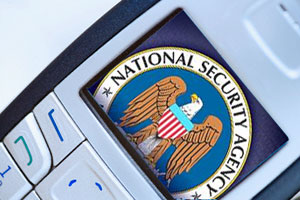

The NSA is on the line — all of them
An intelligence expert predicts we'll soon learn that cellphone and Internet companies also cooperated with the National Security Agency to eavesdrop on us.
By Kim Zetter
When intelligence historian Matthew Aid read the USA Today story last Thursday about how the National Security Agency was collecting millions of phone call records from AT&T, Bell South and Verizon for a widespread domestic surveillance program designed to root out possible terrorist activity in the United States, he had to wonder whether the date on the newspaper wasn’t 1976 instead of 2006.
Aid, a visiting fellow at George Washington University’s National Security Archive, who has just completed the first book of a three-volume history of the NSA, knew the nation’s bicentennial marked the year when secrets surrounding another NSA domestic surveillance program, code-named Project Shamrock, were exposed. As fireworks showered New York Harbor that year, the country was debating a three-decades-long agreement between Western Union and other telecommunications companies to surreptitiously supply the NSA, on a daily basis, with all telegrams sent to and from the United States. The similarity between that earlier program and the most recent one is remarkable, with one exception — the NSA now owns vastly improved technology to sift through and mine massive amounts of data it has collected in what is being described as the world’s single largest database of personal information. And, according to Aid, the mining goes far beyond our phone lines.
The controversy over Project Shamrock in 1976 ultimately led Congress to pass the 1978 Foreign Intelligence Surveillance Act and other privacy and communication laws designed to prevent commercial companies from working in cahoots with the government to conduct wholesale secret surveillance on their customers. But as stories revealed last week, those safeguards had little effect in preventing at least three telecommunications companies from repeating history.
Aid, who co-edited a book in 2001 on signals intelligence during the Cold War, spent a decade conducting more than 300 interviews with former and current NSA employees for his new history of the agency, the first volume of which will be published next year. Jeffrey Richelson, a senior fellow at the National Security Archive, calls Aid the top authority on the NSA, alongside author James Bamford.
Aid spoke with Salon about how the NSA has learned to maneuver around Congress and the Department of Justice to get what it wants. He compared the agency’s current data mining to Project Shamrock and Echelon, the code name for an NSA computer system that for many years analyzed satellite communication signals outside the U.S., and generated its own controversy when critics claimed that in addition to eavesdropping on enemy communication, the satellites were eavesdropping on allies’ domestic phone and e-mail conversations. Aid also spoke about the FBI’s Carnivore program, designed to “sniff” e-mail traveling through Internet service providers for communication sent to and from criminal suspects, and how the NSA replaced the FBI as the nation’s domestic surveillance agency after 9/11.
Having studied the NSA and its history extensively, were you surprised and concerned to discover that, since 2001, the agency has been amassing a database of phone records, and possibly other information, on U.S. citizens?
The fact that the federal government has my phone records scares the living daylights out of me. They won’t learn much from them other than I like ordering pizza on Friday night and I don’t call my mother as often as I should. But it should scare the living daylights out of everybody, even if you’re willing to permit the government certain leeways to conduct the war on terrorism.
We should be terrified that Congress has not been doing its job and because all of the checks and balances put in place to prevent this have been deliberately obviated. In order to get this done, the NSA and White House went around all of the checks and balances. I’m convinced that 20 years from now we, as historians, will be looking back at this as one of the darkest eras in American history. And we’re just beginning to sort of peel back the first layers of the onion. We’re hoping against hope that it’s not as bad as I suspect it will be, but reality sets in every time a new article is published and the first thing the Bush administration tries to do is quash the story. It’s like the lawsuit brought by EFF [Electronic Frontier Foundation] against AT&T — the government’s first reaction was to try to quash the lawsuit. That ought to be a warning sign that they’re on to something.
I’ll tell you where this story probably will go next. Notice the USA Today article doesn’t mention whether the Internet service providers or cellphone providers or companies operating transatlantic cables like Global Crossing cooperated with the NSA. That’s the next round of revelations. The real vulnerabilities for the NSA are the companies. Sooner or later one of these companies, fearing the inevitable lawsuit from the ACLU, is going to admit what it did, and the whole thing is going to come tumbling down. If you want some historical perspective look at Operation Shamrock, which collapsed in 1975 because [Rep.] Bella Abzug [D-NY] subpoenaed the heads of Western Union and the other telecommunications giants and put them in witness chairs, and they all admitted that they had cooperated with the NSA for the better part of 40 years by supplying cables and telegrams.
The newest system being added to the NSA infrastructure, by the way, is called Project Trailblazer, which was initiated in 2002 and which was supposed to go online about now but is fantastically over budget and way behind schedule. Trailblazer is designed to copy the new forms of telecommunications — fiber optic cable traffic, cellphone communication, BlackBerry and Internet e-mail traffic.
Were you really surprised to learn recently that the NSA was eavesdropping on phone calls, as the New York Times reported last December? I think most people assumed, or at least suspected, that the government had been monitoring some domestic conversations for years after the Echelon program was revealed. Echelon, though never confirmed by the government, was described as a global surveillance system that had the ability to intercept every phone, fax and e-mail conversation around the world.
I think it was generally assumed that when I heard breathing on the other end of the phone, it was the FBI and not the NSA listening in.
Since [the movie] “Enemy of the State” came out, everybody has assumed that the NSA had the ability to turn its antennas around and monitor us in the U.S. as much as they did anybody else. But I honestly believe that prior to 9/11, the NSA was not engaged in any domestic work at all. Then 9/11 changed the entire equation, and Congress, in its rush to prove how patriotic it was, passed the Patriot Act, which gave the government unlimited powers to conduct surveillance in the US. Basic freedoms were abridged.
Echelon, in fact, is nothing more than a VAX microcomputer that was manufactured in the early 1970s by Digital Equipment Corp., and was used at six satellite intercept stations [to filter and sort data collected from the satellites and distribute it to analysts]. The computer has long since been obsolete. Since 9/11, whatever plans in place to modernize Echelon have been put on hold. The NSA does in fact have a global intercept network, but they just call it the intercept collection infrastructure. They don’t have a code name or anything sexy to describe it, and it didn’t do domestic spying.
In 1988 Duncan Campbell, a U.K. journalist, wrote an article for the New Statesman based on an interview with a Lockheed Martin employee named Margaret Newsham, who had worked at an NSA satellite listening station in England. She claimed the NSA was eavesdropping on U.S. phone conversations back then and that she herself had eavesdropped on a conversation involving Senator Strom Thurmond. The stories reported then were that the NSA did have the ability to eavesdrop globally on conversations and was doing so domestically.
I’m not sure what she heard, but I can tell you the NSA was not listening to domestic calls — they were testing the system at the time that [Newsham] was in England, so while playing with the receiver they may have scrolled over some signals, but the system was not yet operational. Lockheed was in the process of installing the brand new processing stations and Newsham was sent to help put it in place. I asked a number of NSA people about this and they said their main focus at the time was the Soviet Union, with a minor focus on the Middle East. They had no U.S. intercept function whatsoever. If there was domestic work being done in the U.S., it was mostly being done by the FBI and not the NSA.
It’s true that some elements in the NSA really wanted to loosen the restrictions imposed by FISA but were told it’s the law of the land. And we can’t go to Congress and ask that the FISA statute be modified to allow the NSA to engage in domestic work. The assumption was that the Justice Department would never agree to it.
Judging by the USA Today article last week they found a way to get around those FISA restrictions and the Justice Department.
The USA Today article doesn’t cover how the NSA convinced all of the phone companies to cooperate. Did General Hayden [former NSA director and current nominee to run the CIA] pick up the phone and call the CEOs? Or were they presented with National Security letters saying you will turn over all your records to us and keep it quiet within your organization? But it does seem clear that the Justice Department was excluded from all of this, or at least the parts of the Justice Department that would normally have some oversight over this. For example, they didn’t refer the case down to the Civil Rights Division for their approval. They kept the number of people within the Justice Department who had knowledge of the program to a small number of people. I think they feared that if they passed it down to other departments that might have some purview over the program they might have encountered a stream of objections.
It’s all coming out now in dribs and drabs, but when it all becomes clear, we’ll find out that the key oversight functions — those functions that were put in place to protect the rights of Americans — were deliberately circumvented. Key components of the Justice Department that would have rightly objected to this were never consulted or told about the program. Alberto Gonzales when he was the White House counsel knew about it, as did Attorney General Ashcroft and his deputy, but outside of that I don’t think there were many others who knew all the details.
According to President Bush, there were apparently some members of Congress who knew about the program.
They can claim that they briefed individual members of Congress but there’s a difference between briefing a few members of Congress and briefing a full committee. Only a few members of the intelligence committee were told and they were told in a way in which they couldn’t do anything about it. And the briefings were very general and lacking in specifics, as I understand.
What happens is that you’re [privately] briefed about the program, and then even if you object to the program, you can’t do anything about it because you can’t tell the whole committee. Our system only works when information is given to the full committee. But the way they did it effectively handcuffed any opposition because you can’t go to the full committee and say I object to this program and we ought to call some hearings and examine the legalistic background and justification for the program. Even if Senator Rockefeller or Congresswoman Pelosi had some issues with it, they couldn’t even tell their own staff, much less other members of the committee. They deliberately did it this way so the intelligence committees couldnt do anything about it.
Who’s the person running the NSA’s data collection program?
James M. Cusick, assistant deputy director of the NSA for data acquisition. He’s Mr. Data Acquisition. He’s the specialist in charge of building collection systems that can acquire vast amounts of data, and his unit is the one that is running this program.
Do you think such a program could be effective at catching terrorists?
To the best of my knowledge, in the five years in which the program has been running, it has not caught a single person.
How did we go from having the FBI doing domestic surveillance to having the NSA serve that function? How was the decision made?
The FBI is in a state of shell shock after 9/11. They’ve become so risk-averse. They’ve been criticized so many times, for the right reasons, that they’re terrified of doing their job anymore. So the White House felt they’d become rather leaky and creaky.
Also, the FBI had to get approval from the attorney general for every tap it used. I’ve been told on fairly good authority that the reason the FBI’s Carnivore telecommunications surveillance program was not used in the fashion that the NSA system has been after 9/11 was because it would require the written consent of the attorney general and the Civil Rights and Criminal Divisions of the Justice Department, any one of which could have scuttled the program. That’s a prospect worse than the FISA court, as far as the White House is concerned. So the White House decided to abandon the FBI in favor of an agency that had not done any domestic work since 1975. As a result, the NSA had to spend billions of dollars constructing a system that it didn’t have the capability to construct prior to 2001, which may explain why some NSA veterans I talked to say that some parts of the NSA are now short of money.
Do you know how much the NSA has spent on its phone record data collection project?
No. I don’t even think the people who have been briefed on the program on Capitol Hill know how the money is being used. Each year the House and Senate intelligence committees pass, by oral vote, the money for the entire intelligence community. Then they pray like the dickens that these people are spending it wisely and properly. It will come as no surprise to anyone that Congress has basically abrogated its responsibility for overseeing the national security establishment of the NSA. And you can’t blame one party over the other. It’s my experience that many senior ranking Democrats on these committees are also not doing their job for one reason or another.
This story has been corrected since it was originally published.
New light on NSA spying
A former Internet expert for the FCC concludes that a secret AT&T installation was most likely used for government surveillance.
By Kim Zetter
A federal court in California released a previously sealed 40-page document on Thursday in the Electronic Frontier Foundation’s lawsuit against AT&T, which bolsters allegations that the telecommunications giant built secret rooms to allow the National Security Agency to conduct widespread surveillance of Internet traffic. The document also paints a detailed scenario of how the NSA may be conducting the top-secret operation, which closely matches information given to Salon by a former AT&T employee who worked at the company’s network operations center in Bridgeton, Mo.
The document, a statement by J. Scott Marcus, a former senior advisor for Internet technology to the Federal Communications Commission, was filed under seal on April 5 on behalf of the EFF to support its class-action suit against AT&T, which alleges that the company violated a number of federal laws in aiding the government’s domestic spying operation against AT&T customers. The court sealed the document because it contained proprietary AT&T information, then ordered AT&T and EFF to work together to produce a redacted version to place in the public record, which they did on Thursday.
EFF asked Marcus to examine records from a former AT&T technician in California named Mark Klein that describe how AT&T reconfigured its network in San Francisco and installed special computer systems in a secret room, allegedly to divert and collect Internet traffic to help the NSA conduct warrantless surveillance. Were the records authentic and was it feasible that they described a government surveillance program, or could the reconfiguration and systems have been put in place for more innocuous uses?
Marcus concludes in his statement that the documents are authentic and, after considering a number of possible reasons for the reconfiguration — such as legitimate network monitoring and maintenance — writes that the system AT&T installed in a secret San Francisco room, and likely other cities, was “exceptionally well suited to a massive, distributed surveillance activity” and that “no other application provides as good an explanation for the combination of engineering choices that were made.”
He considered that the system might be set up to accommodate lawful traffic intercepts under the Communications Assistance for Law Enforcement Act, but deemed this not a credible scenario, since there are far simpler and less expensive solutions for meeting CALEA, which required Internet service providers to make their networks wiretap-ready. He also concludes that given how cash strapped AT&T was in 2002 and 2003 when the expensive changes and additions to the system were made, it is “exceedingly unlikely” that AT&T financed the project on its own. “I therefore conclude that it is highly probable that funding came from an outside source, and consider the U.S. Government to be the most likely source,” he writes in the document.
Over several pages that are redacted at key points, Marcus discusses technical details in the Klein documents that have previously been unavailable. (The Klein documents are under seal, and although some of them have made it to the Internet, others, judging by details revealed by Marcus, have never been made public.) According to Marcus, the Klein documents refer to a “private … backbone network, which appears to partition from AT&T’s main Internet backbone.” This suggests the presence of a private network, Marcus writes, whose existence is “not consistent with normal AT&T practice.”
“The most plausible inference is that this was a covert network that was used to ship data of interest to one or more central locations for still more intensive analysis,” Marcus writes.
The most interesting aspect of the Marcus statement is the clear, though speculative, scenario he provides for how the National Security Agency is likely conducting its surveillance and data collection through that network. Marcus, currently a consultant with WIK-Consult GmbH in Bad Honnef, Germany, was unavailable for comment. But in the statement, he suggests that the secret San Francisco room is connected to two separate networks — the regular commercial network on which e-mail, Web surfing and voice-over Internet Protocol traffic runs, and the second private, covert network that is partitioned off from the regular network and is used to divert traffic that has been copied and sent back to a central collection place. He suggests that massive amounts of data are collected at 15 to 20 locations around the country, where it is automatically screened and winnowed down to only “data of interest” by a special system installed in San Francisco (and likely elsewhere) before it is shipped off to one or two central collection points, where it is processed by powerful computers and analyzed by skilled staff.
This agrees with what several sources told Salon this week. A former AT&T network technician who is well acquainted with AT&T’s common backbone and asked to remain anonymous, told Salon about a secret, heavily secured room located in AT&T’s Bridgeton facility, where the company runs its technical command center from which it manages all of its backbone. From that facility, the company could send commands to any of its 1,500 to 2,000 routers around the country to filter and divert traffic from those locations. To do that, the technician said, AT&T would need to physically place network “sniffers” at key points in the company’s backbone. “There are 10 or 15 data centers located in major cities around the country,” he said. “So they would need to stick [a sniffer] in each of those data centers to capture all the information.” Then the company could easily send commands from the Bridgeton room to the routers in those locations. The commands would indicate what data to collect and where to divert it afterward.
Marcus writes that although the configuration in San Francisco was deployed in early 2003, given AT&T processes, the planning for it was probably underway six to 12 months earlier. This coincides with the timing of the Bridgeton Network Operation Center, which was put in place about eight months before the San Francisco room was configured and was the place from which the work order for the secret room in San Francisco originated.
The Bridgeton room, guarded with a high-tech mantrap with retinal and fingerprint scanners, is restricted to government workers and AT&T employees with top-secret security clearances and is likely just used for remotely monitoring and maintaining the secret rooms around the country and sending commands. Russ Tice, a former NSA officer and senior analyst until last year, told Salon that the data once collected is probably not sent to Bridgeton but instead is diverted to an NSA facility where powerful processing equipment can analyze it.
As for the kind of data collected, Marcus infers from the Klein documents that the configuration in place in San Francisco would enable surveillance of “both overseas and purely domestic traffic.” But the Klein evidence suggests that only “off net” traffic was being collected in San Francisco at the time the documents were written. “Off net” refers to traffic sent between AT&T customers and customers of other ISPs; “on net” traffic is sent strictly between one AT&T customer and another AT&T customer.
Still, this amounts to a lot of data, Marcus says. It would mean that any traffic that passed through AT&T’s network from another ISP or network would be intercepted. He suggests the possibility, however, that authorities could conceivably weed out domestic traffic to collect only international traffic exchanged between an AT&T customer and noncustomer, given that software programs exist that can help distinguish domestic Internet traffic from traffic that travels from outside the United States. But he writes that even with such weeding, some purely domestic traffic would likely slip through the filter.
A hearing on the EFF lawsuit against AT&T is being held in San Francisco Friday to determine whether the case should be thrown out. The Department of Justice has interfered in the case, calling on the court to dismiss it on grounds that national security secrets would be exposed if a trial were to proceed.
Is the NSA spying on U.S. Internet traffic?
Salon exclusive: Two former AT&T employees say the telecom giant has maintained a secret, highly secure room in St. Louis since 2002. Intelligence experts say it bears the earmarks of a National Security Agency operation.
By Kim Zetter
In a pivotal network operations center in metropolitan St. Louis, AT&T has maintained a secret, highly secured room since 2002 where government work is being conducted, according to two former AT&T workers once employed at the center.
In interviews with Salon, the former AT&T workers said that only government officials or AT&T employees with top-secret security clearance are admitted to the room, located inside AT&T’s facility in Bridgeton. The room’s tight security includes a biometric “mantrap” or highly sophisticated double door, secured with retinal and fingerprint scanners. The former workers say company supervisors told them that employees working inside the room were “monitoring network traffic” and that the room was being used by “a government agency.”
The details provided by the two former workers about the Bridgeton room bear the distinctive earmarks of an operation run by the National Security Agency, according to two intelligence experts with extensive knowledge of the NSA and its operations. In addition to the room’s high-tech security, those intelligence experts told Salon, the exhaustive vetting process AT&T workers were put through before being granted top-secret security clearance points to the NSA, an agency known as much for its intense secrecy as its technological sophistication.
“It was very hush-hush,” said one of the former AT&T workers. “We were told there was going to be some government personnel working in that room. We were told, ‘Do not try to speak to them. Do not hamper their work. Do not impede anything that they’re doing.’”
The importance of the Bridgeton facility is its role in managing the “common backbone” for all of AT&T’s Internet operations. According to one of the former workers, Bridgeton serves as the technical command center from which the company manages all the routers and circuits carrying the company’s domestic and international Internet traffic. Therefore, Bridgeton could be instrumental for conducting surveillance or collecting data.
If the NSA is using the secret room, it would appear to bolster recent allegations that the agency has been conducting broad and possibly illegal domestic surveillance and data collection operations authorized by the Bush administration after the terrorist attacks of Sept. 11, 2001. AT&T’s Bridgeton location would give the NSA potential access to an enormous amount of Internet data — currently, the telecom giant controls approximately one-third of all bandwidth carrying Internet traffic to homes and businesses across the United States.
The nature of the government operation using the Bridgeton room remains unknown, and could be legal. Aside from surveillance or data collection, the room could conceivably house a federal law enforcement operation, a classified research project, or some other unknown government operation.
The former workers, both of whom were approached by and spoke separately to Salon, asked to remain anonymous because they still work in the telecommunications industry. They both left the company in good standing. Neither worked inside the secured room or has access to classified information. One worked in AT&T’s broadband division until 2003. The other asked to be identified only as a network technician, and worked at Bridgeton for about three years.
The disclosure of the room in Bridgeton follows assertions made earlier this year by a former AT&T worker in California, Mark Klein, who revealed that the company had installed a secret room in a San Francisco facility and reconfigured its circuits, allegedly to help collect data for use by the government. In detailed documents he provided to the Electronic Frontier Foundation, Klein also alleged there were other secret rooms at AT&T facilities in other U.S. cities.
NSA expert Matthew Aid, who has spent the last decade researching a forthcoming three-volume history of the agency, said of the Bridgeton room: “I’m not a betting man, but if I had to plunk $100 down, I’d say it’s safe that it’s NSA.” Aid told Salon he believes the secret room is likely part of “what is obviously a much larger operation, or series of interrelated operations” combining foreign intelligence gathering with domestic eavesdropping and data collection.
“You’re talking about a backbone for computer communications, and that’s NSA,” Russ Tice, a former high-level NSA intelligence officer, told Salon. Tice, a 20-year veteran of multiple U.S. intelligence agencies, worked for the NSA until spring 2005. “Whatever is happening there with the security you’re talking about is a whole lot more closely held than what’s going on with the Klein case” in San Francisco, he said. (The San Francisco room is secured only by a special combination lock, according to the Klein documents.)
Tice added that for an operation requiring access to routers and gateways, “the obvious place to do it is right at the source.”
In a statement provided to Salon, NSA spokesman Don Weber said: “Given the nature of the work we do, it would be irresponsible to comment on actual or alleged operational issues as it would give those wishing to do harm to the United States insight that could potentially place Americans in danger; therefore, we have no information to provide. However, it is important to note that NSA takes its legal responsibilities seriously and operates within the law.”
Since last December, news reports have asserted that the NSA has conducted warrantless spying on the phone and e-mail communications of thousands of people inside the U.S., and has been secretly collecting the phone call records of millions of Americans, using data provided by major telecommunications companies, including AT&T. Such operations would represent a fundamental shift in the NSA’s secretive mission, which over the last three decades is widely understood to have focused exclusively on collecting signals intelligence from abroad.
The reported operations have sparked fierce protest by lawmakers and civil liberties advocates, and have raised fundamental questions about the legality of Bush administration policies, including their consequences for the privacy rights of Americans. The Bush administration has acknowledged the use of domestic surveillance operations since Sept. 11, 2001, but maintains they are conducted within the legal authority of the presidency. Several cases challenging the legality of the alleged spying operations are now pending in federal court, including suits against the federal government, and AT&T, among other telecom companies.
In a statement provided to Salon, AT&T spokesman Walt Sharp said: “If and when AT&T is asked by government agencies for help, we do so strictly within the law and under the most stringent conditions. Beyond that, we can’t comment on matters of national security.”
According to the two former AT&T workers and the Klein documents, the room in the pivotal Bridgeton facility was set up several months before the room in San Francisco. According to the Klein documents, the work order for the San Francisco room came from Bridgeton, suggesting that Bridgeton has a more integral role in operations using the secured rooms.
The company’s Bridgeton network operations center, where approximately 100 people work, is located inside a one-story brick building with a small two-story addition connected to it. The building shares a parking lot with a commercial business and is near an interstate highway.
According to the two former workers, the secret room is an internal structure measuring roughly 20 feet by 40 feet, and was previously used by employees of the company’s WorldNet division. In spring 2002, they said, the company moved WorldNet employees to a different part of the building and sealed up the room, plastering over the window openings and installing steel double doors with no handles for moving equipment in and out of the room. The company then installed the high-tech mantrap, which has opaque Plexiglas-like doors that prevent anyone outside the room from seeing clearly into the mantrap chamber, or the room beyond it. Both former workers say the mantrap drew attention from employees for being so high-tech.
Telecom companies commonly use mantraps to secure data storage facilities, but they are typically less sophisticated, requiring only a swipe card to pass through. The high-tech mantrap in Bridgeton seems unusual because it is located in an otherwise low-key, small office building. Tice said it indicates “something going on that’s very important, because you’re talking about an awful lot of money” to pay for such security measures.
The vetting process for AT&T workers granted access to the room also points to the NSA, according to Tice and Aid.
The former network technician said he knows at least three AT&T employees who have been working in the room since 2002. “It took them six months to get the top-security clearance for the guys,” the network technician said. “Although they work for AT&T, they’re actually doing a job for the government.” He said that each of them underwent extensive background checks before starting their jobs in the room. The vetting process included multiple polygraph tests, employment history reviews, and interviews with neighbors and school instructors, going as far back as elementary school.
Aid said that type of vetting is precisely the kind NSA personnel who receive top-secret SCI (Sensitive Compartmented Information) clearance go through. “Everybody who works at NSA has an SCI clearance,” said Aid.
It’s possible the Bridgeton room is being used for a federal law enforcement operation. According to the Communications Assistance for Law Enforcement Act of 1994, telecom companies are required to assist law enforcement officials who have legal authorization to conduct electronic surveillance, either in pursuit of criminal suspects or for the protection of national security. The companies must design or modify their systems to make such surveillance possible, essentially by making them wiretap-ready.
The FBI is the primary federal agency that tracks and apprehends terrorist suspects within the U.S. Yet, there are several indications that the Bridgeton room does not involve the FBI.
“The FBI, which is probably the least technical agency in the U.S. government, doesn’t use mantraps,” Aid said. “But virtually every area of the NSA’s buildings that contain sensitive operations require you to go through a mantrap with retinal and fingerprint scanners. All of the sensitive offices in NSA buildings have them.” The description of the opaque Plexiglas-like doors in Bridgeton, Aid said, indicates that the doors are likely infused with Kevlar for bulletproofing — another signature measure that he said is used to secure NSA facilities: “You could be inside and you can’t kick your way out. You can’t shoot your way out. Even if you put plastique explosives, all you could do is blow a very small hole in that opaque glass.”
Jameel Jaffer, deputy director of the American Civil Liberties Union’s national security program, said it is unlikely that the FBI would set up an ongoing technical operation — in this case, for several years running — inside a room of a telecommunications company. The Foreign Intelligence Surveillance Act, passed by Congress in 1978, requires law enforcement officials to obtain warrants from a secret federal court for domestic surveillance operations involving the protection of national security. If the FBI (or another federal agency) wanted data, it would more likely be targeting a specific individual or set of individuals suspected of engaging in criminal or terrorist activities. The agency would obtain a warrant and then call AT&T, or show up in person with the warrant and ask for the wiretap to be engaged. According to Jaffer, the FBI, NSA or any other federal agency could also legally tap into communications data under federal guidelines using technical means that would not require technical assistance of a telecom company.
In an e-mail statement to Salon, FBI spokesperson Paul Bresson said: “The FBI does not confirm whether or not we are involved in an alleged ongoing operational activity. In all cases, FBI operations are conducted in strict accordance with established Department of Justice guidelines, FBI policy, and the law.”
Rather than specifically targeted surveillance, it is also possible that the Bridgeton room is being used for a classified government project, such as data mining, with which the Pentagon has experimented in the past. Data mining uses automated methods to search through large volumes of data, looking for patterns that might help identify terrorist suspects, for example. According to Tice, private sector employees who work on classified government projects for the NSA are required to undergo the same kind of top-secret security clearance that AT&T workers in the Bridgeton room underwent.
According to the former network technician, all three AT&T employees he knows who work inside the room have network technician and administration backgrounds — not research backgrounds — suggesting that those workers are only conducting maintenance or technical operations inside the room.
Furthermore, Tice said it is much more likely that any classified project using data collected via a corporate facility would take place in separate facilities: “The information that you garner from something like a room siphoning information and filtering it would be sent to some place where you’d have people thinking about what to do with that data,” he said.
Dave Farber, a respected computer scientist at Carnegie Mellon University and former chief technologist for the Federal Communications Commission, also said it is likely that data collected in a facility like the Bridgeton center would be used elsewhere, once the facility is set up to divert the data. “If I own the routers, I can put code in there to have them monitor for certain data. That’s not a particularly difficult job,” said Farber, who is considered one of the pioneers of Internet architecture. Farber said that “packets” of data can essentially be copied and then sent to some other location for use. “Most of the problems would have to do with keeping your staff from knowing too much about it.”
According to the former network technician, workers at Bridgeton, at the direction of government officials, could conceivably collect data using any AT&T router around the country, which he says number between 1,500 and 2,000. To do so, the company would need to install a wiretap-like device at select locations for “sniffing” the desired data. That could explain the purpose of the San Francisco room divulged by Klein, as well as the secret rooms he alleged existed at AT&T facilities in other U.S. cities.
“The network sniffer with the right software can capture anything,” the former network technician said. “You can get people’s e-mail, VoIP phone calls, [calls made over the Internet] — even passwords and credit card transactions — as long as you have the right software to decrypt that.”
In theory, surveillance involving Internet communications can be executed legally under federal law. “But with most of these things,” Farber said, “the problem is that it just takes one small step to make it illegal.”
AT&T can’t silence whistle-blower
A federal judge rules for the Electronic Frontier Foundation in its suit against AT&T for cooperating with the NSA to spy on customers.
By Kim Zetter
A federal judge denied AT&T’s request on Wednesday to force the Electronic Frontier Foundation to return documents the nonprofit organization received from a retired AT&T employee.
The documents that former AT&T technician Mark Klein gave EFF earlier this year, and which the court has sealed, contain details of what EFF and Klein are alleging is a secret agreement between the telecommunications company and the National Security Agency to provide the government agency with illegal access to communications belonging to its customers. In a preface to the documents, Klein said he was motivated to blow the whistle in 2004 “when it became clear to me that AT&T, at the behest of the National Security Agency, had illegally installed secret computer gear designed to spy on Internet traffic.”
The documents, which Klein released to the New York Times and other newspapers before the court sealed them, describe how AT&T diverted the communications of customers to a secret room that the company maintained at its hubs in San Francisco, San Diego, San Jose, Calif., Los Angeles and Seattle. The rooms housed “computer gear for a government spy operation which taps into the company’s popular WorldNet service and the entire Internet,” Klein wrote. “These installations enable the government to look at every individual message on the Internet and analyze exactly what people are doing.”
Klein’s assertions help support a class-action lawsuit that EFF filed against AT&T in January on behalf of its customers, alleging that the company violated the wiretap statute, the FISA statute and several communications and privacy laws in aiding the government’s domestic spying operation without a court order.
AT&T claimed the documents contained trade secrets and asked the court to force EFF to return them to prevent the organization from distributing them further. EFF acknowledged that it had provided the documents to two technical consultants, who helped investigate and validate Klein’s claims. U.S. District Court Judge Vaughn Walker ruled against AT&T, but did order EFF not to give the documents to anyone else. The order does not, however, prevent Klein from sharing the documents with anyone else. Klein is not a party to the EFF lawsuit against AT&T, and so the judge couldn’t prevent Klein from disclosing the documents.
AT&T spokesman Marc Bien declined to comment after the hearing on what action if any the company might still take against Klein to protect the trade secrets that it says are in the documents that Klein possesses.
Klein’s attorney, James J. Brosnahan, said the documents should be made public since the public’s right to know “trumps any proprietary information.” He added that although Klein had shared his information with members of the Senate, he had not given the documents to anyone since the court sealed them and would not do so now, out of respect for the court. Brosnahan said he thought it was interesting, however, that AT&T had not yet taken any legal action against his client. “They have, what, a hundred lawyers up there? And they haven’t sued him,” he said.
Brosnahan said the real issue, however, was not the documents but whether AT&T had diverted all customer correspondence and Web traffic to the government. “Someone in this country has got to answer the question quickly: Is that true? And if that’s true, when will it stop?”
Bien would not take questions and only responded with a prepared statement after the hearing. “AT&T does not provide customer information to law enforcement agencies or government agencies without legal authorization … If and when AT&T is asked by government agencies for help, we do so strictly within the law and under the most stringent conditions. ”
A number of questions remain to be answered by the court before the case can go forward. Both the Department of Justice and AT&T are seeking to have the case dismissed — the DOJ on the basis that the case will yield classified information and harm national security, and AT&T on the grounds that the company’s actions are immune from liability.
With regard to national security, EFF lawyer Cindy Cohn said that nothing EFF had filed so far contained state secrets. Cohn said that EFF gave the government the documents before filing them and that the government allowed EFF to file them. “They would not have granted that permission if they claimed that it was a state secret. So plainly the information that we’ve filed so far is not a state secret.”
Brosnahan also said that the information his client knows was never classified or declared top secret, and that Klein himself was never cleared for classified work. “So the government allowed all that to happen without the slightest order, suggestion or word on anybody’s part that what he did was confidential and top secret,” Brosnahan said.
Even if, as the government argues, the case will inevitably reveal state secrets, Cohn said EFF could easily argue the case without revealing such secrets. She said the case lies solely on the question of whether or not AT&T provided the government with data in an illegal manner, not on what the government did with the data after obtaining it. “What the government does after that isn’t actually relevant in order to determine whether AT&T broke the law,” she said.
As for AT&T being immune from customer lawsuits, Cohn said that would be the case only if AT&T acted according to the law and handed over data under court order. “If they had a court order and they responded to a court order by providing information, then they have immunity and we think that’s right,” she said. “But if they’re breaking the law, then they don’t get any immunity.”
In the meantime, EFF is trying to prevent AT&T from continuing to provide the government with customer data. The group filed a preliminary injunction to stop AT&T’s activity. But Judge Walker refused to address that issue until after the court addresses motions to dismiss the case, which will occur on June 23.
The injunction is the core of the case, Cohn said on the courthouse steps after the hearing. “While of course we want to seek recompense for our clients — the millions of people who have had this happen to them for what appears to be about four years — but really what we want it to do is to stop and to stop now.”
Cohn said she wouldn’t say whether EFF would settle the suit if AT&T agreed to stop supplying the government with data. But her group would seriously consider a proposal from AT&T if the company said it would stop, and if her clients approved.
When asked if EFF had received any information about other companies that implicated them in a similar agreement with the NSA, she replied, “I’m not going to comment on that right now.”
Kim Zetter is a freelance writer based near San Francisco.