
Africa
Destination: Togo
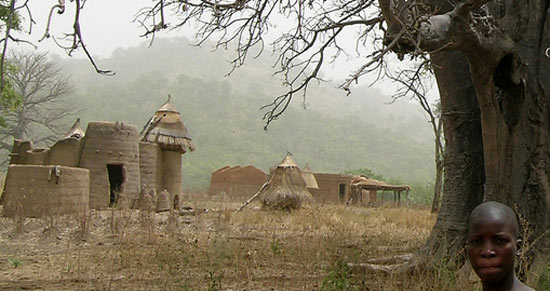
The wild character of this tiny West African nation is captured in a brilliant roman
Togo is the Zembla of West Africa: If it did not exist, it would have been invented by the author of an absurdist experimental novel, prompting generations of unwary readers to leaf through their atlases in search of the place. Indeed, some of Togo’s own residents may occasionally be tempted to leaf through their atlases, to assure themselves of their own existence. How is one to account for this finger of a country tucked in between Ghana and Benin, its population of 5 million people speaking 40-odd different languages? A country that owes its existence to the off chance of having been the tiniest of Germany’s short-lived African colonies, inherited by France after World War I, which absentmindedly failed to consolidate it into its other colonies? Where, until February of 2005, a general who had first seized power in 1967 still reigned, Mobutu-like, over a tribalized kleptocracy, propped up by French money and military advisors, referred to by his countrymen in hushed whispers as “le vieux.” Is this place for real?
In fact, Togo does exist; but that didnt stop the great Ivorian novelist Ahmadou Kourouma from inventing it. Kouroumas brilliant 1998 roman à clef, “Waiting for the Vote of the Wild Animals,” is a folk-absurdist chronicle of the life of Koyaga, a champion wrestler from a northern hill tribe (as Togo’s longtime dictator Eyadéma was) who is recruited into the French army, fights in Vietnam (as Kourouma did), and winds up commanding a clique of disgruntled ex-officers in his country’s first coup. He then gradually descends into the familiar dictatorial narrative of gold-plated extravagance and familial intrigue. Koyaga is tutored in the fine arts of torture, repression and opulent state dinners by a panoply of African greats, including Ivory Coast’s Houphouët-Boigny, Guineas Sékou Touré, Congo’s Mobutu, and the Central African Republic’s Bokassa. (They appear in clever guises: “The Man whose Totem is the Crocodile,” “The Man whose Totem is the Leopard,” and so on.)
The novel follows Koyaga’s history through the Cold War years of Western-sponsored corruption, and into the ’90s, when the old wrestler finds himself lost in a new world of IMF-mandated structural adjustment programs and exiles returning from Europe demanding transparency and decentralization. But its real genius is stylistic: The narrator, Bingo, is Koyaga’s griot, a praise-singing storyteller who recites the leader’s history over the course of a six-day, five-night banquet. The language, thick with African idiom and oral tradition, throws the postcolonial political narrative into high relief, like Woody Guthrie reciting the life and times of Richard Nixon.
For a more realistic introduction to Togo, there’s the book beloved of every Peace Corps volunteer: “The Village of Waiting” (1988), by George Packer. Packer is best known today for his superb reporting on the Iraq war for the New Yorker, which culminated in the 2005 book “The Assassins’ Gate.” He was a Peace Corps volunteer in Togo in 1982-83. Stationed as an English teacher in a sluggish village of the Ewe ethnicity called Laviéma (whose name, according to legend, meant “wait a little longer”), Packer found his modest optimism deteriorating into a profound alienation and cynicism over the course of 18 months. His intense friendships with his host family, with the village chief, and with his students were laced with mistrust and incomprehension. Confronted by their poverty, he felt responsible; confronted by their manipulation and dishonesty, he felt simultaneously abused and sympathetic. Ultimately, wracked by hypochondria and anxiety, he quit before his two-year Peace Corps term was up. “The Village of Waiting” is one of the most wrenchingly honest books ever written by a white person about Africa, a bracing antidote to romantic authenticity myths and exotic horror stories alike. Isak Dinesen, Packer notes, wrote of waking in the Kenyan highlands and thinking, “Here I am, where I ought to be.” He himself woke up sweating, hungry, “mildly at ease, or mildly anxious. But never where I ought to be.”
Tété-Michel Kpomassie didn’t feel Togo was where he ought to be, either, though he grew up in a typical family of the Mina ethnicity in the 1940s and ’50s, herding goats and picking coconuts on a coastal plantation. When a priestess of the local python god demanded that he be apprenticed to her, he fled the country, setting out for a far land he had become obsessed with since discovering a book about it in a missionary bookshop: Greenland. It took him eight years to work his way up through West Africa and Europe, but he made it, and spent two years living among the Inuit, driving a dog sled and hunting seal in a kayak. “An African in Greenland,” his 1981 account of those years, is one of the more original volumes of amateur anthropology ever written, as well as a ripping good travel yarn. And it’s a curious meditation on Africa, Europe, the Arctic, and the tenuous and arbitrary ways in which different cultures regard each other as “savage.”
No bibliography of Togo would be complete without a guide to some aspect of vodun, the animist religion that thrives from southeastern Ghana to southern Benin, and the ancestor of Haitian voodoo. Judy Rosenthal’s 1998 “Possession, Ecstasy, and Law in Ewe Voodoo” focuses on two of the more colorful and fast-growing sects, gorovodun and Tchamba vodun, both of which are tied up in fascinating ways with cultural exchange between Togo’s Christian/vodun south and its Muslim north, and with the history of slavery. Rosenthal lived for long stretches in an impoverished fishing village called Dogbeda, and intimately shared the lives of the vodun priestesses, or “horses.” She recounts their jealous rivalries, their ever-changing family arrangements, and the splendidly chaotic festivals at which they are possessed and transformed by spirits of varying personalities and sexes. Imagine the early-’90s voguing documentary “Paris Is Burning” recast in a dirt-poor African fishing community, with a certain amount of animal sacrifice thrown in. If that sounds appealing, you will enjoy your time in Togo.
Matt Steinglass writes for the Boston Globe and other publications, and for the children's television show "Arthur." He lives in Hanoi, Vietnam. More Matt Steinglass.
A victory for The Hague
Charles Taylor's guilt puts violent leaders in Syria and Libya on notice
A Freetown street vendor watches a live broadcast of the Taylor verdict being delivered. (Credit: Reuters/Finbarr O'Reilly) The verdict against former Liberian President Charles Taylor at the Sierra Leone Special Court has been eagerly anticipated by many in Sierra Leone. But, as is often the case with abusive leaders wielding power, bringing Taylor to justice was once considered a less-than-welcome development in diplomatic circles. More than a few feared at that time that bringing charges against a sitting president in the midst of a conflict would do more harm than good.
In June 2004, though, I roamed Freetown’s muggy markets trying to get a sense of what people in Sierra Leone’s capital thought of the Sierra Leone Special Court, the mixed national and international court established to deal with atrocities committed during the country’s civil war. The court’s first trial, against a popular government official, had begun that day, and the prosecutor’s opening statement could be heard on radios in market stalls and on street corners. The talk in town was not, however, of that trial. Instead people wanted to know when Taylor would be brought to justice for supporting the rebels who had caused their country so much horror. It was clear that many in Sierra Leone felt justice could be served only if Taylor was held accountable.
Continue Reading CloseSara Darehshori is senior counsel in the U.S. program of Human Rights Watch and author of the report "Selling Justice Short: Why Accountability Matters for Peace." More Sara Darehshori.
Sudan’s return to war?
As Sudan vows to retake the Heglig oilfields, South Sudan warns it will retaliate
This photo of Saturday, April 14, 2012, shows the aftermath of a bombing by the Sudanese Air Force in Bentiu, South Sudan . Two Sukhoi jet fighters dropped 6 bombs in the area, killing 5 and wounding 4 others. Two Sudanese warplanes dropped "many bombs" Monday April 16, 2012, on the oil-rich city of Heglig, as long-range artillery targeted southern army positions in the disputed town, said southern army spokesman Col. Philip Aguer. He did not give a casualty figure. He also said Monday that Sudan's air force killed five civilians in aerial attacks Sunday over Heglig. Aguer also said that the town of Bentiu in South Sudan's Unity State was hit and that the conflict has spread to several southern states bordering Sudan, including Western Bahr el Ghazal. (AP Photo/Michael Onyiego) (Credit: AP) BENTIU, South Sudan — As fears mount that Sudan and South Sudan will return to war, a South Sudan army commander here says he does not intend to withdraw troops from the disputed Heglig oil fields and he is prepared to fight.

On April 9 the South Sudan army seized Heglig on the border between the two countries. Heglig, a major oil producing area, is internationally recognized as Sudan’s territory, but South Sudan has always claimed it.
How Mandela united a nation
John Carlin talks about how the South African leader averted a bloodbath and the triumphs of the post-apartheid era
Nelson Mandela Nelson Mandela was a most unusual, and unusually astute, leader, says author and journalist John Carlin. He used forgiveness as a political tool, in so doing ensuring that South Africa avoided what could have been a bloodbath.
You’ve had a professional interest in South Africa as a writer and journalist for more than 20 years. Can you tell us more about it?
I’ve been a journalist for 30 years now. I’ve mainly been a foreign correspondent. I’ve been based in half a dozen places and I think I’ve actually worked as a journalist in about 50 countries. South Africa is the one that left by far the deepest imprint on me. I was there at an extraordinary time, during the transition from apartheid to democracy. I arrived in 1989 as a correspondent for the Independent in London, which meant that I caught the last year of full-on, hard apartheid. Then after that there was Mandela’s release and the very painful birth pangs of the new nation, leading to the elections of 1994.
Continue Reading CloseBoys like me
It took traveling halfway across the globe to meet a gay male. And to realize I was one, too
(Credit: Lerche&Johnson via Shutterstock/Salon) Although I was 16 and knew nearly nothing, my heart had sense enough to start racing the moment he took the seat next to me on our tour bus.
William, as he introduced himself, was tall and handsome, and his hair had a slight red tint to it as if it were burnt around the edges. I guessed he was maybe a year older than me, although it was hard to tell because all the Namibian students wore the same uniform, a polo shirt and khaki pants.
“You’re from the United States!” he announced upon sitting down. “New York or Los Angeles?”
Continue Reading CloseSam Biederman lives in Brooklyn. His writing has appeared in publications including N+1, Bookforum, and The Nation. More Sam Biederman.
The Trump brothers’ grotesque hunting spree
The Trump sons go on safari -- and prey on the weak and helpless for fun. Sound familiar?
Donald Trump, Jr. and Eric Trump (Credit: huntinglegends.com) How arrogant and out of touch are Donald Trump’s sons? Let’s put it this way – this is a story in which their father comes off as the subtle, nuanced thinker.
It seems Donald Jr. and his brother Eric went to Africa on a hunting trip last year, and their tour company, Hunting Legends, decided recently to brag of the men’s prowess on their Web site, complete with graphic photos of the brothers and their kills. And here’s a shocker – there’s something about rich white men smiling with the carcasses of the African animals they’ve killed that a lot of people just don’t like.
Continue Reading Close
Mary Elizabeth Williams is a staff writer for Salon and the author of "Gimme Shelter: My Three Years Searching for the American Dream." Follow her on Twitter: @embeedub. More Mary Elizabeth Williams.
Page 1 of 76 in Africa