

Events in Iraq have long ceased to dominate the news. The trial of Saddam Hussein, which the media once seized on as yet another “defining moment,” has been lost amid the daily repetition of car bombs, assassinations, the countless numbers of Iraqi and American dead. It is a sideshow for Iraqis, who are too busy trying to stay alive, and a bore for Americans, who have ceased to be interested in the war’s many retroactive justifications. But the show in the Green Zone proceeds, and the well-groomed deposed dictator maintains his defiance, even hoping, it has been revealed, that the Americans will realize their mistake and reinstate him. He stands accused of bearing responsibility for 148 Shias killed in 1982, a paltry number compared to the cases to come, including a genocidal campaign against the Kurds. Safe from the chaos engulfing the rest of the country, the closest Saddam may come to experiencing the terror that now consumes Iraq is the murder of three of his lawyers.
Outside the Green Zone, any hopes for a better future in post-Saddam Iraq were dashed a long time ago. As early as the summer of 2003, Sunnis had been sufficiently alienated to long for their halcyon days under the Baathists, and since then the situation has deteriorated catastrophically. With Shia death squads torturing and executing Sunnis, Sunni insurgents killing Shia, criminal gangs running rampant and a vicious civil war raging, people frequently ask me: Are things worse for Iraqis now than they were under the man who now stands in the dock?
I don’t know the answer to that question. But the very fact that it can legitimately be asked is horrifying. For Saddam’s Iraq deserved the name given it by the exiled writer Kanan Makiya: “Republic of Fear.” I began to learn why soon after I arrived in the country in April 2003.
He picked me up in his taxi on a busy street, that first spring in Baghdad. In Iraq you never know who will stop for you when you hail a cab. Most taxis were orange and white “Brazili” Volkswagens made in Brazil. When you asked them what the fare was they would disingenuously insist, “No, it’s on me.” When you insisted on paying and asked for a price they would say, “As you wish,” knowing you would be too uncomfortable to pay them what you really wished, and in case you did, they would say, “No, that’s too little.” Taxi drivers were my oracles in Iraq. They knew all the rumors, more often false than true, they were my spies, they knew what explosion had happened in what neighborhood, what neighborhood was off limits thanks to the resistance, the Americans or some other militia. And like their colleagues throughout the world, they were always eager to talk.
My driver was a thin middle-aged man, olive-toned, wiry, bony and angular. The thick hair on his arms was gray, as were his grizzled cheeks and bushy mustache. He had large eyes, sunken and hidden beneath the shadow of his brows. I felt like striking a conversation. “How are things in Baghdad?” Driving, he hung his arm straight out of the window and gazed at it silently as I waited for an answer. Without uttering a word or demonstrating that he had even heard the question, he stared ahead expressionless. Worried, I realized his jaws were tightly clenched and his eyes were glazing. Anxiously I watched a tear swell and burst off his eyelashes, slowly making its way down his cheek. I resisted the urge to reach over and wipe it for him. “I’m sorry,” I said, “did somebody from your family die?”
He struggled to answer me. In a controlled whisper, he said, “We all died.”
In those first weeks, I began to learn what he meant. I was present when family members exhumed the corpses of loved ones killed by Saddam. I even stumbled upon my own treasure trove of documents in an abandoned police station, papers that revealed the reality of life under the dictator. But then new horrors took center stage, pushing the old ones aside.
When I arrived, Iraq’s walls were already covered with leaflets and banners announcing the deaths of “martyrs.” At first, the walls bore the names of those killed by the liberating American military, but soon there were new martyrs, victims of the nihilistic anarchy spreading in the country — the faudha, or chaos, as Iraqis called it. These Iraqis were killed by the criminal violence that sprang up in the power vacuum, and then by the insurgents — Sunni men seeking to kill the “Crusaders and Jews” who were occupying Iraq. Others were killed by the aggressive U.S. military that was now occupying them.
I spent nearly three years writing about the new victims, those killed under the occupation or during the civil wars being fought in Iraq. In my focus on Iraq’s newest victims, I forgot about Saddam’s victims.
The trial of Saddam reminded me of the files I looted from that security station, and of my notes from those first few weeks, which I had forgotten. And as the people of Iraq endure yet another nightmare — one the United States unlocked — it seems important to remember them.
Abdel Satar al Musawi’s dark brown decomposed remains lay on the ground above his former grave. His older brothers sat beside them, holding them and crying. Although he was arrested in 1998 and killed in 2001, they had only learned of his death three days before. They had come to claim his body. “His crime was loving freedom,” said his friend Abdel Karim, who had come to find his own brother.
I had only been in Iraq a few weeks, beginning my career as a journalist. I had opposed the war, not because of illusions I had about Saddam’s brutality, but because I knew that helping the Iraqi people was not on the Bush administration’s agenda, and nothing good would come of war. It was simple to me: A war predicated on lies was wrong, and would subvert democracy at home as well as international law. In the early days of the war, the magazine that sent me asked me if I wanted a gas mask or a suit to protect me from chemical weapons. I scoffed at the need, explaining that I did not believe Iraq had those weapons anymore. I had come to Iraq to give a voice to Iraqis, and this meant restraining my views, and listening to Iraqis. As Iraqis rubbed their eyes and awoke to the new reality in a mix of shock, depression and euphoria, I was as confused as they were, and nothing seemed black-and-white.
With the collapse of Saddam Hussein’s regime the circumstances surrounding the disappearance of thousands of political prisoners were finally being revealed to their families. Iraqi families could find the files on their loved ones and discover their fate. More often than not, the news was not good.
Several dozen members of the al Musawi family had come to claim four of their brethren from the Karkh cemetery in Haswa, outside of Baghdad and near the Abu Ghraib prison, where many of Saddam’s political prisoners were murdered. All four were cousins: Abdel Sattar al Musawi, born in 1966, from the Dora neighborhood of Baghdad, married with two children; Salah Hadi al Musawi, born in 1974, from Baghdad’s Thawra neighborhood; Salah Hasan al Musawi, born in 1971 and also from Thawra; and Saad Qasim al Musawi, born in 1967, from Thawra, married with six children. A family friend, Qasim Ahmad al Maliki, born in 1966 and also from Thawra, married with no children, was also buried in the cemetery. All were killed in 2001.
“They were political prisoners,” a friend of the al Musawis explained, “killed for no reason. There was no justice, no court, no defense.”
The men had come on a bus and in a pickup truck. They carried with them flimsy wooden coffins made of boards and a black flag of mourning. At 7 in the morning, they were the first family in the cemetery that day.
The dafan, or grave digger, Muhammad Muslim Muhammad, was a small man in sweat pants with a buttoned shirt tucked in. He assisted with an obsequious eagerness and I suspected that he was compensating for an unconfessed complicity in the crimes he helped bury.
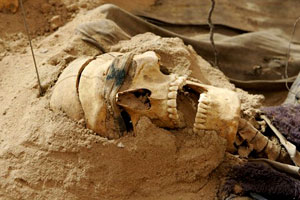
The Karkh cemetery was the size of a football field, surrounded by a brick wall the height of a man. Eucalyptus trees lined the edges by the wall. The ground was a sandy gray, with mounds marking the shallow graves containing the bodies. Some of the mounds had holes burrowed into them, where animals had fed on the corpses. On a stick in the mound was a card with a number on it. The al Musawi family had the plot numbers for their dead, and Muhammad led them to the first one, striding over other graves. It belonged to Abdel Satar. When they found the grave, the previously silent men collapsed in loud sobs, kneeling on the ground or clinging to one another. They quieted down as the gravedigger undid his work, watching in apprehensive and lachrymose silence, as if still hoping the grave would be empty. The digging slowed as the earth being removed turned to a wet dark red, as if stained with blood. The gravedigger abandoned his shovel and used his hands. The body was the color of the earth, thin and dry. Amid wails of “my brother!” the body was placed on a plastic sheet and wrapped in a kiffin, or white cloth. It was then placed in the wooden coffin, to await the trip to Najaf, where it would be buried in the City of Peace, the biggest cemetery in the world outside of China, and the preferred burial site for all Shias.
As Abdel Sattar’s brothers and a handful of others remained by his coffin, the rest of the family moved on to dig up Saad’s body. It emerged in separate pieces; the bones were placed together by the skull. Saad’s father was present. By 9 in the morning six families had arrived to reclaim their loved ones and their wailing cries could be heard from all corners of the cemetery. I was crying too. Abdel Sattar’s former employer was also present. “He was a lovely boy,” he said of him. I asked if this had happened to many people he knew. Gesturing behind him to the hundreds of graves, he said, “See for yourself.”
I felt ashamed intruding on the pain of the al Musawi family, and I sobbed with them. It was my first month as a journalist and I was not yet able to watch other people’s pain without participating in it. In 1991 Sattar’s relative Daghir Jasim al Musawi tried to escape to Iran following the failed Shia uprising against Saddam, which George Bush the elder encouraged and which was brutally suppressed by Saddam after Bush failed to support it. Daghir visited Sattar before escaping, and this caused all the suffering that befell their family. Eleven men from the al Musawi family were arrested, suspected of taking part in the uprising.
I spoke with one of the men, 29-year-old Husayn Sayer Naama al Musawi from Thawra. He was arrested in the summer of 2001 because he was a relative and Saddam’s secret police thought he might know something. He was held for 70 days in the Saddam City security prison with the four al Musawi cousins who were killed.
In prison they tied Husayn’s hands behind his back and hung him from them, dislocating his shoulders. They tortured him with electricity and beat him with cables and metal rods until he was drenched in his own blood. They wanted to know why Daghir had come to visit him, but he could tell them nothing, since Daghir had only come to visit Sattar.
He would still be able to recognize the faces of the security officers who did this to them, he told me. The prison was run by someone named Saad al Ithawi. There was an officer called Abbas who was drunk during the interrogation and beat Husayn brutally. Executions were carried out by an officer called Hamid. Husayn said, “If I saw them I would seek revenge, I would eat them.”
Before they left, several of the men from the al Musawi family blasted the Arab media for their failure to speak out. “The Arab press failed,” said one. “They were a part of these crimes. They covered it up. They always said Saddam was a hero and they took his money.” Another exhorted me, “Don’t be like Arabs, tell the whole world.”
Some graves had no numbers, meaning that some families never found their loved ones. The al Musawis themselves had not known whether their lost sons were dead or alive until three days before they dug up their bodies. They received the information from a remarkable organization called the Association of Free Prisoners.
Located in the confiscated riverside villa of a former security official in the Kadhimiya neighborhood of Baghdad, the association was formed three weeks before, just when the war ended. Muhamad Jamal Abdel Amir, a 28-year-old engineer, volunteered along with 50 or so others. He explained that the organization was created by four former prisoners. It was an entirely Iraqi project; they received no help from outside and had not coordinated their activities with anyone foreign. When Iraqis looted the headquarters of the many security organizations that had terrorized them for so long, people began handing over the files to the association, and its director Ibrahim al Idris. Abdel Amir explained that he had volunteered in order to help Iraq.
On the outside walls of the association’s villa hung many sheets of paper with alphabetical listings of prisoners’ names. Hundreds of desperate relatives ran their fingers down the lists taped to the walls, hoping to learn their fate. A steady stream of men and women visited the wall, reading the names. Inside, past two boys with machine guns who guarded the association, the atmosphere was bustling, as workers rushed back and forth, their faces blocked by the immense piles of documents they carried to different rooms of the house, organizing them by subject. They were entering all the information onto a database, but for now, the dozens of rooms were full of thousands of files going back to the 1960s, stacked on top of each other, stored in sacks, or still in their original file cabinets, marked Da’wa (for the banned Islamic party), Communist, and other labels that testified to Saddam’s ruthless repression of all independent political activity. New files continued to come in by the thousands from all over Iraq; the association was planning on moving to the former military intelligence headquarters.
A random file revealed that Sadiq Hamudi Salih, born in 1960, was a soldier accused of joining the Da’wa party in 1981 and criticizing the regime. In 1984 he was sentenced to five years in prison. Another file revealed that when authorities could not find Madhkur Salim Mishish they executed his relatives in 1984. Yet another file documented the mass execution of 16 people.
Saad Muhammad was a 39-year-old volunteer at the association responsible for gathering information. He was imprisoned for four years for criticizing Saddam. He showed me a Procrustean British-made traction couch that they found in the general security headquarters, and demonstrated its use during interrogations: to stretch victims until their bodies broke and tore. He also showed me a meat grinder for humans that they had found.
I came upon my own trove of records one day, as I was walking through Baghdad’s streets. In the poor neighborhood of Betawin, I stumbled into an abandoned police station, housing the Saadun general security directory office on its second floor. It was clear that a systematic attempt had been made to destroy the documents on the second floor, presumably by the minor intelligence officials who had worked in it. I found two overturned document shredders, and the thin strings that had borne the bureaucratic record of various horrors were strewn about the floor along with broken glass and ashes. Most file cabinets and their contents had been thrown into a few rooms that were torched, and all that remained in the file drawers were ashes. A local Christian boy, 12 years old and illiterate, brought sacks for me to load files into. Those documents that were salvageable bore witness to the mundane daily operations of a dictatorship’s local security station over the previous years, right up to the final days in March 2003 before the war.
They included:
The 2001 duties of security officers, files recording people changing their locations of residence, information from a snitch about a stolen antique sword and drug deals, inquiries from family members about disappeared or arrested people and the responses that no information was available about them, lists of people belonging to enemy or sectarian organizations, lists of people who had criticized Saddam, a report about a Da’wa party member who had killed a Baath party official, lists of Shias making, importing or selling religious tapes, lists of people under surveillance, reports on people observing religious ceremonies, a file about a rich man arrested in the company of several young girls, information on participants in the 1991 Shia uprising, weekly orders to spread pro-regime rumors and combat anti-regime rumors, lists of executed political prisoners and the reasons why they were executed, information on bank employees in Baghdad, a report about the Pakistani minister of health visiting a mosque in Baghdad, lists of security monitors in schools, surveillance orders for political and religious suspects, lists of local barbers, list of collaborators, lists of all the Friday sermons from Baghdad mosques in organized charts, each chart bearing the name of the mosque, the date of the prayer, the name of the cleric, the subject of the speech, the numbers and ages of the attendees, the number of women praying, whether it was a Sunni or Shia mosque, whether the cleric praised Saddam, and the name of the spy, lists of spies in mosques and churches, names of applicants to study in the Islamic university, reports on people who had tried to leave Iraq illegally, orders for the families of executed prisoners to come pick up the corpses, a report about a Wahhabi Muslim arrested for placing a bomb in a liquor store, names of men who had walked in the pilgrimage to Karbala (some of whom were accused of murder as a result), a report about a man accused of impersonating an intelligence officer, orders to spread rumors that Iraq could defeat the U.S. and would attack Israel and liberate Palestine, that the Iraqi gifts to Palestinians raised their morale and caused the Israeli prime minister’s government to fall, that POWs from Iran were returning, that supermarkets would soon be open, that the government would let people retain the temporary homes they were assigned, that the euro would become the international currency and not the dollar, a report on a woman arrested because her son had deserted the military, a list of people accused of belonging to a group seeking to avenge the murder of Shia leader Muhammad Sadiq Sadr, a report about a man accused of breaking a picture of Saddam Hussein, an order to use the term “American administration” instead of “American government,” and a memo to all branches about the U.S. information war against Iraq.
One dense folder contained numerous official security service memos about the arrest of Abad Ali Safai Ahmad, who was accused of insulting Saddam and the Baath Party. According to the files Ahmad was a taxi driver, born in 1975, who lived in the Shia slums then known as Saddam City (now Sadr City). He was a veteran of the war against Iran, and one of his brothers had been killed in that war.
On July 4, 2002, the leadership of the Batal al Tahrir, or “Heroes of Liberation,” section of the Al Aqsa group office of the Baath Party, ordered the arrest of Ahmad for his “assault on the person of the master and leader the President, may Allah bless and protect him,” and his detention for “a reasonable period” according to section 225q.aa.
Basher Aziz al Tamimi, Ahmad’s neighbor, a Baath Party member from the al Aqsa branch and also a taxi driver, testified against him. Tamimi encountered a very drunk Ahmad on the night of July 3. According to Tamimi, Ahmad suggested to him that they sell a privately owned car but Tamimi reminded him that there was a law against this proposed activity because it was a 1978 model. Al Tamimi then testified that Ahmad cursed Saddam, saying, “Saddam’s sister’s pussy over this law!” In Arabic referring to the vagina of a man’s female relatives is a terrible insult. Tamimi asked Ahmad why he was attacking the president when he knew that Tamimi was a member of the Baath Party. “Your sister’s pussy and the Baath Party’s sister’s pussy!” Ahmad replied, according to Tamimi. Tamimi then testified that “We had a fist fight and I reported the case to my supervisor Saad Khalaf and he requested I file a written report and then we went to Shahab because he is responsible for the branch security.”
The men organized a group to go to Ahmad’s house. Tamimi testified that when they arrived Ahmad hit him and threatened him, saying, “I will shave your mustache and the Baath Party’s mustache.” In Iraq a mustache is considered a symbol of manhood and honor, and threatening to shave a man’s mustache is an insult. A man can also take an oath, swearing by his mustache, and if he has been humiliated, or if his sister has, for example, he can shave his mustache and refuse to grow it until his honor has been restored and he is once more “a man.”
Another witness testifying at the security investigation court against Ahmad was Shehab Hamad Jabar al Shebli, a retired officer born in 1952 and also living in Saddam City. “I am a Baathi with the rank of section leader and a member of the Al Aqsa branch,” he began, continuing that on the night in question, at 1:30 a.m., he was met by Tamimi and another Baath Party member, who informed him that the accused had “assaulted the president the master and leader himself, Allah bless him and protect him.” They formed a committee and went to Ahmad’s house, where he angrily hit Tamimi and threatened to shave Tamimi’s mustache and that of the Baath Party. “Which caused me to hit him and bring him to committee center and I did not hear him attack the personality of the master leader the president, Allah bless him and protect him, and should I have heard him assault him I would have killed him and this is my testimony.” Other witnesses also testified in support of Ahmad’s accusers.
In his testimony Ahmad explained that “I had consumed alcoholic drink and I did not assault the person of the master and the leader president, Allah bless him and keep him.” Ahmad claimed he had witnesses who supported his side of the story. He admitted that “the same night an individual party committee came to my house to arrest me” including Tamimi, “and as I was in a bad temper I hit him and as he does not have a mustache I said to him I shave yours and the party’s mustache and I did not mean to direct the assault on the party in my words and as I mentioned I was under the influence of alcohol and was drunk and in a bad temper for I had a brother who was martyred in the great battle of Qadisyat Saddam his name was Abad al Radha and he died in 1986 and I seek the forgiveness and this is my testimony.” Ahmad claimed that Tamimi owed him 10,000 dinars and when he had asked for it back they got into an argument.
Ahmad was jailed but released in an amnesty granted two months later.
Another file I found documented the arrest of a traditional healer who was accused of being a witch. I tracked down the accused witch, Aliya Jasem, who lived in the village of Huseiniya, north of Baghdad. Huseiniya’s own inhabitants did not know the names of their own streets. Amid sewage- and waste-filled unpaved roads, where half-naked toddlers played, I finally found Aliya’s modest house. Her husband, Sadiq Naji Muhamad, was a tailor in Baghdad. They had four children. Sadiq had been a prisoner of war in Iran for nine years. He told me that Shia prisoners were singled out for special punishment by the Iranian guards who viewed them as traitors fighting for Sunnis. He was held in the Hashmetiya prison in Tehran where he saw many fellow prisoners killed or tortured.
As an unrelated male I could not meet Aliya; I could only catch a glimpse of her silhouette or the end of her dress, hear her voice as she spoke with her husband and hear her moving about in the kitchen. Sadiq related their shared story. She was a fortuneteller, psychic and traditional healer. Many Iraqi Shias believe that descendents of the prophet Muhammad, such as Aliya, can treat the spirit using the Quran. Aliya was one such descendant. She treated spiritual ailments such as depression. If a woman is expelled from her husband’s family’s home Aliya could treat her and she would be taken back. If a dog attacked a child she opened and closed the Quran three times in the child’s face in order to cure it. She could cure women who were not wanted as wives. She placed special stones in front of the afflicted woman’s house and washed her, reading from the Quran and the sayings of Imam Ali, Muhamad’s nephew and a key figure for Shias; this helped the woman find a husband. Sadiq proudly related that Aliya could not read or write but despite that she could know everything about a person by looking at their face.
When she was a child Aliya’s legs were paralyzed. Her family took her to a Shia shrine near Hilla since no doctor could treat her. Sadiq explained that at the shrine she was able to stand on her own feet and walk and since then she had special powers. “There are two types of magic,” Sadiq said, “the devil’s magic, practiced by some sects in Iraq, but which is against the Quran, and merciful magic, which can combat the devil’s magic and which she practiced. The book on magic is called the talasim.”
Aliya was paid for her services, but it was very little. This traditional healing is very common in Iraq and since every woman in the neighborhood knew about her (she only treated women), her abilities spread through word of mouth. Sadiq maintained that most women in his wife’s field were also security agents or collaborators. The security service wanted Aliya to work with them because she had access to every woman in the city and could discover the secrets of each home, such as who was against Saddam and who was involved in illegal political activity. She refused to be an agent, so they accused her of having an anti-Saddam political group in her home. Sadiq said that the mayor was a security agent and Baath Party official.
On Aug. 10, 2002, Aliya was arrested by the Iraqi security forces led by an officer named Bahar. She was found guilty of witchcraft and spent two months in jail. The order to arrest her came from the national security directorate. The documents said she was released due to her husband’s request. He wrote a letter to the security service that she had only been using special spiritual techniques to cure ailments of the soul, and only for women, using the Quran and only in the neighborhood or to female relatives. He asked for another chance, promising that she would never do it again. He also mentioned that he was a POW in Iran and he chose to return to Iraq, unlike other Shias who joined Iranian-sponsored anti-Saddam militias.
Although Aliya was sentenced to six months she was released after 70 days from the Rashas women’s prison (she was transferred from the al Rusufa prison) in a general amnesty. When she was arrested Sadiq followed the police to inquire why but they pushed him away and ordered him to leave. Aliya was beaten in the police station.
Sadiq was still bitter. “She is a good wife and they put her in the same prison with prostitutes,” he said. “She was so traumatized she has ceased performing her magic since.”
After her release Aliya went to the tomb of Abbas, an important Shia shrine, and said, “If I am really your relative prove it by destroying Saddam and all his men within a year.” Six months later his government fell. Sadiq explained that “God answered the prayers of those who had suffered.”
Thinking back on these notes, which remained in my notebooks for years, takes me back to the question I started with. Was it all worth it? Was it better to leave Saddam in power? Are Iraqis better or worse off than they were before the American war?
I never know what to say when asked this question. How do you compare different kinds of terror?
Those spared Saddam’s prisons and executioners may be better off, though they have not been spared the American prisons, or attacks, or the resistance’s bombs, or the death squads of the civil war. The Kurds are certainly better off, on their way to independence, benefiting from their relative stability and improved economy. The rest of Iraq? In many ways, things are worse. Under Saddam the violence came from one source, the regime. Now it has been democratically distributed. Death can come from anywhere, at all times, no matter who you are. You can be killed for crossing the street, for going to the market, for driving your car, for having the wrong name, for being in your house, for being a Sunni, for being a Shia, for being a woman. The American military can kill you in an operation, you can be arrested by militias and disappear in Iraq’s new secret prisons, now run by Shias, or you can be kidnapped by the resistance, or by criminal gangs.
Americans cannot simply observe the horror of Iraq and shake their heads in wonder, as if it were Rwanda and they had no role. America is responsible for the new chaos in Iraq, which began following the invasion and the botched and brutal occupation. Iraq’s people continue to suffer under the American occupation and civil war, just as they did under the American-imposed sanctions and bombings before the war, and just as they did under the years of dictatorship. Once more they are mere victims of powers they cannot control. Saddam is out and the Americans are in, but Iraq is still a republic of fear.
