
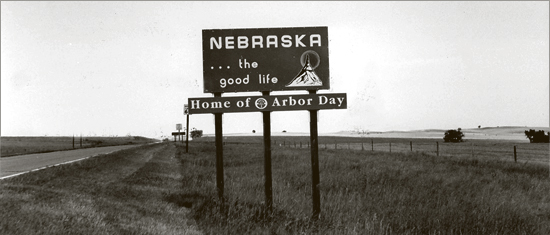
Nebraskans like to say that their state is a great place to live but you wouldn’t want to visit. It’s not that they’re not a welcoming people. But let’s not forget the adage that guests, like fish, start to smell after three days. Nebraskans tend not to like fish, at least for eating. With this in mind, the tourist would do well to see the state on a road trip, and refrain from lingering in any one place for too long. This is how most people see Nebraska anyway, while crossing the country on Interstate 80, a route whose descriptives have ranged from “stultifying” to “isn’t that the same cow we saw five hours ago?”
First road rule: Stay off the interstate. There are, believe it or not, other routes here, many of them paved.
I’ll guide you east to west, though you can certainly reverse the course if you’re going the other direction (in which case you’ll be coasting off the Rockies, then deposited into the barren plains of Eastern Colorado, which are a warm-up for the even more barren plains to come). But let’s say you’re coming from Iowa on that plebeian interstate, to which you’ll bid adieu at Council Bluffs. You’ll cross the Missouri River into Omaha, which might be the least Nebraska-like place in Nebraska. (You can do Bikram yoga here, as well as get decent sushi.)
Head over to Jackson Street Books to pick up your rations for the road. Ladette Randolph’s beautifully crafted 2005 short story collection, “This Is Not the Tropics,” will lead the way through Lincoln; Timothy Schaffert’s new novel, “The Singing and Dancing Daughters of God,” covers central Nebraska; and Tom McNeal’s “Goodnight, Nebraska” (1998) rounds out the western part of the state.
Oh, and of course there’s Willa Cather, the undisputed literary queen of the Beef State. At the very least, pick up “O Pioneers” (1913) and “My Ántonia” (1918). But don’t panic, you have until the midpoint of the state to start reading them.
In many ways, Lincoln is a small town that has grown too large for itself, its railroading and agricultural roots having given way to McMansions and superstores that now stretch its borders for miles in every direction. But its original neighborhoods, many of which are clustered around the state capitol and the University of Nebraska campus, have a historic feel that manages to be stately and earthy at the same time. It is here that many of Ladette Randolph’s stories take place. In the tense, subtly suspenseful “The Girls,” a college student entrusted with her professor’s dogs discovers a quietly disturbing world inside his house. Another story, “Miss Kielbasa,” plumbs the strange rituals of a small rural town that holds an annual drag queen pageant, all the while examining a young woman’s anxiety over her impending interracial marriage.
What’s great — and, I dare say, vital — about contemporary Nebraska authors who write honestly and unsentimentally about their state is that stereotypes are challenged at every turn. You won’t see gingham dresses and hokey language here. Instead, you get authors whose affection for the region comes through even as they poke fun at it, who refuse to spoon-feed readers the kind of folksy treacle often associated with the Midwest.
Timothy Schaffert’s novel, “The Singing and Dancing Daughters of God,” (set in the Grand Island/Aurora region of Nebraska, about 70 miles west of Lincoln) doesn’t feed us its story as much as it serves a continual stream of delicacies until your head spins. Think of it as the literary equivalent of dim sum. A totally whacked-out yarn about a divorced couple who still haven’t quite split up, Schaffert’s book is both ruthlessly funny and utterly compassionate about his characters’ ridiculous aspirations — the main character sings country songs in a Ramada Inn, dreaming of making it big — and tragic limitations.
No literary tour of Nebraska is complete (or possible) without a stop in Red Cloud, just a few miles from the Kansas border. This town is tiny, but, as Willa Cather’s home and geographical muse, it’s a very big deal to bookish Cornhuskers. Cather fled Nebraska after college, and from the looks of this town — the population is around 1,000 and falling — it’s clear she wasn’t the last one out. But Red Cloud has retained much of its historical and architectural integrity thanks to the Willa Cather Pioneer Memorial and Educational Foundation, which provides tours of buildings connected to her work as well as access to archives. There’s also a municipal pool here, which, though it was never graced by Cather’s inflatable chair, is a must-visit if you come in the summer, where the heat can cause hallucinations of sod houses and grasshopper storms. Oh, wait … maybe that’s not a hallucination.
Cather’s work, though psychologically rooted in the high plains, is largely concerned with the tension between staying in a place and leaving it. Just as “O Pioneers”‘ Alexandra Bergson struggles to maintain her family’s farm after so many others have given up and moved to the cities, “My Ántonia” focuses on Bohemian immigrants forging their way in a new country, where the Homestead Act often promised more than it could deliver.
If unmet expectations are the theme of much contemporary fiction, Nebraska literature gives it a particular spin, offering characters who don’t expect much of themselves to begin with and later find themselves pleasantly surprised. “Goodnight, Nebraska,” which is set in the panhandle town of Alliance (yes, Nebraska has a panhandle), tells the story of a teenage boy with a little too much love for his sister and none whatsoever for his creepy stepfather. While leaving the house for a date with his dream girl, he impulsively shoots his stepfather, kicking off a chain of events that sends him to western Nebraska. Here, he plays football, lives with an elderly widow and eventually finds himself in an unexpected marriage that elicits alternating feelings of entrapment and belonging.
At this point, you might be feeling something similar. In other words, you might want to go home, but you’re probably too exhausted to drive another mile. These tandem sensations are characteristic of much of Nebraska, where a collective inferiority complex tends to give way to the proud knowledge that those who live here and remain here (or even drive here without using the interstate) have endured extraordinary geographical, meteorological and existential hardship in order to do so. For all there is to appreciate about the place — the oceanlike undulations of the prairie, the psychedelic pink sunsets, the steak — there’s also, quite honestly, not a lot to do. Except read. Now that’s a vacation.
