
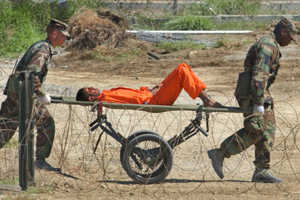

The 150,000-member American Psychological Association is facing an internal revolt over its year-old policy that condones the participation of psychologists in the interrogations of prisoners during the Bush administration’s “war on terror.”
Last summer, the APA adopted new ethical principles drafted by a task force of 10 psychologists, who were selected by the organization’s leadership. That controversial task-force report, which is now official APA policy, stated that psychologists participating in terror-related interrogations are fulfilling “a valuable and ethical role to assist in protecting our nation, other nations, and innocent civilians from harm.”
But Salon has learned that six of the 10 psychologists on the task force have close ties to the military. The names and backgrounds of the task force participants were not made public by the APA; Salon obtained them from congressional sources. Four of the psychologists who crafted the permissive policy were involved with the handling of detainees at Guantánamo Bay, Cuba, at Abu Ghraib prison in Iraq, or served with the military in Afghanistan — all environments where serious cases of abuse have been documented.
APA president Gerald Koocher, who handpicked the task-force members along with the organization’s former president Ronald Levant, said in an interview that the psychologists’ military and national-security backgrounds did not raise conflict of interest or broader questions about the task force and its report. He defended choosing psychologists with such backgrounds, saying “they had special knowledge to contribute.”
The 10-member task force enunciated the new principles for interrogations in a June 2005 report. The 11 pages of ethical obligations include 12 statements on interrogations, including one directing psychologists to report abuse and remember that suspects may be innocent. But detractors say its ban on “torture or other cruel, inhuman, or degrading treatment” is pro forma, an insufficient safeguard in the post-9/11 atmosphere.
Critics of the APA’s interrogation policy are planning an all-out assault during the organization’s annual meeting Aug. 10-13 in New Orleans, using tactics that include taking out a full-page advertisement in the local newspaper.
Opponents argue that when psychologists use their technical training to help break down the resistance of a prisoner, they are performing in a role diametrically at odds with their professional mission to serve as a healer. “I do not believe that psychologists should be involved in interrogations which are intrinsically coercive and inherently harmful to the person being interrogated,” said Steven Reisner, a psychologist and senior faculty member at Columbia University’s International Trauma Studies Program.
Joining in this chorus of dissent, former APA president Philip Zimbardo said psychologists used “the wrong model” to come up with the interrogation ethics principles. As the architect of a famous 1971 Stanford prison experiment in which students who were instructed to pretend they were guards in a mock prison quickly began to exhibit sadistic behavior, Zimbardo has more than a passing familiarity with the dynamics of cruelty. He warned against “abandoning the high moral ground in unquestioned support for ideological banners of ‘national security.'”
Reisner said in an interview that the revelations of the close ties between the Department of Defense and a majority of psychologists on the task force would help galvanize opposition to the policy. The biographies of the task force members underscore these extensive and questionable connections.
Task force member Col. Larry James was the chief psychologist for the intelligence group at Guantánamo in 2003. In 2004, James was at Abu Ghraib working as the director of the behavioral sciences group in the interrogation unit there. His biography said he was sent to Abu Ghraib “in response” to the abuse scandal. Requests to interview James were rebuffed; U.S. Army Medical Command spokeswoman Cynthia Vaughn referred Salon back to the APA.
Col. Morgan Banks spent four months during the winter of 2001 and 2002 “supporting combat operations” at Bagram Airfield in Afghanistan, where serious abuses have been reported. Banks told Jane Mayer of the New Yorker last summer he had also “consulted generally” on Guantánamo interrogations, but could not recall any specific cases. Banks’ biography lists him as one of the founders and the senior psychologist at the Army’s secretive Survival, Evasion, Resistance and Escape (SERE) program at Fort Bragg, N.C., where the military trains elite soldiers to resist torture in case of capture. The techniques used to harden those soldiers against torture — sleep deprivation, isolation, sexual humiliation, bags on the head, long exercise — have been used on detainees in Afghanistan, Guantánamo and Abu Ghraib. (Salon reported last month on a military document showing that SERE instructors taught their techniques to interrogators at Guantánamo.)
APA task force member Capt. Bryce Lefever was assigned to the Navy’s SERE school in the early 1990s and deployed with Special Forces to Afghanistan in 2002, “where he lectured to interrogators and was consulted on various interrogation techniques,” according to his bio.
Two other members of the task force worked for the Department of Defense Counterintelligence Field Activity, which coordinates Pentagon security efforts. One of them, R. Scott Shumate, was in charge of a team of psychologists who “engaged in risk assessments of the Guantanamo Bay detainees.” Another psychologist on the APA task force worked for the Navy.
Requests to interview the APA task force members who had military ties were unsuccessful, even though Salon approached them through both the APA and, in most cases, the military.
Zimbardo, the former APA president, warned that the task force members’ independence could be curtailed by their ties to the Pentagon. “There likely would be implicit pressures on them to keep the scope of their recommendations restricted,” Zimbardo said.
Some psychologists go so far as to wonder if the APA has allowed its interrogation policy to be set by the military. “The military seemed to be very well represented on that committee,” Reisner said. “This issue, which is never spoken about, is the relationship between the American Psychological Association and the military. This has been in the back of my mind throughout this whole debate.”
That relationship appeared to be codified last month, when the Pentagon effectively embraced the psychologists’ interrogation guidelines. In May, the American Psychiatric Association reacted to the detainee-abuse scandal by barring psychiatrists’ participation in interrogations. A month later, in June, Assistant Secretary of Defense for Health Affairs William Winkenwerder Jr. unveiled a new policy clarifying the role of medical professionals in interrogations. It laid out a preference for psychologists (rather than psychiatrists) to advise on interrogations. That 10-page document also set other guidelines for military medical professionals who deal with detainees, such as establishing a barrier between acting as caregivers and those who advise interrogators.
Speaking to reporters last month, Winkenwerder said that, when the system works correctly, psychologists assess “the character, personality, social interactions and other behavioral characteristics of detainees.” The psychologists, he explained, do not conduct the interrogations themselves, but instead “coach and counsel the interrogator in a way that allows him or her to build a relationship with the detainee.”
Dr. Steven Miles, the author of “Oath Betrayed: Torture, Medical Complicity and the War on Terror,” said that the use of psychologists in these interrogations flowed from Secretary of Defense Donald Rumsfeld’s orders to get tough with prisoners. “They devised interrogation plans to exploit the physical and emotional vulnerabilities of the prisoners,” Miles said in a telephone interview. “They turned to psychologists because they wanted to find every way of breaking people down.”
APA president Koocher, the editor of the journal Ethics and Behavior and a former associate professor at Harvard Medical School, said it was unfair to link task force members to abuses at Guantánamo or elsewhere, just because they worked there. “The conceptual leap required to conclude that the particular person on our task force was involved is unreasonable,” Koocher said.
The task force was empaneled last summer as news reports were piecing together a disturbing portrait of medical professionals stationed at Guantánamo and in Afghanistan and Iraq — rifling through medical files for interrogation tips, withholding medical treatment from detainees, omitting evidence of abuse from records, or just remaining silent about what went on around them. “Physicians have a checkered past on this,” said Dr. Allen Keller, director of the Bellevue/NYU Program for Survivors of Torture. “Who knows better how to inflict pain and suffering, physically and psychologically, than somebody who has studied the human body?”
In response to the scandals, some medical organizations have raced to develop new ethical standards that would bar anyone from using their professional training to assist in breaking down prisoners. Typical was the unequivocal new policy of the American Psychiatric Association, adopted in May, that forbids participation in interrogations.
“I think it is wrong to use one’s professional knowledge in the service of breakdown — breaking people down,” author and psychiatrist Robert Jay Lifton said in a phone call from his home at Cape Cod, Mass. He called the psychological association’s willingness to participate in interrogations “wrong.” Lifton added, “Even though they do not take the Hippocratic oath, they are in the healing profession.”
In defense of his association’s position, Koocher pointed out that many psychologists are behavioral scientists, and as such aren’t caregivers. The APA president cited examples such as psychologists who evaluate people’s competence to stand trial or who train hostage negotiators.
To underscore the difference between caregiver and interrogation consultant, the APA’s ethics principles bar the same person from performing both functions, stating that psychologists should “refrain from engaging in such multiple relationships.”
APA director of ethics Stephen Behnke added that psychologists may actually help keep interrogations safe, by encouraging interrogators to talk to prisoners rather than employ harsher methods. “Psychologists take advisory or consultative roles in relation to interrogations to help ensure interrogations are safe, legal, ethical, and effective,” Behnke wrote in an e-mail.
That may be true in some cases, but the presence of a psychologist did not prevent the interrogation of so-called 20th hijacker Mohammed al-Khatani at Guantánamo from turning brutal. Khatani was stripped naked, isolated, given intravenous fluids and forced to urinate on himself, and exercised to exhaustion during interrogations that lasted 18 to 20 hours a day for 48 of 54 days.
Part of the plan was to humiliate Khatani and submit him to extreme psychological stress. He became exhausted, disoriented and hopeless. He was called a homosexual, forced to wear a mask and dance, and leashed and made to perform dog tricks. Interrogators hung pictures of fitness models on his neck and had a female interrogator “invade his personal space,” according to the unredacted interrogation log obtained by Salon.
To help break down Khatani’s psyche, the interrogation team included a psychologist, Maj. John Leso, a member of the military’s Behavioral Science Consultation Teams, called BSCTs. The teams are a newly minted tool in the “war on terror.” They include psychologists who are supposed to help interrogators break down resistance and pry loose useful information. Former Guantánamo commander Maj. Gen. Geoffrey Miller called the teams “essential in developing interrogation strategies” in a September 2003 internal military report.
At various points during the questioning of Khatani, Leso’s BSCT operators instructed interrogators to keep the prisoner awake, force him to stop staring at a wall, and advised on the effectiveness of techniques. “BSCT observed that detainee does not like it when the interrogator points out his nonverbal responses,” reads an entry in the log from Dec. 29, 2002.
Leso’s actions may not be typical. But the press has obtained a much more detailed record of Khatani’s interrogation than that of any other “high-value” prisoner.
Leso’s behavior would appear to violate the ethics principles that were later established by the APA task force, which bar “torture or other cruel, inhuman or degrading treatment.” Those prohibitions might ordinarily appear to be unequivocal, but the Bush administration’s “war on terror” has made them far murkier. As Zimbardo, the former APA president, noted, that kind of terminology is precisely the lexicon that Bush administration lawyers have turned into Swiss cheese. The Bush administration has “changed the definition of torture, the definition of detained prisoners, and the nature of their prolonged confinement without due process,” Zimbardo said. In the Bush administration’s eyes, Zimbardo said, “nothing done to such detainees qualifies as torture.”
Several civilians close to the APA task force criticized the final product for failing to make a clear statement about the excesses of the “war on terror” and failing to explicitly say what psychologists can and cannot do. “It is a bunch of platitudes without any situational reality to it,” said Jean Maria Arrigo, a civilian psychologist who served on the APA task force and founder of the Intelligence Ethics Collection at the Hoover Institution at Stanford University. “This was not a politically adequate document. There are no specifics in it. We needed to at least say that we can’t do waterboarding,” Arrigo said.
Arrigo said she doesn’t have any complaints with the military members of the task force. Instead, she blames Koocher for the vagueness of the APA position statement, which allows psychologists broad latitude in interrogations. “Koocher was involved in appointing the task force, he strongly guided and monitored it and had taken the position of representing the document,” she said.
Other civilian psychologists on the task force agree that the fault lies not with individual military members of the task force, but with the APA leadership. Task force member Michael Wessells, a psychology professor at Randolph-Macon College, resigned from the task force in protest early this year. According to his resignation letter, which he provided to Salon, “At the highest levels, the APA has not made a strong, concerted, comprehensive, public and internal response of the kind warranted by the severe human rights violations at Abu Ghraib and Guantanamo Bay.”
Wessels said that the ethics guidelines, which sailed through the APA’s board of directors and Council of Representatives to become APA policy, never addressed such controversial questions. “I think by going this route, strategically, the organization was playing it safe,” he said. “As a response to the nature of the situation, it was completely inadequate.” Despite promises that the standards would be further debated, Wessells said that there was never any follow-up. As a result, he said, “I felt more than a little exploited.”
Both sides expect intense debate next month over the interrogation standards — and the question may overwhelm the other items on the APA’s agenda at the convention. Koocher has asked Lt. Gen. Kevin C. Kiley, the surgeon general of the Army, to come to New Orleans and address the organization’s leadership.
Koocher acknowledged that his organization could revisit the issue in the future. “Remember that as far as APA is concerned, the issue is not over,” Koocher said in a phone call.
But some psychologists are not satisfied with bland promises of further review. “At the moment, the American Psychological Association is complicit in the mode of interrogations going on at Guantánamo, by focusing on the justification for interrogation,” said Reisner. “We are being used to further the ends of what amounts to torture.”
