
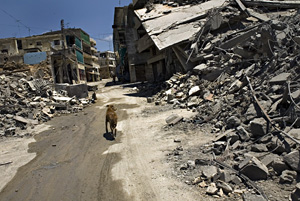

The bombs came just as night fell, around 7 p.m. The locals knew that the 10-story apartment building had been the office, and possibly the residence, of Sheik Tawouk, the Hezbollah commander for the south, so they had moved their families out at the start of the war. The landlord had refused to rent to Hezbollah when they requested the top floors of the building. No matter, the locals said, the Hezb guys just moved in anyway in the name of the “resistance.”
Everyone knew that the building would be hit eventually. Its location in downtown Tyre, which had yet to be hit by Israeli airstrikes, was not going to protect it forever. And “everyone” apparently included Sheik Tawouk, because he wasn’t anywhere near it when it was finally hit.
Two guided bombs struck it in a huge flash bang of fire and concrete dust followed by the roar of 10 stories pancaking on top of each other, local residents said. Jihad Husseini, 46, runs the driving school a block away and was sitting in his office when the bombs struck. He said his life was saved because he had drawn the heavy cloth curtains shut on the windows facing the street, preventing him from being hit by a wave of shattered glass. But even so, a chunk of smoldering steel flew through the air, broke through the window and the curtain, and shot past his head and through the wall before coming to rest in his neighbor’s home.
But Jihad still refuses to leave.
“Everything is broken, but I can make it better,” he says, surrounded by his sons Raed, 20, and Mohammed, 12. “I will not leave. This place is not military, it is not Hezbollah; it was an empty apartment.”
Throughout this now 16-day-old war, Israeli planes high above civilian areas make decisions on what to bomb. They send huge bombs capable of killing things for hundreds of meters around their targets, and then blame the inevitable civilian deaths — the Lebanese government says 600 civilians have been killed so far — on “terrorists” who callously use the civilian infrastructure for protection.
But this claim is almost always false. My own reporting and that of other journalists reveals that in fact Hezbollah fighters — as opposed to the much more numerous Hezbollah political members, and the vastly more numerous Hezbollah sympathizers — avoid civilians. Much smarter and better trained than the PLO and Hamas fighters, they know that if they mingle with civilians, they will sooner or later be betrayed by collaborators — as so many Palestinian militants have been.
For their part, the Israelis seem to think that if they keep pounding civilians, they’ll get some fighters, too. The almost nightly airstrikes on the southern suburbs of Beirut could be seen as making some sense, as the Israelis appear convinced there are command and control bunkers underneath the continually smoldering rubble. There were some civilian casualties the first few nights in places like Haret Hreik, but people quickly left the area to the Hezbollah fighters with their radios and motorbikes.
But other attacks seem gratuitous, fishing expeditions, or simply intended to punish anything and anyone even vaguely connected to Hezbollah. Lighthouses, grain elevators, milk factories, bridges in the north used by refugees, apartment buildings partially occupied by members of Hezbollah’s political wing — all have been reduced to rubble.
In the south, where Shiites dominate, just about everyone supports Hezbollah. Does mere support for Hezbollah, or even participation in Hezbollah activities, mean your house and family are fair game? Do you need to fire rockets from your front yard? Or is it enough to be a political activist?
The Israelis are consistent: They bomb everyone and everything remotely associated with Hezbollah, including noncombatants. In effect, that means punishing Lebanon. The nation is 40 percent Shiite, and of that 40 percent, tens of thousands are employed by Hezbollah’s social services, political operations, schools, and other nonmilitary functions. The “terrorist” organization Hezbollah is Lebanon’s second-biggest employer.
People throw the phrase “ghost town” around a lot, but Nabatiya, a bombed-out town about 15 miles from the Lebanon-Israel border, deserves it. One expects the spirits of the town’s dead, or its refugees, to silently glide out onto its abandoned streets from the ruined buildings that make up much of the town.
Not all of the buildings show bomb damage, but those that don’t have metal shutters blown out as if by a terrible wind. And there are no people at all, except for the occasional Hezbollah scout on a motorbike armed only with a two-way radio, keeping an eye on things as Israeli jets and unmanned drones circle overhead.
Overlooking the outskirts of this town, which has a peacetime population of 100,000 or so — mostly Shiite supporters of Hezbollah and its more secular rival Amal — is the Ragheh Hareb Hospital, a facility that makes quite clear what side the residents of Nabatiya are on in this conflict.
The hospital’s carefully sculpted and trimmed front lawn contains the giant Red Crescent that denotes the Muslim version of the Red Cross. As we approach it, an Israeli missile streaks by, smashing into a school on the opposite hilltop. As we crouch and then run for the shelter of the hospital awning, that giant crescent reassures me until I look at the flagpole. The Lebanese flag and its cedar tree is there — right next to the flag of the Islamic Republic of Iran.
It’s safe to say that Ragheh Hareb Hospital has an association with Hezbollah. And the staff sports the trimmed beards and polite, if somewhat ominous, manner of the group. After young men demand press IDs and do some quick questioning, they allow us to enter.
Dr. Ahmed Tahir recognizes me from a funeral in the nearby village of Dweir. An Israeli bomb dropped on their house killed a Hezbollah cleric and 11 members of his immediate family, mostly children. People in Lebanon are calling it a war crime. Tahir looks exhausted, and our talk is even more tense than the last time.
“Maybe it would be best if the Israelis bombed your car on the road here,” he said, with a sharp edge. “If you were killed, maybe the public outcry would be so bad in America that the Jews would be forced to stop these attacks.”
When I volunteered that the Bush administration cared little for journalists, let alone ones who reported from Hezbollah territory, he shrugged. “Maybe if it was an American bomb used by the Israelis that killed an American journalist, they would stop this horror,” he said.
The handful of people in the town include some from Hezbollah’s political wing, as well as volunteers keeping an eye on things while the residents are gone. Off to the side, as we watch the Israelis pummel ridgelines on the outskirts of town, one of the political operatives explains that the fighters never come near the town, reinforcing what other Hezbollah people have told me over the years.
Although Israel targets apartments and offices because they are considered “Hezbollah” installations, the group has a clear policy of keeping its fighters away from civilians as much as possible. This is not for humanitarian reasons — they did, after all, take over an apartment building against the protests of the landlord, knowing full well it would be bombed — but for military ones.
“You can be a member of Hezbollah your entire life and never see a military wing fighter with a weapon,” a Lebanese military intelligence official, now retired, once told me. “They do not come out with their masks off and never operate around people if they can avoid it. They’re completely afraid of collaborators. They know this is what breaks the Palestinians — no discipline and too much showing off.”
Perhaps once a year, Hezbollah will hold a military parade in the south, in which its weapons and fighters appear. Media access to these parades is tightly limited and controlled. Unlike the fighters in the half dozen other countries where I have covered insurgencies, Hezbollah fighters do not like to show off for the cameras. In Iraq, with some risk taking, you can meet with and even watch the resistance guys in action. (At least you could during my last time there.) In Afghanistan, you can lunch with Taliban fighters if you’re willing to walk a day or so in the mountains. In Gaza and the West Bank, the Fatah or Hamas fighter is almost ubiquitous with his mask, gun and sloganeering to convince the Western journalist of the justice of his cause.
The Hezbollah guys, on the other hand, know that letting their fighters near outsiders of any kind — journalists or Lebanese, even Hezbollah supporters — is stupid. In three trips over the last week to the south, where I came near enough to the fighting to hear Israeli artillery, and not just airstrikes, I saw exactly no fighters. Guys with radios with the look of Hezbollah always found me. But no fighters on corners, no invitations to watch them shoot rockets at the Zionist enemy, nothing that can be used to track them.
Even before the war, on many of my trips to the south, the Lebanese army, or the ubiquitous guy on a motorbike with a radio, would halt my trip and send me over to Tyre to get permission from a Hezbollah official before I could proceed, usually with strict limits on where I could go.
Every other journalist I know who has covered Hezbollah has had the same experience. A fellow journalist, a Lebanese who has covered them for two decades, knows only one military guy who will admit it, and he never talks or grants interviews. All he will say is, “I’ll be gone for a few months for training. I’ll call when I’m back.” Presumably his friends and neighbors may suspect something, but no one says anything.
Hezbollah’s political members say they have little or no access to the workings of the fighters. This seems to be largely true: While they obviously hear and know more than the outside world, the firewall is strong.
Israel, however, has chosen to treat the political members of Hezbollah as if they were fighters. And by targeting the civilian wing of the group, which supplies much of the humanitarian aid and social protection for the poorest people in the south, they are targeting civilians.
Earlier in the week, I stood next to a giant crater that had smashed through the highway between Tyre and Sidon — the only route of escape for most of the people in the far south. Overhead, Israeli fighters and drones circled above the city and its outlying areas and regular blasts of bombs and naval artillery could be heard.
The crater served as a nice place to check up on the refugees, who were forced by the crater to slow down long enough to be asked questions. They barely stopped, their faces wrenched in near panic. The main wave of refugees out of the south had come the previous two days, so these were the hard-luck cases, the people who had been really close to the fighting and who needed two days just to get to Tyre, or who had had to make the tough decision whether to flee or stay put, with neither choice looking good.
The roads in the south are full of the cars of people who chose wrong — burned-out chassis, broken glass, some cars driven straight into posts or ditches. Other seem to have broken down or run out of gas on the long dirt detours around the blown-out highway and bridge network the Israeli air force had spent days methodically destroying even as it warned people to flee.
One man, slowing his car around the crater, almost screams, “There is nothing left. This country is not for us.” His brief pause immediately draws horns and impatient yells from the people in the cars behind him. They pass the crater but within two minutes a large explosion behind us, north, in the direction of Sidon, rocks us.
As we drive south toward Tyre, we soon pass a new series of scars on the highway: shrapnel, hubcaps and broken glass. A car that had been maybe five minutes ahead of us was hit by an Israeli shell. Three of its passengers were wounded, and it was heading north to the Hammound hospital at Sidon. We turned around because of the attack and followed the car to Sidon. Those unhurt staked out the parking lot of the hospital, looking for the Western journalists they were convinced had called in the strike. Luckily my Iraqi fixer smelled trouble and we got out of there. Probably nothing would have happened — mostly they were just freaked-out country people who didn’t like the coincidence of an Israeli attack and a car full of journalists driving past.
So the analysts talking on cable news about Hezbollah “hiding within the civilian population” clearly have spent little time if any in the south Lebanon war zone and don’t know what they’re talking about. Hezbollah doesn’t trust the civilian population and has worked very hard to evacuate as much of it as possible from the battlefield. And this is why they fight so well — with no one to spy on them, they have lots of chances to take the Israel Defense Forces by surprise, as they have by continuing to fire rockets and punish every Israeli ground incursion.
And the civilians? They see themselves as targeted regardless of their affiliation. They are enraged at Israel and at the United States, the only two countries on earth not calling for an immediate cease-fire. Lebanese of all persuasions think the United States and Israel believe that Lebanese lives are cheaper than Israeli ones. And many are now saying that they want to fight.
