

It’s the best part of summer, the long lovely passage into fall. A procession of lazy golden days that my sandy-haired, gap-toothed little girl has been painting, small abstract masterpieces in tempera and crayon and glitter, reminiscent of Franz Kline or Willem de Kooning (his early glitter period). She put a sign out front, “Art for Sale,” and charged 25 cents per painting. Cheap at the price.
A teacher gave her this freedom to sit unselfconsciously and put paint on paper. A gentle 6-foot-8 guy named Matt who taught art at her preschool. Her swimming teachers gave her freedom from fear of water. So much that has made this summer a pleasure for her I trace to specific teachers, and so it’s painful to hear about public education sinking all around us. A high school math class of 42! Everybody knows you can’t teach math to 42 kids at once, kids doped up on sugar and Coke, sleepy kids, Hmong kids, African-American kids who think scholarship is white bread. The classroom smells bad because the custodial staff has been cut back. The teacher is shelling out $900 a month for health insurance, one-third of his take-home. Meanwhile, he must whip his pupils into shape to pass the federal No Child Left Untested program. This is insanity, the legacy of Republicans and their tax cutting and their hostility to secular institutions.
Last spring I taught a college writing course and had the privilege of hanging out with people in their early 20s, an inspirational experience in return for which I tried to harass them about spelling and grammar and structure. My interest in being 21 again is less than my interest in having a frontal lobotomy, but the wit and passion and good-heartedness of these kids, which they try to conceal under their exquisite cool, are the hope of this country. You have to advocate for young people, or else what are we here for?
I keep running into retirees in their mid-50s, free to collect seashells and write bad poetry and shoot video of the Grand Canyon, and goody for them, but they’re not the future. My college kids are graduating with a 20-pound ball of debt chained to their ankles. That’s not right and you know it.
This country is squashing its young. We’re sending them to die in a war we don’t believe in anymore. We’re cheating them so we can offer tax relief to the rich. And we’re stealing from them so that old gaffers like me, who want to live forever, can go in for an MRI if we have a headache.
A society that pays for MRIs for headaches and can’t pay teachers a decent wage has made a dreadful choice. But healthcare costs are ballooning, eating away at the economy. The boomers are getting to an age where their knees need replacing and their hearts need a quadruple bypass — which they feel entitled to — but our children aren’t entitled to a damn thing. Any goombah with a Ph.D. in education can strip away French and German, music, art, dumb down the social sciences, offer Britney Spears instead of Shakespeare, and there is nothing the kid can do except hang out in the library, which is being cut back too.
This week we mark the anniversary of Hurricane Katrina and the Current Occupant’s line “You’re doing a heckuva job,” which already is in common usage, a joke, a euphemism for utter ineptitude. It’s sure to wind up in Bartlett’s Quotations, a summation of his occupancy. Annual interest on the national debt now exceeds all government welfare programs combined. We’ll be in Iraq for years to come. Hard choices need to be made, and given the situation we’re in, I think we must bite the bullet and say no more healthcare for card-carrying Republicans. It just doesn’t make sense to invest in longevity for people who don’t believe in the future. Let them try faith-based medicine, let them pray for their arteries to be reamed and their hips to be restored, and leave science to the rest of us.
Cutting out healthcare for one-third of the population — the folks with Bush-Cheney bumper stickers, who still believe the man is doing a heckuva job — will save enough money to pay off the national debt, not a bad legacy for Republicans. As Scrooge said, let them die and reduce the surplus population. In return, we can offer them a reduction in the estate tax. All in favor, blow your nose.
– – – – – – – – – – – – – – – – – –
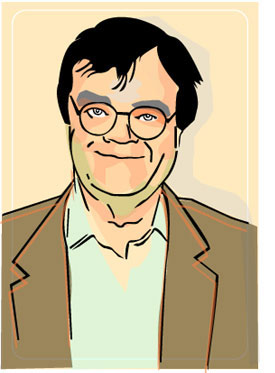
(Garrison Keillor’s “A Prairie Home Companion” can be heard Saturday nights on public radio stations across the country.)
© 2006 by Garrison Keillor. All rights reserved. Distributed by Tribune Media Services Inc.
