
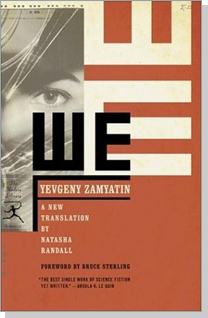

“True literature,” wrote the Russian author Yevgeny Zamyatin, “can exist only where it is created, not by diligent and trustworthy functionaries, but by madmen, hermits, heretics, dreamers, rebels, and skeptics.” In that case, Zamyatin was a truly mad heretic. The father of the dystopian novel, Zamyatin is widely recognized as the first writer to take H.G. Wells’ science-fiction vision and turn it on its head. If the novel, with its low-tech paper-and-ink delivery system, is rebellion against scientific progress, the dystopian novel has to be the greatest act of rebellion in existence. Technology is about making us more efficient and happier; the dystopian novel is about making us realize how important, and deeply human, it is to be lazy and unhappy.
Zamyatin wrote his masterpiece “We” in 1920-21 as a satire of the tyrannical bent institutionalized Bolshevism was taking — years before the worst features of the Soviet system truly became apparent. “We” served as the inspiration for George Orwell’s “1984,” and although Aldous Huxley swore he’d never read “We,” his “Brave New World” bears a resemblance to it. (“We” also probably influenced Ray Bradbury’s “Fahrenheit 451,” Ayn Rand’s “Anthem,” and Ursula K. Le Guin’s “The Dispossessed.”) And yet Zamyatin’s name is rarely mentioned when discussing dystopian literature outside of the classroom. Orwell and Huxley regularly top best-book lists; “Big Brother,” “newspeak” and “soma” are a part of our lexicon, but invoking terms from “We” brings up blank looks.
Hopefully, Natasha Randall’s new translation will earn Zamyatin the readers he sorely deserves. “We” is one of the few dystopian novels to invoke a nightmarish atmosphere that hasn’t aged. (Margaret Atwood’s “The Handmaid’s Tale” is another, though it’s still very young by comparison.) Now that we know that the biggest utopian ideas of the 20th century — communism, fascism, the perfectibility of mankind through technology — were not only insane but also destined to fail, the classics of the genre can seem a little outdated. “1984,” with its crumbling, post-blitzkrieg London, invokes a fear of rampant communism that is no longer a part of our lives. “Brave New World’s” child hatchery and whizzing airplanes call to mind “Gattaca” more than a foreseeable future; Huxley’s character names — Lenina, Bernard Marx — are quaintly mid-century. That doesn’t mean we should discount these novels; they are a part of our literary history. On the other hand, because there is nothing era-specific about “We’s” landscape, Zamyatin’s imagined future still feels sadly, scarily possible.
As the novel opens, it’s the 26th century A.D., and the Earth is under the power of the government of the dictator known as the Benefactor. A Two-Hundred-Years War has killed all but .02 percent of the world’s population, giving rise to the One State, which was partly created out of the need to ensure that there could be no more revolutions. The One State has discovered the equation for “mathematically infallible happiness,” which mostly consists of eliminating ego and desire. People no longer have names but numbers, and they’re taught to think of themselves not as individuals, but as parts of a whole, a unified “we.” They are referred to as “ciphers.” (A quibble with Randall’s Modern Library translation: In the 1993 Penguin Classics edition, “ciphers” are “Numbers,” and “the One State” is the compactly futuristic “OneState.” It may be that Randall’s choices are closer to the original Russian, but they’re much less evocative.)
In this mechanically minded future, a Table of Hours dictates every movement of the day; the ciphers get up, eat breakfast, and go to work in constant synchronicity. Their heads are shaved, and they wear matching unifs (uniforms) and gold badges on their chests announcing their numbers. There’s also a Table of Sex Days that ensures each cipher gets exactly as much sex as he or she needs. Thanks to the “Lex sexualis” claiming “Each cipher has the right to any other cipher as sexual product,” finding a partner is no longer a problem.
Without individuality, privacy ceases to be an issue. The city of the One State is surrounded by a Green Wall, made of glass, and within the wall, everything too is made of transparent glass — buildings, sidewalks, beds and chairs. (Only on Sex Days do the ciphers get to lower the blinds in their own rooms.) Even the space shuttle that the One State is set to launch — in the hopes of conquering whatever unknown societies exist on other planets — is made of glass. “We” takes the form of a diary started by the builder of that shuttle, a mathematician called D-503. When the Benefactor urges the ciphers to write something dealing with “the beauty and the grandeur of the One State” to send up in the shuttle — in the hopes that words, before arms, will convince the extraterrestrials to willingly subjugate themselves to the One States’ “beneficial yoke of reason” — D-503 decides to record his daily life, so that those living “in the savage state of freedom” will see how wonderful un-freedom really is.
D-503 is cheerfully aware that life in the One State might sound absurd. Comparing his diary entries to a 20th century novelist needing to explain the word “jacket,” he writes, “I am certain that the barbarian, looking at a ‘jacket’ would think: ‘What’s this for? Just more to carry on my back.’ I have a feeling that you will think exactly the same thing when I tell you that none of us, since the Two-Hundred-Year War, has been beyond the Green Wall.” But he soldiers on nonetheless: “I will just attempt to record what I see, what I think — or more exactly, what we think,” he writes, and he stays true to that goal even when his “I” begins to deviate from the “we.”
Soon after D begins his records, he goes on a “walk” — really a march of “hundreds and thousands” “in measured rows, by fours” — and meets I-330, a female cipher with “white — unusually white — and sharp teeth” who immediately gets under his skin: “There was a kind of strange and irritating X to her, and I couldn’t pin it down, couldn’t give it any numerical expression.” He hates her at first and then realizes that she’s infected him with the one thing that trumps all rational thought: love. And, as he soon discovers, I-330 is a rebel; before long she ensnares him in her plot to overthrow the One State.
Anyone who has read “1984” can probably guess what happens, but Zamyatin’s plot is almost secondary to his playful character sketches and his poetic descriptions of D’s metamorphosis. Zamyatin’s characters are, on the surface, cartoonish, but that adds a gleefully surreal element to the novel. Almost every cipher magically contains the physical properties of his or her number: I-330 is “thin, sharp, stubbornly supple, like a whip”; O-90, the female Number D shares his Sex Days with, is short and round, and D refers often to her “pink circle of a mouth.” Even the X factor that D notices in I-330 expresses itself physically, in the sharp lines of her eyebrows and between the corners of her mouth and nose.
D himself doesn’t resemble the letter D, but he too is a caricature: He obsesses over his hands, which are “hairy and shaggy,” “monkey hands” — a portent of the transformation he’s about to undergo. And some of D’s thoughts are hilariously inhuman, like when O-90 tells him, “I would so like to come to you today and lower the blinds,” and D thinks it a sign of her dimness, writing with exasperation that she “knows as well as I do that our next Sex Day is the day after tomorrow.” But he is also overwhelmingly passionate — even when discussing math problems, his excitement nearly shakes the page — and when he starts to embrace the irrational, that passion turns him into a poet, and he experiences love, and all its accompanying terror and wonder, with heartbreaking rawness. Shortly after sleeping with I-330 for the first time, D finds “the air itself is a little rosy, all steeped in the sun’s gentle blood,” but later, suffering from her absence, the days become “the same yellow color, like desiccated, incandescent sand.” As a doctor tells him, when D goes to the Bureau of Medicine with the hopes of being cured, “How awful for you! By the looks of it, you’ve developed a soul.”
With his childlike confliction and confusion, D appears to share little with his creator, aside from their mathematical backgrounds. Zamyatin was born in Lebedyan, Russia, in 1884, the son of an Orthodox priest, and worked for most of his life as a naval engineer. The rest of his biography describes a man who was not only unafraid of a fight, but was perpetually looking for one. He was arrested several times, first in 1905, for being a Bolshevik student activist, and later for trying to publish satire critical of the regime that had risen from Bolshevism. He was also exiled repeatedly, and always managed to find his way back into the country. Thanks to his friend Maxim Gorky, he managed to land a literary job in 1917 and helped nurture the young literary talent that arose in Russia in the 1920s. “We,” naturally, was banned (it was first published in New York, in English, in 1924, and wasn’t allowed into the USSR until ’88 under glasnost). In 1931, tired of censorship, Zamyatin asked to be allowed to go into exile one more time, writing to Stalin, “I beg to be permitted to go abroad with my wife with the right to return as soon as it becomes possible in our country to serve great ideas in literature without cringing before little men” — and, amazingly, won his freedom. He fled to Paris, where the lack of conflict seemed to disagree with him: He died in 1937, unable to complete another novel.
D does embody one of Zamyatin’s most steadfast beliefs, that the dialectic between entropy and energy — dogma and revolution — propels history. By framing that dialectic as a psychological drama, Zamyatin also ensured that “We” would resonate long after he was gone, transcending mere parable or satire. Unlike Orwell’s Winston Smith or Huxley’s Bernard Marx, D starts off happy, a truly dutiful cipher who believes wholeheartedly in the One State. He acknowledges that there are kinks in the system — “even today from the shaggy depths of things, you can here the wild echoes of monkeys” — but rejoices that these are “easily repaired, without having to stop perpetual, great progress of the whole machine.” And besides, as he’s writing, the powers-that-be are putting the finishing touches on the Great Operation, which will surgically remove every cipher’s imagination and complete the perfection of mankind.
Because he’s telling the story, much of the novel’s action takes place in D’s head, a Freudian battle between the superego and the id, which I-330 awakens in him. (And like so many innocent-seeming words in Zamyatin’s novel, the title “We” takes on this other layer, of the two different D’s fighting between love and reason.) The further he goes down the path to the irrational, the more forcefully he argues for the One State rationalism, as if he were trying to exert some control over his mind. Reading his defenses of the One State is to understand that tyranny isn’t the product of some monstrous impulse, but rather an extension of human reason, stretched, unchecked, until it’s gone too far. There’s a dispassionate, theoretical logic to D making fun of the “ancients” for knowing animal husbandry but allowing humans to procreate willy-nilly, or in proclaiming the hypocrisy of those same old governments for making it a crime to kill one person but allowing everyone to shorten their own lives through unhealthy habits.
Nor is it illogical to read the story of Adam and Eve as he does, as a choice between “happiness without freedom, or freedom without happiness,” and the “beneficial yoke” of the One State as returning mankind to the garden. And when love invades — what the mathematically inclined D first understands as the irrational number √-1 — and unhappiness, jealousy and yearning pervade him, it becomes impossible not to pity him and almost to wish that he could go back to his blissful, robotic state. As a character, D becomes far more interesting when he starts to live in the irrational world “where minus one has roots.” And yet, how can we not want him to be happy, even if that means subjecting him to the Great Operation? Zamyatin knows that the One State doesn’t just exist on the page, nor is it some evil plot concocted by an unknown they; that “we” encompasses all of us.
The tension between reason and the irrational doesn’t just exist in D’s head; each detail in “We” hums with hidden meaning, a compressed accordion of metaphors, jokes and symbolism. I-330 doesn’t just look like the letter “I,” she also represents the individual “I,” revolting against the “we,” and the irrational √-1, represented in math as i. Mathematicians tend to dismiss D’s social-mathematical defenses of the One State as overly simplistic and error-ridden “pseudo-math,” but because of Zamyatin’s engineering background, it’s probably wise to assume that his mistakes were intentional, signaling the faultiness of the One State’s happiness formula and adding another layer to D’s unstable psyche. For example, D writes that “bliss and envy are the numerator and denominator of that fraction known as happiness,” and that thanks to the “Lex sexualis,” “the denominator of the happiness fraction has been reduced to zero and the fraction becomes magnificent infinity.” Of course, dividing by zero yields nothing; it is an illegal operation — probably Zamyatin’s sly joke on the impossibility of ever really eradicating envy.
But if we’re safe from ever being rid of envy or desire, Zamyatin suggests that something equally scary could occur. One of the remarkable things about the One State is that it doesn’t seem to need to censor the past. There is an Ancient House at the edge of town, where D and I-330 meet up, that serves as a museum to the creaky history of opaque walls and jumbled apartments. Early in the novel, D attends a lecture on music that features a classical piano performance. He frequently refers to Kant and Pushkin, and he’s familiar with Shakespeare. Yet none of these things move him or the other ciphers to feel, to revolt. Orwell’s dystopian tyrants rewrote books, and Huxley’s simply destroyed them, because they feared such things might awaken the humanity in their citizens. The real-life tyrants under whom Zamyatin lived feared art’s power as well. There’s something comforting in that thought — that as long as we have books and music, religion and history, humanity can be brought back to itself. And yet Zamyatin gets at a scarier idea: For people without humanity, art has no effect. It’s not a theory we should put to the test. While “We” still has the power to hold our imaginations, we need to read it.
