Fiction
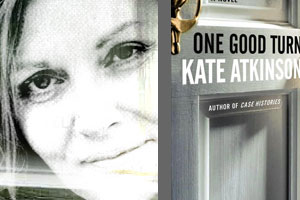
“One Good Turn”
A lifesaving good deed by a meek crime novelist sets off a series of unpredictable events in Kate Atkinson's shrewd and witty new novel.
All but one of the principal characters in Kate Atkinson’s new novel, “One Good Turn,” witness the same disturbing incident. After a fender bender on an Edinburgh, Scotland, street, a driver gets out of his car and savagely attacks another man with a baseball bat. The assailant is about to finish the victim off with a blow to the head when someone in the crowd of bystanders flings a laptop case at him, clipping his shoulder and thereby chasing him off. The laptop-case flinger is Martin Canning, a meek crime novelist who’s produced a successful series of nostalgic mysteries under a pseudonym. Tossing that case is the bravest thing he’s ever done.
Martin’s intervention is the “good turn” of the book’s title, but does it lead, as the proverb would have it, to another? Not exactly. In Atkinson’s universe, a good turn is more likely to set off a chain of unpredictable events, whose connections will only become apparent when the dust clears at the very end.
One of the witnesses to the assault is Jackson Brodie, a policeman turned private eye turned man of leisure, familiar to admirers of Atkinson’s delightful 2004 novel, “Case Histories.” That book came as a revelation to many readers. It was undoubtedly literary — the characters were three-dimensional and idiosyncratic, the writing artful, the emotional nuances in the scenes never sacrificed to the exigencies of plot — but it was also outrageously entertaining. Despite Jackson’s profession, “Case Histories” isn’t quite a mystery novel, and there’s something impish about Atkinson writing another book with Jackson in it, as if she’s playing at writing a genre series.
“One Good Turn” also isn’t quite a mystery, despite the crimes and conspiracies that keep the plot humming along like an unstoppable little two-stroke engine. There are few clues to decipher, and you can probably make a pretty solid guess about who’s behind the novel’s skulduggery if you choose to try (though there is a final surprise). Atkinson has certainly borrowed some techniques from Olympian crime novelists like Ruth Rendell; she moves her authorial eye from one character to another, allowing each one to know a small piece of an overall pattern that only the reader and author can grasp in toto.
This is the opposite of the classic clever detective yarn, with its unflappable confidence in the preternatural deductive powers of the sleuth hero. Like Rendell, Atkinson has little faith in heroes, or in anyone’s ability to figure out what’s really going on in life, let alone control it. The pleasure here lies in watching the intricate branches of Atkinson’s plot unfurl, and in savoring the tart, quirky character portraits that hang from them.
In addition to Jackson and the long-suffering Martin, those characters include Gloria Hatter, the 59-year-old wife of a shady real estate developer, who contemplates a potential new lease on life when her husband has a heart attack in a hotel room during a session with a Russian dominatrix. Gloria holds firm, mordant opinions about nearly everything, from her cohort, Pam (not “what Gloria would have called a friend, just someone she had known for so long she had given up trying to get rid of her”), to her suspicions about people “who had no time for sugar, it was a personality flaw,” to her enthusiasm for the notion of “cameras watching everyone everywhere.” Gloria is bullish on accountability, and she’d like the payback to start with her unconscious, hospitalized husband, Graham.
As for Jackson, having inherited 2 million pounds from a former client and fulfilled his lifelong dream of buying a farmhouse in southern France, he’s dismayed to find himself feeling “unmanned.” “Real men,” he suspects, “didn’t spend their days filling up their iPods with sad country songs and feeding apples to French donkeys.” He’s been dragged to Edinburg for the annual theater festival, where his girlfriend, Julia (another character from “Case Histories”), is performing in a ghastly, pretentious play. Like a real mystery series sleuth (say, Nina Riley, the Nancy Drew-style detective in Martin’s books) he has a slightly absurd tendency to stumble onto crime scenes, but unlike the intrepid Nina, he’s merely adequate at nailing the culprits.
Then there’s poor Martin: His good Samaritan impulses manage both to endanger and to save his life. There are a couple of murders in “One Good Turn,” but they aren’t really much more gruesome than the killings in Martin’s Nina Riley novels. Instead, it’s the everyday slaps and pinches that Atkinson depicts with an excruciating — and very British — eye for life’s routine humiliations. A BBC producer who’s bought the rights to Martin’s books announces that reading them is “‘Like getting into a warm bath. Perfect fodder for the Sunday evening slot’… making it sound like an insult, which of course it was.”
In truth, there’s far less Agatha Christie in “One Good Turn” than there is Barbara Pym, the late great comic novelist who specialized in improbably funny stories about vicars’ wives and village “jumble” (rummage) sales. Atkinson has updated the settings and injected some ambition into the mix, but she has the same shrewd, observant wit and surreptitious fondness for humble, put-upon people who try to behave decently in a cutthroat world. There may not be a great detective in “One Good Turn,” but there are a few of these menschen, and they make much better company.
Laura Miller is a senior writer for Salon. She is the author of "The Magician's Book: A Skeptic's Adventures in Narnia" and has a Web site, magiciansbook.com. More Laura Miller.
50 shades of Shutterstock
Slide show: Everyone's favorite light-bondage bestseller illustrated by inexplicable stock photography SLIDE SHOW
This week, for roughly the millionth time, E.L. James’ romance-bondage trilogy “50 Shades” nabs the No. 1, 2 and 3 spots on the New York Times bestseller lists. We don’t get it either. Every page of that book, which famously began as “Twilight” fan fiction, elicits a sigh of confusion and weird secondary embarrassment. The question is: Who would read this? (The answer is: Apparently everyone.) It’s the same baffled, helpless feeling we get when we sort through stock photos on a daily basis. Stock photos – which have been the subject of recent outstanding Internet satire – are used by this site, and many others, to illustrate our flood of content. Many are plain and simple, but a good portion are flat-out mind-blowing. Why did anyone think that photo was a good idea? It only made sense to join these forces. And so, we present to you passages from the most head-scratching bestseller of our time, illustrated with the assistance of inexplicable stock photography.
Megaphone by Natalie Bakopoulos
Miracles happen, even in an Athens crippled by a garbage strike, to a young mother unsure of her ability to love
(Credit: iStockphoto/caracterdesign) It’s the third week of the garbage strike and Athens has begun to smell. Bright-colored trash bags fill the curbs and alleyways, and we have learned to step over the rubbish and avoid the blocks that had become unnavigable. We know which stretches are particularly foul — a stretch along Mavili Square, or the entire top end of Monastiraki. Odos Athinas is a sea of trash, and Omonia is ghastly but we don’t go there anyway. May has gone from unseasonably cool to raging hot, and the garbage seems to be melting. In front of the museum it’s like yet another installation project. When I arrive each morning I want to wretch.
Continue Reading CloseNatalie Bakopoulos's first novel, "The Green Shore," will be published by Simon & Schuster in June 2012. Her work has appeared in Tin House, Ninth Letter, Granta Online, and The O. Henry Prize Stories 2010, and she is a contributing editor for the online journal Fiction Writers Review. More Natalie Bakopoulos.
Almost by Chris Pavone
She never thought of herself as ambitious, until motherhood and career collided in one horrifying hospital ride
(Credit: iStockphoto/caracterdesign) It’s just before dawn when Isabel puts the final page down on the fat stack of paper that sits on the rumpled bedspread, next to an overflowing crystal ashtray and a crumpled soft-pack of cigarettes. She’d tried Wellbutrin and Xanax; she’d used patches and gum. In the end, the only thing that made her quit smoking was being pregnant.
But then, after everything, she couldn’t help but start up again. At first it was just a single cigarette per day, or two. Then it became a few, and within months she was back to full-throttle. Over the past couple of years, she’s tried to quit a few times, but not seriously. She anticipates — she accepts — failure. Because she doesn’t want to quit, not really. She wants instead to try, and fail.
Continue Reading CloseMemorial Day fiction: Are we there yet?
Salon exclusive: At the start of the summer fiction season, new stories from Chris Pavone and Natalie Bakopoulos
(Credit: iStockphoto/caracterdesign) “Are we there yet?”
It’s a dreaded sentence. When it’s spoken by an anxious child from the back seat, it’s enough to make stressed-out parents wish they’d never taken a family vacation in the first place. And even if it’s delivered as a sing-songy punch line, from an impatient partner or spouse on a long road trip, it’s an irritating eye-roller of a joke.
So this Memorial Day weekend — the unofficial start of the summer vacation season, and therefore the summer fiction season — we asked two novelists to reclaim the sentence in a new and adult context. For our latest fiction project, there was only one simple rule: Each story had to include the line “Are we there yet?” in a fresh and surprising way.
Continue Reading CloseDavid Daley is the senior culture editor of Salon. More David Daley.
“Frankenstein” remixed
This masterful new adaptation of Mary Shelley's classic novel may be the best interactive fiction yet
Whatever interactive fiction is (and we’re still figuring that out) it suffers from all the problems of traditional fiction and then some. The vast majority of novels and short stories aren’t much good, but when a branching fiction — along the lines of the old “Choose Your Own Adventure” children’s books — fails to engage, the first impulse is to blame the form rather than the content. Let “Frankenstein,” just released by Inkle Studios and Profile Books, serve as a reproach to that reflex. The app is a creative, subtle and sensitive adaptation of Mary Shelley’s classic novella, and it has singlehandedly renewed this critic’s hopes for interactive fiction.
Laura Miller is a senior writer for Salon. She is the author of "The Magician's Book: A Skeptic's Adventures in Narnia" and has a Web site, magiciansbook.com. More Laura Miller.
Page 1 of 130 in Fiction


