
Iran
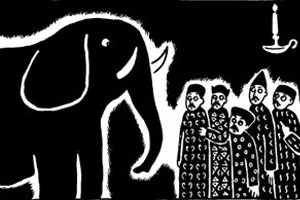
“Chicken With Plums”
In an excerpt from her new graphic memoir, Marjane Satrapi's music-loving great-uncle recalls the death of his cigarette-loving mother.
Iranian graphic memoirist Marjane Satrapi’s heralded books “Persepolis” and “Persepolis 2″ chronicled the impact that the Iranian revolution had on her and her liberal-minded, cosmopolitan, secular family. Last year, when “Embroideries” was published, Michelle Goldberg spoke with Satrapi about, among other things, the relative worldliness of Iranians’ private lives, George W. Bush and how security fears limit our freedoms. “People have stopped talking about pleasure,” Satrapi said. “If you eat you’re going to get high cholesterol. If you make love, you’re going to get AIDS. If you smoke, you’re going to get cancer. But smoking is a pleasure. Eating is a pleasure. Making love is a pleasure. OK, it’s a risk sometimes. If you have freedom, then you have more risks.”
This insight is explored in her latest book, “Chicken With Plums,” where cigarettes are “food of the soul” and protagonist Nasser Ali Khan can find no pleasure in his life — and so decides it is time to die. Ali, Satrapi’s great-uncle, is an Iranian musician with a wife he doesn’t love, children who don’t respect him, a broken heart, a broken instrument, and unfulfilled fantasies about Sophia Loren. The book follows his final eight days on earth, as he lays in bed awaiting death. “Chicken With Plums” has a more somber tone than Satrapi’s previous work; it is, after all, about a dying man. But it contains flashes of her familiar, caustic wit — a lighthearted conversation with the angel of death, a young boy who refuses to stop singing for the duration of a long bus ride, and a family of Iranian exiles who come to America and get really, really fat. Set in 1958, just years after the CIA-sponsored coup, the book’s overall mood reflects the disheartening gravity of these events — as with all of Satrapi’s work, the political is always personal.
In the excerpt that follows, Nasser Ali has just begun his fifth day of dying and recalls the events surrounding his mother’s death.


Marjane Satrapi is the author of "Persepolis," "Persepolis 2," and "Embroideries." More Marjane Satrapi.
Energy wars heat up
From Africa to South America, conflicts over waning resources are becoming more tense -- and dangerous
A member of the military stands guard near pump stations before a
ceremony in which oil operations at Heglig oilfield will resume in
Heglig, Sudan, May 2, 2012.
(Credit: Reuters/Mohamed Nureldin Abdallah) Conflict and intrigue over valuable energy supplies have been features of the international landscape for a long time. Major wars over oil have been fought every decade or so since World War I, and smaller engagements have erupted every few years; a flare-up or two in 2012, then, would be part of the normal scheme of things. Instead, what we are now seeing is a whole cluster of oil-related clashes stretching across the globe, involving a dozen or so countries, with more popping up all the time. Consider these flash-points as signals that we are entering an era of intensified conflict over energy.
Continue Reading CloseNYPD must spy on all Muslims to protect us from Iranian photographers
New York City's own constitutionally iffy intelligence agency justifies itself with fear-mongering
Ray Kelly (Credit: Reuters/Brendan McDermid) The NYPD is less a “police department” than a secretive and unaccountable international intelligence-gathering organization with a large minority-frisking division and the firepower of a mid-sized army. Lately they have been facing a bit of criticism for their style of intelligence-gathering, which seems to be done with more gusto than concern for civil liberties or… accuracy. Sometimes the NYPD’s muscular-but-stupid approach to spying gets them in trouble with the FBI. And when the organization that fights terror by recruiting shady weirdos to try to trick random Muslims into saying “jihad” into tape recorders says your practices are counterproductive and out of line, they are probably pretty counterproductive and out of line.
Continue Reading Close
Alex Pareene writes about politics for Salon and is the author of "The Rude Guide to Mitt." Email him at apareene@salon.com and follow him on Twitter @pareene More Alex Pareene.
Former Bush official warns against Iran attack
National Security Council advisor and Iraq hawk Stephen Hadley counsels diplomacy, not war
Stephen Hadley (Credit: AP/Alex Brandon) Another voice against war in Iran is heard and from perhaps an unexpected source. Former Bush administration National Security Advisor Stephen J. Hadley warned against an attack on the Islamic Republic yesterday. “If something needs to be done, it is not military action,” said Hadley. “There’s a wide spectrum between sheer diplomacy and military action.”
Hadley was an early and enthusiastic functionary in the war against Iraq. During the George H. W. Bush administration, he was a Pentagon aide to uber-hawk Paul Wolfowitz, and later served as a senior foreign policy advisor to George W. Bush’s presidential campaign. Hadley was instrumental in allowing the “Yellowcake Forgery” fabrication into Bush’s 2003 State of the Union address, a mistake for which he reportedly offered to resign. Taking over as national security advisor in 2005 from Condoleezza Rice, he was known for being on the relatively moderate spectrum of the Bush administration (well, at least when compared to Cheney and Rumsfeld). Upon leaving office, he formed a consulting shop with Rice, and he recently co-wrote a piece calling for negotiations with the Taliban.
Continue Reading CloseJordan Michael Smith writes about U.S. foreign policy for Salon. He has written for the New York Times, Boston Globe and Washington Post. More Jordan Michael Smith.
What Iran’s election results mean
The growing divide between the president and the Supreme Leader could be good news for the West
In front of a portrait of late Iranian leader Ayatollah Khomeini, former President Akbar Hashemi Rafsanjani casts his ballot for the parliamentary elections at a polling station in Tehran, Iran, Friday, March 2, 2012 (Credit: AP Photo/ISNA, Ruhollah Vahdati) BOSTON — It was no coincidence last week when Iran’s Supreme Religious leader, Ayatollah Ali Khamenei, praised a 64 percent turnout for parliamentary elections at home as well as President Barack Obama’s words that dampened talk of war against Iran. The elections gave him a commanding authority at home and a freer hand to deal with foreign threats.
Continue Reading CloseNazila Fathi reported out of Iran for nearly two decades, most recently for The New York Times. In 2009, following the elections, she was forced to leave the country because of government threats against her. She was a Nieman Fellow at Harvard in 2010 and is currently a fellow at the Shorenstein Center on Press, Politics and Public Policy at the Harvard Kennedy School. More Nazila Fathi.
A Hollywood party, with a nervous look to Iran
Behind the scenes at the Academy Awards with the star of "A Separation"
Payman Maadi (right) in "A Separation" The 405, Los Angeles’ leading freeway, is under construction. Lanes suddenly close and then merge haphazardly into the one nuzzled next to it. Center dividers inch closer and closer into carpool lanes. And drivers – which in a city of waitresses, actresses and waitresses longing to be actresses, might be the most infamous population of all — drive erratically as a result. The drivers are erratic because the road has become erratic; the road has become erratic because the city is erratic.
Continue Reading CloseRod Bastanmehr is a freelance writer, born in San Francisco, with a focus on film, culture and politics. His writing has appeared in Nerve, Thought Catalog, Not Coming to a Theatre Near You and more. More Rod Bastanmehr.
Page 1 of 91 in Iran
