
Suicide
“Fun Home”
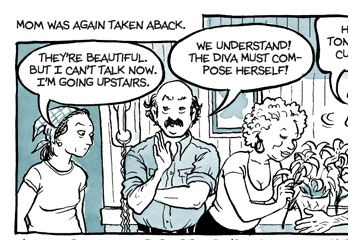
Step inside Alison Bechdel's graphic memoir with this interview with the author and an excerpt from her book.
The structure of “Fun Home” is pretty unconventional — it’s about as far away from straightforward chronology as storytelling gets. How did it evolve? Or was it pretty much set from when you began to sketch it out?
Nothing was set from the beginning — I had no idea what shape the book would take. It was entirely a process of discovery from start to finish. But it did become clear early on that a chronological structure wouldn’t work because I found myself wanting to say so many different things about particular events. Eventually I settled on a thematic structure, which enabled me to replay those events through the lenses of multiple ideas.
Have any more notable facts or documents about your father’s life come to light since you finished the book?
No, but I’ve heard from a bunch of people who knew my dad — students, friends, family members — that they either knew or suspected his homosexuality as well as his suicide. That surprised me. I thought I was revealing these big secrets.
In “Fun Home” as well as “Dykes to Watch Out For,” you play around a lot with unexpected (and funny) conjunctions — verbal and visual puns and coincidences. Do you specifically look for them, or are they naturally part of the way you experience the world?
I think that’s a symptom of my attention surfeit disorder. Or perhaps of something worse, a grandiosity complex in which I interpret all phenomena as personally meaningful. Whichever it is, seeing these visual and verbal connections everywhere is definitely a natural part of the way I experience the world. But I cultivate them a bit too.
The images of photographs in “Fun Home” are drawn in a much more tightly rendered, “realistic” style than the rest — but you’ve also talked about how almost everything in the book is drawn from extensive photo reference. What do you think of as the relationship between representation and interpretation (or “objectivity” and “subjectivity”) in the way you drew the book?
I spent a lot of time thinking about the relative ontological status of these different kinds of drawings within the universe of “Fun Home” — too much time, I worried, but somehow it seemed necessary.
I begin each chapter of “Fun Home” with a drawing of a family photograph. I wanted these drawings to be clearly legible as actual, extant photographs, so I could draw on the “objective” property of photography to ground the story in real life. I wanted to keep reminding readers that the characters are real people, the events really happened. So I copied the photos as exactly as I could, preserving their weird cropping and perspective, dimensions, borders, deckle edges. And I drew in black photo corners to reinforce the effect.
These drawings look very different than the rest of the book, which is drawn in my normal style — on the realistic end of the spectrum for comics, but far from photographic.
At several points in the book I incorporate other drawn versions of photographs into my story. Which also contrast with my regular drawing. Snapshots of my father and me at the same age, looking identical. A publicity photo of my mom in character as Lady Bracknell. And most importantly, a photograph of the high school boy who used to baby-sit my brothers and me, sprawled on a hotel bed in his jockey shorts. This was taken by my dad, and I found it in a box of family photos. The whole book grew out of that single image, actually. Finding that glimpse of the parallel life my father had been leading right under our noses was like finding the key to a cryptogram.
I think growing up in a family where appearance and reality were at such odds has made me very attuned to questions like, What’s real? And, how real is it?
One of the most striking lines in the book is “My parents are most real to me in fictional terms.” Do you think of yourself in fictional terms at all? Do you imagine other people understanding their own families, or themselves, through the lens of “DTWOF” or “Fun Home”?
No, I never think of myself in fictional terms. That was just the methodology that worked best for me to explain my parents. I do keep hearing from readers who say that my family reminds me of theirs and then they proceed to describe a family that’s nothing like mine. But I guess that’s what stories are, lenses. If people can look through the lens of my family drama and find some meaning, that makes me very happy.


Pick of the week: Haunting, gorgeous “Oslo, August 31st”
Pick of the week: "Oslo, August 31st" is a wrenching voyage of discovery in Norway's suddenly trendy capital
“Oslo, August 31st” is, as the title suggests, an evocation of one day in the Norwegian capital, as experienced by a troubled young man who’s facing the end of summer and the end of his youth. It’s a marvelously constructed personal journey, both wrenching and bittersweet, whose emotional ripple effects stay with you for days and weeks afterward. While much of international art cinema can seem overly talky or conceptually alien to American viewers, this second feature film from Norwegian director Joachim Trier is a dynamic, even breathtaking visual experience without much dialogue or any philosophical heavy lifting, following the bony, handsome, exceedingly vulnerable Anders (Anders Danielsen Lie) through coffee shops, nightclubs and bodies of water, en route to an ambiguous final destination.
Continue Reading CloseLearning from suicidal salmon
The fish's journey home is extreme and deadly -- and it offers surprising insight into human extremist belief
(Credit: iStockphoto/MichaelFossler) Salmon go to great lengths to kill themselves. After a short few years frolicking in the open ocean, they may travel thousands of kilometers to get back to the precise stretch of the same river in which they were born. On this journey they will have to slip past the birds, bears, sea lions, and humans that gather at river mouths to feast on them. They must swim exhaustively upstream for many miles, using most of their energy reserves to leap up waterfalls or swim ladders (artificial waterfalls constructed on the sides of artificial dams) until they reach their spawning grounds, where their last gasps are spent producing eggs or fertilizing them with sperm before collapsing in death, never to see the ocean again.
Continue Reading CloseRafe Sagarin is a marine ecologist and environmental policy analyst at the University of Arizona. His research has appeared in Science, Nature, Foreign Policy, among other publications. He lives in Tucson, Ariz. More Rafe Sagarin.
I can’t go on. I’m overdosing
I try to hurt myself, I ingest household products, anything to stop the pain of being abused as a child
(Credit: Zach Trenholm/Salon) Dear Cary,
When I was growing up I was abused. I feel like hurting myself badly, which many times I acted on … when I went to hospital a couple of months ago a nurse told me I should go hang myself, not in the hospital … it had a big effect and a psychiatrist too said the same thing in a separate incident. It feels like my life is over for good this time like there’s nothing to live for. I had seen someone kissing today. For people it might seem normal but for me it hurt, it was like a knife in the chest. I wanted to hit my mum.
Continue Reading Close
Cary Tennis writes Salon's advice column, leads writing workshops and creative getaways, publishes books, writes an occasional newsletter and tweets as @carytennis.
- Send me a letter! Ask for advice! Letter writers please note: By sending a letter to advice@salon.com, you are giving Salon permission to publish it. Once you submit it, it may not be possible to rescind it. So be sure.
- Make a comment to Cary Tennis not for publication.
- Send a letter to Salon's editors not for publication.
More Cary Tennis.
The depressing toll of the Great Recession
Mental health problems mount nationwide while budgets for treatment and care are shrinking
Down and out (Credit: AP/Rick Bowmer) In late 2009, as the unemployment rate in San Joaquin County, California, reached 18 percent and one in twelve homes were being foreclosed, two high school students in the town of Ripon, population 15,000, committed suicide within two months of each other. Over the next eighteen months, sixteen more teenagers around the county took their own lives, a not-uncommon occurrence that public health researchers refer to as “suicide contagion.”
Years of declining budgets had cut the number of counselors, nurses and psychologists in county schools, impairing the ability of individual districts to handle the needs of grieving students, parents and communities on their own. So school officials in cities like Ripon, Stockton, Lodi and Linden turned to each other for help.
Continue Reading CloseRob Waters writes about health, mental health and science from his home in Berkeley, California. His investigative feature in Mother Jones, “Medicating Aliah,” examined pharmaceutical industry influence over prescribing guidelines and won the Casey Award in 2006. His articles have appeared in Bloomberg Businessweek, Mother Jones, Health, Reader’s Digest and other publications. More Rob Waters.
I kissed her and then her husband killed himself
Now I'm in an agony of guilt and my life will never be the same
(Credit: Zach Trenholm/Salon) Dear Cary,
I met a woman at work nine months ago. We clicked immediately but I refused her advances because she was married, to her second husband, in fact. After a few months, I could no longer resist the attraction. Immediately after we kissed, she told her husband they hadn’t been in a real marriage for a long time and she was leaving.
She asked him to discuss dividing their possessions. Shortly after, he went upstairs and shot and killed himself.
Continue Reading Close
Cary Tennis writes Salon's advice column, leads writing workshops and creative getaways, publishes books, writes an occasional newsletter and tweets as @carytennis.
- Send me a letter! Ask for advice! Letter writers please note: By sending a letter to advice@salon.com, you are giving Salon permission to publish it. Once you submit it, it may not be possible to rescind it. So be sure.
- Make a comment to Cary Tennis not for publication.
- Send a letter to Salon's editors not for publication.
More Cary Tennis.
Page 1 of 22 in Suicide