
“The Rolling Stone Illustrated History of Rock and Roll” includes a wonderful photograph of the original Supremes — Mary Wilson, Diana Ross and founder Florence Ballard — circa 1965, posing in front of a supermarket display of their very own brand of bread, Supremes Bread. As the biggest and most marketable Motown act of the time, the Supremes could have lent their names to just about anything, and we can only imagine that impresario Berry Gordy — the man who made the Supremes larger than life — sold them out for loaves of white bread, in puffy white wrappers bearing their likeness, simply because the price was right.
White bread may be an enduring symbol of blandness and of whiteness, but this photograph — showing us three women smiling dutifully for the camera, dressed in luxe, boxy coats and wearing shellacked wigs that could withstand any windstorm — is, to me, more touching than it is ironic. Today, pop stars lend their faces and bodies to expensive watches and designer clothes, but the Supremes, who found fame in very different times, lent their glamour to something anyone could buy. Their sound, whipped full of air and wonder, lofty and light even in the face of hardship and heartache, was magic as commodity: It was the staff of life, packaged.
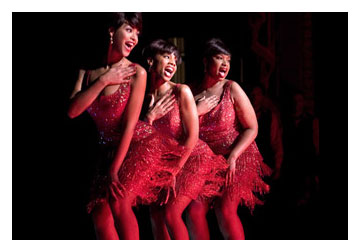
“Dreamgirls,” originally brought to the Broadway stage by Michael Bennett in the early 1980s and now a movie musical directed by Bill Condon, is another kind of package, one that commodifies the Supremes’ story by turning it into something shrink-wrapped, airless and glitzy. “Dreamgirls” — which opens today for one week at the Ziegfeld Theater in New York, and nationwide on Dec. 25 — is a fictional version of the Supremes’ rise to fame and the ensuing rifts and rivalries between its members: A Detroit singing trio — they start out as the Dreamettes, later dropping the “ettes” — become huge stars with the guidance of a sharp but duplicitous manager, Curtis Taylor Jr. (Jamie Foxx). The group’s frontwoman, Effie White (2004 “American Idol” finalist Jennifer Hudson), is a pretty powerhouse with a big voice and a lush, zaftig figure to match; she’s also Curtis’ girl. As Curtis grooms the trio to succeed not just in Apollo Theater-type venues but in swanky supper clubs as well (in other words, he’s training them to jump color and class barriers), he pushes Effie, with her very big, very black voice, into the background, and makes her willowy, glamorous co-member, Deena Jones (Beyoncé Knowles), the trio’s star; third member Lorrell Robinson (Anika Noni Rose) is simply eager for success and goes along with the power play. Deena’s voice has the “lighter” — in other words, whiter — touch Curtis is looking for; the subtext is that Effie is too intimidating for white audiences, too coarse for the aura of elegance Curtis wants to cultivate for the group.
All of those things essentially happened to the Supremes, too: Even though Florence Ballard had the strongest voice of the three women, Berry Gordy ultimately pushed the vixenish Diana Ross into the lead singer’s slot. The snub deeply troubled Ballard, and she was fired from the group in 1967; she died in poverty in 1976, after several failed attempts to launch a solo career.
It’s the kind of story that’s almost too big to be contained by fiction, and “Dreamgirls” — beginning with Tom Eyen’s book, which was adapted by Condon for the screen — doesn’t come close to mapping the alternately sad and joyous contours of that story. This is a puny, pinched vision of R&B history and of R&B itself, a sanitized, show-tunized reading of some of the greatest pop music to come out of the 1960s. An early scene in “Dreamgirls” features a speech about how the white man has repeatedly stolen from the black man, and yet the show’s music sounds like one massive instance of thoughtless appropriation. The songs — with lyrics by Eyen and music by Henry Krieger — sound nothing like those that came out of Motown (with their repetitive but dreamily seductive Holland-Dozier-Holland hooks); they have the toe-tapping sheen of the phoniest show music, as if you could give a melody soul just by wriggling your spirit-fingers extra-hard. Even the movie’s alleged showstopper, the bloated ballad “And I Am Telling You I’m Not Going” (made famous by Jennifer Holliday, who originated the role of Effie onstage) is less a song than a diaphragm workout, a number designed to prove how physically demanding it is to pull off. When Hudson’s Effie performs it here, you can see her trying to find some emotional footing on this craggy Matterhorn. It’s a testament to Hudson’s gifts as a singer, and to her unsugary effervescence, that she actually comes close to making the song mean something. (And even then, the sequence is cut so clumsily we’re barely allowed to watch her; editor Virginia Katz — who has done terrific work elsewhere, particularly on “Jet Li’s Fearless” — has chopped the number into little bits, distracting us from Hudson’s unshakable focus.)
Even taken on its own terms, divorced from the real story of Motown and the Supremes (if it’s even possible to do so), “Dreamgirls” is a frenzied, slapdash exercise, a dramatic slice-and-dice in which scenes zip past us in an inconsequential blur. Characters have crises before they even have personalities (if they’re ever lucky enough to get personalities). When Beyoncé’s Deena wails to Foxx’s Curtis, who has become her controlling, obsessive husband as well as her manager, “Maybe you just don’t see me for who I am,” we can’t really blame the guy: We have no idea who she is, either. In “Dreamgirls,” Deena isn’t a delectable villainess or even a guileless victim; she observes the machinations around her — chief among them Curtis’ cruel treatment of Effie, whom she supposedly loves like family — with nothing but a blank, glazed gleam in her beautifully almond-shaped eyes. Diana Ross may not have a reputation for being a sweetheart, but you can’t say she’s not fascinating: In performance footage of the group, you can sometimes see her brittle ambition nearly breaking through her winsomeness — she’s one of those pop-culture figures who’s easier to love than to like. But “Dreamgirls” asks nothing of Beyoncé, an appealing presence who’s untested as an actress: All she has to do is wear a succession of alternately sequined and slinky outfits and blink her big Bambi eyes; even her musical numbers are dwarfed by Hudson’s. She’s less a dream girl than a waxy living doll.
“Dreamgirls” vibrates with not-so-hidden messages and meanings, among them “Sisterhood is powerful” and “You can be what you want to be if only you dare to dream.” Maybe the picture would be more pleasurable if it weren’t so laden with hefty empowerment lessons, if it were constructed as a sharp, sly entertainment like Rob Marshall’s film of Bob Fosse’s “Chicago” (which Condon also adapted for the screen).
Even some of the performers seem a bit confused about how seriously to take the whole enterprise: Jamie Foxx plays a cardboard villain, a guy who bulldozes his way through other people’s lives to make his dreams come true, but we never quite understand how he pulls it off — his charisma has only a flat, dull surface glow. (It’s hard to believe this is the same actor who gave so much dimension to Ray Charles in Taylor Hackford’s “Ray.”) Other actors have more impact in much smaller parts: Anika Noni Rose plays Lorrell as a sweet, ditzy charmer; Keith Robinson, as Effie’s brother and the group’s chief songwriter, C.C. White, gives a relatively slight role some interesting gravity. And Eddie Murphy, as James “Thunder” Early, one of Curtis’ earliest acts and one who is, like Effie, ultimately betrayed by him, has some wonderful scenes: He brings glammed-up grace to his early song-and-dance numbers, momentarily distracting us from how lousy the songs are. And he’s deeply moving in some of his later scenes. Murphy doesn’t let his guard down readily — he’s more of a showman, a dazzler — and when he does, you feel you’ve been let in on a closely guarded secret.
Whatever the flaws of “Dreamgirls” may be, there’s no escaping the allure of Jennifer Hudson. Hudson has a hearty voice and a luscious, rounded figure, and yet she gives the picture the very dashes of lightness it so sorely needs. Even in her later scenes, when hardship threatens to crush Effie, she maintains a quiet, serene equilibrium — there’s nothing brassy or false about her. Hudson gets far less screen time than Beyoncé does, even though she’s practically the movie’s lifeblood.
“Dreamgirls” was a beloved stage musical, and I suspect plenty of people will love this movie, too. But it’s troubling that a prefab production like “Dreamgirls” is poised to be a hit, while the most original movie musical of the past few years (if not of many years), Bryan Barber’s Prohibition-era fantasy “Idlewild,” disappeared from the movie landscape with barely a flicker. “Idlewild” is a celebration not just of black culture but of all pop culture, a rapturous patchwork of movie conventions that results in something deeply unconventional.
By comparison, “Dreamgirls” gives us everything we expect, and less. Murphy’s James “Thunder” Early is an R&B performer who’s James Brown, (a straight) Little Richard, Sam Cooke and Marvin Gaye all rolled into one. Composite characters are a staple of fiction. And yet there’s something unsettling about the very conception of this figure, as if all black pop music were of a piece, as if even its greatest voices were interchangeable. “Where did our love go?” the Supremes once asked us, a question so bold in its simplicity that some of us have never gotten over it. There’s so little love to be found in “Dreamgirls.” It’s a product that promises magic, and yet gives us nothing to live on.
It may feel to you as if the summer moviegoing season has only just begun and many months of popcorn-munching delight lie ahead. That’s both true and not true. There’s a degree of pseudo-Calvinist predestination about the whole thing this year that’s unusual even by the standards of Hollywood, where conventional wisdom and guesswork-in-advance count for actual knowledge.
I mean, nobody knows for sure how much money the 1980s big-hair musical “Rock of Ages” will gross or whether “The Dark Knight Rises” will beat out “The Avengers” as the top box-office hit of the year. (My answers: Not enough to be a huge hit, and no.) But pretty much any idiot with a computer — me, for instance — can look at the calendar and figure out what the biggest hits of the summer will be. As I just mentioned, the summer’s No. 1 movie, in all probability, has already been released. (I’ll save the trollery about how it wasn’t really all that great for some other time.) After we get through “Prometheus” and “Abraham Lincoln: Vampire Hunter” in June, followed by “The Amazing Spider-Man” and “The Dark Knight Rises” in July, well, that’s pretty much it. I exaggerate, but only a little — these days, blockbuster season commences in early May and is over by the end of July, with August reserved as usual for offbeat genre movies, the fourth chapters of trilogies, and the continuing careers of Sylvester Stallone and Jackie Chan. (In other words, the good stuff.)
Now, I’m not copping some elitist attitude — or at least not the one you’re thinking. I’m plenty excited to see Ridley Scott’s “Alien” prequel “Prometheus” later this week, believe me. And I have a funny feeling about Chris Nolan’s last “Dark Knight” chapter, which might wind up being a lot better, and tougher, than skeptics like me are inclined to expect. But there is a lot of smaller-scale summer movie goodness to look forward to, and arthouse-type specialty distributors have learned that packing the season with alternative fare aimed at grownups can definitely pay off. Please note that I do mean “summer movies,” that is, those possessing high entertainment value and ample sensual rewards. Of course I still love three-hour fillums from Turkey about the meaninglessness of existence (like that one some of you will never forgive me for), but I also agree they don’t go all that well with flip-flops, the smell of spray-on sunscreen, and those mind-altering cola-slush concoctions.
So here are 10 terrific blockbuster alternatives for the summer of 2012, ranging from some mildly offbeat studio fare to low-budget indies that will spread slowly and gradually across the country. (Several will also be available on-demand, and I’ve tried to note that.) I should mention that three excellent such options have already opened in major cities and should reach you soon if they haven’t already: Wes Anderson’s blissful, tragicomic mid-1960s fantasy “Moonrise Kingdom”; Norwegian director Joachim Trier’s heartbreaking one-man, one-day character study “Oslo, August 31st”; and Nadine Labaki’s “Where Do We Go Now?” a sweet-natured, mildly experimental retake on “Lysistrata” set in a Lebanese village.
Extraterrestrial A guy wakes up next to a hot chick after an apparent one-night stand — but why can’t he remember anything about it? And why is there a flying saucer hovering over their now-abandoned city? From Spanish director Nacho Vigalondo, who made the deceptively silly and thoroughly enjoyable time-travel heist movie “Timecrimes,” comes this appealing hybrid of indie relationship comedy and alien-invasion flick. (Opens June 15 in Brooklyn, N.Y.; Seattle; Austin, Texas; and on VOD. Other cities will follow.)
Your Sister’s Sister This irresistible indie rom-com from Seattle-based filmmaker Lynn Shelton may be less distinctive than her provocative bromance “Humpday,” but Shelton has stepped up her game, movie-star-wise, while retaining her sharp-edged dialogue and real-life characterizations. Mark Duplass plays a grieving loser who has a fun, drunken one-nighter with a lesbian friend (Rosemarie DeWitt) — but it’s her sister (Emily Blunt), the ex of his late brother, for whom he’s kept a torch burning. (Opens June 15 in Chicago, Los Angeles, New York, San Francisco, Seattle and Washington, D.C., with a wider release to follow.)
Beasts of the Southern Wild First-time director Benh Zeitlin’s magic-realist fable is already the year’s most acclaimed debut. Set in an isolated corner of Louisiana’s bayou country, where a six-year-old girl lives in a fantastical harmony with nature — at least until the big storm hits — “Beasts” has won both the Sundance Grand Jury Prize and the Caméra d’Or at Cannes, for best first film in any section of the festival. This is a genuinely visionary work, albeit one that will strike some viewers as a mite too precious. I simply can’t tell whether it’s a breakout hit waiting to happen or this year’s version of “Uncle Boonmee” — a film loved by a handful of cinephile insiders but ignored by most. (Opens June 27 in major markets, with wider release to follow.)
Magic Mike Yeah, picking this one is probably cheating. It’s a studio film (at least at the point of release) that stars Channing Tatum, Alex Pettyfer and Matthew McConaughey as male strippers. In other words, it’s got obvious audience appeal and will probably be a hit, at least at some level — but it’s also a Steven Soderbergh film, meaning it was shot fast and cheap and close to the ground. (Soderbergh shot and edited the whole damn thing himself, as usual.) That also means it’s got at least a bit of clinical, borderline-misanthropic edge to go along with the ample humor and even ampler servings of beefcake. Honestly, what’s not to love? (Opens June 29.)
Take This Waltz Actress-turned-director Sarah Polley’s second film (the first was the wonderful “Away From Her”) is an almost ruthless examination of one woman’s journey out of an apparently happy marriage into a stormy new relationship, featuring 2011 Oscar nominee Michelle Williams in what I think is her best role to date. (And Seth Rogen is so terrific as her jilted husband that I hereby forgive him his willfully dumb comedy roles.) By turns erotic, comic, tragic and even experimental, “Take This Waltz” has divided critics and audiences at festivals so far. I think it’s one of the year’s best movies, and it announces Polley’s arrival in the front rank of North American filmmakers. What will you think? (Now available on VOD; opens June 29 in theaters.)
Ballplayer: Pelotero Summer simply isn’t summer without an unconventional take on the baseball movie. In this acclaimed documentary, already a hit at numerous festivals, directors Ross Finkel, Trevor Martin and Jonathan Paley take us inside the rarely seen world of Major League Baseball’s training camps in the Dominican Republic, where teenagers from the poor island nation are bred to become future diamond superstars (or, more likely, to wash out somewhere along the way). The filmmakers follow two highly ranked prospects as they approach their 16th birthday — the moment they can sign professional contracts. (Opens July 13 in New York, with other cities and home video release to follow.)
The Queen of Versailles A Florida real-estate tycoon and his appealing, immensely flawed wife try to build the country’s biggest McMansion in photographer-turned-filmmaker Lauren Greenfield’s documentary, which is stranger than any work of fiction. Surrounded by controversy since well before its Sundance premiere (when subject David Siegel tried to sue the festival), “Queen of Versailles” veers from profound human compassion to domestic horror as Siegel’s wife Jackie wanders through her enormous but trashed home scraping dog crap off the carpets. It’s like a Theodore Dreiser novel for our time, infused with the vivid, vulgar spirit of reality TV. (Opens in theaters July 20; VOD release is likely but has not been announced.)
Killer Joe A mean-spirited plot about a guy who takes out a hit on his own mother, a delightful-sounding cast headed by the resurgent Matthew McConaughey (what a big year for him!), and an NC-17 rating. Add that all up, and this Coens-flavored tale of backwater deviance, written by playwright Tracy Letts, could finally be the comeback film that onetime Oscar-winner William Friedkin (“The Exorcist,” “The French Connection”) has been pointing toward for decades. Mind you, like all of Friedkin’s recent movies, “Killer Joe” was made on the cheap, far away from Hollywood and its piles of money. That only makes me want to see it more, especially with Emile Hirsch, Juno Temple, Thomas Haden Church and Gina Gershon all along for the ride. (Scheduled to open July 27 in limited release.)
Premium Rush This one’s another studio movie, technically speaking — but everything about this Manhattan chase thriller screams irresistible August sleeper, from its indie-rific star (Joseph Gordon-Levitt, still a niche-oriented leading man) to its director (A-list screenwriter David Koepp, who’s made several other films, none of them hits). Gordon-Levitt plays a bike messenger who picks up a mysterious envelope that lures a dubious cop (the inimitable Michael Shannon) into an extended street pursuit, complete with BMX-style bike acrobatics and action-movie clichés galore. (Scheduled to open Aug. 24 in wide release.)
Lawless This bootlegging saga set in Depression-era Virginia, from the Aussie duo of director John Hillcoat and screenwriter Nick Cave (yes, the post-punk music legend, who also wrote Hillcoat’s “The Proposition”), has run through three titles during its brief existence, which often signals a troubled production. (It was previously “The Wettest County in the World” and then just “The Wettest County” — and the filmmakers only switched to “Lawless” after Terrence Malick agreed to give it up.) Reviews and reactions at the Cannes premiere ran the gamut from raves to outrage, but with an ensemble that includes Tom Hardy, Gary Oldman, Jessica Chastain, Guy Pearce and Mia Wasikowska (along with the much-mocked Shia LaBeouf), I can’t believe it won’t be fascinating. (Scheduled to open Aug. 29.)
Continue Reading
Close
The best movies act as a kind of amber, trapping the life of their times. Sometimes, you get jewels, other times you get, well, amber.
It was hard to read anything about “We Need to Talk About Kevin” without some reference to its distinguished antecedents in the “there’s something about that boy, June” school of demon child cinema. “The Omen,” “Rosemary’s Baby” and “Problem Child” all got their time on deck, but one film in particular gets mentioned, for it invented this entire genre. And that film is Mervyn LeRoy’s 1956 epic “The Bad Seed.” This is one of those movies embedded in our consciousness that perhaps should stay embedded and not actually be pried loose.
Which brings us to this week’s double bill. “We Need to Talk About Kevin,” just out today, is an unrelentingly grim, absolutely depressing, difficult-to-recommend-to-anyone work of sublime, essential filmmaking. Say again? OK. In the words of Preston Sturges, there is “nothing like a deep-dish movie to drive you out into the open.” “We Need to Talk About Kevin” is that kind of movie, an absolutely brilliant work of narrative and deliberately elliptical narrative storytelling. It takes this trope of the bad seed and plants it so it grows into some kind of hallucinatory kudzu. It cannot be easily eradicated once it is experienced first-hand. Not since Billy Mumy wished those pesky adults into the cornfield in one of the all-time creepiest works of TV Noir has a demon child been depicted as being quite so, well, “hellish.”
Based on the 2004 novel by Lionel Shriver, “We Need to Talk About Kevin” is told from the point of view of worldly travel writer Eva Khatchadourian. Besides having to cope with a difficult-to-spell last name, Eva has to endure a nightmarish life as the mother of perhaps the worst child in cinema history. This slow-motion torture of Eva is capped with a Columbine-style school massacre that tears this movie’s heart wide open. No surprise there, but the brilliance of the film is the way the chronology of catastrophe coils around itself, yet propels relentlessly forward. I must mention here that the editing of the film is wonderful. I also must mention that the editor of this film is my friend and colleague Joe Bini, but I’m not just saying this to butter Joe up so he takes my notes seriously next time. If anything, the editing in this film makes me nervous to ever suggest anything to Joe ever again — it is that good. But there is enough praise to go around. The film’s director, Lynn Ramsey, has a command of film vocabulary that keeps it from becoming the Art House “Omen” it so easily might have been. Yes, there are many scenes of mannered excess, but what manners, what excess!
Now, no film about a Bad Seed can succeed with a bad child actor – and “We Need to Talk About Kevin” has two extraordinary seeds. Ezra Miller plays the teenage Archer from Hell, and Jasper Newell is simply terrifying as a Satan in Snuggies. Both not only look alike and talk alike, at times they even glare alike. You can lose your mind, as Tilda Swinton does, thoroughly, across two excruciating hours. Any parent who read the recent New York Times Magazine article on 9-year-old newly diagnosed psychopaths cannot help but empathize with Swinton’s Eva. Those same parents also should not — repeat not — watch this movie. Cherish your pet hamster and let this one go. Trust me on this.
This brings us to the only real problem with “We Need to Talk About Kevin” — the reason for its existence. One wonders just why this story demanded to be told and why so many consummate craftsmen felt compelled to tell a story of such absolute darkness and despair. It reminds me of another work of scary excellence that was pretty much a career black-hole for all connected with it, Bob Fosse’s “Star 80.” Perhaps the worst first-date movie of all time, “Star 80” worked brilliantly on just about every level, except for the basic story it told, which had even Fosse disciples screaming for the exits and pretty much torpedoed the career of Julia Roberts’s far more talented brother.
Both “Star 80″ and “We Need to Talk About Kevin” get the “Michael Powell Peeping Tom” award for Excellence In Service of Repulsion, and both are great films. I really just wonder what the filmmakers thought they were doing, what audiences they thought they were going to reach, and why they wanted to reach them in the first place. I’m not going to ask my friend Joe, but, God bless Lynn Ramsey and her creative team, and Bob Fosse and Michael Powell, for going for it – whatever they thought “it” might be.
“The Bad Seed,” on the other hand, did nothing to derail the career of its director, Mervyn LeRoy. Perhaps it should have. A too-faithful translation of the 1954 hit Broadway play, it’s a film best consigned to legend and not actually watched, unless, of course, as the first part of this double bill with “We Need to Talk About Kevin.” LeRoy was the ’50s king of Broadway adaptations, with “The Bad Seed” following “Mister Roberts” and leading into his translation of “No Time for Sergeants.” His best work helming Warner Brother’s Pre-Code quickies was 25 years behind him, not to mention a guest shot at the “Wizard of Oz.” LeRoy brought very little to the “The Bad Seed.” Most of the cast of the play were imported to LeRoy’s set, and most were still delivering their lines to the far balcony. LeRoy’s camera just got in the way.
And what lines they delivered! “The Bad Seed” is one long pulled punch.
Remember the ending of “Psycho” where all of the delicious crimes are explained away in a long exposition scene? This film is stuffed with what Orson Welles called “dollar-book Freud,” apparently necessary for 1950s audiences who could not – or would not – imagine a child who actually did enjoy pulling the wings off flies. Even Bosley Crowther, the arteriosclerotic film critic for the New York Times, called the movie out on its staginess and over-the-top acting — and this was in 1956. Sadly, the film isn’t really bad enough to be really good. With the exception of Patty McCormack’s trailblazing performance as Rhoda Tasker, the titular Bad Seed in question, all the other performances are mannered beyond belief. Henry Jones, in particular, must be signaled out for essaying the role of Leroy, the dimwitted proto-pervert maintenance man. Leroy has Rhoda’s number early on, but keeps forgetting to add it up correctly, until Rhoda demonstrates convincingly why children should not play with matches.
But, rejoice, fans of Hollywood tacked-on Hays Code endings. You will absolutely love the very end of this film, where the cast takes an actual curtain call (!) and demon Rhoda gets an actual spanking (!!) from a smiling mom. And all this after God smites Evil in just about that amount of time. Astonishing now, and I have to believe astonishing then. This is as complete an act of dramatic self-negation as ever appended to a Hollywood movie. When TCM junkies pine for the days of classic old Hollywood, movies like “The Bad Seed” do not help them make their case. “We Need to Talk About Kevin,” on the other hand, is a fully realized work of committed cinematic virtuosity, in the service of a story that many simply do not want to hear. It has the courage of its convictions, and in this era of focus-group-driven filmmaking, courage is more than enough.
Watching this double bill shows just how far we have come – on a journey we may not want to make.
Worst first-date movie of all time? I suggested “Star 80,” but perhaps you, dear readers, can help with other titles, and, perhaps, the saga of other disastrous movie dates. See you in the comments section!!
Continue Reading
Close
“Oslo, August 31st” is, as the title suggests, an evocation of one day in the Norwegian capital, as experienced by a troubled young man who’s facing the end of summer and the end of his youth. It’s a marvelously constructed personal journey, both wrenching and bittersweet, whose emotional ripple effects stay with you for days and weeks afterward. While much of international art cinema can seem overly talky or conceptually alien to American viewers, this second feature film from Norwegian director Joachim Trier is a dynamic, even breathtaking visual experience without much dialogue or any philosophical heavy lifting, following the bony, handsome, exceedingly vulnerable Anders (Anders Danielsen Lie) through coffee shops, nightclubs and bodies of water, en route to an ambiguous final destination.
I saw “Oslo, August 31st” last year at Cannes and found it powerfully affecting, but I never would have guessed that this small movie from a small country would have touched an international nerve the way it apparently has. In the wake of a breathless profile of doctor-turned-actor Lie and his supermodel wife, Iselin Steiro, in the New York Times’ style magazine — which made the film sound rather like a fashion accessory, or a handbook to Oslo architecture — I almost feel the need to dial back expectations a little. Yes, there are drugs and dance clubs and traveling shots but, honest to Pete, we’re not talking stylish, scenic, lovable hipster romp here, people. While “Oslo, August 31st” definitely has the dynamism and street-level energy of, say, an early Godard picture, and may indeed leave you eager to visit Norway, it’s first and foremost an intimate tragedy about a likable young man who has wandered off the path of life into some very dark woods, and isn’t necessarily finding his way back.
As in Trier’s equally wonderful first film, the 2006 “Reprise” — I’m pretty much the president of the cult on that one — the director is interested in exploring the existential dark side of Scandinavian social democracy, with its largely homogeneous character and devotion to equal opportunity. When I talked to Trier about that film, which featured Lie and Espen Klouman-Hoiner as a pair of arrogant, doomed aspiring novelists, he observed that in Norway “there are a lot of people with a lot of choices. It sounds wonderful but there’s a darker side to that. Lots of people are not dealing with those choices very well.” Anders in “Oslo, August 31st” is something like the worst-case outcome for Lie’s character in “Reprise”; he’s a guy from a loving, middle-class family who’s got looks, health, intelligence and education, but for unknowable reasons finds himself on the edge of middle age as a penniless, unemployable, supposedly recovering junkie.
Trier and co-writer Eskil Vogt adapted their central premise from “Le Feu Follet,” a 1930s novella about alcoholism by Pierre Drieu La Rochelle, but “Oslo, August 31st” could really be set anywhere at any time. It’s about the painful necessity of adapting to change, every single day that we’re alive, and if we identify with Anders even as we rage against his despair, it’s because every living human has at some point considered the possibility that it’s just too much and the struggle isn’t worth it. Anders is doing well in drug rehab, and has cautiously been granted a one-day leave to visit Oslo friends and apply for a job. But we can tell from the first moments of the film that his agenda is more complicated than that; Anders is in the position of a certain Danish prince, evaluating the reasons for being against the reasons for ceasing to be. (Trier, by the way, is cousin to another famous Dane, “Melancholia” director Lars von Trier, and one could argue their visions of the world are related as well.)
“Oslo, August 31st” runs a lean, mean 95 minutes, and not one second seems unimportant. Anders moves through the streets of Oslo looking for reasons to live and reasons to die, and even though we don’t know those streets as he does, we can tell that they’re haunted with memories and private agonies. The city is dotted with construction cranes and demolition sites, remorselessly regenerating itself while he appears to stand still. Indeed, Anders’ family home will soon be sold, and one of his personal missions is to pay a final visit. (The fluid, poetic cinematography is by Jakob Ihre.) He insults a prospective employer, refuses to make peace with his alienated sister, falls off the wagon — at first tentatively, and then enthusiastically — and leaves increasingly pathetic messages for his lost love, a woman who’s now in New York. (It’s the voice of Steiro, Lie’s real-life spouse.) On the other hand, he flirts with a younger girl who seems affectionate and charming, and who seems to open for him the promise of a new beginning. Their scene together at an Oslo swimming pool that has just closed for the season, so suggestive of both death and rebirth (and, literally, of baptism) is so gorgeous I wanted to cry. OK, I did cry, and that wasn’t the only time.
But none of that, not even the scenes where we feel that Anders is in imminent danger of taking his own life, are quite as painful as his visit with Thomas (Hans Olav Brenner), an old friend and veteran of long literary discussions and booze-and-drug sessions. Thomas has a wife and a kid now, and his vices involve an occasional bottle of beer. In the manner of one-time bohemians who’ve more or less grown up, he’s kind of an ostentatious jerk about it — but then admits to Anders, when they’re alone, that he’s desperately unhappy. Perhaps that’s the “ordinary unhappiness” Freud wrote about, the unhappiness we all have to accept to get from the last day of August into the first day of September, in Oslo or anywhere else. But is that enough? Is that ever enough, for anybody? And can we forgive those who decide that it isn’t?
“Oslo, August 31st” opens this week at the IFC Center in New York, and June 1 at Laemmle’s Playhouse 7 and Laemmle’s NoHo 7 in Los Angeles, with more cities and DVD release to follow.
Continue Reading
Close
All the details of Wes Anderson’s rapturous and hilarious mid-1960s New England summer romance “Moonrise Kingdom,” taken one at a time, are plausible. Indeed they are more than plausible; they’re perfect, from the fitted uniforms and yellow canvas tents of the troop of “Khaki Scouts” headed by cigarette-smoking Edward Norton to the achingly picturesque island home where the brood of children belonging to Bill Murray and Frances McDormand sit around listening to the Leonard Bernstein recording of “A Young Person’s Guide to the Orchestra.” (I’m not going to bother questioning whether that record existed in 1965; some production intern probably spent half a day tracking down its history.)
Yet, as usual with an Anderson movie, this meticulous and convincing detail does not add up to realism but — depending on your perspective — to something either much less or much more than that. Something that could be described, and has been, in all kinds of ways: As fantasy or fairytale; as a whimsical miniature under glass; as a diorama created by a brilliant, obsessive-compulsive child. All reasonable descriptions, at least up to a point — and I’m on board for all of it. I’ve pretty much been on Anderson’s wavelength from Day One — or at least from “Rushmore,” which isn’t quite Day One. That’s not the same thing as saying that I think all his movies work equally well, or that he doesn’t occasionally lapse into laziness or self-indulgence. (I’ll have to give “The Life Aquatic with Steve Zissou” another chance one of these days, but I feel pretty confident that was a misstep.)
I understand why Anderson’s films drive some viewers nuts, in fact, and I would simply respond that it should be clear by now that his vision of cinema and the world is idiosyncratic and not to everyone’s taste and that there’s no point sitting around hoping he’ll become more normal. But here’s what I reject completely: The idea that the artificiality or hyperrealism (a better word, I think) of Anderson’s worlds — which is admittedly cranked up pretty high here — is fundamentally pretentious and insincere, or that it reflects some kind of “kidult” refusal of grown-up emotion. Yes, Anderson’s principal subject, and arguably his only subject, is the collision between the emotional lives of adults and children and the paradoxical tragicomedy it can so often produce. But if Anderson’s adults yearn for the comparative simplicity of childhood while his children long for the big, important feelings they believe (wrongly) go with growing up, that in itself is a distinctly adult perspective.
“Moonrise Kingdom” takes place at the tail-end of summer — that season which is more charged with a rueful sense of passage than any other. Its preteen lovers, Sam and Suzy (played by newcomers Jared Gilman and Kara Hayward, respectively), most certainly aspire to the grand passions of Tristan and Isolde or Abelard and Heloise, and it’s entirely possible they’ve heard of them. They first met backstage during a performance of Britten’s “Noye’s Fludde” at the island of New Penzance’s only church, when Sam was in his Khaki Scout uniform and coonskin cap, and Suzy was wearing a bird costume. (The use of Britten, of all possible composers, as this film’s musical muse is wonderfully unlikely, and totally Andersonian.) After a hot and heavy epistolary romance, they conspire to run away together — as it happens (so we are told by on-screen narrator Bob Balaban), just three days before a major hurricane will hit New Penzance.
As irresistible as our young lovers are — Sam with his corncob pipe and camp-tested scouting skills, Suzy in her saddle shoes and with her dangerous pre-Lolita sexuality — this isn’t a movie about kids, and they are Potemkin protagonists. Against the certainty and clarity of the childhood world, we see the real heroes of New Penzance: Norton’s upright Scout Master Ward, who confesses his secret fears to a reel-to-reel tape recorder in the depths of the night; Bruce Willis’s Captain Sharp, the island’s only cop, who’s in love with Kara’s artsy, bespectacled mother, Laura (McDormand); Murray as the gentle, lawyerly Walt (Laura’s husband and Kara’s dad), who knows he is being cuckolded but can’t quite bring himself to do anything about it. All these lonely people are portrayed with wonderful delicacy and sensitivity, right in the middle of an artificial construction that contains plenty of shtick. I honestly don’t think I’ve ever seen Norton and Willis, in particular, be better than they are here.
Sam and Suzy’s tempestuous love affair, along with that looming act of God that’s boiling up out there in the Atlantic, will not merely bring all these people together but will give them an excuse to escape their everyday routine and their ingrained fears. In that sense, and in others too, “Moonrise Kingdom” is a deeply romantic film, perhaps the sweetest and most compassionate Anderson has ever made. What has evidently confused some viewers is the fact that it’s also an obsessively curated re-creation of an era that never quite existed, a meticulous storybook version of 1965 that’s more perfect than the original. In real life, Boy Scout tents of that era were made of canvas but were never yellow, and government social workers never wore Salvation Army-style uniforms, as Tilda Swinton’s officious character (whose only name appears to be “Social Services”) does here. And so on.
I suspect that people conflate the artificiality of Anderson’s movies with inauthenticity or insincerity (different things, to be sure) because his artificiality is obvious and worn on the surface, whereas the highly mannered films of, say, Martin Scorsese masquerade as realism. I’m not picking that example at random, by the way; Scorsese has identified Anderson as his favorite among younger American directors, I suspect because he sees a kindred spirit. The two men have very different aesthetics, but both are visionaries who see the world through a personal lens, and both are technical virtuosi concerned with managing every detail of their created universes. You’re free to prefer one director’s work to the other’s, of course, but “Raging Bull” and “Goodfellas” are every bit as obsessed with style and production design as any Anderson film. (The cinematography in “Moonrise Kingdom” is by Robert D. Yeoman, who has shot all of Anderson’s live-action films. The production designer is Adam Stockhausen, the art director is Gerald Sullivan and the spectacular costumes are by Kasia Walicka-Maimone.)
To the extent that “Moonrise Kingdom” can be described as nostalgia, it isn’t personal nostalgia, since Anderson himself was not born until 1969. Very likely it’s an attempt to create a fantasy version of the lost world of his own parents. I wonder whether Scout Master Ward, when the magical summer of ’65 fades into memory, will get married, move to Texas and have a son. The island cabin of Walt and Laura feels like a creation out of a classic children’s novel, but it is imbued with the sadness of a failing adult marriage. In the third act, it feels like Anderson and co-writer Roman Coppola get a little lost in plot shenanigans, and they introduce several extra characters (Jason Schwartzman, Harvey Keitel and Swinton all show up in small roles) to little effect. But all of “Moonrise Kingdom” — from Sam’s miniature stolen canoe to the Benjamin Britten excerpts to Captain Sharp’s heartbreaking bachelor trailer home — is a labor of love, as pure and sweet as the lovelorn letters of its young runaways. Wes Anderson can fool some people, maybe, but he’s not fooling me.
“Moonrise Kingdom” opens this week in New York and Los Angeles, with wider release to follow.
Continue Reading
Close
It’s a general rule of thumb that a grown man doesn’t get a lot of support for knocking out a 10-year-old child’s teeth. But Yong Hyun Kim has won himself a few fans lately for doing just that.
Back on April 11, the 21-year-old Washington state man settled in with his girlfriend to enjoy “Titanic” in 3D — right in front of a boy known only in police documents as KJJ. What ensued led to a night in jail and a charge of second-degree assault.
According to the Associated Press, the boy, who was at the theater with three friends and his mother, says “they were watching the movie and talking when Kim told them to be quiet.” KJJ maintains that they settled down, but when he later whispered something to a companion, Kim “jumped over the seat, threw an iced drink at them and punched KJJ in the face.” He says Kim told him something like, “You know what, I paid a lot of money to see this movie.”
Kim, however, insists that the boys “were hitting him and his girlfriend with popcorn, running back and forth in the aisle and bumping him with their arms.” He says that when he confronted the group, “they started laughing at him,” provoking him to take a swing at the boy. “I got so mad that it just happened,” he told police, adding that he didn’t realize his tormentors were children. He now faces the possibility of up to nine months in jail. When police arrived at 10:40 p.m., they found the boy in the lobby “bleeding from the nose and missing a tooth.”
What really transpired that night is still under investigation. I do know that, as a parent, I would never take a group of 10 year olds out late on a school night to see Kate Winslet’s boobies. Nor would I, under any circumstances, let them talk through a movie, as KJJ himself admits he and his friends were doing. I’ve suffered through too many other families and that precise brand of self-centered behavior. And that’s why Kim’s assertion that a bunch of kids wouldn’t stop wrecking his movie-going experience has struck a powerful chord of recognition among moviegoers.
Among the online commenters horrified that an adult would physically assault a child instead of just getting a manager, there have been plenty of folks who seem to know exactly where the guy was coming from. On USA Today, commenters have called Kim “a hero” and even offered “to pay for the man’s defense.” The more level-headed commenters suggest he should have hit the parents instead. And on the Seattle Post-Intelligencer’s site, comments have been flooded by those who admit they’ve “wanted to do that” themselves and “understand the guy’s feeling behind it.”
As ticket prices skyrocket, the movie-going experience continues to deteriorate. If you’ve gone to a film lately – or for that matter, any public entertainment — you’ve likely experienced the astonishingly rude behavior of individuals who seem unaware that they’re not in their own living rooms. Texting. Talking. Kicking seats. It’s exasperating and sometimes outright experience-ruining. And we rarely get the satisfying experience I once had when a row of rowdy teens were talking and texting during the film and a patron with roughly the dimensions of the screen barreled over, leaned down and whispered something to the group. I don’t know what he said, but the kids all got up and left. When they did, there was a palpable exhalation of admiring relief in the theater. And when an Austin, Texas, woman was kicked out the Alamo Drafthouse last year for texting, the theater’s cheeky pride in her outrage promptly went viral.
It’s inexcusable to assault someone for being annoying or disruptive or even for laughing at you. Furthermore, Kim’s assertion that he couldn’t see how young the kids were – when he saw well enough to land a face punch — seems a little shaky. Don’t knock out little boys’ teeth. In fact, don’t knock out anybody’s if you can help it. If you applaud hitting kids, you’re probably a bad person. But the lesson here – whether you’re a child or a grownup — is pretty simple. If you don’t know how to behave in public and you don’t like losing teeth or going to jail, for God’s sake, just stick to Netflix.
Continue Reading
Close