
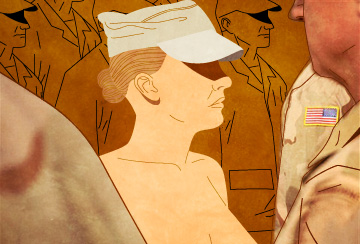

As thousands of burned-out soldiers prepare to return to Iraq to fill President Bush’s unwelcome call for at least 20,000 more troops, I can’t help wondering what the women among those troops will have to face. And I don’t mean only the hardships of war, the killing of civilians, the bombs and mortars, the heat and sleeplessness and fear.
I mean from their own comrades — the men.
I have talked to more than 20 female veterans of the Iraq war in the past few months, interviewing them for up to 10 hours each for a book I am writing on the topic, and every one of them said the danger of rape by other soldiers is so widely recognized in Iraq that their officers routinely told them not to go to the latrines or showers without another woman for protection.
The female soldiers who were at Camp Arifjan in Kuwait, for example, where U.S. troops go to demobilize, told me they were warned not to go out at night alone.
“They call Camp Arifjan ‘generator city’ because it’s so loud with generators that even if a woman screams she can’t be heard,” said Abbie Pickett, 24, a specialist with the 229th Combat Support Engineering Company who spent 15 months in Iraq from 2004-05. Yet, she points out, this is a base, where soldiers are supposed to be safe.
Spc. Mickiela Montoya, 21, who was in Iraq with the National Guard in 2005, took to carrying a knife with her at all times. “The knife wasn’t for the Iraqis,” she told me. “It was for the guys on my own side.”
Comprehensive statistics on the sexual assault of female soldiers in Iraq have not been collected, but early numbers revealed a problem so bad that former Defense Secretary Donald H. Rumsfeld ordered a task force in 2004 to investigate. As a result, the Defense Department put up a Web site in 2005 designed to clarify that sexual assault is illegal and to help women report it. It also initiated required classes on sexual assault and harassment. The military’s definition of sexual assault includes “rape; nonconsensual sodomy; unwanted inappropriate sexual contact or fondling; or attempts to commit these acts.”
Unfortunately, with a greater number of women serving in Iraq than ever before, these measures are not keeping women safe. When you add in the high numbers of war-wrecked soldiers being redeployed, and the fact that the military is waiving criminal and violent records for more than one in 10 new Army recruits, the picture for women looks bleak indeed.
Last year, Col. Janis Karpinski caused a stir by publicly reporting that in 2003, three female soldiers had died of dehydration in Iraq, which can get up to 126 degrees in the summer, because they refused to drink liquids late in the day. They were afraid of being raped by male soldiers if they walked to the latrines after dark. The Army has called her charges unsubstantiated, but Karpinski told me she sticks by them. (Karpinski has been a figure of controversy in the military ever since she was demoted from brigadier general for her role as commander of Abu Ghraib. As the highest-ranking official to lose her job over the torture scandal, she claims she was scapegoated, and has become an outspoken critic of the military’s treatment of women. In turn, the Army has accused her of sour grapes.)
“I sat right there when the doctor briefing that information said these women had died in their cots,” Karpinski told me. “I also heard the deputy commander tell him not to say anything about it because that would bring attention to the problem.” The latrines were far away and unlit, she explained, and male soldiers were jumping women who went to them at night, dragging them into the Port-a-Johns, and raping or abusing them. “In that heat, if you don’t hydrate for as many hours as you’ve been out on duty, day after day, you can die.” She said the deaths were reported as non-hostile fatalities, with no further explanation.
Not everyone realizes how different the Iraq war is for women than any other American war in history. More than 160,500 American female soldiers have served in Iraq, Afghanistan and the Middle East since the war began in 2003, which means one in seven soldiers is a woman. Women now make up 15 percent of active duty forces, four times more than in the 1991 Gulf War. At least 450 women have been wounded in Iraq, and 71 have died — more female casualties and deaths than in the Korean, Vietnam and first Gulf Wars combined. And women are fighting in combat.
Officially, the Pentagon prohibits women from serving in ground combat units such as the infantry, citing their lack of upper-body strength and a reluctance to put girls and mothers in harm’s way. But mention this ban to any female soldier in Iraq and she will scoff.
“Of course we were in combat!” said Laura Naylor, 25, who served with the Army Combat Military Police in Baghdad from 2003-04. “We were interchangeable with the infantry. They came to our police stations and helped pull security, and we helped them search houses and search people. That’s how it is in Iraq.”
Women are fighting in ground combat because there is no choice. This is a war with no front lines or safe zones, no hiding from in-flying mortars, car and roadside bombs, and not enough soldiers. As a result, women are coming home with missing limbs, mutilating wounds and severe trauma, just like the men.
All the women I interviewed held dangerous jobs in Iraq. They drove trucks along bomb-ridden roads, acted as gunners atop tanks and unarmored vehicles, raided houses, guarded prisoners, rescued the wounded in the midst of battle, and searched Iraqis at checkpoints. Some watched their best friends die, some were wounded, all saw the death and mutilation of Iraqi children and citizens.
Yet, despite the equal risks women are taking, they are still being treated as inferior soldiers and sex toys by many of their male colleagues. As Pickett told me, “It’s like sending three women to live in a frat house.”
Rape, sexual assault and harassment are nothing new to the military. They were a serious problem for the Women’s Army Corps in Vietnam, and the rapes and sexual hounding of Navy women at Tailhook in 1991 and of Army women at Aberdeen in 1996 became national news. A 2003 survey of female veterans from Vietnam through the first Gulf War found that 30 percent said they were raped in the military. A 2004 study of veterans from Vietnam and all the wars since, who were seeking help for post-traumatic stress disorder, found that 71 percent of the women said they were sexually assaulted or raped while in the military. And in a third study, conducted in 1992-93 with female veterans of the Gulf War and earlier wars, 90 percent said they had been sexually harassed in the military, which means anything from being pressured for sex to being relentlessly teased and stared at.
“That’s one of the things I hated the most,” said Caryle García, 24, who, like Naylor, served with the Combat Military Police in Baghdad from 2003-04. García was wounded by a roadside bomb, which knocked her unconscious and filled her with shrapnel. “You walk into the chow hall and there’s a bunch of guys who just stop eating and stare at you. Every time you bend down, somebody will say something. It got to the point where I was afraid to walk past certain people because I didn’t want to hear their comments. It really gets you down.”
“There are only three kinds of female the men let you be in the military: a bitch, a ho or a dyke,” said Montoya, the soldier who carried a knife for protection. “This guy out there, he told me he thinks the military sends women over to give the guys eye candy to keep them sane. He said in Vietnam they had prostitutes to keep them from going crazy, but they don’t have those in Iraq. So they have women soldiers instead.”
Pickett heard the same attitude from her fellow soldiers. “My engineering company was in the first Gulf War, and back then it had only two females,” she said. “One was labeled a whore because she had a boyfriend, and the other one was a bitch because she wouldn’t sleep around. And that’s how they were still referred to all these years later.”
In the current Iraq war, which Pickett spent refueling and driving trucks over the bomb-ridden roads, she was one of 19 women in a 160-troop unit. She said the men imported cases of porn, and talked such filth at the women all the time that she became worn down by it. “We shouldn’t have to think every day, ‘How am I going to go out there and deal with being harassed?'” she said. “We should just have to think about going out and doing our job.”
Pickett herself was sexually attacked when she was training in Nicaragua before being deployed to Iraq. “I was sexually assaulted by a superior officer when I was 19, but I didn’t know where to turn, so I never reported it,” she told me.
Jennifer Spranger, 23, who was deployed at the beginning of the war with the Military Police to build and guard Camp Bucca, a prison camp for Iraqis, had a similar experience.
“My team leader offered me up to $250 for a hand job. He would always make sure that we were out alone together at the beginning, and he wouldn’t stop pressuring me for sex. If somebody did that to my daughter I’d want to kill the guy. But you can’t fit in if you make waves about it. You rat somebody out, you’re screwed. You’re gonna be a loner until they eventually push you out.”
Spranger and several other women told me the military climate is so severe on whistle-blowers that even they regarded the women who reported rape as incapable traitors. You have to handle it on your own and shut up, is how they saw it. Only on their return home, with time and distance, did they become outraged at how much sexual persecution of women goes on.
Having the courage to report a rape is difficult enough for civilians, where unsympathetic police, victim-blaming myths, and simple fear prevent 59 percent of rapes from being reported, according to the U.S. Bureau of Justice. But within the military, reporting is even more risky. Military platoons are enclosed, hierarchical societies, riddled with gossip, so any woman who reports a rape has no realistic chance of remaining anonymous. She will have to face her assailant day after day, and put up with rumors, resentment and blame from other soldiers. Furthermore, she runs the risk of being punished by her assailant if he is her superior.
These barriers to reporting are so well recognized that even the Defense Department has been scrambling to mend the situation, at least for the public eye. It won’t go so far as to actually gather statistics on rape and assault in Iraq (it only counts reported rapes in raw numbers for all combat areas in the Middle East combined), but in 2006 the DOD did finally wake up to the idea that anonymous reporting might help women come forward, and updated its Web site accordingly.
The Web site looks good, although some may object that it seems to pay more attention to telling women how to avoid an assault than telling men not to commit one. It defines rape, sexual assault and harassment, and makes clear that these behaviors are illegal. The site now also explains that a soldier can report a rape anonymously to a special department, SAPR (Sexual Assault Prevention and Response), without triggering an official investigation — a procedure called “restricted reporting.” And it promises the soldier a victim’s advocate and medical care.
On closer scrutiny, however, the picture is less rosy: Only active and federal duty soldiers can go to SAPR for help, which means that neither inactive reservists nor veterans are eligible; soldiers are encouraged to report rapes to a chaplain, and chaplains are not trained as rape counselors; if soldiers tell a friend about an assault, that friend is legally obliged to report it to officials; soldiers must disclose their rank, gender, age, race, service, and the date, time and/or location of the assault, which in the closed world of a military unit hardly amounts to anonymity; and, in practice, since most people in the Army are men, the soldier will likely find herself reporting her sexual assault to a man — something rape counselors know does not work. Worse, no measures will be taken against the accused assailant unless the victim agrees to stop being anonymous.
The DOD insists on the success of its reforms, the proof being that the number of reported military sexual assaults rose by 1,700 from 2004 to a total of 2,374 in 2005. “The success of the SAPR program is in direct correlation with the increased numbers of reported sexual assaults,” Cynthia Smith, a Defense Department spokeswoman, wrote to me in an e-mail.
In fact, as anyone familiar with sexual assault statistics knows, nobody can ever tell whether increases in rape rates are due to more reporting or more rapes.
My own interviewees and advocates on behalf of women veterans say these reforms are not working. They say there is a huge gap between what the military promises to do on its Web site and what it does in practice, and that the traditional view that reporting an assault betrays your fellow soldiers still prevails.
“Are soldiers who report sexual assaults in the military still seen as betraying their comrades?” I asked Smith.
“Our soldiers are being fully trained that sexual assault is the most under-reported crime,” she wrote in reply. “In that training, not reporting a sexual assault is the betrayal to their comrades.”
Back in real life, Pickett watched several of her friends try to report sexual harassment and assault since the 2005 reforms, and she said that none of them were sent a victim’s advocate, a counselor or a chaplain. “These women are turning perpetrators in and they’re not getting anyone to speak on their behalf,” she told me. “There’s no one sitting in that room with you, so you’re feeling all alone.” In the end, she added, it boils down to the woman’s word vs. the man’s, and he is the one with the advocate, not her.
Meanwhile, the studies I have cited, along with the other past and present studies of veterans, who feel freer to talk than soldiers because they are out of the military, show that women soldiers are suffering post-traumatic stress disorder as a consequence of military sexual abuse. All soldiers with PTSD come home to some combination of sleeplessness, nightmares, bursts of temper, flashbacks, panic attacks, fear and an inability to cope with everyday life. They often turn to drugs or alcohol for escape. Some become depressed, others commit suicide. Many are too emotionally numb to relate to their families or children. But those who have been sexually assaulted also lose their self-respect, feel they have lost control over their lives, and are particularly prone to self-destruction.
I have yet to meet an Iraq war veteran of either sex who does not suffer from some form of post-traumatic stress disorder, but officially the number of Iraq veterans with PTSD is estimated to be about 30 percent for those newly back from war, according to a 2004 study of combat veterans in the New England Journal of Medicine.
The extent and severity of PTSD in women who have had to cope with both combat and sexual assault in Iraq is still being studied, but as it is known that these are two of the highest predictors of PTSD, it is logical to assume that the combination is pretty bad. “When you are sexually assaulted by people who are your comrades, PTSD can be worse than in other circumstances,” said Paula Shnurr, a research professor of psychiatry who conducted a new Veterans Administration study of therapy for women veterans with PTSD, published last week in the Journal of the American Medical Association. “You feel incompetent and helpless, like children feel when abused by the very people who are supposed to look after them,” Schnurr told me. “The people you depend on have attacked you.”
I am not claiming that sexual persecution is universal in the military, or that it is inevitable. Several soldiers I interviewed told me that if a commander won’t tolerate the mistreatment of women, it will not happen, and studies back this up. Jennifer Hogg, 25, who was a sergeant in the Army’s National Guard, said her company treated her well because she had a commander who wouldn’t permit the mistreatment of women. But another National Guard soldier, Demond Mullins, 25, who served with the infantry in Iraq for a year, from 2004 to ’05, told me that although there were no problems in his unit he heard from his commanders that there were rapes in other units in his camp. “One time a woman was taking a shower late, and guys went and held the door closed so she couldn’t get out, while one guy went in to rape her,” he said.
While commanders of some units are apparently less vigilant about policing rape, others engage in it themselves, a phenomenon known in the military as “command rape.” Because the military is hierarchical, and because soldiers are trained to obey and never question their superiors, men of rank can assault their juniors with impunity. In most cases, women soldiers are the juniors, 18 to 20 years old, and are new to the military and war, thus vulnerable to bullying and exploitation.
Callie Wight, a psychosocial counselor in women veterans’ health in Los Angeles, has been treating women who were sexually assaulted in the military for the past 11 years. In all that time, she told me, she has only seen a handful of cases where a woman reported an assault to her commander with any success in getting the assailant punished. “Most commanders dismiss it,” she said. A nine-month study of military rape by the Denver Post in 2003 found that nearly 5,000 accused military sex offenders had avoided prosecution since 1992.
At the moment, the most shocking case of military sexual assault is that of Army Spc. Suzanne Swift, 21, who served in Iraq in 2004. Swift was coerced into sex by one commanding officer, which is legally defined as rape by the military, and harassed by two others before she finally broke rank and told. As a result, the other soldiers treated her like a traitor for months.
Unable to face returning to the assailant, she went AWOL during a leave at home, and was arrested and put in jail for desertion. At first the Army offered her a deal: It would reduce her punishment if Swift would sign a statement saying that she had never been raped. She refused, saying she wouldn’t let the Army force her to lie.
The Army court-martialed Swift, and stripped her of her rank. She spent December in prison and was then sent to Fort Irwin in the Mojave Desert, far away from her family. She must stay in the Army for two more years, and may face redeployment. The men who assaulted her received nothing but reprimanding letters.
Swift’s mother, Sara Rich, has set up a Web site with a petition calling for her daughter’s release: More than 6,700 veterans and soldiers have signed it, and 102 of them signed their names to stories of their own sexual persecution in the military.
Swift’s case, and those of her petitioners, illustrate the real attitude of the military toward women and sexual assault, the one that underlies its fancy Web site and claims that it supports soldiers who’ve been raped.
The real attitude is this: If you tell, you are going to get punished. The assailant, meanwhile, will go free.
Which brings up an issue that lies at the core of every soldier’s heart: comradeship.
It is for their comrades that soldiers enlist and reenlist. It is for their “battle buddies” that they risk their lives and put up with all the miseries of sandstorms, polluted water, lack of sanitation, and danger. Soldiers go back to Iraq, even if they’ve turned against the war, so as not to let their buddies down. Comradeship is what gets men through war, and is what has always got men through war. You protect your battle buddy, and your battle buddy protects you.
As an Iraq veteran put it to me, “There’s nobody you love like you love a person who’s willing to take a bullet for you.”
So how does this work for women? A few find buddies among the other women in their squads, but for most there are no other women, so their battle buddies are men. Some of these men are trustworthy. Many are not.
How can a man who pressures you for sex every day, who treats you like a prostitute, who threatens or punishes you if you refuse him, or who actually attacks you, be counted on to watch your back in battle?
“Battle buddy bullshit,” said García from the Military Police. “I didn’t trust anybody in my company after a few months. I saw so many girls get screwed over, the sexual harassment. I didn’t trust anybody and I still don’t.”
If this is a result of the way women are treated in the military, where does it leave them when it comes to battle camaraderie? I asked soldier after soldier this, and they all gave me the same answer:
Alone.
