
Environment

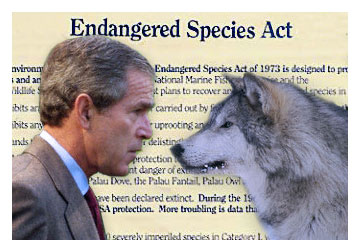
Inside the secretive plan to gut the Endangered Species Act

Proposed regulatory changes, obtained by Salon, would destroy the "safety net for animals and plants on the brink of extinction," say environmentalists.

The U.S. Fish and Wildlife Service is maneuvering to fundamentally weaken the Endangered Species Act, its strategy laid out in an internal 117-page draft proposal obtained by Salon. The proposed changes limit the number of species that can be protected and curtail the acres of wildlife habitat to be preserved. It shifts authority to enforce the act from the federal government to the states, and it dilutes legal barriers that protect habitat from sprawl, logging or mining.

“The proposed changes fundamentally gut the intent of the Endangered Species Act,” says Jan Hasselman, a Seattle attorney with Earthjustice, an environmental law firm, who helped Salon interpret the proposal. “This is a no-holds-barred end run around one of America’s most popular environmental protections. If these regulations stand up, the act will no longer provide a safety net for animals and plants on the brink of extinction.”

In recent months, the Fish and Wildlife Service has gone to extraordinary efforts to keep drafts of regulatory changes from the public. All copies of the working document were given a number corresponding to a person, so that leaked copies could be traced to that individual. An e-mail sent in March from an assistant regional director at the Fish and Wildlife Service to agency staff, asking for comments on and corrections to the first draft, underscored the concern with secrecy: “Please Keep close hold for now. Dale [Hall, director of the U.S. Fish and Wildlife Service] does not want this stuff leaking out to stir up discontent based on speculation.”

Many Fish and Wildlife Service employees believe the draft is not based on “defensible science,” says a federal employee who asked to remain anonymous. Yet “there is genuine fear of retaliation for communicating that to the media. People are afraid for their jobs.”

Chris Tollefson, a spokesperson for the service, says that while it’s accurate to characterize the agency as trying to keep the draft under wraps, the agency has every intention of communicating with the public about the proposed changes; the draft just hasn’t been ready. And, he adds, it could still be changed as part of a forthcoming formal review process.

Administration critics characterize the secrecy as a way to maintain spin control, says Kieran Suckling, policy director of the Center for Biological Diversity, a national environmental group. “This administration will often release a 300-page-long document at a press conference for a newspaper story that will go to press in two hours, giving the media or public no opportunity to digest it and figure out what’s going on,” Suckling says. “[Interior Secretary Dirk] Kempthorne will give a feel-good quote about how the new regulations are good for the environment, and they can win the public relations war.”

In some ways, the proposed changes to the Endangered Species Act should come as no surprise. President Bush has hardly been one of its fans. Under his reign, the administration has granted 57 species endangered status, the action in each case being prompted by a lawsuit. That’s fewer than in any other administration in history — and far fewer than were listed during the administrations of Reagan (253), Clinton (521) or Bush I (234). Furthermore, during this administration, nearly half of the U.S. Fish and Wildlife Service employees who work with endangered species reported that they had been directed by their superiors to ignore scientific evidence that would result in recommendations for the protection of species, according to a 2005 survey of more than 1,400 service biologists, ecologists and botanists conducted by Public Employees for Environmental Responsibility, a nonprofit organization.

“We are not allowed to be honest and forthright, we are expected to rubber stamp everything,” wrote a Fish and Wildlife Service biologist as part of the survey. “I have 20 years of federal service in this and this is the worst it has ever been.”

The agency has long seen a need to improve the act, says Tollefson. “This is a look at what’s possible,” he says. “Too much of our time as an agency is spent responding to litigation rather than working on recovering the species that are most in need. The current way the act is run creates disincentives for people to get involved with recovering species.”

Kempthorne, boss of the Fish and Wildlife Service, has been an outspoken critic of the act. When he was a U.S. senator from Idaho in the late 1990s, he championed legislation that would have allowed government agencies to exempt their actions from Endangered Species Act regulations, and would have required federal agents to conduct cost-benefit analyses when considering whether to list a species as endangered. (The legislation failed.) Last June, in his early days as interior secretary, Kempthorne told reporters, “I really believe that we can make improvements to the act itself.”

Kempthorne is keeping good on his promise. The proposed draft is littered with language lifted directly from both Kempthorne’s 1998 legislation as well as from a contentious bill by former Rep. Richard Pombo, R-Calif. (which was also shot down by Congress). It’s “a wish list of regulations that the administration and its industry allies have been talking about for years,” says Suckling.

Written in terse, dry legal language, the proposed draft doesn’t make for easy reading. However, the changes, often seemingly subtle, generally serve to strip the Fish and Wildlife Service of the power to do its stated job: to protect wildlife. Some verge on the biologically ridiculous, say critics, while others are a clear concession to industry and conservative Western governors who have long complained that the act degrades the economies of their states by preventing natural-resource extraction.

One change would significantly limit the number of species eligible for endangered status. Currently, if a species is likely to become extinct in “the foreseeable future” — a species-specific timeframe that can stretch up to 300 years — it’s a candidate for act protections. However, the new rules scale back that timeline to mean either 20 years or 10 generations (the agency can choose which timeline). For certain species with long life spans, such as killer whales, grizzly bears or wolves, two decades isn’t even one generation. So even if they might be in danger of extinction, they would not make the endangered species list because they’d be unlikely to die out in two decades.

“It makes absolutely no sense biologically,” wrote Hasselman in an e-mail. “One of the Act’s weaknesses is that species aren’t protected until they’re already in trouble and this proposal puts that flaw on steroids.”

Perhaps the most significant proposed change gives state governors the opportunity and funding to take over virtually every aspect of the act from the federal government. This includes not only the right to create species-recovery plans and the power to veto the reintroduction of endangered species within state boundaries, but even the authority to determine what plants and animals get protection. For plants and animals in Western states, that’s bad news: State politicians throughout the region howled in opposition to the reintroduction of the Mexican gray wolf into Arizona and the Northern Rockies wolf into Yellowstone National Park.

“If states are involved, the act would only get minimally enforced,” says Bob Hallock, a recently retired 34-year veteran of the Fish and Wildlife Service who, as an endangered species specialist, worked with state agencies in Idaho, Washington and Montana. “States are, if anything, closer to special economic interests. They’re more manipulated. The states have not demonstrated the will or interest in upholding the act. It’s why we created a federal law in the first place.”

Additional tweaks in the law would have a major impact. For instance, the proposal would narrow the definition of a species’ geographic range from the landscape it inhabited historically to the land it currently occupies. Since the main reason most plants and animals head toward extinction is due to limited habitat, the change would strongly hamper the government’s ability to protect chunks of land and allow for a healthy recovery in the wild.

The proposal would also allow both ongoing and planned projects by such federal agencies as the Army Corps of Engineers and the Forest Service to go forward, even when scientific evidence indicates that the projects may drive a species to extinction. Under the new regulations, as long as the dam or logging isn’t hastening the previous rate of extinction, it’s approved. “This makes recovery of species impossible,” says Suckling. (You can read the entire proposal, a PDF file, here.)

Gutting the Endangered Species Act will only thicken the pall that has hung over the Fish and Wildlife Service for the past six years, Hallock says. “They [the Bush administration] don’t want the regulations to be effective. People in the agency are like a bunch of whipped dogs,” he says. “I think it’s just unacceptable to go around squashing other species; they’re of incalculable benefit to us. The optimism we had when this agency started has absolutely been dashed.”

Rebecca Clarren writes from Portland, Ore.

Is it ethical to drive stick?

More drivers are buying manual transmissions -- a boon for auto sentimentalists but bad news for the environment

(Credit: cristapper via Shutterstock)

Ever since I first watched my dad drive his chocolate brown Datsun 280 ZX back in the early 1980s, I’ve been inculcated to believe that driving — true driving — can only be performed with a stick shift. From that childhood experience, I came to see the manual transmission as a birthright passed down from my grandfather, to my father, and eventually to me via a series of tense, stall-filled lessons when I turned 16. In my case, after ripping apart the transmission one too many times, my dad went barking drill sergeant on me, eventually teaching me that a stick requires a special kind of focus, and that I needed to ease up more slowly on the clutch in order to get into first gear on those damn inclines. Through the experience, I learned to consider my stick-shifting skill a special talent with transcendent value.

Yes, of course, in the intervening years I’ve had the chance to drive an automatic transmission. But that has always felt a bit like playing a post-Konami Code game of Contra — a bit too easy, a bit too idiot proof, a bit too, shall we say, inauthentic. On top of that, the automatic always seemed like a wasteful luxury because it always was more expensive and less fuel-efficient. That difference consequently added an ascetic populism to the inherent machismo of the engine-revving manual transmission.

No doubt, for stick shift enthusiasts, these factors have all conspired to create an alluring mystique around the manual transmission — one that, according to new data, is on the rise.

Last week, USA Today reported that while “the percentage of new vehicles with stick-shift gearboxes remains a small slice of the new vehicle market,” the “the first quarter this year manuals were in 6.5 percent of new vehicles sold, and that’s getting close to double each of the past five years.” The stick shift is back in a big way — but is that really such a good thing?

Upon hearing the news, my initial thought — for aforementioned reasons — was that, yes, of course it’s a good thing. In an ocean of bad drivers and wasteful vehicles, the news seemed like a distant island of hope. I thought that perhaps more motorists are being converted to the automobile religion (cult?) I first was exposed to in Dad’s Datsun 280 ZX. And maybe, just maybe, that’s a sign that American drivers are wising up, both stylistically and efficiency-wise.

Then I did a bit more investigation, and realized the news might not be so good, and that my quasi-religious fervor for the gearbox may have blinded me to my catechism’s new downsides.

In the past, the stick shift was an all-but-guaranteed fuel saver. But not anymore. As AOL Autos notes, computer technology has advanced to the point where “automatics have become so efficient that most of the time their fuel economy is on par with manuals — and in some cases even better.” USA Today notes that such a trend may eventually erase the long-term price differential between manual and automatic transmissions, meaning the manual will lose its frugal-chic appeal. Meanwhile, according to AOL, new technology also boosts automatics’ overall performance (read: speed), meaning many driving aficionados have come to prefer the automatic over the manual.

Thanks to all this, on the days I don’t bike to work and instead fire up my 11-year-old Saturn and shift it into first gear, I no longer feel so righteous or populist. I feel like part of the problem — not just because I’m driving a fossil fuel-dependent vehicle, but also because the manual transmission seems like a silly relic. Likewise, word that manual transmissions may be coming back no longer seems like such great news; it seems like more proof that when it comes to transportation, we’re still prone to making shortsighted decisions.

And yet, I can’t let go of my love for the stick — or maybe “can’t” isn’t the right word. Perhaps “don’t want to” is more appropriate. If the automobile is still one of the key chronological markers in a typical American’s life (and, unfortunately, it still is), the stick shift is a special symbol of our general heritage, and my specific family traditions.

That’s why I was happy to see that there remains one significant reason to still love the manual transmission — a reason that’s substantive, rather than just aesthetic or experiential. In the age of distracted driving, many believe the stick shift might encourage kids to stay focused on operating their vehicles, rather than operating their smartphones. The idea is that because a manual transmission requires special attention to operate, it doesn’t allow for as much multitasking as an automatic.

While there’s no science (yet) to prove the manual-transmission-as-deterrent-to-distracted-driving hypothesis, the memory of those first harrowing stick-shift lessons — with my dad imploring me to “really focus, goddammit!” — suggests to me that there’s something to the theory.

At least, that’s what I’m going to tell myself to justify my stick-shift fetish — that is, until the automatic fully surpasses the manual in every other way.

Continue Reading Close
David Sirota

David Sirota is a best-selling author of the new book "Back to Our Future: How the 1980s Explain the World We Live In Now." He hosts the morning show on AM760 in Colorado. E-mail him at ds@davidsirota.com, follow him on Twitter @davidsirota or visit his website at www.davidsirota.com.

An eco-pioneer’s final words

The visionary author of "Ecotopia," who died in April, warns of dark times ahead, but sees a path through the decay

This document was found on the computer of "Ecotopia" author Ernest Callenbach (1929-2012) after his death. It originally appeared on TomDispatch.com.

To all brothers and sisters who hold the dream in their hearts of a future world in which humans and all other beings live in harmony and mutual support — a world of sustainability, stability, and confidence. A world something like the one I described, so long ago, in “Ecotopia” and “Ecotopia Emerging.”

As I survey my life, which is coming near its end, I want to set down a few thoughts that might be useful to those coming after. It will soon be time for me to give back to Gaia the nutrients that I have used during a long, busy and happy life. I am not bitter or resentful at the approaching end; I have been one of the extraordinarily lucky ones. So it behooves me here to gather together some thoughts and attitudes that may prove useful in the dark times we are facing: a century or more of exceedingly difficult times.

How will those who survive manage it? What can we teach our friends, our children, our communities? Although we may not be capable of changing history, how can we equip ourselves to survive it?

I contemplate these questions in the full consciousness of my own mortality. Being offered an actual number of likely months to live, even though the estimate is uncertain, mightily focuses the mind. On personal things, of course, on loved ones and even loved things, but also on the Big Picture.

But let us begin with last things first, for a change. The analysis will come later, for those who wish it.

Hope. Children exude hope, even under the most terrible conditions, and that must inspire us as our conditions get worse. Hopeful patients recover better. Hopeful test candidates score better. Hopeful builders construct better buildings. Hopeful parents produce secure and resilient children. In groups, an atmosphere of hope is essential to shared successful effort: “Yes, we can!” is not an empty slogan, but a mantra for people who intend to do something together — whether it is rescuing victims of hurricanes, rebuilding flood-damaged buildings on higher ground, helping wounded people through first aid, or inventing new social structures (perhaps one in which only people are “persons,” not corporations). We cannot know what threats we will face. But ingenuity against adversity is one of our species’ built-in resources. We cope, and faith in our coping capacity is perhaps our biggest resource of all.

Mutual support. The people who do best at basic survival tasks (we know this experimentally, as well as intuitively) are cooperative, good at teamwork, often altruistic, mindful of the common good. In drastic emergencies like hurricanes or earthquakes, people surprise us by their sacrifices — of food, of shelter, even sometimes of life itself. Those who survive social or economic collapse, or wars, or pandemics, or starvation, will be those who manage scarce resources fairly; hoarders and dominators win only in the short run, and end up dead, exiled, or friendless. So, in every way we can we need to help each other, and our children, learn to be cooperative rather than competitive; to be helpful rather than hurtful; to look out for the communities of which we are a part, and on which we ultimately depend.

Practical skills. With the movement into cities of the U.S. population, and much of the rest of the world’s people, we have had a massive de-skilling in how to do practical tasks. When I was a boy in the country, all of us knew how to build a tree house, or construct a small hut, or raise chickens, or grow beans, or screw pipes together to deliver water. It was a sexist world, of course, so when some of my chums in eighth grade said we wanted to learn girls’ “home ec” skills like making bread or boiling eggs, the teachers were shocked, but we got to do it. There was widespread competence in fixing things — impossible with most modern contrivances, of course, but still reasonable for the basic tools of survival: pots and pans, bicycles, quilts, tents, storage boxes.

We all need to learn, or relearn, how we would keep the rudiments of life going if there were no paid specialists around, or means to pay them. Every child should learn elementary carpentry, from layout and sawing to driving nails. Everybody should know how to chop wood safely, and build a fire. Everybody should know what to do if dangers appear from fire, flood, electric wires down, and the like. Taking care of each other is one practical step at a time, most of them requiring help from at least one other person; survival is a team sport.

Organize. Much of the American ideology, our shared and usually unspoken assumptions, is hyper-individualistic. We like to imagine that heroes are solitary, have super powers, and glory in violence, and that if our work lives and business lives seem tamer, underneath they are still struggles red in blood and claw. We have sought solitude on the prairies, as cowboys on the range, in our dependence on media (rather than real people), and even in our cars, armored cabins of solitude. We have an uneasy and doubting attitude about government, as if we all reserve the right to be outlaws. But of course human society, like ecological webs, is a complex dance of mutual support and restraint, and if we are lucky it operates by laws openly arrived at and approved by the populace.

If the teetering structure of corporate domination, with its monetary control of Congress and our other institutions, should collapse of its own greed, and the government be unable to rescue it, we will have to reorganize a government that suits the people. We will have to know how to organize groups, how to compromise with other groups, how to argue in public for our positions. It turns out that “brainstorming,” a totally noncritical process in which people just throw out ideas wildly, doesn’t produce workable ideas. In particular, it doesn’t work as well as groups in which ideas are proposed, critiqued, improved, debated. But like any group process, this must be protected from domination by powerful people and also over-talkative people. When the group recognizes its group power, it can limit these distortions. Thinking together is enormously creative; it has huge survival value.

Learn to live with contradictions. These are dark times, these are bright times. We are implacably making the planet less habitable. Every time a new oil field is discovered, the press cheers: “Hooray, there is more fuel for the self-destroying machines!” We are turning more land into deserts and parking lots. We are wiping out innumerable species that are not only wondrous and beautiful, but might be useful to us. We are multiplying to the point where our needs and our wastes outweigh the capacities of the biosphere to produce and absorb them. And yet, despite the bloody headlines and the rocketing military budgets, we are also, unbelievably, killing fewer of each other proportionately than in earlier centuries. We have mobilized enormous global intelligence and mutual curiosity, through the Internet and outside it. We have even evolved, spottily, a global understanding that democracy is better than tyranny, that love and tolerance are better than hate, that hope is better than rage and despair, that we are prone, especially in catastrophes, to be astonishingly helpful and cooperative.

We may even have begun to share an understanding that while the dark times may continue for generations, in time new growth and regeneration will begin. In the biological process called “succession,” a desolate, disturbed area is gradually, by a predictable sequence of returning plants, restored to ecological continuity and durability. When old institutions and habits break down or consume themselves, new experimental shoots begin to appear, and people explore and test and share new and better ways to survive together.

It is never easy or simple. But already we see, under the crumbling surface of the conventional world, promising developments: new ways of organizing economic activity (cooperatives, worker-owned companies, nonprofits, trusts), new ways of using low-impact technology to capture solar energy, to sequester carbon dioxide, new ways of building compact, congenial cities that are low (or even self-sufficient) in energy use, low in waste production, high in recycling of almost everything. A vision of sustainability that sometimes shockingly resembles “Ecotopia” is tremulously coming into existence at the hands of people who never heard of the book.

- – - – - – - – - – - – - – - -

Now in principle, the Big Picture seems simple enough, though devilishly complex in the details. We live in the declining years of what is still the biggest economy in the world, where a looter elite has fastened itself upon the decaying carcass of the empire. It is intent on speedily and relentlessly extracting the maximum wealth from that carcass, impoverishing our former working middle class. But this maggot class does not invest its profits here. By law and by stock-market pressures, corporations must seek their highest possible profits, no matter the social or national consequences — which means moving capital and resources abroad, wherever profit potential is larger. As Karl Marx darkly remarked, “Capital has no country,” and in the conditions of globalization his meaning has come clear.

The looter elite systematically exports jobs, skills, knowledge, technology, retaining at home chiefly financial manipulation expertise: highly profitable, but not of actual productive value. Through “productivity gains” and speedups, it extracts maximum profit from domestic employees; then, firing the surplus, it claims surprise that the great mass of people lack purchasing power to buy up what the economy can still produce (or import).

Here again Marx had a telling phrase: “Crisis of under-consumption.” When you maximize unemployment and depress wages, people have to cut back. When they cut back, businesses they formerly supported have to shrink or fail, adding their own employees to the ranks of the jobless, and depressing wages still further. End result: something like Mexico, where a small, filthy rich plutocracy rules over an impoverished mass of desperate, uneducated, and hopeless people.

Barring unprecedented revolutionary pressures, this is the actual future we face in the United States, too. As we know from history, such societies can stand a long time, supported by police and military control, manipulation of media, surveillance and dirty tricks of all kinds. It seems likely that a few parts of the world (Germany, with its worker-council variant of capitalism, New Zealand with its relative equality, Japan with its social solidarity, and some others) will remain fairly democratic.

The U.S., which has a long history of violent plutocratic rule unknown to the textbook-fed, will stand out as the best-armed Third World country, its population ill-fed, ill-housed, ill-educated, ill-cared for in health, and increasingly poverty-stricken: even Social Security may be whittled down, impoverishing tens of millions of the elderly.

As empires decline, their leaders become increasingly incompetent — petulant, ignorant, gifted only with PR skills of posturing and spinning, and prone to the appointment of loyal idiots to important government positions. Comedy thrives; indeed writers are hardly needed to invent outrageous events.

We live, then, in a dark time here on our tiny precious planet. Ecological devastation, political and economic collapse, irreconcilable ideological and religious conflict, poverty, famine: the end of the overshoot of cheap-oil-based consumer capitalist expansionism.

If you don’t know where you’ve been, you have small chance of understanding where you might be headed. So let me offer a capsule history for those who, like most of us, got little help from textbook history.

At 82, my life has included a surprisingly substantial slice of American history. In the century or so up until my boyhood in Appalachian central Pennsylvania, the vast majority of Americans subsisted as farmers on the land. Most, like people elsewhere in the world, were poor, barely literate, ill-informed, short-lived. Millions had been slaves. Meanwhile in the cities, vast immigrant armies were mobilized by ruthless and often violent “robber baron” capitalists to build vast industries that made things: steel, railroads, ships, cars, skyscrapers.

Then, when I was in grade school, came World War II. America built the greatest armaments industry the world had ever seen, and when the war ended with most other industrial countries in ruins, we had a run of unprecedented productivity and prosperity. Thanks to strong unions and a sympathetic government, this prosperity was widely shared: a huge working middle class evolved — tens of millions of people could afford (on one wage) a modest house, a car, perhaps sending a child to college. This era peaked around 1973, when wages stagnated, the Vietnam War took a terrible toll in blood and money, and the country began sliding rightward.

In the next epoch, which we are still in and which may be our last as a great nation, capitalists who grew rich and powerful by making things gave way to a new breed: financiers who grasped that you could make even more money by manipulating money. (And by persuading Congress to subsidize them — the system should have been called Subsidism, not Capitalism.) They had no concern for the productivity of the nation or the welfare of its people; with religious fervor, they believed in maximizing profit as the absolute economic goal. They recognized that, by capturing the government through the election finance system and removing government regulation, they could turn the financial system into a giant casino.

Little by little, they hollowed the country out, until it was helplessly dependent on other nations for almost all its necessities. We had to import significant steel components from China or Japan. We came to pay for our oil imports by exporting food (i.e., our soil). Our media and our educational system withered. Our wars became chronic and endless and stupefyingly expensive. Our diets became suicidal, and our medical system faltered; life expectancies began to fall.

And so we have returned, in a sort of terrible circle, to something like my boyhood years, when President Roosevelt spoke in anger of “one third of a nation ill-housed, ill-fed, ill-clothed.” A large and militant contingent of white, mostly elderly, Anglo-Saxon, Protestant right wingers, mortally threatened by their impending minority status and pretending to be liberty-lovers, desperately seek to return us still further back.

Americans like to think of ours as an exceptional country, immune through geographical isolation and some kind of special virtue to the tides of history. Through the distorted lens of our corporate media, we possess only a distorted view of what the country is really like now. In the next decades, we shall see whether we indeed possess the intelligence, the strength, and the mutual courage to break through to another positive era.

No futurist can foresee the possibilities. As empires decay, their civilian leaderships become increasingly crazed, corrupt, and incompetent, and often the military (which is after all a parasite of the whole nation, and has no independent financial base like the looter class) takes over. Another possible scenario is that if the theocratic red center of the country prevails in Washington, the relatively progressive and prosperous coastal areas will secede in self-defense.

“Ecotopia” is a novel, and secession was its dominant metaphor: how would a relatively rational part of the country save itself ecologically if it was on its own? As “Ecotopia Emerging” puts it, Ecotopia aspired to be a beacon for the rest of the world. And so it may prove, in the very, very long run, because the general outlines of Ecotopia are those of any possible future sustainable society.

The “ecology in one country” argument was an echo of an actual early Soviet argument, as to whether “socialism in one country” was possible. In both cases, it now seems to me, the answer must be no. We are now fatally interconnected, in climate change, ocean impoverishment, agricultural soil loss, etc., etc., etc. International consumer capitalism is a self-destroying machine, and as long as it remains the dominant social form, we are headed for catastrophe; indeed, like rafters first entering the “tongue” of a great rapid, we are already embarked on it.

When disasters strike and institutions falter, as at the end of empires, it does not mean that the buildings all fall down and everybody dies. Life goes on, and in particular, the remaining people fashion new institutions that they hope will better ensure their survival.

So I look to a long-term process of “succession,” as the biological concept has it, where “disturbances” kill off an ecosystem, but little by little new plants colonize the devastated area, prepare the soil for larger and more complex plants (and the other beings who depend on them), and finally the process achieves a flourishing, resilient, complex state — not necessarily what was there before, but durable and richly productive. In a similar way, experiments under way now, all over the world, are exploring how sustainability can in fact be achieved locally. Technically, socially, economically — since it is quite true, as ecologists know, that everything is connected to everything else, and you can never just do one thing by itself.

Since I wrote “Ecotopia,” I have become less confident of humans’ political ability to act on commonsense, shared values. Our era has become one of spectacular polarization, with folly multiplying on every hand. That is the way empires crumble: they are taken over by looter elites, who sooner or later cause collapse. But then new games become possible, and with luck Ecotopia might be among them.

Humans tend to try to manage things: land, structures, even rivers. We spend enormous amounts of time, energy, and treasure in imposing our will on nature, on preexisting or inherited structures, dreaming of permanent solutions, monuments to our ambitions and dreams. But in periods of slack, decline, or collapse, our abilities no longer suffice for all this management. We have to let things go.

All things “go” somewhere: they evolve, with or without us, into new forms. So as the decades pass, we should try not always to futilely fight these transformations. As the Japanese know, there is much unnoticed beauty in wabi-sabi — the old, the worn, the tumble-down, those things beginning their transformation into something else. We can embrace this process of devolution: embellish it when strength avails, learn to love it.

There is beauty in weathered and unpainted wood, in orchards overgrown, even in abandoned cars being incorporated into the earth. Let us learn, like the Forest Service sometimes does, to put unwise or unneeded roads “to bed,” help a little in the healing of the natural contours, the re-vegetation by native plants. Let us embrace decay, for it is the source of all new life and growth.

Continue Reading Close

Gorgeous saga, global crisis

"Last Call at the Oasis" paints a haunting, even poetic, portrait of the global water crisis. Will anyone listen?

Here’s the short version of humanity’s relationship with water, as delivered by hydrologist Jay Famiglietti in Jessica Yu’s compelling and often gorgeous documentary “Last Call at the Oasis”: “We’re screwed.” Yes, we should all install low-flush toilets and plant gardens that require less watering, but conservation is simply insufficient to cope with a global fresh-water crisis that involves many interlocking factors: overpopulation and overdevelopment, depletion of groundwater, climate change, and widespread contamination.

Solving the human race’s worsening water problem requires overcoming what Yu’s film terms the “Hydro-Illogical Cycle,” which is defined by the belief that because most of the Earth’s surface is covered in wet stuff, there’s no problem. As one horrified woman proclaims in a hilarious segment that explores the possibility of marketing recycled and purified sewage water (to be sold under the brand name Porcelain Springs), “This says to me that there’s some shortage I don’t know about. When they show those photographs from space, there’s a lot of water!”

“Last Call at the Oasis” is the latest social-advocacy documentary from Participant Media, whose previous output includes “An Inconvenient Truth,” “Food, Inc.” and “Waiting for ‘Superman,’” along with many other less obvious (and less successful) films. Like most of those movies, it’s adapted from existing material in another format, in this case journalist Alex Prud’homme’s book “The Ripple Effect.” At its best, Participant has been able to marry a message-delivery system to a genuine cinematic experience, and that’s definitely what Yu — an eclectic talent whose work includes the documentary “In the Realms of the Unreal” and the narrative feature “Ping Pong Playa,” along with numerous TV episodes — delivers here. “Oasis” packs in a lot of dire information, but it wraps it in often-spectacular images and cutting-edge graphics, moving from Las Vegas to rural Michigan to the Australian outback to the nearly depleted waters of the Jordan River, where the traditional baptismal spot of Jesus has become a fetid swamp contaminated with sewage from a nearby Israeli town.

While the discussion in “Last Call at the Oasis” is never directly about partisan politics or ideology, and although Yu relies mostly on the testimony of respected scientists, this film probably faces a version of the “Inconvenient Truth” problem. It’s largely preaching to the converted, in the sense that if you fail to accept certain basic premises — that climate change is a scientific fact, for example, and that fresh water is a limited and fragile resource that is nearly maxed out on a global scale — then you’ll just blow this off as left-wing fearmongering. In one especially effective section, Yu shows us file footage of Sean Hannity and Sarah Palin ostentatiously taking the side of Latino farmers in California’s Central Valley who were denied irrigation water because of an endangered fish called the Delta smelt. Then she has a scientist explain the larger context: Yes, the smelt is an insignificant species in and of itself, but you can’t consider it on its own. In fact, it’s a key indicator species in an enormous interlocking ecosystem that extends from the rivers and estuaries of the inland West to San Francisco Bay and the Pacific Ocean. If the smelt dies, that tells us the whole system is dying.

“Last Call at the Oasis” follows a familiar pattern seen in Participant productions and other social-issue docs, but it does so with such panache and visual variety that I really never felt lectured at. About three-quarters of the film lays out an immensely complicated set of problems and argues that they’re all connected. Agriculture and overdevelopment in the West and Southwest have drained the regions’ reservoirs and aquifers nearly dry, while in many wetter heartland areas the groundwater has been poisoned with exotic industrial toxins and antibiotic-laced cattle manure. Americans’ growing use of all sorts of supplements and pharmaceuticals — many with unknown long-term effects — has created a problem for municipal sewage treatment facilities, which are set up to remove trash and organic waste, not unknown chemical compounds.

Then, of course, Yu has to make the case that it’s not too late for us to clean up this precious resource — along with sunlight, the one absolutely necessary component of life on Earth — and learn to share it better. Erin Brockovich leads a campaign on behalf of poisoned homeowners in Midland, Texas, that leads to new regulations on hexavalent chromium in drinking water. (Yu does not fail to mention that Midland is George W. Bush’s adopted hometown.) The Israeli town stops pumping poop into a Christian holy site, and a coalition of Jordanian, Palestinian and Israeli activists work on a plan to share the Jordan River’s water. Many people, the marketing firm discovers, can be convinced to try Porcelain Springs. (The water we drink every day is recycled sewage, too — we just don’t know where or when it happened.)

If anything, the real downside of “Last Call at the Oasis” comes after the movie is over, when you think back over the rather thin optimism of the last 20 minutes. Sure, Los Angeles will supposedly start piping recycled tap water by the end of this decade, and that’s great and all. But that does nearly nothing to address the fact that only about 1 percent of the planet’s water is drinkable, and 80 to 90 percent of that is used to grow food, often in agricultural regions (like the Central Valley of California) that would otherwise be barren. In case you’re wondering about desalinating seawater, by the way, the answer is no. (It’s like the hydrogen-car solution to the energy crisis, an expensive boondoggle that won’t work.) So we need to figure out how to use a lot less water, very quickly, with a rapidly growing population. Or we just shrug our shoulders and agree with Famiglietti’s two-word prognosis.

“Last Call at the Oasis” is now playing at the Lincoln Plaza Cinema and Sunshine Cinema in New York, and at the Landmark in Los Angeles, with wider release to follow.

Continue Reading Close

Global warming hits home

After a year of freakish and destructive weather, Americans are finally waking up to the dangers of climate change

Houses were severely damaged after Hurricane Irene came through Bethel, Vt. on August 28, 2011 (Credit: U. S. Fish and Wildlife Service - Northeast Region / CC BY 2.0)
This originally appeared on TomDispatch.

The Williams River was so languid and lovely last Saturday morning that it was almost impossible to imagine the violence with which it must have been running on August 28, 2011. And yet the evidence was all around: sand piled high on its banks, trees still scattered as if by a giant’s fist, and most obvious of all, a utilitarian temporary bridge where for 140 years a graceful covered bridge had spanned the water.

The YouTube video of that bridge crashing into the raging river was Vermont’s iconic image from its worst disaster in memory, the record flooding that followed Hurricane Irene’s rampage through the state in August 2011.  It claimed dozens of lives, as it cut more than a billion-dollar swath of destruction across the eastern United States.

I watched it on TV in Washington just after emerging from jail, having been arrested at the White House during mass protests of the Keystone XL pipeline. Since Vermont’s my home, it took the theoretical — the ever more turbulent, erratic and dangerous weather that the tar sands pipeline from Canada would help ensure — and made it all too concrete. It shook me bad.

And I’m not the only one.

New data released last month by researchers at Yale and George Mason universities show that a lot of Americans are growing far more concerned about climate change, precisely because they’re drawing the links between freaky weather, a climate kicked off-kilter by a fossil-fuel guzzling civilization and their own lives. After a year with a record number of multi-billion dollar weather disasters, seven in ten Americans now believe that “global warming is affecting the weather.” No less striking, 35 percent of the respondents reported that extreme weather had affected them personally in 2011.  As Yale’s Anthony Laiserowitz told the New York Times, “People are starting to connect the dots.”

Which is what we must do. As long as this remains one abstract problem in the long list of problems, we’ll never get to it.  There will always be something going on each day that’s more important, including, if you’re facing flood or drought, the immediate danger.

But in reality, climate change is actually the biggest thing that’s going on every single day.  If we could only see that pattern we’d have a fighting chance. It’s like one of those trompe l’oeil puzzles where you can only catch sight of the real picture by holding it a certain way. So this weekend we’ll be doing our best to hold our planet a certain way so that the most essential pattern is evident. At 350.org, we’re organizing a global day of action that’s all about dot-connecting; in fact, you can follow the action at climatedots.org.

The day will begin in the Marshall Islands of the far Pacific, where the sun first rises on our planet, and where locals will hold a daybreak underwater demonstration on their coral reef already threatened by rising seas. They’ll hold, in essence, a giant dot — and so will our friends in Bujumbura, Burundi, where March flooding destroyed 500 homes. In Dakar, Senegal, they’ll mark the tidal margins of recent storm surges.  In Adelaide, Australia, activists will host a “dry creek regatta” to highlight the spreading drought down under.

Pakistani farmers — some of the millions driven from their homes by unprecedented flooding over the last two years — will mark the day on the banks of the Indus; in Ayuthaya, Thailand, Buddhist monks will protest next to a temple destroyed by December’s epic deluges that also left the capital, Bangkok, awash.

Activists in Ulanbataar will focus on the ongoing effects of drought in Mongolia.  In Daegu, South Korea, students will gather with bags of rice and umbrellas to connect the dots between climate change, heavy rains, and the damage caused to South Korea’s rice crop in recent years. In Amman, Jordan, Friends of the Earth Middle East will be forming a climate dot on the shores of the Dead Sea to draw attention to how climate-change-induced drought has been shrinking that sea.

In Herzliya, Israel, people will form a dot on the beach to stand in solidarity with island nations and coastal communities around the world that are feeling the impact of climate change. In newly freed Libya, students will hold a teach-in.  In Oman, elders will explain how the weather along the Persian Gulf has shifted in their lifetimes. There will be actions in the cloud forests of Costa Rica, and in the highlands of Peru where drought has wrecked the lives of local farmers.  In Monterrey, Mexico, they’ll recall last year’s floods that did nearly $2 billion in damage. In Chamonix, France, climbers will put a giant red dot on the melting glaciers of the Alps.

And across North America, as the sun moves westward, activists in Halifax, Canada, will “swim for survival” across its bay to highlight rising sea levels, while high-school students in Nashville, Tennessee, will gather on a football field inundated by 2011’s historic killer floods.

In Portland, Oregon, city dwellers will hold an umbrella-decorating party to commemorate March’s record rains. In Bandelier, New Mexico, firefighters in full uniform will remember last year’s record forest fires and unveil the new solar panels on their fire station.  In Miami, Manhattan, and Maui, citizens will line streets that scientists say will eventually be underwater. In the high Sierra, on one of the glaciers steadily melting away, protesters will unveil a giant banner with just two words, a quote from that classic of western children’s literature, ”The Wizard of Oz.” “I’m Melting” it will say, in letters three-stories high.

This is a full-on fight between information and disinformation, between the urge to witness and the urge to cover-up. The fossil-fuel industry has funded endless efforts to confuse people, to leave an impression that nothing much is going on.  But — as with the tobacco industry before them — the evidence has simply gotten too strong.

Once you saw enough people die of lung cancer, you made the connection. The situation is the same today.  Now, it’s not just the scientists and the insurance industry; it’s your neighbors. Even pleasant weather starts to seem weird.  Fifteen thousand U.S. temperature records were broken, mainly in the East and Midwest, in the month of March alone, as a completely unprecedented heat wave moved across the continent.  Most people I met enjoyed the rare experience of wearing shorts in winter, but they were still shaking their heads. Something was clearly wrong and they knew it.

The one institution in our society that isn’t likely to be much help in spreading the news is… the news. Studies show our papers and TV channels paying ever less attention to our shifting climate.  In fact, in 2011 ABC, CBS, NBC, and Fox spent twice as much time discussing Donald Trump as global warming. Don’t expect representatives from Saturday’s Connect the Dots day to show up on Sunday’s talk shows.  Over the last three years, those inside-the-Beltway extravaganzas have devoted 98 minutes total to the planet’s biggest challenge. Last year, in fact, all the Sunday talk shows spent exactly nine minutes of Sunday talking time on climate change — and here’s a shock: all of it was given over to Republican politicians in the great denial sweepstakes.

So here’s a prediction: Next Sunday, no matter how big and beautiful the demonstrations may be that we’re mounting across the world, “Face the Nation” and “Meet the Press” won’t be connecting the dots. They’ll be gassing along about Newt Gingrich’s retirement from the presidential race or Mitt Romney’s coming nomination, and many of the commercials will come from oil companies lying about their environmental efforts. If we’re going to tell this story — and it’s the most important story of our time — we’re going to have to tell it ourselves.

To stay on top of important articles like these, sign up to receive the latest updates from TomDispatch.com here.

Continue Reading Close

Bill McKibben is the Schumann Distinguished Scholar at Middlebury College, and founder of the global climate campaign 350.org. His latest book is "Eaarth: Making a Life on a Tough New Planet.".

Two stupid lies the right spread this week

No, there's no new pro-necrophilia law in Egypt, and the EPA isn't "crucifying" all oil companies

The (now updated) Daily Mail story that launched the necrophilia myth (Credit: Daily Mail)

Did you hear about the new law in Egypt that the Muslim Brotherhood supported that allowed people to have sex with dead women? It was on all the blogs yesterday. “Hard to come up with a more apt image of the Arab Spring than an aroused Islamist rogering a corpse,” wrote Mark Steyn. It’s hard to come up with a more apt image of the state of contemporary Islamophobia than Mark Steyn furiously pondering the image of “an aroused Islamist rogering a corpse.”

So, it’s not a real thing. There’s no such law or even any evidence that anyone proposed said law, and even if someone had proposed such a law, there is not even a remote possibility that the Egyptian Parliament would consider it. It’s total bullshit. It’s the Daily Mail overhyping a story Al-Arabiya took from a newspaper opinion column written by a dedicated Hosni Mubarak supporter.

The Christian Science Monitor’s Dan Murphy explained as much yesterday, but the people who highlight specious stories like this don’t actually care about “accuracy”; they are just engaged in a propaganda campaign designed to tar all Muslims as violent radical pervert monsters who are slowly taking over the West.

That is actually not the case, and anyone who’s ever met a Muslim could probably tell you!

It’s important to remember that the structure of the Muslim clergy is, by and large, like that of a number of Protestant Christian sects. Anyone can put out a shingle and declare themselves a preacher. The ones to pay attention to are the ones with large followings, or attachment to major institutions of Islamic learning. The preacher in Morocco is like the preacher in Florida who spent so much time and energy publicizing the burning of Qurans.

This seems like a really staggeringly obvious point — there are mainstream Muslim clerics and nutty fringe ones, just like in Mormonism and Judaism and all forms of Christianity! — but the Islamophobia industry has spent years trying to make sure that Americans by and large don’t understand this.

Number 2: That Obama EPA person said they were going to “crucify” the oil industry. This is a much bigger story (though it is still limited almost entirely to the conservative press) because it was first spread by an actual senator: James Inhofe, the Senate’s worst pilot and best friend of oil and gas. And then it was on Fox, obviously.

And it has now become a regular talking point, that Obama’s EPA is “crucifying” oil companies. (Which is bad because oil companies give us our precious life-giving oil!)

Of course the guy, an administrator named Al Armendariz, was specifically talking about going after companies that broke the law. The idea is that the EPA would punish companies that violated the law, because that is the EPA’s whole deal. (Some people think there shouldn’t be any environmental laws and no EPA, but instead of making that argument, they are instead making the untrue claim, based on words taken out of context, that Obama’s EPA is unfairly punishing all oil companies for no reason.)

It is also sort of weird that everyone thinks it’s a political winner to say Obama is being too tough on oil companies when no one likes oil companies, but what do I know.

Continue Reading Close
Alex Pareene

Alex Pareene writes about politics for Salon and is the author of "The Rude Guide to Mitt." Email him at apareene@salon.com and follow him on Twitter @pareene

Page 1 of 158 in Environment

www.salon.com/topic/environment/