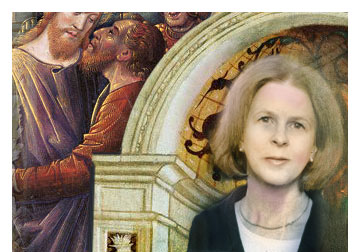
Atoms and Eden

Gospel according to Judas

The recently unearthed Gospel of Judas "contradicts everything we know about Christianity," says religious historian Elaine Pagels.

As almost every child knows, Judas was the disciple who betrayed Jesus, selling his life for 30 pieces of silver. If there’s an arch villain in the story of Jesus, it’s Judas Iscariot. Or is it? The newly discovered Gospel of Judas suggests that Judas was, in fact, the favorite disciple, the only one Jesus trusted to carry out his final command to hand him over to the Romans.

Rumors about the gospel have circulated for centuries. Early church fathers called it a “very dangerous, blasphemous, horrendous gospel,” according to historian Elaine Pagels. We now know that the manuscript was passed around the shadowy world of antiquities dealers, at one point sitting in a safe deposit box in a small town in New York for 17 years. Pagels herself was once asked by a dealer in Cleveland to examine it, but he only showed her the last few pages, which revealed little more than the title page. She assumed there was nothing of significance. Finally, the manuscript was acquired by the National Geographic Society, which hired Pagels as a consultant to study it.

More than any other scholar, Pagels has brought the lost texts of early Christianity to public attention. A Princeton historian of religion, she wrote the 1979 bestseller “The Gnostic Gospels” — the book that launched the popular fascination with the Nag Hammadi manuscripts found by Egyptian peasants in 1945. That book, which won both the National Book Award and the National Book Critics Circle Award, was later chosen by the Modern Library as one of the 100 best nonfiction books of the 20th century. Pagels went on to write a series of acclaimed books about early Christianity and, along the way, recounted her own personal tragedies — her young son’s death after a long illness and, just a year later, her first husband’s death in a hiking accident. It’s no surprise that Pagels has felt compelled to wrestle with some of religion’s thorniest subjects, like how to make sense of suffering and evil.

For much of her career, Pagels has straddled two worlds — the academic and the popular. She’s often the go-to expert when a magazine needs a comment on the latest theory about Mary Magdalene or some other bit of revisionist Christian history. But her standing among the scholars who study early Christianity is more complicated. Conservative scholars tend to dismiss the Gnostic texts as a footnote in Christian history, hardly worth all the hype that’s been generated by “The Da Vinci Code” and other racy stories. Not surprisingly, these scholars have questioned Pagels’ interpretations of early Christian texts.

With Harvard historian Karen L. King, Pagels has written a new book, “Reading Judas: The Gospel of Judas and the Shaping of Christianity.” The authors argue that this recently discovered gospel offers a new understanding of the death of Jesus. I spoke with Pagels by phone about the bitter quarrels among early Christians, why it’s a bad idea to read the Bible literally, and the importance of this new discovery.

When was the Gospel of Judas written?

As far we can tell, probably at the end of the first or early second century.

So it’s clearly not written by Judas himself, or even dictated by Judas.

That’s right. And most New Testament scholars would say the gospels in the New Testament — all of them attributed to disciples or followers of disciples — were probably not written by the people whose names are on them. If you say, “the Gospel according to Matthew,” you might not be pretending to be Matthew if you wrote it. You might be saying, this is the gospel the way Matthew taught it, and he was my teacher. So these are certain followers of Jesus who collected and transmitted his teaching.

Does this Gospel of Judas reveal something new about early Christianity?

Yes, the Gospel of Judas really has been a surprise in many ways. For one thing, there’s no other text that suggests that Judas Iscariot was an intimate, trusted disciple, one to whom Jesus revealed the secrets of the kingdom, and that conversely, the other disciples were misunderstanding what he meant by the gospel. So that’s quite startling.

It’s shocking to suggest that Judas wasn’t just one of the disciples but was actually the favorite disciple of Jesus.

That’s right. And also the idea that he handed over Jesus to be arrested at the orders of Jesus himself. This wasn’t a betrayal at all. In fact, it was obedience to a command or request that Jesus had made.

But how do we reconcile this with all the other stories we’ve ever heard about Judas? He’s the symbol of treachery and betrayal.

Well, he has become the symbol of treachery and betrayal. But once you start to look at the gospels one by one, you realize that followers of Jesus were trying to understand what had happened after he was arrested and killed. They knew Judas had handed him over to the people who arrested him. The earliest gospel, Mark, says Judas handed him over, but it doesn’t give any motive at all. The people who wrote after Mark — Matthew’s and Luke’s gospels — apparently felt that what was wrong with the Gospel of Mark was that there was no motive. So Matthew adds a motive. Matthew says Judas went to the chief priests who were Jesus’ enemies, and said, “What will you give me if I hand him over to you?” And they agree on a certain sum of money. So in Matthew’s view, the motive was greed. In Luke’s gospel, it’s entirely different. It says the power of evil took over Judas. Satan entered into him.

I think Luke is struggling with the question, If Jesus is the son of God, how could he be taken by a mere trick, by a human being? And Luke is trying to show that all evil power was concentrated in Judas. So they are very different stories. However, other gospels, like John’s, suggest that Jesus not only anticipated what was going to happen but initiated it. The Gospel of John says that he told Judas to go out and do what he had to do, which Jesus knew was to betray him. So the Gospel of Judas just takes the suggestion one step further. Jesus not only knew what was going to happen but initiated the action.

There’s something else that’s striking about the Gospel of Judas. The writer is very angry, and he’s especially angry at the other disciples.

Yes, that’s where we realized that it’s not just a story about Jesus and the disciples. It’s a story about this follower of Jesus — the Christian who’s writing this story, maybe 60 years after the death of Jesus. Even using the name of Judas is a slap in the face to the tradition. You realize that whoever wrote it was a very angry person. And we were asking, What’s going on here? Why is he so angry? And we discovered that it’s very dangerous to be a follower of Jesus in the generations after his death. You know, they say his disciple Peter was crucified upside down. And Paul was probably beheaded by the Romans. James was lynched by a crowd, and so were Stephen and other followers. So leaders of this movement were in great danger. And other Christians were also in danger of being arrested and killed because they followed Jesus. The question for many of them was, What do you do if you’re arrested?

And to acknowledge that you were a Christian would probably kill you.

Exactly. All you had to do is say no. Or you can try to escape or bribe the people persecuting you. And many did. The only answer that most Christians agreed was right was to say, “Yes, I’m a Christian.” You defy them and you go heroically into the lions. So we’ve always thought of Christianity as a religion that glorifies martyrdom. Now we realize that we’ve had that impression because the people who weren’t in favor of martyrdom had their writings buried and burned and trashed and ridiculed. And they were called cowards and heretics.

So the Gospel of Judas is a kind of protest literature. It’s challenging leaders of the church. Here the leaders are personified as disciples who are encouraging people to get killed, to “die for God,” as they called martyrdom. This gospel is challenging them and saying, when you encourage young people to die for God, you’re really complicit in murder.

Are there also theological issues at stake? This gets at the meaning of suffering, and the nature of evil as well.

It does. This was at a time when all followers of Jesus were struggling with the question, Why did Jesus die? What does it all mean? In the New Testament, the gospels say he died as a sacrifice. Paul says Christ, our Passover lamb, was sacrificed for us. Why? Well, to save us from sin.

But this author is saying, wait a minute. If you think God wants his son to be tortured and killed before he’ll forgive people their sins, what kind of God do you have in mind? Is this the God who didn’t want animals to be sacrificed in the temple anymore? So this author’s asking, isn’t God a loving father? Isn’t that what Jesus taught? Why are we saying that God requires his son to die for the sins of the world? So it’s a challenge to the whole idea of atonement, and the idea that Christians — when they worship — eat bread and drink wine as if it were the body and blood of Christ. This person sees that whole thing as a celebration of violence.

You can see why some early Christians would have attacked this gospel. This is very threatening to other Christian accounts of why Jesus died.

It contradicts everything we know about Christianity. But there’s a lot we don’t know about Christianity. There are different ways of understanding the death of Jesus that have been buried and suppressed. This author suggests that God does not require sacrifice to forgive sin, and that the message of Jesus is that we come from God and we go back to God, that we all live in God. It’s not about bloody sacrifice for forgiveness of sins. It suggests that Jesus’ death demonstrates that, essentially and spiritually, we’re not our bodies. Even when our bodies die, we go to live in God.

Does this raise questions about how we should think about the Resurrection? In orthodox Christian accounts, this is considered a resurrection of the flesh.

That’s right. The idea that Jesus rose in the flesh is very important for a lot of Christians. And certainly for the martyrs. When people were going to get themselves killed, some of them were asked, Do you believe that you’re going to be raised from the dead in your body? And many of them said yes, of course we do. That’s why we’re doing this. So those promises of bodily resurrection and heavenly rewards were very important for many Christians.

Some of the things we’re talking about would seem to have great resonance in the Islamic world. Do you see any parallels between this Christian history and what we’re seeing among Muslim martyrs today?

I do. The author of the Gospel of Judas wasn’t against martyrdom, and he didn’t ever insult the martyrs. He said it’s one thing to die for God if you have to do that. But it’s another thing to say that’s what God wants, that this is a glorification of God. I think he would have spoken in the way that an imam might today, saying those who encourage young people to go out and supposedly die for God as martyrs are complicit in murder. The question of the uses of violence is very much at the heart of the Gospel of Judas. If you have to die as a martyr, you do because you don’t deny Christ. But you don’t go around encouraging people to do it as though they would get higher rewards in heaven.

Can you put the Gospel of Judas in perspective, alongside some of the other Gnostic texts that have come to light in recent decades — the Gospel of Thomas, the Gospel of Mary Magdalene? Do these really change our understanding of early Christianity?

Before, we had a puzzle with just a few pieces. Now we have many more pieces. We begin to see that in the early Christian movement, people discussed and struggled with all the issues that we now think of as normative Christianity, like, What does the death of Jesus mean? There wasn’t one kind of understanding of Jesus in the early Christian movement. Actually, there were many.

In recent years, there’s been a huge debate over what to make of the Gnostic Gospels. And plenty of Christian scholars and theologians say there’s good reason they were not admitted into the Christian canon. They say the Bible presents the most reliable story of Jesus based on eyewitness accounts. For instance, Ben Witherington has written, “The four canonical gospels have stood the test of time and other apocryphal gospels and texts have not … This is because the canonical gospels are our earliest gospels and have actual historical substance, while the later gospels have none.”

Well, Witherington has a particular point of view to prove. I would say it’s very hard to date these other texts. Some of them are as early as the gospels of the New Testament, like the Gospel of John. But what’s different is the emphasis. Let me give you an example. The Gospel of Thomas says that all who recognize that they come from God are also children of God, instead of teaching that Jesus is the only son of God through whom one must be saved. It’s a teaching that is akin to what the Quakers and some other Christian groups teach, including some Greek and Russian Orthodox groups. The divine is to be found in everyone, and we can discover, at some level, that we’re like Christ. It’s not a complete contradiction, but it is somewhat different.

But aren’t there crucial doctrinal issues at stake in terms of what it means to be a Christian? For instance, was Jesus the son of God? Was the return of Jesus an actual resurrection of the flesh?

In the fourth century, the Council of Nicaea established certain doctrines about what it means to be orthodox: belief in one God, maker of heaven and earth, and one Jesus Christ, his only son and Lord. So Jesus Christ is the only one who brings salvation to the whole world. There are, of course, Christians who believe in Jesus but also wonder whether people can’t find God in other religions — if they’re Jews or Muslims or Buddhists and so forth. There’s nothing Jesus himself said that contradicts that, as far as I can see. But fourth-century Christian orthodoxy did set out the doctrines you’re talking about.

Some people say the historical study of early Christianity really doesn’t matter to a person’s faith. Being a Christian means you believe in certain things, like the Resurrection, like the Virgin Birth. These are matters of faith, not of historical research. You can choose not to believe those things, but then you’re not part of the Christian creed. How do you respond to that argument?

Well, it’s absolutely true that the Virgin Birth and the Resurrection can’t be verified historically. On the other hand, if you start to look at it historically, you find out that there are plenty of people who call themselves Christians who see those very things differently. There have been Christians from the beginning — St. Paul is one of them — who say the Resurrection is not a matter of this kind of body. Paul talks about resurrection as a matter of being transformed. Yes, it’s about the body, he said, but it’s more like a body of the stars or the moon or the sun — a body of light. So there are many ways that people have understood themselves to be Christians.

This has huge implications for so many people today, especially those who simply can’t accept these kinds of miracles. It does raise the question of whether you can be a Christian if you don’t believe any of the Bible’s supernatural stories.

I don’t think you have to discard all the supernatural stories. The Bible is really about what is beyond the natural. But there are other ways of understanding. For example, the Gospel of Philip, which some people called a heretical text, actually says Jesus had human parents as you and I do. His parents were Mary and Joseph. But when he was born of the spirit, he became the son of the Heavenly Father and the Holy Spirit. In Syriac and Hebrew, the spirit is spoken of in feminine forms, so metaphorically, one could speak of her as a divine mother, just as one speaks of God as a divine father. So there are Christians who didn’t reject the Virgin Birth, but said wait a minute, why would you take it literally? Why don’t you take it as an image for spiritual reality?

You have spent decades studying early Christian history. Do you consider yourself a Christian?

Yes, I do. And the reason I can is that I understand that there are countless people who’ve been Christians for 2,000 years, in many different ways. It’s not a matter of one version, you must believe this exactly the way I tell it to you. Christian theologians have always said that the truth of God is beyond our understanding. And so we speak in metaphors. Paul said we see through a glass darkly.

I’ve heard that you didn’t grow up in a religious family.

Well, it was a Protestant family, nominally. We went to church, but my father had rejected the Bible for Darwin. He decided the Bible was a bunch of old fables and that evolution was right. So I was brought up to think the Bible was just kind of irrelevant. I grew up and became deeply and passionately interested in it and went to a church and was born again. I was 14 or 15. It was quite wonderful, and I loved what I found there.

Even though your father was a confirmed atheist.

It did shock him, yes. Of course, that’s one way adolescents like to shock their parents. I didn’t do it for that reason, but it had that effect. The power and the passion of that kind of evangelical Christianity was very real for me. And it was a discovery of something very important — a spiritual dimension in life that I was not able to ignore. On the other hand, after a year of living in that church, one of my friends in high school was killed in an automobile accident. The people at the church asked, was he born again? And I said, no, he wasn’t. And they said, well, then he’s in hell. And I thought to myself, I don’t believe that. That doesn’t match up with what I’d heard about God. So at that point, I decided I had to find out for myself what I could about the early Christian movement, what I believe about it, and what is being said in the name of Jesus that I found not true.

That’s fascinating. Basically, it was because you couldn’t buy into that fundamentalist version of Christianity that you launched your career as a historian of Christianity.

That’s the truth, yes.

Well, this does raise the question of what we mean by God and what we mean by transcendence, and whether there is a transcendent reality out there. Is that discussion of transcendence meaningful to you?

Oh, certainly it is. If we don’t understand how important spiritual life is to people, I don’t think we’re going to understand human beings or the 21st century. There are many people who said religion is essentially over now, and everyone will become rational. They don’t understand that the way humans are has a lot to do with religious experience.

Your late husband, the eminent physicist Heinz Pagels, wrote very eloquently about the mysteries of science. Did he influence your thinking about this intersection between science and religion?

Oh yes, he was deeply interested in philosophy and religion and science, and understood how profound and complicated those issues are. When you’re dealing with science, for example, you’re dealing all the time with metaphors. So to assume that religious language isn’t metaphor doesn’t make sense to me.

There’s a big debate right now over whether religion and science are two totally different domains, as Stephen Jay Gould once said, or whether they overlap. Where do you come down on that?

That’s a very tough question. I think religion and science both have a lot to do with understanding and imagination, but they certainly explore the world in very different ways. For example, when the eminent physicist Stephen Weinberg wrote in his book “The First Three Minutes,” “the more we know about the universe, the more we know it’s pointless and meaningless,” my late husband said, “That doesn’t make any sense.” Einstein thought the more we knew about the universe, the more we knew about the divine intelligence. There are many ways to make inferences from physics. And inferences like that are not scientific at all; they’re philosophic.

Of course, there’s still a huge debate about whether Einstein was religious or not. The atheists want to claim him for their camp, but religious people say he was actually quite open to religious ideas.

Part of the problem is that Einstein used the language about God as a metaphor. When he said, “God does not play dice with the universe,” he meant the universe is not put together in an accidental way. It does show a kind of intelligent process in it. Einstein was speaking about God in the way that physicists would — aware that language like that is always going to be metaphorical, speaking beyond our understanding. But many people took him literally and said he’s a religious man. Scientists said he was just using language carelessly.

Isn’t that part of the problem that we get into when we talk about metaphor and the religious imagination? If you don’t take scripture literally, how do you take it?

You can take scripture seriously without taking it literally. If you speak about the Resurrection of Christ, all we know historically is that after Jesus died, his followers became convinced that he was alive again. Now, what does that mean? They told many stories. Some of them said, I saw him with my own eyes, I touched him, he actually ate food, he was not a ghost. That’s in Luke’s gospel. And others said, I saw him for a moment and then he faded — the way many people say they’ve seen people they knew who died. What I’m saying is there are many ways that people who believe in the Resurrection speak about Christ being alive after his death without meaning that his body got out of the grave and walked.

It sounds like you’re saying that it’s perfectly possible to take the Bible very seriously, to be a Christian, and yet not to believe in the supernatural miracles that so many people simply cannot accept.

Well, that may be. I don’t dismiss all supernatural miracles, like a healing that can’t be explained. Those do happen sometimes.

You’ve been studying these texts for decades. Has your scholarly work deepened your own faith?

Yes. And the scholarly work is part of the spiritual quest. Opening ourselves to exploring as much as we can about this can be, in fact, an act of faith. At Princeton, there’s a course in the study of New Testament that some evangelical students were warned not to take. They called it “Faith Busters 101.” And some of them come just to flex their muscles and see if they can sit there and stand it while somebody teaches them about how the gospels were written. But what they usually discover is that learning about those things doesn’t change the fundamental questions about faith.

Does faith necessarily involve some leap into mystery, into something that can’t be explained?

I think it does. Earlier this year, I was asked to do an interview with somebody who had written a book to demonstrate that Jesus had been raised bodily from the dead. And they expected me to say that was impossible. But I can’t say it’s impossible. From a historical point of view, there’s no way you can comment on that. It’s just not susceptible to that kind of analysis. So there’s a lot that history can’t answer and that science can’t answer. I mean, there’s a lot about all of our lives that we have no rational understanding of. And so faith comes into our relationships with the people we love, and our relationship to our life and our death.

There seems to be a rather vigorous movement among scientists to try to explain the origins of religion. I’m struck by how often these theories come from atheists. And I think the underlying impulse is to demystify the divine. But can religion really be explained from the outside, by people who are not themselves religious?

Probably not. For example, suppose you found the basic brain chemistry that explains religious perceptions. In fact, there are neurologists in New York trying very hard to understand precisely that. And you find that when people who’ve clinically died say they’ve had a near-death experience, they’ve gone into a brilliant light and then they’ve come back from some place. This is the flashes of light on the brain as it expires. Well, it may be. And it may not be. Is this a trick that our brain plays on us? Or is this intimations of some other kind of reality? I don’t think science is going to answer that question.

Isn’t there an inherent limitation to any of those brain-imaging studies? Because there’s the whole question, Are we just imagining this? Or is there really some contact with the divine?

Exactly. For example, there’s a study now at New York University about epilepsy. We know that epileptics often have an experience of seeing an aura. They can have an epileptic convulsion and they have a kind of vision. It was understood in ancient times to be demonic possession. So if people then say, epilepsy has a certain relationship to electrical activity in the brain, and that’s what precipitates these experiences, does that mean that they are not real? I don’t think that answers the question.

What do you make of the recent claim by the atheist Richard Dawkins that the existence of God is itself a scientific question? If you accept the idea that God intervenes in the physical world, don’t there have to be physical mechanisms for that to happen? Therefore, doesn’t this become a question for science?

Well, Dawkins loves to play village atheist. He’s such a rationalist that the God that he’s debunking is not one that most of the people I study would recognize. I mean, is there some great big person up there who made the universe out of dirt? Probably not.

Are you saying that part of the problem here is the notion of a personal God? Has that become an old-fashioned view of religion?

I’m not so sure of that. I think the sense of actual contact with God is one that many people have experienced. But I guess it’s a question of what kind of God one has in mind.

So when you think about the God that you believe in, how would you describe that God?

Well, I’ve learned from the texts I work on that there really aren’t words to describe God. You spoke earlier about a transcendent reality. I think it’s certainly true that these are not just fictions that we arbitrarily invent.

Certainly many people talk about God as an ineffable presence. But if you try to explain what transcendence is, can you put that into words and explain what it means?

People have put it into words, but the words are usually metaphors or poems or hymns. Even the word “God” is a metaphor, or “the son of God,” or “Father.” They’re all simply images for some other order of reality.

There’s one aspect of the Bible that’s especially troubling. What do you make of the many passages that condone violence? Killing infidels seems to be what God wants.

You mean in the Hebrew Bible?

Yes, I’m particularly thinking about the Hebrew Bible.

Well, yes. When you read the discussion of holy war in the Hebrew Bible, it’s violent, definitely. This was a war god, identified with a particular tribe, with particular kinds of religious war. Christians often don’t read that now. But when I talk with Jewish leaders, they say, yes, we remember that very well because we remember the Crusades. And the Muslims of course say the same. They say, why are you talking to us about violence? Christians have done violence in the name of Christ for nearly 2,000 years.

So how should we read those passages that are so violent?

That gets us back to the question, Can you read the Bible seriously without reading it literally? There are parts of the New Testament which encourage slaves to remain slaves. Do we take that literally? Those were fighting words during the Civil War when some Christians said slavery was part of God’s plan and some people should live and die as slaves. I think few would agree with that now. But it was a position that one could seriously take on the basis of many biblical passages.

You’re saying that we have to understand context.

I think we do. You were saying that some people believe faith has nothing to do with history. The fact is, somebody wrote those texts. They wrote them in a world in which slavery was taken for granted. That’s a different world. So if we don’t understand that, well, it says, Slaves, obey your masters, for this is right.

Steve Paulson is the executive producer of Wisconsin Public Radio's nationally syndicated program "To the Best of Our Knowledge." He has also been a Templeton-Cambridge Journalism Fellow in Science & Religion.

God, He’s moody

In an interview with something to offend everyone, Robert Wright explains why religion has given us a fickle deity

Robert Wright has carved out a distinct niche in American journalism. While his essays range freely across the political landscape — from foreign policy to technology — it’s his meaty, book-length forays into evolutionary psychology and the sweep of history that have set him apart. Now his latest book goes after bigger game: God Almighty.

Actually, “The Evolution of God” never grapples with the most basic religious question — the existence of God. Instead it charts the twists and turns of how God’s personality has kept changing over the centuries, and specifically, how the rough-and-tumble politics of the ancient Middle East shaped the Abrahamic religions. The book is filled with richly observed details about the Bible and the Quran, though Wright wears his learning lightly as he guides us through several thousand years of religious history.

There’s something to offend just about everyone in this book. Wright recounts in harrowing detail how the early Israelites, who’d been conquered and humiliated by the Babylonians, invoked Yahweh to wreak vengeance on their enemies. This is no God for the faint of heart! And he’s no gentler on Christianity. Wright’s Jesus is not the prophet of peace and love but a sometimes mean-spirited apocalyptic preacher obsessed with the approaching End Times. Islam’s founder, Muhammad, comes across as much a warrior as a prophet, bent on annihilating his enemies when they cross him.

Despite all this religious mayhem, the book also shows a gentler side of the Abrahamic religions, especially when they manage to find common cause with their heathen neighbors and rival monotheists.

At first, “The Evolution of God” reads like another atheistic tract exposing the seamier side of religion. But then I came to Wright’s account of the “moral imagination” and his surprising conclusion: He may not believe in God, but Wright thinks humanity is marching — however wobbly — toward moral truth.

In our interview, we talked about the bloody history of monotheism, what a mature religion would look like, and Wright’s own spiritual awakening at a meditation retreat.

At the very beginning of your book, you describe yourself as a materialist. This raises an interesting question: Can a materialist really explain the history of religion?

I tend to explain things in terms of material causes. So when I see God changing moods, as he does a lot in the Bible and the Quran, I ask, what was going on politically or economically that might explain why the people who wrote this scripture were inclined to depict God as being in a bad mood or a good mood? Sometimes God is advocating horrific things, like annihilating nearby peoples, or sometimes he’s very compassionate and loving. So I wanted to figure out why the mood fluctuates. I do think the answers lie in the facts on the ground. And that’s what I mean by being a materialist.

What do you mean by the facts on the ground?

My basic premise is that when a religious group sees itself as having something to gain through peaceful interaction with another group of people, including a different religion, it will find a basis for tolerance in its scriptures and religion. When groups see each other as being in a non-zero sum relationship — there’s a possibility of a win-win outcome if they play their cards right, or a lose-lose outcome if they don’t — then they tend to warm up to one another. By contrast, if people see themselves in a zero-sum relationship with another group of people — they can only win if the other group loses — that brings out the intolerance and the dark side of religion. You see that in the world today. A lot of Palestinians and Israelis think they’re playing a win-lose game. They think their interests are opposed and inversely correlated. In the long run, I think they’re wrong. They’re either both going to win or both going to lose.

And you’re saying these attitudes keep fluctuating back and forth over the history of religion. It’s not just a gradual movement from less tolerance to more tolerance.

There hasn’t been any smooth progression toward tolerance in any of the religions. If you look at the way human beings treated each other 10,000 years ago, it was not uncommon for members of one hunter-gatherer tribe to consider strangers as subhuman and worthy of death. I try to show that all the Abrahamic religions — Judaism, Christianity and Islam — are capable of making great moral progress by extending compassion across national and ethnic and religious bounds. But there has not been any kind of smooth progression.

Do you think religions share certain core principles?

Not many. People in the modern world, certainly in America, think of religion as being largely about prescribing moral behavior. But religion wasn’t originally about that at all. To judge by hunter-gatherer religions, religion was not fundamentally about morality before the invention of agriculture. It was trying to figure out why bad things happen and increasing the frequency with which good things happen. Why do you sometimes get earthquakes, storms, disease and get slaughtered? But then sometimes you get nice weather, abundant game and you get to do the slaughtering. Those were the religious questions in the beginning.

And bad things happened because the gods were against you or certain spirits had it out for you?

Yes, you had done something to offend a god or spirit. However, it was not originally a moral lapse. That’s an idea you see as societies get more complex. When you have a small group of hunter-gatherers, a robust moral system is not a big challenge. Everyone knows everybody, so it’s hard to conceal anything you steal. If you mess with somebody too much, there will be payback. Moral regulation is not a big problem in a simple society. But as society got more complex with the invention of agriculture and writing, morality did become a challenge. Religion filled that gap.

But it’s easier to explain why bad things happen in these older religions. You can attribute it to an angry spirit. It’s harder to explain evil if there’s an all-powerful, all-loving God.

The problem of evil is a product of modern religion. If you believe in an omnipotent and infinitely good God, then evil is a problem. If God is really good — and can do anything He or She wants — why do innocent people suffer? If you’ve got a religion in which the gods are not especially good in the first place, or they’re not omnipotent, then evil is not a problem.

Why did monotheism first develop?

My explanation for Abrahamic monotheism is different from the standard one. I believe it emerged later than most people think — in the 6th century BCE, when Israelite elites were exiled by the Babylonians who conquered them. The spirit of monotheism was originally a lot less sunny and benign than people claim. Morally, it got better, but at its birth, monotheism was fundamentally about retribution.

Israel was a small nation in a bad neighborhood that got kicked around. This culminated in the exile, which was humiliating. It dispossessed the Israelites. It’s not crazy to compare the mind-set of the Israelites then to the mind-set of today’s Palestinians, who feel humiliated and dispossessed. This kind of mind-set brings out the belligerence in a religion. You see that in the Book of Isaiah, thought to be written by so-called Second Isaiah. These are the earliest scriptures in the Bible that are clearly monotheistic. You get the sense that monotheism is about punishing the various nations that have persecuted Israel.

So you see a connection between the political power of a people and the god they believed in?

In ancient times, there was always a close association between politics and gods. The victor of a war was always the nation whose god beat the other god. But the specific political dynamic that monotheism reflected at its birth was Israel’s desire to punish other nations by denying the very existence of their gods, and also envisioning a day when Israel’s god, Yahweh, would actually subjugate those nations.

Does Yahweh become a tool for Israelite kings to consolidate power?

You see that especially with King Josiah. Israel was polytheistic for a lot longer than most people think. A lot of things factored into its movement toward monotheism. One was a king who wanted to eliminate domestic political rivals. Those political rivals would have claimed access to various gods other than Yahweh, so King Josiah wanted to eliminate them. He killed some of them and also made it illegal to worship their gods. That gets you to the brink of monotheism. I think the exile pushes you over. You have a very belligerent, exclusive monotheism, whose very purpose is to exclude other nations from this privileged circle of God’s most favored people.

King Josiah comes off rather badly in your book. He’s hugely influential in the development of monotheism, but also a brutal tyrant who tried to wipe out people with competing religious beliefs.

He was an authoritarian. By the standards of the day, maybe not an unusually harsh one. Politics were pretty rough and tumble in those days. He was a nationalist, populist authoritarian — maybe a little bit like Hugo Chavez. It was a rejection of cosmopolitanism and internationalism. By our standards, King Josiah was a bad guy. He kills a bunch of priests who had the misfortune of not focusing their devotion exclusively on Yahweh. He cleans out the temple.

For people who claim that Israel was monotheistic from the get-go and its flirtations with polytheism were rare aberrations, it’s interesting that the Jerusalem temple, according to the Bible’s account, had all these other gods being worshiped in it. Asherah was in the temple. She seemed to be a consort or wife of Yahweh. And there were vessels devoted to Baal, the reviled Canaanite god. So Israel was fundamentally polytheistic at this point. Then King Josiah goes on a rampage as he tries to consolidate his own power by wiping out the other gods.

However, after the exile, monotheism evolves into something much more laudable and inclusive. Now the exiles have returned to Jerusalem and Israel is in a secure neighborhood. It’s part of the Persian empire and so are its neighbors. So you see a much sunnier side of God, with expressions of tolerance and compassion toward other nations. This shows that monotheism isn’t intrinsically good or bad. It depends on the circumstances in which it finds itself.

This gets pretty confusing for today’s religious believer. There’s a vengeful God in some of these early books of the Old Testament — a God who at times says you need to wipe out people with different religious beliefs. But within this same sacred text, you can also read about a very compassionate God.

You’re right, the contrasts are extreme. At one point in the Hebrew Bible, God is saying, “I want you to annihilate nearby peoples who worship the wrong gods.” He says do not leave anything alive that breathes — not livestock, women or children. Then other times you have Israelites not only tolerating a neighbor who worships another god but using that other god to validate their desire for tolerance. So they’ll say to the Ammonites, “Look, you’ve got your god, Chemosh. He gave you your land. We’ve got our god, Yahweh, who gave us our land. Can’t we just get along?”

You see this kind of vacillation in the Bible and also in the Quran. In both cases, it’s a question of whether people think they can gain through peaceful interaction with other people. That’s also the challenge in the modern world. Barack Obama gets this. So long as Israeli settlements are expanding, you’re not going to convince Palestinians that they’re playing anything other than a zero-sum game with the Israelis. Obama understands it’s partly a question of perception. Muslims who feel disrespected — whether or not they really are — will fuel religious extremism.

Let’s skip ahead to the next great monotheistic religion. Why did Christianity take root?

The doctrines we associate with Christianity probably took root a little later than most people think. There’s reason to doubt that Jesus is the source of the stuff we consider most laudable in Christianity: universal, transnational, transethnic love. I think that is a product of people like the Apostle Paul, who, after the crucifixion, carried the Jesus movement into the Roman Empire. Paul wanted to build a network of churches. He was a true believer, but he went about this in a very pragmatic, businesslike way. In many ways, the church served as a networking service. That was part of its appeal. The network of Christian churches made it easier for merchants to travel from city to city in the Roman empire and do business.

Paul also made some good strategic choices. There were followers of Jesus who dictated that any non-Jews who became part of the Jesus movement had to be circumcised. Adult men had to be circumcised to join the church. This was before modern anesthesia, so you can see this would be a disincentive. Paul said no, and they don’t have to follow the dietary laws either. They also developed an attractive doctrine of an afterlife. The Roman empire was in a way waiting for a church to dominate it. The more Christians there were, the more valuable it was to join that network. When Christianity reached critical mass, then its dominance of the Roman Empire became almost inevitable.

So later Christians, Paul among others, really institutionalized Christianity. What about the historical Jesus? What do we know about him?

It’s popular to say he said the good stuff and not the less good stuff. I think it’s the opposite.

He’s typically seen as the great prophet of peace and love.

Yeah. But the fact is, the Sermon on the Mount, which is a beautiful thing, does not appear in Mark, which was the first written gospel. And these views are not attributed to Jesus in the letters of Paul, which are the earliest post-crucifixion documents we have. You see Paul develop a doctrine of universal love, but he’s not, by and large, attributing this stuff to Jesus. So, too, with “love your enemies.” Paul says something like love your enemies, but he doesn’t say Jesus said it. It’s only in later gospels that this stuff gets attributed to Jesus. This will seem dispiriting to some people to hear that Jesus wasn’t the great guy we thought he was. But to me, it’s actually more inspiring to think that the doctrines of transnational, transethnic love were products of a multinational, imperial platform. Throughout human history, as social organization grows beyond ethnic bounds, it comes to encompass diverse ethnicities and nations. And if it develops doctrines that bring us closer to moral truth, like universal love, that is encouraging. I think you see it in all three religions.

If Jesus was not the prophet of love and tolerance that he’s commonly thought to be, what kind of person was he?

I think he was your typical Jewish apocalyptic preacher. I’m not the first to say that. Bart Ehrman makes these kinds of arguments, and it goes back to Albert Schweitzer. Jesus was preaching that the kingdom of God was about to come. He didn’t mean in heaven. He meant God’s going to come down and straighten things out on Earth. And he had the biases that you’d expect a Jewish apocalyptic preacher to have. He doesn’t seem to have been all that enthusiastic about non-Jews. There’s one episode where a woman who’s not from Israel wants him to use his healing powers on her daughter. He’s pretty mean and basically says, no, we don’t serve dogs here. He compares her to a dog. In the later gospels, that conversation unfolds so you can interpret it as a lesson in the value of faith. But in the earliest treatment, in Mark, it’s an ugly story. It’s only because she accepts her inferior status that Jesus says, OK, I will heal your daughter.

But wasn’t Jesus revolutionary because he made no distinctions between social classes? The poor were just as worthy as the rich.

It’s certainly plausible that his following included poor people. But I don’t think it extended beyond ethnic bounds. And I don’t think it was that original. In the Hebrew Bible, you see a number of prophets who were crying out for justice on behalf of the poor. So it wasn’t new that someone would have a constituency that includes the dispossessed. I’m sure in many ways Jesus was a laudable person. But I think more good things are attributed to him than really bear weight.

So you are distinguishing between Jesus and Christ — Jesus the flesh and blood historical figure as opposed to how he was later represented as Christ, the son of God.

That’s right. There’s no evidence that Jesus thought he should be equated with God. He may have thought he was a messiah, but “messiah” in those days didn’t mean what it’s come to mean to Christians. It meant a powerful figure who leads his people to victory, perhaps a successful revolt against the Romans. But Christ as we think of Christ — the son of God — that’s something that emerges in the later gospels and reaches its climax in John, which is the last of the four Gospels to be written. So the story of what Jesus represents in theology did not take shape during his lifetime.

Do you see Islam as essentially an offshoot of the Judeo-Christian tradition or as something fundamentally new?

Muhammad was trying to create a synthetic religion, drawing on the existing traditions of Judaism and Christianity. He says very nice things in the Quran about Christians and Jesus, though he can’t quite accept the idea that Jesus was the son of God. He also made great overtures toward Jews. He established a fast that was essentially Yom Kippur. The ban on eating pork probably comes as a reflection of Judaism. There’s every indication that he hoped to play a successful non-zero-sum game with Christians and Jews and draw them into a larger religion. He insisted that his God was their God. But it didn’t work out. Apparently, not that many Jews bought into his mission.

In the standard telling, once Muhammad was ruling the city of Medina and he’d become a statesman as well as a prophet, some Jewish tribes betrayed him and were collaborating with the enemy. So there was a very violent falling out. And he expelled Jewish tribes and in one case killed the adult males. But there’s no doubt that the origins of Islam are rooted in the existing traditions of Christianity and Judaism.

You make the point that the Quran is a different kind of sacred text than the Bible. It was probably written over the course of two decades, while the stories collected in the Bible were written over centuries. That’s why the Bible is such a diverse document.

We think of the Bible as a book, but in ancient times it would have been thought of as a library. There were books written by lots of different people, including a lot of cosmopolitan elites. You also see elements of Greek philosophy. The Quran is just one guy talking. In the Muslim view, he’s mediating the word of God. He’s not especially cosmopolitan. He is, according to Islamic tradition, illiterate. So it’s not surprising that the Quran didn’t have the intellectual diversity and, in some cases, the philosophical depth that you find in the Bible. I do think he was actually a very modern thinker. Muhammad’s argument for why you should be devoted exclusively to this one God is very modern.

Do you think it’s been harder for today’s Muslims to accept liberal interpretations of the Quran because it’s linked so directly to Muhammad, while the Bible isn’t so closely associated with Moses or Jesus?

Yes, and also because Muhammad spent a certain amount of his career as a politician and a military leader. There are parts of the Quran that are a military manual, which advocate killing the enemy. Of course, the Bible has these things too, but they’re a smaller portion of the overall Bible. But when you look at that part of the Quran, it’s much more subtle than a lot of people think.

Take the famous verse “Kill the infidels wherever you find them.” Actually, it’s a mistranslation. It’s “Kill the polytheists.” So it probably wouldn’t include Christians and Jews. If you look at the verse in context, it seems that he exempts those polytheists who are on the side of the Muslims in this particular war. So all that passage says is “Kill the people who are enemies in this war.” It’s not fundamentally about religion. In this case and others, it complies with my basic argument: When people see themselves in a non-zero-sum relationship with other people, they will be tolerant of them and of their religion. Muhammad probably exemplifies that better than any single figure in ancient Abrahamic history.

Your book focuses on the Abrahamic religions. But aren’t Eastern religions like Buddhism and Hinduism actually more open to the idea that other religions can also be the path to truth and salvation?

Yes, it’s not uncommon in Asia for somebody to be a little bit of a Buddhist and a little bit of a Taoist. It’s certainly possible for religion to be non-exclusive. Parts of Buddhism are exemplary. In some ways it was the earliest religion to recognize the fundamental problem of being human. The challenge is to change the already existing character of a religion. The world is not full of Buddhists. And even Buddhist monks have gone on rampages. There is no religion that is always a religion of peace. But in Buddhism, you’re seeing some very interesting developments. The Western, quasi-secular Buddhism is an interesting adaptation to a scientific age because it makes relatively few claims about the supernatural.

You’ve written a secular history of how religion has been used by various political movements to consolidate power. But you’re ignoring the power of personal spiritual experience — what some people would call revelation. Can you explain religion without acknowledging the importance of actual religious experience?

I do think religious experience has played an important part in religion. I think the Apostle Paul felt genuinely inspired. I myself have had profound experiences that could be characterized as religious. I certainly had some when I was young and a believing Christian. And I’ve had some since then. I did a one-week silent meditation retreat and had very profound experiences.

What kinds of experiences?

As the week wore on, the walls between me and other people and the rest of reality broke down a little. I became much less judgmental. I remember at one point looking at a weed and thinking, I can’t believe I’ve been killing weeds because they’re as pretty as anything else. Who put this label on weeds? And that’s just a metaphor for what was changing in my consciousness. It was completely profound by the end of the week. Of course, a week later it wore off and I was a jerk again. But I think it was a movement toward moral truth. The truth is that I’m not special, and you’re not special.

That is the key adaptation that religions have to make in the modern world — to make people appreciate the moral value of people in circumstances very different from their own. That is a move toward moral truth. It’s a fascinating feature of the world we live in that as technology expands the realm of social organization, its coherence and integrity depends on moral progress.

There is another way to understand religion. Certain influential people have intense and profound spiritual experiences, which are later codified and turned into systems of belief for their followers. Do you accept this distinction between spiritual experience and organized religion?

I’m against the idea that there was a golden age of spiritual experience, but then at some point organized religion corrupted everything. I try to show that shamans are as political as anyone and were as self-serving as modern religious leaders. At the same time, there are valid spiritual experiences. I’ve had them.

But you don’t acknowledge that there’s anything transcendent about spiritual experience — any communication with a deeper, alternative reality.

No, I do think the experience I had at that meditation retreat was transcendent. It removed me from the ordinary trappings of mundane consciousness. There is a moral axis to the universe. If we don’t make moral progress, chaos ensues. If only in that sense, we are tethered to a moral axis. It raises legitimate questions as to whether the whole system was in fact set up by some being, something you could call a divinity.

It’s really interesting to hear you say there’s moral truth. That’s not the kind of thing we usually hear from someone who calls himself a materialist.

Maybe not, but materialism has gotten a bad name. You can be a materialist and still believe that some larger purpose is unfolding through the history of life on this planet. And you can think of the source of that purpose — however hard it is to conceive of that source — in favorable terms. You can use the term “divine,” if you want. I do believe there’s evidence of some larger purpose unfolding; you’d think religious people would like that. On the other hand, I take a very skeptical view of the claims to special revelation that religions make. You would think my account of religious history would be to the liking of atheists and agnostics.

So we can believe there’s an underlying moral truth without believing in God.

The phrase that philosophers use is “moral realism.” Do you think morality is in some sense a real thing out there? It’s a very elusive question. What I feel sure of is that there’s a moral axis to the universe, a moral order, without believing in God.

Are you also saying we can be religious without believing in God?

By some definitions, yes. It’s hard to find a definition of religion that encompasses everything we call religion. The definition I like comes from William James. He said, “Religious belief consists of the belief that there is an unseen order and that our supreme good lies in harmoniously adjusting to that order.” In that sense, you can be religious without believing in God. In that sense, I’m religious. On the God question, I’m not sure. But I can call myself religious and have a fully scientific worldview.

You write, “Religion needs to mature more if the world is going to survive in good shape — and for that matter, if religion is going to hold the respect of intellectually critical people.” How does it need to mature?

You can’t believe the Earth was created 6,000 years ago. There’s a whole list of things that are not compatible with modern science.

That’s obvious. But some people would also say the idea of a personal God does not square with the scientific worldview today.

It’s not a logical impossibility that there’s a personal God out there. It’s not even quite impossible that God intervenes when the scientists are not measuring stuff, when nobody’s watching. But if you’re going to have a religion that’s broadly reconcilable with a scientific worldview and going to win acceptance among intellectual elites, then it’s not going to involve an interventionist God. There are certainly people who find tremendous reassurance and guidance from religions that don’t involve a god of any kind, and here I’m thinking about secular Buddhism.

Or you have a Christian theologian like Paul Tillich who tried to get away from an anthropomorphic God. He talked about God as “the ground of being.”

Of course, he got accused of sugarcoating what was in fact something like agnosticism or atheism. It’s easier to get reassurance by thinking there’s some powerful being looking out for you than for something called “the ground of being.” But for my money, if you’re interested in hanging on to some kind of religious worldview that’s viable in the modern world, you have to make that effort. I haven’t tried to work out any detailed program here. It’s something I’d like to think about in the future.

At the end of your book, you say the great divide in modern thinking is between people who think there is some divine source of meaning — a higher purpose in the universe — and those people who don’t. Is this different than the usual dichotomy between believers and atheists?

It’s a little different. I’m trying to get members of the different Abrahamic religions to realize that if they want to have an enemy, there’s a bigger one than each other. I don’t want them to declare jihad on atheists, but it might be good for them to realize, in the modern intellectual battle, they all have something in common: not only a specific Abrahamic God, but belief in a transcendent source of meaning. And I’d like to add that there are a lot of other people who don’t subscribe to your notion of God, maybe not to any notion of God, who do believe in a transcendent source of meaning and a larger purpose that’s unfolding.

As opposed to the Nobel Prize-winning physicist Steven Weinberg, who famously said, “The more the universe seems comprehensible, the more it also seems pointless.”

I think he’s wrong. But it’s not surprising. Physicists don’t think much about the animate world. So he probably hasn’t given a lot of thought to the human condition and the direction of human history. But I’d say even the realm of physics — just the weirdness of quantum physics — should instill in all of us a little humility. It should make us aware that human consciousness, designed by natural selection to do really mundane things, is clearly not capable of grasping some ultimate things that are probably out there.

Continue Reading Close

Steve Paulson is the executive producer of Wisconsin Public Radio's nationally syndicated program "To the Best of Our Knowledge." He has also been a Templeton-Cambridge Journalism Fellow in Science & Religion.

Those ignorant atheists

In this witty book, Terry Eagleton argues that Richard Dawkins, Christopher Hitchens and their ilk are shockingly ill-informed about the Christian faith.

Here is how British literary critic Terry Eagleton begins his brisk, funny and challenging new book: “Religion has wrought untold misery in human affairs. For the most part, it has been a squalid tale of bigotry, superstition, wishful thinking, and oppressive ideology.” That’s quite a start, especially when you consider that the point of Eagleton’s “Reason, Faith, and Revolution: Reflections on the God Debate” — adapted from a series of lectures he delivered at Yale in April 2008 — is to defend the theory and practice of religion against its most ardent contemporary critics.

But Eagleton, a professor of English literature and cultural theory who divides his time between the University of Lancaster and the National University of Ireland, is determined not to commit the same elementary errors he ascribes to such foes as biologist Richard Dawkins and political journalist Christopher Hitchens. (Those two, collectively dubbed “Ditchkins” by Eagleton, are the self-appointed leaders of public atheism and the authors of bestselling books on the subject, Dawkins’ “The God Delusion” and Hitchens’ “God Is Not Great.”) Atheists of the Ditchkins persuasion have raised valid points about the sordid social and political history of religion, with which Eagleton largely agrees. Yet their arguments are fatally undermined by their own unacknowledged dogmas and doctrines, he goes on to say, and they completely fail to understand Christian faith (or any other kind) except in its stupidest and most literal-minded form.

A few years ago, I read an article by a Roman Catholic theologian who wryly observed that the quality of Western atheism had gone steadily downhill since Nietzsche. Eagleton heartily concurs. He freely admits that what Christian doctrine teaches about the universe and the fate of man may not be true, or even plausible. But as he then puts it, “Critics of the most enduring form of popular culture in human history have a moral obligation to confront that case at its most persuasive, rather than grabbing themselves a victory on the cheap by savaging it as so much garbage and gobbledygook.”

Atheists like Dawkins and Hitchens, Eagleton insists, are playing to the high-minded liberal-humanist prejudices of their elite audience and, in the process, are displaying a shocking ignorance of their supposed subject, one that would be deemed unacceptable in almost any other intellectual forum. Would anyone be permitted to write a book about courtly love in the Middle Ages based on several visits to a Renaissance Faire, or a book about Nazism based on episodes of “Hogan’s Heroes”?

Yet the argument of “Reason, Faith, and Revolution” goes much further, and is much more complicated, than simply pointing out that St. Augustine and Thomas Aquinas would roll their eyes in disbelief at the third-rate challenge to their God posed by the likes of Ditchkins. Like Lewis Carroll’s White Queen, Eagleton is striving to believe several impossible things — or at least remarkably unfashionable things — before breakfast. He seeks to reclaim the transformative and even revolutionary potential of Christian faith, in the face of both liberal atheism and right-wing fundamentalism. And as perhaps the most prominent academic Marxist still in captivity, he puts his own faith in the possibility that socialism can survive its spectacular 20th-century self-immolation.

It’s only a slight simplification to say that in this compact little tome, which runs less than 200 pages and is largely conversational in tone, Eagleton hopes to save Christianity from the Christians and Marxism from the Marxists. Yet the book’s easy-breezy, wisecracking character is deceptive; I had to read it through twice before concluding that it’s one of the most fascinating, most original and prickliest works of philosophy to emerge from the post-9/11 era.

I’m not sure there’s a human being on earth, Terry Eagleton’s family members included, who will agree with everything in “Reason, Faith, and Revolution” — Eagleton seems delighted with the idea that he will outrage both the secular left and the religious right — but it repeatedly challenges us to reconsider terms and ideas most of us take for granted most of the time. Is the apparent opposition between faith and reason inherent, or an ideological artifact? How is Western capitalism, agnostic and relativistic down to its roots, to confront a “full-blooded ‘metaphysical’ foe” (Islamic fundamentalism) that has no problem believing in absolute truth? Whether or not you like his answers, Eagleton approaches all such questions with an open and questioning mind.

As Eagleton ultimately admits, the discount-store atheism of Dawkins and Hitchens is something of a useful straw man, and his real differences with them are, in the main, not theological but political. Still, attacking them in broad and often hilarious strokes — he depicts Dawkins as a tweedy, cloistered Oxford don sneering at the credulous nature of the common people, and Hitchens as a bootlicking neocon propagandist and secular jihadist — lends his book considerable entertainment value. More importantly, it also allows him to develop an extended interpretive summary of what he describes as mainstream Christian doctrine, a subject about which (as he repeatedly reminds us) the Ditchkins duo, along with the Western intellectual elite in general, knows almost nothing.

Eagleton’s terminology is deliberately provocative, and some Christians won’t find his account of their beliefs, colored as it clearly is by the Catholic “liberation theology” of his youth, to be mainstream at all. Still, he is incontestably correct about two things: There is a long Judeo-Christian theological tradition that bears no resemblance to the caricature of religious faith found in Ditchkins, and atheists tend to take the most degraded and superstitious forms of religion as representative. It’s a little like judging the entire institution of heterosexual marriage on the basis of Eliot Spitzer’s conduct as a husband.

Many secular intellectuals, for instance, have claimed as Christian doctrine “the idea that God is some kind of superentity outside the universe, that he created the world rather as a carpenter might create a stool; that faith in this God means above all subscribing to the proposition that he exists; that there is a real me inside me called the soul, which a wrathful God may consign to hell if I am not egregiously well-behaved; that our utter dependency on this deity is what stops us thinking and acting for ourselves; that this God cares deeply about whether we are sinful or not, because if we are then he demands to be placated.”

As Eagleton knows, some Christian believers, especially in the various strains of fundamentalism, would subscribe to most if not all of those propositions. But he’s right that from the perspective of the past several centuries’ worth of mainline Protestant and Catholic theology, none of those statements is true. In those terms, they range from crude distortions to outright idolatry. Aquinas would tell you that God is not an entity of any classifiable or verifiable kind and most certainly is not a mega-manufacturer who plotted out the universe on some celestial computer screen. Rather, “God is what sustains all things in being by his love, and … is the reason why there is something instead of nothing, the condition of possibility of any entity whatsoever.”

Biologist Stephen Jay Gould’s famous pronouncement that science and religion were “non-overlapping Magisteria” has sometimes been viewed as a cop-out, or as a polite attempt to say that the former is real and the latter imaginary. Whatever Gould’s intentions, Eagleton agrees wholeheartedly, and finds this view entirely consonant with Christian theology. Dawkins is making an error of category, he says, in seeing Christian belief as a counter-scientific theory about the creation of the universe. That’s like saying that novels are botched and hopelessly unscientific works of sociology, so there’s no point in reading Proust.

Christian theology cannot explain the workings of the universe and was never meant to, Eagleton says. Aquinas, like most religious thinkers that came after him, was happy to encompass all sorts of theories about the creation, including the possibility that the universe was infinite and had always existed. Indeed, Aquinas would concur with Dawkins’ view that religious faith is irrelevant to scientific inquiry. But there are questions science cannot properly ask, let alone answer, questions about “why there is anything in the first place, or why what we do have is actually intelligible to us.” That is where theology begins.

Eagleton further argues that not only is the Ditchkinsian version of traditional Judeo-Christian belief a travesty, in which God is envisioned as an unproven and improbable creature like the yeti or the Loch Ness monster, but that this strain of post-Enlightenment atheism cannot comprehend the character of religious faith at all. The creedal declaration “I believe in God” is a statement of action and will; it is performative rather than assertive. It is not equivalent to the claim that God exists (although Christians believe that too). It possesses the kind of certainty that belongs to such wistful sentences as “I love you” or “I believe the Mets are the best team in baseball.” It clearly lacks the empirical certainty of the sentence “I believe this maple tree will turn red in October.”

Among the many extraordinary positions Eagleton takes in this book, perhaps nothing is more startling than the highly original claim that the United States of America is not religious enough. All right, I am paraphrasing — what he actually says is that our nation’s nauseating, wall-to-wall public piety is strictly pro forma. It’s a kind of ideological window dressing for a social and economic system based on the ruthless exploitation of human beings and natural resources, which is about as far from the teachings of that radical Jewish carpenter from Nazareth as you can possibly get.

In one of Eagleton’s most ingenious turns of phrase, he describes contemporary Christian fundamentalists as faithless, because they specifically lack the kind of performative faith mentioned above. Philosopher Slavoj Zizek has described fundamentalism as a species of neurosis, in which a person keeps demanding proof that he is loved and never finds it sufficient. In trying to shoehorn anti-scientific hokum into schoolbooks, or wasting money and time on a “creationist science” that strives to prove that the Grand Canyon is less than 6,000 years old and that Noah, for reasons unknown, kicked T. rex off the ark, fundamentalists have become the mirror image of atheists. Unsatisfied with the transcendent and unknowable nature of the Almighty, they’ve stuffed and jammed him into a dinosaur diorama.

Much of the anti-religious fervor of the Ditchkins school, Eagleton says, derives from a high-Victorian idealism, in which humankind rides the upward-bound escalator of progress and civilization, held back only by the forces of unreason and irrationality. Its adherents see an absolute dichotomy between faith and reason, one that lacks any rigorous philosophical underpinning or an understanding of the inescapable relationship between the two. Heidegger, Wittgenstein and Fichte have all observed in different ways that unspoken assumptions about the world around us (that is, faith) are the precondition of all knowledge in the first place. As for the Enlightenment narrative of steady upward progress from superstition to reason, Eagleton is certainly not arguing that the first is superior to the second. He is suggesting, rather, that the escalator can go up and down at the same time.

What the rationalist myth sees in the modern age are the tremendous advances made in curing disease and in increasing agricultural yield, which neither believer nor atheist wants to do without. It views Zyklon-B and the hydrogen bomb as momentary setbacks, if it notices them at all, and it generally avoids comment about the contradictory and confused economic system our allegedly liberal-humanist age has produced. It’s a system, as Eagleton sees it, that pretends to be entirely logical but produces a cruel and irrational result: the poor made poorer and the rich much richer. And what are the greenhouse effect and the melting of the glaciers, if not artifacts of the Enlightenment?

In fairness, neither Dawkins nor Hitchens has been silent about social and environmental questions, and neither they nor their liberal-humanist-atheist peers are directly to blame for the excesses of capitalism. But where they see an uplifting tale of a self-aware species ascending from the swamp of history into the Apollonian light of reason, throwing off the chains of superstition, Eagleton sees a tragic tale of overweening idealism, of men so blinded by their own arrogance that they’re eager to throw away lessons taught long ago, by Aeschylus and Spinoza and William Blake and, yes, by Jesus Christ.

You can almost hear the steel chairs creaking as the last secular liberals rise to depart when Eagleton declares where his true disagreement with Richard Dawkins lies, which does not directly concern the existence of God or the role of science. “The difference between Ditchkins and radicals like myself,” he writes, “hinges on whether it is true that the ultimate signifier of the human condition is the tortured and murdered body of a political criminal, and what the implications of this are for living.”

Eagleton is cagey about the nature of his personal belief. On one hand, he says that he speaks on behalf of his Irish Catholic forebears, “against the charge that the creed to which they dedicated their lives is worthless and void.” On the other hand, he never makes any unambiguous truth claims for Christian doctrine, and he remarks that Marx and Nietzsche, unlike Ditchkins, are atheistic in “by and large the right kinds of ways.” As he must realize, he is running the risk here of being dismissed as an apologist for not just one discredited faith but two different and nominally opposed ones.

Eagleton believes in Jesus — believes, that is, in the profound symbolic potency of Jesus — whether or not he believes that Jesus was the begotten son of God. It’s a truism to say that contemporary Christianity has little to do with its eponymous founder, but Eagleton breathes new life into it. He describes Jesus as a Jewish “lifestyle revolutionary” who urged his followers to love their enemies, give away their possessions, and leave their dead unburied, who expressed his love and solidarity for whores, criminals and other “shit of the earth” (the phrase is Paul’s), and was tortured and killed for it.

Such a figure, Eagleton suggests, represents “the truth of history,” and those who deny it “are likely to adopt some bright-eyed superstition such as the dream of untrammeled human progress,” a naive Enlightenment ideal expressed in our time by the likes of Ditchkins. I’m sure Eagleton would be delighted to imagine a resurgent 21st-century combination of democratic Marxism and left-wing Christianity, but he wishes to appear hard-headed and never quite comes out and says that such a thing might be possible. (One could argue that precisely that combination, which was never quite extinguished in Latin America, has made an unexpected comeback in the last few years.)

Having banished such embarrassing metaphysical matters as God and love to the private sector, and having put its faith in an economic system that seems much less eternal than it used to, Western civilization finds itself in quite a pickle. As Eagleton sees it, late-capitalist society believes in nothing except a limited marketplace vision of tolerance, which has spawned a surfeit of irrational belief systems, from fundamentalism to neoconservative imperialism to do-it-yourself New Age spirituality. He even agrees with the neocons and fundamentalists that we cannot successfully combat Islamist zealotry without any core beliefs of our own.

But the cures proposed by the fundies and neocons are worse than the disease, Eagleton makes clear, while the childish and arrogant idealism of the Ditchkins crowd bears no relationship to human history or contemporary social reality. He sees the potential for hope in a “tragic humanism,” one informed by the likes of John Milton and Karl Marx but not necessarily religious or socialist in character, one that “shares liberal humanism’s vision of the free flourishing of humanity,” but believes “that this is possible only by confronting the very worst.” We were sent a man who preached a message of love and we killed him; we were given a beautiful blue-green planet to live on and we killed it. What do we do now?

Continue Reading Close

Jane Goodall’s animal planet

In a surprising interview, the famous primatologist talks about her mystical experiences in the jungle and her ever-increasing passion for animal rights and cleaning up the "horrendous mess" of our environment.

Jane Goodall has an iconic status like no other living scientist. For decades, she’s lived in the public eye, as we’ve watched her evolve from curious ingenue to celebrated sage. By now, she’s so widely admired that it’s easy to forget how she once rattled the cages of the scientific establishment.

 At a time when wildlife biologists were taught that animals didn’t have minds or personalities, Goodall wrote vivid accounts of David Greybeard, Flo and the other chimpanzees she studied in Tanzania’s Gombe Stream. She was the first scientist to observe that chimps not only use tools but make tools. And she was the first to discover that chimpanzees hunt other animals. In three decades of field study, Goodall revolutionized the study of primates and forced people to re-think what it means to be human. As Stephen Jay Gould said, “Jane Goodall’s work with chimpanzees represents one of the Western world’s greatest scientific achievements.”

 Goodall’s appeal, though, has always stretched beyond her scientific accomplishments. Partly it stems from those old National Geographic shows of the lone white woman out in the bush with these wild apes. The cultural critic Donna Haraway once wrote, “There could be no better story than that of Jane Goodall and the chimpanzees for narrating the healing touch between nature and society,” though Haraway went on to say that our fascination with Goodall also played on Western stereotypes about Africa: “It is impossible to picture the entwined hands of a white woman and an African ape without evoking the history of racist iconography.”

Goodall has remained a fascinating figure partly because she’s kept one foot outside of mainstream science. She’s an outspoken advocate of animal rights and also the rare scientist who talks openly about mystical experiences — from her transformative encounters in the wild to a ghostly vision she once had of her dead husband. Now 75, Goodall is a larger-than-life figure who looms over the field of primatology. Today she spends less time with her beloved Gombe chimps than traveling the world as a U.N. messenger of peace, campaigning for environmental causes and promoting her Roots and Shoots program for young nature lovers.

 I caught up with Goodall after she received the Leakey Prize, awarded to “scientists who transcend the boundaries of their disciplines.” The prize was fitting since it was famed paleontologist Louis Leakey who first asked Goodall to conduct a field study of chimpanzees. Leakey’s choice was remarkable, as Goodall had not been to college and had no scientific training. As she explains, Leakey picked her “because he wanted to send somebody into the field with an unbiased mind.”

As I’ve read the accounts of your early field work at Gombe, I’m struck by how much time you were out in the field, alone with the chimpanzees.

It was absolutely amazing. It wasn’t only a beautiful place, surrounded by this timeless world, but also, everything I saw with the chimpanzees was new. I mean, how lucky can you get?

Didn’t they just run away from you when you first approached them?

Oh yeah. They’d never seen a white ape before and they were horrified. They vanished into the bushes. Fortunately, one of them — I named him David Greybeard — lost his fear before the others and came to my camp, where he found some bananas. And it was because of him that the others gradually began to lose their fear. So it was as though he helped me open a door into a magic world.

Some of your early discoveries — that chimps can use tools — involved David Greybeard. Can you describe the first day you saw this?

It had been raining. I was pushing through some tall grass and suddenly I saw this dark shape hunched over the golden soil of a termite mound. I peered through the bushes with my binoculars and saw a hand reach out and pick a piece of grass. I could see him pushing it down into the termite mound. After he left, I went over there and saw termites crawling over the surface of the mound. There were stems lying around, so I poked them down and the termites bit on them. A couple of days later, not only did I see David Greybeard using the tools but stripping leaves from a twig, therefore making a tool. That was the exciting thing. Up until then, it was thought that only humans used and made tools. We were defined as man the tool-maker.

You discovered that chimpanzees hunt. Did anyone know this before you saw it?

 No Western scientist knew. I think the local people knew. But it was very exciting the first time I saw it. They hunt young pigs, young bushbuck, and they share the prey after they’ve had a successful hunt. They beg, with gestures like we use. And the meat is shared.

Some years later, you found that chimpanzees can be a lot more aggressive than people had known. Some of your colleagues saw that chimpanzees will even hunt and kill other chimpanzees.

That was disappointing to find that, just like us, they have a dark side. The first accounts were of male chimpanzees patrolling the boundary of their territory and catching a female from a neighboring social group — a stranger — and subjecting her to such a violent attack that she later died of her wounds, and taking her baby and killing it. It was a total shock. Soon after that, the community divided. The smaller group took up residence in the south of the range. And four years later, the males of the larger community systematically hunted down, attacked and killed all of the breakaway males — seven of them, and two females.

These were all chimpanzees that had once lived together. They had been intimate with each other.

It’s like a civil war. And civil wars in human society are the worst. This was horrible.

 How do you explain what happened?

I think it was territorial. The southern community had taken over part of what had once been shared range. As soon as the southern community was annihilated, the northerners moved back into the territory with their females and young. It’s very human, isn’t it?

It must have made you wonder about how violent humans can be. What conclusions did you come to?

When I first started publishing those attacks — that four-year war — various scientists suggested that I didn’t need to publish it. They said that if you publish this, certain people will use this information to show that aggression is hard-wired. Certainly, if you look at human behavior around the world, you have to admit that we can be very aggressive. So it goes back to Louis Leakey’s premise when he sent me: If we find behavior common to chimpanzees and humans today, perhaps it was present in our common ancestor 6 million years ago. If that’s so, perhaps violence has been with us all the way through human evolution.

But does that mean that war and violence are inevitable? I would argue not because we have also evolved this amazingly sophisticated intellect, and we are capable of controlling our innate behavior a lot of the time. Chimpanzees equally show tendencies of love, compassion and altruism, so we have these from our ancient past as well.

It’s striking that Louis Leakey picked three women to lead pioneering primate studies: you with chimpanzees, Dian Fossey with gorillas, and Birute Galdikas with orangutans. Was that just coincidence?

No, not at all. He felt that women made better observers, and he liked working better with women. So he deliberately chose women.

Do you think he was right?

If you look at women in an evolutionary perspective — and I compare chimp mothers with human mothers — you find that a mother needs to be patient. Otherwise her children won’t do very well. A woman needed to understand the needs of a nonverbal creature, or our children before they can speak. And women, even if they’ve been subjugated, have been quick to recognize the little communication signals in a household to prevent arguments before they blow up — all to keep children out of the way of irritable men. So all those characteristics would be useful.

And when I began, most women didn’t have careers. So you could afford to go sit in a forest and expect that a white knight would come along with shining armor and gather you up and look after you for the rest of your life. Whereas men, they were the breadwinners. They had to finish their field research, get a PhD and get a job.

There was another convention back in the ’60s. Scientists were not supposed to get emotionally involved with the subjects they studied. It seems that you violated that rule in your study of chimpanzees.

I didn’t know about that when I began. I’d just done biology in high school. But I’d watched animals all my life, long before I watched chimpanzees. And I think having empathy with the creature you’re watching is an immensely powerful tool. It gives you a platform from which you can start asking questions. Especially with chimpanzees, our nervous system is almost identical. Their brain is just a little bit smaller.

You were studying mother-infant interactions of chimpanzees, and then you had a child of your own. You raised him at Gombe while you were doing these field studies. Did you learn anything about raising your own son from the chimpanzees you studied?

I’m quite sure I did. I looked on Flo as a role model. She was patient and supportive. She was protective but not overprotective. She could impose discipline when she wanted. She provided a nice secure base for her kids. And she supported them when they got into difficulties. That’s a hallmark of a good mother. But looking back on it, my own mother raised me much the same way, so I don’t know if I really learned from Flo.

You’ve written about the death of Flo and the impact it had on some of her family members. How did it affect her son Flint?

Flo, at the time of her death, looked older than any other individual we’ve observed at Gombe. She was probably close to 50. Chimpanzees don’t have a menopause, and it’s interesting to consider how useful menopause is in a long-lived species. Because Flo gave birth to an infant when her previous child, Flint, was only 4 and a half, she didn’t have the strength to wean Flint. She didn’t have the strength to nurture this embryo inside her and push Flint toward independence. So when he threw violent tantrums, she allowed him to suckle and ride on her back. And then, when the infant died at 6 months, Flint was still sleeping with her, and she just took him back and treated him as though he was an infant. So he developed this strange, abnormal dependency on his old mother.

When she died, he was 8 and half years old, but it seemed he simply couldn’t cope without her. And he showed signs of clinical depression. He rejected food, he rejected the approaches of other chimps. And in this state, which I can only describe as grief, his immune system weakened. He fell sick and was dead within a month of losing Flo.

He was simply too sad to live anymore.

He was too sad. I’ll never forget seeing him about five or six days after she died. He climbed very slowly up a tree. He was already a little sick, and he got to a nest, which he’d shared with his mother about two weeks earlier. He just stood there looking at that nest. You can only wonder what was going on in his mind. Then he turned around and walked very, very slowly along the branch, climbed down to the ground and curled up in a little heap. It was heartbreaking. We sat with him, we offered him food, but he did get some sickness and we couldn’t help him.

You had known Flo for many years. How did her death affect you?

I sat with her body. We found it at the edge of the stream, and I sat there during the day and also during most of the following night — to see the reaction of other chimpanzees and also, I didn’t want the pigs to eat her. It was like losing an old friend.

Your research showed that chimpanzees have sophisticated emotional and mental capacities, which raises a big question: How unique are human beings?

 It’s the explosive development of our intellect that sets us apart. I personally believe that this happened because we, and only we, have developed the kind of language that enables us to teach about things that are not present, to tell stories, learn from the past, plan the distant future and perhaps most important of all, gather together a group of people to discuss a new idea. That has really stimulated the growth of the intellect.

So if this is what makes us more human than anything else, makes us the most intellectual being that’s ever walked the planet — able to arrange the environment to suit our needs, able to create technology to go to the moon — then why are we destroying our only home? That is so unintelligent of us.

 Do we need to revise our definition of consciousness so that it includes the great apes?

Maybe we should include the great apes. Maybe we should extend certain rights to them that we agree are human rights. I’m always pushing for human responsibility. Given that chimpanzees and many other animals are sentient and sapient, then we should treat them with respect. But we don’t even treat each other with respect. We have all these barriers between cultures and religions and nations, and between us and the natural world.

What are the moral implications of treating other animals with more respect — especially sentient beings like the great apes?

We should not be torturing them in medical research labs in five-foot by five-foot prison cages. We should not be taking them from their mothers and dressing them up for circuses of entertainment. We should not be buying and selling them like slaves for pets. And we shouldn’t be killing them for food or for the live animal trade in the African forests. But we’re doing many of those things to our own species as well. It doesn’t make either of those things better.

When you were at Gombe, did you find yourself wondering what was going on inside the minds of chimpanzees?

Constantly. We can guess what they’re thinking, but how do they think? Are they thinking in pictures? How do you think without words? I spent ages wondering about that.

Were there any particular moments when you felt like you got a better understanding of that?

One moment was very special. That was when I was sitting in the forest with David Greybeard and I picked up a fruit and held it out to him. He turned his head away and I put my hand closer. He turned, looking directly into my eyes, and reached out, took the fruit and dropped it. He didn’t want it. He then very gently squeezed my hand, which is how chimpanzees reassure each other. So in that moment, we communicated with a language — or in a way — that seems to pre-date words, perhaps in a way that was used by our own common ancestor millions of years ago. It was an extraordinary feeling. It was bridging these two worlds.

You seem drawn to the idea of knowing the world without language or words.

I am fascinated by it. I always have been. We think with words. But when we don’t think with words, I think we come close to what mystics might describe as a mystical experience. I don’t think words would come into that.

Did you have mystical experiences at Gombe?

Yeah, sometimes. But it’s awfully hard to describe because words aren’t there. It’s a feeling of complete oneness with the natural world, and being able to hear it better and sense it better and smell it better and be better.

Can you tell me about one of those moments?

One was when I’d been following a little group of chimpanzees and I was wet. In the evening, they climbed up into this tree, which had beautiful lime green shoots. The sun behind them was making them shine and the trunks of the trees were still wet and shining black ebony. And the chimpanzees’ coats were black ebony shot with little gleams of chestnut. The smell of ripe figs was strong in the air. Then this beautiful male bushbuck appeared with his coat dark with the rain, his spiraled horns gleaming, and just stood there. It seemed I could hear the insects loud and clear, much differently than usual. And the birds. And each leaf with its pattern of veins. It was incredibly vivid, being at one with that beautiful world.

It sounds like you lost your sense of your own self.

That’s it. Totally losing sense of one’s own self. That’s the only way I can study animals. Because if I’m on my own, I forget that I’m there. I’m with them. I’m not considering that I’m there. I’m just considering them.

In your book “Reason for Hope,” you speculate that chimpanzees might also have spiritual lives of their own. You’ve written, for instance, about a beautiful waterfall they go to. You suggest that they may even have some experience of awe.

 Well, they sometimes pass there when they go from A to B, but it’s what happens when they’re near that. You can hear the roar of the falling water. It falls about 80 feet. The chimpanzees, usually the males, will bristle a little bit with excitement. And as they get near, they start these rhythmic displays, swaying from foot to foot, often upright. They may climb the vines and push out into the spray. And afterward, they may sit watching the water as it falls, watching as it flows past them. What is it? What is this strange substance which is always coming and always going and always here? You can’t help feeling that if they had a language like ours, they could discuss whatever feeling it was that led them to these dramatic displays, which would turn into some kind of animistic religion. Watching these displays, you can’t help feeling that it must be something that we would describe as awe or wonder or amazement, which can turn into the worship of things that we don’t understand.

It makes you wonder if our own ancestors millions of years ago had similar experiences.

I would bet they did. I think we still do. But we immediately describe them with words.

Has that made you wonder about the origins of religion?

Yes, it probably originated with something like that. Because we have language, because we like to explain everything, we describe experiences in terms of a spiritual or religious experience. Whatever is inside us that makes who we are feel different from our mind, we call a soul or a spirit. And if we have souls or spirits, then I suspect that chimpanzees do too. I’ve always felt that if I had to describe what it is, I would say it’s a little spark of a great spiritual power that I felt so strongly around me when I was out in the forest alone. Probably that little spark is in all living things. And it’s we, with our passion for describing everything, who decided to call it a soul or a spirit.

It’s unusual for a scientist of your stature to be upfront about your own spiritual views. You’ve written about how you were raised in an open-minded Christian family. How has your sense of spirituality evolved over the years?

I don’t spend that much time being introspective, believe it or not. All I know is that I grew up not questioning God because that’s how you are. God was there like the birds and the wind. Then I was in Gombe, spending all that time alone out there with nature, and just feeling a strong sense of something other than me that was out there.

You’ve also written about a transformative experience you once had at Notre Dame in Paris. What happened there?

It was not a peaceful time of my life. I went there early in the morning, just as the sun was coming in the great rose window. And it was Bach’s Tocata and Fugue in D Minor from the organ that suddenly filled the cathedral. There was a wedding, though I just heard this music. I can’t accept that the humans who built that amazing cathedral and wrote that music, and the people who’d prayed there for hundreds of years, I couldn’t accept that it was all chance — little bits of matter dancing around that suddenly somehow turned into this amazing experience. Therefore, if it wasn’t chance, then it was anti-chance, which means something like God. But as I’m not a theologian or a philosopher, I don’t have the words to explain what I mean.

 You seem to be convinced that there’s some underlying purpose to our existence and to the universe.

That’s what I strongly feel. And I feel that for some extraordinary and peculiar reason, I have been almost pushed to do what I’ve done. I look back over my life and see the stages that led seamlessly from one to another to another. I suppose I could have said “no” and chosen a different way. But it just seemed inevitable to bring me to what I’m doing now, which is crazy, really.

 What do you say to all those biologists who think it’s just an evolutionary accident that human beings ever evolved?

I don’t get into discussions with them because I don’t care. I just feel this way myself. It helps me to believe there’s a purpose. I don’t want to argue with them. I don’t mind what they believe.

But you’re taking me away from everything I’m trying to do now, which is trying to get people to roll up their sleeves. People often ask me, “OK, do you believe in creation or God?” And I always say quite honestly, how we got to be who we are is so much less important than getting together to get ourselves out of this horrendous mess that we have put the planet in. We’re reaching the point of no return. We’ve got to roll up our sleeves. We’ve got to take action. We can’t afford to sit back and philosophize too long about how we got to be the way we are.

Well, you’ve written, for instance, about a remarkable experience you had, a vision of your husband Derek after he died. Can you describe what happened?

Yes, it was extremely strange. I’d gone back to Gombe because it’s very peaceful to be out in nature with chimpanzees who aren’t questioning you or sympathizing with you. They’re just getting on and being and doing. You get this feeling of the cycles of life and death. But I was woken up at night and there was Derek talking to me, very happy. I couldn’t see him. At least I don’t know if I could, because all I remember is waking and thinking, “I’ve got to write this down. It’s fantastic.” And then this feeling that you get when you’re about to faint, this roaring in the ears. And then, I don’t know if I fell asleep again or what, but I started remembering. And when I started remembering, the roaring came back. So I went to sleep again, and I couldn’t remember anything he’d said. I’d vividly remembered what happened, but I couldn’t remember any words.

I talked to a very strange lady — a medium — who said exactly the same had happened to her when her husband died. She had tried to get out of bed to write it down, and had gone into a coma and nearly died. So I said, “Goodness, don’t get out of bed if it happens again!” And I asked, “What do you think it was?” She said, “I don’t know, but maybe I was trying to move from one plane to another.” You know, I’m not going to go deeply into exactly what happened. I don’t know. All I know is that something happened that gave me this strong feeling that there is something that continues after we die.

And you’re convinced that wasn’t just a dream you had?

No, it wasn’t a dream. And it was strange that she had exactly the same feeling. Of course, we read these books about lights at the end of tunnels, and the “Tibetan Book of Living and Dying.” I’ve been with so many people who accept this absolutely as a matter of fact.

I’m willing to bet that you get a lot of flak from scientists for talking publicly about this kind of thing. Do you worry about that?

No, I don’t care. I never have. And I think it’s very helpful for a lot of people who do have a religion that they find my books extremely helpful.

Today, you are more an activist than a scientist. You travel constantly, talking about environmental concerns and animal rights issues. What do you see as the biggest impact you can have right now?

I always think there are two. One is going back to my roots. Because I had this opportunity to work with chimpanzees, it has given people a different way of looking at animals and understanding them better. And the other one is working with youth and giving people hope. There’s hope when we realize that every one of us makes an impact on this planet every single day. We have a choice as to what we buy, what we eat, what we drink, what we wear, how we get from A to B, how we interact with people and animals. These small changes in lifestyle can add up to the kind of change that we need.

How have some of these issues played out in your own life — what you eat, what you buy, what you wear?

In the early 70s, I read Peter Singer’s book “Animal Liberation.” Once I learned what factory farms did to cows and pigs and hens, I was totally horrified. I looked at the piece of meat on my plate and I thought this is symbolic of fear and pain and death. I never ate another piece of meat. I’m not a vegan. I’m a vegetarian. And try to think about buying a cheap garment. Was it cheap because it involved child slave labor? Have products that you just pick up off a shelf caused destruction to the environment? If we would try to think about the consequences of our actions, it would make a big difference.

How are the chimpanzees at Gombe doing now?

Not that well. There were 150 in three communities when I arrived. The main study community is in the middle of a long, thin strip of forest, and it’s about the same as it always was. But to the north and the south, where chimps have come up against cultivated fields, which now completely surround the tiny 30-square mile park, those communities have dwindled. So there are only a total of about 100 chimpanzees at Gombe today.

We’re trying to ensure their future by working with the people living around the park. They are very poor people. They can’t afford to pay for food elsewhere, so they’ve degraded the land. We can’t really hope to save the chimps unless we can improve the lives of these people. So now we’re in 32 villages with our Take Care program. We provide information about farming practices most suitable to this degraded land, information and help for water systems and sanitation, we provide microcredit for groups of women so they can start their own small environmentally sustainable projects, scholarships for girls so they can stay in school — concentrating on women because all around the world, family size drops as women’s education improves.

The final piece in all of this is that up in the high hills a very good coffee is grown. I was able to persuade some coffee roasters — primarily Green Mountain coffee roasters — to come and test the coffee, buy it, help to improve the farming practices for harvesting and storing the coffee, and provide a good price for the first time. As a result, the villagers are setting aside between 10 and 20 percent of their village land for regeneration of forest or protection of the last little patches. We’ve done it by deliberately helping them in the way that they wish, not going in and telling them what a bunch of white people want to do, but with our Tanzanian team listening and asking, what would make your lives better? It didn’t start with conservation at all. It was health and their children’s education. That’s where we began. Now, these people are our partners. They’re fascinated by the chimpanzees. They realize it’s part of their heritage. They realize it’s because of the chimpanzees that we’re there in the first place. They’re grateful and they’re putting land aside for the chimps.

What advice do you have for kids who would like to do what you did — to become a naturalist and study animals?

Don’t just learn virtually. Don’t just learn from your TV screen. Go out and watch. Even if you’re in the middle of an inner city, you can grow things and watch how they grow. You can study pigeons or trees out in the streets. There’s always a way of getting out there and feeling the earth, and learning something about the natural world. It’s so important.

Continue Reading Close

Steve Paulson is the executive producer of Wisconsin Public Radio's nationally syndicated program "To the Best of Our Knowledge." He has also been a Templeton-Cambridge Journalism Fellow in Science & Religion.

Jesus is just alright with him

To the author of "Jesus Interrupted," the man from Galilee was a radical Jewish prophet, not God. But in an interview, Bart Ehrman says history doesn't have to undermine Christian faith.

Bart Ehrman’s career is testament to the fact that no one can slice and dice a belief system more surgically than someone who grew up inside it. Raised as a not particularly devout Episcopalian in 1950s Kansas, the best-selling Bible scholar had a “born-again” experience as a high school sophomore and asked Jesus into his heart. Eager to study Holy Scripture full-time, he entered the Moody Bible Institute in Chicago — motto: “Moody Bible Institute, where Bible is our middle name” — where every professor and student had to sign a statement attesting that the Bible is the inerrant word of God, a divinely inspired document from its first page (Genesis 1:1) to its last (Revelation 22:21).

But almost immediately, Ehrman ran into a problem. It was an intellectual problem at first, but it soon became larger and harder to quarantine. In one of the first classes he took at Moody, he learned that none of the original texts of the New Testament exist. All we have are copies, made years later — usually, many centuries later. In fact, the copies are copies of copies, and they’re filled with errors or intentional changes made over decades or centuries by scribes. Burning with fervor to discover the true word of God, the authentic divine voice that had been obscured or changed by all-too-human writers, Ehrman decided to begin a serious study of the New Testament. He completed his undergraduate studies at Wheaton College, where he began studying ancient Greek, the original language of the New Testament. But there was still no answer to his original question: How could we know what the word of God was if all we had were error-riddled copies?

So Ehrman decided to plunge all the way in and immerse himself in the academic study of the texts of the New Testament. He entered the Princeton Theological Seminary, home to the world’s leading authority in the field, Bruce Metzger. His literalist faith in and his devotional approach to the Bible were under increasing strain, but he managed to hold onto them for a while — until a professor jotted a casual comment on one of Ehrman’s papers. Ehrman was attempting to explain a passage from the Gospel of Mark in which Jesus refers to an event that took place “when Abiathar was the high priest.” The problem is that the book in the Old Testament that Jesus is referring to states that not Abiathar but his father Ahimelech was the high priest. Ehrman came up with a convoluted argument to reconcile the contradiction, using Greek etymology to prove that Mark did not mean what he apparently said. Ehrman believed that his professor, a beloved and pious scholar named Cullen Story, would appreciate his argument as a fellow believer in biblical inerrancy.

Story’s response, Ehrman wrote in his best-selling 2005 book “Misquoting Jesus,” “went straight through me.” “Maybe,” Story scrawled at the end of Ehrman’s paper, “Mark just made a mistake.”

Story’s comment proved fatal for Ehrman’s belief that the Bible was the inerrant word of God. Realizing that his own argument was unconvincing, he was forced to acknowledge that yes, maybe Mark did make a mistake. “Once I made that admission, the floodgates opened,” Ehrman wrote. “For if there could be one little, picayune mistake in Mark 2, maybe there could be mistakes in other places as well. Maybe, when Jesus says later in Mark 4 that ‘the mustard seed is the smallest of all seeds on the earth,’ maybe I don’t need to come up with a fancy explanation for how the mustard seed is the smallest of all seeds when I know full well it isn’t. And maybe these ‘mistakes’ apply to bigger issues. Maybe when Mark says that Jesus was crucified the day after the Passover meal was eaten (Mark 14:12, 15:25) and John says he died the day before it was eaten (John 19:14) — maybe that is a genuine difference.”

The dike of Ehrman’s literalist belief had been breached, and no divine intervention would turn back the floodwaters. He came to believe that the Bible was “a human book from beginning to end. It was written by different human authors at different times and in different places to address different needs. Many of these authors no doubt felt they were inspired by God to say what they did, but they had their own perspectives, their own beliefs, their own views, their own understandings, their own theologies … Mark did not say the same thing that Luke said because he did not mean the same thing as Luke.”

Ehrman’s demolition of biblical literalism in “Misquoting Jesus” is neatly summed up by an anecdote. “Occasionally I see a bumper sticker that reads, ‘God said, it, I believe it, and that settles it.’ My response is always, What if God didn’t say it?” A lucid, accessible and entertaining guided tour of biblical scholarship, “Misquoting Jesus” makes it indubitably clear — unless one simply decides in advance that all logic, scholarship, rules of historical evidence and rational thought do not apply to the Bible — that God did not”say it.” A bunch of human beings said a lot of different things over hundreds of years, a bunch of other human beings wrote down different versions of what they said, and yet another bunch of human beings decided — also over hundreds of years — which of these writings should be part of the Holy Book and which should not. This is simply the historical truth.

As Ehrman repeatedly points out, none of what he is saying is the least bit academically controversial. Even scholars who are devout Christians agree, and have for decades. The field of biblical textual studies is 300 years old; Ehrman’s books simply present the accepted findings of that field for a mass audience. His own scholarly credentials are impeccable: As the James A. Gray Distinguished Professor of Religious Studies at the University of North Carolina, Chapel Hill, he has a deep and extensive knowledge of the field, knows the ancient languages the Bible was written in, and has published widely.

But Ehrman’s scholarly standing did not soothe the evangelical Christians who were outraged by “Misquoting Jesus.” Angered by what they took to be the book’s subversive import, they attacked it as exaggerated, unfair and lacking a devotional tone. No less than three books were published in response to Ehrman’s tome. While learned evangelical critics matched Ehrman Greek exegesis for Greek exegesis, the less erudite complained that he was an intellectual snob whose pedantic historical excurses had nothing to do with their living faith.

Ehrman’s new book, “Jesus, Interrupted,” will not lead many evangelicals and conservative Christians to invite him to talk to their Bible study groups. Picking up where “Misquoting Jesus” let off, it goes beyond the Bible’s textual problems to look at deeper doctrinal inconsistencies and contradictions. Ehrman points out that Mark and Luke had radically different attitudes toward Jesus’ death: Mark saw him as in doubt and despair on the way to the cross, while Luke saw him as calm. Mark and Paul saw Jesus’ death as offering an atonement for sin, while Luke did not. Matthew believed that Jesus’ followers had to keep the Jewish law to enter the kingdom of Heaven, a view categorically rejected by Paul. The conventional response to this is to try to “harmonize” the Bible by smashing all four Gospels together. But as Ehrman argues, this only creates a bogus “fifth Gospel” that doesn’t exist.

Ehrman’s critique is far from over. He points out that many of the books in the New Testament were not even written by their putative authors: only eight of its 27 books are almost certain to have been written by the people whose names are attached to them. He writes that scholars have tended to avoid the word “forged” because of its negative connotations, but argues convincingly that much of the Bible is, in fact, forged.

Then there’s the problem of “which Bible?” As Ehrman notes, there were many other Gospels floating around in the days of the early Christians, many of which claimed to be written by apostles, and there’s no historical reason to believe that some of these non-canonical gospels were any less worthy of being part of the Bible than the books that made it in. Later Christians excised some texts and included others for various reasons. Once one begins to look critically at what was left out and why, it becomes impossible to deny that the biblical canon was constructed by humans for human purposes.

Finally, and most devastatingly, Ehrman points out that “some of the most important Christian doctrines, such as that of a suffering Messiah, the divinity of Christ, the trinity and the existence of heaven and hell,” were not held by Jesus himself and were not contemporaneous with him. They developed later, “as the Church grew and came to be transformed into a new religion rather than a sect of Judaism.” The doctrine of the trinity only appears once in the New Testament, and the doctrine that Jesus is equal but not identical to God is found in none of the four Gospels.

Perhaps most surprising, even to readers who have some familiarity with biblical scholarship, is Ehrman’s argument — which, again, is the mainstream position among biblical scholars — that Jesus did not teach that he was divine. Only in one Gospel, John, does Christ call himself divine, but John’s theology is radically different from that in the other three Gospels. To understand Jesus’ attitude toward himself, Ehrman argues, we must remember who he was: a radical millenarian Jew. Like other Jewish prophets in the Palestine of his day, Jesus thought that a cosmic judge, the Son of Man, was coming soon to earth. But he did not regard himself as the Son of Man.

The old subversive line goes, “The last Christian died on the cross.” But it would be more historically accurate to say that Jesus was not a Christian at all, but a Jewish apocalyptic prophet. It was only with his followers that “Christianity” came into existence. Ironically, Jesus preached a profoundly Jewish religion: It was the later Christians (including John and Paul) who turned Christianity into the virulently anti-Semitic religion it was to become.

As for Ehrman’s own attitude toward Christianity, it evolved in a long and complex process. His realization that the Bible is an all-too-human document ended his literalist faith, but did not cause him to leave the church. Instead, he embraced Christianity as a “beautiful myth,” in effect taking what he needed from it and leaving the rest. He practiced this “soft” Christianity for years, but abandoned it too. What ultimately led him to leave the church was a more profound issue: the problem of evil, what theologians call theodicy. In his 2008 book “God’s Problem,” Ehrman explains that he could no longer believe in an all-knowing and all-powerful God in a world in which an innocent child dies of hunger every five seconds.

Ehrman is hard to categorize. He’s a bomb-throwing moderate, a non-dogmatic rationalist. Unlike outspoken critics of religion such as Sam Harris, he does not regard organized religion as dangerous, nor does he claim that any rational person of intellectual integrity must embrace the same conclusions he does. He insists that he is not out to convert anyone, and has nothing but respect for his fellow scholars who know the same historical things he does about the Bible, yet continue to be devout Christians.

At the same time, it’s hard not to feel that Ehrman shares some of the irreverent glee, and maybe subversive purpose, of Mark Twain, who sent up literalist Christian belief in hilarious stories like “Captain Stormfield’s Visit to Heaven.” There’s something delicious (for non-believers, anyway) about the implacable, dispassionate way that Ehrman reveals how the supposedly “divine truth” of Christianity was historically constructed.

Ehrman is a true agnostic. He’s sophisticated enough to realize that the realms of rationality and faith may be separate, and he’s respectful of the idea of the ineffable. But he himself does not believe in it, and his practice is thoroughly rational. For some of his most brilliant religious friends, Ehrman notes in “God’s Problem,” “religious faith is not an intellectualizing system for explaining everything. Faith is a mystery and an experience of the divine in the world, not a solution to a set of problems.” Ehrman’s comment: “I respect this view deeply and some days I wish that I shared it. But I don’t.”

I reached Ehrman by telephone at his home in Chapel Hill. In conversation, he was affable, thoughtful and unpretentious. I made a conscious decision to steer our conversation away from the specific scholarly arguments he makes in his books and toward his own views of faith and rationality. For me, as someone who regards religions that contain supernatural beliefs as culturally sanctioned superstitions, the idea that the Bible is a document written by non-divinely inspired humans, and that a first-century Palestinian Jew named Jesus was not the son of God, are truisms. I was more interested in Ehrman’s thoughts about whether one can reject supernatural beliefs and still be a Christian, and the larger relationship between reason and religion.

“Misquoting Jesus” aroused a lot of controversy. Were you surprised by the reaction?

I wasn’t surprised because a lot of Christians who see the Bible as the fundamental basis for their faith were taken aback to learn that we don’t have the original copies of any of the books of the Bible. And not only do we not have any of the original copies, but we don’t have any copies that are completely reliable. And that’s troubling to people who think the words of the text are the very foundation of their faith. But I was a little surprised by the reaction of evangelical scholars. Nobody objected to any of the information that I presented. They agreed with everything I said but they just thought I made too much of it.

They try to argue that the inconsistencies you point out are unimportant, that they don’t touch the central message of the Gospels or of the Bible. And yet, to a non-expert, the things you cite seem extremely important. You point out that John is radically different in its intellectual approach from the other three Gospels, that there are radically different accounts of the death of Jesus, that one Gospel says he had an encounter with the adulterous woman and one doesn’t. And there are even bigger ones, that there’s only one place in the Bible where the doctrine of the Trinity is found. I don’t understand how one could maintain that these are not important. They seem on the face of it to be very important.

Right. And that’s what I argue in the new book. I have a lot of reactions to people who say these things are unimportant, and one of them is that I just don’t believe them. The people who spend the most time doing textual criticism, which means trying to reconstruct the original text using the surviving manuscripts, are the evangelical Christians. So if the differences aren’t important, why are they wasting their time?

They’re trying to arm themselves against precisely these kind of objections.

So what I argue in “Misquoting Jesus” is that some of these changes affect how a verse might be interpreted, or how an entire passage might be interpreted, and in some cases they affect how an entire book would be interpreted. So it may be true that nobody’s overall doctrine [in the Gospels] is going to change. But I never argued that their entire doctrine is going to change. What I argued is that these changes in the manuscripts are important for interpreting these texts. And sometimes they’re of crucial importance for interpreting these texts. And I don’t know how anybody can deny that.

You say you don’t believe that pursuing this kind of scholarship impacts one’s belief. But I have difficulty understanding that. Once you begin to view the Bible as being humanly constructed, and study the history of how the biblical canon was constructed, it requires a mental schizophrenia to view the contingent, all-too-human doctrine that emerged from this process as something that contains the ultimate truth about the nature of reality. How do you reconcile those two ways of looking at the world?

Well, yeah, I can see how it would seem like schizophrenia. I think, though, the situation is this. People who are evangelical Christians, who think the Bible is the only source for truth and doctrine, have real problems with accepting that there can be discrepancies and contradictions and different points of view. But there are a lot of Christians who simply don’t have that view of the Bible. If the Bible is not the be-all and end-all for somebody’s faith, then the historical problems in the Bible don’t really touch their faith.

It’s almost a peculiarly American version of Christianity that says that to be a Christian you have to believe in the Bible. It’s actually a modern invention, located in America and wherever American missionaries have gone out. But historically, Christianity has never been about belief in the Bible. So that historical problems don’t shake up people who have a historically grounded understanding of the Bible.

I take your point that there are many sophisticated Christians who don’t believe that everything in the Bible is literally true. And yet, in order to be a Christian, one has to subscribe to the fundamental tenets that are in the Bible. That’s not really an option, is it?

Well, you know, part of it comes down to a debate over what really is a Christian. A lot of sophisticated Christian thinkers, theologians and biblical scholars would say that you shouldn’t have an essentialist understanding of Christianity. You can’t just define Christianity and then gauge whether somebody is that or not. I have friends who don’t believe that Jesus was physically raised from the dead. But they still call themselves Christian, and they still believe Jesus is divine. They have a different understanding of what it means to be Christian from an evangelical understanding of what it means to be Christian.

But isn’t that view not only different from the evangelical one but outside mainstream Christian beliefs?

It probably is, although people who hold this claim would say that it’s also the view of the early Christians. And so they would claim some historical continuity with the earliest forms of Christian belief. Christianity is just a widely diverse phenomenon. That’s why I wrote the last chapter in the book, “Is Faith Possible?” I’m against the idea of thinking that Christianity is just one thing and that you have to toe the line or else you can’t be a Christian anymore. I want people to feel free to accept the historical conclusions that scholars have come to, and not feel like they can’t accept these because they can’t be Christians.

You teach in North Carolina and talk about how many of your undergraduate students are pretty devout and some of them are fundamentalists. Have you had any experiences in which either a student or their parents have come to you in anguish and said, “You wrecked my faith!”

[laughs] I probably teach an average of 300 students every year, and I’ve been here for 20 years. So that’s 6,000 students. And 12,000 parents. And I have never gotten a phone call from a parent. It’s surprising. I don’t think I’ve ever gotten an e-mail from a parent. I think the students who find their faith challenged feel like I’ve done a service for them. I’ve done what a university professor is supposed to do, which is to make somebody think. And even the people who remain faithful Christians are forced to think. I’m not trying to convert people to become agnostics like me. I’m trying to get people to think. If I can make somebody a more thoughtful Christian, then I think I’ve succeeded in what I’m supposed to be doing.

Is America moving toward this more inclusive and less literalistic Christianity?

I think there are several things going on at once. You have the growth of very conservative Christianity, the form of Christianity growing faster than any other. To me, that’s not surprising sociologically. We live in an age of such uncertainty, where absolute truths are being questioned, objectivity is being questioned, the economy has gone completely south and we’ve got wars abroad. So in times of uncertainty, people love to have clear answers. The conservative Christian churches provide certainty when people are looking for it.

At the same time, I’m seeing — if you want to say on the left — a far more accepting understanding of the diversity of Christianity, and the realization that Christianity is and always has been extremely diverse, and that we ought to be forgiving of differences. I see that as a very hopeful sign. I see the other as very frustrating and aggravating. But there are a lot of people who realize that Christianity is a much broader phenomenon than their fundamentalist neighbors want them to think.

Christianity in this broader interpretation could be seen as a kind of vessel into which one pours one’s ethical or spiritual beliefs. You don’t have to believe that Jesus was the son of God and is consubstantial with God the Father. You can say, “I like the idea of a human being who was so ethically pure and so noble that he gave his life for other human beings.” You pick and choose, taking those elements of Christianity that work for you in your life. And you went through this stage of Christian belief yourself, right?

Yeah, that was the kind of Christianity I adopted at one point, when I gave up being an evangelical Christian. And it came after I realized all the historical problems with Christianity and with the Bible and the historical contingencies that led to the development of Christian doctrine. That was pretty much the view that I had.

Tell me about that phase you went through. I think a lot of people who don’t have an institutional religious upbringing are interested in that kind of ambiguous spirituality. That sustained you for some time, didn’t it?

That’s right. For a number of years, I was that kind of Christian. Understanding the Christian myth as a powerful myth that informed my life. And I got to that point because I had been an evangelical Christian who thought the Bible was infallible and was the absolute guide to all faith and practice. And when that was swept away from me, after I had done my research as a graduate student, I still wanted to cling on to Christianity. I couldn’t cling on to the idea that the Bible was my infallible guide, so it made sense to me that I would grab on to this other understanding that you would strip away the myth of the Bible, or in a sense almost remythologize the Bible in modern terms.

Would you describe it as a state of faith, or as something other than faith?

I think it was a matter of faith. The thing is, I think everybody has faith in something. Human beings believe in things. My agnosticism is a kind of faith. I have faith in the possibilities of history and science. I’ve got faith in things still. So that was my faith at the time — a faith in a kind of mythological interpretation of these religious views that I accepted as being in some metaphorical sense true.

You say it was the problem of evil, theodicy, that caused you to leave the church. Was there one dramatic moment? Did something happen to you? Or was it more of a long-term process that led you to be unable to reconcile your previous religious views with the problem of evil?

It was a long-term process for me. I didn’t have any major catastrophe happen that made me think “God does not exist.” But I thought about it for a long, long time. I actually taught courses on the problem of suffering in the Bible. Some people seem surprised. They say, “You always knew about the problem of suffering, so why after so many years would that finally get to you?” And it’s because, for a long time, I held on to the traditional solutions that people have, but the more you look around the world, the harder it is to sustain those ideas. And I finally got to a point where I just didn’t believe it anymore. I just didn’t believe that there’s a God who’s looking over this world and is in some sense active within it, who’s intervening to solve problems of suffering and is answering prayer. I just don’t believe that.

I presume that lack of belief would apply not just to Christianity but to any monotheistic religion that has an all-knowing and supposedly beneficent God. Because the same problem would arise.

I think it does. I get e-mails from a lot of people who are trying to convert me to something else. [laughs].

Do you get a lot from Buddhists?

Some Buddhists. But actually I get a lot from Mormons. They tell me that the New Testament may be problematic, but I should read the Book of Mormon. [laughs]. But the most common one I get is from the Muslims. But I think any monotheistic religion’s going to have exactly the same problem, so I’m not really thinking that I’m going to switch over to something else.

What’s your feeling about the ongoing clash between religion and rationalism in this country? The Discovery Institute’s arguments for intelligent design, the Texas School Board arguing against the validity of evolution — it’s like we’ve had an ongoing Scopes trial in this country for 80 years.

I know. You just wish they would get over it and wake up to reality. But it doesn’t seem to happen. I grew up in Kansas and it’s shameful what has happened in Kansas with creationism and evolution. But it ebbs and flows, and partly it ebbs and flows for political reasons. And with this new administration, there are good signs. So hopefully this will have some impact.

If more people embrace a personal Christianity, a pick-and-choose Christianity, and if their beliefs continue to be diffused and diluted, is the church itself going to cease to exist in any meaningful way?

Well, usually, people who argue are people who assume that the church is the primary force for good in the world. And that without it, all hell is going to break out. I don’t think that’s true. I do think the church does a lot of good in the world, and I think I’d probably be sad to see the church go because of all the charity work that gets done through the church. But on the other hand, the church is also the source of a lot of oppression, and war and all sorts of evils.

B
y “the church,” do you mean institutional organized religion in general?

Yeah, organized religion generally, but Christianity in particular. It’s the main force, in this country at least, of organized religion. And so I would imagine that other institutions would take its place. For me personally, one of the reasons I was afraid of becoming an agnostic was that if I did, I worried that I would have no moral compass and my life would end up in shambles. And it turns out that’s simply not true. I’m as moral now as I was when I was a Christian. And I think that’s true of society. Whether the church is in it or not, people are going to be basically as moral as they are now.

If institutional religion were to fade away, would the world be a better place?

I don’t know if it would be or not. Some of the new atheists argue that the world would be a better place. Sam Harris thinks that. I don’t think Christianity or monotheistic religions are the source of all evil in the world. I think the problem is people just do wretched things. And they’re going to do wretched things whether they’ve got a religious justification for it or some other justification for it. I don’t think the church is either holding the world together or causing it to fall apart.

Continue Reading Close

Gary Kamiya is a Salon contributing writer.

You are not your brain

We have become too reductive in understanding ourselves, argues philosopher Alva Noe. Our thoughts and desires are shaped by more than neurons firing inside our heads.

For a decade or so, brain studies have seemed on the brink of answering questions about the nature of consciousness, the self, thought and experience. But they never do, argues University of California at Berkeley philosopher Alva Noë, because these things are not found solely in the brain itself.

In his new book, “Out of Our Heads: Why You Are Not Your Brain, and Other Lessons From the Biology of Consciousness,” Noë attacks the brave new world of neuroscience and its claims that brain mechanics can explain consciousness. Nobel Prize-winning molecular biologist Francis Crick wrote, “You, your joys and your sorrows, your memories and your ambitions, your sense of personal identity and free will, are in fact no more than the behavior of a vast assembly of nerve cells and their associated molecules.” While Noë credits Crick for drawing popular and scientific attention to the question of consciousness, he thinks Crick’s conclusions are dead wrong and dangerous.

Noe’s conversational style is gentle, attentive and easygoing. But, in true philosopher fashion, he also picks his words deliberately, as if stepping off the path of right thinking would result in some tragic plummet into the abyss of illogic.

In San Francisco there’s a brain gym where members exercise their brains with “neurobic” software. A sign outside the place reads: “You Are Your Brain!” It has become almost a mainstream notion now. But the subtitle of your book begins “Why you are not your brain.” What’s wrong with the “You are your brain” view?

It’s one thing to say you wouldn’t be you if not for your brain, that your brain is critical to what you are. But I could say that about your upbringing and your culture, too. It’s another thing entirely to say that you are your brain.

I don’t reject the idea that the brain is necessary for consciousness; but I do reject the argument that it is sufficient. That’s just a fancy, contemporary version of the old philosophical idea that our true selves are interior, cut off from the outside world, only accidentally situated in the world. The view I’m attacking claims that neural activity is enough to explain consciousness, that you could have consciousness in a petri dish. It supposes that consciousness happens inside the brain the way digestion occurs inside the GI tract. But consciousness is not like digestion; it doesn’t happen inside of us. It is something we do, something we achieve. It’s more like dance than it is like digestion.

Even if we had a perfect way of observing exactly what a brain was doing, we would never be able to understand how it made us have the kinds of experiences we do. The experiences just aren’t happening inside our skulls. Trying to understand consciousness in neural terms alone is like trying to understand a car driving down the road only in terms of its engine. It’s bad philosophy masquerading as science.

Maybe I’m naive but it seems kind of obvious that the brain is the mechanism that — in the context of a person’s life and environment — gives rise to consciousness. That’s not to say it is the same as consciousness, but that it is the mechanism from which consciousness emerges.

The brain is necessary for consciousness. Of course! Just as an engine is necessary in a car. But an engine doesn’t “give rise” to driving; driving isn’t something that happens inside the engine. The engine contributes to the car’s ability to drive. Consciousness is more like driving than our philosophical tradition leads us to expect. To be conscious is to have a world. The fact is, you and I don’t have what it takes to make a world on our own. We find the world, we don’t make it in our brains.

The brain is essential for our lives, physiology, health and experience. But the idea that it is the whole story, or even the key to understanding the story, is not a scientific conclusion. It’s a prejudice. Consciousness requires the joint operation of the brain, the body and the world.

In fact, neuroscience is probably not in the best position to answer questions of consciousness and mind and experience. When we look for who and what we are in the brain alone, we lose the phenomena that interest us most.

Imagine that we find the Holy Grail of neurobiology, the patterns of neural activation that correlate perfectly with different events in our mental lives. We would still never understand or make sense of why those correlations exist. There is no intrinsic relationship between the experience and the neural substrates of the experience. We always need to look at what factors bring the two together. The environment, other people, our needs and desires — all these things exist outside the brain and have to be seen as essential parts of our selves and consciousness. So we aren’t just our brains, we’re not locked inside our craniums; we extend beyond our skulls, beyond our skin, into the world we occupy.

Francis Crick did us a major service by taking seriously and publicizing the problem of consciousness. But in the journal Nature he wrote, “Scientists need no longer stand by listening to the tedious arguments of philosophers perpetually disagreeing with each other. The problem of consciousness is now a scientific problem.”

I say, “Bravo!” Consciousness is a scientific problem! But Crick framed the problem in terms of an unquestioned set of philosophical dogmas; namely that the key to consciousness will be found in the brain, that that’s literally where experience and thought take place. My book is not anti-science; it’s a challenge to science to get serious. It’s deluded to think we’re free of philosophy.

Is your battle a turf war between philosophy and neuroscience?

Not at all. I think these are scientific questions. I want to help science take them over. But I think science is in philosophically troubled waters here and it’s just not ready yet to go it alone.

You’re arguing that all we’ll learn about by studying the brain is the brain. We’ll never learn from the brain what love is? Or what religion is? Or consciousness?

Right. And that the radically reductionist view is not only unfounded, but it’s also ugly. And dangerous.

Dangerous, how?

There are practical dangers, like raising expectations too high for specific scientific programs. The motivation for proceeding along some line, or justification for funding it, may be based on the assumption that it will find the place where consciousness is happening.

Second, the question of consciousness is a problem for all of us — not just for science. We all want to know how to understand humans and think about ourselves. And claiming that neuroscience is going to explain us to ourselves is false advertising. It’s important that we not believe it.

But the view that the self and consciousness can be explained in terms of the brain, that the real us is found inside our skulls, isn’t just misleading and wrong, it’s ugly. In that view, each of us is trapped in the caverns of his own skull and the world is just a sort of shared figment. Everything is made interior, private, rational and computational. That may not pose a practical danger, but it presents a kind of spiritual danger.

In that view, each of us is an island of intellect, alone. When you think of us as just interior neurological mechanisms, you see us as alienated from the world around us. The world shows up for us as bits of information that we decipher, like linguistic relics of an ancient culture that we have to interpret. Like when Mr. Spock says, “What is this strange kissing custom?” The danger is alienation, plain and simple. We’re strangers in a strange land.

I find this a very sad and ugly picture of our circumstance. Now contrast that view with a sense of ourselves as engaged in the flow, responsive to the things going on around us, part of the world. It’s a very different picture.

The late David Brower, conservationist and founder of Friends of the Earth, said that a California condor is only 5 percent feathers and blood and 95 percent its environment.

Exactly.

There’s a kind of temporal lobe epilepsy that causes people to experience deeply religious feelings. Couldn’t the relevance of that association tell us something about, say, the roots or essence of religious experience?

I’m pessimistic. A lot is context; things always happen in a setting. Imagine how you feel after a run. Out of breath, rapid heartbeat, sweaty? Now imagine you just woke up feeling like that. It would be terrifying. But after a run it makes sense and it feels good. Meaning is not intrinsic, it’s relational. It’s only in context that an intense feeling means one thing or the other. Again, we need to look outside neuroscience to understand what that significance is.

If someone had a seizure that caused a sensation like they imagine they might have if they were meeting God, that would be very confusing. But it would be a mistake to conclude from that that religious experience is only a brain state.

I’m not a religious person. And putting aside the fact I don’t believe in God, I don’t think the impulse of religion can be thought of as a kind of biological feature of us, or that there’s something about our brains that makes us apt for that. I think of religions as communal and as literary traditions, both things existing outside the brain. I don’t think of religious belief as something we can understand individualistically. When someone says they believe in God, you’ve got to understand the practices, customs, backgrounds and social realities that are part of that. None of it is going to reduce to anything individual inside of that person’s brain.

People like Sam Harris, who worry about the irrationality of religious customs and practices, are right to be concerned. I agree that religion can be dangerous. But I don’t think neuroscience is the way to understand it at all.

Why are so many smart people these days looking at the brain as the key to understanding consciousness? Is it just irrational exuberance about the new imaging techniques and other technological advances that give us peeks inside the functioning brain?

Yes, but there’s something else, too. For a long time now, going back at least to Descartes and Galileo, we’ve liked to be told that things are not what they seem. When we go to a magic show, there’s a feeling of delicious pleasure when the wool has been pulled over our eyes. Similarly, to be told that the love you feel is actually just a chemical reaction, or that your depression is just a malfunctioning of your brain, is surprising and in some paradoxical way satisfying. There’s a modern pleasure in the unmasking of our everyday experience. We feel like we’re seeing behind the curtain, seeing how the trick is done.

It validates our suspicion that the world is different than it looks?

Yes. Galileo said that the apple in your hand is colorless, odorless and flavorless. That color and so on are effects that the apple has on you, comparable to the sensation of the prick of a pin. The flavor of the apple, he said, is no more in the apple than the prickliness is in the pin. The taste and the prickliness are in you. Galileo thought we were radically deceived by the world around us. The contemporary neuroscientists simply extend this even further — this idea that the world is a kind of grand illusion that the brain creates.

Sure, it’s an important fact that the perception of colors depends on the physics of light and the nature of the nervous system. If our physiology were different, our ability to detect colors would be different. But none of that speaks to the unreality of color, any more than saying that I can’t see anything in my room if I turn the lights off speaks to the unreality of my desk. We’ve almost made a fetish of this desire to be told that things are not what they seem. We get a thrill from the paradox.

OK, if our brains aren’t going to explain thought and consciousness, then how should we study these things?

Consciousness is an achievement of the whole animal in its environmental context. And to really understand it, you’d have to study it that way.

Suppose we ask ourselves: What makes certain patterns of neural activity visual? What I have proposed — building on work with collaborators — is that to answer that question, we need to look to the behavioral and environmental context. I think we can make progress toward explaining the character of experience, but only by looking at the way the neural activity arises in and indeed enables a certain kind of dynamic exchange with the world.

Seeing is a certain way of relating to the world around you; the brain plays a critical role in supporting that relation. It’s not revealing something about the cells themselves — or the way they are firing — that does the explanatory work. Rather, it’s understanding the way the cells participate in a larger interaction with the world that will shed light on what it is to see. This is a whole new way of approaching the problem. The “it’s all in your brain” approach doesn’t work. If we expand our idea of the machinery of mind to include the body and the world, whole new ways of thinking about and explaining consciousness come into view.

The study of consciousness should be a cross-disciplinary field: behavioral science, math, linguistics, robotics, artificial intelligence and philosophy — these all make contributions. Brain studies, too. But you can’t reduce the study of human life to the study of things happening inside a person’s brain. You have to look at a person’s active life in its context.

Evolutionary biology is one good example of the way to proceed. We don’t look at an organism as a collection of cells or molecules or atoms. We look at it as a creature with interests and needs. We take an ecological approach that has the organism as an actor facing problems and struggling to survive and reproduce. We view all of that as the natural backdrop against which to carry on our investigations. I think it’s that organism-centered approach, where you look at the animal in its environmental situation, that’s the appropriate way to approach and study consciousness and the human mind.

Now, neuroscience can look for meaningful correlations between what’s going on in the brain and experience, or the ways brain functions contribute to our ability to have the kinds of experience we have. It makes sense to use brain-imaging techniques like fMRI that way. Studying the brain is part of the picture, but only a limited part. The important point is not to think we’re somehow catching the mind in action by stop-motion photography; that’s not what we’re doing with fMRI at all.

What role do you think the brain does play in consciousness?

Instead of asking how the brain makes us conscious, we should ask, How does the brain support the kind of involvement with the world in which our consciousness consists? This is what the best neuroscientists do. The brain is not the author of our experience. If we want to understand the role of the brain, we should ask, How does the brain enable us to interact with and keep track of the world as we do? What makes a certain pattern of brain activity a conscious perceptual experience has nothing to do with the cells themselves, or with the way they are firing, but rather with the way the cells’ activity is responsive to and helps us regulate our engagement with the world around us. There’s a lot to learn about the way the brain does this and this work is important.

At the end of your book you say that we occupy “Home sweet home.” What do you mean by that?

The dominant view in neuroscience today represents us as if we were strangers in an alien environment. It says that we go about gathering information, building up representations, performing calculations and making choices based on that data. But in reality, when we get up in the morning we put our feet on the floor and start to walk. We take the floor for granted and the world supports us, houses us, facilitates us and enables us to carry on whatever our tasks might be. That kind of fluency, that kind of flow, is, I think, a fundamental feature of our lives. Our fitting into the world is not an illusion created by our brains, it’s a fundamental truth about our nature. That’s what I mean by home sweet home.

Continue Reading Close

Gordy Slack is the author of "The Battle Over the Meaning of Everything: Evolution, Intelligent Design, and a School Board in Dover, PA." He is currently writing a book about epilepsy.

Page 1 of 5 in Atoms and Eden

www.salon.com/topic/atoms_and_eden/