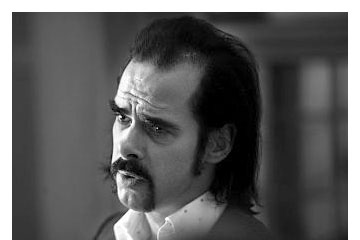

The angry young man's getting older and angrier. In this interview and podcast, he discusses why his bad mood makes for good music.

To listen to a podcast of the interview, click here.
To subscribe: Click here to add Conversations to iTunes or cut and paste the URL into your podcasting software:

Long one of rock’s most darkly charismatic figures, Nick Cave has filled his career with songs that married an almost biblical sense of morality and justice to an evocative, highly literate lyrical style that marked him as sort of a louder, angrier Leonard Cohen. Cave’s new album, recorded under the name Grinderman (and without his longtime backing band the Bad Seeds), finds the Australian singer-songwriter, who turns 50 this year, making some of the noisiest, harshest music of his career. The reasons for the added aggression? He’s getting old and, if songs like “No Pussy Blues” are any indication, he’s not getting laid.
Rail thin and dressed all in black, with a long handlebar mustache hugging the sides of his mouth, Cave — accompanied by Grinderman drummer Jim Sclavunos (hear them both in this podcast) — cut an imposing figure as he spoke with Salon about an album that he says came out of a “monumental midlife crisis.”
There’s a sexual frustration that permeates the album — and this is the year you turn 50.
Absolutely. I’m about to turn 50 and sex preoccupies you the older you get. You’re a young guy, you don’t know about that. I think you become invisible. I suspect the older you get the more invisible you become.
Invisible in what sense?
To the world. The less impact you really have. You’re not seen in the same way. This record’s actually about a person who’s physically disappearing. There’s a song, “Love Bomb,” where he keeps looking at himself in a mirror and he’s becoming thinner and a girl reaches out to touch him and her hand goes right through him. I think, as you get older, you become more and more invisible and then you die.
So why get up in the morning?
Because what we’re doing, as far as I’m concerned, is doing something. The least we can do is put out something that inspires people and can be genuinely uplifting in some way. Every day in the papers, without getting too drawn into specifics, there’s mounting evidence that the direction we’re going in is wrong and we’re heading for major catastrophes in a lot of different areas. If one thing doesn’t get us, something else is going to, and it doesn’t look like that’s too far away. You would think that the powers that be would shift their focus slightly and try to remedy this, but that hasn’t happened and I guess that makes you feel a little bit impotent.
I think there’s also for me, as I get older, a feeling that as an individual whatever impact I’m going to have is done; I’ve had it. This actually is a cause of celebration for me, and liberating, because I can just go and do whatever the fuck I want.
You’ve talked about listening to a John Lee Hooker song and hearing the lines “I went down to my baby’s house/ I sat down on the step,” and how they opened up the album for you.
Yeah. You’re toying around with different ideas and you want something … I’m doing this at the moment with the Bad Seeds record and there are these half ideas floating around in fucking aspic or something, floating around in space, and suddenly you just get this thing and you know what it’s about and these things can collect around a basic idea. I had some ideas and those two lines came out when I was listening to this John Lee Hooker song trying to work out how he played guitar.
Those seem like such innocuous lines.
Not to me.
Can you explain why?
There was a sense of disengagement between the man and the woman. You don’t go around to your baby’s place and then sit down on the step. There was something so beautiful to me about that. With the Bad Seeds, when I write songs, they’re very often about a man and a woman sitting and looking at the world and the world’s going to shit in a handbasket and all that kind of stuff, but there’s this connection and love will save the day. I guess that this was something else, where the woman on the Grinderman record has been released and has flown off to do whatever she wants to do and the man is there imprisoned in some way — that’s what that meant to me.
Look, when I’m alone and writing there are all sorts of influences — feminine and masculine influences, memories and ghosts of the past, all that stuff — having an impact on what I write. With Grinderman, most of it, I’m stuck in a room with four guys in the middle of a fucking monumental midlife crisis. It’s a male thing. It’s an old man kind of thing. I think there’s really something kind of hysterical in the music that’s a reflection of that.
So now you’re going through a midlife crisis and —
I was being slightly ironic.
So you’re dealing with these issues, and the sound of the album is wilder and looser than it’s been in a while.
[Cave snickers]
No? Musicians just don’t like to be told what they sound like! But your early music was also maybe written at a time of sexual frustration …
Well, actually, no. In the “Birthday Party” days it was pussy on tap. You had to beat it away with a stick. Are you saying that the music sounds like something we would have done when we were younger?
Yeah.
I reckon the music sounds something like, you know when you go to a disco and you see some middle-aged guy getting down? It sounds like some dad guy having a few drinks and going nuts in a disco. The young kids are loving it, we’re getting all this response from the kids, but we certainly weren’t trying to recapture some lost youth.
You were right, though. We just don’t like to be told where our music’s going. So get fucked. [Smiles]
How important is the concept of morality to your music?
I wish I could get away from that. Maybe not so much now, but I used to write in a narrative form of songwriting, which required a kind of conclusion at the end, or a summing up of what the story was about with a kind of moral perspective. It comes from there. I hope you don’t listen to my stuff and think I’m trying to persuade you. That’s never the intention.
– David Marchese
Santorum’s well-compensated love of fracking
Rick's claims about the practice's safety puts him far to the right of his state's GOP -- and the oil industry
(Credit: AP/Eric Gay)
If any state was going to produce a Republican who might understand the dangers of unbridled oil and gas drilling — and specifically, of the drilling process known as “fracking” — you would think it would be Pennsylvania.
The state, after all, is the home of Dimock, a town near the crucial Delaware River watershed that has become the Erin Brockovich-worthy example of what can go wrong when fracking goes completely unregulated. As Vanity Fair reported in its shocking 2010 expose of the situation, Dimock is “the place where, over the past two years, people’s water started turning brown and making them sick, one woman’s water well spontaneously combusted, and horses and pets mysteriously began to lose their hair.” Similarly, the state has most recently seen a massive fracking blowout in Canton — one in which the Environmental Protection Agency subsequently found evidence of contaminated groundwater. And it is the state where a landmark Duke University study found “evidence for methane contamination of drinking water associated with shale-gas extraction.”
So when former Pennsylvania senator turned Republican presidential candidate Rick Santorum late last week cited his roots in the Keystone State as reason to support more fracking and oppose any regulation of the process, it provided a disturbing example of the power of Big Money over our political system.
To review: In an Oklahoma speech last week, Santorum said, “I come from Pennsylvania [where] we’re doing a little bit of that in Pennsylvania, thank God.” He then went on to say fracking is “the new boogeyman” — the “new way [for environmentalists] to try to scare you [by] saying, ‘Look what’s going to happen. Ooh, all this bad stuff’s going to happen, we don’t know all these chemicals and all this stuff.’ Let me tell you what’s going to happen: Nothing’s going to happen.”
I don’t know for sure what sickened residents of Dimock or Canton would say in response to Santorum’s declaration that “nothing’s going to happen” — nor do I know for sure what the response would be from the Oklahomans who, according to the U.S. Geological Survey, have likely experienced pretty serious earthquakes thanks to fracking. My guess is that they wouldn’t cheer on such statements from a lowly city councilman, much less a presidential candidate — and they almost certainly wouldn’t mimic the right-wing activists who wildly cheered on Santorum’s head-up-the-ass statements.
That’s just a guess, of course — but what isn’t a guess is that Santorum has now put himself squarely to the far right of both the already-conservative Pennsylvania Republican Party and even the drilling industry itself.
As the Associated Press reports, the state’s Republican legislators just passed a bill “that could force Pennsylvania’s booming natural gas industry to help pay for a wide range of state and local government programs [and] toughen safety standards” for fracking. While the GOP bill is certainly not perfect — AP reports that “environmental groups were split over the bill, and the industry has been largely silent on it” — unlike Santorum, it at least acknowledges the reality of the health and safety concerns surrounding fracking. The legitimacy of such concerns are conceded even by the fracking industry in Pennsylvania: As Santorum’s hometown CBS affiliate previously reported, “The president of the Marcellus Shale Coalition, which represents natural gas companies, said the group now believes the natural gas exploration industry is partly responsible for rising levels of contaminants found in area drinking water.” And that admission came before the EPA’s headline-grabbing revelation of groundwater contamination in heavily fracked Pavillion, Wyo.
Considering this, Santorum’s, ahem, controversial position can only be explained as the behavior of a person who not only famously doesn’t actually live in Pennsylvania, but more important, was long ago bought and paid for by the oil and gas industry.
As the Center for Responsive Politics reports, Santorum is one of the top U.S. Senate recipients of campaign contributions from the oil and gas industry — and what makes those numbers so stunningly outsized is the fact that he remains one of the top Senate recipients even though the last time he ran for Senate was in 2006. Put another way, this is not a run-of-the-mill legislator who happened to get a few afterthought contributions from the industry; this is a guy who was such a sycophantic apostle of the industry that he received enough oil and gas money to keep him on the top-recipient list a full six years after he was voted out of office — that is, a full six years after he raised a single dollar for a Senate campaign. In baseball terms, it’s the equivalent of Hank Aaron racking up so many home runs that he was able to hold the record well after he retired — only with Santorum, it’s not home runs, it’s oil and gas cash.
For the industry’s part, spending that kind of cash was clearly brilliant. With Santorum ahead in national Republican presidential primary polls, the oil and gas money has presciently purchased a potential major-party nominee who gives them an unthinkably powerful spokesperson: a candidate willing to actually cite his fracking-scarred state as reason to support less regulation of fracking. As expenditures go, that’s about the best political investment money can buy.
The Tea Party’s war on mass transit
House Republicans try to gut federal funds for subways as they extend the culture wars to urban policy issues
(Credit: iStockphoto/Peterfactors)
In the week since House Republicans introduced their proposed transportation bill, one thing has become clear: it has virtually nothing to do with fiscal responsibility.
The Tea Party soared to power on the notion that it was the antidote to wasteful government spending. It’s now clear that reigniting the culture wars was a top priority, too. From guns to abortion, the extremist wing of the Republican party has fought to turn back the clock on many socially progressive ideals.
Mass transit is their newest target.
“Federal transportation and infrastructure policy has traditionally been an area of strong bipartisan agreement,” says Aaron Naparstek, a Loeb Fellow at Harvard University’s Graduate School of Design and founder of Streetsblog.org. “Now, it seems, Republicans want to turn cities into a part of the culture wars. Now it’s abortion, gay marriage and subways.”
House Republicans seek to eliminate the Mass Transit Account from the federal Highway Trust Fund. The Mass Transit Account is where public transportation programs get their steady source of funding. Without it, transit would be devastated, and urban life as we know it could become untenable.
And there’s the rub. “The Tea Party leaders and the Republicans who pander to them do not care about cost-effectiveness in the slightest,” wrote blogger Alon Levy in a comment about the bill on The Transport Politic. “They dislike transit for purely cultural and ideological reasons.” To the Tea Party, transit smacks of the public sector, social engineering and alternative lifestyles.
How do we know this is a cultural battle and not an economic one? Because transit spending is far more fiscally fair than spending on roads and highways. Transit riders subsidize roads to a greater degree than drivers subsidize transit. And cities, which are the chief engines behind the American economy, rely on buses and trains to function. “The economic future for states hinges largely on the performance of their metropolitan economies,” determined a recent Brookings Institution study.
Tea Party leaders know all of this. But they also knew that defunding NPR wouldn’t help balance the budget, and they voted to do it anyway. They knew that by law no federal money can go toward abortion services, yet they voted to defund Planned Parenthood too. The Tea Party is superb at disguising cultural battles as the pursuit of responsible thrift. And mass transit exists at the vortex of many of their number-one ideological targets. It’s brilliant, when you think about it.
Defunding transit is how you smack down urbanites, environmentalists, and people of color, all in one fell swoop. It’s how you telegraph a disdain for all things European. It’s how you show solidarity with swing-state suburbanites who don’t understand why their taxes are going toward subways they don’t even use. And it’s how you subtly reassure your base that you’re not concerned about the very poor.
Republicans haven’t pretended to care about cities for decades. In January, none of the candidates showed up to the annual Conference of Mayors. (Two of them didn’t even RSVP.) And even just a month ago, you could argue, as this web site did, that “today cities are more ignored than attacked” by Republicans. But the calculus just changed. The transportation bill sends an aggressive message: “Tea Party to Cities: Drop Dead.”
It doesn’t matter to the Tea Party that Ronald Reagan, in 1982, created the Mass Transit Account that Republicans now want to kill. Reagan was no friend to cities. But even he earned a respectable share of the vote in New York, Philadelphia, and San Francisco. Things hadn’t yet gotten so personal.
That era is over. Over the past couple decades, the GOP has found that bashing “elites” can translate into victory at the polls. And by “elites” they don’t mean folks with Chevy Tahoes and McMansions in the exurbs. They mean urbanites, no matter what their net worth. When they tar Nancy Pelosi as a San Francisco liberal, or Barack Obama as a Chicago politician, they’re not just referencing those cities’ stereotypes. They’re referencing the stereotypes of city culture itself: full of swindlers and gays and blacks and other suspect types. Calling Obama the “food stamp president” conjures up images of housing projects. Sarah Palin calling small-town folks “real America” states unequivocally that urbanites aren’t real Americans. The offensiveness of that statement still boggles the mind.
The Tea Party plan to decimate transit is no less explicit a statement. “House Republicans are, essentially, declaring war on cities in the federal transportation bill,” tweeted Naparstek. It’s not just that they know they can’t expect many votes from urban dwellers — that at least would be political calculus. It’s that they despise cities in general. They see “smart growth” principles as a U.N. plot, gun control as fascist, and funding for transit not just as wasteful, but un-American. Don’t like it? Get a car like the rest of us.
The House transportation bill will not become law, but that doesn’t make it benign. Like the debt ceiling battle, it could become a political bargaining chip, or reframe the national debate: Maybe cities are getting more than their fair share? Are we overspending on transit? Why should I help fund some far-away bus system? It plants these questions in voters’ minds.
This is why transit advocates are apoplectic, and why Transportation Secretary Ray LaHood (a former Republican congressman) called it “the worst transportation bill I’ve ever seen in 35 years of public service.” If conservatives have truly decided that transit is next on their culture war hit list, anyone who believes in the importance of cities had better start firing back right now.
At the CPAC-Occupy beer summit
Over drinks, foot soldiers of the left and right explore what they agree on: more than you'd think
VIDEO
At the CPAC-Occupy beer summit (Credit: Eddie Becker)
In my report on the Conservative Political Action conference in Washington I wrote that the Occupiers and the CPAC crowd “barely know how to talk to each other.”
But they’re trying.
My colleague Eddie Becker was there when it happened at CPAC this weekend. A couple of Tea Party militiamen understood that if you buy a few cold ones and start talking, you may discover you have some things in common (along with some huge differences). There have been other friendly encounters of these two movements. In Richmond Virginia for example.
This video is 15 minutes long. Its worth the wait to see Occupiers and Tea Partiers trying to get to the heart of the problem.
Whitney Houston’s lessons in love
As a girl, the late diva's songs taught me about love. As an adult, she showed me about loss and pain
VIDEO
Whitney Houston at Wembley Stadium in 1988. (Credit: Reuters)
In seventh grade I owned the cassette tape of “Whitney,” the second album by Whitney Houston, which was true of pretty much every 12-year-old female in America. I played the hell out of that tape. I used to spend afternoons in my bedroom, lip-syncing those songs to my bedroom wall, because that’s the kind of kid I was. Always longing for an imaginary audience. I did not want to be a writer back then, or the president of the United States. I wanted to be a pop star. And in 1987, there wasn’t any pop star more elegant or talented than Whitney Houston. Daughter of a gospel singer, niece of a R&B legend, smashingly beautiful — she was practically anointed by the gods for greatness.
The song I loved the most on that tape was “Didn’t We Almost Have it All.” Fourth song, first side. I would perform the song to the wall, then rewind it and perform it again. Play, rewind, repeat. I can still hear the squiggle of the tape in my head as I pressed on the jam-box button just long enough to find the song’s opening once more. This is a lost art in the age of the iPod, but back then, knowing how many seconds to rewind a cassette was a sign you truly understood its rhythms. You had literally learned the music backwards and forwards.
“This again?” my brother would ask as the tinkling synthesizers kicked in. My brother was a metalhead, who loved the righteous anger of AC/DC and Judas Priest and did not give a rip for the likes of Whitney Houston.
He did not get a choice in the matter. Here is how the song begins:
Remember when we held on the rain, the nights we almost lost it?
Once again, we can take the night into tomorrow
Living on feelings, touching you I feel it all again
It’s a bit mundane, frankly. It’s a fill-in-the-blank tale of a broken relationship. Funny how every love story sounds the same but feels so different when you’re inside it. That’s the poignancy of love stories, I guess. You’re never alone. Then again: You’re never unique.
But this song is all about the chorus. It is a song constructed almost entirely of its irresistible chorus — half a dozen times in less than five minutes — and the chorus launches a mere 45 seconds in. No foreplay, no footsie under the table, no lingering glances and sighs. This song grabs you by the collar and sticks its tongue down your throat.
It’s a really fantastic chorus, by the way. It’s OK to sing along:
Didn’t we almost have it all, when love was all we had worth giving?
The ride with you was worth the fall, my friend. Loving you makes life worth living.
At 12 years old, I had never been in love. I had never even kissed anyone. And so it’s peculiar that I experienced this song so powerfully. The agony. The crashing emotion. The ka-pow of it all. Why did I feel it so intensely? What was it teaching me? I wonder if all these songs of woe and regret didn’t warp my sense of romance. I wanted to grow up and fall in love, but more to the point: I wanted to grow up and lose that love, because that’s when the real drama began. I understood, even then, the delicious pain of being broken-hearted.
The chorus returns, a little different this time:
Didn’t we almost have it all, the nights we held on till the morning?
You know we’ll never love that way again. Didn’t we almost have it all?
This song climaxes so quickly. Not even a minute into it, and we’re already basking in Whitney’s vibrato, the glorious burst of sustained sound that would become her signature. The woman could push a note like nobody else, squeeze it and feel it up till the listener wanted to cry for mercy. But when you peak this early, it’s hard to know where to go next. The excitement is unsustainable, and for the next three minutes the song will throw out its back trying to one-up itself — a series of elevated key changes, strings atop swell. The song wants you to know the singer is bleeding.
For the moment, though, it pulls back. Whitney’s voice grows subdued. We get more of the back story which, naturally, is like every back story we’ve ever heard.
The way you used to touch me felt so fine
Kept our hearts together, down the line
A moment in the soul can last forever, comfort and keep us
Help me bring the feeling back again.
I can understand why people hate Whitney Houston. I mean, these lyrics are dreck. It’s cooler to love the big, dirty riffs of Van Halen, the gritty excess of Guns N Roses. But I still find the stadium ballads of the mid-1980s strangely moving. The REO Speedwagon, the Air Supply, the Chicago, the Bryan Adams. The cheesy, lighter-held-aloft songs. They are not clever. They are not sly. They have the temerity to be earnest and unblinking, nothing but a desperate plea to be loved. Like a boyfriend who dims the lights and scatters rose petals in the bathtub. Please, baby, come back to me.
Or, as Whitney Houston sings it:
Didn’t we almost have it all? When love was all we had worth giving?
The ride with you was worth the fall, my friend. Loving you makes life worth living
I finally did fall in love in my sophomore year. He was sweet like my father, charming like my older brother. I still adore him. We drove around in his Chevy Nova listening to David Bowie and Elvis Costello. I began to understand that Whitney Houston was bad and not to be encouraged. We made fun of “I Will Always Love You,” the No. 1 song that would not go away in 1992, the year we graduated. We wanted to stab that song with knives; we wanted to punish it somehow. We were not the only ones turning on Whitney. That was the year Nirvana hit. Culture was edging away from the light and toward the dark, and there was Whitney in the video for “I Will Always Love You,” singing her heart out in the middle of an empty winter landscape as Kevin Costner walked away.
My boyfriend and I broke up at the end of high school, and I secretly bought the cassingle to “I Will Always Love You.” I listened to it in my bedroom, over and over. Nothing could touch the pure emotion of that song. I listened to “Didn’t We Almost Have It All,” too, and it was exactly the comfort I wanted, like pulling an old teddy bear off the shelf and cradling it in your arms as you cried.
Didn’t we almost have it all? The nights we held on to the morning?
You know you’ll never love that way again. Didn’t we almost have it all?
“Didn’t We Almost Have It All” is a good breakup song because it grows temperamental. It’s not just a lament. It’s a bit of a tantrum. It’s all so unfair, Whitney is telling us. It wasn’t supposed to go like this. We had it all, and then we did not. How could that possibly happen?
And I like this part, the growl in Whitney’s voice, like she is stomping her foot.
Didn’t we have the best of times, when love was young and new?
Couldn’t we reach inside to find the world of me and you?
We’ll never lose it again. Cause once you know what love is, you’ll never let it end.
After college, I stopped paying attention to Whitney Houston. I guess a lot of people did. There was a reality show, and crack, and debasement that defied easy explanation. It was easy to shove it off on Bobby Brown — the controlling spouse, the bad influence — but she was the one who stayed with him. The reality show made her seem coarse and a little bit mean. When she told Diane Sawyer that “crack is wack,” it was like she was participating in her own satire. This was unanticipated. Crack addicts were not supposed to look like Whitney Houston.
The thing is, I’ve met other crack addicts since then, and they don’t look the part either. That might be the one characteristic they have in common, other than an addiction to smoking crack. I never did drugs; I was a boozehound, a pure-bred lush. But I understand that you have to keep pushing to get the same feeling. You level out, and so you need more. You level out again, and you need more again. Play, rewind, repeat. It’s not just the crack or the booze that destroys people. It’s the always needing more.
I once heard drug addiction described as nostalgia. Chasing the perfection and the abandon of that first time.
Didn’t we almost have it all? The nights we held on to the morning.
You know you’ll never love that way again.
I was reading a book about Marilyn Monroe when I heard that Whitney Houston had died at the age of 48. Monroe’s is the ur-diva downfall, and these tragedies have elements in common: Drugs, a questionable taste in men, the inability to live up to a public persona, success like a rocketship. And they had beauty, of course. Uncommon, breathtaking beauty.
Earlier that afternoon, I had been taking a walk with a friend. I am 37, she is a little older, perhaps 39. We were talking about how hard it is for gorgeous women to age, because they get too accustomed to the oxygen of male desire. One of the good things about never being the best-looking woman in the room is that you never have to stop being the best-looking woman in the room. It is a dangerous game to base your meaning and self-worth on other people’s admiration, because it will inevitably recede, and I don’t think anyone would understand that better than Whitney Houston. It must be agonizing to hold the world’s attention in your palm, and then to feel it slowly drain away.
Didn’t we almost have it all?
After I learned about Whitney Houston’s death, I went searching for this song on YouTube. It is such a corny song, I know, but it made my heart pound nonetheless. I love it completely, without reason, the way you feel about a high school sweetheart, the way you feel about a drug, the way you feel about a song you loved when you were dumb and splendid and 12 years old.
I listen to songs over and over again. I have always been like this. I asked my mother, who is a therapist, why I did this, and she said maybe I was trying to unlock a song’s mystery, to master it in some way.
And I do notice different things every time I hear this song. I notice a quiver in the voice, a breath, a pause. I notice how the song ends by asking the same question twice, different each time. First it is defiant. Then it is sad and vulnerable.
Didn’t we almost have it all? the song asks. And I don’t know the answer to this question. So I press repeat, and listen to it once more.
Our non-withdrawal from Afghanistan
Despite the alleged 2014 end date, the military has ramped up its construction of long-term bases
A helicopter lands near U.S. soldiers at the Forward Operating Base Bostic in Kunar, Afghanistan (Credit: Reuters/Erik de Castro)
In late December, the lot was just a big blank: a few burgundy metal shipping containers sitting in an expanse of crushed eggshell-colored gravel inside a razor-wire-topped fence. The American military in Afghanistan doesn’t want to talk about it, but one day soon, it will be a new hub for the American drone war in the Greater Middle East.
Next year, that empty lot will be a two-story concrete intelligence facility for America’s drone war, brightly lit and filled with powerful computers kept in climate-controlled comfort in a country where most of the population has no access to electricity. It will boast almost 7,000 square feet of offices, briefing and conference rooms, and a large “processing, exploitation and dissemination” operations center — and, of course, it will be built with American tax dollars.
Nor is it an anomaly. Despite all the talk of drawdowns and withdrawals, there has been a years-long building boom in Afghanistan that shows little sign of abating. In early 2010, the U.S.-led International Security Assistance Force (ISAF) had nearly 400 bases in Afghanistan. Today, Lieutenant Lauren Rago of ISAF public affairs tells TomDispatch, the number tops 450.
The hush-hush, high-tech, super-secure facility at the massive air base in Kandahar is just one of many building projects the U.S. military currently has planned or underway in Afghanistan. While some U.S. bases are indeed closing up shop or being transferred to the Afghan government, and there’s talk of combat operations slowing or ending next year, as well as a withdrawal of American combat forces from Afghanistan by 2014, the U.S. military is still preparing for a much longer haul at mega-bases like Kandahar and Bagram airfields. The same is true even of some smaller camps, forward operating bases (FOBs) and combat outposts (COPs) scattered through the country’s backlands. “Bagram is going through a significant transition during the next year to two years,” Air Force Lieutenant Colonel Daniel Gerdes of the U.S. Army Corps of Engineers’ Bagram Office recently told Freedom Builder, a Corps of Engineers publication. “We’re transitioning… into a long-term, five-year, 10-year vision for the base.”
Whether the U.S. military will still be in Afghanistan in five or 10 years remains to be seen, but steps are currently being taken to make that possible. U.S. military publications, plans and schematics, contracting documents and other official data examined by TomDispatch catalog hundreds of construction projects worth billions of dollars slated to begin, continue or conclude in 2012.
While many of these efforts are geared toward structures for Afghan forces or civilian institutions, a considerable number involve U.S. facilities, some of the most significant being dedicated to the ascendant forms of American warfare: drone operations and missions by elite special operations units. The available plans for most of these projects suggest durability. “The structures that are going in are concrete and mortar, rather than plywood and tent skins,” says Gerdes. As of last December, his office was involved in 30 Afghan construction projects for U.S. or international coalition partners worth almost $427 million.
The Big Base Build-Up
Recently, the New York Times reported that President Obama is likely to approve a plan to shift much of the U.S. effort in Afghanistan to special operations forces. These elite troops would then conduct kill/capture missions and train local troops well beyond 2014. Recent building efforts in the country bear this out.
A major project at Bagram Air Base, for instance, involves the construction of a special operations forces complex, a clandestine base within a base that will afford America’s black ops troops secrecy and near-absolute autonomy from other U.S. and coalition forces. Begun in 2010, the $29 million project is slated to be completed this May and join roughly 90 locations around the country where troops from Combined Joint Special Operations Task Force-Afghanistan have been stationed.
Elsewhere on Bagram, tens of millions of dollars are being spent on projects that are less sexy but no less integral to the war effort, like paving dirt roads and upgrading drainage systems on the mega-base. In January, the U.S. military awarded a $7 million contract to a Turkish construction company to build a 24,000-square-foot command-and-control facility. Plans are also in the works for a new operations center to support tactical fighter jet missions, a new flight-line fire station, as well as more lighting and other improvements to support the American air war.
Last month, Afghan President Hamid Karzai ordered that the U.S.-run prison at Bagram be transferred to Afghan control. By the end of January, the U.S. had issued a $36 million contract for the construction, within a year, of a new prison on the base. While details are sparse, plans for the detention center indicate a thoroughly modern, high-security facility complete with guard towers, advanced surveillance systems, administrative facilities and the capacity to house about 2,000 prisoners.
At Kandahar Air Field, that new intelligence facility for the drone war will be joined by a similarly-sized structure devoted to administrative operations and maintenance tasks associated with robotic aerial missions. It will be able to accommodate as many as 180 personnel at a time. With an estimated combined price tag of up to $5 million, both buildings will be integral to Air Force and possibly CIA operations involving both the MQ-1 Predator drone and its more advanced and more heavily-armed progeny, the MQ-9 Reaper.
The military is keeping information about these drone facilities under extraordinarily tight wraps. They refused to answer questions about whether, for instance, the construction of these new centers for robotic warfare are in any way related to the loss of Shamsi Air Base in neighboring Pakistan as a drone operations center, or if they signal efforts to increase the tempo of drone missions in the years ahead. The International Joint Command’s chief of Intelligence, Surveillance and Reconnaissance (ISR) operations, aware that such questions were to be posed, backed out of a planned interview with TomDispatch.
“Unfortunately our ISR chief here in the International Joint Command is going to be unable to address your questions,” Lieutenant Ryan Welsh of ISAF Joint Command Media Outreach explained by email just days before the scheduled interview. He also made it clear that any question involving drone operations in Pakistan was off limits. “The issues that you raise are outside the scope under which the IJC operates, therefore we are unable to facilitate this interview request.”
Whether the construction at Kandahar is designed to free up facilities elsewhere for CIA drone operations across the border in Pakistan or is related only to missions within Afghanistan, it strongly suggests a ramping up of unmanned operations. It is, however, just one facet of the ongoing construction at the air field. This month, a $26 million project to build 11 new structures devoted to tactical vehicle maintenance at Kandahar is scheduled for completion. With two large buildings for upkeep and repairs, one devoted strictly to fixing tires, another to painting vehicles, as well as an industrial-sized car wash, and administrative and storage facilities, the big base’s building boom shows no sign of flickering out.
Construction and Reconstruction
This year, at Herat Air Base in the province of the same name bordering Turkmenistan and Iran, the U.S. is slated to begin a multimillion-dollar project to enhance its special forces’ air operations. Plans are in the works to expand apron space — where aircraft can be parked, serviced and loaded or unloaded — for helicopters and airplanes, as well as to build new taxiways and aircraft shelters.
That project is just one of nearly 130, cumulatively valued at about $1.5 billion, slated to be carried out in Herat, Helmand and Kandahar provinces this year, according to Army Corps of Engineers documents examined by TomDispatch. These also include efforts at Camp Tombstone and Camp Dwyer, both in Helmand Province as well as Kandahar’s FOB Hadrian and FOB Wilson. The U.S. military also recently awarded a contract for more air field apron space at a base in Kunduz, a new secure entrance and new roads for FOB Delaram II, and new utilities and roads at FOB Shank, while the Marines recently built a new chapel at Camp Bastion.
Seven years ago, Forward Operating Base Sweeney, located a mile up in a mountain range in Zabul Province, was a well-outfitted, if remote, American base. After U.S. troops abandoned it, however, the base fell into disrepair. Last month, American troops returned in force and began rebuilding the outpost, constructing everything from new troop housing to a new storage facility. “We built a lot of buildings, we put up a lot of tents, we filled a lot of sandbags, and we increased our force protection significantly,” Captain Joe Mickley, commanding officer of the soldiers taking up residence at the base, told a military reporter.
Decommission and Deconstruction
Hesco barriers are, in essence, big bags of dirt. Up to seven feet tall, made of canvas and heavy gauge wire mesh, they form protective walls around U.S. outposts all over Afghanistan. They’ll take the worst of sniper rounds, rifle-propelled grenades, even mortar shells, but one thing can absolutely wreck them — the Marines’ 9th Engineer Support Battalion.
At the beginning of December, the 9th Engineers were building bases and filling up Hescos in Helmand Province. By the end of the month, they were tearing others down.
Wielding pickaxes, shovels, bolt-cutters, powerful rescue saws and front-end loaders, they have begun “demilitarizing” bases, cutting countless Hescos — which cost $700 or more a pop — into heaps of jagged scrap metal and bulldozing berms in advance of the announced American withdrawal from Afghanistan. At Firebase Saenz, for example, Marines were bathed in a sea of crimson sparks as they sawed their way through the metal mesh and let the dirt spill out, leaving a country already haunted by the ghosts of British and Russian bases with yet another defunct foreign outpost. After Saenz, it was on to another patrol base slated for destruction.
Not all rural outposts are being torn down, however. Some are being handed over to the Afghan Army or police. And new facilities are now being built for the indigenous forces at an increasing rate. “If current projections remain accurate, we will award 18 contracts in February,” Bonnie Perry, the head of contracting for the Army Corps of Engineers’ Afghanistan Engineering District-South, told military reporter Karla Marshall. “Next quarter we expect that awards will remain high, with the largest number of contract awards occurring in May.” One of the projects underway is a large base near Herat, which will include barracks, dining facilities, office space and other amenities for Afghan commandos.
Tell Me How This Ends
No one should be surprised that the U.S. military is building up and tearing down bases at the same time, nor that much of the new construction is going on at mega-bases, while small outposts in the countryside are being abandoned. This is exactly what you would expect of an occupation force looking to scale back its “footprint” and end major combat operations while maintaining an on-going presence in Afghanistan. Given the U.S. military’s projected retreat to its giant bases and an increased reliance on kill/capture black-ops as well as unmanned air missions, it’s also no surprise that its signature projects for 2012 include a new special operations forces compound, clandestine drone facilities and a brand new military prison.
There’s little doubt Bagram Air Base will exist in five or 10 years. Just who will be occupying it is, however, less clear. After all, in Iraq, the Obama administration negotiated for some way to station a significant military force — 10,000 or more troops — there beyond a withdrawal date that had been set in stone for years. While a token number of U.S. troops and a highly militarized State Department contingent remain there, the Iraqi government largely thwarted the American efforts — and now, even the State Department presence is being halved.
It’s less likely this will be the case in Afghanistan, but it remains possible. Still, it’s clear that the military is building in that country as if an enduring American presence were a given. Whatever the outcome, vestiges of the current base-building boom will endure and become part of America’s Afghan legacy.
On Bagram’s grounds stands a distinctive structurecalled the “Crow’s Nest.” It’s an old control tower built by the Soviets to coordinate their military operations in Afghanistan. That foreign force left the country in 1989. The Soviet Union itself departed from the planet less than three years later. The tower remains.
America’s new prison in Bagram will undoubtedly remain, too. Just who the jailers will be and who will be locked inside five years or 10 years from now is, of course, unknown. But given the history — marked by torture and deaths — of the appalling treatment of inmates at Bagram and, more generally, of the brutality toward prisoners by all parties to the conflict over the years, in no scenario are the results likely to be pretty.
To stay on top of important articles like these, sign up to receive the latest updates from TomDispatch.com here.
Page 1 of 15125 in All Salon

Santorum’s well-compensated love of fracking
The Tea Party’s war on mass transit
At the CPAC-Occupy beer summit
Whitney Houston’s lessons in love
Our non-withdrawal from Afghanistan
“We don’t need someone to think”
How rough it’s gotten for Mitt
The Grammys’ most memorable moments
A passport to utopia
“The Fault in Our Stars” and “There Is No Dog”: Not kids’ stuff 

