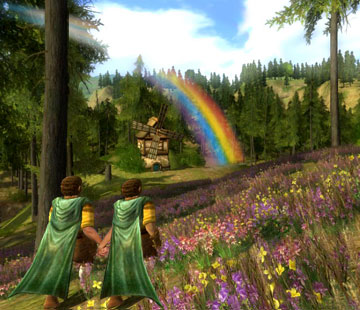

Gay Marriage

Why can’t gay dwarves get married in Middle-earth?

Video games have been ahead of the real world in accepting same-sex marriage. Why doesn't a new online "Lord of the Rings" game allow it?

I can vouch for my stepbrother — he’s a big supporter of equal rights for the gay and lesbian community. But when the issue of gay marriage came up at work, he voted against it. Same-sex marriage for U.S. citizens is one thing, but same-sex marriage for gay dwarves in Middle-earth is quite another.

Nik Davidson is a game designer at Turbine, the Westwood, Mass., company producing “The Lord of the Rings Online: Shadows of Angmar.” The game has been in beta (a test version) since September, and during discussions of new features for the game, which was officially released Tuesday, the design team wound up in a heated discussion over what restrictions should be placed on marriage. They debated not only gay marriage but also marriage between members of different species. Finally, the game’s executive producer settled the matter by pulling the entire marriage feature.

The controversy over whether hobbits should be able to marry dwarves may be unique to Turbine, but the issue of in-game relationships is not. Most American households have some form of single-player video or computer games; in addition, at least 12.5 million people subscribe to multiplayer online games, going online to interact with other game players in elaborate virtual worlds, many with sword and sorcery themes. Games like “The Lord of the Rings Online” — often referred to as MMORPGs, or massively multiplayer online role-playing games — don’t just allow players to create life in the form of their characters; increasingly, they take over the lives of the players themselves. Perhaps the quintessential example is “EverQuest,” launched in 1999, and so addictive it came to be known as “EverCrack.” Once the most popular MMORPG, it has been displaced by “World of Warcraft,” which boasts an estimated 8.5 million users. One study estimated that the average player was on “EverQuest” some 20 hours per week; of course, that number is skewed by casual users — some hard-core gamers spend more like eight to 12 hours per day on the game.

Players devoting that much time and energy to their games will naturally want to live part of their life inside the game, and that includes developing committed relationships, sometimes with ceremonies. According to a study by Haverford College student Nick Yee, now a Ph.D. candidate at Stanford University, 23 percent of “EverQuest” players surveyed had role-played at falling in love within the game. Gay players, an increasingly visible demographic in a scene once known as the preserve of young and not necessarily enlightened males, often want the same thing. These players don’t want to be shunted off to the side, either, or given “gay” games marketed to gay audiences; they just want to see themselves reflected in the games they play and to have safe spaces within the games, free of the homophobia that comes freely from the other players.

Largely due to the uniquely libertarian culture of game design, games are ahead of the real world in terms of acceptance of same-sex marriage — the first game reported to have allowed same-sex marriage debuted in 1998, two years before Vermont recognized civil unions and six years before Massachusetts became the first state to allow same-sex marriage. Today, the discussion of same-sex marriage in games redraws the battle lines over the issue, making it not a fight over marriage but an issue of the philosophy of video games themselves.

Last fall, with “The Lord of the Rings Online” in beta, Turbine did a survey to determine the major reasons people played MMORPGs. It turned out that what players ranked as most important weren’t beautiful graphics or compelling storylines. They said they played because their friends were playing.

“The relationships that are being formed in-game are more important than anything we can provide to them,” says Jeff Anderson, Turbine’s CEO.

Erin Davison, a veteran game player from San Diego, says some of her oldest friends are people she met in a text-based online fantasy game in the 1990s. “I was a military child,” she explains. The game was a way for her to stay in touch with the same people as she moved from place to place. One of the people she met in that game is now her husband; they’ve been married for six years.

Even that game — “NannyMUD,” a fantasy-based game that Davison describes as “basically like ‘EverQuest,’ but no pictures” — had methods of coupling. “There are lockets that tell you when your other person is logged on, and wedding rings that glow when the other person is logged on,” Davison says.

“Virtual worlds have always had marriage,” Anderson says, “whether it’s people staging an event in a town, or whether it’s people meeting online and then getting married in real life.”

But over the years since “NannyMUD” and other similarly primitive games premiered, gaming demographics have changed. It still skews male, for example, but not as male as it did even six years ago, when Yee’s study showed that only 16 percent of “EverQuest’s” players were female. Some of the games that are currently popular, like “The Sims,” actually skew female.

“Gaming has become more socially acceptable. It’s not just the bastion of geeks and nerds anymore,” says Alexander Sliwinski, who writes about gay issues in video games for In Newsweekly and Joystiq.

There isn’t a whole lot of information about the gay gaming demographic, but Flynn De Marco, aka Fruit Brute, the editor of GayGamer.net, says his site gets between 12,000 and 15,000 visitors a day.

De Marco and some friends started GayGamer.net last summer to provide a site where gay gamers could congregate and talk about their obsession. “Most game sites,” De Marco says, “while they’re great, they are definitely heavily slated towards the straight male: lots of pictures of scantily clad girls and lots of that kind of thing.” And the atmosphere in a lot of these sites’ forums, De Marco says, is “extremely homophobic.”

Last year the first survey on sexual orientation and video games was launched at the University of Illinois at Urbana-Champaign, directed and independently funded by former student Jason Rockwood.

“My research suggests that gay gamers don’t want games that are made for a ‘gay audience,’ Rockwood says. “They simply want to be able to play games that everyone else is playing, but they want to have inclusion; they want the option to have gay characters.”

Rockwood says some gay players were upset about his survey because they were afraid it would lead to companies targeting the gay demographic by creating ridiculously stereotyped characters. “Gay gamers do not want ‘Queer Eye for the Straight Guy: The Video Game,’” Rockwood says.

Rockwood posted the survey online and got responses from almost 10,000 people. Two-thirds of the respondents — gay, straight and bisexual gamers — said they felt the gaming community was either somewhat hostile or very hostile toward gay people. Eighty-eight percent of respondents said that during online game-play chat, other players had used the phrase, “That’s so gay.” Eighty-three percent had experienced other players using “gay” or “queer” in a derogatory fashion, and 52 percent felt that the depiction of homosexual characters in games was stereotypical.

It was this kind of hostility that in January 2006 led Sara Andrews to create an LGBT-friendly guild within “World of Warcraft.” She wanted a space where people, queer or not, could play without having to contend with insults like “fag” being tossed around by other players.

But a moderator at Blizzard Entertainment, “WoW’s” manufacturer, gave Andrews a warning, saying the guild violated the company’s harassment policy by mentioning sexual orientation.

Andrews fought back, gaining media attention and prompting others to write letters in support of the guild. Blizzard quickly issued Andrews an apology and said it would review its harassment policy. The new policy bans only language that refers to any aspect of sexual orientation “insultingly.” Representatives for Blizzard didn’t respond to a request for comment on the issue.

Game players often improvise their own weddings in games that have no official “marriage” commands embedded in the game, and some of those unions, of course, have been same-sex. The first known game to deal with the issue of same-sex marriage head on, and officially allow it, was “Fallout 2,” a role-playing game set in a post-apocalyptic America that was released in 1998. Timothy Cain, then a designer and producer with Interplay, the maker of the game, says the idea to allow players the option of a same-sex marriage was his.

“A big part of the ‘Fallout’ series was that we wanted it to be as open-ended as possible,” Cain says. “We had no way of knowing whether you were going to be a man or a woman, so we decided to write all the different dialogue combinations.”

Asked whether he was concerned that the core audience for role-playing games would be turned off by the possibility of a same-sex marriage within “Fallout 2,” Cain was dismissive.

“I’ve always kind of said I made the games for myself and didn’t think too much of the audience,” Cain said, “but even though the primary demographic is males, it’s also young males, and I would like to think this isn’t an issue for males in their 20s anymore.”

Cain says the same-sex marriage in “Fallout 2″ didn’t even receive much attention, and he’s not surprised by that — he thinks the option of a same-sex marriage is a natural thing in a role-playing game. He draws a distinction between role-playing games, which he thinks should be as open-ended as possible, and an adventure game, in which a character’s actions are more carefully proscribed.

“To me, it’s not surprising that a role-playing game would do this,” he says. “A role-playing game, you invent your character at the beginning, so you should get to determine what they do, and if we’re going to put any romantic element in, we should cover all the bases.”

That’s what Cain did when he moved to the now-defunct Troika Games, which he co-founded. He tells Salon that all three of the games Troika produced had some element of a same-sex relationship in them. Most notable was “The Temple of Elemental Evil,” an adaptation of a 1980s “Dungeons & Dragons” game, which allowed players to marry a gay pirate named Bertram if they chose. That option did attract some attention, which Cain says he was surprised by, given that “Fallout 2″ had already had the option. He adds that Wizards of the Coast, which owns the rights to “Dungeons & Dragons,” had asked him to remove the option for same-sex marriage from the game, as they did other elements — such as a brothel and alcohol — that might keep the game from getting a T (Teen) rating.

“I told [Wizards of the Coast] I’d remove [the same-sex marriage] if they gave me something in writing explaining their reasons for removing it,” Cain says. “That one seemed so ambiguous as to why they wanted it removed, so I asked for clarification in writing.” After that, Cain says, Wizards of the Coast dropped their request that the same-sex marriage be removed.

However, despite its predecessors, and perhaps because of its wider reach, the game often credited with breaking down the barriers to same-sex relationships in gaming, is “The Sims.” Originally released by Electronic Arts in 2000, the game allowed players to manage, with few restrictions, the day-to-day activities of one or more virtual characters. Included in that was the option for relationships, including same-sex relationships. “The Sims” became the best-selling PC game of all time, a feat widely attributed to its attraction for women, a largely underserved segment of the market that has exploded since “The Sims” debuted. Up to 60 percent of “Sims” players are female.

When “The Sims 2″ came out in 2004, it allowed characters to marry and again did not discriminate between heterosexual and homosexual marriage.

“Players should be able to do whatever they want within their own game, and it’s not our business to stop them,” Rod Humble, head of the Sims Studio, says, explaining Electronic Arts’ decision. “If you have two regular plastic dolls, you wouldn’t expect someone to come along and tell you what positions you could and couldn’t put them in. That’s generally our philosophy.”

“Fable,” released in 2004 by Lionhead Studios, also incorporates same-sex marriage. The designers never intended to create this feature, according to a 2006 interview in Gamasutra.

“It was not so much a question of overt inclusion as a reluctance to remove something that occurred naturally in the course of creating our villagers’ artificial intelligence,” Dene Carter, “Fable’s: creative director, told Gamasutra at the time. “Our villagers each had a simple concept of ‘attraction to the hero.’ We’d have had to write extra code to remove that in the case of same-sex interactions. This seemed like a ridiculous waste of time.”

“Second Life,” the popular user-run virtual world, also allows gay marriage. Joyce Bettencourt, known in “Second Life” as Rhiannon Chatnoir, owns a cathedral within the game and performs marriage ceremonies there for all kinds of couples.

Bettencourt says there isn’t as much stigma online as in the real world. She met a lesbian couple within the game and found out months later that one of them was a man. “People can pick what they want to be, or even if they want to be human,” Bettencourt says.

Catherine Smith, the director of marketing for Linden Lab, which produces “Second Life,” says the decision to allow players the option of same-sex marriage came out of the game’s generally libertarian philosophy.

“Environment and tools, that’s what we provide,” Smith says. “We’re not legislating anything.”

The question of same-sex marriage within “Second Life” wasn’t completely separated from the political realities of the outside world, however. Smith noted that the Linden Lab press release announcing the feature that allows players to marry proudly proclaimed, “Can’t be married in real life? Try Second Life.”

Actually, other than that, the message from the makers of these games is nearly identical: They see their mission as providing space for users to create what is, in essence, their own reality. Within that mission, the question as a game is developed is not what users will be allowed to do but what they’ll be stopped from doing.

“I think for us the general message is, as a creativity tool, we’ve never forced any kind of relationship or marriage on any of our players,” Humble says. “We just allowed it, and people who aren’t interested in it would never think to do it.”

That philosophy is echoed by Rockstar Games, the controversial makers of such games as the “Grand Theft Auto” series and “Bully,” which allows users to play the character of a teenage boy dropped into a boarding school gone wrong. Before it was even released, “Bully” was already the subject of much heated discussion; more fuel was added to that fire when users discovered last year that Rockstar had allowed gamers the option of same-sex kissing.

Rodney Walker, a spokesman for Rockstar, says the Rockstar team thinks of their games not like films, with static storylines, but as worlds that allow players to make their own choices, and Rockstar tries to shut down as few of those choices as possible. “If you’re planning to take a vacation to California, you don’t say to yourself, ‘Where am I not going?’” Walker says. “When people talk about what’s allowed in a video game, it’s not about permission, it’s about experience … The thing that’s so exciting about video games, which is why we think the medium is so popular right now, is because … you can have an actual individual experience.”

The difference for “The Lord of the Rings Online,” according to Nik, is that for Turbine the idea was all about keeping Middle-earth, the world in which the story takes place, authentic.

The team at Turbine is serious about staying true to the source material. Several Turbine employees can speak Elvish, Tolkien scholars have been hired as consultants, and Nik was even asked to do research on Middle-earth plants and minerals so that clothing colors in the game could correspond to available dyes.

When fans complained on the message board about an erroneous squirrel color, Turbine promptly corrected the mistake. Turbine had released a screen shot of a forest scene featuring a gray squirrel, but Tolkien once wrote in a letter that he hated gray squirrels.

Authenticity isn’t Turbine’s only concern, though, according to CEO Jeff Anderson.

“We don’t want to just create something that’s truly authentic and no fun,” Anderson says. “Our main goal is making a great game.”

In order to make something fun and build on the online relationship trend, Turbine’s design team came up with a pedigree system whereby a player can offer to “adopt” another player. “Tom” can become “Tom son of Jonathan,” in the spirit of Tolkien’s original “Gimli son of Glóin” and “Aragorn son of Arathorn.”

The team had also originally planned to introduce a way for characters to marry other characters — within certain guidelines.

“The rule that we tried to follow across the board was: if there’s an example of it in the book, the door is open to explore it,” Nik says. “Very rarely will you see an elf and a human hook up, but it does happen; the door is open. Dwarves don’t intermarry with hobbits; that door is shut … Did two male hobbits ever hook up in the shire and have little hobbit civil unions? No. The door is shut.”

More than that, Nik says, it seemed as if same-sex marriage would simply not have fit with Tolkien’s vision for the worlds he created.

“Tolkien was a conservative Catholic,” Nik says. “He went out drinking with C.S. Lewis every night, and the two of them had a worldview that was — well, let’s just say it clashes a little bit with the sensibilities of East Coast liberals who make up the largest population of Turbine.”

Brenda Brathwaite, a game designer and a professor at the Savannah College of Art and Design who wrote the book “Sex in Video Games,” says she doesn’t think a desire for authenticity gets Turbine completely off the hook for its decision. Brathwaite says a video game, by its nature, sacrifices some authenticity because of its interactivity.

“Players are still creating their own experience,” Brathwaite says. “In a video game, it’s about abdicating authorship and letting a player explore a world.”

The concerns Brathwaite raises, not to mention the development philosophy of the other game developers, were raised internally at Turbine. When the “Lord of the Rings Online” design team released its patch notes to the entire development team, Nik says, the restrictions caused a shouting match in the office, and opposition to the decision to restrict in-game marriage came from some surprising quarters.

Nik says there were a couple of conservative Christian people on the team who oppose gay marriage in real life but argued in favor of allowing same-sex marriage within the game. Their opposition grew out of that libertarian streak in game design.

“They felt that we should be removing interaction barriers, just as a design philosophy,” Nik says.

Jeffrey Steefel, the game’s executive producer, says he hasn’t ruled out introducing marriage into the game at some point in the future. “I just couldn’t figure out how to get it all done with all the other things we had to get finished,” he says. “I think we’re waiting to see how the players react.”

Katherine Glover is a freelance writer from Minnesota.

Manny Pacquiao loses his crown

The boxer's anti-gay remarks lead us to take an unprecedented step: We're revoking his Salon Sexiest Man title

Steve Carell and Manny Pacquiao (Credit: AP)

We’re all relieved around here that Manny Pacquiao is not really some Leviticus-quoting loon who says that gays “must be put to death” – even if that may have something to do with the fact that he admits “I haven’t read the Book of Leviticus yet.”

But it’s nonetheless disappointing that a man we at Salon bestowed our highest honor to just six months ago has proven himself so terribly unenlightened. In an interview for Examiner.com last week, one of our 2011 Sexiest Men declared of marriage, “It should not be of the same sex so as to adulterate the altar of matrimony, like in the days of Sodom and Gomorrah of Old.” Oh dear. Winning lots of fights? Sexy. Getting elected to the Filipino Congress? Sexy. “Donating millions to improve living conditions in his poverty-stricken nation”? Super hot. Not being down with civil rights? Bzzzzzzt!

That is why we have decided to take an unprecedented step here at Sexiest Men World Headquarters. We have in the past fought epic, bloody internal battles over men like Zach Galifianakis, Al Franken and Louis C.K. But we have never, in our sexy, sexy history, revoked a man’s title. Until now.

We understand that the Roman Catholic boxer has to be true to his beliefs, and we would never insist that falling in lock step with Salon’s own socialist, American fabric-destroying agenda is the only criterion for making the list. It’s just that we suddenly don’t feel like going a few sweaty rounds with a dude who thinks civil rights “adulterate the altar of matrimony.”

So instead we’re passing on the crown to one of last year’s runner-ups. Like Pacquiao — and also like our beloved first Sexiest Man, Carell’s former “Daily Show” colleague Stephen Colbert – he’s a happily married, self-described “born and bred” Catholic. But this one says, “I stay clear of declaring my political choices,” insisting humbly, “I feel like my voice is no more valuable, no less valuable than anyone else’s.”

What really makes us go weak in the knees is how he turned a bumbling, inept bag-of-wind character and made us care when he said goodbye to “The Office.” And, last summer, he took a broken, pathetic, recently divorced dad and made him so tenderly romantic (and so darn good-looking in a tailored suit) he nearly made us forget Ryan Gosling in “Crazy, Stupid Love.” We’ve had a thing for him since before he became a 40-year-old virgin. We’d choose him as our friend for the end of the world. How could we ever have been so blinded by that pugilistic piece of beefcake? That’s why today, we’re asking newest Salon Sexy Man Steve Carell, will you gay marry us?

Continue Reading Close
Mary Elizabeth Williams

Mary Elizabeth Williams is a staff writer for Salon and the author of "Gimme Shelter: My Three Years Searching for the American Dream." Follow her on Twitter: @embeedub.

Jonathan Rauch: “We are a sideshow no longer”

At his first same-sex marriage since Obama's big announcement, a longtime advocate reflects on a decades-long fight

(Credit: Chris Howey via Shutterstock)

It’s a beautiful spring day in Washington, D.C., around 5 p.m. I am arriving at the august Peterson Institute for International Economics. Today, however, the place is not a think tank but a chapel, and the important words to be uttered are not “trade-weighted exchange rates” but “I do.”

My old friend Joe Gagnon is getting married today to Paul Adamczak, his longtime partner. How I hate that word “partner”! As if Joe and Paul were members of the same law firm. Within the hour, I am pleased to realize, they will be partners no longer. Under District of Columbia law, they will be husbands.

Today’s ceremony is freighted with extra excitement. Only three days ago, President Obama announced his support for same-sex marriage. The subject is much discussed here at the wedding. Of course, as an invitee mentions, Obama’s endorsement alters not a jot of law, not a tittle of policy. Yet a cultural barrier has been crossed, a taboo forever retired. The highest officer in the land and, by extension, his political party and half the country have embraced today’s ceremony as their own. We are a sideshow, an outlier, no longer.

The think tank’s auditorium is transformed by draperies, flowers, gentle lighting, rows of plush chairs. Lovely. It occurs to me, as I reflect on the week’s events, that only one decoration is missing. An American flag would be very much in order.

Chamber musicians play as I take a seat. A few rows ahead of me sits a restless boy, perhaps 8 or 9 years old. My mind pitches back to an earlier time, more than four decades ago, and another boy, about the same age. He is sitting on the piano bench in his house in suburban Phoenix. I remember exactly the spot, exactly the moment, though I could not tell you the date exactly. Suddenly, out of the blue, the boy realizes that he will never be married. He does not know why marriage and family are out of his reach. He will in fact not understand why for almost 20 years, when he comes to understand he is homosexual. But children understand marriage long before they understand sex, and this boy knows, intuitively, that he is different in some way that rules out the kind of life that other people take for granted. He will always be an outsider to family life.

I look again at the boy in front of me and try to imagine what it is like to be him. He will never experience the desolate realization that I had long ago in Phoenix. He will never even be able to comprehend it. The wedding he now witnesses seems ordinary to him. For the whole span of his life, whether he is straight or gay, there will be a destination for his love within the folds of marriage. I find I envy him.

The grooms are walking down the aisle, Joe accompanied by his father, Paul by his mother. In front, two candles are lit for the parents who are not here. I wonder how Joe’s father feels, giving away his son to a man in a legally recognized ceremony. I think back on a conversation with my own father. This is in 1995, not so very long ago, but an eon as it seems today. He is urging me not to write about gay marriage, a subject I will soon take up for the Economist and the New Republic. He knows and accepts that I am gay; that is not the problem. It is my career he is worried about. The idea of a man marrying a man or a woman marrying a woman, he tells me, is such an outlandish idea that if I associate myself with it I will no longer be taken seriously as a writer. People will think I’m a nut. At the time, his prediction seemed plausible.

My gaze alights on one of the absent parents’ candles. My father lived to know and love Michael, who became like another son to him. He lived to see same-sex marriage legalized in Massachusetts and then in several other states. Alas, he died only a few months before Michael and I could legally marry in Washington, D.C. Had he been at our wedding, he would have blessed us, happy to see his prediction proved so blessedly wrong.

The officiant begins the ceremony and the grooms join hands. There are readings from Robert Frost and Plato’s Symposium. Later, Joe will admit to worrying that the readings might seem hackneyed. But the words have their intended effect as my eyes well up. They have an unintended effect, also, as I realize the improbability of what I am witnessing: a thoroughly conventional same-sex wedding.

Earlier that very day, as it happens, I had received an email that was like a bad LSD flashback. Objecting to a recent pro-gay-marriage article of mine, the writer identified himself as a member of the Stonewall generation. “I myself  was active in the Gay Liberation Movement way back in the beginning in the early ’70s and am now horrified by the whole cloying Gay Marriage issue,” he wrote. “It seems deranged that we should now want to ape straights; surely we should continue to do what we’ve always done best: standing aside from, and viewing sardonically, the straight world.”

When I began advocating gay marriage in the mid-1990s, and then well into the new century, I used to hear this kind of objection all the time. A gay couple first attempted to marry in 1970, just a few months after the famous riots outside the Stonewall Bar in New York City; but marriage was not then taken up by the gay-rights movement. Matrimony seemed not only out of reach but out of touch with the liberationist, libertine ethos of the time. We were supposed to be breaking the fetters of conventionality, reinventing sexuality and ourselves.

But then came the plague, and the discovery, too often, that we had only each other for family, yet we had none of the tools to care for one another that families need. We could not enter the hospital room; sometimes, we could not even enter the country. We would use our bodies to warm our shuddering “lover” (such was the term in those days — even worse than “partner”). We would hand-feed him as he wasted. Then, when he passed, we would be sent packing by the relatives who had never known or cared we existed.

Never again, we said. That was when we understood that real liberation lies in family’s embrace, not its rejection. Triple-drug HIV therapy and the gay-marriage movement arrived almost simultaneously. No coincidence, that.

Conservatives worry that gay participation will change marriage for the worse. Gay-liberationists (the few that remain) worry it will change gays for the worse. I wish they could all be here, as the grooms take their vows, to see how marriage has changed gays for the better. The ancient words wash over me. To have and to hold … for better for worse … until death do us part. These are words with the power not only to turn unrelated individuals into next of kin, to bond their extended families, to shelter their children, and to build communities; they are words that have reformed, and indeed re-formed, an entire culture.

As I sit here, I cannot help feeling vindicated by the rage of that aging gay objector. He has lost. It is over. Gays have not claimed marriage; it has claimed us.

The couple, now husbands, are returning down the aisle amid a commotion of hugs and smiles. Now there will be a cocktail reception, then a dinner, then a honeymoon — in Disney World, no less. It occurs to me that I have never seen so traditional and comfortingly familiar an occasion. It occurs to me that to be alive just now, seeing what I am seeing, is a miracle. The air around us is thick with the spirits of long-passed homosexual men and women, so many of them tormented and persecuted, who could never have dreamt of this future.

As I pass a multi-tiered wedding cake, I suddenly wish I could rectify a blunder. A couple of days earlier, in a radio interview, an interviewer asked me how I felt, as a gay man, about Obama’s announcement. I had been expecting to talk about politics and polls, not myself. Caught off guard, I rambled about being pleased and surprised and whatnot. Only now do I realize that the right answer was a single word. “Grateful,” I should have said. “I feel grateful.”

I kick myself. Why does one always think of the right answer when it’s too late? But the reproach barely registers before I am lost in the happy glow of sunshine and champagne.

Continue Reading Close

Jonathan Rauch is a guest scholar at the Brookings Institution and author of "Gay Marriage: Why It Is Good for Gays, Good for Straights, and Good for America."

Obama’s next moves on marriage

The president should speak out against state marriage bans and stop enforcing DOMA

President Obama (Credit: Reuters/Yuri Gripas)

President Obama’s support for same-sex marriage is a huge victory for the gay rights movement, but it’s also a qualified one. Obama said he still supports the right of states to deny couples same-sex marriage rights, but “personally,” he thinks that’s wrong. In addition to making Obama’s stance on gay rights a bit less incoherent — how much sense did it make for him to oppose both gay-marriage and the gay-marriage ban in North Carolina, which passed on Tuesday? — the president’s much-anticipated “evolution” opens the door for him to be a more fierce advocate for gay rights.

I don’t mean to downplay the importance of having the president support marriage equality. It’s a decisive blow in the culture war. For years, the National Organization for Marriage, which opposes same-sex marriage, has been able to deflect criticism by pointing out that Obama shared its views.

“Four years ago in California, Prop. 8 supporters had a flyer that they passed out saying Obama opposed same-sex marriage,” says John Lewis, legal director for Equality USA, a gay-rights group. “They used his equivocation quite effectively against us. They can’t do that anymore.”

But there are key ways in which Obama can pay this forward. A few weeks ago, the president angered many in the gay-rights community by refusing to sign an executive order banning government contractors from discriminating against gay people. In most of the country, your employer can still fire you because of your sexual orientation. The Defense of Marriage Act (DOMA) continues to prevent the federal government from recognizing same-sex marriages performed in the states, which among other things means same-sex partners who aren’t U.S. citizens face deportation. The president’s announcement yesterday, while a step forward, is hardly the end of the road.

Most immediately, say gay-rights advocates, the president should use his platform to oppose proposed bans on same-sex marriage in Minnesota, Maryland and Washington state, as well as support a ballot initiative in Maine that would grant same-sex couples marriage rights (last year, the state’s gay-marriage law was overridden by a referendum).

“I hope he speaks out on the ballot measures,” says Marc Solomon, national campaign director for Freedom to Marry. “We want the president to speak out forcefully on each of [these pieces of legislation], and I think he will.”

The president can also champion other important pieces of legislation, among them the Employment Non-Discrimination Act, which would make discrimination against gay people in employment and housing illegal, and the DOMA repeal currently struggling in the House of Representatives.

Many people also don’t realize that, while “don’t ask, don’t tell” put an end to the systematic removal of gay people from the military, it doesn’t abolish discrimination entirely. Because there are no affirmative protections in place (as there are for women and minorities in the military), gay service members can still be passed up for promotions or, hypothetically, get kicked out of the military for being gay. The difference is that now, it’s not an official policy.

“The repeal of ‘don’t ask, don’t tell’ did not affirmatively put into law protections against discrimination,” Lewis says.

In the same way Obama could sign an executive order preventing government contractors from discriminating against gay people, he could amend federal policy to protect gay and lesbian service members from discrimination.

Perhaps the most significant way the Obama administration can make things better for gay people is to stop enforcing DOMA. It has plenty of cover to do so. Last year, the Department of Justice said it would no longer defend the law against the numerous challenges it faced in court, which has already been ruled as unconstitutional by two separate federal courts. It can take a similar position when it comes to putting it in place. Earlier this year, and after a lot of legal wrangling, the administration finally allowed Karen Golinsky, a federal lawyer, to add her wife to her Blue Cross/Blue Shield health plan. But the decision was a one-off, and doesn’t allow other federal employees the same benefits. While the Obama administration would need legislative approval for other things — like recognizing same-sex couples for tax purposes — extending health benefits to all federal workers is one concrete way it can show its support for gay people.

This election, social issues will take a backseat to concerns over the economy, which might be a good thing for gay-rights supporters. It allows the president to make to make inroads on gay rights without the maelstrom of controversy that might erupt were conservatives not busy trying to put us back on the gold standard or firing federal workers. In other words, Obama has plenty of room left to evolve.

Continue Reading Close

Obama’s finest hour

For once, the president who ran on a platform of hope and change lived up to his ideals

President Obama (Credit: Reuters/Yuri Gripas)

On Wednesday, the real Barack Obama stood up. He is a better man and a better president for having done so. And America is a better country.

Homophobia is the last refuge of open bigotry in American life. Racism, anti-Semitism and misogyny still exist, but they lurk in the shadows. It is no longer socially acceptable in any segment of society to openly say that blacks are violent or Latinos are lazy or Jews are grasping or women are genetically inferior. But it is still acceptable to say the crudest and most hate-filled things about gay people. In his 1999 book “One Nation, After All,” sociologist Alan Wolfe found that Americans were remarkably tolerant and open-minded about every controversial subject except one: homosexuality. Attitudes toward gays have become far more enlightened during the last 13 years, but Wolfe’s findings touch on a profound social reality: Many Americans still feel gays are somehow unacceptable, or scary, or immoral, or just different in some way that makes it acceptable to discriminate against them and/or openly disparage them.

That does not mean that all of the North Carolinians, for example, who voted Tuesday for an amendment outlawing same-sex marriages are homophobes. Many of them simply believe that marriage should be restricted to heterosexual couples because that’s the way marriage has traditionally been defined, and they believe that defending tradition as important. But their personal views have become irrelevant. The fact is that same-sex marriage has become a national civil rights issue, and as such, it has enormous symbolic importance. To simply stand on the sidelines and not take a position on it, as Obama tried to do until Wednesday, is to tacitly accept that gay people are second-class citizens. This narrow, legalistic approach to gay marriage only encourages bigotry and stands in the way of needed progress. It was necessary for Obama to take a risk – and take a stand.

I did not think he would do it. But he did.

Obama dislikes conflict, and he dislikes risk even more. Some of that is both understandable and justifiable. Politics is the art of the possible. You have to get elected to get anything done. And to get elected, or reelected, you have to make compromises. That is why Obama hid behind the transparently false excuse that his views on same-sex marriage were “evolving.” He wanted to avoid a hot-button issue that could potentially cost him the election.

To be sure, that was a questionable political tactic. Advocates argued that Obama faced little political risk in endorsing same-sex marriage because the social conservatives for whom this issue is crucial were not going to vote for him anyway. Moreover, they argued that the number of swing and independent voters the president would lose would be more than made up for increased turnout among his supporters.

Those arguments may be correct – but they may not be. We just don’t know. North Carolina is a swing state. It just voted to ban same-sex marriage. It is indeed possible that Obama will lose the election because he took the opposite position.

It is no secret that Obama has sorely disappointed his most ardent supporters. Throughout his first term, he has consistently refused to do anything truly politically risky. He spoke of fundamentally changing the rules and culture of Wall Street – then stood by as the same looters who destroyed the economy gamed the system. He talked up a progressive reform of healthcare – and ended up with a watered-down version of a Republican idea. He announced a bold stimulus package – then made it too small to be fully effective. He gave the best speech about the Israeli-Palestinian crisis ever given by an American president – then caved in to the Israel lobby. And so on.

But there are times when pragmatism must take a back seat to principle. And to his undying credit, Obama decided that this was one of them. He decided that it was more important for him, the leader of the United States, to stand up and defend the rights of an abused minority group, than to accept the unacceptable status quo.

We don’t know why he decided to take the risk. A cynic – or perhaps a realist – might simply say that he decided there was no risk, that most Americans would stand with him on this issue. But I prefer to think of his decision as being at least in part shaped by the two most crucial, and inseparable, parts of his identity: his blackness, and his profoundly inclusive ideals. As president, Obama has never played the race card, never asserted his racial identity in any significant way. This reticence is both politically astute and deeply grounded in Obama’s own sense of what race means – and does not mean. For Obama, race matters – but paradoxically, it matters precisely because it offers all of us, black or white or brown or yellow or red, an opportunity to transcend it. In that regard, Obama is a true child of the civil rights movement. The men and women who struggled and died at Selma and Birmingham and Little Rock and Neshoba County are his heroes, and he was not going to betray their memory. That’s bedrock for him.

What happened yesterday is that Barack Obama, as flawed and brave and human as the rest of us, just struck his own bedrock. And the sound of that pick hitting stone brought tears to my eyes.

He did not have to do it. History is filled with crucial decisions that did not have to be taken. Gandhi could have decided the Salt March was too divisive. John Fitzgerald Kennedy could have decided that extending the hand of friendship to the USSR at the height of the Cold War, in his famous American University speech, was too politically risky. Lyndon Baines Johnson could have decided the Civil Rights Act of 1964 was not worth spending so much political capital on. Martin Luther King could have decided that white America was not ready for a campaign of civil disobedience. The hundreds of thousands of Arab men and women who risked their lives to demand justice, opportunity and freedom could have turned back when the club-wielding thugs appeared. The Occupy protesters who came out in the rain to demand that America live up to its ideals could have stayed home.

But they did not. Those people – leaders and ordinary citizens alike — took the risk. They did the right thing. And history will remember them, and honor them, when the pragmatists and calculators have long been forgotten.

The night before he was shot, Martin Luther King Jr. seemed to prophesy his own death. “But it doesn’t really matter with me now,” he said. “Because I’ve been to the mountaintop … And I’ve seen the Promised Land. I may not get there with you. But I want you to know tonight, that we, as a people, will get to the Promised Land. So I’m happy, tonight. I’m not worried about anything. I’m not fearing any man. Mine eyes have seen the glory of the coming of the Lord.”

Obama could lose the presidency because he stood up for the rights of gay Americans. But if he does, for the rest of his life he can look back and know that when it counted most, he did the right thing. That is something no one can ever take away from him. Or from the American people.

Continue Reading Close

Gary Kamiya is a Salon contributing writer.

Obama’s marriage epiphany

The president has "evolved" past religious conservative figures, like Rick Warren, to whom he used to pander

Rick Warren and Barack Obama (Credit: AP/Alex Brandon)

“God is the author of marriage,” came the declaration of National Organization for Marriage president Brian Brown moments after President Obama’s historic ABC News interview aired this afternoon. It cannot be redefined, Brown charged, “according to presidential whim.”

Indeed not, but while Obama’s expressed support for marriage equality changes nothing legally, his words — and particularly those about how his faith informed his views — signal a new direction away from kowtowing to a religiously narrow concept of marriage. In previous statements Obama had parroted the conservative line about “one man and one woman” and just two years ago paid homage to “traditional marriage.” Today Obama explicitly rejected the idea that religious conservatives have a monopoly, either legally or rhetorically, on defining marriage as a straights-only institution.

As the Rev. Welton Gaddy, president of the Interfaith Alliance pointed out, “it is the Constitution, not his religion that should form the basis of his position.” Yet while Obama certainly shouldn’t say that his religious views dictate policy or legislation, his discussion of how his faith informed his own thinking may signal a political turning point. By rejecting the idea that “true” Christianity demands fealty to “one man and one woman,” Obama appeared less invested in pandering to religious conservatives like Rick Warren, Jim Wallis or Joel Hunter, Obama’s spiritual advisor, who say they’re concerned about issues beyond the culture war but nonetheless remain opposed to marriage equality.

Somehow, though, Obama will have to square this newfound position with his allegiance to anti-equality religious figures. The director of the Democratic National Committee’s faith outreach, the Rev. Derrick Harkins, for example, is opposed to same-sex marriage. While he’s not “a bomb-thrower in terms of saying things that will get a rise out of a crowd,” he told me last year, he is still opposed to same-sex marriage, calling it a “vexing” theological issue. Now the president is for it, but the director of the party’s faith outreach is not.

Republicans, though, are gloating, because they think Obama’s change of heart will energize voters to pull the lever for the flip-flopping Mitt Romney. Ralph Reed, chairman of the Faith and Freedom Coalition, whose chief talking point following the 2010 midterms was that evangelical turnout decides elections, threatened that Obama’s turnabout “is certain to fuel a record turnout of voters of faith to the polls this November.” Romney, said Family Research Council president Tony Perkins in a statement, “may have been handed the key to social conservative support by President Obama.” And Mike Huckabee, whose name was floated earlier in the day by National Review as a possible Romney running mate to energize the social conservative base, maintained that marriage “is going to be a defining issue this election.”

There are already signs that conservatives are going to taunt Obama with predictions of losing black voters. In his statement, Perkins took pains to point out that majority-black counties in North Carolina voted in favor of Amendment 1, the constitutional amendment that will ban not just same-sex marriage, but civil unions and domestic partnerships as well. (Obama opposed the amendment, although his decision not to campaign in North Carolina in the days before the vote was seen as skittishness over alienating voters in a traditionally Republican state that gave him its electoral votes in 2008.)

Perhaps any black and Latino voters who might be moved to vote against Obama over this single issue should take a look at NOM’s own strategy document, in which the organization admits it aims to “drive a wedge between gays and blacks — two key Democratic constituencies.” Targeting Latinos, NOM wants to “interrupt this process of assimilation by making support for marriage a key badge of Latino identity — a symbol of resistance to inappropriate assimilation.” And it wants to portray Obama as a “social radical” unfit for the presidency.

Picking up on that last theme, Rick Santorum accused Obama of “radical social engineering” and blamed “cultural elites” for undermining “the institution that gives the best opportunity for healthy, happy children and a just and prosperous society.”

But public opinion is not on NOM’s side, except for the base it already attracts. While a vast majority (77-21 percent) of white evangelicals remain steadfastly opposed to marriage equality and a smaller segment of minority Christians (50-43 percent) oppose it, other groups — Catholics, mainline Protestants, Jews and the unaffiliated — support it, according to recent data from the Public Religion Research Institute. And a recent polling analysis by the Pew Research Center for the People and the Press found that “since 2008, the proportion of African Americans favoring gay marriage has increased from 26 percent to 39 percent, while opposition has fallen from 63 percent to 49 percent.” Another PRRI analysis found that “younger black Millennials (age 18-24) and younger black Protestant Millennials demonstrate more support for same-sex marriage than black Americans overall.” The younger someone is, the more likely he or she is to support same-sex marriage, although young white evangelicals remain the most resistant.

Before Obama’s announcement, the Romney campaign had been reaching out to the Rev. Samuel Rodriguez, an outspoken opponent of marriage equality and president of the National Hispanic Christian Leadership Conference, which claims to represent 16 million Latino evangelicals. There’s a conventional wisdom that these voters matter a lot in swing states like Florida, or Colorado. But polling data on the religious breakdown of Latinos is hard to come by; a spokesperson for the Pew Hispanic Center told me the organization “does not have any data on the religious composition of Hispanics by state.” Rodriguez’s actual sway over or representation of voters has never been measured.

To be sure, the religious right is going to make as much hay over this as it can, through fundraising, campaigning, moralizing and browbeating. But in the end, it will probably turn out to be a definitive case of preaching to the choir.

Continue Reading Close

Sarah Posner is the senior editor of Religion Dispatches, where she writes about politics. She is also the author of God's Profits: Faith, Fraud, and the Republican Crusade for Values Voters" (PoliPoint Press, 2008).

Page 1 of 69 in Gay Marriage