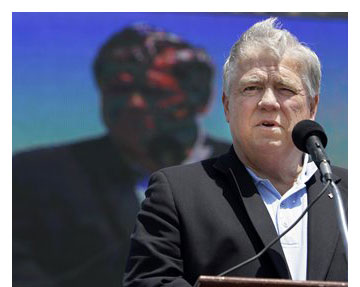

Haley Barbour

A harder look at Haley Barbour’s post-Katrina miracle

Mississippi's GOP governor did a good job getting cash out of Republicans in Washington, but is he really doing a good job cleaning up after Katrina?

  • more
    • All Share Services

A harder look at Haley Barbour's post-Katrina miracle

As president of the supervisory board in Hancock County, Miss., Roderick “Rocky” Pullman faces more problems than he sometimes cares to think about. In August 2005, his coastal county became “ground zero” for Hurricane Katrina, when the eye of the most destructive storm in the nation’s history made landfall just south of Pearlington, the small town on the Louisiana border 40 minutes from New Orleans that he calls home.

Katrina’s 170-mph winds and 35-foot waves literally reduced Pearlington to rubble. Every last vehicle and building in town was destroyed. In Hancock County as a whole, 50 residents were killed, and half the businesses and homes were wiped out. When relief teams arrived 10 days later, they found 600 people living under tents and tarps, linked to the outside world only by ham radio.

Today, Hancock County and the rest of coastal Mississippi are 21 months into a recovery that has garnered Gov. Haley Barbour lavish praise. Governing magazine named Barbour its 2006 Public Official of the Year largely due to his supposed post-Katrina leadership and savvy, including his skill in convincing federal lawmakers to channel billions of relief dollars to the Magnolia State. As Billy Hewes III, a Republican official from Gulfport, said: “He is to Katrina what Rudy Giuliani was to 9/11.” Outsiders might be surprised to learn then, that despite the plaudits, and despite the fact that Barbour’s GOP connections seem to have won him a disproportionate share of relief money from Washington, post-Katrina recovery in some of the hardest-hit areas of the Mississippi coast is moving as fast as molasses in winter.

In Hancock County, Rocky Pullman paints a bleak picture. The recovery is proceeding so slowly that, almost two years after the storm, most of his neighbors still can’t get mail. Before Katrina, the majority of Pearlington residents used post-office boxes; but since no post offices — or any other major city, county or school buildings in Hancock County — have been rebuilt, they have to drive an hour round-trip to Bay St. Louis to pick up a letter.

“We’ve been asking for three post offices to be erected in Hancock County for well over a year now and have got no response whatsoever,” Pullman says. “Those are the kind of things that really bother you. It’s hard to get people to feel good when they have to spend the amount of money they do with the price of gasoline just to get their mail.”

Barbour, the former chairman of the Republican National Committee with close ties to the Bush administration, has definitely proved more successful than his maligned Louisiana counterpart, Democratic Gov. Kathleen Blanco, in one respect: lobbying Washington for cash. In fact, Barbour’s ability to steer a lopsided share of Katrina money to Mississippi has touched off a firestorm of outrage in Louisiana, which suffered considerably more destruction from the storm.

Consider the Gulf Coast housing crisis, one of the key issues that has kept nearly half the population of New Orleans from returning to the city since Katrina. More than 75 percent of the housing damage from the storm was in Louisiana, but Mississippi has received 70 percent of the funds through FEMA’s Alternative Housing Pilot Program. Of the $388 million available, FEMA gave a Mississippi program offering upgraded trailers more than $275 million. Meanwhile, the agency awarded Louisiana’s “Katrina Cottage” program, which features more permanent modular homes for storm victims, a mere $75 million.

It’s not just housing. Mississippi is also slated to get 38 percent of federal hospital recovery funds, even though it lost just 79 beds compared to 2,600 lost in southern Louisiana, which will get 45 percent of the funds. Mississippi and Louisiana both received $95 million to offset losses in higher education, even though Louisiana was home to 75 percent of displaced students. The states also received $100 million each for K-12 students affected by the storms, despite the fact that 69 percent resided in Louisiana.

The disparity between the states’ needs and the funding they received from Washington has been so glaring that even disgraced former FEMA director Michael Brown recently charged that politics played a role. “Unbeknownst to me, certain people in the White House were thinking we had to federalize Louisiana because she’s a white, female Democratic governor and we have a chance to rub her nose in it,” Brown told students at Metropolitan College of New York in January.

The White House denies any favoritism. But as Sen. Mary Landrieu, D-La., has pointed out, much of the power in allocating Katrina recovery funds before this year fell to a Republican-controlled Congress — and, more specifically, to a Senate committee chaired by Sen. Thad Cochran, who just happens to be a Mississippi Republican.

“Sen. Cochran certainly felt very fortunate to be in the position he was in when the hurricane hit because he was able to make sure both Mississippi and Louisiana got the help they needed,” press spokeswoman Margaret McPhillips told Salon.

As for Gov. Haley Barbour, his office declined to comment on the funding disparity for this story. But when the issue came to a head this spring, Barbour downplayed the role of his political connections, instead insisting that his state was putting federal money to better use; as he told the Associated Press, “Congress is getting their money’s worth in Mississippi.”

For the residents of Hancock County, Barbour and Mississippi’s ability to capture the lion’s share of Katrina relief dollars makes the slow progress in their area all the more demoralizing. The county’s 911 system still operates out of a trailer. Damaged wastewater and drainage systems frustrate hopes of a return to normalcy; earlier this month in Waveland, 16 miles east of Pearlington, a 9-and-a-half-foot alligator was found swimming in a drainage ditch next to a bus stop at 8 o’clock in the morning. Mayor Tommy Longo says the creatures freely roam throughout devastated residential areas.

Indeed, Hancock County was one of three Gulf Coast areas recently singled out as having “severe problems” by the Rockefeller Institute on Government and the Louisiana Public Affairs Council, with the towns of Waveland and Bay St. Louis flat-out “struggling to survive.”

Most important, Hancock leaders say, Mississippi leaders and their federal allies have failed to use their clout to tackle some of the most obvious barriers to rebuilding.

For example, the Robert T. Stafford Act, a federal law governing recovery efforts, requires affected communities to pay a 25 percent match upfront before they can receive federal disaster funds. After Katrina, the White House reduced the match requirement to 10 percent — a still-hefty sum for devastated areas. Rocky Pullman estimates Hancock County will need to come up with up to $8 million to get federal funds for basic services. “I don’t know where they expect us to get that money from,” Pullman says.

President Bush waived the match requirements entirely for New York following the 9/11 attacks, but he has said he opposes any further waiver for Katrina funds. The Iraq/Katrina supplemental appropriations bill passed by Congress last month would have completely waived the match, but the president vetoed it. The new House bill approved last week also waives the match, but the president has not signaled his willingness to compromise on the issue.

“If ever they’ve waived that match requirement, they should do it now,” says Pullman. “If they don’t do it for Katrina, then shame on them, because that’s almost as bad as the storm hitting us again.”

Parts of Mississippi are doing much better than Hancock County. The Rockefeller Institute report found that recovery “is well underway” in Biloxi, Gulfport and Pascagoula, and that there’s actually been a post-Katrina economic boom in Jackson, Hattiesburg and Laurel.

And thanks to the economic boost in certain areas, Mississippi is now looking at a windfall in tax revenues. For the first six months of the 2007 budget year, general fund revenues were up 12.7 percent, and the Mississippi Legislative Budget Committee and the governor recently increased the estimate for the 2007 budget from $4.5 billion to nearly $4.7 billion, which means the state has an extra $192.7 million thanks to higher-than-expected tax collections largely from Katrina spending.

But under Barbour’s leadership, the state has been unwilling to use its good fortune to help debt-ridden towns — and some are at risk of going under.

In Hancock County, towns racked up massive debt when federal officials promised to make disaster loans but failed to move quickly enough. The Mississippi Development Bank stepped in and loaned $5.3 million to Hancock County and $4.5 million to the town of Waveland to keep basic operations running. State officials hoped FEMA would reimburse some of the money, but that hasn’t materialized.

Now those loans — about $79 million across the Mississippi coast — come due in October, and small towns hardest hit by Katrina have no idea how they’ll meet the obligation. “We literally had no choice” but to take out those loans, says Waveland’s Mayor Longo. “And in the ground zero area of Hancock County and Waveland, we’re not in really much better shape economically than we were then. We’re certainly not in any shape to pay back those loans right now.”

Mayor Longo thinks at least part of Mississippi’s post-Katrina tax windfall could go to help his and other storm-crippled communities deal with their debt, but Gov. Barbour has rebuffed the idea. And that has Longo and other local officials in Hancock contemplating the heretofore unimaginable.

“One thing you continually hear from officials from FEMA to the state level is that — and they love this phrase — they’ve ‘never seen a city go under because of a natural disaster,’” Longo says. “But there have been so many firsts in Katrina.”

Chris Kromm and Sue Sturgis are editors of Gulf Coast Reconstruction Watch, a project of the Institute for Southern Studies in Durham, N.C.

Personhood’s Mississippi moment of truth

Personhood is heading for a tight vote today. Either way, the result will reshape the abortion debate for years

  • more
    • All Share Services

Personhood's Mississippi moment of truth Protestors during a prayer rally for the Personhood Amendment at the Capitol in Jackson, Mississippi (Credit: Rogelio V. Solis/AP)

“It just seems so unfair that you got your two children and now you’re taking the rights (away) for others,” said Cristen Hemmins yesterday.

Hemmins, the most visible face of the movement to defeat Mississippi’s now-notorious Personhood Amendment, heading for a close vote today, was talking to Brad Prewitt. He’s the campaign director charged with passing the initiative, which defines life as beginning at fertilization. He’s also a father through in-vitro fertilization, which fertility specialists say Initiative 26 would make practically impossible.

“Nothing’s fair,” Prewitt replied, according to a recording, and walked away.

Prewitt (who didn’t respond to my request for an interview yesterday) had reason to be testy. Initiative 26, until recently considered an easy sell in a fiercely antiabortion state, had just been declared a tossup in a reliable poll. Support for the amendment has dropped 17 points in just two weeks, his anti-26 counterpart, Stan Flint, told me, as the public debate shifted to what it would actually mean to declare fertilized eggs people. It would affect not only IVF, but also ban abortion and many common forms of birth control, open the door to prosecuting women who suffer suspicious miscarriages, and tie the hands of doctors trying to save women’s lives.

Prewitt’s compatriots sounded worried from the stage of the Tupelo, Miss., press conference. “I thought we would have won easily two months ago, but there’s been so much distortion, lies told, and some people believe them,” said Donald Wildmon, whose American Family Association helped take Initiative 26 (relatively) mainstream. “We’ll wait and see and we’ll pray that tomorrow will be a good day.”

No one was as upset as Lt. Gov. Phil Bryant, despite the fact that the same polling that found Personhood too close to call also predicted he would be elected governor of Mississippi today. ”You’ve heard some very complex television and radio ads lately that say that these men here and many of the women that join us … somehow want to do harm to women,” he fumed. “Let’s just call it what it is, it’s wild and crazy. But that’s what the other side must do whenever we stand up for life and say, it’s simple, that child in the womb after conception has the same basic human rights as you and I.”

Bryant went so far as to compare the issue to the Holocaust and the Jews of Nazi Germany “being marched into the oven,” because of “the people who were in charge of the government at that time.” He described the ballot measure as “a battle of good or evil,” and warned, “the evil dark side that exists in this world is taking hold. And they’re saying, what we want you to be able to do is continue to extinguish innocent life. You see, if we could do that, Satan wins.”

Presumably referring to Christian leaders who have opposed or declined to support the measure, including the state’s Catholic and Episcopal bishops and a Baptist pastor in Greenville, Miss., who wrote a letter saying, “I’m a Christian and I love Jesus … I’m pro-life and against abortion … and I love Mississippi … but I’ll be voting NO on Initiative 26,” Bryant finished, ”Those who are out there and say, ‘I don’t know, it just seems too complex for me,’ remember this: You’re on the side of the lie. You’re on the side of taking the lives of innocent children. It is no more complex than that.”

Notably absent from the event was Haley Barbour, the current Mississippi governor, who last week inexplicably gambled some of his massive popularity in the state by first expressing doubts on Initiative 26, then saying he’d voted for it anyway by absentee ballot. In the interim, he was blasted by Personhood USA for being in the pocket of abortion-pill makers and turned into a robocall for the anti-26 side (which he later demanded, successfully, that they stop running).

Though a press release had been sent out for yesterday’s event, and the lineup included U.S. Sen. Roger Wicker and Rep. Alan Nunnelee, there also seemed to be no reporters present. The only questions were asked by Alan-Michael White, a smart-ass student at the University of Mississippi who recorded the media availability, and Hemmins, who asked Bryant how he could deny her, a rape survivor, autonomy over her body. “What I could never understand, because this is so personal to me, is why can’t you men have any sympathy for me as a rape victim?” she said. “All your sympathy goes to a fertilized egg. You can’t even see it yet … But we’re here and we’re real people and we deserve to make decisions with our own bodies.”

Strangely, this is where Bryant eventually yielded some ground. “To believe that somehow a judge would say, ‘I’m going to prosecute this rape victim,’ I think is beyond anyone’s reasonable ability in a real world instance to say that that’s going to happen,” he said, declining to elaborate how judges might decide to give one-time passes to “murders.”

The press conference came to a close with Hemmins’ friend Elizabeth Feder Hosey objecting, emotionally, to being “likened to Satan,” and how her “daughter is going to grow up in a state that doesn’t value her.” She shouted, “Mississippi mothers are not evil, we are not Hitler. You look me in the eye, Phil Bryant, you tell me I’m evil! You never carried a child.”

Meanwhile, Personhood USA, which made a significant investment in trying to get Mississippi to pass the first ever such amendment to try to flout Roe v. Wade, was trying to use similar rhetoric. “Increasingly, the American people are being treated paternalistically by a government, media and public sector elite that stands in direct opposition to our traditional American values,” wrote Gualberto Garcia Jones in USA Today. He continued, “Using the courts as its instrument, this American elite has emasculated a once independent America.”

With that recent polling showing a one-point spread between yes and no votes, with 11 percent undecided, each side will be mobilizing its ground game today. On pro-26 sites, which still boast a major organizational and political advantage, grass-roots activists talked about fasting today and exchanged Bible verses.

Hemmins told me last night, “All of the nation and people around the world are waiting to see how we vote … and whether Mississippi is going to reinforce all the negative stereotypes that most people have of our state. Are we going to vote against our interests again? Are we going to be the backwards idiots they think we are? I really think we’re going to prove them wrong.”

Continue Reading Close
Irin Carmon

Irin Carmon is a staff writer for Salon. Follow her on Twitter at @irincarmon or email her at icarmon@salon.com.

Haley Barbour’s neo-Southern strategy fails

Maybe America isn't ready for a president who claims Mississippi racism wasn't "that bad"

  • more
    • All Share Services

Haley Barbour's neo-Southern strategy failsHaley Barbour

Only a few hours after the Washington Post reported that Mississippi Gov. Haley Barbour was less than a week from his declared deadline to make a decision, “and most expect him to run,” Barbour announced the opposite. “I will not be a candidate for president next year,” the Republican said in a statement Monday. “A candidate for president today is embracing a ten-year commitment to an all-consuming effort, to the virtual exclusion of all else. His (or her) supporters expect and deserve no less than absolute fire in the belly from their candidate. I cannot offer that with certainty, and total certainty is required.”

In a primary field still crowded with people who will never be president, Barbour’s departure is nonetheless good and bracing news. Late last year, the man from Yazoo City floated a new Southern strategy in what was probably intended as a positive Weekly Standard profile, and it went nowhere. Barbour told the Standard that racism in his hometown wasn’t “that bad,” and praised the local chapter of the notorious White Citizens Council for policing the Ku Klux Klan; later he refused the state NAACP’s request that he denounce efforts to issue a state license plate to honor KKK founder Nathan Bedford Forrest. I said at the time that Barbour’s Weekly Standard comments weren’t a gaffe, but a trial balloon for politics in post-Obama America: C’mon, isn’t everybody sick of all the whining about racism? It wasn’t that bad!

It turns out maybe America isn’t ready for a president who wants to say racism wasn’t “that bad.” Certainly Barbour wasn’t ready for a campaign in which his efforts to whitewash the past came in for scrutiny and even criticism, rather than praise. Barbour was also stuck trying to sell his past as a lobbyist and ultra-D.C. insider as an asset in a party whose Tea Party base is rejecting insiders.

In a short post on Barbour’s decision, CNN added this observation: “Although he is popular among Washington insiders, he has had trouble gaining traction in recent national polls.” That’s what makes Barbour’s statement so petulant; rather than acknowledging his limited electoral appeal, he’s saying he’s just not that into us and can’t make a 10-year commitment. Please.

The conventional wisdom is that Barbour’s decision helps his friend Mitch Daniels, the Indiana governor who seems to be the Beltway’s crush of the week (the way Fred Thompson was four years ago). A glowing Washington Post profile just this morning lamented that despite his alleged leadership on debt and deficit issues, Daniels still seems reluctant to run for president. The Indiana Republican even has a catchy slogan, calling debt the “new red menace,” comparable to the Soviet Union’s nuclear threat.

A couple of things about Daniels’ crusade against deficit spending. First, let’s remember that during the last decade of the Cold War, at least, the Soviet Union turned out not to be much of a threat; in the short term, deficit spending isn’t either. Then and now, “the red menace” is just one in a long series of GOP slogans designed to foment fear, not problem-solving. Maybe more important, it’s pretty incredible to see George W. Bush’s former budget director hailed as a deficit hawk, having worked for the man who sank the Clinton budget surplus in a tide of red ink. But Daniels is another guy Beltway insiders think is “serious.” He’s not much more likely to be president than Haley Barbour, but we’ll have to take him seriously for a while nonetheless.

All of this might seem to benefit Mitt Romney, the nominal GOP front-runner, except Romney can’t get out of his own way. He just accused President Obama of engaging in “one of the biggest peacetime spending binges in American history.” That would be a catchy charge, except with wars in Iraq and Afghanistan, this isn’t peacetime. The president who ran up the largest peacetime deficit in history, by the way, was Ronald Reagan. And in case you’re inclined to think maybe Romney just misspoke on the campaign trail, he denounced Obama’s “peacetime spending” in an op-ed for the Union-Leader in New Hampshire.

Continue Reading Close
Joan Walsh

Joan Walsh is Salon's editor at large.

We won’t have Haley Barbour to kick around anymore

The Mississippian with a tin ear for race decides not to run for president. Is Mike Huckabee the big winner?

  • more
    • All Share Services

We won't have Haley Barbour to kick around anymorePossible Republican presidential candidate, Mississippi Gov. Haley Barbour talks with reporters at Riley's Gun Shop, Thursday, April 14, 2011, in Hookset, N.H. (AP Photo/Jim Cole)(Credit: AP)

This was going to be the week that Haley Barbour made official what we’ve all been assuming for a while: That he’s a candidate for the 2012 Republican presidential nomination.

Instead, he’s dropping out.

The Mississippi governor, who was in New Hampshire just over a week ago and who was slated to return to the first-in-the-nation primary state in early May, released a statement Monday afternoon claiming that he’s not sure he has the “absolute fire in the belly” required to wage a ’12 campaign.

On one level, it’s easy to see why Barbour is backing out now. The burden of his tone deaf (and worse) comments on race and his home state’s fraught racial history posed two serious problems for him: (1) In a general election campaign against America’s first black president, they might distract from or overshadow his and his party’s preferred message; (2) The prospect of (1) threatened to cost him primary season support from the conservative establishment — which might not have a problem with his comments per se, but which is not overly eager to commit political suicide in the ’12 election.

So Barbour, a man with no shortage of longstanding, intimate ties to members of the conservative establishment, has spared himself the potential indignity of being told, day after day throughout 2011 and early 2012, “Sorry, Haley” by one old friend after another.

Still, it’s surprising that he didn’t take a shot. There continues to be an unusual amount of room to maneuver on the Republican side. There is no runaway favorite gobbling up cash and endorsements and leaving the rest of the field in the dust in horserace polls. Mitt Romney may be the closest there is to a natural front-runner, and his struggle to win acceptance from key GOP coalition components is well-documented. Donald Trump’s recent rise in GOP polls — which will almost certainly reverse itself if he persists with his candidacy charade — is a testament to how eager GOP voters are for someone, anyone to rescue them from the uninspiring candidate choices they now face.

Against Mitt and T-Paw and Rick Santorum and Buddy Roemer, maybe Barbour could have found some traction (as improbable as it seems), fared surprisingly well in Iowa, made it through New Hampshire, then made a big move in South Carolina and the rest of Dixie. This is the kind of Republican field in which every candidate (well, OK, not every candidate) can look at his rivals and ask, “Why not me?”

Within minutes of Barbour’s announcement, some conventional wisdom had already emerged: The biggest beneficiary of this news would be … Mitch Daniels, the Indiana governor and Barbour buddy who’s been mulling a run (with David Brooks and other think tank-types pleading with him to get in).

This might be a bit shortsighted, though. Sure, to the extent Daniels was undecided because of his personal friendship with Barbour, this news should make it easier for him to run and (perhaps) to corral some establishment support that otherwise would have gone to Barbour. But another potential candidate stands to benefit far more: Mike Huckabee, who has seemed far more interested in running lately than he did just a few months ago.

Huckabee, obviously, has strong built-in support from evangelical voters — enough to make him the instant Iowa front-runner if he gets in. Now, remember one of the reasons why Huckabee’s campaign fizzled after his Iowa victory in 2008: Too many white born-again Christian voters in the South stayed away from him, instead opting for Romney or John McCain (who by the time Super Tuesday rolled around had become the clear GOP frontrunner). The good news for Huckabee is that, since the ’08 campaign, his appeal to all Republican voters has grown significantly; his popularity is higher today within the GOP than any other ’12 prospect. In other words, Huckabee has put himself in position — at least potentially — to expand his ’08 coalition and to win key Southern states that eluded him in 2008.

In this sense, a Barbour candidacy, with its strong regional appeal, could have been problematic for Huckabee. If he does run and win Iowa, Huckabee would probably then lose New Hampshire handily; Southern, religious-flavored conservatism has never sold well in the Granite State. Thus, he’d then need to bounce back — strongly — in the South. The last thing he’d need is Barbour eating up votes that might otherwise go to the region’s other candidate in the race.

The South’s importance to the GOP is only growing, and so is its sway in the party’s nominating process. And Huckabee may be the region’s best bet in ’12; unlike Barbour, he’s learned to talk about race in a way that doesn’t alienate general election voters from outside the region. If he does run, his prospects of doing so as the South’s candidate just improved.

Continue Reading Close
Steve Kornacki

Steve Kornacki writes about politics for Salon. Reach him by email at SKornacki@salon.com and follow him on Twitter @SteveKornacki

Haley Barbour doesn’t care about born children

Mississippi has been shamefully slow in making ordered reforms to its child welfare agency

  • more
    • All Share Services

Haley Barbour doesn't care about born childrenMississippi Gov. Haley Barbour speaks during the Conservative Principles Conference Saturday, March 26, 2011, in Des Moines, Iowa. (AP Photo/Charlie Neibergall)(Credit: AP)

One of the many reasons why it’s amazing that Haley Barbour is supposed to be taken semi-seriously as a presidential candidate is that he’s basically the governor of a failed state. (Among the other reasons are his appearance, voice and career history.) Mississippi leads the nation in almost everything that a state doesn’t want to lead the nation in. Mississippi is the poorest state in the union, with the highest poverty rate and the lowest quality of life. And the state government is ineffective and oblivious when it isn’t just plain corrupt. Which brings me to Mother Jones’ report today on Mississippi’s child-welfare system, which, you will probably not be surprised to learn, is underfunded, understaffed and completely unable to protect the welfare of children.

That is hardly fresh news. Mississippi’s child welfare system has been shockingly inadequate for years. Poorly trained social workers are handling far too many cases, and there are thousands upon thousands of reports of abuse and neglect every year. Many of those reports are not acted upon by the state’s Division of Family and Children’s Services, which the governor controls. The state was sued in 2004 and was forced to agree to a series of reforms. Now, years after settling, the state has not reformed very much:

Except, four years later, that overhaul hasn’t happened. According to the independent monitor assigned by the court to the Olivia Y. case, DFCS, under Barbour’s watch, has struggled to implement the required reforms. A 2010 report (PDF) by the monitor, Grace Lopes, noted that DFCS had missed deadlines laid out in the settlement, and was nowhere near on track to meet the requirements agreed to by the state. While child welfare funding had increased and a new management team was in place, the state was still failing badly. In some instances, Lopes wrote, there was “no evidence” that Barbour and state officials had even tried to comply with the settlement.

In October, the attorneys who had sued Barbour years earlier filed a contempt motion. Of the 119 requirements Mississippi needed to meet by the end of 2009, it had partially or fully fulfilled only 17, according to legal filings. Barbour’s administration failed outright to meet 52 of the requirements, and neglected to provide data to Lopes on the remaining 50, so she couldn’t assess whether the state had done what it had promised or not. The lawyers say extreme measures are now necessary to fix Mississippi’s child welfare system, including appointing a receiver who would seize control of DFCS and force changes to be made. “Mississippi’s court-ordered reform of its foster care system is moribund and children continue to live in jeopardy,” the motion concludes.

“Republican governor of impoverished state does as little as possible to help neediest citizens.” That will probably not ever be a FLASH in Politico’s PLAYBOOK.

But then, Gov. Barbour has a very different idea of who counts as Mississippi’s “neediest citizens”:

“My first year as governor my pro-life agenda was adopted by our Democrat-majority legislature, and Americans United for Life, I am proud to say, named Mississippi the safest state in America for an unborn child,” Barbour said.

It’s a bumper-sticker cliché, I know, but rarely is it illustrated so starkly: Mississippi is “the safest state in America” for a child until the second it is born. At that point, you’re on your own, sister!

Continue Reading Close
Alex Pareene

Alex Pareene writes about politics for Salon and is the author of "The Rude Guide to Mitt." Email him at apareene@salon.com and follow him on Twitter @pareene

Haley Barbour’s morning e-mail list full of tasteless jokes

The Mississippi governor's staff can't put together press clippings without insulting women, Japan, everyone else

  • more
    • All Share Services

Haley Barbour's morning e-mail list full of tasteless jokesGov. Haley Barbour addresses a meeting of the Mississippi Energy Policy Institute in Jackson, Miss., Tuesday, Feb. 15, 2011. At a news conference following the address, Barbour said he would not denounce a Southern heritage group's proposal for a state-issued license plate to honor Confederate Gen. Nathan Bedford Forrest, who was an early leader of the Ku Klux Klan. (AP Photo/Rogelio V. Solis)(Credit: Rogelio V. Solis)

You know that older relative you probably have who forwards awful sexist or racist jokes to everyone in his address book, or obliviously writes offensive comments on Facebook posts? Haley Barbour and his staff are basically that relative, only they are trying to set up a presidential campaign instead of just spending their retirement watching Fox News all day.

Every morning Barbour’s press secretary e-mails “a list of press clippings, along with a daily compendium of birthdays, historical notes, and jokes” to the rest of Barbour’s staff along with some unidentified other Barbour “allies.” And, obviously, the “jokes” on the list are real knee-slappers about how Janet Reno is a man and something about the horrible disaster that struck Japan a few days ago. And that’s just from the “on this day in history” section:

Otis Redding posthumously received a gold record for his single, “(Sittin’ on) The Dock of the Bay”. (Not a big hit in Japan right now.)

In 1993: Janet Reno was unanimously confirmed by the U.S. Senate to become the first female attorney general. (It took longer to confirm her gender than to confirm her law license.)

Ha ha ha! Those are top-quality jokes from Barbour press secretary Dan Turner, who, when questioned about those awful jokes and others, did not even bother to sound embarrassed. Though he did say Barbour doesn’t himself receive the e-mails. Not that he wouldn’t enjoy them! “His sense of humor isn’t so much in the SNL vein,” Turner said. Though, wait, maybe that means he doesn’t enjoy jokes about Janet Reno’s apparently insufficient femininity?

Continue Reading Close
Alex Pareene

Alex Pareene writes about politics for Salon and is the author of "The Rude Guide to Mitt." Email him at apareene@salon.com and follow him on Twitter @pareene

Page 1 of 6 in Haley Barbour