
Terrorism
Bomb plot tests British again
New Prime Minister Gordon Brown edges away from Tony Blair and the Iraq war as the U.K. braces against the rising terror threat.
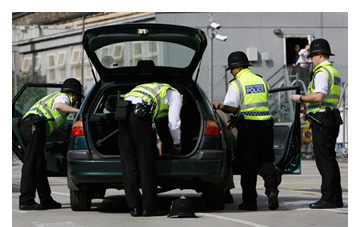
The Tubes are crammed with commuters, the pubs packed with people downing a few pints after work. Even the tourists are out in force in Piccadilly Circus, seemingly more put off by the torrential rain than the fact that a few days earlier, just around the corner, two potentially lethal car bombs — each of which was stuffed with gasoline cans, nails and propane gas cylinders — failed to explode. The British have also taken the attack on Glasgow international airport in stride; police and airport officials moved quickly to reopen the airport after two men rammed a flaming Jeep Cherokee into its main entrance. Almost two years after the 7/7 London bombings — in which four suicide bombers killed 52 people on the capital’s public transport system — the threat of terrorism is something the British have learned to live with.
They’ve had a lot of practice, of course. Decades of IRA terror inured many to the risk. Over a two-week period in the spring of 1999, three nail bombs, apparently aimed at London’s ethnic and gay communities, went off around the city. Then came the July 7, 2005, attacks, followed two weeks later by a second, failed attempt to strike the transport system. These new attacks are different, though, for two reasons. First, this time around Gordon Brown, not Tony Blair, is prime minister. And second, it so far appears that none of the suspects are British-born.
Some have speculated that the Glasgow hit was meant to send a message to the new Scottish prime minister: Your government will not be spared. Glasgow international airport is clearly not a high-profile target, certainly nowhere near as conspicuous as Heathrow, the locus of a failed plot to blow up a dozen airliners last year, or Haymarket in central London, the busy theater and nightclub district where the two car bombs were parked. Brown responded with characteristic solemnity. “We will have to be constantly vigilant,” he said. “We will have to be alert at all times. And I think the message that’s got to come out from Britain, and from the British people, is that as one, we will not yield. We will not be intimidated and we will not allow anyone to undermine our British way of life.” And he deftly sidestepped the question of whether the war in Iraq had made the U.K. a target in the first place: “Irrespective of Iraq, irrespective of Afghanistan, irrespective of what is happening in different parts of the world, we have an international organization trying to inflict the maximum damage on civilian life in pursuit of a terrorist cause that is totally unacceptable to most people.”
One columnist described Brown’s demeanor as that of an “anxious headmaster.” There was definitely something plodding about his rhetoric, but he sounded both assured and reassuring. The style and substance of his remarks were clearly crafted to underline the differences between himself and his predecessor. He went out of his way, for example, to defer discussion of new police powers to question suspects after they have been charged, something Blair had pushed hard for. In the weeks before Brown became prime minister, he was at pains to signal he would be just as tough as Blair on terror, but that he would insist on judicial and parliamentary oversight of any new laws, something to which Blair was often seen as indifferent.
Brown also stressed the need to win the battle for hearts and minds, calling for a “cultural effort, almost similar to what happened in the Cold War b
Three of the four 7/7 suicide bombers were born in Britain to immigrant parents, leading to fears that the war in Iraq combined with Britain’s own internal ethnic tensions were spawning home-grown terrorists. So far, none of the seven people arrested in connection with the London-Glasgow attacks are believed to be British-born; two are said to be doctors, one from Iraq and one from Jordan. The fact that there seems to be no local involvement is encouraging, if only because it may suggest the radicalization of young British-born Muslims has not escalated since 7/7. That is small comfort, though, given that this is not the first car bomb plot in the U.K. A similar plan by Dhiren Barot, an Indian-born Muslim convert, was foiled in 2004. Barot was sentenced to 40 years in prison last year for preparing what he called the “gas limos project,” a plot to fill stretch limos with propane gas cylinders and detonate them in the parking lots of key London buildings. The British will need all the poise and determination they can muster, because it looks like the threat is here to stay.
James Geary, the former Europe editor for Time magazine, is the author of the New York Times bestseller "The World in a Phrase," a history of the aphorism. "Geary's Guide to the World's Great Aphorists" is out in October. More James Geary.
Senate Democrats heroically fund TSA
Democrats score the dumbest political victory of 2012
(Credit: Reuters/Frank Polich) On Tuesday, a Senate Appropriations Committee vote effectively highlighted everything that is stupid about politics.
The Transportation Security Administration, a universally loathed government agency, is facing a shortfall, despite its more than $8 billion budget. Instead of having a debate over what effective airport security might actually look like and how much should reasonably be spent on the honestly rare threat of commercial-air-travel-based terrorism, there was a debate over how best to come up with the money needed for all the radioactive naked picture machines and bomb-sniffing dogs. The Democrats suggested passing on the cost of ineffective, cumbersome and intrusive security theater to citizens, via higher fees on airfares. The Republicans, even more predictably, suggested cutting spending that directly helps poor people to ensure there is enough to spend on stopping imaginary future 9/11s.
Continue Reading Close
Alex Pareene writes about politics for Salon and is the author of "The Rude Guide to Mitt." Email him at apareene@salon.com and follow him on Twitter @pareene More Alex Pareene.
Police arrest artist setting up ‘I Love NY’ work
The installation included a plastic bag with a battery inside of it, hanging from a tree
(Credit: http://tmiyakawadesign.com/) NEW YORK (AP) — An artist who was setting up an “I Love New York”-themed public art display in Brooklyn was arrested after the wired contraption was mistaken for an explosive device.
Takeshi Miyakawa, a visual artist and furniture designer, was arrested Saturday after placing the installation in two separate areas of the same New York City neighborhood. His lawyer and employer both called the arrest a misunderstanding.
The first apparatus was found Friday morning after a caller reported a suspicious package to police. It consisted of a plastic bag that contained a battery and was suspended from a metal rod attached to a tree. The bag, which had the classic “I Love New York” logo printed on it, was connected by a wire to a plastic box that contained more wires.
Continue Reading CloseBehind the underwear bomb
The latest airplane terror plot wouldn't have been foiled without airport security -- but not the kind we all know
Travelers line up at a TSA checkpoint at Los Angeles International Airport.
(Credit: Reuters/Danny Moloshok) Another deadly plot taken down in the planning stages. This time, thanks to the work of a CIA double agent, officials were able to infiltrate a Yemen-based al-Qaida plot to destroy a U.S.-bound jetliner using a nearly undetectable underwear bomb.The moral of the story: Airport security works!Am I being facetious? Not necessarily. It depends on your definition of airport security.
In my mind, the key to keeping airplanes safe is, and always has been, stopping acts of sabotage while they are still in the planning stages. Here in the age of the TSA checkpoint, with its toothpaste confiscations and obsession with pointy objects, we tend not to think this way, preoccupied instead with a kind of airport Kabuki — the tedious, fanatical screening of passengers and their carry-ons. Real airport security takes place offstage, as it were. It is the job of the folks at the CIA and the FBI, working together with foreign authorities. And while TSA has an important role here too, we can do without the spectacle of airport guards rifling through innocent people’s bags in a pathological hunt for what are effectively harmless items.
Continue Reading ClosePatrick Smith is an airline pilot. More Patrick Smith.
Hiding 9/11′s last secrets
The military tribunal for Khalid Sheikh Mohammed means the American people will never know what drove him to terror
(Credit: Reuters//Brennan Linsley) After a Navy SEAL team killed Osama bin Laden at his Pakistan hideout a year ago this week, it flew his body to the Arabian Sea, weighted it down, and slid it silently off an aircraft carrier into the watery depths.
For many Americans, the secret raid provided a measure of revenge and catharsis for the strikes of Sept. 11, 2001. But it didn’t provide the kind of justice and official reckoning that the country needs to gain real closure. Now the government has a chance to achieve that through a full, fair and open trial of Khalid Sheikh Mohammed and four co-defendants, so the world can finally see the evidence against him as the true architect of the attacks on New York and Washington. The trial kickoff — an arraignment for the men — is scheduled for this Saturday at the U.S.-run detention facility in Guantanamo Bay, Cuba.
Continue Reading CloseJosh Meyer is the author, with Terry McDermott, of the new book, "The Hunt for KSM: Inside the Pursuit and Takedown of the Real 9/11 Mastermind, Khalid Sheikh Mohammed.’’ More Josh Meyer.
FBI heroically locks up ridiculous anarchists on May Day
Feds stop inept radicals from carrying out a plot feds helped them conceive and carry out
U.S. Attorney Steven Dettelbach, left, and FBI special agent in charge Stephen Anthony walk past a map showing the location of a bridge on Ohio Rt. 82. Five men, pictured on the wall behind the map, have been arrested for conspiring to blow up the bridge. (Credit: AP/Mark Duncan) Happy May Day, fellow travelers! If you’re not currently disrupting capitalism and/or having your wrists zip-tied for exercising your right to freely assemble, you probably read about the Federal Bureau of Investigation’s latest, not-at-all suspiciously timed terror sting. The Bureau, in an inspired bit of early-20th century nostalgia, has railroaded a bunch of dangerous anarchists. (Or “dangerous” “anarchists.”) America will not waver in the face of the Galleanist threat!
Continue Reading Close
Alex Pareene writes about politics for Salon and is the author of "The Rude Guide to Mitt." Email him at apareene@salon.com and follow him on Twitter @pareene More Alex Pareene.
Page 1 of 159 in Terrorism