
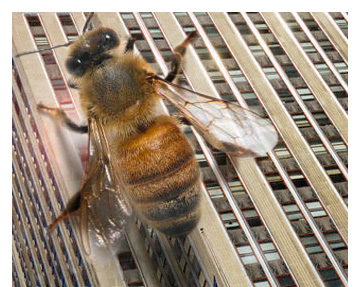

“Beekeeping is a completely sensuous experience,” says Roger Repohl, a beekeeper at the Genesis Community Garden behind St. Augustine’s Catholic Church in the South Bronx, in New York. “You touch and taste the honey, listen to the bees hum, smell the smoke.” Clad in his “vestments” — a white beekeeper suit, veiled hat, thick canvas gloves — he squeezes a “smoker,” a bellows attached to a can that he’s filled with pine needles and lighted with a match. The smoke warns the bees that the keeper is approaching to inspect the hive, but the aroma evokes Christmas. “I use pine needles,” he says, “because they smell good and you might as well be an aesthete about the experience.”
Repohl’s hives are not the natural conical ones that inspired 1960s hairstyles, but square wood boxes stacked five high, like file cabinets, or dresser drawers. He harvests about 300 pounds of honey a year at this peaceful outpost in the middle of auto repair shops, hardware stores and a mom-and-pop slaughterhouse.
Beekeeping is illegal in New York City. The law lumps honeybees together with alligators, lions and ferrets as “wild and ferocious animals.” The city’s urban beekeepers, then, form an unofficial secret society of asphalt naturalists — romantics drawn to the beauty of a beehive’s intelligent design, epicureans seeking the delectable taste of locally procured honey, and off-the-grid types keeping nature alive in the city. Restrictions on beekeeping like those in New York City are uncommon, however. “Chicago has beehives on top of City Hall,” says Kim Flottum, editor of Bee Culture magazine. “Chicago, along with Dallas, Boston, San Francisco and Portland, actively promote beekeeping for pollinator health.”
After years in which they seemed like charming throwbacks — rooftop denizens and community gardeners procuring raw honey and making beeswax candles, tending to insects that inspire fear and awe and irritation — beekeepers and their bees are having a moment. The current national interest in locally grown and organic food and low-impact city living is inspiring people to look into ways to have their hands in their own food production, whether by joining CSAs (community-supported agriculture), raising chickens, or keeping bees.
There are 513 beekeeping associations across the United States, according to Bee Culture magazine. Of its 12,000 readers, Flottum says, “Fifteen percent live in cities with more than 100,000 people.” However, trying to put a number on how many hobbyist beekeepers there are “is like asking how many people garden,” he laughs. “From our surveys, we estimate about 75,000.”
Troy Fore, executive director of the American Beekeeping Federation, which provides educational programs about bees for children and scholarships for graduate students of apiculture, says he feels the increased interest in beekeeping. “The further people get from the agrarian life and the more media attention to bee losses there is, the more people say, ‘Well, maybe I’ll get into beekeeping.'”
This interest, coincidentally, puts urban and backyard beekeepers on the cutting edge of one of agriculture’s biggest dilemmas: colony collapse disorder — the “AIDS of bees,” as Dennis vanEngelsdorp, acting state apiarist for the Pennsylvania Department of Agriculture, puts it. VanEngelsdorp is part of the CCD research team at the University of Pennsylvania. With CCD, the honeybees, highly organized, predictable creatures with finely tuned homing instincts, leave their hives to gather pollen and never return, like sailors drifting into the Bermuda Triangle.
More than a quarter of the country’s 2 million commercial bee colonies have been wiped out, according to the Apiary Inspectors of America, and the hobbyists are not necessarily immune. At stake, says the U.S. Department of Agriculture, is one-third, or $15 billion annually, of the food we eat — everything from almonds and apples to cherries and pears.
Explanatory theories abound, from pesticide and pathogen to radiation from cellphone towers and the onset of the Rapture. Losses by backyard beekeepers have been estimated only anecdotally, but the beekeepers are fearful of the implications. VanEngelsdorp says “pollinators are canaries in the coal mine,” and their disappearance is a referendum on the state of our environment — a reminder of the brilliant and frightening interdependence of our ecosystem.
– – – – – – – – – – – –
Bees stroll along Repohl’s neck like parrots on a friendly pirate’s shoulder. He has an intimate knowledge of their ways and a knack for reading their moods. Still, he says, “Sometimes I stand there looking at them just paralyzed and I don’t know what to do. It’s like looking into the mind of God.”
Repohl is a choir director who lives in the St. Augustine rectory in the South Bronx, providing an ecological education to local kids and sweet honey to those in the know. Each month the honey he procures takes on the flavor of the flowers in bloom: In June, linden flower; in July, clover. No bland-tasting honey pumped into supermarket plastic bears here. He’s dealt with mites, but thus far has been spared CCD.
During a hive inspection, Repohl uses a tool similar to a chisel to pry open the top and assess the health of his hive. In a hive of some 60,000 bees, workers and drones, only one queen rules. Inside the honeycomb’s hexagonal shapes, connected like so many votive candles, worker bees deposit pollen for making bee bread and nectar for curing honey. Deeper down in the hive we see the brood: brownish-tan in color, capped with wax from side to side indicating a strong colony. Repohl breaks open a drone pupa and the bees go to work removing the carcass, which he says they will eat. “Bees live so that the hive may survive,” he says, “but bees also eat their brothers.”
Repohl grew up in the San Fernando Valley, “halfway between L.A. and Disneyland.” He came to the Bronx to do a Ph.D. in theology at Fordham University and befriended a former Trappist monk and master beekeeper who ran St. Augustine’s Church at the time. Now, Repohl, through his workshops at Wave Hill in the North Bronx and in garden conversation, baptizes many a soul into beekeeping. During my visit, we worked while we talked, scraping propolis (a type of glue the bees create to seal the hive) from the hive frames before checking to see if the queen he’d ordered from Texas had been accepted by the hive. She hadn’t. The bees were busily preparing the peanut-shaped cell for a queen of their own. In another hive, bee babies were being born, squirming in circles to push out of their eggs, arms up high, as if at the top of a roller coaster.
Norman Bantz, a Yonkers apitherapist, keeps his hives conspicuously between his door and driveway, the din of the Bronx River Parkway just yards away. The hives buzz with spring fever. At the other end of his unmanicured yard lay empty hive boxes lined with wax moth carcasses. Now in his 80s, Bantz believes that honeybee stings help treat multiple sclerosis and arthritis; he (and many other beekeepers) claim that eating raw, unpasteurized local honey banishes seasonal allergies. He began beekeeping decades ago to help one of his sons, whose allergies were so bad that he couldn’t go outside to play baseball. He and his wife, married 62 years now, sting each other weekly, and he says, “I never have been in a hospital except to visit friends.”
Bantz has perfected the art of mead making (honey wine) and swarm catching — how to act at that moment when the bees decide en masse to leave the hive in search of a new home, to the horror of the uninitiated. He developed an award-winning gadget to catch them: a pool pole attached to a wide-woven basket. Bantz never wears the traditional beekeeper’s protective suit when he enters a hive. He wears short sleeves and sandals. “I believe in divine providence,” says Bantz. “I survived three World War II invasions.”
Both Repohl’s and Bantz’s hives have been untouched by CCD. Bantz’s theory about CCD lays some of the blame with bioengineering. “Queens usually fly out to mate with a drone in the air,” Bantz explains. “The drone has to be very strong to hold them both together, but today the queens are artificially inseminated, the species weakens and loses its instincts.” Repohl uses minimal pesticides and says his bees live a relatively happy, isolated life in the South Bronx, so he prefers to leave the diagnosis of CCD to the scientists. But he likes this theory from his piano tuner: “He thinks bees have gotten turned on to hip-hop and when they do their little dance to tell their sisters where the honey is the bees just take off and don’t come back.”
Sidney Glaser, the retired beekeeper at the Clinton Community Garden on West 48th Street in Manhattan, found his hive dead after winter; the bees had disappeared, probably casualties of CCD. On May Day, as children dance around the Maypole, only flies circle his hive. A Brooklynite by blood and accent, a veteran of the Peace Corps, Glaser began beekeeping on the Lower East Side 20 years ago, having joined the Green Guerillas after retiring from teaching. Wearing denim jacket, pants and shirt, he appears slightly confused and impatient for his apprentice, Michael Hegedus, to arrive with a new queen and a colony of bees to replenish the deserted hive. He has his smoker at the ready, burlap burning in the can.
Glaser likes to tell the story about his bee beard, for which he is infamous in these parts. He first made one while in Paraguay, and then did it again five years ago for PBS. “I hung the queen cage around me like a necklace and all the bees come and gather around her. Before I knew it I had guys on the set doing it as well.”
Hegedus, an actor who renovates Brooklyn homes, arrives with a cardboard box from South Carolina marked “fragile” and bearing the cartoonish image of a bee. Inside, the bees hum actively. Hegedus says he’s waiting to hear the scientific evidence on CCD but he likes to tell people: “It’s the gasoline exhaust. Let’s get rid of the guzzlers.”
To date 35 states have experienced CCD. Maine is not one of them. Once commercial beekeepers have pollinated the state’s vast blueberry fields, there are concerns that CCD could come here as well — that the epidemic, having decimated agribusiness pollen factories and consumed city and suburban hives alike, will spread up the coast like urban blight.
Sitting in a House and Garden-ready country kitchen on the 65-acre Maine farm of the D’Entremont family, Phil Jackson ponders what CCD might mean for them. “If a commercial keeper has lost 80 percent of his hives, you can’t say, ‘I won’t use a cellphone,’ and hope that will bring the bees back,” he says. The cellphone theory, which proposes that the radiation from cellphone towers interferes with bees’ navigational powers, has been discredited by some scientists but is still under investigation. Yet Jackson’s point is clear: They have not been able to rule out any possible explanations.
Jackson started beekeeping during World War II to have some extra sweetener when sugar was being rationed. Since then he’s seen the “complete disappearance of wild honeybees” and watched the simple art of beekeeping become complicated. Not so long ago, he says, “basically they took care of themselves and you’d get 50 to 75 pounds of honey.” But problems have come with mites, and now CCD.
“If CCD continues then we’re at the threshold of catastrophe, especially the farming business. It’s one thing for us backyard keepers to not have a jar of honey, but for the big apple farmer, that [beehive is] a livelihood.” Without bees to pollinate, the apple fields’ survival is at risk.
The D’Entremonts, Chuck and Peg, have been raising their own beef, chicken and turkeys, and making maple syrup for 30 years. Their 18th century house has window sills blooming with orchids, and hummingbirds feeding outside the window at eye level. Chuck D’Entremont thinks that Maine has so far been spared CCD “because of what we do with diversity” — keeping a variety of flowering plants and wild grasses. “And the state of Maine has very strict pesticide license requirements,” which means that beekeepers are alerted when large sprays for gypsy moths or other pests will happen, and take precautions.
The theory that the bees have been taken out by pesticides seems obvious enough, and one group of pesticides — neonicotinoids — has been cited in particular. They impact the central nervous system of insects and can lead to memory and navigational impairment. To be careful, the D’Entremonts don’t order their queens by mail or use pesticides. “Somebody said to me that CCD was like human Alzheimer’s,” says Chuck D’Entremont. “If the bees are getting Alzheimer’s, then the things that are happening to them may be happening to us.”
Nutritional deficiency (the replacement of agricultural diversity with vast fields of a single crop), environmental stress (global warming screwing up the bee’s sensitive attention to seasons), and turning bees into migrant workers for large-scale agribusiness (a movable pollination force that travels by truck from state to state during blooming season) may also play a role in the ultimate diagnosis. The autopsies that vanEnglesdorp and his group are currently performing on those bees that have been recovered are leading toward an “all of the above” answer, but it’s a mystery in need of a particular detective, a cross between Agatha Christie and Rachel Carson.
Massachusetts farmer David Graves runs an underground collective of 17 rooftop keepers in New York City, finding homes for orphaned hives, then selling their honey at his stand in Manhattan’s Union Square Greenmarket. One of his hives sits precariously on a platform, 13 stories up on top of a hotel. Just Food, an organization that addresses food and farm issues, is lobbying the New York City Council to legalize bees so they don’t have to be hidden high in the sky and so that the city can contribute to pollinator health.
“Usually zoning changes to restrict beekeeping are the result of one bad beekeeper who pissed everybody off,” says Bee Culture magazine’s Flottum. “Or one bad neighbor who’s pissed off. And anyway you can’t legislate bees. If a bee wants to get in a hollow and make a hive it will. It’s like telling chipmunks where to dig holes. Having zoning restrictions on bees is just plain silly.”
As for change, as vanEngelsdorp puts it: “Things happen a backyard at a time.” Or one rooftop.
