
Apple
Why I returned my iPhone
The iPhone changed my life. But I'll save my money until Apple makes some key fixes.

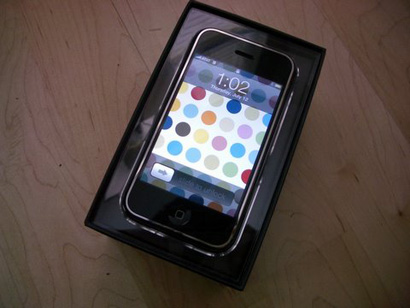
A few hours ago I walked into the Apple Store at the Stonestown Mall in San Francisco and gave back my iPhone. When the friendly salesperson asked me why I wanted to return it, I answered honestly. “I can’t afford it,” I said.
But that was not the whole story.
I’ve been enraptured by the iPhone since January, but I never intended to keep it. Two weeks ago I spent a whole day in line waiting to get one, but as I explained at the time, I did so mainly out of a professional obligation. To me, a $600 phone seemed at least $300 too rich.
This is the story of how I came around. It’s a story about how a beautiful and delightfully useful machine undid my cost-benefit analysis and shifted my calculus of desire. You’ll tell me to get a room, I’m sure, but this much is true: This is a love story — but it’s a love that, alas, must remain unrequited, at least for now.
The romance began at first sight, but it was the touch that felled me. In my review, I wrote that the iPhone’s killer app is your finger. That feeling only deepens with use; in two weeks’ time, I became a master at flying through its touch-screen menus, and typing — which bothered some people but which I found immediately satisfactory — became almost fun. There’s indescribable pleasure in pulling off the phone’s finger gestures — in pinching it, in flicking it, in double-tapping it — and the moves quickly fix themselves into muscle memory. You begin to want to flick your laptop screen too.
But if tapping the iPhone activates your lust, it’s surfing the phone that awakens a deeper, more meaningful connection. It may sound indulgent and tech-obsessed to argue that having constant access to the Web changes the way you think about the world, but give it a try and you’ll see. When you’ve got the Web with you always, printing out grocery lists or directions becomes unnecessary. You never have to call 411. You can find out what’s playing at the movies while you’re in the car. You can look up reviews of products and comparison shop while you’re in the store.
The other night I was at the grocery looking to buy, among other ingredients, Sichuan peppercorns. The store didn’t carry them — a stocker told me that in accordance with an import restriction, the tangy dried berries are hard to find. Ordinarily I’d have been sunk — the peppercorns were a crucial piece in what I was making, and I’d brought along a list for only this one recipe. But I had an iPhone. From the store I did a quick Google search for another recipe I’d been eyeing, and within a minute I had an ingredient list for something new.
The situation sounds banal. Hell, it is banal. But sometimes technology excels exactly when it eases the banal, when it lifts the pressures of the workaday life. I imagine that before they changed everything, refrigerators once struck some people as rather too grandiose, too — what was so wrong with the icebox?
Or recall how, a decade or so ago, you thought about cell phones: that you had no need for them; that because you weren’t a drug dealer, a doctor or Gordon Gekko, you could wait until you got home to make a call. But then you finally got one — because everyone else did — and now you can’t imagine going without. In all kinds of ways, every day, you use the cell to manage your life. Its presence is ingrained in your consciousness. The iPhone is that kind of device; it marks a new way of life. One day we’ll all have iPhones, or things that aim to do what this first one does, and your life will be better for it. Don’t believe me? Bookmark this page and come back in five years.
So if I’m so hot for it, why am I giving the iPhone back? There are loads of reasons: As a phone, it’s middling (or it’s fantastic and stuck on a middling network, which amounts to the same thing); it’s missing some key features; and even though many of these features could be added by third-party developers, Apple has locked it up. I listed the main missing features here; of these, the one that rankles most is 3G networking. The iPhone’s portable Web, as great as it is, runs on EDGE, and thus is too damned slow. I’m hoping that when Apple puts out a phone that can take advantage of the 3G networking standard, it’ll be appreciably faster.
Other omissions aren’t as painful, but they grate: There’s no clipboard, no voice dialing, no way to add wallpaper or ring tones, no search function for contacts or e-mail, no native instant-messaging application, and no way to fully sync the phone’s calendar with Google Calendar (yes, I know about this hack, but it’s not bidirectional and doesn’t work with Windows).
I’m counting on Apple to fix all these, and I’m counting on coders everywhere to help. People have built some nice Web applications for the phone, but as Steve Jobs himself has argued, the best iPhone apps will run directly on the device, not through Safari. Right now, the folks who are trying to build such programs are called “hackers”; as soon as Apple puts out a kit for them to create real iPhone programs — I have faith that Apple sees this as a necessary step — these people will be called “iPhone developers,” and they’ll prompt a flourish of innovation on the phone. All the problems that I have with the phone — even its lock to AT&T — are, in other words, likely not long for this world. Apple or the hackers will clean them up, and maybe soon, too.
But this phone — the phone as it exists right now — is not worth the $600 plus two years of AT&T service (that is, more than $2,000 total). This will change soon. For me, indeed, it’s right on the edge; they could just add voice dial and I’d snap it up. But I couldn’t wait: Apple gives you 14 days to return the phone, and my deadline — as for everyone else who bought the phone on opening day — was July 13. (Apple charges a 10 percent restocking fee when you bring back an open phone.)
Returning the iPhone, by the way, proved easy. At the store, the Apple salesman turned on my phone, navigated to the settings menu and erased all my data. Then he pushed the point of a paper clip through a tiny hole at the top of the device, releasing a little drawer in which the iPhone’s SIM card is housed. He handed me the SIM card, which contains my personal info.
I called up AT&T and canceled my iPhone plan. Later, I popped the iPhone SIM into my old cell, and everything worked as normal. Calls to my number now ring my old phone.
My iPhone, meanwhile, will presumably fly back to Apple to be cleaned up and eventually sold to some very lucky soul. I wish it well.
Farhad Manjoo is a Salon staff writer and the author of True Enough: Learning to Live in a Post-Fact Society. More Farhad Manjoo.
America’s great divergence
The new innovation economy is making some cities richer, many cities poorer -- and it's transforming our country
(Credit: karamysh via Shutterstock) Menlo Park is a lively community in the heart of Silicon Valley, just minutes from Stanford University’s manicured campus and many of the Valley’s most dynamic high-tech companies. Surrounded by some of the wealthiest zip codes in California, its streets are lined with an eclectic mix of midcentury ranch houses side by side with newly built mini-mansions and low-rise apartment buildings. In 1969, David Breedlove was a young engineer with a beautiful wife and a house in Menlo Park. They were expecting their first child. Breedlove liked his job and had even turned down an offer from Hewlett-Packard, the iconic high-tech giant in the Valley. Nevertheless, he was considering leaving Menlo Park to move to a medium-sized town called Visalia. About a three-hour drive from Menlo Park, Visalia sits on a flat, dry plain in the heart of the agricultural San Joaquin Valley. Its residential neighborhoods have the typical feel of many Southern California communities, with wide streets lined with one-story houses, lawns with shrubs and palm trees, and the occasional backyard pool. It’s hot in the summer, with a typical maximum temperature in July of ninety-four degrees, and cold in the winter.
Continue Reading CloseEnrico Moretti is a professor of economics at the University of California, Berkeley, whose research has been supported by the National Science Foundation, the National Institutes of Health and has been featured in the New York Times, the Wall Street Journal and Slate, among other publications. More Enrico Moretti.
The Foxconn raise paradox
The Apple manufacturer's decision to increase wages in China isn't necessarily good news for its workers there
In this May 26, 2010 file photo, staff members work on the production line at the Foxconn complex in the southern Chinese city of Shenzhen, southern China (Credit: AP Photo/Kin Cheung) TAIPEI, Taiwan — Guilt-ridden iPad users were ready to rejoice last weekend, after Foxconn announced that it would bump up pay, reduce overtime and improve living conditions and safety protocols for its legions of Chinese workers producing Apple products in the coastal boomtown of Shenzhen.
For years, the Taiwanese electronics giant has been dodging accusations of bad labor practices, charges that have tarnished the reputation of the world’s hottest gadget retailer.
The trial of Mike Daisey
Salon writers debate the backlash around "This American Life's" retraction scandal
Mike Daisey and Ira Glass (Credit: mikedaisey.blogspot.com/AP/Seth Wenig) Laura Miller: The retraction by the radio program “This American Life” of an episode based on Mike Daisey’s stage show, “The Agony and the Ecstasy of Steve Jobs,” raises (once more) the question of how much fiction we’re getting in our nonfiction. “This American Life” found that several incidents and facts in Daisey’s account of his firsthand investigation of working conditions in the Chinese factories where Apple devices are made were fabricated or otherwise inaccurate.
Continue Reading Close
Mary Elizabeth Williams is a staff writer for Salon and the author of "Gimme Shelter: My Three Years Searching for the American Dream." Follow her on Twitter: @embeedub. More Mary Elizabeth Williams.
Laura Miller is a senior writer for Salon. She is the author of "The Magician's Book: A Skeptic's Adventures in Narnia" and has a Web site, magiciansbook.com. More Laura Miller.
Mike Daisey and the inconvenient truth
When storytellers exaggerate facts -- as a "This American Life" episode about Apple did -- the audience loses
In this undated image released by The Public Theater, Mike Daisey is shown in a scene from "The Agony and The Ecstasy of Steve Jobs," in New York. Daisey, whose latest show has been being credited with sparking probes into how Apple's high-tech devices are made, is finding himself under fire for distorting the truth. The public radio show This American Life retracted a story Friday, March 16, 2012, that it broadcast in January about what Daisey said he saw while visiting a factory in China where iPads and iPhones are made. (AP Photo/The Public Theater, Stan Barouh) (Credit: AP) I can’t be the only listener who thought this past weekend’s edition of “This American Life,” the public-radio show, was among the most compelling work Ira Glass and his team of producers had ever done. As I sat in my rental car stuck in Los Angeles gridlock listening to the radio, I felt certain I was part of a community of people across the country listening to the radio thinking Unbelievable.
Episode 460, “Retraction,” was an hour-long correction to Episode 454, “Mr. Daisey and the Apple Factory,” which aired January 6. That episode was a special hour-long condensation of Mike Daisey’s one-man show, “The Agony and the Ecstasy of Steve Jobs.” In that show, which ended Sunday in New York and heads next to Washington, D.C., Daisey recounts his trip to China to interview workers in the Foxconn factory, which makes Apple products. And in fact that episode — in which Daisey describes meeting workers who had to sleep in prison-like barracks; whose hands shook from the neurotoxins in cleaning solutions that Apple forced them to handle; whose arms were mangled from industrial accidents for which they were not compensated — had also been among the most compelling hours of radio I had ever heard. It launched Daisey into a role as a nationally prominent critic of Apple, appearing on MSNBC and elsewhere.
Continue Reading CloseMark Oppenheimer writes the Beliefs column for The New York Times. He can be followed on Twitter @markopp1. His website is www.MarkOppenheimer.com More Mark Oppenheimer.
Scott Turow on why we should fear Amazon
The feds might sue Apple and publishers over pricing. But a top author suggests the e-retailer's playing monopoly
(Credit: AP/Ben Margot) Late last week, the Justice Department warned Apple and five of the nation’s largest publishers that it was planning to sue them for price fixing. At issue is the agency model, a method of wholesaling e-books in which the publisher sets the retail price and the retailer takes a 30 percent cut. Most print and many e-books are sold under the traditional wholesale model, in which publishers sell books at a discounted price, and the retailer can resell them for whatever price it likes.
The unnamed player in this drama is Amazon, which had been selling e-books at a loss until two years ago, when the iPad came along and publishers used the emergence of the new device to pressure the online megaretailer into adopting the agency model, too. If Amazon wanted to sell e-books from the Big Six (as the six largest book publishers are called), it could no longer sell those titles for $9.99.
Continue Reading Close
Laura Miller is a senior writer for Salon. She is the author of "The Magician's Book: A Skeptic's Adventures in Narnia" and has a Web site, magiciansbook.com. More Laura Miller.
Page 1 of 51 in Apple