
It’s deceptive to say that you are what you eat. If you were, you would likely be heavily processed, refined and packaged, rich in high-fructose corn syrup and hydrogenated fats. Or even worse: caged for the majority of your life and fed strictly grain until you were slaughtered unceremoniously.
Be ecstatic that you aren’t what you eat.
With each passing year, the food piled on our nation’s plates travels greater distances from the field to the table and is increasingly cultivated under factory-farm conditions. But for all we now know about the unseemly origins of much of what we ingest, we are still a little foggy on what has made the U.S. food supply what it is today: an expansive piece of legislation called the farm bill.
Voted on by Congress every five years, the farm bill has dramatically changed the American way of eating in just the past half-century. Its corn subsidies have given way to the tidal wave of high-fructose corn syrup that fuels the nation’s obesity epidemic, its corporate-friendly policies led to the growth of major agribusiness and the death of family farms — and it continues to affect quality-of-life issues ranging from food stamps to school nutrition programs to clean-water, -air and -energy initiatives.
Thanks to attention in the press and the high-profile success of writers like Michael Pollan and Marion Nestle, this might well have been a year of substantial reform in farming legislation; even the Bush administration and the Department of Agriculture were ironically joined with organic- and sustainable-farming advocates in a push for major change. But the version of the farm bill passed by the House of Representatives this August was just business as usual. (The Senate has not yet taken up the bill; it has to be finalized by the end of September, when the 2002 bill expires.) Farmers making up to a million dollars were still made eligible for government aid, only $2.4 billion (over five years) was allotted to clean-energy research (well short of the USDA’s proposed $5 billion), and farm subsidies were still structured to heavily favor refined goods over fresh and local produce.
To help take stock of what happened, Salon contacted Dan Barber, the chef and co-owner of the Blue Hill restaurants in New York and a longtime advocate of sustainable farming, who weighed in on the farm bill and its far-reaching effects in a New York Times Op-Ed earlier this year. We spoke about politics, agriculture’s effect on our everyday lives and why it’s simply fun to eat.
Let’s start with the farm bill. What do you think of the version that just passed the House?
I’m not surprised by it. Everyone knew when the Democrats came in that the seats they won in the House were precarious — and a lot of them are in districts that rely on farm subsidies. The problem is the political landscape. Until recently, few people considered this farm bill a food bill. But if people in metro regions can understand that the farm bill directly affects how they eat, then politicians will stop trading votes. If you look back on the last five bills, up and down the line you see urban congressional representatives trading votes with rural Midwestern congressional representatives, because they don’t think their constituencies in the blue states and metro regions care about this bill. So they trade votes for gun control laws, or transportation issues.
But this was supposed to be the year of reform — the agricultural economy is good, food politics have been getting more press than they ever, and obesity is increasingly regarded as a deep-rooted epidemic. What happened?
You have to understand that even Michael Pollan’s book, “The Omnivore’s Dilemma,” was written and published at a time when a lot of what was included in this year’s farm bill had already taken place. This stuff happens over many years. What it shows is that the farm bill in general has just been this ignored, incredibly important omnibus piece of legislation, which just in the last few years has gotten more notice. But that notice has already had a profound impact.
Do you seen any positives in this year’s bill?
There’s some stuff about organic agriculture, research and money for environmental stewardship that wasn’t there before, and that’s very positive. But the main question now is which of those positive elements will end up getting appropriated. Because the last farm bill also contained some good stuff, like the conservation security program. But a year later, when everyone had turned their heads away from the bill, that’s when the money got voted on. And in the case of the conservation security program, $4 billion — 50 percent of its funding — got cut.
Federal farm subsidies were originally designed during the Dust Bowl and Great Depression for farmers in need, but under the current bill, a farmer who earns up to a million dollars is still eligible for government payments. That seems insane.
It’s just illustrative of a system gone amok — there are dead farmers getting payments! But honestly, while the issue gets press because it’s so emblematic of the bill’s problems, in the scheme of things, those subsidies represent a tiny amount of money. We’re missing the point when we start concentrating on that stuff because it’s just politics.
At the same time, a lot of the important reforms we’re asking for — for organic research, environmental causes or school lunches — are also mind-numbingly small. What is $30 million a year in the scope of an $80 billion bill? Yet still, when anyone tries to get those reforms pushed through, the lobbying that goes on to kill them is intense!
What has happened to the small family farm?
One way to look at it is that after World War II the U.S. absorbed a huge influx of GIs at the same time that there was a supercharged economy and a boom in technology that encouraged monoculture. Before the war you couldn’t grow 500 acres of corn or 30 acres of broccoli. You would have been asking for economic collapse because you would have been vulnerable to things like weather and climate. But after the war farmers were able to get specialized because of new pesticides and fertilizers.
So pesticides were a result of the war?
A lot of the factories that made machinery for World War II ending up making chemical fertilizers and pesticides. It is actually the same raw materials, chemically speaking, that are invested in war machinery and ammunition that go into chemical fertilizers. You could be both very productive and very profitable with the use of chemicals, and that changed the game.
Was there a pivotal moment in government policy that paved the way for the rise of refined and fast foods?
Everything really changed in the early 1970s with Earl “Rusty” Butz, the secretary of agriculture under Richard Nixon who changed the rules of the subsidies program. We stopped paying farmers loans and we just paid them direct payments, based on how much they produced. That changed everything.
Fence row to fence row planting was Butz’s other famous thing. All of a sudden everyone was given incentives to get bigger. He was an organizational guy, an Army lieutenant, and his calling card was productivity. Fence row to fence row just encouraged everyone to rip up their natural ecology of grass and mixed farms, of animals and agriculture, and just plant corn, because you were going to be assured to get paid at a good price.
Nutritionists and writers like Michael Pollan have fingered government corn subsidies for flooding the market with high-fructose corn syrup — and therefore causing a host of dietary ills, especially obesity. Do subsidies really affect how we eat as a nation?
To me, there seems to be an obvious link between corn subsidies and obesity. Michael Pollan likes to say that “everything leads to a cornfield in Iowa” and he’s kind of right.
It’s a very simple point that the incredible growth of fast- and processed-food products began with a change in farm legislation. There is a perfect correlation between the explosion of snack foods, processed foods and fast foods — like McDonald’s and Burger King, Kraft and the rest — and cheap raw materials such as corn and soy.
It’s amazing to look at the charts. I mean, you see this perfect correlation between diabetes, heart disease and obesity aligning with the rise of these products.
But the figure that really brings it all into focus is that in 1984, as a nation, we were spending a little less than 15 percent of our disposable income on food and around 9 percent on healthcare. Twenty years later, in 2004, we were spending less than 10 percent on food and 16.2 percent on healthcare.
That’s quite an inversion.
You have to wonder, if we were spending a little bit more on our food — if we were paying the real cost of food — would we be spending less on healthcare? I think there’s a strong argument to be made that we would.
OK, we’ve talked a little about the health costs of the current agricultural system. What are the environmental costs?
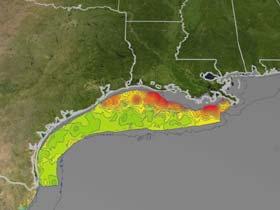
Just look at the Gulf of Mexico, where there is a dead zone the size of New Jersey that’s growing, where oxygen depletion is so severe that very little marine life can survive there. The Gulf of Mexico’s fishing industry has collapsed.
What does that have to do with farming?
If you look at a map, you can trace your finger from the Gulf of Mexico up through the Mississippi River and right into Iowa, corn country. The chemical fertilizers leach into the soil and drip down into the Mississippi River. And people who rely on the Mississippi for drinking water and water irrigation are experiencing all sorts of problems. But the greatest demonstrable casualty is the gulf’s dead zone. No environmental scientist, even the most Republican or conservative, would argue that there isn’t a correlation between the amount of nitrogen fertilizer that we’re spraying on our corn and that type of pollution.
Does it also have an impact on global warming?
In this country alone, food — from growing to processing, transportation and fertilizer — accounts for about 17 percent of all oil we use, a little less than automobiles. Not only is there an ecological cost to transporting food, because of fossil fuels, but there is a huge ecological impact from the way we grow our food — whether it travels 10 feet or 10,000 miles. Growing with pesticides and fertilizers, and processing and packaging food, are all hugely based on cheap oil.
Some critics of the so-called slow-food movement — which focuses on organic, local and artisanal foods — have called it pretentious and inaccessible. What would you say to someone who calls you an indulgent elitist?
At the checkout aisle, we’re not paying the real cost of food. Whether you’re an elitist or not, you’re a human being and the real costs of your food are being paid in environmental costs and healthcare costs. And who pays when we have an obese nation? We all do. We just pay it under the radar. To call it elitist, I think, is really shortsighted.
I think that eventually what we’re talking about is really rooted in peasantry, which is the ironic thing. To say that good food is for the elite is preposterous, like saying that Chinese peasants who talk about and revolve their day around food are elitist, or the Peruvian mountain farmers who grow dozens of different types of potatoes are elitist.
Most importantly, I’d say that in order to experience the pleasures of good food, leave the politics, leave the health issues and leave the ecological issues aside. Tasting good food is a pleasure that people will come back to. That’s what this is: hedonism, a to z. And I think that’s one angle that makes sense [in connection] to slow food. Let’s look at this from a hedonistic, celebratory viewpoint and not a depressing one, and I think that has some legs for the future.
At the same time you have to recognize that not everyone can afford to eat organic produce regularly.
Twenty years ago, if I said to you, “I bet in 20 years, 96 percent of the United States of America is going to have cable TV,” you would have laughed in my face and said where is an extra $100 to $150 of disposable income a month going to come from. If I had also said to you that in 20 years there’ll be an 85 percent penetration of cellphone use, what would you have said? Well, look what happened.
The question isn’t, Can we all eat organically? The question is, How much of us can eat organically to make a difference? And my argument is 100 percent of us can do something, even if it’s very small. Can you shop at a farmers market once a week instead of once a year? Yes! Can you grow herbs on the windowsill if you live in a city but can’t get to a farmers market. Yes!
So far we’ve focused on the problems facing the food industry. But in your dream world, what would American food culture look like in 20 years?
You know, I’ll rephrase your question, and say not what is my dream world, but what I see as a positive possibility for the future. In my dream world I’d like to see everyone grow their own food, but I don’t think that’s possible in today’s world.
The biggest thing I’d like to see is more organic agriculture. Right now organic agriculture only represents about 2 or 3 percent of what people eat. But in the future I think you’ll be seeing a lot of smaller farms get into the game. And their best hope is farmers markets. The money from markets goes directly to helping farmers make a living selling fruits and vegetables, and that’s a change that came out of the last farm bill. It has exploded! Cities and communities that are supporting farmers markets are finding it profitable. Farmers are actually making a living.
What is on people’s plates in this ideal world?
I think you’ll see much more grass-based [instead of corn-based] agriculture because it’s efficient. Not only is it healthier for you and tastier, but it’s the answer to a highly industrialized food system that’s relying on oil. The typical American cow is just an oil barrel. It’s [fed] corn. And that corn is fed fertilizer and pesticides, meaning oil. It is trucked from a cornfield in Iowa to a feedlot in Colorado, or wherever, again oil. And then that hamburger meat is processed … in oil. And then that hamburger meat is shipped to all the fast-food restaurants — more oil. [The process is] a gas guzzler.
So in the end, it’s not about people like me saying you shouldn’t be eating that stuff. It’s going to be about not being able to afford to produce it.