
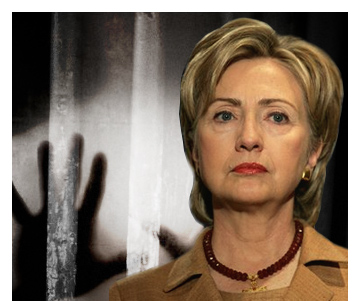

The first fusillade at Hillary Clinton during the Democrats’ feisty debate on Tuesday night came, as expected, from Barack Obama. But it included an unexpected subject. Obama called Clinton a flip-flopper on torture. “She has taken one position on torture several months ago, and then most recently has taken a different position,” he fired.
At first blush it seemed like an odd attack on Clinton, who has emphasized her “clear” opposition to torture. But while Clinton continues to inch closer to the rest of the Democratic pack in her positions on the subject, her stance on torture isn’t as ironclad as it appears. Compared to her competitors for the Democratic presidential nomination, she has often been vague, relying on broad condemnations of “torture.” As Obama noted during the debate, she has changed positions on her support for harsh interrogation in a ticking-time-bomb scenario. And she has not addressed the ethics of the CIA rendition program as it existed under her husband’s administration.
Because of the ambiguities, Salon recently asked for Clinton’s specific positions on three issues central to the torture debate. The candidate responded with her most detailed answers to date, again underscoring her opposition to torture and moving closer to the other Democratic candidates. However, her answers still contained wiggle room. Only on one specific point, so-called black sites — secret prisons — was her reply definitive.
The differences between Clinton and her Democratic competitors have been most striking when it comes to the CIA, which institutionalized prisoner abuse after 9/11 through harsh interrogations at “black site” prisons. The agency has also secreted terror suspects to third-party countries for torture through so-called renditions.
The other major Democratic candidates have said they would shut down the CIA activities. “No more secret authorization of methods like simulated drowning,” Obama said early this month in one of his many statements on these issues. John Edwards said in the Democrats’ debate at Dartmouth College on Sept. 26 that there would be “no more secret prisons. Not when I’m president of the United States.” At the same debate, Gov. Bill Richardson of New Mexico said, “What the administration has been using is called waterboarding … I would not permit it.” Sen. Chris Dodd’s campaign Web site says, “Extraordinary Rendition. Secret Prisons. No more.” Sen. Joe Biden recently wrote a letter to the American Freedom Campaign, an anti-torture group, pledging that he would “close down secret CIA prisons in other countries where detainees are held incommunicado and cruelly mistreated.”
In contrast, Clinton hasn’t been clear about the CIA even when asked directly about the agency’s interrogation program. In an interview in early October, the Washington Post asked Clinton to address the CIA techniques specifically. According to a transcript of that interview, the Post asked Clinton about the CIA since “you’ve said you’re against torture, but the types of methods that are now used that aren’t technically torture but are still permitted, would you do something in your first couple days to address that, suspend some of the special interrogation methods immediately or ask for some kind of review?”
Clinton responded that it was unclear exactly what the CIA was up to. She needed more information. Clinton added only that: “I think we have to draw a bright line and say, ‘No torture — abide by the Geneva Conventions, abide by the laws we have passed,’ and then try to make sure we implement that.”
The Post described the answer as “vague.”
Directly after the interview appeared in the Post, Salon asked the Clinton campaign to address CIA activities head-on. Salon solicited the candidate’s position on three issues, and the campaign released her most detailed statement yet about the agency’s practices. This is the full text of an e-mail sent by campaign spokesman Phil Singer in response to Salon’s inquiry:
1) Does HRC support renditions?
The Bush administration’s policy of rendition is a moral and national security failure, and Senator Clinton strongly opposes it. Senator Clinton opposes sending anyone to places for interrogation where they will be tortured or where their basic human rights will not be protected.
2) Does HRC support the policy of “Enhanced Interrogation Techniques”?
No. The Senator is in favor of interrogations that are lawful.
3) Does Senator Clinton support the use of “black sites”?
Senator Clinton categorically opposes enforced disappearances as wrong, damaging to our security, and contrary to our international obligations.
The more direct language from Clinton in this new statement to Salon is a “step in the right direction,” according to retired Rear Adm. Don Guter, dean of the Duquesne University School of Law and the former Navy judge advocate general.
But Guter noted that in the first part of her response, Clinton panned the Bush administration’s version of a rendition program, leaving open the theoretical possibility that a different rendition program could replace it. The CIA started renditions in the mid-1990s under then-President Bill Clinton, with assurances from participating countries that subjects sent overseas for questioning would not be tortured. Jane Mayer explored the origins of the program in a Feb. 14, 2005, New Yorker article. She found out about two men the CIA sent to Egypt in the mid-1990s. One claimed he was tortured with electrical shocks to his genitals. Another disappeared and may have been executed.
Guter also noted that Clinton’s statement to Salon repudiating the CIA’s interrogation tactics — “The Senator is in favor of interrogations that are lawful” — would still be functional in a Bush White House.
He added that Clinton’s language rejecting the so-called black sites, where the CIA holds prisoners without access to the International Committee of the Red Cross, is the “strongest” part of her new statement. (“Enforced disappearances” is a term used by experts in international law to describe programs like the CIA’s secret prisons.)
Clinton’s progress toward such a position has been slow and not very steady. Obama’s charge Tuesday night that Clinton has flip-flopped on torture may have some merit.
On Sept. 28, 2006, Clinton gave an impassioned speech on the Senate floor in opposition to the Military Commissions Act, a law that President Bush says allows the CIA interrogation program at the black sites to continue.
In her speech, Clinton seemed to be unequivocal on torture. “Have we fallen so low as to debate how much torture we are willing to stomach?” she thundered. “By allowing this administration to further stretch the definition of what is and is not torture, we lower our moral standards to those whom we despise, undermine the values of our flag wherever it flies, put our troops in danger, and jeopardize our moral strength in a conflict that cannot be won simply with military might.”
But within days, Clinton was arguing that she, too, could stomach torture under certain circumstances. Clinton told the Daily News in October 2006 that in a ticking-time-bomb scenario, she favored a legal loophole to allow the torture of a terror suspect. At the time, she argued for a “very, very narrow exception within very, very limited circumstances.”
Eleven months later, when Clinton was asked about a ticking-time-bomb scenario during the debate at Dartmouth in September 2007, she ruled it out, saying torture “cannot be American policy, period.”
Clinton’s campaign has credited her evolution on the ticking-time-bomb scenario, in part, to an April meeting at Franklin Pierce Law Center in Concord, N.H., with 19 retired senior military leaders, including two former chiefs of staff. It was one of several similar meetings at Pierce Law with some of the presidential candidates. The gatherings were intended to provide the former senior military officials with an opportunity to argue that coercive interrogations are an ineffective intelligence tool and that the United States — including the CIA — should return to more proven techniques that emphasize knowing the enemy’s language and culture to build rapport.
But within days of the Dartmouth debate, Clinton was again using broad, indistinct language. On Oct. 4, Clinton wrote to the American Freedom Campaign, but she was not as explicit as Joe Biden had been. “It should never be the policy of the United States to torture,” she wrote. When she mentioned interrogations in a national security treatise in the November/December issue of Foreign Affairs, she wrote, “We cannot support torture and the indefinite detention of individuals we have declared beyond the law.” Her interview with the Washington Post, with the answer described as “vague,” ran on Oct. 10.
Salon interviewed five of the retired military leaders who met with Clinton at Pierce Law School in April, including Guter and retired Army Lt. Gen. Robert Gard. And they all agreed they would much prefer that all of the presidential candidates directly address the CIA activities rather than simply condemn torture.
When it comes to rejecting torture, “It all depends on what is, is,” said Lt. Gen. Gard, recycling a famous Clinton-ism. “It all depends on how you define torture.”
“[President Bush] says we don’t torture,” said retired Rear Adm. John Hutson, the dean of Pierce Law who moderated the meeting with Clinton in April. “We have so lost our bearings on what that word means, it has become meaningless because it means everything,” Hutson told me in mid-October. He has since endorsed Barack Obama.
