
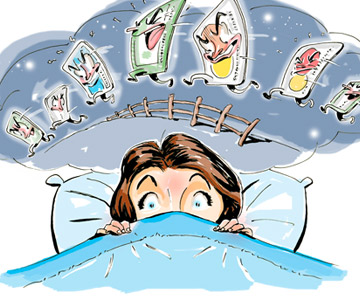

It was December of last year, a few weeks before Christmas, and I was buying a present at Barnes & Noble.
“Do you have another credit card?” asked the salesman. “This one doesn’t want to go through.”
How gracious of him to make it sound like the credit card’s fault. That credit card was such a coward, always chickening out in the face of a crucial transaction. Unfortunately, I did not have another credit card. Well, actually, I had three, but experience had proved they didn’t want to go through, either.
There was a time when this exchange would have flustered me, left me stammering excuses about how the card had just worked, and I couldn’t imagine what was wrong. But by late December, I had grown so accustomed to this awkward scenario that I wasn’t even all that embarrassed. It was as if I had presented him with a lottery ticket and, failing to win big, went back to the original game plan.
“Just take this.” I handed him one of my few remaining 20s. I was, officially, broke.
I was so broke, in fact, that I actually had no idea how broke I was. The exact number had become a mystery, something hidden (or, rather, stuffed) in the closet: I didn’t know how much I owed on those credit cards, or how much was in my bank account, or whether that balance — were I to check it online, which I did not do that month — would be positive or negative. I knew I owed several thousand. Five freaking digits. The evidence sat in a neat stack of unopened credit card bills, which had been piling up next to the French press since October. The evidence came in the form of phone calls from bill collectors, from 8 a.m. to 9 p.m., calls that I never answered.
If this sounds like breezy indifference, if it seems that I was not worried, then good; I fooled you. I was desperately trying to pretend that my financial plight did not bother me. Who wants to confront such colossal failure? Besides, it was the holidays. Gifts and parties and free champagne. Every day the mail brought Christmas cards with pictures of friends’ babies doing adorable, uncanny things. The mail also brought bills. The pictures went on the fridge. The bills? They went into the stack.
In my apartment, alone, I had fits of anxiety. Tears, clenched fists, the works. I lay bug-eyed at 4 a.m., wondering how I was going to get out of this mess. I needed more time. I needed more work.
What I needed was an ejector seat.
Most people get into catastrophic debt for one of two reasons — job loss and medical crises — but that was not my case at all. I was single with no kids, a lifestyle that had allowed me to spend late nights at the bar, to travel, even move to New York. But I sometimes worried that living so free of responsibility for so long had left me a bit reluctant to grow up — to sacrifice immediate gratification for future stability, to acknowledge the simple confines of my bank account. I didn’t have savings. I let bills slip. For two years, I lived with no health insurance and my fingers crossed. I couldn’t escape the feeling that I was making messes for someone else to clean up. I couldn’t escape the feeling that, at 33, I had failed to become an adult.
One morning, I sat down at the kitchen table, armed with a strong cup of coffee, the stack of bills and a printout from
The number was ugly, but it wasn’t what alarmed me. No, what alarmed me was the hideous charade of my minimum balance payments. All four of my maxed-out cards had risen to around a 30 percent APR, and I was getting walloped by late fees, over-limit fees and finance charges. Agh, the finance charges: I can’t imagine the real cost of all the piddling purchases I’d made over the years; some Fatboy Slim record from 2000 probably cost me $250, which is $249 more than I should have paid for “Funk Soul Brother.”
Mostly, it made me ill thinking how hard I had scrambled to make regular payments on those cards, just to keep them current. It was like throwing money into a fire. I was paying $500 a month for the mere privilege of running in place. And I’d been doing it for two years. (By the way, this amount didn’t even include the thousands in back taxes I already owed to the federal government. Story for another time.) As I surveyed the damage, all I could think was: How did this happen?
Well, I mostly knew how this happened. I’m not the victim of identity theft. I’m the one who made all these charges. That $80 bar tab? Yeah, that’s mine. When things got tight last summer — checks weren’t coming in on time, I wasn’t getting enough work as a freelancer — I knew leaning on my credit cards was a bad idea. I knew how evil they can be. So the question isn’t, “How did this happen?” but rather: “How did I let it?” I could give you several excuses for that debacle last December — I was living in the city with the highest cost of living! I was supporting myself as a writer! — but none of them explains away the fact that I spent too much, and when I got in trouble, I closed my eyes, put my fingers in my ears, and went, “La-la-la.”
I suppose part of me believed my situation wasn’t all that bad. Most of my friends have credit card debt. Some of them have far more than I do. (And some of them have student loans, mortgages, car loans heaped on top of that.) We don’t talk about that credit card debt — even as our sex lives make for good cocktail conversation, financial instability still feels like an ugly taboo — but there is a general, jokey acknowledgment that we’re all slaves to our plastic.
America’s chronic debt has been the subject of countless news stories and at least one documentary, “Maxed Out.” Weirdly, the more I heard about our binge spending, the less I worried about my own. It started to feel normal. I watched the first episode in Oprah’s Debt Diet series, and I remember the gratitude I felt upon hearing what those poor fools owed. $90,000! They’re screwed!
The morning I calculated my debt, that’s how I felt: screwed. I also felt embarrassed, and guilty, because I should have known better. But I could only give myself so many lashes before I had to put that sucker away. Really the question wasn’t how I got into debt, or why I let myself, it was this: How was I going to get out of it?
There is no shortage of books on the subject of financial recovery. Walking into a bookstore and looking for one is like searching the Internet for hilarious cat videos. If you are looking (if your credit card wants to go through), I can recommend “Credit Repair Kit for Dummies,” though reading it on the subway made me feel like I was trumpeting not one but two personal deficiencies. A friend of mine swears by Suze Orman’s “The Money Book for the Young, Fabulous, & Broke,” in which the straight-shooting CNBC host gives you advice on using your credit cards sensibly with all the rah-rah of a self-help guru. “If you don’t think you are fabulous, if you don’t have incredible confidence in yourself, you will never have the strength to go after what can make you happy.” Go, team.
The books were full of practical advice — get your credit report, know your FICO score — but for me, using them alone wasn’t enough. It was nice to lie in bed, underlining passages and nodding in agreement. But I have a tendency to lose steam when it seems as if the solution to my problem is going to require more commitment than, say, lying in bed and underlining passages. I get overwhelmed with how much work there is to do. And that leads to my abandoning the book on my bedside table and ordering delivery sushi while I watch TV to forget the whole sordid mess, which is exactly how I got here in the first place.
So that week, I made an appointment with a financial counselor. As it happens, he’s dating a friend. But as a lawyer for a New York nonprofit called the Financial Clinic, which helps people in serious credit card debt, David Friedman works with people like me all the time.
“We demonize credit card companies, and we should,” David told me, as we sat in his office. “But a lot of what I see is a failure of people to advocate for themselves.”
I liked a lot of things about talking to David. He was honest about my problems but also encouraging. He seemed nonjudgmental about the damage I had done. Mostly I liked that I walked into that session a little bit helpless. But I left with a plan.
“We have to stop the bleeding,” said David. That meant two immediate things: getting my credit cards under the limit and trying to raise my credit score, which had been officially branded “poor.”
I had an idea: “What about transferring my balance to a no-interest card?” I asked. “Or getting them to raise my credit limit?”
“You could try that,” he said, with the tact of a hairdresser telling the old woman she might not look like Jennifer Aniston. “But I’m pretty sure you won’t qualify.”
As it turned out, all the quick fixes I had been mulling over were not going to work. Debt consolidation was too expensive. Defaulting and bankruptcy would torpedo my credit rating and set me back for years. I couldn’t ask the credit card companies to lower my APR until I got my payments under control and raised my credit score, which would take two months of no-shit efforts. I was going to have to stare down my debt the old-fashioned way: I was going to have to pay it.
David and I drew up a list of my current expenses, and I was astonished by the starkness of my bottom line. I didn’t make enough. Like, not nearly enough. Sure, I could cut out $3.50 cappuccinos, but my problem was much bigger than that. I always thought I spent reasonably because I shop at H&M and Target, don’t own designer shoes or an iPod. Looking at my expenses, I saw that I had been living outside my means for so long that I clearly didn’t have any sense what my means were.
I borrowed $2,000 from my father. It was, in some ways, the most grown-up thing to do. I don’t feel good about it — actually, I considered leaving it out of this story entirely, except that I think it’s important to point out the drastic help my situation required. If my father hadn’t been there, I would have had to call the credit card companies myself and hammer out a payment plan, and I’m incredibly grateful to bypass that step, since I’ll be making friends with them in two months, when I call to negotiate a lower APR.
In the meantime, I’ve had to change a lot of things about my lifestyle. I bring my lunch to work, and I stopped buying Diet Cokes during the day, and I don’t go out much on weekends. In a wash-and-fold town like New York, I actually do my own laundry. When my lease is up in April, I’m moving somewhere much cheaper and getting a roommate, and I hope to halve my rent. This is the painfully obvious step I’ve been avoiding all along. Ever since I moved to New York, my apartment has been a great source of personal satisfaction for me. I had it all to myself. I could let visitors stay anytime. And when they stayed, they always said the same thing — how big it was, how lovely it was, how I was really making it in New York. I loved hearing that more than anything. But it wasn’t really true. Even then, I knew it.
I didn’t cut out everything. I still get delivery sushi, I still go out for drinks with friends. It’s like a diet — you can’t deny yourself what you really love, or you’ll fail. But I don’t think of it as a diet, or as punishment at all. I think of it as being an adult.
