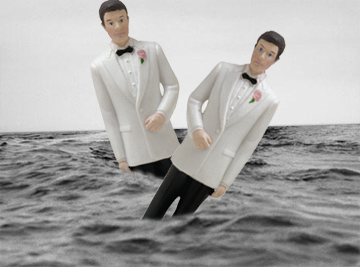
In May 2004, as Massachusetts became the first state in the country to legalize gay marriage, more than 1,000 gay and lesbian couples streamed into city and town halls.
“One small kiss for us, one giant kiss for mankind,” said an ecstatic Erin Golden as she locked lips with her partner of 25 years, Eileen Counihan, on the steps of Provincetown Town Hall.
It was supposed to be a whole new era, as celebrations accompanied the adoption of civil union and domestic partnership laws in several states. But a funny thing happened on the way to the altar: Gay couples decided they might not want to get married after all.
So what happened? Gay couples are discovering the legal and financial drawbacks of marriage, for one thing, and the complications of letting the government get involved in your personal life. There’s also a frustration about the current marital landscape — with some states on board, others not, and the federal government standing on the sidelines.
Currently, only eight states allow same-sex marriage or marriage equivalents. Massachusetts is the only one to call it marriage, but New Jersey, Connecticut, Vermont, California and New Hampshire — and, to a large extent, the District of Columbia and Oregon — have all created their own brand of union, granting couples the same rights and responsibilities as married couples in those states — minus the federal benefits. Maine, Hawaii and Washington also have gay unions, but with fewer rights than those afforded to married couples. (That may change in Washington shortly.)
“Personally, I’m holding out for real marriage, not the reconstituted variety,” said Shawn Cowls, a 42-year-old insurance agent. “It connotes a second-class situation to me. What do you call us — civil uniteds? Civil unionized? Civil union members? However you say it, it immediately implies ‘people who aren’t allowed to get married.’”
He’s not alone. In Massachusetts, there are some 30,000 gay couples living together, yet as of April of this year, only 9,695 opted to tie the knot, according to census data and the Massachusetts Department of Public Health. And that includes the gay couples residing outside of Massachusetts who ran there to wed once the marriage laws passed.
The figures are similar for the other states. California has about 108,734 gay households, yet only 40,663 are registered as domestic partners. In New Jersey, which allows for civil unions, the state has 21,405 gay households, yet only 2,069 civil unions have been registered. Connecticut has 9,540 gay households, yet only 1,750 civil unions have been recorded. (Only in Vermont does this trend not hold. The census bureau puts the number of same-sex households at 2,886, yet 8,598 civil unions have been recorded — an indication that either census data grossly underreports the number of gay households or gay couples from other states are getting married in Vermont.)
Some same-sex couples, of course, never wanted to get married in the first place.
“For millennia, gay people have not had access to these institutions,” said Joyce Kauffman, an attorney in Cambridge, Mass., who specializes in lesbian and gay family law. “And so to some people, marriage is anathema.”
Kauffman, who is gay, was among them. She says women like her, feminists who came out during the women’s lib movement of the 1970s, viewed marriage as oppressive. Now 57, Kauffman says she’s since mellowed her stance, but plenty of gay women have not.
“For many of us, the idea of getting married sticks in your craw,” she says. “Why would anyone want to get married? It’s almost a visceral reaction.”
But for others, the reluctance is based on discoveries of troubling financial downfalls.
“It’s a difficult situation,” said Jill Hollander, a financial planner based in Berkeley, Calif. “You’re getting the responsibilities of the federal laws, but you’re not getting the benefits.”
There are some upsides to getting married — getting onto a partner’s health plan, creating a stronger legal framework for having children, cementing the relationship in the eyes of the courts.
But there are compelling financial reasons gay couples should remain single. For instance, in a divorce, alimony is normally tax-deductible for the person paying it and counted as income for the person receiving it. But because the Internal Revenue Service does not recognize gay marriage, alimony payments for same-sex couples could be treated as “gifts” and thus subject to taxes. The estate tax exemption that applies to married couples would also be a moot point. That is, in a heterosexual marriage, the surviving spouse pays no taxes on the estate. In a gay marriage, there would be no such exemption — and an estate tax bill can be hefty.
Privacy has also become a sticking point for some. After all, marriage documents, domestic partnership registrations and civil union applications are all public documents. Not everyone wants to be outed — say, those in the military or with immigration issues. In California, the list of domestic partnership registrants is not currently available online, but you can purchase it for $50.
Arlene Mose, a CPA in Pleasant Hill, Calif., said the tax and regulatory implications of domestic partnership (California’s version of gay marriage) are so complicated, and the benefits so limited, that she and her partner of 15 years opted not to register. And that’s true for most of her gay clients who are self-employed and not concerned about getting on their partner’s health plan.
“There can be many advantages to being ‘legal strangers,’” Mose said, adding, “The less government involvement in our lives, the better.”
And if gay couples think the state is involved in their marriage, wait until they try to get divorced. Indeed, several divorce attorneys said gay couples who married and are now going through a divorce are often shocked to hear they may have to pay their former spouse alimony or be responsible for their debts. For some gay couples, divorce (and its unfolding nightmare) wasn’t even on their radar.
Frederick Hertz, an Oakland, Calif., attorney who advises gay couples on marriage and divorce, says gay couples have always been more financially autonomous than their heterosexual counterparts, and some are simply not comfortable with the potential financial exposure that comes with being married. Hertz tells concerned clients they have two options to avoid this risk: Enter into a prenuptial agreement — for a fee of $5,000 — or simply don’t register. Many opt for the latter.
But all of this applies to gay couples who can actually divorce. Given the convoluted gay marriage laws, which differ widely from state to state, attorneys say gay divorce promises to be a messy business. Those interviewed for this story say they receive calls and e-mails almost weekly from couples who “married” in one state and now live elsewhere and desperately want to get divorced. In Massachusetts, for instance, at least one party must reestablish residency in the state — a process that takes a year — in order to file for divorce. Divorce will be particularly problematic for couples who relocated to states that don’t even recognize gay marriage. If a state doesn’t recognize the marriage, it ain’t going to recognize gay divorce.
Hertz says he gets e-mails all the time from people who have moved and now want out of their marriage. He puts them into two categories: those who lived in one state and moved, and those with the “Holiday Wedding Problem.” That is, they married three, four, even five times, as each state passed its own version of gay marriage, and now they want to untie those knots.
Hertz tells them, “Get yourself a good lawyer.”
The problem is, if gay couples can’t find a way to untangle their unions, they won’t be able to marry anyone else. At least that’s the theory. In practice, many will, and they could wind up bigamists, he said.
“The bottom line is, states do not have to recognize a marriage if their state constitution has a Defense of Marriage Act included in it. And lots of states have that,” Hertz said.
Thomas Curtiss Jr., a principal with the California law firm of Rodi Pollock Pettker Christian & Pramov, says he has a lot of gay clients, and only a small minority of them have registered as domestic partners. Curtiss himself, who is gay, says he wouldn’t even consider it.
“My partner and I would never register, unless there was a real benefit,” he said.
He’s not the only one. When California initially passed a domestic partnership law in 2000, 4,894 gay couples jumped on the bandwagon. But when the state beefed up its domestic partnership law in 2005, giving it more of the financial rights and obligations of a heterosexual marriage, gay couples were allowed to withdraw their domestic partnership registrations. And 2,513 did just that. Another 1,651 have done so since. Curtiss says he still gets clients coming to him inquiring how they can withdraw those early registrations.
“I titled one of my speeches, ‘Beware of What You Ask For,’” Curtiss said.
If increasing access to quality higher education is as crucial to U.S. economic growth as everybody seems to think it is, then two news item from California this week deliver a simple, straightforward message: We’re screwed.
1) Ace education reporter Nanette Asimov reported on Tuesday in the San Francisco Chronicle that the California State University system is withholding around $90 million in cash grants previously allocated to graduate students in the CSU system.
Graduate students across the 23-campus system began receiving financial aid notices this week and were astonished to see that the State University Grant that takes care of tuition for low-income students was missing. In its place was the offer of a federal loan at 6.8 percent interest.
2) Also on Tuesday, University of California officials announced a sharp increase in out-of-state student admissions to the U.C. system:
More than 23 percent of all those incoming freshmen will be out-of-state and international students who pay nearly three times more than California residents to attend UC…. The figures mark a big jump from last fall, when 18 percent of admissions were from out of state. And it’s almost double the percentage of foreign and non-California residents who were admitted in fall 2009.
The common link to these two data points: California’s increasing inability to fund its public university system. The CSU system has already weathered a 33 percent cut in its overall state funding — $1 billion — over the last four years, and faces another $200 million cut if Gov. Jerry Brown fails to convince voters to pass a state initiative authorizing a tax hike this November.
The UC system is in similar straits. Once upon a time, California gave every student who qualified for the UC system a completely free ride. Now the state pays only 11 percent of UC tuition costs. As a result, for in-state students, tuition has tripled over the last 20 years, to $13,200. But out-of-state students pay three times as much as that, a fact that has made them more and more attractive to admissions departments.
California’s troubles paying for higher education can be traced all the way back to the passage of Proposition 13 in 1978, which made it extraordinarily difficult for the state to raise taxes. But California’s s woes are by no means unique. In 2011, state funding for higher education dropped by $6 billion, or 8 percent nationwide. And with the federal government caught in the same vice grip — an intransigent refusal to raise taxes for any purpose whatsoever — there’s little help that can be expected from Washington. In fact, the same graduate students who are getting their unpleasant mail from CSU this week are due for another unhappy surprise on July 1, when interest rates on their federal student loans bump up, a result of one of the cost-cutting deals that was part of the debt ceiling agreement one year ago.
All these numbers add up to another simple, straightforward truth: Quality higher education is increasingly available only to those who can afford it. So income inequality becomes educational inequality, and the stratification of American society into haves and have-nots continues apace. If we’re looking for strategies on how to prosper in an ever more competitive global economy, this isn’t it.
Continue Reading
Close
This originally appeared on
Thanks to the smoking gun of Josh Fox’s sobering documentary “Gasland,” hydraulic fracturing has finally entered our renewable news cycle. Yet despite poisoning groundwater, freeing methane and literally creating earthquakes back east, fracking has a visibility problem in California.
The situation became less clear after a recent investigative report from D.C.-based nonprofit Environmental Working Group explained that California has experienced 60 unregulated years of widespread fracking, whose technical methods and geographical locations in the seismically active state exist outside of the public purview. It got darker after Gov. Jerry Brown’s administration wiped the state government’s Division of Oil, Gas and Geothermal Resources (DOGGR) website of fracking fact-sheets and documents. Good luck finding anything about fracking on the governor’s official site either.
“Since our report came out, the Brown administration hasn’t been happy with it,” Bill Allayaud, EWG‘s California director of government affairs, told AlterNet by phone. “They said we quoted their meetings but left out important quotes. But I don’t know what we left out, or how we could shine a better light on the situation. We’ve been trying to work with them now for over a year.”
There has also been a great disappearing act. According to Allayaud, gone is the issue’s main page, an account of fracking in other states, as well as what he calls an “inaccurate and misleading factsheet about fracking in California.” Gone also is a copy of a letter sent by the state in response to questions from Senator Fran Pavley (D-Santa Monica), chair of the Senate Committee on Natural Resources and Water, whose rebuffed inquiries about the extent of California fracking inspired assembly bill 591 (AB 591), currently at the center of a tug-of-war between the interested citizenry and an industry that seems desperate to avoid transparency.
Punch the term “fracking” into DOGGR’s search today and you’ll receive a white screen with the perhaps accidentally ironic query “Did you mean: cracking” in response. That’s probably funny to even most Californians, whose fault-laced state is due for its next catastrophic earthquake, but it doesn’t inspire confidence that DOGGR is taking fracking seriously.
“No word on that, sorry,” DOGGR spokesman Don Drysdale told AlterNet via email when asked for clarification on the division’s online document scrub, or whether they will be replaced or upgraded. Drysdale also explained that DOGGR doesn’t have regulations requiring that operators report when, where and how they use hydraulic fracturing to stimulate production. He also said that information from DOGGR regarding fracked wells in the San Joaquin-Sacramento River delta gas fields near shallow groundwater is “not available, and that “we do not have records” of offshore fracking operations in the Long Beach-Santa Barbara drilling area.
“However, the City of Long Beach has its own oil and gas department and may have some information,” he added. “We recently began to request that operators voluntarily report their hydraulic fracturing operations (PDF) to FracFocus, a public Web site run by the Groundwater Protection Council and Interstate Oil & Gas Compact Commission.”
This Kafkaesque labyrinth doesn’t exactly inspire confidence that DOGGR “has regulations designed to ensure well integrity and to protect underground resources,” as Drysdale claimed to AlterNet. If it did, there’s a good chance that AB 591 wouldn’t exist in the first place. That law proposes to legislatively define the fracking technique and disclose its “chemical constituents,” recognize its “long history of its application within the state,” evaluate its impact on California’s natural resources and “geologic and seismic complexity,” disclose its sources and amounts of water used and relay any data on “recovery and disposal of any radiological components.” That a bottomless well’s worth of disclosure demands for a regulatory regime professing to do its job just fine, thanks.
It is also why “DOGGR was raked over the coals” in a March 28 budget hearing “that was more about fracking than anything else,” according to Allayaud, who attended. At that meeting, California Department of Conservation (DOC) director Mark Nechodom was rebuffed in his efforts to procure more funding and positions for DOGGR. That fact that he repeatedly assured Assembly members that DOGGR was regulating fracking but was unable or unwilling to disclose the location of any fracked wells or well-casing failures to those members might have had something to do with it. By meeting’s end, Nechodom promised to prepare fracking regulations, undertake a scientific inquiry into its practice, and conduct a series of listening sessions in the state.
Better late than never, but DOC and DOGGR still need to speed the plow. According to a report from the Center for Investigative Reporting’s Tia Ghose, both the Center for Biological Diversity and Sierra Club are suing the Bureau of Land Management to prevent fracking on federal lands (PDF) — 2,500 “environmentally sensitive” acres in Monterey and Fresno counties have already been leased. The BLM has suggested that it’s mostly grazing land that has been leased before but still remains undeveloped, and consoled worriers by explaining that the agency executes environmental reviews in the drilling permit process.
“Our case is proceeding in the district court on a normal schedule, but there hasn’t been any merits briefing or rulings yet,” Sierra Club attorney Nathan Matthews told AlterNet. “Nobody from the state has contacted us about this suit. The BLM Web site lists who purchased the leases, but presumably the land could be developed by someone else. Our claim demands that BLM assess these types of risks before proceeding to allow development.”
Like DOGGR before them, the BLM’s distaste for transparency on an issue as controversial as fracking is counterproductive, and could prove costly in the final analysis if the problems that continue to plague the practice back east migrate westward. But their profit-oriented perspective nevertheless comfortably aligns with the industry itself, which seems all too content to rely on hindsight rather than foresight when it comes to tragedies large and small.
“An original version of AB 591 we had last year asked the industry to map where it was fracking in California, and indicate any active seismic fault within five miles,” said Allayaud. The industry’s non-profit trade group Western States Petroleum Association “said it wanted thatout. When I asked why, the answer I got was, ‘Look, if we were causing earthquakes through drilling, injection wells or fracked wells, you would know it. Look how many geophysicists are running around the state looking at earthquakes.’”
That flippant industry response, taken together with those of the California agencies overseeing that very industry, has only galvanized regional opposition. Many more will inevitably follow AB 591 and the joint complaint against BLM if industry and government alike condescendingly assert that everything is under control to a citizenry told too many times to keep its nose out of its own affairs. The fight over AB 591 exists precisely because the industry won’t release its fracking data, from the location of its wells to the chemical makeup of its bedrock-fracturing injection cocktails, without rigorous enforcement.
To play fair, the EWG stripped the mapping requirements near active seismic faults. “We agreed to take it out because the industry is trying to be cooperative,” Allayaud told AlterNet. “They’re not opposing the bill.”
For his part, Allayaud isn’t too concerned about California’s fault-riddled seismology or inevitable earthquake catastrophes. So far, neither is the United States Geological Service, whose Web site search results on fracking are more extensive than Governor Brown and DOGGR’s blank pages. The USGS explains that California’s faults are better studied and understood than anywhere else in the nation, and that its populaces are also better prepared for earthquakes large and small. “Hydraulic fracturing has been taking place for many decades in California,” the USGS Earthquake Science Center’s Art McGarr told AlterNet, “mostly to stimulate oil and gas production in old fields.”
“In any event, there is little likelihood that any fracking operation could perturb a nearby active fault so as to trigger a major earthquake,” he added. “The stress changes associated with fracking are much too small and localized to interact with a fault capable of producing a significant earthquake. In other parts of the country where fracking has enabled gas production from tight shales, the fracking has not caused earthquakes of any consequence.”
To McGarr’s knowledge, there are no high-volume waste-water injection wells in California located within areas of high population density, and he guesses that will continue to be the case. But we’ll never know until the federal and state government is compelled by a plugged-in citizenry to force the industry’s hand, and disclosure. Until that happens, they will side with controversial corporations like Halliburton, which is leading the opposition against AB 591 by arguing that disclosing the chemical cocktails it uses to fracture wells would be a violation of trade secrets. And the last-gasp natural gas bubble that fracking enables will continue to create flammable groundwater and destabilized grounds. Once it becomes apparent that the green defense of fracking is negated by more methane, which is 25 times more powerful a greenhouse gas than CO2, then hydraulic fracturing’s disclosure game will be up.
In hindsight, it will look like a bunch of junkies who just didn’t know when to stop tapping fossil fuel’s disappearing veins.
“We need strong disclosure rules with narrow trade secret protections,” Matthews explained to AlterNet. “BLM will be announcing a proposed disclosure rule in the coming weeks, and the public will be able to submit comments on that.”
“The Brown administration still says there is no urgency to create regulations to deal with fracking,” said Allayaud. “Their focus is on getting permits for regular oil drilling out the door faster. We think they have the capability to do both, and I think AB 591 will push them in that direction, because they need to be pushed. I’ve never seen a state agency behave this way, and I’ve been working around them for 36 years.”
Continue Reading
Close
By turns playful, suggestive and bewitching, the photographs in a new show at the Palm Springs Art Museum propel us back through the decades, to a time when the glamour of choreographed capitalist displays had a singular hold over the American imagination.
These images, though diverse in many respects, all have one thing in common: the swimming pool. That, and their mid-to-late 20th-century Southern California backdrop.
The exhibition is part of “Pacific Standard Time,” a multi-institutional project devoted telling the story “of the birth of the Los Angeles art scene and how it became a major new force in the art world,” sponsored by the Getty Research Institute. Over the phone, curator Daniell Cornell explained the place of the swimming pool in Southern California’s cultural history, and discussed the show’s principal themes — from architecture and suburban idealism to the cult of the Hollywood celebrity. Click through the following slide show for a sun-soaked trip back in time.
Had you considered doing a swimming-pool themed photography exhibition before “Pacific Standard Time”?
I’d been thinking for a long time, actually — ever since graduate school — about trying to do an exhibition that investigated a theoretical concept: the notion that a place is both a real, topographic entity and an ideological construct … It’s just an idea I’ve been wanting to explore. When the opportunity came to apply for a grant to do an exhibition as part of this larger project looking at art in Southern California, I realized that it was the perfect opportunity to begin to explore that idea.
When I started thinking about it … I realized that in many ways, in the post-war period, Southern California was the ideal of what the American dream was going to look like. At the center of that was the swimming pool, and suburban expansion, and the concept of everybody living in this place that didn’t have the danger of nature, but had all the benefits of the natural landscape. A place that was away from the city, but at the same time felt domesticated. I started thinking about the pool as the central icon of that both real and imaginary place. And it grew from there.
What do swimming pools say about Southern California in particular (that they don’t say, for instance, abut other parts of the country, such as the Midwest or New England)?
Well, in the immediate postwar period of the ’40s, ’50s and even ’60s, there weren’t that many swimming pools elsewhere. Maybe in Florida, which had a similar kind of expansion at that time. But Southern California was growing very rapidly in terms of suburbia in that period, and that expansion included houses that incorporated swimming pools. I grew up in the ’60s and ’70s in Seattle, and I envied Southern California — because in Seattle, in the summer, we would drag out our above-ground swimming pools and set them up and pretend that we lived the same kind of life that I imagined people in Southern California lived all the time. Thinking about kids my age in the ’70s growing up with swimming pools in their backyard and having this kind of experience as the norm for their life — that was a very seductive sensibility. I don’t think that that was unusual, when you look at how much Hollywood promoted itself and Southern California as an ideal for the country. You pretty much see it everywhere.
Two themes that seem immediately apparent in many of these images are architecture — that is, the houses or buildings we often see beside the pools — and sex.
The exhibition is divided into thematic groups. It does start with California architecture and design, because swimming pools were at the center of the way that mid-century architects here in Southern California were thinking about modern architecture. The pool created a very porous experience between indoor living and outdoor entertaining. These were houses literally built for entertaining, and the movement from the inside to the outside was part of how Southern California architecture was developed … The pool really allowed for fluid movement between those spaces. So architecture and design is certainly at the beginning of the way that you would want to think about pools, in the period from 1945 to 1982 in general, in Southern California.
In addition, this is a period in which … culture was creating an image for the Hollywood celebrity that was built around the pool. You see all of these images of Hollywood celebrities — supposedly just casual, unscripted moments. [But] none of those photographs are meant to do anything except promote the persona of the celebrity. They give you this impression that what you’re seeing is the “real” celebrity, when in fact you’re seeing the carefully narrated Hollywood persona that that celebrity is based on.
[Another section of the show focuses on] suburbia, and how much the private, backyard pool (as opposed to the public pool) was at the center of suburban life. There were some public pools in suburbia, but the ideal was a private, protected space; especially in the ’50s, it had very much to do with this notion that we Americans had a private experience — as opposed to the communal experience of the Soviet countries. When you look at what people circulated in terms of photographs, and even what they said about their own experience, it almost always revolved around things that they were doing in the backyard. If they were lucky enough, it revolved around a pool in the backyard. And as you say, because of the very nature of the fact that, when you’re around a pool, you’re wearing a swimsuit, it becomes an opportunity for the body to be on display.
[The final section of the exhibition is a conceptual one.] I wanted this show to be not just about these social topics, but also about what was happening in photography during the period. 1945 is a high modernist moment in photography, and the earliest photograph in the show is by Ruth Bernhard, who emigrated from Germany to escape the Nazis. She went first to New York and then to Southern California, and her images represent all of the things that you would expect in a high modernist photograph: … even though it’s representative, there’s a very abstract organization of the forms and the shapes in the image, because it’s done through high contrasts of light and dark.
As you move through the period, you get photography really blurring the boundary between popular culture and high culture, because photographs circulate in commercial advertising; they circulate in journalistic reporting; they exist in lifestyle magazines as well as in professional trade journals … all of those things in addition to showing up as fine art in museums.
Then, in the 1980s — that’s when photography goes big; that’s when Cindy Sherman’s photographs go up on the wall large, and Barbara Kruger’s imagery goes up big, and David Hockney first takes his smaller Polaroid images and montages them together into something large enough that it can go up on the wall and challenge painting as the dominant mode in contemporary art practice. You see this shift from a very high modernist fine art practice to color photography that we recognize as a part of postmodern contemporary art. That really literally happens from 1945 to 1982, so it spans the dates of this show. The conceptual section really shows you how photography used the pool, not as a subject, but as an opportunity to explore all kinds of developments in photography as an aesthetic mode itself.
The exhibition features several works by David Hockney — and several that were inspired by him (or even actually incorporate him [slide 10]). Can you talk a little about his art and influence?
[The Hockney photo in your slide show,] “John St. Clair Swimming,” [slide 9] is actually very small. It’s typical of a series of images he took; he used photography in the way that other artists might use a sketch or a prefatory painting: as a way to think about his compositions. That image of John St. Clair swimming became source material for a later famous painting by Hockney that is actually set in Italy. But that particular image [was taken in California].
When I decided to do this exhibition, I knew it had to have Hockney, because if you say “the swimming pool in Southern California,” the first thing that comes to almost everybody’s mind is Hockney. It’s ironic, though — I don’t think most people know that he only painted 15 paintings of swimming pools. They loom so large, because they circulated so widely through reproductions and in the popular imagination that people think he must have painted dozens of them. But he only did 15.
“Backyard Oasis: The Swimming Pool in Southern California Photography, 1945-1982″ is on display at the Palm Springs Art Museum in Palm Springs, Calif., through May 27, 2012.
View the slide show
Continue Reading
Close
California has long been a hotbed of political activism, so it’s no real surprise that residents across the state are expressing their solidarity with the Occupy Wall Street movement. In fact, in the relatively small tract of land between Los Angeles and San Diego, a number of groups have staged protests of their own. Here’s a roundup:
Occupy Los Angeles: A group of 10,000 to 15,000 protesters — not just Angelenos, but Californians from near and far — marched in dowtown L.A. on Saturday. According to the Los Angeles Times:
Despite the frustration and anger that many protesters expressed, the march took on a decidedly festive atmosphere. Families walked together, with mothers carrying babes in Snuggies and tattooed fathers toting toddlers on their shoulders. One woman twirled a Hula-Hoop around her middle as she walked. A man strummed a guitar. Several people pounded drums.
Occupy Long Beach: Though only a few dozen protesters reportedly came out for a Sunday protest, a few ran into trouble when they set up camp in the city’s Lincoln Park. From the Los Angeles Times:
Police said that the 35 to 40 demonstrators in Long Beach’s downtown Lincoln Park were peaceful Sunday and that most of them followed an order to move to the sidewalk when the park closed.
But as police searched tents in the park, they found a few had stayed behind. Those arrested and cited were among those who refused to leave, police said.
Occupy Orange County: A bastion of conservatism in a solidly blue state, Orange County hasn’t swung for a Democratic presidential candidate in decades. That doesn’t, however, mean that there isn’t some genuine frustration with the establishment. A group calling itself Occupy Orange County assembled in Irvine, Calif., on Saturday in solidarity with OWS, drawing a crowed of 1,000-plus demonstrators. Similar protests have popped up in Anaheim and Orange, with another planned for Santa Ana this upcoming Saturday, according to the Orange County Register:
Occupy Riverside: A group of some 200-to-300 protesters assembled at Riverside’s downtown mall area over the weekend. City officials have granted permits to camp out nearby, but also set a number of restrictions for conduct at the mall, which the city has reportedly spent “millions of dollars” renovating recently.
Per the Press-Enterprise:
Demonstrators waved signs with slogans such as “Banks got bailed out; We got sold out” and the now-familiar “We are the 99 percent,” and cheered when passing cars honked in support.
Occupy San Diego: The refusal of protesters to remove their tents near City Hall resulted in arrests and pepper-spraying on Friday. Since then, the atmosphere among the dozens of remaining at Occupy San Diego has been substantially more low-key.
According to Sign On San Diego:
Demonstrators…adjusted to the mandate by police late last week prohibiting all but one tent in the Civic Center Plaza, a stark contrast to the movement’s tent city that formed during the first week of the protest.
Protest signs continued to dot the downtown plaza with messages such as “Separation of Corporation and State” and “End the Fed.”
Continue Reading
Close
Back in July, I interviewed a drug policy expert about an apparent change in Justice Department policy that suggested a crackdown on medical marijuana — which is legal in many states but illegal under federal law — might be coming.
Now, with the announcement last week by California’s four U.S. attorneys that pot dispensaries will be targeted with harsh criminal sanctions, the shift feared by drug policy reform advocates appears to have come to pass. The rhetoric from candidate Barack Obama about not prioritizing medical marijuana cases now seems a distant memory.
To learn more about what’s happening in California, I spoke to Bob Egelko, a veteran reporter who covers courts for the San Francisco Chronicle and has been following the story.
Starting with the basics, what is the medical marijuana law in California and what does it allow for?
In 1996 the voters approved Proposition 215. It allows people to receive marijuana for medical purposes with their doctor’s approval — not prescription, but recommendation. It also allows them to grow it themselves or get it from a caregiver without being prosecuted under state law. It was the first law like that in the country, and there are now laws somewhat similar to it in 15 other states plus the District of Columbia.
Before this week, what has the federal response been to medical marijuana use in California?
There was opposition even before Proposition 215 passed. The Clinton administration made it clear that it opposed Prop. 215 and moved almost immediately to try, first of all, to punish doctors who recommended marijuana to their patients by removing their federal prescription licenses. That was rejected in court. The administration also moved to shut down some dispensaries for violating federal law. That reached the Supreme Court, which agreed with the administration and allowed closure of an Oakland marijuana collective. So the federal government has been pretty much hostile to the California law from the beginning, with the possible exception of the initial year or so of the Obama administration.
How big is the industry in the state?
It’s a very good-sized industry. A conservative estimate of its size is $1.5 billion per year. There are more than 1,000 dispensaries. There was a recent account suggesting that 400,000 Californians may be using medical marijuana. Of course there’s not always rigorous screening as to which use is medical and which is not. That depends on how rigorous doctors are.
So bring us up to the present — where has the Justice Department been on this?
In October 2009 the Obama DOJ announced it would not devote prosecutorial resources to people who were complying with their state’s medical marijuana laws, in California and elsewhere. This was very much in keeping with what Senator Obama said during the presidential campaign: that basically states could go their own way and he was not interested in interfering with them carrying out their own policies. This past June, the Justice Department issued a memorandum saying in effect, “We don’t want to be misunderstood here. What we really meant was, we’re not going to target individual patients and their caregivers. But we certainly are not going to let commercial dispensaries off the hook.” That was in keeping with what they have been doing: a lot of raids, continuing prosecutions of people who had been charged under the Bush policies, pressing for long sentences, and so on.
This past week, all four U.S. attorneys in California held a press conference in Sacramento to announce they would be going after dispensaries, which they regard as commercial entities. They said these entities were hiding profit-making machines under the cover of providing medical marijuana. The prosecutors said these dispensaries would be subject to civil and criminal forfeiture actions. Each of them announced that they had already notified landlords of various dispensaries that if they didn’t close them down the landlords themselves could be subject to prosecution.
Have there been other concrete steps taken yet?
Several of the prosecutors named charges they had brought against large-scale operators, with hundreds of pounds of marijuana confiscated. There have been warning letters sent out. Fewer of those have gone out in the San Francisco Bay Area, where the U.S. attorney says she is focusing on dispensaries that are near parks and schools and the like.
This is not the only action the federal government has taken. A couple of dispensaries have been hit with very large tax-enforcement actions recently. The IRS has said they will not be allowed to deduct business expenses or payroll, which essentially would bankrupt the dispensaries. There is a combination of anxiety and anger in the medical marijuana community.
The prosecutors made a lot of the distinction between for-profit and nonprofit dispensaries. Why does that matter?
When Jerry Brown, now the governor, was attorney general, he issued guidelines in 2008 that said only not-for-profit dispensaries could operate legally. Of course there is always a question of what is and is not for-profit. It doesn’t seem to be in dispute that most of these dispensaries have been operating with either the tacit approval or the formal blessing of the state and local government. A lot of them have permits, or the local police or district attorney haven’t gone after them.
I know the Justice Department has said this is not a change in policy. But is there a clear sense of why the DOJ is cracking down at this particular moment?
There’s a lot of speculation about election-year politics. But there’s always been a certain amount of tension between the U.S. attorneys and Main Justice. Even when policies are announced in Washington, they have to be implemented by these semi-autonomous U.S. attorneys, whose policies vary. Many of them don’t take too kindly to the notion that they’re to ignore violations of federal drug law just because the state sanctions it. There may be internal Justice Department politics at work. It could be that strategies change over time. No matter what the Justice Department says, this is certainly a change in philosophy. Previously they were talking about cutting the states a lot of slack. They’re not talking about that now.
Continue Reading
Close