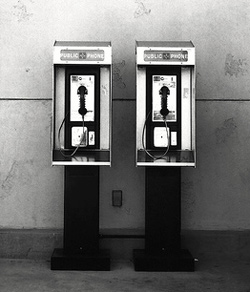

Google gives free voice mail to San Francisco’s homeless
Bless it for doing something amazing.
Bless Google for doing something amazing: The company is handing out phone numbers and voice-mail boxes to every homeless person in San Francisco.
Folks can sign up for the numbers at shelters across the city. The numbers will be local and personal — i.e., each person will get a unique 415-area code number that will never expire.
The number will ring a voice-mail box that will play a personalized greeting; homeless people can check their messages by dialing in from any phone.
Google announced the plan at an event with Mayor Gavin Newsom on Wednesday. The service, Newsom said, will help people who are filling out job applications or are awaiting medical test results. According to the San Francisco Chronicle, Google has already handed out more than 4,000 numbers.
The project uses technology from GrandCentral, the phone start-up that Google bought last year. GrandCentral lets you use one number to ring all your phones, and track your voice-mail messages online.
Boy, this story is so uplifting it nearly erases two month of the serious downer that is watching “The Wire.”
S.F. homeless get free phone numbers [San Francisco Chronicle]
Google Gives All SF Homeless Free Voicemail [KNTV]
Farhad Manjoo is a Salon staff writer and the author of True Enough: Learning to Live in a Post-Fact Society. More Farhad Manjoo.
“Tubes”: What the Internet is made of
If you think your data lives in the cloud and flies through the air, you're wrong
Andrew Blum The title of Andrew Blum’s “Tubes: A Journey to the Center of the Internet” is a ricocheting joke. When Alaskan Sen. Ted Stevens described the Internet as a “series of tubes” back in 2006, he was roundly mocked for not understanding the online world despite being chairman of the Commerce, Science and Transportation Committee and therefore instrumental in overseeing it. Stevens may not have known what he was talking about, Blum (a correspondent for Wired magazine) acknowledges, but he wasn’t wrong, either. In writing this account of “the Internet’s physical infrastructure,” Blum found that “one thing [the Internet] most certainly is, nearly everywhere, is, in fact, a series of tubes.”
Continue Reading Close
Laura Miller is a senior writer for Salon. She is the author of "The Magician's Book: A Skeptic's Adventures in Narnia" and has a Web site, magiciansbook.com. More Laura Miller.
Google’s darkening agenda
The company's attitudes toward privacy have grown increasingly dismissive. Now some countries are taking notice
In this May 11, 2011 file photo, attendees chat at the Google IO Developers Conference in San Francisco. (Credit: AP Photo/Marcio Jose Sanchez, File) In 1999, Scott McNealy, the former head of Sun MicroSystems, reportedly declared, “You have zero privacy anyway….Get over it.” He unintentionally let the proverbial cat out of the bag of the digital age.
In 2009, McNealy’s assessment was confirmed by Google’s CEO, Eric Schmidt. In an interview with NBC’s Mario Bartiromo, he proclaimed, “If you have something that you don’t want anyone to know maybe you shouldn’t be doing it in the first place.” Schmidt’s words have become Google’s new mantra. Welcome to 21st-century corporate morality.
Who owns the cloud?
Google claims users retain intellectual property rights, but the terms of service tell a more complex story
(Credit: winul via Shutterstock) When you hear the phrase “property rights,” you probably think of farmers fighting environmental regulators and homeowners arguing with oil drillers. But in the Information Age, you should also be thinking about your computer – and asking, how much of you is really yours? It’s not a navel-gazing rumination from a college Intro to Existentialism class – it’s an increasingly pressing question in the brave new world of social networking and cloud computing.
Last week’s big technology announcement spotlighted the thorny issue. As the Los Angeles Times reported, Google’s announcement of its “Google Drive” came with the promise that users will “retain ownership of any intellectual property rights that you hold in that content.” But when you save files to Google’s new hard-drive folder in the cloud, the terms of service you are required to agree to gives Google “a worldwide license to use, host, store, reproduce, modify, create derivative works, communicate, publish, publicly perform, publicly display and distribute (your) content” as the company sees fit.
Continue Reading Close
David Sirota is a best-selling author of the new book "Back to Our Future: How the 1980s Explain the World We Live In Now." He hosts the morning show on AM760 in Colorado. E-mail him at ds@davidsirota.com, follow him on Twitter @davidsirota or visit his website at www.davidsirota.com. More David Sirota.
The birth of the Google Translate era
The rise of new technology is changing the way we think about language and the world. An expert explains how
For most of human history, the notion of a “Star Trek”-style universal translator seemed as farfetched as a warp drive or American universal healthcare. Not anymore: In recent years, Google Translate has made automated translation as easy as copy-and-pasting text into a browser; you can now auto-translate entire news articles at the click of a button, and a host of mind-blowing translation apps have hit the iPhone. Word Lens, for example, allows you to point your camera at a piece of text and see it translated in real time on your phone. (Check out the app trailer here).
Continue Reading Close
Thomas Rogers is Salon's Arts Editor. More Thomas Rogers.
Senators clearly don’t understand Google
At the company's antitrust hearing, CEO Eric Schmidt defends himself to a subcommittee that seems very confused
Google Executive Chairman Eric Schmidt is sworn in on Capitol Hill in Washington, Wednesday, Sept. 21, 2011, prior to testifying before the Senate Antitrust, Competition Policy and Consumer Rights subcommittee hearing to answer whether Google has used its dominance unfairly as it has grown from an Internet search engine expanding into broader services and markets. (AP Photo/J. Scott Applewhite)(Credit: J. Scott Applewhite) Google chairman Eric Schmidt had an easy time of it during his much anticipated congressional testimony before the Senate Judiciary Committee’s antitrust subcommittee yesterday afternoon, in large part because senators on both sides of the aisle clearly have little grasp of the nuances of how Google works. Schmidt is likely counting that as a victory. But ignorance is not a guaranteed long-term strategy for Google.
Continue Reading CloseNancy Scola is a New York City-based political writer whose work has appeared in the American Prospect, the Atlantic, Columbia Journalism Review, New York Magazine and Salon. On Twitter, she's @nancyscola. More Nancy Scola.
Page 1 of 30 in Google