
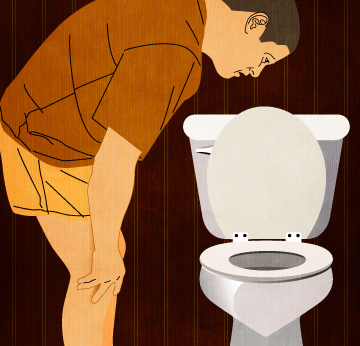

I looked, all right? This morning, I took a long and unflinching gaze. How do I say this without sounding boastful? There in the bowl was a real beauty, my reward for yesterday’s hearty oatmeal breakfast and black bean and rice dinner. It was the kind of (how do we settle on a comfortable euphemism?) ejecta that would make Mom proud.
I consulted “What’s Your Poo Telling You?
I am hardly alone in poring over “What’s Your Poo Telling You?” Not only does poo have a lot to tell you, but lately scores of Americans seem anxious to listen. Last spring, Chronicle Books printed 20,000 copies of the little brown book, mostly to be sold as a novelty in Urban Outfitters. Today it has sold more than 225,000 in big-box bookstores nationwide. Apparently its success is proof that at long last poo has come out of the water closet.
Indeed, what the book’s coauthors, Josh Richman and Anish Sheth, M.D., say was once regarded as “malodorous waste” can now be openly regarded for what it is: a miracle of creation, a crystal ball of intestinal health, a feng shui of the derrière. “Like a snowflake, each poo has a wondrous uniqueness,” they write. They deconstruct specimens such as the “log jam,” “a cruel reminder of your inability to perform,” and “hanging chads,” “stubborn pieces of turd that cling.”
And for those who aspire to leave behind a shameful history of faulty stools? “The ideal poo is a pillowy soft, singular bolus of stool that exits the body with minimal effort,” says Sheth. And that paragon of poo is achieved by consuming plenty of fruits, vegetables and fiber superstars: beans, peas, seeds and nuts.
But wait, there’s more on the fecal front. Author Danielle Svetcov is set to publish “The ‘Regular’ Gourmet Everyday: Sumptuous Recipes for the Gastro-intestinally Challenged.” Tens of thousands of Americans are signing onto the Cleanse diet, a sort of spiritual-cum-vegan Roto-Rooter for the intestines. “Functional foods” like Activia yogurt aren’t selling by the cases because they are low-fat. That’s so 20th century. They are being hyped for how they “maintain digestive health.” Cutting-edge Japanese toilets can read your droppings for dietary deficiencies. But there’s a far more convincing sign that poo has hit the big time.
Much as they did with eating disorders and sex obsessions, viewers of “The Oprah Winfrey Show” are being invited to stop withholding about this most intimate and private act. Encouraged by the charismatic Dr. Mehmet Oz, a cardiovascular surgeon who appears regularly on the show, we are being told to look before we flush, to study what we’ve produced as a talisman of health. When it comes to diet, we need to make “number two” our “number one priority.”
On “Oprah,” women are pouring out their troubles on the toilet. Susan talks freely about her constipation. Maureen, a mother of four, lets loose entirely. “My hemorrhoids feel so bad that it’s like grapes hanging out of my rear,” she confesses. “Sometimes they hurt so bad, I can’t get out of bed for two days.”
Clearly, says Oz, Maureen and Susan, like millions of white-flour-addicted Americans, aren’t listening to what their stools are telling them. (Really, who knew the intestinal tract was so chatty?) “‘Help! Help!’ Their big colon is saying, ‘I need something from you,'” says Oz. If Maureen and Susan stop eating their children’s leftover Happy Meals and start eating more lima beans, oh, the satisfaction, wastewise, they would realize.
“You want to hear what the stool, the poop, sounds like when it hits the water,” Oz instructs. “If it sounds like a bombardier, you know, ‘plop, plop, plop,’ that’s not right because it means you’re constipated. It means the food is too hard by the time it comes out. It should hit the water like a diver from Acapulco hits the water.” Oz makes a “swoosh” sound — the sound of an Olympian excrement champion.
So why poo, and why now? Well, when it comes to the success of “What’s Your Poo Telling You?” there are two good reasons that two men in their 30s, who were potty-trained with the children’s scatological classic “Everyone Poops,” would grow up to write an adult version that speaks to their generation. No. 1, now that baby boomers are decidedly middle-aged, they’re becoming ever more aware of physiological changes that make poop an important topic of conversation. No. 2, we’re experiencing a baby boomer boomlet, with millions of new parents focusing, as new parents will, on their wee ones’ output.
Moreover, this is the natural progression of a nation obsessed, and browbeaten, about eating healthy. So we’ve moved from mouth southward, from fretting over what goes in our mouth to what comes out the other end.
The moment is ripe to come clean about our inner workings, say coauthors Sheth and Richman, who met when they were undergraduates at Brown University (where else?). Sheth, along with other collegiate pastimes, developed what he calls the PQI, or Poo Quality Index, that he and fellow students would use to compare the superiority of their bowel movements. Years later, the pair reconnected when Richman, who works in Silicon Valley to develop clean-energy technology, got back in touch with Sheth, who’d since become a gastroenterologist fellow at Yale University School of Medicine. “Poo has been in a societal sewer,” says Richman. “It’s something people didn’t feel comfortable talking about outside a small circle of friends. What we’re seeing is a cultural evolution where it’s no longer a taboo subject.”
Reading Richman and Sheth’s book is similar to pulling an enormous ball of wax out of your ear. Although you know you should be disgusted, you can’t stop looking at and obsessing over it. Quite simply, theirs is a fascinating read. (“Two thumbs up! Gripping and loaded!”) You feel relieved to get to the bottom of so many rectal mysteries, to find out that certain bathroom experiences — sometimes seemingly weird and extraordinary — are not signs that you’re a freak of nature.
When a kernel of corn makes its rear exit and comes out perfectly intact, it’s not a personal failing that proves you’re a bad child who didn’t listen to his mother and failed to chew properly. Instead, this common phenomenon, “deja poo,” refers to certain foods like corn that have insoluble fibers that are difficult for even the most efficient digestive tract to break down. “Regularity” spans the range from three times a day to three times a week. And a case of nerves — whether before an important business meeting or a performance — can induce “performance enhancing poo.”
“With so many of these experiences, we’ve had a lot of people come up to us and say, ‘I thought that was just me,'” says Richman. He adds that since the book came out, people are so anxious to talk about their stools that almost every dinner party discussion descends into potty talk, conjuring up a scene straight out of a Buñuel film.
Who knew it’s better to squat than sit? Or that because of a heavy fiber diet, the national average for detritus in southern Asia is three times that of the waste-makers in England. Then there’s the rarely discussed form of toilet elation, “poo-phoria.”
“This poo can turn an atheist into a believer and is distinguished by the sense of euphoria and ecstasy that you feel throughout your body when this type of feces departs your system,” write the coauthors. “To some, it may feel like a religious experience, to others like an orgasm, and to a lucky handful it may feel like both. This is the type of poo that makes us all look forward to spending time on the toilet.”
Going to the john is no longer simply a process of elimination. No, the “unbridled elation that results from releasing the perfect poo” is now a transformative act, bringing the conscientious fiber-eating toilet sitter to a spiritual or sexual high.
Unsettling connections between defecation and sexual pleasure aside, health may be one of the book’s biggest benefits. An interesting point when you consider that Urban Outfitters shoppers aren’t exactly the Ex-lax crowd, paying close attention to their colon’s health.
Even for a relatively young and fit person, the book makes the reader want to achieve a healthier dump. After this bathroom read, you find yourself reaching for that binding banana or drinking loads more water; and to prevent those punishing pebble poos (they can, uh, hurt on the way out), an indicator of a low-fiber diet, you opt for that sensible, grandmotherly bran muffin over the constipating chocolate croissant.
On a serious and somber note, the book advises taking a look before you flush for indicators of serious internal trouble including liver disease (white or gray feces), pancreatic disease (yellow poos) and more. (Unless you’ve been eating beets, the proper response to any deep red or black stools is an immediate check-in with your doctor.)
A snarky yet smart book like this — a “Colbert Report” of bowel movements — is in sync with today’s Web-savvy population. “With the advent of the Internet, people want to know a lot more about their health,” says Sheth. “Gone are the days people go to their doctor and take everything on blind faith. As it’s obviously intermeshed with one’s diet, the whole aspect of taking health into one’s own hands has trickled down to poo.”
Getting to know your poo may also improve your mental health, says New York City child psychologist and parent educator Lawrence Balter, author of “Dr. Balter’s Child Sense.” More openness, and less repressiveness, about our bodily functions are a good thing, he believes, although he pooh-poohs resorting to such infantile words as “poo” rather than the more forthright “bowel movement.” “These words give the impression that there’s something wrong or unacceptable,” he says. “The fact that an adult book would use a word like ‘poo’ suggests it’s a childish leftover and a childish reaction to these things.”
What would Freud say? We may have a way to go to grow out of our childish anal stage; getting beyond fourth-grade humor and cutesy euphemisms may take years. But being more serious about studying our stools may be a sign our country is growing up.
Oz says that in old-world countries like Turkey, where he has spent much of his life, the connection between overall health and healthy bowels is part of the culture. Indeed, the practice of taking an informed and forthright look at one’s waste as a vital sign of good or ill health is hardly new, practiced by societies worldwide for hundreds of years. In his recent Harper’s essay, “Wasteland,” about sewage treatment, Frederick Kaufman tells of the great Kamchatka god Kutka, who created the world and every living being, “then fell in love with his excrement and wooed it as his bride.” Now, that’s poo love.
In the United States, alternative-health practitioners have proved to be ahead of the intestinal curve, looking at the health of the gut as an indicator of systemic problems. “This kind of awareness is a critical first step in taking better care of ourselves,” says Daphne Miller, a San Francisco-based integrative family physician and author of the upcoming book “The Jungle Effect: A Doctor Discovers the Healthiest Diets From Around the World — Why They Work and How to Bring Them Home.”
“When I do an initial assessment of someone’s overall health, I really focus on their digestion and I often find myself getting down to the nitty-gritty when it comes to bowel movements,” she says. Seemingly unrelated health problems, including skin rashes, allergy symptoms and hormonal imbalances, can have their root in the gut, an assertion that’s supported by recent mainstream biomedical research. “Over and over again, I find that by fine-tuning someone’s digestion, other health issues can improve dramatically,” Miller says.
Yet can so much fecal gazing be a bad thing? Absolutely, says James Dillard, medical director of Columbia University’s Rosenthal Center for Complementary and Alternative Medicine. “All the neurotics are going to think this is wonderful,” he says. “The whole alternative side of life is a little bit self-obsessed. If you’re reading a book that has you focusing on your poop, you need to get out more. Instead of looking at your butt, you might want to look more at the vegetable aisle.”
Dillard says that focusing on excrement is “an irrelevant distraction” from necessary health habits, including a good diet, regular exercise, sleep and stress management. “There is no such thing as the ‘ideal’ stool,” he says. “This is a nonsense, pre-science concept. Obviously, if someone is eating only McDonald’s, they will get stopped up.” Otherwise, says Dillard, even the most laudable diet will show enormous variation in what comes out, all dependent on multiple factors like what you had for lunch, the amount of soluble and insoluble fiber you’ve eaten, hydration and — given that the gut is inextricably linked to the nervous system — your mood.
Dillard also points to the current fad for “detoxing” the body by regularly getting high colonics as an obsessively unhealthy one. “This is a manifestation that a part of you is dirty,” he says. “The colon has been around million of years and the wisdom of the colon predates us. This notion that we can somehow always intervene in some way so we can be intellectually or psychically or physiologically superior to this part of the body is kind of foolish.”
What’s more, obsessive stool reading may be a sign of an emotionally unhealthy culture. Since the turn of the 21st century, says private-practice psychologist Susan Lipkins, we’re increasingly panicked over the inability to control factors like terrorism, global warming and the government. “As Americans’ anxiety increases, it makes sense that we’d try to control everything,” says Lipkins, an expert on toilet training. Our recent enthusiasm for stool perfection may be yet another manifestation of Americans’ “obsessive, narcissistic” behavior, she suggests.
“Parents are trying to control their children, corporations are trying to control workers, and on an individual level, we’re trying to control our bodies, including our poop: when we poop, how often we poop and what we poop, including the right size, consistency and color.” As with all fads that strive toward the perfect body — be it the face, the pecs or the wardrobe — Lipkins says we’re missing something essential.
“You can be perfectly shaped and have perfectly shaped poops and still be an unhappy camper.” What’s more, says Lipkins, obsessing is not good for overall health, and certainly not for one’s bowel movements, since to poop with ease, it’s essential to relax. “But Type A people don’t have an hour to relax, so they take fiber to make sure they poop, so it fits into their schedule. Giving yourself time in the morning is a lot better than taking something so you can poop.”
In the end, as with all health practices, balance is key. “I don’t think there’s anything wrong with analyzing one’s excrement,” says Dillard. “But if this is the center of your life, you need to consult a mental health practitioner.”
