
The most important call for the next president won’t come at 3 a.m., and it won’t involve military security.
The gravest threat to the American way of life is posed by unrestricted greenhouse gas (GHG) emissions. Global warming threatens to put the Southwest into a permanent drought, raise sea levels by 6 or more inches a decade, generate hundreds of millions of environmental refugees at home and abroad, wipe out half the planet’s species, and increase average temperatures in the nation’s interior 10-20 degrees Fahrenheit. And these impacts would likely get steadily worse for hundreds of years or longer.
No enemy, foreign or domestic, poses a threat to us that is so devastating, so irreversible. Top climate scientists tell us the threat might be all but unstoppable if the nation and the world don’t take serious steps over the next decade to restrict GHG emissions. For all the urgent crises the next president has to deal with in the middle of the night, the most important calls he or she will have to make concern how to stop global warming.
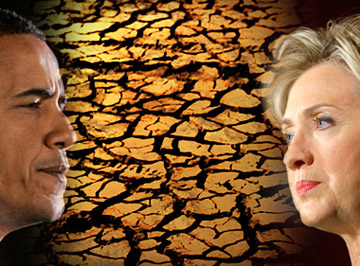
We’ve seen that a President McCain is not likely to be the leader this country and the world need to maintain the planet’s livability for our children and the next 50 generations. What about a President Hillary Clinton or Barack Obama? Both would be a giant step forward. Unlike McCain, they have both put out detailed and comprehensive plans. (Obama’s is here. Clinton’s is here.) Although you wouldn’t know it from the media coverage, these plans are more important to the long-term health and well-being of future generations than the candidates’ healthcare or Iraq plans.
Before I look in depth at them, the first thing to make clear is that no president, not even a modern-day Lincoln or FDR, could possibly stop global warming even by their second term. The increase in concentrations of heat-trapping greenhouse gases is primarily what determines how much humans will increase the planet’s temperature. To stop concentrations from rising further, the entire planet will have to reduce total annual emissions at least 60 percent or more from current levels, including carbon dioxide emissions from burning fossil fuels. Absent a World War II-type mobilization, that kind of dramatic change in the planet’s energy system will take a few decades.
Even when concentrations stop rising, global temperatures will continue to increase for many decades because it takes a long time for the planet’s temperature to come into equilibrium with any new level of GHG concentrations. Ultimately, by 2100, we will probably need net human GHG emissions to be close to zero, if not negative, to avert catastrophe. We can’t stop global warming in the next decade.
Humanity’s great challenge is to stop the warming before we cross key thresholds or tipping points, in which amplifying feedbacks in the carbon cycle start to seriously kick in and overwhelm human efforts to reduce emissions. A typical feedback would be the melting of the permafrost or tundra, which currently has locked away some 1,000 gigatons of carbon — more carbon than the atmosphere is holding today.
If the permafrost stops being perma, that would release tens of billions of tons of carbon into the atmosphere, much of it in the form of methane — a much more potent greenhouse gas than carbon dioxide. That, in turn, would speed the temperature increase and the thaw of additional permafrost. In short, passing such a tipping point would set the planet on an all-but-unstoppable path to high concentrations of GHGs, destroying the planet’s livability for centuries if not millennia, according to the latest research.
So we must sharply reduce emissions even as the population keeps growing, and do it in a way that increases, rather than hinders, economic development, particularly in undeveloped nations already wracked by poverty, disease, dirty water, hunger and other scourges.
This necessitates deploying all existing or near-term clean energy technologies today as rapidly as possibly, while shutting down or capturing the emissions of at least half of the dirty technologies. At the same time, we must accelerate the development and introduction of the next generation of clean technologies, which can ultimately take global emissions as low as possible by century’s end.
A mandatory GHG control system that establishes a price for carbon dioxide emissions, such as a cap-and-trade system, is necessary. Both Clinton and Obama endorse a cap-and-trade system, requiring an 80 percent reduction in U.S. GHGs by 2050 compared to 1990 levels, much deeper than McCain has so far endorsed and close to what is currently believed necessary for our country and planet. Recently, McCain has also begun waffling about just how “mandatory” his program would be. Voluntary caps don’t work and must be rejected.
Yet cap and trade is not enough. The next president has a great many important calls to make:
Appoint judges who will uphold laws to reduce emissions against challenges from the big polluters. Appoint leaders and staff of key federal agencies who take climate change seriously and believe in the necessary solutions. Embrace an aggressive and broad-based technology deployment strategy to keep the cost of the cap-and-trade system as low as possible. Lead a change in utility regulations to encourage, rather than discourage, energy efficiency and clean energy. Offer strong public advocacy to reverse the years of muzzling and misinformation of the Bush administration.
McCain is unlikely to do any of these five things. Obama and Clinton are likely to do them all. In particular, at least from my perspective as a former Energy Department official, the most important news is that both of them understand the necessity of the technology side.
Obama’s plan states:
“Barack Obama will use some of the revenue generated from the cap-and-trade permit auction to invest in climate-friendly energy development and development. This will transform the economy and create millions of new jobs. Obama will invest $150 billion over 10 years to advance the next generation of biofuels and fuel infrastructure, accelerate the commercialization of plug-in hybrids, promote development of commercial scale renewable energy, invest in low emissions coal plants, and begin transition to a new digital electricity grid. A principal focus of this fund will be devoted to ensuring that technologies that are developed in the U.S. are rapidly commercialized in the U.S. and deployed around the globe.
Both candidates also understand the importance of, as Clinton’s plan explains it, “Changing the Way Utilities Do Business”:
“The current model for electric and natural gas utilities puts customers and utilities at odds on efficiency investments. Consumers benefit by spending less on electricity, while utilities actually lose money from every electron or cubic foot of gas saved through energy efficiency. As a result, utilities lack incentives to implement programs that would reduce demand, even if those efficiency programs are more cost-effective than building new power plants. Breaking this model would enable consumers and utilities to share in the benefits of efficiency, and when combined with a requirement that utilities take steps to reduce demand, would unleash tens of billions of dollars of investments in energy efficiency technology. To put this process in motion, Hillary would set binding energy efficiency targets for utilities at the national level. She would then encourage states to establish rate rules for utilities that both decouple electricity sales from utility profits and enable utilities to profit from investments in energy efficiency.”
Both Clinton and Obama understand the current electric grid is too antiquated to capture all the opportunities for clean technology, such as distributed power, real-time energy management and plug-in hybrids. So both propose to create a Smart Grid. Obama explains:
“… our energy grid is outdated and inefficient, resulting in $50-$100 billion losses to the U.S. economy each year. The 2003 East Coast blackout alone resulted in a $10 billion economic loss … Obama will invest federal money to leverage additional state and private sector funds to help create a digitally connected power grid. Creating a smart grid will also help insulate against terrorism concerns because our grid today is virtually unprotected from terrorists. Installing a smart grid will help consumers produce electricity at home through solar panels or wind turbines, and be able to sell electricity back through the grid for other consumers, and help consumers reduce their energy use during peak hours when electricity is more expensive.”
Clinton would even fund 10 “Smart Grid Cities,” public-and private partnerships to deploy smart grid technology and plug-in hybrid vehicles on a large scale, to test and refine the possibility that plug-ins could communicate with the smart grid to sell power back to utilities when utilities most need it. Her plan notes, “Some experts believe that providing such ‘vehicle to grid’ power at times when the utilities need it most could be worth $2,000-4,000 dollars per vehicle per year, slashing the cost of owning a plug-in hybrid.”
Yes, Clinton or Obama — and their advisors — have thought through the climate issue a great deal, including how to overcome the traditional barriers to residential energy efficiency. Clinton points out:
“Builders often neglect to make energy efficient investments because they add to the purchase price, even though they save money down the road. As President, Hillary will establish a ‘Carbon Reduction Mortgage Association,’ or ‘Connie Mae,’ by directing Fannie Mae and Freddie Mac to facilitate the origination of energy efficiency improvement loans in order to subsidize the additional costs of investing in energy efficiency from the outset … The energy bill savings will ultimately offset the cost of the loan … The program will target lower and middle-income homebuyers.”
Clinton and Obama have aggressive efforts to boost vehicle fuel economy and shift the country to alternative fuels. You might be worried that this would mean a big jump in corn ethanol or maybe liquid coal, based on the fact that each of the candidates has, in recent years, lent support to both of those ideas. But the strong cap on carbon emissions will render those energy sources uneconomic. Also, Obama “will establish a National Low Carbon Fuel Standard to speed the introduction of low-carbon non-petroleum fuels. The standard, which Obama introduced in the U.S. Senate with Tom Harkin (D-IA), requires fuels suppliers to reduce the carbon their fuel emits by ten percent by 2020.” That would be fatal to liquid coal and drive fuels toward low-carbon sources, such as cellulosic ethanol.
And Obama and Clinton would both take steps to ensure that U.S. car companies would have the financial strength to meet any new regulations. The Clinton campaign states:
“Hillary would authorize $20 billion in low-interest ‘Green Vehicle Bonds’ in order to provide immediate help to retool the oldest auto plants to meet her strong efficiency standards. She will address retiree health legacy costs by providing a tax credit for qualifying private and public retiree health plans to offset a significant portion of catastrophic expenditures that exceed a certain threshold.”
Both recognize that solving the climate problem requires commitments from the large developing-country emitters. So, along with a commitment to reverse Bush policy and reengage with the U.N. climate process, both would create a new, more focused international forum. Says the Obama campaign:
“Obama will build on our domestic commitments by creating a negotiating process that involves a smaller number of countries than the nearly 200 countries in the current Kyoto system. Obama will create a Global Energy Forum — based on the G8+5, which included all G-8 members plus Brazil, China, India, Mexico and South Africa — of the world’s largest emitters to focus exclusively on global energy and environmental issues.”
Perhaps most important, both Clinton and Obama have said they will bring urgency from the very top of their administrations to the enormous energy problem. Clinton promises:
“She will create a National Energy Council modeled on the National Economic Council and the National Security Council. This new body will bring together disparate agencies in the federal government to put everyone on the same page and ensure that we all have the same priorities — much like the National Economic Council does for the economy. The National Energy Council would be headed by a National Energy Advisor who reports directly to the President, and who is charged with coordinating the implementation of Hilary’s energy and climate agenda across the Executive Branch.”
Obama said in early February he would start working on a global climate effort as soon as he becomes the Democratic nominee (which at the time he probably thought would have happened already): “I’ve been in conversations with former Vice President (Al) Gore repeatedly, and his recommendation, which I think is sound, is that you can’t wait until you are sworn into office to get started … I think we need to start reaching out to other countries ahead of time, not because I’m presumptuous, but because there’s such a sense of urgency about this.”
Clinton and Obama understand this is not just about the environment, but also about jobs. Both have a clean-energy jobs training program. As Clinton describes hers, “The program would target at-risk youth, veterans, displaced workers, and would teach them skills to install and maintain energy efficiency and renewable energy technology.” These are the high-wage jobs of the future. She believes “we have the potential to unleash a wave of private sector innovation and create at least 5 million new jobs from clean energy over the next decade.” She sponsored a clean energy jobs provision that was included in the 2007 Energy Bill.
Yes, the plans are similar and comprehensive. I believe that, if enacted in total, they would work, would cut emissions sharply, while generating millions of new jobs and giving the United States leadership in what will certainly be the biggest industry of this century: GHG-reducing technologies.
Plans are, however, easy to write, at least for Democratic candidates. The two bigger questions are about leadership: Could Clinton or Obama get their plans enacted by Congress? Could they get developing countries, particularly China, to agree to GHG controls?
Each of these challenges is so huge and so unique, there is little in the record of either candidate that lets us know which is more likely to succeed. McCain failed twice in the Senate to win a majority for his climate bill, let alone earn the 60 votes needed to beat a filibuster by his Republican colleagues. In fact, the second time he tried, in 2005, he mustered only 38 votes, five fewer than he had the first time.
The first challenge is that conservatives are dead-set against virtually every single one of the strategies needed to fight global warming. They don’t like the mandatory cap-and-trade system. McCain himself is telling journalists his mandatory program isn’t a mandate, and asking them not to use the word. Conservatives don’t even like long-standing clean energy tax credits, and McCain said he would vote against them. And they don’t like funding for clean energy research and development and deployment programs, which have been gutted by conservatives going back to President Reagan and the Gingrich Congress, and including President Bush, who has tried to shut down many of the best federal programs. But they do like tax breaks for big oil, even when the oil companies are swimming in $123 billion in profits and record high oil prices.
That is why the U.S., once the world leader in all clean energy industries, is now a laggard in most of them. That is why China is projected to be the top producer of both solar photovoltaic cells and wind turbines by 2010. If you’re wondering how the U.S. could generate millions of new jobs and make deep reductions in GHG emissions, while rejecting federal energy policies that have worked for every other country in the world — well, you’ll have to ask that question of Sen. McCain yourself, since I’m sure the traditional media won’t.
So who would be better, Clinton or Obama, at bringing conservatives along? I suppose that depends on whether you think we need a fighter or an inspirer to do this next-to-impossible task. My guess is you need both. And many of the most important phone calls for the next president will be to members of Congress to secure their vote.
The second great climate challenge is getting China to agree to cap emissions by 2020. Given its rapacious pace of building coal plants — a staggering 200,000 megawatts of fossil-fuel-based generating capacity (mostly coal) in the past two years alone — China is sending a clear signal to the world that it cares as much about climate as the Bush administration. The only way to avoid catastrophic climate change is if the next president 1) gets a strong U.S. climate agreement in his or her first year to show the rest of the world we are serious about this problem; 2) makes an international treaty that includes China and India their top international priority in their first term.
I do think it matters to China a great deal that it become the world leader in clean technology. So if we embrace most of the Clinton and Obama strategies, we will be sending a clear signal to the world that we aim to pursue leadership in all the key technologies. That would make it more likely that China will get onboard. The nations that adopt a strong emissions reduction strategy must also establish a border adjustment for imported goods, so that countries like China won’t perceive an economic advantage by continuing to be polluters.
None of this will be easy. Again, it will probably require a fighter and an inspirer. Someone who can make tough calls to foreign and domestic leaders. A president (and senior staff) who believes in the crucial role of government in restoring U.S. leadership in clean energy development, deployment and job creation. On these, the most important of issues, I think Clinton or Obama — not McCain — will make all the necessary calls.
