
Video Games

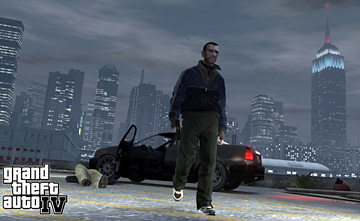
“Grand Theft Auto IV” is a dark urban masterpiece

With a fictional universe of astonishing cleverness and complexity, this is one of the smartest video games ever created.

  • more
    • All Share Services

Rockstar Games

“Grand Theft Auto IV” wears its reputation on its sleeve, most likely in an ambidextrous shoulder holster with a double-mag pouch. Fans of the series come to this latest game, which has already set sales records since its release last week, with high expectations: that its landscape will be lush and flexible, offering endless opportunities to wreak havoc over a tyrannized virtual populace — but also intricate and clever, stamped with in jokes, futuristic absurdities and wry references to pop culture and politics.

Detractors, too, keep a checklist handy for any new “GTA” release. In a game that aims to re-create the underside of urban life, there’ll be guns and crooks and prostitutes and sex and drugs and booze. The combination, under the thumbs of 14-year-olds and re-created in high-def right in your living room, has proved a recurrent boon to the nation’s concern industry.

What’s beautiful about “Grand Theft Auto IV” is how grandly it both fulfills and tweaks these expectations. This may be the darkest, most realistically violent game in the series, and if you go looking for sin — as many players do — you’ll find dozens of sequences that’ll provoke outrage on the late local news. “GTA IV” allows you to hire prostitutes and then murder them — need any more be said?

On the other hand, as several reviewers have pointed out, the graphical and narrative realism of “GTA IV” serves, unexpectedly, to diminish a player’s blood lust. The game’s story line is so absorbing that you aren’t really moved to murder random passersby. Its fictional universe is unendingly deep, far more complex than what came before — not to mention than much of what one finds on TV or at the movies.

This new dimension elevates “GTA” from mere entertainment into something that can credibly, if a little self-consciously, demand to be called art. The more you play “GTA IV,” the more real everything in it feels. And it won’t be long before you’re calling it the smartest video game ever created.

Folks cleverer than me — notably Steven Johnson — have convincingly expounded on the mind-expanding capacities of video games, but with previous versions of “Grand Theft Auto,” the argument has been a tough sell. When you tell people you’re playing a game that allows you to mow down virtual civilians — indeed, that such behavior constitutes the game’s defining thrill — they recoil. It sounds hollow, mindless, attractive only to sadists — on the order of rape porn, “Bumfights” or a Gordon Ramsay reality show.

“GTA IV,” like previous versions, sets you up as an outsider in the city, where you gain status and notoriety by embarking on a series of missions (murder, robbery, mayhem) for a variety of friends and associates. But unlike the other “GTAs,” this one gives each of your associates unique, fully fleshed personalities and characteristics.

The fellow you play, Niko Bellic, is an Eastern European immigrant scarred by unnamed strife in the motherland, and his actions hew to a moral code born of that conflict. Others have odder quirks: the wife of a gang leader who can’t stand the monster her husband has become. The ex-con who feels the press of suicide as he adjusts to life outside the can. The girlfriend who’s a clean freak, and who, during some off-screen activity that one presumes is sex (the controller vibrates knowingly), ecstatically compliments your conversational skills.

But it’s not only that the people you encounter are interesting — it’s also that there are so many of them! I was often struck, while immersed in “GTA IV,” at its resemblance to another fictional universe I love, David Simon’s in “The Wire.” The similarity is not narrative, but rather structural — understanding the game’s world depends on your learning and navigating a web of sometimes mysterious social connections.

As much as it is a driving and shooting game, then, “GTA” is also a puzzle game. The puzzle concerns social relationships: You’re working with and for several characters at once, and what you do for some of them affects how you get along with others. In a game known mainly for carjacking, it’s surprising how much time you’re asked to spend building and maintaining friendships and romantic liaisons — going on dates to bowling alleys and comedy clubs, hanging out with your pals at bars and pool halls, keeping up with a surfeit of text messages and e-mail (even deleting Nigerian spam).

Where “The Wire” tries to present the modern American city as it is, “GTA IV” gives us the city as it might become. The city here is called Liberty, a stylized riff on New York, but the name’s ironic: There’s no liberty in Liberty City. Officials pump up terrorism fears, crime is rampant, ethnic tensions are high, and everyone is rude.

It may be too much to say that “GTA” has a message, but it certainly has a vision: It’s the dystopian near-future, something like the world of “The Children of Men” (there are no kids here, either).

The vision is pushed by the media your character encounters — the radio stations, the TV networks, the astonishingly deep in-game Web (with parodies of Craigslist, Fox News, Match.com and other sites, which you access at Internet cafes called TW@).

As you pass through the city, you learn about the end of reading as a pastime, or the new market in selling babies over the Internet, or the extremely elevated terrorist threat — “Liberty City is now officially on Charcoal 8 Alert, more serious than the Red High 7 Risk Alert, but not as serious as the recently created Black Severe 9 Alert,” the game’s Fox News analogue, Weasel News, warns.

Crucially, your aim here, unlike in many games, is not to set right what’s wrong with this place. I haven’t finished the game — it could take weeks — but I get the sense that once Niko Bellic has achieved all he can in Liberty City, it will still be the pits.

Win or lose, the world goes on without you.

Holiday carols, eggnog — and video games

It's a new tradition -- generations around a game console. For 25 years, families have shared "The Legend of Zelda"

  • more
    • All Share Services

Holiday carols, eggnog -- and video games

The legend goes like this: As a boy growing up in Japan, Shigeru Miyamoto was playing outside and discovered a cave. The cave haunted the child, who loved comics and dreamed of becoming an artist, but he was too afraid to go explore. Pained days followed, and the boy tried to summon the courage to see what was hidden. As we all do eventually, however, Miyamoto finally faced his fears. He went inside — and it helped change the way we all play.

Thirty years later, Miyamoto defined video games during a period of remarkable creativity. He gave games their first story in “Donkey Kong”: Ape kidnaps lady, climbs a building, mustachioed fella rushes to save her. It’s a classic boy-rescues-girl plot, but before “Kong,” games only had beginnings and endings in the sense that a challenge was completed or not. “Kong” had a story arc — and gave birth to games’ most enduring icon, Mario.

But it was that cave that inspired Miyamoto’s definitive work, “The Legend of Zelda.” The game celebrates its 25th anniversary this year, and no doubt it is under more than one Christmas tree today. Someone in your house might be playing right now. It’s become one of the most enduring and popular games of all time; while it wasn’t the first to set players loose in a world without direction, “Zelda” was the first to make adventure games easy to understand.

“The Legend of Zelda’s” very first screen shows a child in a floppy green hat, a boy named Link. There are paths to the west, east and north, but none to the south. There is also — of course — a cave. There is no option to go back. The best option is the one Miyamoto feared as a child — heading into the cave. Maybe there will be something you can use? Inside, an old man hands over a wooden sword and advises, “It’s dangerous to go alone! Take this.” He isn’t offering to join you. He’s just reminding you that it will be dangerous out there all by yourself.

That first outing was a revelation, an experience that pointed toward just what kind of story games would be best at telling: There were goals, but you would discover them at your own pace, in a countryside that was surprising and unpredictable. There were forests to get lost in, mountains that didn’t end, old women in burned-out hollows selling potions to keep you alive in desperate situations.

As “Zelda” games are opened today, generations will share a holiday tradition that has become as much a part of Christmas as tossing a football once was — playing video games together. I will be 35 when Nintendo releases the next “Legend of Zelda.” I was 4 when the first came out. Once I played with my brothers. Now I play as a husband, and soon it will be with a family of my own.

But while my life has changed, “Zelda” remains recognizable, which is one of the reasons these games hold so much cross-generational appeal. The kids who opened “Zelda” games two decades ago are parents and aunts and uncles now — but still know their way around a video game. And “Zelda” comes right back — it will always be about an elfin gentleman in a green tunic who crosses the world using a variety of tools and a blue-hilted sword to rescue a woman from a malevolent force. It will likely sport rousing music and a long quest. Not for the first time over the past quarter-century, I will have changed and “Zelda” will have stayed exactly the same, waiting to beguile some unsuspecting fourth-grader for the first time.

“Zelda” has evolved; there’s a good reason why, even as the average game player’s age has risen above 40, “Zelda” has remained a beloved institution and not just a tired nostalgia trip. Even as the series has become a traditional, seemingly wholesome stalwart in a medium increasingly known for guns, guns and more guns, it has also managed to grow alongside its audience in quiet, meaningful ways. People continue to play “Zelda” because it speaks to both the 6-year-old and the 30-year-old. What’s changed in the latest entry, “The Legend of Zelda: The Skyward Sword,” is that it speaks more lucidly to the 30-year-old than it ever has before.

Miyamoto and the series’ other stewards, including longtime producer/director Eiji Aonuma and composer Koji Kondo, have always insisted that any narrative ties between the various editions are more treats for fans than the foundation of a thorough, evolving story. The games are called legends on purpose, making each new game part of an interactive, oral tradition. Here is the way it was told to me when I was a boy, etc.

In “Skyward Sword,” the most recent telling, Link is a young man living on the floating island of Skyloft, a community of bird-riding people who haven’t lived on the ground in thousands of years. Things get underway when Link graduates from the knight academy alongside Zelda, daughter of the school’s headmaster and Link’s lifetime friend. Ceremony complete, Zelda and Link take off for a joyride on their giant birds. The two are caught off guard by a massive tornado; Zelda is thrown to the lost world below the clouds and Link is knocked unconscious. When he comes to and finds Zelda mixed up in world-altering troubles, he heads off to find her.

The quest is familiar. Link’s been saving Zelda for 25 years now. When Link hits terra firma, he’s told by an oracle to seek out Zelda in a variety of ancient temples hidden away in lava-ridden mountains, dense forests and wind-blown deserts. All of these locations are rich with implied history and feel lived in. Link collects a variety of tools, meets colorful characters anxious to help, and the world below unfolds like a complex, organic puzzle box, a place that slowly reveals itself as you can further access it, whose inner compartments are new puzzles themselves.

These components make up the childhood fantasy that has kept Zelda so entertaining over the years. It’s a process of private discovery and problem solving. It’s backyard play by design, a lush, animated version of discovering that cave in the woods and then finally daring to go inside. “Skyward Sword” is as rewarding in this regard as any of its predecessors, but something is different.

“Skwyard Sword” draws Link into its community more than any other “Zelda.” You’re drawn in as well. Link, after all, is nothing more than a proxy for the player in “Zelda’s” world. It’s why he doesn’t speak, even now when most video-game characters never shut up. “The most important thing about the ‘Zelda’ series,” says composer Koji Kondo, “is that the player becomes Link.”

“Zelda” has never been a totally solitary experience. All of the games since 1988′s “Zelda II: The Adventure of Link” feature towns filled with citizens who need help with all kinds of things. In all of them, however, you aren’t a part of the town’s day-to-day life; you’re just a journeyman passing through. The town is there to be a home you leave at the outset of your adventure. The moment of growth comes from what’s discovered outside, not from what’s learned at home. In “Skyward Sword” you never fully leave home. You fight an evil monster and save the world, but these tasks are secondary to mending your broken community and bringing your loved one home.

It’s a decidedly adult goal for what used to be an engrossing but simplistic fantasy. It’s about responsibility as much as progress. The relief and tenderness of Link’s reunion with Zelda carries more weight than it would if the boy saved an idealized princess, or if the infatuated teen is brought back together with his girlfriend, or any number of other pairings. The story here still offers the wandering freedom of that game of caves from 1986, but now there are consequences. Life beyond you goes on, both during and after the quest. So “Zelda” is again a benchmark. Where it proved back when that video games could tell a story that was as much yours as it was the author’s, now it points to how there’s room for more than adolescent fantasy inside the would-be book bindings. The adolescent thrills are still there, of course. They just sit alongside something that speaks to a set of experiences that run deeper than just daring to go into the cave.

I first beat “Zelda” when I was just 6 years old, and, apoplectic with joy, I was nearly hit by a car when I ran outside to tell my brother. Back then, Zelda was not something I shared with my parents, it was not a tradition to be passed on. It was about the newness of discovery. Twenty-five years later, video games are something that mothers and fathers pass on to their children, the way they once shared Beatles albums.

“Skyward Sword’s” caves are still bewitching, but the world outside is a complex place worth living in. It has a past that sits heavy on people’s shoulders, and they survive by relying on one another. Kind of nice to imagine all the relying going on today.

Continue Reading Close

Inside the geeky, revolutionary world of “Minecraft”

Can a video game change the world? At the "Minecraft" convention in Las Vegas, crazily costumed obsessives say yes

  • more
    • All Share Services

Inside the geeky, revolutionary world of (Credit: FLICKR USER NAME / CC BY 3.0)

The revolution will be pixelated. It will be digital, yes, but also lo-fi and open-ended. And it’s underway right now in the virtual world of “Minecraft,” the deceptively simple online video game that has conquered the gaming world by stealth. Well, it was stealthy until one November weekend, when 5,000 die-hard fans converged on Las Vegas for Minecon and the celebration of “Minecraft’s” official launch.

“Launch” is a bit of a misnomer, as the game already has 16 million registered users in its beta form. The day before the announced launch, Mojang, the small Swedish company that created “Minecraft,” quietly released its new smartphone app — and within 24 hours it became the No. 1 selling app in the U.S. With an Xbox version of the game coming this spring, another 30 million Xbox Live subscribers will be jumping into the “Minecraft” Nether. The Minecraft Generation has officially begun.

As “Minecraft” is a user-driven experience, the convention’s organizers decided to let the fans decide where to hold Minecon. Vegas must have sounded good on paper, but the heart of empty consumerism was a strange place to drop 5,000 Utopian-minded geeks. Each day there was a long, pasty parade through Mandalay Bay’s casino en route to the conventional halls; bleary-eyed gamblers and prostitutes didn’t know exactly what to make of gamers in costumes and capes. At one point, a popular panel let out and Minecon enthusiasts found themselves outside a theater where Katy Perry was about to play. The anti-consumerist virtual army marched past a hyper-sexualized horde of sparkly-eye-shadowed tweens.

So what the hell is “Minecraft”? And what brought together these 5,000 die-hard fans from 23 countries? What’s difficult to explain to those who haven’t spent time with “Minecraft” is that it is not simply a game, but an open-ended virtual world, one that has spawned a massive and rapidly expanding online community. The gamers believe that “Minecraft” is a powerful force for creativity in an overly prescribed world. I went to Minecon with my guide and translator, namely my son, just shy of 13 years old, a “Minecraft” early adopter and veteran who has taught himself programming simply to manipulate the game.

But despite making Time magazine’s Top 50 Inventions of the Year, “Minecraft” has spread mainly by word of mouth and social media. I was the only journalist at Minecon who didn’t work for a blog or gaming magazine. It’s especially popular on YouTube, which has seen an explosion of screen-capture videos with voice-overs produced by “commentators” who do everything from show off their latest massive builds, “walk-throughs” of challenges and humorous send-ups of things like “Lord of the Rings” within “Minecraft.”

Unlike the all-time bestselling online game, “World of Warcraft,” you play “Minecraft” as yourself, not as a fantastic version of oneself. Therefore, when interacting with other players, you are interacting with humans, not someone acting out their fantasy of being a muscle-bound warrior with flowing locks, or a bosomy blood elf, or a 7-foot-tall slathering goblin. This lack of artifice makes for genuine, personal bonds and it was great to watch as people who’d known each other virtually for months (if my kid is any indicator) meet in person.

It was also interesting to hear parents of kids with Asperger’s relate how “Minecraft” has enabled their kids to socialize in a way they never could before in the real world. Even more surprisingly, the kids have been able to translate these newfound skills into the physical world. One mother said that because her kid, who was brilliant but had trouble in school, spent so much time explaining aspects of “Minecraft” to his mother, he was able to translate this patience and work on his homework from start to finish for the first time.

- – - – - – - – - -

So how popular is this game? Many of the most popular commentators have become massive game-world celebrities and are now employed by the gaming video company Machinima (which boasts the most-viewed entertainment channel on YouTube, with nearly 950 million videos posted to date). The Machinima “Directors” make long, elaborate videos, often featuring electronic dance music soundtracks by artists like DeadMau5 and Skrillex. The most popular commentators, the Yogscast, are beyond even Machinima. Starring Simon and Lewis, a very funny British duo (who have a running shtick of their avatars bumbling through adventure maps), Yogscast now has over a million subscribers, and employs four people to keep up with the relentless demands of fans. At Minecon, Simon and Lewis were the elusive prey. Fans lined up for three hours or more for an autograph, and their presentation was easily the most well-attended panel of the weekend.

The game itself is an eight-bit, super-pixelated Java-built universe where you are a generic character (“Steve,” which you can personalize with your own skin) armed with nothing but a pickax. That’s it. Just Steve and the pickax. There are no instructions. It falls to the players to make the most of the randomly generated pixelated landscapes, which naturally involves, you guessed it, mining. You dig for various elements — from gravel to gold to obsidian — then combine (“craft”) elements into mine carts, tracks, doors, windows, and then build anything you want above- or below ground, including towers, Taj Mahals or music-generating trip-wires powered by intricate “redstone” circuitry.

The constructions can be truly spectacular. Sky towers of remarkable complexity, beautifully elegant, geometric, massive structures resembling cathedrals or Miasaki-like flying fortresses. Engineering marvels of circuitry that create whimsical “pig slot machines” or even other games within the game. “Minecraft” gives you the tools, and almost all players love to MacGyver more than anything.

Whereas “World of Warcraft” has set missions that you must complete to advance, the genius of “Minecraft” lies in its mutability and adaptability. Its creator, the Swedish game designer Marcus Persson, aka Notch, encourages outside coders to modify and subvert the game. This includes developing “mods,” which can be inserted into “Minecraft,” introducing everything from werewolves to nuclear power.

“Minecraft” can be played in single-player mode, allowing for uninterrupted construction, or in multi-player mode with a running chat feature. Collaborative spirit is one of “Minecraft’s” main emotional engines. The game is played on a seemingly endless number of servers, both public and private, which you can then open to friends, virtual or otherwise.

“Minecraft” is revolutionary because it has no real goals, no real end. At least until Minecon, where Notch decided to announce “The End.” Notch, a self-effacing, charming, gnomish Swede in his ubiquitous fedora and polo shirt, told me, “I always imagined ‘Minecraft’ would have an end. I like games with an end. But,” he smiles amiably, “I’m not taking it too seriously.”

And neither did the gamers. Most were willing to indulge Notch his end. As it turns out, after playing “The End,” which involves defeating an “Enderdragon,” a menacing black dragon, which, in Classic mode took the assembled geeks anywhere from one to 15 minutes to dispatch, the gamers jumped right back into the heart of the game. For “Minecraft” users, it is all about the journey, not the destination.

After test-driving the new version on any of the hundreds of free computers set up in the exhibit hall, most gamers returned to creating their own worlds — and to the all-consuming mission at Minecon: meeting the rock stars of their universe, the Directors. There was also buzz about who was actually going to get into the closing party, where wildly successful 23-year-old British artist DeadMau5 himself, a “Minecraft” über-fan, with a Creeper (the green, phallic, zombie-like creatures that prowl the “Minecraft” night) tattoo on his arm and a green Space Invader on his neck, would be playing.

As with any geeky gathering, part of the joy is getting to be with your own people and letting your freak flag fly. In that spirit, many participants brought homemade pickaxes, diamond swords, boxheads and full-on costumes. The chaotic costume contest, judged by fan applause, was a highlight. There were plenty of Steves, Creepers, black-clad Endermen, boxes of TNT and even the online avatar of DeadMau5 — a blue mouse-head with beady red eyes. Since the crowd was half teenage boys, a “Sexy Wolf,” wearing only a few strips of fur, won going away.

- – - – - – - – - -

But this online world has applications in real life as well. On one panel, a Swedish developer discussed using “Minecraft” to redesign and rebuild dilapidated public housing. He said that the “Minecraft” rendering was much more user-friendly for the community, making it easier to envision the functionality of the new buildings and parks. The physical results exceeded everyone’s expectations.

Jason Levin, aka “the Minecraft Teacher,” founded MinecraftEdu and uses the game in his curriculum. He’s discovered that students go beyond their assignments when “Minecraft” is introduced to the classroom. The game’s applications range from simple ones — foreign-language classes where students build a world and label everything with their new vocabulary words — to elaborate. Students have made entire cell structures, or created the equivalent of a living, breathing book report of the “Lord of the Flies” island, re-created with all of its characters. “If the kids are already going to be playing ‘Minecraft,’ why not incorporate these challenges?” he said.

Collective, virtual problem-solving that can be applied to the physical world is most certainly the future. Game theorist Jane McGonical, author of “Reality Is Broken: Why Games Make Us Better and How They Can Change the World,” is convinced that an entire new generation raised playing collaborative games will help solve the world’s greatest challenges. In online games, she argues, we are at our best and most optimistic selves. Real-world goals of money, fame and beauty are more and more hollow to young people, she suggests. They’re much happier collaborating on “epic wins” in the virtual world. She believes that we are well on our way to harnessing this energy and creativity to tackle real-world issues.

It’s an argument that dovetails with Rachel Botsman’s economic utopian theories. Botsman, the author of “What’s Mine Is Yours: The Rise of Collaborative Consumption,” argues that we are moving away from endless consumerism. Economic necessity and finite resources, she writes, have generated a moral shift; many people are now more interested in “uses versus possessions.”

At Minecon, this utopian idealism was pervasive. The participants ranged in age from 4 to 77, and there were many, many families present, usually one parent with one very happy teenager. A majority of the parents were players themselves, while a sizable number came to find out more about this all-consuming passion. Via Twitter, I noticed that Lauren Myracle was in the building with her 13-year-old son, who is only a few months older than mine. Myracle, who had been disnominated for the National Book Awards YA category in a colossal blunder on the part of the NBA, decided to attend Minecon rather than accept an invitation to the awards ceremony. When we spoke, our sons talked about which Directors they had met, and we tried not to embarrass ourselves in front of our kids as we compared notes about the phenomenon. Like most of the parents at Minecon, we found that we are much more willing to indulge endless hours of “Minecraft” as opposed to first-person shooter or role-playing games.

I also tracked down Alex Leavitt, who is working on his Ph.D. at the Annenberg School of Communication at the University of Southern California. His thesis is on “Minecraft” and its popularity. (I studied the psychology of sport in grad school, so I know the incredulous eyebrows Alex gets.) Leavitt is onto something quite profound. As an academic subject, “Minecraft” is endlessly fascinating, and changing by the second. “Two years ago this couldn’t have happened,” Leavitt told me. “The infrastructure was not there to support this.” Leavitt told me that one year ago there were a few thousand “Minecraft” YouTube videos. Today, there are well over a million. And with the rise and cult of the Directors, these videos are heavily curated with instantaneous feedback. “Captain Sparklez,” one of the most prominent Directors (his “Revenge” video, based on the Usher song “DJ’s Got Us Fallin’ in Love,” about the dangers of Creepers, is a “Minecraft” legend with over 16 million YouTube views) says that within minutes of posting a video he has thousands of comments. “You are my content,” he told a cheering crowd of fans.

Minecraft Miles, who has the daunting task of running the constantly updated Official Minecraft Wiki and Forum, came to Minecon straight from Occupy Portland. He was very happy to have his first shower in two weeks. You might think that a populace that spends a lot of time in a Lego-like virtual world wouldn’t be in tune with current events, but the Occupy movement was very much in the Minecon air. Everyone who works for the tech company IGN, the official online streamers of the convention, were wearing “Occupy Minecon” T-shirts, and there was more than one overheard conversation along the lines of “How do we take Occupy into ‘Minecraft’?”

For all the utopian, anti-consumeristic idealism, the most popular booth at Minecon was Jinx, the official swag retailer, which had a nonstop line for T-shirts. There’s nothing like a physical manifestation to show which tribe you belong to.

Indeed, Minecon attendees left with a new sense of how profoundly meaningful the community is to so many players. With the new app and the Xbox versions, the “Minecraft” revolution is only going to spread further and deeper. While I’m looking forward to all of the incredible new “Minecraft” creations, what I’m particularly interested in is what the Minecraft Generation is going to do in the virtual and real worlds. My son and several million other kids are coming of age playing a utopian game with no limits and no rules. Their creations are going to change the world in ways we cannot imagine.

Continue Reading Close

Rob Spillman is co-editor of Tin House magazine.

Court reaffirms: Sex much worse than violence

A high court ruling underlines the increasingly obvious problems we have with nudity but not gore -- and why

  • more
    • All Share Services

Court reaffirms: Sex much worse than violence

Sex is scarier, and more dangerous, than violence.

That was the cultural belief the Supreme Court reinforced on Monday when it rejected an attempt to ban the sale of violent video games to minors. Despite the frequent rhetorical link made by politicians and activists between sex and violence in the media, when it comes to First Amendment exemptions, sex stands entirely on its own. The majority ruling states clearly that federal obscenity law applies only to “depictions of ‘sexual conduct’” and not to scenes that are “shocking” for other reasons, like extreme violence. The Court ruled in the 1968 case of Ginsberg v. New York that states could ban the sale of sexual material to children, even if the content is not considered “obscene” for adults.

This latest ruling reveals a remarkable double standard — one that dissenting justice Stephen Breyer calls out in his written remarks. He asks:

[W]hat sense does it make to forbid selling to a 13-year-old boy a magazine with an image of a nude woman, while protecting a sale to that 13-year-old of an interactive video game in which he actively, but virtually, binds and gags the woman, then tortures and kills her? What kind of First Amendment would permit the government to protect children by restricting sales of that extremely violent video game only when the woman — bound, gagged, tortured, and killed — is also topless?

He ultimately takes this argument to a place I’m uncomfortable with, calling for more aggressive restrictions, but his basic point is well made: There is a disturbing inconsistency here.

Blogger Nilay Patel points out that the Court’s decision uses examples of gruesome scenes in “Grimm’s Fairy Tales,” “Snow White” and “Lord of the Flies” to make “a forceful case for treating video games exactly the same as any other literature or media” — but it also underscores “the incredible disparity in American societal attitudes toward sex and violence.” Because if those are valid defenses, then why aren’t depictions of nudity or other sexual content in literature also reasonable arguments against restricting the sale of sexual content to children? As Breyer argues: “For every Dante, there is an Ovid. And for all the teenagers who have read the original versions of Grimm’s Fairy Tales, I suspect there are those who know the story of Lady Godiva.”

What it really comes down to is that, as Justice Samuel Alito wrote, “For better or worse, our society has long regarded many depictions of killing and maiming as suitable features of popular entertainment, including entertainment that is widely available to minors.” Killing and maiming? Bring it on! But nudity or “sexual conduct”? Good heavens no — we are a civilized people. This attitude pervades our culture, as Adam Cohen writes in Time magazine: “The court’s tougher line on sex parallels the movie industry’s voluntary ratings system, which is much quicker to give a rare NC-17 rating for sex than for violence — but the industry has not done much to explain its double standard, either.”

Regardless of your feelings on this particular case, the culture-wide acceptance of violence over sex deserves some critical attention. It’s no accident, at least on a primal level, that sex and violence are so often linked. Evolutionary psychologists point to the violence that can erupt between male animals during sexual competition. It’s also the case that scientists have found a neural link between the two behaviors — in mice, at least. I’m partial to the philosophical explanation: Violence is destructive and can cause death, while sex brings life (OK, it can also bring death, but I’m talking symbolism here). There are the inherent themes of dominance and submission, power and vulnerability; and then, of course, there is straight-up sexual violence.

Developmental psychologist James W. Prescott, formally of the National Institute of Child Health and Human Development, argues that there is a “preference for sexual violence over sexual pleasure in the United States.” He says, “This is reflected in our acceptance of sexually explicit films that involve violence and rape, and our rejection of sexually explicit films for pleasure only (pornography),” he says. “Apparently, sex with pleasure is immoral and unacceptable, but sex with violence and pain is moral and acceptable.”

We do love our sexy violence, don’t we? A gun-toting busty babe makes for a Hollywood blockbuster — but if all the blood, gore and cleavage was replaced by simple nudity or sex? No way — at least not until we’re behind closed doors, secretly watching it by our lonesome.

I am far from the first to suggest it, but it deserves to be said again: Our cultural blood lust is such a blatant transference of sexual shame and repression. (By the way, in a cross-cultural survey, Prescott found a strong link between “deprivation of body pleasure” — meaning physical affection that is, importantly, not explicitly sexual — and “the amount of warfare and interpersonal violence” in a society. I’m just sayin’.) Sometimes I really have to wonder who we’re most trying to protect by restricting sexual imagery.

Continue Reading Close
Tracy Clark-Flory

Tracy Clark-Flory is a staff writer at Salon. Follow @tracyclarkflory on Twitter.

Court: Calif. can’t ban violent video game sales

Supreme Court says governments do not have the power to "restrict the ideas to which children may be exposed"

  • more
    • All Share Services

Court: Calif. can't ban violent video game salesThe U.S. Supreme Court building in Washington, D.C.

The Supreme Court on Monday refused to let California regulate the sale or rental of violent video games to children, saying governments do not have the power to “restrict the ideas to which children may be exposed” despite complaints about graphic violence.

On a 7-2 vote, the high court upheld a federal appeals court decision to throw out the state’s ban on the sale or rental of violent video games to minors. The 9th U.S. Circuit Court of Appeals in Sacramento had ruled that the law violated minors’ rights under the First Amendment, and the high court agreed.

“No doubt a state possesses legitimate power to protect children from harm,” said Justice Antonin Scalia, who wrote the majority opinion. “But that does not include a free-floating power to restrict the ideas to which children may be exposed.”

The California law would have prohibited the sale or rental of violent games to anyone under 18. Retailers who violated the act would have been fined up to $1,000 for each infraction.

More than 46 million American households have at least one video-game system, with the industry bringing in at least $18 billion in 2010.

Unlike depictions of “sexual conduct,” Scalia said there is no tradition in the United States of restricting children’s access to depictions of violence, pointing out the violence in the original depiction of many popular children’s fairy tales like Hansel and Gretel, Cinderella and Snow White.

Hansel and Gretel kill their captor by baking her in an oven, Cinderella’s evil stepsisters have their eyes pecked out by doves and the evil queen in Snow White is forced to wear red hot slippers and dance until she is dead, Scalia said.

“Certainly the books we give children to read — or read to them when they are younger — contain no shortage of gore,” Scalia added.

But Justice Clarence Thomas, who dissented from the decision along with Justice Stephen Breyer, said the majority read something into the First Amendment that isn’t there.

“The practices and beliefs of the founding generation establish that “the freedom of speech,” as originally understood, does not include a right to speak to minors (or a right of minors to access speech) without going through the minors’ parents or guardians,” Thomas wrote.

Continue Reading Close

Should I worry about my son’s gaming obsession?

I'm concerned he's wasting his college years in front of a screen -- but is it just a generational difference?

  • more
    • All Share Services

Should I worry about my son's gaming obsession?

Not long ago I was trying to pry some news out of my reticent senior-in-college son without much success when I changed the subject to computer gaming. He’s been punching the keyboard ever since I got my first Apple II when he was 5, when electronic games were beyond Pong but not yet past Pac-Man, and I know it’s not something he’s outgrown. Still, he’s usually circumspect about his gaming life, knowing his mother and father consider it something between an addiction and a vice.

“You know that new game that I’m playing?”

I said yes, even though my knowledge of the gaming world is vague and inexact, picked up from occasional glimpses over shoulders and back-seat conversations between my two sons.

“Well, I’m currently ranked No. 1.”

“No 1? In your league or whatever?”

“Not exactly.”

“In the country?”

“No,” he said, pausing for effect. “In the world.”

I didn’t know whether to be proud or appalled. I could only imagine how many hours a week he must be committing to this game, and even though his grades were fine — even better than fine — isn’t college a time to grow intellectually and socially, rather than to be squirreled away monastically, staring obsessively into a glowing screen?

A recent survey showed that virtually every American kid plays some sort of video game and when asked, over half said that the last time they played was either today or yesterday. The video-gaming industry now generates more annual revenue than Hollywood. And my boys are contributing more than their share.

My wife and I have tried to figure out where we went wrong. We had fine intentions. We decided that we could limit TV viewing by limiting the attraction, so we have lived for over 20 years with rabbit ears and a handful of broadcast options. We refused, over and over, to buy any gaming consoles, so that our deprived children could only hone their PlayStation and Nintendo skills while visiting friends. We encouraged, even demanded, reading time and have a house filled with more books than bookshelves, and we are out of room for shelves.

But even back in preschool times, game time was a lot more popular than reading time. I still recall, with palpable pain, the frustration of being on the verge of finishing an endless game of Candy Land and pulling the card that sends your piece back to the beginning. From Candy Land to Chutes and Ladders to Uno to Monopoly to chess to Magic: The Gathering to “World of Warcraft.” It was a classic case of starting with the light, recreational stuff with a steady slide into hardcore addiction.

Malcolm Gladwell writes in his book “Outliers” of the almost magical 10,000 hours of concentrated application required to reach full potential in any pursuit, whether it be figure skating or solving Fermat’s theorem. That’s about three hours a day for 10 years. Check on that for son No. 1; son No. 2 is getting close. Of course, the implications are almost completely speculative.

Just as we baby boomers were an experiment on TV fixation, we are just graduating into adulthood a generation who has spent at least as much time in front of a screen, but this time with a hand on a controller or mouse. How does such a life affect brain development, world outlook, social interactions?

A few years ago, at the onset of summer break, my elder son asked if he could borrow a car to go visit a good friend. I scarcely looked up from my novel until he dropped the second half of the request: He’d need it for a week or two, and the friend was 500 miles away in Fargo, N.D. Naturally, the two had never actually met, but had spent thousands of hours together in one virtual world or another. When I asked how he could have a good friend that he had never actually met, he seemed as puzzled by my question as I was by the concept. He ended up flying to Fargo on my frequent flier miles and stayed for over a week. Lately he’s proposed visiting another gaming buddy. In Mumbai. Meanwhile, my younger son is currently pressing us to let him drive 12 hours to Indianapolis to play a pro-qualifier for Magic: The Gathering card game. And as for college selection, the key factor is not the school’s reputation or relative strength of academic departments but whether there is a sufficiently sophisticated gaming community on campus.

But friends counsel me not to obsess too much about their gaming fixation.

“The key is the passion, not the object of the passion,” says a particularly wise neighbor.

And it’s true that my sons have older friends who have seemed to translate their gaming backgrounds into interesting, even lucrative careers. One runs one of the world’s largest collectible card e-stores; another is living in the Caribbean, calculating sporting event betting odds for an Internet gambling site; while another has just begun work as a game designer.

My concerns were only temporarily assuaged as I helped my elder son unpack a large crate of equipment from SK Gaming, the pro gaming team he had just joined. Fancy keyboard, gaming mouse, mouse pad, futuristic headset, all with the team logo. And then there was the free trip to San Francisco to play the North American championships, comfortably ensconced in a four-star hotel whose price would have deterred his mother and father. Still, the actual prize money was hardly a living wage and as graduation loomed, the offer from a local software company was the obvious and practical choice.

But just in case, we’ve been keeping a bedroom available, equipped with everything a young college grad could need: a door that locks, a computer desk and broadband access.

Continue Reading Close

Lawrence Tabak is a writer currently looking for a home for his YA novel about a teen gaming prodigy who makes the leap to the South Korean professional circuit.

Page 1 of 22 in Video Games