
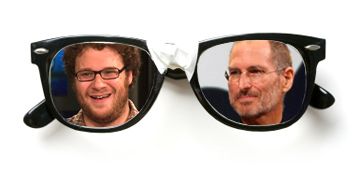

The information age has been good to nerds. No longer are they relegated to getting sand kicked in their faces by that other familiar archetype, the jock. We’ve gotten used to watching Steve Jobs grin awkwardly as he announces the latest hot techie toy, and when it comes to pop culture, nerds like “Superbad” writer/star Seth Rogen are increasingly in control of their own image. But even with the cultural cachet that comes with having your achievements validated by the masses, nerds are still high school losers.
In his absorbing new book, “American Nerd: The Story of My People,” Benjamin Nugent chronicles this underdog class. He considers the etymology of the word “nerd” — possible origins include the name of a creature in Dr. Seuss’ 1950 book “If I Ran the Zoo,” and a bucktoothed ventriloquist dummy dubbed “Mortimer Snerd” — and explores the world of hipsters, “an androgynous paradise where adults of both sexes look like enlarged spelling-bee champions.” He traces popular representations of nerds, from Mary Shelley’s “Frankenstein,” to Gilda Radner and Bill Murray’s sketches on “Saturday Night Live,” to “Napoleon Dynamite.” And he asks what a person’s race has to do with their chances of being a nerd. Are nerds born, or are they made? According to Nugent, it’s both.
Appropriately, the whole thing is a pretty nerdy undertaking. It’s also a personal one. Nugent, a journalist and author of a 2004 critical biography of the late musician Elliott Smith, was himself a nerdy kid, and he laces this wide-ranging cultural investigation with bittersweet bits of his own story. Perhaps most poignantly, he tracks down two of his childhood friends and asks them to reflect on formative years filled with Dungeons & Dragons and self-loathing. His encounters with them reveal that being a nerd is not something everyone experiences the same way.
For Nugent, nerdiness is a complicated state of being that should be challenged at least as much as it’s celebrated. Salon spoke to him about what ham radio fanatics have in common with debate team enthusiasts, and why people with Asperger’s syndrome may just be diagnosed nerds.
You write at the beginning of the book that you “empathize with nerds and antinerds alike,” and even say there are reasons to despise your younger, nerdy self. With that mix of sympathies, what did you set out to find or explain?
I wanted to find out what makes someone nerdy in the eyes of their peers, and also what compels them to keep doing the nerdy activities: what they get out of it, what urges it fulfills, whether it was a voluntary decision for them to be nerds, or whether it was foisted upon them. I wanted to give the reader a window into the heads of nerds, and into the heads of people who hate nerds.
Do you feel like nerds are an especially misunderstood class of people?
I actually think people are pretty good at understanding what makes a nerd a nerd, on a gut level. But they aren’t in touch with why they hate nerds. They haven’t examined their prejudices and their own feelings vis-à-vis nerdiness.
Your examples of nerdy individuals and endeavors are pretty wide-ranging. How did you refine your idea of what a nerd is?
After spending a lot of time with different subcultures that I intuitively knew were nerdy, I figured out what they all had in common: a love of rules, a love of hierarchies that were meritocratic and open to everybody, and in some cases the affectation of rationalism (whether computer programming or math). Ham radio operators kept using Morse code long after they had to, because they saw it as a purely rational form of language. That seems to me to be a common trait of the Society for Creative Anachronism, and kids on debate teams, and computer programmers.
“Nerd” really implies being an outsider, being picked on as a kid, social awkwardness.
What makes people insiders in high school is their ability to intuitively figure out how the hierarchies work. Some nerds can’t follow the hierarchies, don’t know how, and sometimes don’t even perceive them. Other nerds are unwilling to follow them. But in general most of the people we consider nerds are people who are oblivious to or incompetent at following the hierarchies.
Can you explain the connection you draw between the symptoms of Asperger’s syndrome and people who might be thought of as nerds?
People with Asperger’s syndrome tend to be good at what psychologists call systemic thinking. They tend to be bad at what the psychologist Simon Baron-Cohen calls empathic thinking, which is the kind you need to interpret nonverbal social cues, the kind you need to program a computer. I think a lot of people we’ve historically called nerds would have been diagnosed with Asperger’s syndrome, had Asperger’s been around at the time.
One of the slightly frightening things about the explosion of Asperger’s diagnoses is that because Asperger’s syndrome refers to a hard-wired neurological state, kids are essentially being told that they are hard-wired to be nerds. It’s a really fraught diagnosis. I wonder if there are kids who would’ve benefited from just being able to think of themselves as nerdy, and then gone on to become something else, instead of being told when they’re young, “You have Asperger’s syndrome, you’re always going to be a socially awkward systemic thinker.”
You write pretty extensively about how race and ethnicity intersect with nerd identity. How are some of these stereotypes alive today?
The concept of the “greasy grind” once referred largely to immigrant kids who studied really hard in high school, and then got into elite colleges. The connotation of that at the time was “Jewish.” Today the term “nerd” refers to the same idea, stripped of the ethnic associations. People don’t think “Jewish” anymore when they think “nerd,” necessarily. But if you look at the most popular prototypes of how nerds look — “Revenge of the Nerds” — and you look at old anti-Semitic cartoons, it’s surprising how much they look the same: a sort of gangly, bespectacled person who is smart, and is good at figures, but isn’t good at social interaction, and is really unathletic. Like Jews, Asians were thought of as harmless but insidious in the 19th century. It wasn’t until after the 1965 immigration act that the Asian American whiz kid became a stereotype.
What’s the relationship between hipsters and nerds?
A lot of the fashion accessories that we’ve come to associate with hipsters refer nostalgically to old prototypes of what nerds are supposed to look like. I first remember seeing it in the early ’90s, when I was in high school. Kids were starting to wear big, bulky glasses, and it was understood that they weren’t actually nerds; they were affecting nerdiness in quotation marks, so that you knew they were really un-nerdy. By using nerdiness as a fun way to develop part of their personality, they’re doing precisely what nerds are not able to do, which is master social interaction, and master how they present themselves.
Pure, unironic nerdiness has come to seem very authentic.
I’ve talked to lots of people who’ve had the experience of going on a first date and getting the “I was such a nerd in high school” line. It’s come to mean, “I’m not afraid of telling you exactly who I am.” The nerd is thought to have a level of authenticity that no other subculture can have, because the nerd is incapable of presenting himself in a false way.
I was talking to someone recently — a former nerd — who found the movie “Superbad” completely excruciating. To him, the way the jocks berated and beat up the nerdy kids was so accurate it was painful. It’s something he was never going to have enough distance to laugh at.
Yeah, if you’ve actually had the experience of being towel-whipped, then you don’t romanticize it.
The idea of nerds is really cool now; people say they like nerds. I wonder if it might be slightly easier for actual nerds in junior high now, because some TV shows are teaching kids that nerds are people you can empathize with, who can change, who might become attractive. I wonder if the Seth Cohen character on “The OC,” as silly as that character might have been, actually prevented some bleeding in junior high corridors. We’ll never know, in the same way we’ll never know if “Will & Grace” prevented gay bashing. But it’s possible.
Who’s the nerd among the presidential candidates?
If I had to reduce our three presidential candidates to high school types, I would say John McCain is clearly the jock, beloved by the administration of the school. Hillary Clinton is one of the mathlete girls, who you know is going to Wellesley or Harvard or Yale. Barack Obama is the black kid on the debate team who cancels out the racial stereotypes about black kids and the stereotypes about nerds by being both. I think Hillary’s the nerd.
Where do you stand in relation to all this material now, having written this book? As an expert on this topic, you could be said to be the king of the nerds.
When I was selling this book, my editor asked me, “Are you a nerd?” I was like, “I don’t know, I certainly was as a kid, but now…” My agent interrupted me and said, “He’s a nerd.” It’s the funniest question to have to keep answering, because for the first time in my life some advantage adheres to me if I say yes. I’m probably the one person on planet Earth who might have to affect nerdiness as part of their professional life.
