
Farhad Manjoo
Bill Gates, the greatest hacker of all time
Reflecting on the Microsoft co-founder's legacy.
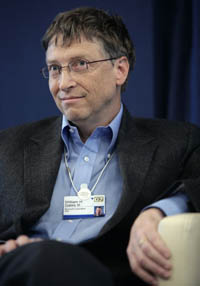
DAVOS/SWITZERLAND, 26JAN07 - William H. Gates III, Chairman, Microsoft Corporation, USA, captured during the session 'Scaling Innovation in Foreign Aid' at the Annual Meeting 2007 of the World Economic Forum in Davos, Switzerland, January 26, 2007.
Copyright by World Economic Forum swiss-image.ch/Photo by Severin Nowacki
+++No resale, no archive+++(Credit: Severin Nowacki)
Two years ago, Bill Gates announced his plan to leave Microsoft as a full-time employee and turn his attention instead to the Bill & Melinda Gates Foundation, the largest philanthropic organization in the world.
The years since haven’t been Microsoft’s best: Its Vista operating system bombed, and online, the software company lost further ground to Google, a failure culminating in its now-best-forgotten effort to purchase Yahoo.
Gates’ reputation, though, has only improved. Today is Gates’ last day at Microsoft; he will continue to serve as the company’s chairman (and will remain its largest shareholder), but he’s said he’ll spend 80 percent of his time at the foundation.
Once the most despised fellow in business, in the last decade, Gates’ philanthropic work has cemented his standing as … there’s no casual way to say this, he’s the leading statesman of our times.
The transformation has been so complete it seems difficult, anymore, to reconcile the old Bill and the new. Though you sometimes see flashes of the combative businessman — Gates told Tom Brokaw the other day that he doesn’t use an iPod because “the Zune is a better way to carry your music around” — these moments seem contrived for comic effect. Caring about which music player wins the market is laughably frivolous beside Gates’ grand ambitions of eradicating the planet of infectious diseases and the ravages of poverty.
On his last day, appreciations and recriminations are flooding the tech blogosphere, but as usual, Anil Dash offers the smartest take:
Bill Gates has pulled off one of the greatest hacks in technology and business history, by turning Microsoft’s success into a force for social responsibility. Imagine imposing a tax on every corporation in the developed world, collecting $100 per white-collar worker per year, and then directing one third of the proceeds to curing AIDS and malaria. That, effectively, is what Bill Gates has done.
Dash also points out the neat symmetry to Gates’ career. In 1980, Mary Maxwell Gates, Bill’s mother, got to know John Opel, the chairman of IBM, through their work at the United Way Foundation.
At the time, IBM was preparing to release the first PC, and it needed an operating system. Opel chose tiny Microsoft as its OS vendor partly on the strength of his connection to the Gates family — a decision, Dash writes, “that ended up being the greatest turning point in the history of the biggest software company that’s ever been created.”
Philanthropy played a key part in Gates’ early success at Microsoft. And in a hundred years, philanthropy may be all anyone remembers him for.
The thinking man’s action hero
Using paper clips, chewing gum, chocolate and down-home ingenuity, MacGyver always saved the day. Let's bring him back -- and give him a girl!
It isn’t necessary to explain how, in the pilot episode of “MacGyver,” our mulleted, Midwestern hero gets himself trapped inside a top-secret research bunker overflowing with sulfuric acid. Suffice it to say, he needs to find a way out, and probably soon (because government agents are fixing to fire a missile at the bunker to prevent the acid from spilling into a nearby aquifer). Plus, he has to save the people he has found inside (among them a gun-wielding climate scientist who wants destroy the bunker in an effort to set back research into an ozone-layer-ruining weapon of mass destruction). Fortunately, MacGyver has a few chocolate bars, a scrap of sodium metal, a cold capsule, a pair of binoculars and cigarettes.
Continue Reading CloseGoodbye to Machinist
Yo, I'm out.

Today much of the tech world is sad that the iPhone 3G’s launch is going so miserably. But I’m sad that it’s my last day at Salon.
I’ve accepted a job at Slate, where, starting next week, I’ll be writing a twice-weekly technology column. Machinist will go on a break for a week, after which a guest blogger will bring you the latest tech dish.
Continue Reading Close“True Enough” at Google, and in San Francisco
A YouTubey presentation of my book.
As I mentioned in the comments yesterday, I’m getting ready to depart this space; I’ll have a fuller explanation tomorrow, sometime before or after I get in line to buy the new iPhone.
In the meantime, I thought I’d add a note about one of the more fun events related to my book’s release — the opportunity I had, in May, to speak at Google’s headquarters in Mountain View.
Continue Reading CloseThe iPhone 3G reviews are in: It’s pretty good
But battery life suffers, and the GPS isn't as great as you hoped.
Walt Mossberg (WSJ), David Pogue (NYT) and Edward Baig (USA Today) have been using the new iPhone 3G for a couple of weeks now, and today they all dish on their experiences.
Continue Reading CloseScary! YouTube ordered to hand your viewing history to Viacom
But there's a silver lining to one of the most bone-headed legal decisions in recent times.
Update: This post has been updated with comments from Viacom.
In the fall of 1987, a freelance reporter named Michael Dolan learned that judge Robert Bork kept an account at Potomac Video, a D.C. rental shop. This was at the height of the contentious and ultimately failed Senate confirmation hearings for Bork’s nomination to the Supreme Court — so naturally, Dolan thought there was a story here, and he went to work on getting a peek at Bork’s video rental history.
Continue Reading ClosePage 1 of 143 in Farhad Manjoo
